Original Research Article
Assessment of hand hygiene knowledge among medical and nursing
students of Mysore medical college and research institute, Mysore
Manasa K., Chandrakumar S. G.*, Prashantha B.
INTRODUCTION
Hand washing is a measure of personal hygiene which is considered important since many generations.1 In 18th century, chlorides of lime and soda solutions were used as disinfectants to remove foul odor. Later around 19th century, antiseptic agents usage started.2 Hand washing in health care setting to prevent infections was adopted as a result of studies by Holmes and Semmelwe is in which they concluded that reason for puerperal fever was infection spread by microorganisms present on healthcare workers hands.3 The main problems associated with improper hand hygiene among health care workers are patient safety, long stay in the hospital, health care expenditure, resistance to antibiotics, and also increased mortality. The guidelines on hand hygiene are issued by
Contaminated hands of health care workers is the main reason for transmission of infections which causes around 7-10% of morbidity and mortality among hospital admissions.5 Although hand hygiene is one of the crucial factor, it is not well recognized by health care workers.6 Awareness on hand hygiene practices among health care workers is less as shown in many studies.7 Medical and nursing students are exposed to hospital acquired infections during their training and it is necessary that they should be aware of hand hygiene.8 The reasons for not practicing appropriate hand hygiene practices are lack of knowledge about guidelines, lack of facilities, insufficient time, patient overload, lack of priority by the institutions. The first step in making the students practice hand hygiene is to make them aware of the guidelines and hazards of improper hand hygiene so that they understand
ABSTRACT
Background: Improper hand hygiene among health care workers is the main cause for many nosocomial infections. Lack of knowledge and lack of recognition of hand hygiene opportunities during patient care are mainly responsible for poor hand hygiene among health care workers.
Methods: Knowledge on hand hygiene was assessed using WHO hand hygiene questionnaire among medical and nursing students of Mysore medical college and research institute.
Results: Among 276 medical and 225 nursing students who participated in the study, 26% of medical and 33% of nursing students had received formal training in hand hygiene in the last three years. Less than 50% of students had knowledge on source, routes of transmission of germs and minimal time needed for hand rubbing in hospital setting. Conclusions: The knowledge is limited on hand hygiene actions which shows the importance of inclusion of hand hygiene topic in curriculum.
Keywords: Hand hygiene, Nosocomial infections, Hand rubbing
Department ofCommunity Medicine, MMC&RI, Mysore, Karnataka, India
Received: 07 January 2018 Revised: 07 February 2018 Accepted: 08 February 2018 *Correspondence:
Dr. Chandrakumar S. G.,
E-mail: [email protected]
Copyright: © the author(s), publisher and licensee Medip Academy. This is an open-access article distributed under the terms of the Creative Commons Attribution Non-Commercial License, which permits unrestricted non-commercial use, distribution, and reproduction in any medium, provided the original work is properly cited.
of knowledge, prevent them from adopting good hand hygiene practices even if facilities are available. Medical students and nurses spend more time with the patients, so chances of them spreading infections are more. Making them aware of this simple cost effective measure during their training period itself will make them to follow it in their future. This can be achieved by training and motivating them about this measure. Studies on burden of hospital acquired infections are more but the studies exploring the knowledge among health care professionals on hand hygiene are less.9 In developing nations it is necessary to focus more on preventive measures which consume less resources. Hand hygiene is one such measure if practiced appropriately can lead to good results. This can be done by assessment of knowledge and developing strategies to improve the awareness of health professionals on hand hygiene and providing facilities for sustaining the cost effective measures.
METHODS
This cross sectional study was conducted in Mysore medical college and research institute. It is a teaching hospital for medical and nursing students. It was conducted from May 2017 to July 2017, a period of three months. The knowledge on hand hygiene was assessed using WHO hand hygiene questionnaire for health care workers. It consists of 25 questions which had answers as
“yes”, “no”, “true” and “false”. The sample size is calculated by „estimation technique for proportion‟ with level of significance () = 5%, and absolute error of 5%. With 74.5%of knowledge among health care workers the sample size calculated was 303.10 There were 600 medical students and 350 nursing students in the college which constituted the sampling frame. Simple random sampling was used to select the students after taking informed consent. The students who could not be met after three visits were excluded from the study. The questionnaires which were not completely filled were not taken for analysis. So a total of 276 medical and 225 nursing students who filled the questionnaire completely were included in the study. Data was entered in Microsoft Office Excel and analyzed with INSTAT graph pad. Descriptive statistics was used to calculate percentage for each of the responses given. Test for proportion was done to compare correct responses between medical and nursing students and p value of less than 0.05 was considered significant.
RESULTS
There were 276 medical and 225 nursing students who were included for analysis. 26% of medical and 33% of nursing students had received formal training in hand hygiene in the last three years. 47% of medical students and 77% of nursing students were routinely using alcohol based hand rub for hand hygiene.
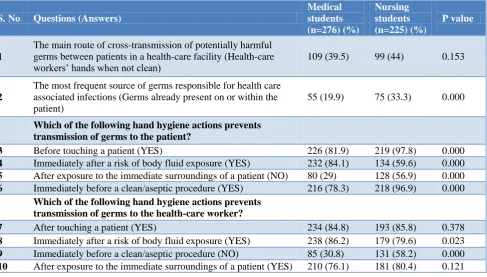
Table 1: Comparison of knowledge on hand hygiene among medical and nursing students.
S. No Questions (Answers)
Medical students (n=276) (%)
Nursing students (n=225) (%)
P value
1
The main route of cross-transmission of potentially harmful germs between patients in a health-care facility (Health-care
workers‟ hands when not clean) 109 (39.5) 99 (44) 0.153
2
The most frequent source of germs responsible for health care associated infections (Germs already present on or within the patient)
55 (19.9) 75 (33.3) 0.000
Which of the following hand hygiene actions prevents transmission of germs to the patient?
3 Before touching a patient (YES) 226 (81.9) 219 (97.8) 0.000 4 Immediately after a risk of body fluid exposure (YES) 232 (84.1) 134 (59.6) 0.000 5 After exposure to the immediate surroundings of a patient (NO) 80 (29) 128 (56.9) 0.000 6 Immediately before a clean/aseptic procedure (YES) 216 (78.3) 218 (96.9) 0.000
Which of the following hand hygiene actions prevents transmission of germs to the health-care worker?
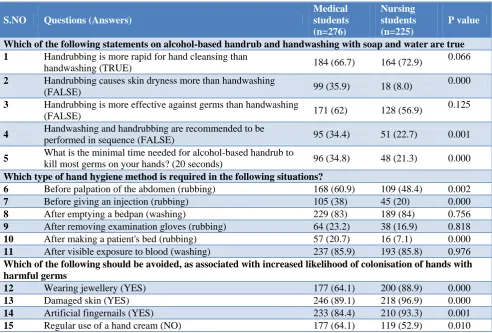
Table 2: Comparison of knowledge on hand rub and hand hygiene during patient care.
S.NO Questions (Answers)
Medical students (n=276)
Nursing students (n=225)
P value
Which of the following statements on alcohol-based handrub and handwashing with soap and water are true 1 Handrubbing is more rapid for hand cleansing than
handwashing (TRUE) 184 (66.7) 164 (72.9)
0.066 2 Handrubbing causes skin dryness more than handwashing
(FALSE) 99 (35.9) 18 (8.0)
0.000 3 Handrubbing is more effective against germs than handwashing
(FALSE) 171 (62) 128 (56.9)
0.125
4 Handwashing and handrubbing are recommended to be
performed in sequence (FALSE) 95 (34.4) 51 (22.7) 0.001 5 What is the minimal time needed for alcohol-based handrub to
kill most germs on your hands? (20 seconds) 96 (34.8) 48 (21.3) 0.000 Which type of hand hygiene method is required in the following situations?
6 Before palpation of the abdomen (rubbing) 168 (60.9) 109 (48.4) 0.002 7 Before giving an injection (rubbing) 105 (38) 45 (20) 0.000 8 After emptying a bedpan (washing) 229 (83) 189 (84) 0.756 9 After removing examination gloves (rubbing) 64 (23.2) 38 (16.9) 0.818 10 After making a patient's bed (rubbing) 57 (20.7) 16 (7.1) 0.000 11 After visible exposure to blood (washing) 237 (85.9) 193 (85.8) 0.976 Which of the following should be avoided, as associated with increased likelihood of colonisation of hands with harmful germs
12 Wearing jewellery (YES) 177 (64.1) 200 (88.9) 0.000
13 Damaged skin (YES) 246 (89.1) 218 (96.9) 0.000
14 Artificial fingernails (YES) 233 (84.4) 210 (93.3) 0.001 15 Regular use of a hand cream (NO) 177 (64.1) 119 (52.9) 0.010
Knowledge among students in which 40% of medical and 44% of nursing students answered correctly for the main route of cross transmission of harmful germs between patients in health care facility. 20% of medical and 33% of nursing students knew about the most frequent source of germs responsible for health care associated infections. Regarding hand hygiene actions preventing transmission of germs to the patient, better awareness was seen among medical students (84%) with respect to practice like immediately after a risk of body fluid exposure. Nursing students had better knowledge for hand hygiene practices like before touching a patient (98%), after exposure to the immediate surroundings of a patient (57%) and immediately before a clean /aseptic procedure (97%). Regarding hand hygiene actions preventing transmission of germs to health care worker better awareness was seen among medical students (86%) with respect to practice like immediately after a risk of body fluid exposure. Nursing students had better knowledge for hand hygiene practices like before touching a patient (86%), after exposure to the immediate surroundings of a patient (80%) and immediately before a clean /aseptic procedure (58%) (Table 1).
About knowledge on hand rub and hand washing with soap and water 73% of nursing students correctly agreed that hand rubbing is more rapid for hand cleansing. 36%
medical students correctly disagreed about hand rubbing causing skin dryness more than hand washing. 62% of medical students agreed that hand rubbing is not more effective than hand washing. 34% medical students were correct about hand washing and hand rubbing not being done in sequence. About 35% of medical and 23% of nursing students had answered correctly about the minimal time needed for alcohol based hand rub to kill germs on hand. About 83% of medical and 84% of nursing students knew that hand washing to be done after emptying bed pan. Around 85% of medical and nursing students knew that hand washing to be done after visible exposure to blood. Nursing students were more aware that wearing jewelry (89%), damaged skin (97%), artificial fingernails (93%) were associated with increased likelihood of colonization of hands with harmful germs. 64% of medical students were aware that regular use of hand cream would not increase the colonisation of germs (Table 2).
DISCUSSION
In our study 26% of medical 33% of nursing students had formal training on hand hygiene which is very less compared to study done in Raichur by Nair et al in which 74% medical and 95% nursing students had formal training.10 In our study 77% of medical students and only 47% nursing students regularly used alcohol based hand rub compared to 58% students in a study done in ESIC college Gulbarga by Vinod et al.11 Less than 50% of medical and nursing students knew the main route of cross transmission of harmful germs in hospitals compared to study done in Sri Lanka by Ariyaratne et al in which 73% of students had answered it correctly.12 Less than 40% of students in our study knew about most frequent source of germs responsible for health care associated infections compared to 94% of students in a study done by Arthy et al in puducherry.5 The knowledge about hand hygiene actions preventing transmission to patients and also to health worker was more among nursing students which is comparable to study done in Raichur by Nair et al.10 35% Medical students knew the the minimal time needed for alcohol-based hand rub to kill most germs on hands compared to 15% in a study done by Arthi et al in Puducherry.5 In our study medical students had good knowledge about hand rubbing, hand washing and its uses in different situations. In contrast nursing students were more knowledgeable about the things associated with colonization of hand with harmful germs. In our study, knowledge on hand hygiene was moderate. Nursing students had more knowledge compared to medical students, this may be due to hand hygiene chapter in their curriculum in the beginning of their course and most of the nursing students had formal training in hand hygiene. They also spend more time in the wards and have more chance of practicing hand hygiene. Medical students knew more about the time and the facts about hand rub and hand washing. They read more about the scientific aspects rather than practicing hand hygiene. They might not be spending more time in the wards which might be the reason for being not aware of hand hygiene aspects during different clinical procedures.
CONCLUSION
In our study almost less than 50% of students had knowledge on source, routes of transmission of germs and minimal time needed for hand rubbing in hospital setting. Their knowledge is limited on hand hygiene actions which show the importance of inclusion of hand hygiene topic in curriculum. There is a need to create awareness on hand hygiene to prevent them from adopting faulty techniques as awareness on hand hygiene is a cost effective measure for preventing hospital acquired infections. Training sessions and also facility for hand washing in hospitals should be made available so that these students can practice better hand hygiene in future as health care workers.
Funding: No funding sources Conflict of interest: None declared
Ethical approval: The study was approved by the Institutional Ethics Committee
REFERENCES
1. Rotter M. Hand washing and hand disinfection. In: Mayhall CG, editor. Hospital epidemiology and infection control. 2nd ed. Philadelphia, PA: Lippincott Williams & Wilkins; 1999: 1339–1355. 2. Labarraque AG. Instructions and observations
regarding the use of the chlorides of soda and lime. Porter J, ed. [French] New Haven, CT: Baldwin and Treadway, 1829.
3. Semmelweis I. Etiology, concept, and prophylaxis of childbed fever. Carter KC, ed. 1st ed. Madison, WI: The University of Wisconsin Press; 1983. 4. World Health Organization. World Health
Organization guidelines on hand hygiene in health care, 2009. Available at http://apps.who.int/iris/ bitstream/10665/44102/1/9789241597906_eng.pdf. Accessed 18 September 2017.
5. Arthi E, Abarna V, Bagyalakshmi R, Anitharaj M, Vijayasree S. Assessment of knowledge, attitude and practice of hand hygiene among nursing and medical students in a tertiary care hospital in Puducherry, India. Int J Contemporary Med Res. 2016;3(4):1203.
6. Abdraboh SN, Milaat W, Ramadan IK, Al-Sayes FM, Bahy KM. Hand hygiene and health care associated infection: an intervention study. Am J Med Med Sci. 2016;6(1):8
7. Vaishnav B, Bamanikar A, Dasgupta S, Reddy A. Aseptic-clinical hand hygiene knowledge survey amongst health care workers in a tertiary care hospital in Western India. Int J Res Med Sci. 2016;4(9):4176.
8. Prabhakumar D, Chakravarthy M, Nayak S, Hosur R, Padgaonkar S, Harivelam C, et al. Knowledge levels of medical students about hand hygiene. J Nat Accred Board Hosp Healthcare Providers. 2016;3:28.
9. Goswami K, Baruah R. Study to assess knowledge, attitude and practice of hand hygiene among medical and nursing students at Gauhati Medical College & Hospital, Guwahati, Assam. Indian J Basic Applied Med Res. 2016;5(2):323.
10. Nair SS, Hanumantappa R, Hiremath SG, Siraj MA, Raghunath P. Knowledge, attitude, and practice of hand hygiene among medical and nursing students at a tertiary health care centre in Raichur, India. ISRN Prevent Med. 2014.
12. Ariyaratne MHJD, Gunasekara TDCP, Weerasekara MM, Kottahachchi J, Kudavidanage BP, Fernando SSN. Knowledge, attitudes and practices of hand hygiene among final year medical and nursing students at the University of Sri Jayewardenepura. Sri Lankan J Infect Dis. 2013;3(1):19.