*Correspondence to Author:
Lv Jianxing
Shanghai Maritime University, Coll-ege of Marine Science and Engine-ering,shanghai, 201306,China.
How to cite this article:
Lv Jianxing, Geng Anchao, Wu Lin-gbing, Qiao Sha, Li Liuhuan. Study on the pollution mechanism of
drin-king water source water to
ultrafiltr-ation membrane.Internultrafiltr-ational Jour-nal of Natural Science and Reviews , 2019; 4:9.
eSciPub LLC, Houston, TX USA. Website: https://escipub.com/
Lv Jianxing et al., IJNSR, 2019; 4:9
International Journal of Natural Science and Reviews
(ISSN:2576-5086)
Research Article IJNSR (2019) 4:9
Study on the pollution mechanism of drinking water source water to
ultrafiltration membrane
The effects of particulate matter (represented by humic acid, kaolin and algae) on ultrafiltration membranes in micro-polluted water sources were investigated, and the mechanism of ultrafiltration membranes was further understood with the change of membrane flux and transmembrane pressure difference. The results showed that the removal rate of kaolin and algae by UF membrane was over 99%, while the removal rate of humic acid was only about 72%. Moreover, the extent of UF membrane fouling caused by humic acid was larger than that caused by kaolin and algae. The higher the concentration of humic acid, the more serious the membrane fouling was. Ultrafiltration membranes contaminated by humic acid were washed by 0.05mol/L NaOH alkali and 0.05mol/L HCL acid. The permeability of the membranes was restored to 91.24% of the cleaned surface, which was better than that of pure water, sodium hypochlorite and sodium hydroxide. It can provide better guidance for choosing appropriate cleaning agents for
ultrafiltration membrane fouling.
Key words: Ultrafiltration membrane; Humic acid; Kaolin; Algae
Lv Jianxing, Geng Anchao, Wu Lingbing, Qiao Sha, Li Liuhuan
Shanghai Maritime University, College of Marine Science and Engineering,shanghai, 201306,China.
ABSTRACT
Introduction
At present, the drinking water source of resi-dents in mountainous rural areas in China mainly comes from river water, river water, well water and reservoir water. The water treatment method is relatively simple, mainly based on faucet filter and direct heating. Very few residents adopt mo- re professional and effective. The water treatme- nt process treats drinking water. By the end of 2010, more than 400 million rural residents in China have used direct water to draw water. Ne- arly 100 million rural residents have not used any water treatment facilities and direct drinking wa-ter. At the same time, with the improvement of people's living standards, the drinking water sa- fety standards have been continuously improved, and the traditional water treatment process can-not meet the requirements of safe drinking water standards. Therefore, it is very urgent to seek a new water treatment process.Ultrafiltration me- mbrane can effectively retain water particles in water, and it is widely used in industrial waste- water reuse and urban drinking water, with its advantages of good filtration performance, small footprint, short process, energy saving, low cost and no secondary pollution.However, the prob-lem of water pollution is also becoming more and more serious, and the main substance causing water pollution is derived from water particles in water bodies.[1]
The composition of water particles can be divid- ed into three parts: organic matter, minerals and biological materials. In this experiment, humus, kaolin and algae were used to replace organic substances, mineral substances and biological substances in natural water bodies. Humus in natural water is generally derived directly from the decomposition of plants and animals in water, especially lignin, by microorganisms, or a rela-tively stable product formed by the condensation
of smaller molecules such as triglycerides, sug-ars and amino acids. As a disinfectant in China's traditional water treatment process, chlorine gas has the advantages of high efficiency and econ-omy, and is widely used in the field of water treat-ment in China. Humic acid in water can react with chlorine disinfectants to form organic disin-fection by-products (DBPs) [2,3], which are ex-tremely harmful to human health. At the same time, humic acid is also a major precursor to the production of “three” substances in the chlorina-tion process. Clay minerals are one of the most important colloids in natural waters and consti-tute the core skeleton of water particles. As the most common clay mineral in nature, kaolin co- mbines with hydrated oxides and humus to form the most active components in the particles, which affects the geochemical behavior of sur-face elements and the migration, transformation and migration of various pollutants in water. Home. Membrane fouling caused by particulate matter in water has been a major problem that restricts the further promotion of ultrafiltration m- embranes, especially in summer, algal blooms exacerbate membrane fouling [4]. Accordingly, it is necessary to conduct further research on the removal of particulate matter in water.
1. Materials and methods
The removal of humus and kaolin is in the exper-imental stage in China, and less engineering pr- actice is carried out, mainly in the laboratory wa-ter distribution research; summer ultrafiltration algae can ensure the stable operation of water plants and water quality, but the water produc-tion rate caused by membrane polluproduc-tion The de-cline is in contradiction with the high-load opera-tion of the summer water plant, so the develop-ment of the experidevelop-ment has certain engineering value.
Humic acid, kaolin, potassium permanganate a- nd ferric chloride are all excellent grade; 1% hy-drochloric acid, 0.05mol/L NaOH solution. 1.2 Preparation of water samples
The experiment was carried out in the laboratory of Suzhou Membrane Separation Technology Co. , Ltd. The experimental water samples were pre-pared by artificial simulation. The tap water was pumped into the 70L water distribution tank, and then humic acid and kaolin were added to the w- ater distribution tank to obtain experimental wa-ter.
1.3 Experimental device
In order to understand the membrane fouling sit-uation more accurately and intuitively, the exper-iment used a monolithic membrane module and conducted a small-scale experiment in the labor-atory of Suzhou Membrane Separation Technol-ogy Co., Ltd. The membrane module is supplied by Minard, Germany, and is made of polyether-sulfone resin (PES), which is capable of separat-ing particles with a molecular weight of more than 1500 Daltons and an effective area of 0.33 m2. It uses an external pressure mode of opera-tion and runs flux. It is about 35L/h. The experi-mental setup is shown in Figure 1.
1, water tank 2, water pump 3, valve 4, ultrafiltration equipment
1.4 Method for measuring humic acid conce- ntration
Take 250mL of known concentration of humic ac- id solution in the evaporating dish, add 1mL of 0.05moL / L ethylenediaminetetraacetic acid (E- DTA solution), evaporate and cool, add 25mL of mixed extract (0.1moL / L pyrophosphate The sodium solution is mixed with 0.1% LL/L sodium hydroxide solution by volume 1:1. After the mix-
ed extract is fully contacted with the dried prod-uct, it is transferred to a centrifuge tube, allowed to stand for 24 hours, and then centrifuged at 25 ° C, 400 r / min. 20min. The supernatant was ta- ken and the absorbance of the supernatant at 340 nm and 440 nm was measured and rec-orded as E3 and E4 [5]. The corresponding ab-sorbance is shown in Table 1.
Absroance(Abs) Humic acid concentration
(mg/L)
Wavelength (nm)
2 4 5 6 8 10 15
340 0.027 0.074 0.10 1
0.13 7
0.22 1
0.29 7
4 9 9 1 2 Table 1 UV spectrum of different concentrations of humic acid in water samples
Taking (E3-E4) as the abscissa and the humic acid concentration as the ordinate C (mg/L), the equation of the standard curve and the correla-tion coefficient R2 are:
Y=45.695(E3-E4)+1.0532 R2=0.997
Measure the humic acid solution of unknown concentration and determine the concentration of humic acid at an unknown concentration by measuring E3 and E4 according to the above
Steps degree. 2. results and talk
2.1 Membrane flux in the presence of humic acid (HA) and kaolin alone
In this experiment, the effects of humic acid and kaolin on the membrane flux and the removal rate of the membrane were investigated. The acidity and alkalinity of the membrane flux when humic acid and kaolin were present alone are shown in Fig. 2
Figure 2 Membrane flux decay in the presence of kaolin and humic acid alone
The removal rate of kaolin by PES ultrafiltration membrane can reach 100%, because the parti-cle size of kaolin is almost more than 1μm, which is much larger than the pore size of ultrafiltration membrane, that is, almost all kaolin is trapped on the surface of ultrafiltration membrane to form dense filtration. Cake layer. The ultrafiltration m- embrane has a low removal rate of humic acid of only 72%. This is because the molecular weight and chemical structure of humus vary greatly with the degree of humification. Humic acid (HA) and fulvic acid (FA) constitute the most reactive component of humus, and its molecular weight
than that of the ridge. The removal rate of the two can be explained as follows: the kaolin particle diameter is much larger than the ultrafiltration membrane pore size, and the membrane is com-pletely trapped. The surface, while the humic acid particles are small, it is easy to enter the ul-trafiltration membrane pores to cause the mem-brane pores to block or narrow, which leads to the membrane flux decay rate much greater than the membrane flux decay rate caused by kaolin [6].
2.2 Analysis of membrane flux characteris-tics when kaolin, Ca2+, HA coexist
Because clay minerals, hydrated oxides and hu-mus combine to form the most active compo-nents in water particles, hydrated oxides mainly include hydrated oxides such as aluminum, iron, calcium and silicon. In this paper, Ca2+ is the re-search object. Figure 4 shows the change of membrane flux corresponding to the presence of kaolin, Ca2+ and HA, and the presence of humic acid alone at a concentration of 15 mg/L.
Fig. 3 Membrane flux attenuation diagram of humic acid, kaolin and Ca2 coexisting
It can be seen from Fig. 3 that when the humic acid is present alone, the membrane flux decay rate is lower than that of kaolin, Ca2+ and humic acid. When kaolin and humic acid coexist, the membrane flux decay rate is significantly greater than the membrane flux decay rate when humic acid is present alone. The researchers showed that the membrane fouling when kaolin and hu-mic acid coexisted was significantly larger than that of humic acid alone. They believed that hu-mic acid was mixed with kaolin, and huhu-mic acid adsorbed on the surface of kaolin particles, whi- ch hindered the agglomeration between kaolin particles and formed a dense cake layer, which
increased the rate of membrane fouling[6]. How-ever, studies by Zularisam et al. showed that the membrane fouling of kaolin and humic acid was significantly smaller than that of humic acid alone. Some of the humic acid adsorbed on the surface of kaolin due to the coexistence of kaolin and humic acid. It reduces the probability of hu-mic acid entering the pore size of the ultrafiltrati- on membrane, thereby slowing the rate of mem-brane fouling [7].
ional hinge-like macromolecules whose surface charge is generated by the ionization of acidic groups. Due to the mutual repulsive force of sur-face charge (for example, COO-), the molecule is in a state of micro-expansion. When Ca2+ is present, the molecule is compressed to form a larger polymer due to charge neutralization [8], making HA easier. It is adsorbed on the surface of the membrane and within the pore size of the membrane to form a dense oxide film, resulting in a sharp decrease in membrane flux. However, some researchers believe that in the absence of Ca2+, as the concentration of humic acid in-creases, the more humic acid adsorbed on the surface of the membrane, due to the negative
charge of humic acid, the presence of Ca2+, the surface of the membrane The potential of Zate moves to the square, which strengthens the sh- ielding between molecules, reduces the charge intensity, weakens the electrostatic repulsion be-tween the membrane surface and the humic acid molecules, and causes the humic acid to adsorb more to the surface of the membrane, forming a dense Filter cake layer, which increases the rate of membrane fouling [7]
2.3 Ultrafiltration membrane removal of algae The experiment was carried out in the Maoshan River in the lower reaches of Taihu Lake. The conventional water quality indicators during the test period are shown in Table 2.
Table 2 Raw water quality analysis table
Water tem-perature
(℃)
pH value Turbidity Number of algae cell
(105/L)
CODMn
(mg/L)
DOC
(mg/L)
UV254
(cm-1)
20-25 7.2-7.4 11.8-14.9 600-800 3.52-4.23 2.79-3.56 0.035-0.039
The experimental process is shown in Figure 1. The river water enters the original water tank af-ter pre-oxidation and coagulation sedimentation in the water distribution tank, and then enters the ultrafiltration equipment through the raw water tank. In this experiment, polyaluminum chloride
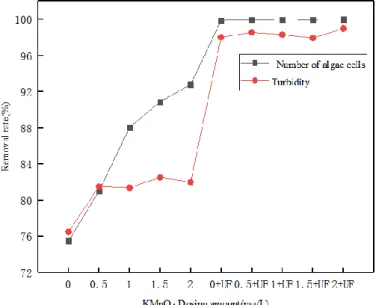
Figure 4 Removal rate of algae cells and turbidity by KMnO4 dosage
The removal rate of algae cells and turbidity is shown in Figure 4 after KMnO4 is filtered by co-agulation sedimentation and ultrafiltration mem-brane at different dosages. It can be seen from Fig. 4 that the removal rates of algae cells and turbidity by coagulation and sedimentation were 75.32% and 76.36, respectively, without KMnO4 pretreatment and ultrafiltration membrane filtra-tion. When the dosage of KMnO4 is small, the removal rate of turbidity is higher than that of al-gae cells. With the increase of KMnO4 dosage, the removal rate of algae cells is higher than tur-bidity, because KMnO4 can oxidize organic The gelatinous layer further destroys the algae en-zyme activity and causes it to die. In addition, the hydrated manganese dioxide formed by the re-action of KMnO4 with water adsorbs on the sur-face of the algae cells, increasing the specific gravity of the cells and making them easily re-moved by coagulation precipitation. On the other hand, regardless of the influent conditions, the ultrafiltration membrane has a removal rate of 100% for algae cells and a turbidity removal rate of 99%. Since the ultrafiltration membrane has an average pore diameter of 0.04 μm and the al-gae cell diameter is much larger than its pore di-ameter, it is theoretically possible to completely
retain the algae cells. However, the ultrafiltration membrane directly treating high algae water will cause serious membrane fouling problems, so it is especially important to reduce the algae con-tent in the membrane water.
2.4 Membrane fouling and cleaning
Since the advent of the film, the problem of ultra-filtration membrane pollution has been one of the key and difficult issues for research staff. For a long time, people have been working on the law of membrane fouling and membrane fouling in order to find suitable backwashing intervals, ba- ckwashing methods and membrane cleaning ag- ents, and even to find a cleaning agent that has no effect on membrane life. Membrane pollution brings a series of problems that need to be sol- ved urgently. Therefore, it is necessary to con-duct further research on the problem of mem-brane fouling in order to find a more efficient me- mbrane cleaning agent.
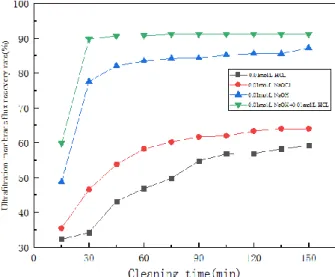
Figure 5 Effect of cleaning time on membrane flux recovery rate
It can be seen from Fig. 5 that the membrane flux recovery rate is 91.24%, which is the highest re-covery rate of the ultrafiltration membrane after the alkali washing and pickling treatment, indi-cating that the acid-base composition has con-tamination of the membrane surface caused by humic acid. Very good removal effect. The mem-brane flux after cleaning with 0.01mol/L HCL can only recover to 59.37% of the clean membrane surface, the membrane flux after NaOCL clean-ing is restored to 65.95% of the clean membrane surface, and the membrane flux after NaOH cle- aning is restored. To 85.69% of the clean film surface. The effect of washing with sodium hy-droxide and sodium hyhy-droxide combined with h- ydrochloric acid solution is better, and the clean-ing time is shorter.
3. Conclusion
(1) The degree of contamination of ultrafiltration membrane by kaolin and the contamination of ul-trafiltration membrane by humic acid, and the higher the concentration of humic acid, the more serious the membrane fouling. Mainly because: the interaction between humic acid molecules is small, and its agglomeration ability is smaller th- an that of kaolin, which makes humic acid easy to enter the pores of the membrane, which cau- ses membrane clogging, resulting in a sharp de-crease in membrane flux.
(2) Compared with the humic acid-contaminated membrane, the membrane fouling caused by the coexistence of kaolin and humic acid is more se-rious. The humic acid adsorbs on the surface of the kaolin particles, hindering the agglomeration behavior of the kaolin and forming a dense The filter cake layer, which increases the degree of membrane fouling.
(3) In the coexistence system of humic acid and Ca2+, Ca2+ neutralizes the negative charge car-ried by the humic acid adsorbed on the surface of the membrane, which reduces the surface charge intensity and weakens the electrostatic repulsion between humic acid molecules. The effect accelerates the rate at which humic acid
adsorbs on the surface of the membrane and ag-gravates membrane fouling.
(4) The degree of membrane fouling when humic acid and Ca2+ coexist is higher than that of hu-mic acid and kaolin. This is because Ca2+ not only reacts with humic acid to form a complex, but also increases the shielding effect between molecules. And the negative charge adsorbed on the surface of the membrane. The adsorption of humic acid on the surface of the membrane causes a decrease in membrane flux and aggra-vates membrane fouling.
(5) Pickling with hydrochloric acid can not effec-tively remove the pollutants on the surface of the membrane. Sodium hydroxide or 0.05mol/L hy-drochloric acid washed with 0.05mol/L sodium hydroxide has good cleaning effect. The mem-brane flux can be Restored to the original clean-ing membrane surface 85.69%, 91.24%, provid-ing guidance for membrane cleanprovid-ing.
(6) Pretreatment of KMnO4 can effectively in-crease the removal rate of algae cells by coagu-lation and sedimentation, up to 18.32%, but the removal of turbidity is not obvious, only about 7%. (7) Poxidation of KMnO4 can effectively re-duce membrane fouling, so that algae removal in summer can improve the water production rate to some extent and the high-load operation in summer water plants.
References
1. Liu Wei, Cai Guangqiang, Zhang Jinsong, Lu Xi- aoyan, Liu Lijun, Huang Hezhen, Yang Yaxin, Liu Jiayu. Changes and removal of protein and hu-mic acid concentration in source water of a city in southern China[J]. China Water & Wastewater, 2017, 33(17) :41-45.
2. Jonathan G. Pressman,Daniel L. McCurry,Sha-hid Parvez,Glenn E. Rice,Linda K. Teuschler, R- ichard J. Miltner,Thomas F. Speth. Disinfection byproduct formation in reverse-osmosis concen-trated and lyophilized natural organic matter fro- m a drinking water source[J]. Water Research,20 12,46(16):5343-5343
uled ultrafiltration(UF) membrane by algae dur-ing reservoir watertreatment[J].Desalination 200 8,220(1-3):267-272
4. Yuan Bin, Lu Song, Zhang Weihong. Determina-tion of Trace Humic Acid in Water by Ultraviolet Spectrophotometry[J]. Industrial Water Treatme- nt, 2010, 30(04): 75-77.
5. WANG Lei,GAO Zhe,MI Na,LI Songshan.Study on the pollution behavior of ultrafiltration mem-brane when inorganic particles and humic acid coexist[J].Journal of Xi\'an University of Architec-ture & Technology(Natural Science Edition),201 6,48(04) ):574-578.
6. Wang Xuliang, Li Zongyu, Zhao Jinghong, Pan Xianhui, Hao Jun. Study on the pollution of hu-mic acid on ultrafiltration membrane based on Zeta potential method[J].China Water & Waste- water,2018,34(17):48-51.