The Effects of the Mexico City Policy on Antenatal Care and Skilled Birth Attendance
in Developing Countries
By
Lisa Martin Carroll
A Master’s Paper submitted to the faculty of the University of North Carolina at Chapel Hill
in partial fulfillment of the requirements for the degree of Master of Public Health in
the Public Health Leadership Program
Chapel Hill
2012
Advisor
Date
Second Reader
ii
Abstract
LISA CARROLL: The Effects of the Mexico City Policy on Antenatal Care and
Skilled Birth Attendance in Developing Countries (Under the direction of Sue Tolleson-Rinehart and Sian Curtis)
The Mexico City Policy is a contentious policy regulating financial aid for international
non-governmental organizations involved in family planning and reproductive health, and over
the last thirty years, it has been the object of significant political tug-of-war. Since its inception
in 1984, the arguments for and against this policy have been based primarily in ideological
arguments about abortion and partisan rhetoric. There have been few efforts to assess the actual
effects of the policy on aid beneficiaries. In this study, I used Demographic and Health Survey
(DHS) data to determine if women in countries with a high degree of exposure to the Mexico
City Policy have diminished odds of having effective antenatal care and skilled birth attendance
at delivery compared to women in countries with a lower degree of exposure to the policy. The
results of this analysis suggest that the maternal health outcomes improved in most parts of the
world between 1993 – 2000 and 2001 – 2008 regardless of exposure to the policy. The results
also indicate that countries that received a higher degree of financial support for reproductive
health between 1995 and 2000 made faster progress on maternal health outcomes in many parts
of the world. Countries in sub-Saharan Africa, however, did not make comparable progress on
iii
Acknowledgements
iv
Table of Contents
Abstract ... iError! Bookmark not defined. Acknowledgements ... iiError! Bookmark not defined.
Table of Contents ... iv
List of Tables and Figures... v
List of Abbreviations ... vii
Introduction ... 1
Background:Evolution of the Mexico City Policy... 4
The Mexico City Policy in the Literature: A Systematic Review ... 7
Methods... 11
Results ... 18
Discussion and Conclusion ... 24
v
List of Tables and Figures
Table 1a: Characteristics for DHS respondents in the Latin America and Caribbean region with a birth reported in the 12-24 months prior to the completion date of the survey, 1994 – 2008 ... T-1 Table 1b: Characteristics for DHS respondents in the North African, Central Asia, and Eastern European region with a birth reported in the 12-24 months prior to the completion date of the survey, 1994 – 2008 ... T-1 Table 1c: Characteristics for DHS respondents in the South and Southeastern Asia region with a birth reported in the 12-24 months prior to the completion date of the survey, 1994 – 2008 ... T-2 Table 1d: Characteristics for DHS respondents in the sub-Saharan Africa region with a birth reported in the 12-24 months prior to the completion date of the survey, 1994 – 2008 ... T-2 Table 2a: Selected characteristics of included countries from the Latin America and Caribbean region, 1994 – 2008 ... T-4 Table 2b: Selected characteristics of included countries from the North African, Central Asia, and Eastern European region, 1994 – 2008 ... T-5 Table 2c: Selected characteristics of included countries from the South and Southeastern Asia region, 1994 – 2008 ... T-6 Table 2d: Selected characteristics of included countries from the sub-Saharan Africa region, 1994 – 2008... T-7 Table 3a: Maternal health outcomes reported by DHS respondents with a birth in the 12-24 months prior to the survey during the period when the Mexico City Policy was inactive (1994-2000) and when it was active (2000-2008) in the Latin America and Caribbean region ... T-9 Table 3b: Maternal health outcomes reported by DHS respondents with a birth in the 12-24 months prior to the survey during the period when the Mexico City Policy was inactive (1994-2000) and when it was active (2000-2008) in the North Africa, Central Asia, and Eastern
European region ... T-10 Table 3c: Maternal health outcomes reported by DHS respondents with a birth in the 12-24 months prior to the survey during the period when the Mexico City Policy was inactive (1994-2000) and when it was active (2000-2008) in the South and Southeastern Asia region ... T-11 Table 3d: Maternal health outcomes reported by DHS respondents with a birth in the 12-24 months prior to the survey during the period when the Mexico City Policy was inactive (1994-2000) and when it was active (2000-2008) in the sub-Saharan Africa region ... T-12 Table 4: Adjusted and Unadjusted Odds Ratios for the Association between Effective Antenatal Care and the Status of the Mexico City Policy (active or inactive), 1994 - 2008 ... T-14 Table 5: Adjusted and Unadjusted Odds Ratios for the Association between Skilled Birth
vi
vii
List of Abbreviations
ANC – Antenatal/Prenatal Care CI – Confidence Interval
DHS – Demographic and Health Surveys FP – Family Planning
GDP – Gross Domestic Product IQR – Interquartile Range MCP – The Mexico City Policy
MDG – The United Nations’ Millennium Development Goals NGO – Non-governmental organization
OECD – The Organization for Economic Cooperation and Development OR – Odds Ratio
RHC – Reproductive Health Care SD – Standard Deviation
TFR – Total Fertility Rate
USAID – United States Agency for International Development USD – United States Dollar
Introduction
As in medicine and domestic public health, evidence-based policy is a concept whose
time has come for global health. In order to create coherent policies that can effectively achieve
their stated goals, it is essential that policy decisions be informed by evidence whenever possible.
The Mexico City Policy (MCP) is an example of a policy that suffers from a severe shortage of
evidence and an excess of volatile ideological rhetoric1. Originally enacted in 1984 by the
Reagan administration, this policy effectively eliminates funding from the United States for any
international non-governmental organization (NGO) that performs abortions, provides
counseling or referrals, or engages in any advocacy for abortion rights within their country2.
Since its inception, subsequent administrations have either reaffirmed or repealed the policy, and
these decisions have uniformly fallen along partisan lines2,3.
Within days of taking office, Presidents Clinton, Bush, and Obama all issued executive
orders reversing their predecessor’s position on the policy2,3. This pattern suggests that decisions
about this policy have more to do with politics than the actual effects of the policy itself. The
MCP is neither a rational response to a demonstrated public health need nor an effective strategy
to reduce the number of abortions worldwide2. It has become a political tool used by both parties
to appease their respective political bases and quickly differentiate the new administration from
the outgoing party2. The problem with this approach is that changes in foreign aid policies have
real consequences outside of domestic politics in the United States.
In many developing countries, the internal capacity to support a functional health care
system is so poor that citizens are dependent on health care services subsidized by outside
donors4. According to data from the Organization for Economic Cooperation and Development
2
than one billion dollars in 2010 and outstripped contributions from all other OECD nations and
multilateral organizations combined5. As the single largest donor of aid for reproductive health
in the world, even seemingly small changes in US aid policy can affect prospective beneficiaries
in meaningful ways.
Although the majority of NGOs accepted US funding with the MCP’s restrictions after
the policy was reinstated in 20016, one study found that its implementation resulted in significant
declines in funding for large, international NGOs that refused to comply with the policy7. In
some developing countries, these agencies were providing for a large proportion of the available
reproductive health care services, and funding cuts required that they scale back rural outreach
activities, make dramatic cuts to staff and services at clinics in high-risk communities, and give
up essential technical support and supplies from USAID funded organizations7. Under these
circumstances, it is irresponsible for the United States to make changes to reproductive health aid
policies without considering the potential for unintended consequences on health outcomes in
recipient nations.
Although maternal mortality is no longer a major concern in wealthy nations, it remains a
pressing public health problem in developing nations. In 2010, the World Health Organization
(WHO) estimated the maternal mortality ratio in sub-Saharan Africa to be 500 deaths per
100,000 live births, which translates to a 1 in 39 lifetime risk of death related to pregnancy or
childbirth for women in the region8. This is especially striking in light of the disparity between
developing nations and wealthier nations, like Sweden for example, where the lifetime risk of
maternal death was just 1 in 14,000 in 20108. The great majority of maternal deaths worldwide
can be attributed to manageable or preventable causes, principally hemorrhage, infection,
3
attendant at delivery, and a health care facility with basic provisions, many of these catastrophic
outcomes can be avoided10; however, even these apparently simple interventions remain out of
reach for a majority of women in developing nations11.
In the last few decades, the international community has prioritized maternal mortality in
the international development agenda12-14. Recent studies have shown that these efforts are
beginning to pay off8,15. Global maternal mortality has decline significantly since 19908,15;
however, an extreme disparity remains between women in wealthy and poor nations8,15. Officials
from the United States played an important role in establishing reproductive health and maternal
mortality as priorities in global health policy2, but over the last several decades, the United
States’ own approach to international reproductive health policy has been inconsistent6
. The
political tug-of-war over the Mexico City Policy demonstrates the need for a sustained,
evidence-based strategy from the US to address global reproductive health and the problem of maternal
mortality in the developing world.
The goal of this study was to add to the body of evidence on the effects of the Mexico
City Policy on reproductive health outcomes by determining whether a relationship exists
between the policy’s reinstatement in 2001 and the odds of appropriate maternal health care in
countries across the world. Specifically, I examined the relationship between a country’s
exposure to the policy and changes in the proportion of women reporting effective antenatal care
and skilled birth attendance at delivery, which are important determinants of maternal
mortality10. Although the findings suggest that the policy did not impede progress in maternal
health on a global scale, further research will be required to assess the policy’s effects within a
4
Background: Evolution of the Mexico City Policy
In the 1973 Roe v. Wade decision, the Supreme Court struck down a Texas state law that
prohibited abortions except to save a woman’s life and in so doing, effectively legalized abortion
in the United States.16 The decision galvanized a fierce opposition movement that responded
with an extensive legislative agenda designed to restricted access to and funding for abortion
services2. One such measure was the 1973 Helms amendment to the US Foreign Assistance Act,
which governs the US Agency for International Development (USAID). The amendment
effectively prohibits the use of foreign aid funds to pay for abortion services directly2,17. The
Helms amendment serves as an important backdrop to a discussion of the Mexico City Policy
(MCP) because unlike the MCP, it has remained in effect without interruption since 1973. As a
result, the primary effect of the MCP has not been on the funding of abortion services but rather
on the funding of an organization’s other health services6,18
.
In 1984, at the fourth United Nations population conference, the Reagan administration
unveiled what would come to be known as the Mexico City Policy in honor of the conference’s
host city1,2. The policy states that any NGOs working outside the US are ineligible for US family
planning aid if they use funds from any source to either perform abortions, provide counseling or
referrals for safe abortion services, or lobby for legalization and/or improved access to abortion
services2.These restrictions apply to both foreign NGOs and NGOs based in the United States
that work internationally but not to aid for foreign governments2. The first part of the policy
takes the Helms amendment one step farther by eliminating funding for entire organizations
rather than simply regulating the use of US funds; however, the policy goes farther still by
preventing US funded organizations from providing any information about safe abortion services
5
speech of health care providers and would-be reproductive rights activists, the policy’s
opponents dubbed it ‘the Global Gag Rule’1
.
In the most recent version of the policy, enacted by President Bush in 2001, some
abortion related activities are permitted, including post-abortion care, abortion related research,
and the provision of emergency contraception, which is not considered abortion by USAID2.
Officially, the policy also allows US funded organizations to provide abortions in the case of
rape, incest, or threat to the life of the woman and to answer specific questions from pregnant
women about how to obtain safe, legal abortions19. In practice, however, studies have shown that
recipient organizations are often reticent to provide any abortion related information or services
out of fear of losing their funding19,20.
Since the policy was originally enacted in 1984, it has remained contentious, and each
executive order changing the policy has been followed by a barrage of legislative efforts seeking
either to challenge the President’s position or cement it2. So far, these efforts have been
successful only once1. In 1999, President Clinton agreed to a diluted version of the Mexico City
Policy in exchange for over one billion dollars owed to the UN Population Fund, but the MCP
provision was later dropped in 20001,3. More recently, both sides proposed amendments to the
State Department appropriations bills for Fiscal Years 2012 and 2013.21,22 Although these
amendments have not been successful, they speak to the very active nature of the debate over
this policy. With such a controversial issue, it seems unlikely that meaningful progress can be
made on ideological grounds, which highlights the need for research on the effects of the policy
on reproductive health aid recipients. This study contributes to that research by examining
6
One recent study, reviewed in the next section, offers a novel approach to making such an
7
The Mexico City Policy in the Literature: A Systematic Review
Much has been written about the Mexico City Policy since it was originally enacted in
1984 by the Reagan administration; however, a rigorous analysis of the utility of any policy must
look past the rhetorical or theoretical arguments and attempt to identify the meaningful
downstream effects of the policy. In the case of this policy, it is essential to examine the existing
evidence with the following question in mind: “Does the Mexico City Policy negatively affect
indicators of reproductive health among women in countries receiving aid for family planning
and reproductive health from the United States?” While there is some evidence of the policy’s
effects on reproductive health funding and health care systems7, there is a shortage of evidence
of the policy’s effects on reproductive health outcomes.
Evidence indicates that other policies restricting access to safe abortion services results in
harm to reproductive health by increasing morbidity and mortality related to unsafe abortion23-25.
The loss of family planning funding and services has also been documented in countries
throughout the world as a result of the implementation of the MCP1,7,20,23,26. In addition, several
sources have demonstrated that the losses in family planning services have a negative effect on
services in other public health initiatives, including HIV/AIDS prevention, post-abortion care
programs, safe motherhood, and access to primary health care2,7,20,23,27. These are important
findings, but many of them concern proximal determinants of health rather than actual health
outcomes. It is essential to identify any evidence of a relationship between the MCP and any
downstream reproductive health outcomes.
Review of the Literature
In order to identify existing evidence of the effects of the Mexico City Policy on
8
yielding 373 abstracts for review and 10 related articles for hand search of the references. (See
Appendix 1 for detailed search strategy and systematic review outcomes table). This search
identified only one study that investigated the explicit effects of the policy on any reproductive
health outcome: Bendavid et al. used Demographic and Health Survey (DHS) data (see Methods
section for detailed description of data) from women in twenty sub-Saharan African countries to
determine whether the reinstatement of the MCP in 2001 had an effect on the probability of
induced abortion among women in the region28. They found that women in countries that
received a high level of financial support for family planning and reproductive health care during
the Clinton administration had greater odds (Adjusted OR 2.55, 95% CI: 1.76 – 3.71) of induced
abortion after the policy was reinstated than before. They also found that for each additional year
under the policy women had 1.21 (95% CI: 1.10 – 1.37) times the odds of having an induced
abortion. The overall quality of this study is very good, especially given the inherent difficulty
of connecting an international policy change to outcomes at the level of individual women.
The investigators measured induced abortion using DHS data on pregnancies that ended
early. They then classified abortions as either ‘induced’ or ‘spontaneous’ based on a validated
WHO algorithm that incorporates individual factors about the women and the circumstances of
the pregnancy. In order to measure exposure to the policy, the investigators devised a novel
measure based on financial assistance data from the Organization for Economic Cooperation and
Development (OECD). Exposure to the policy was quantified by measuring the amount of
reproductive health aid received by a given country from the United States during the period
when the policy was not active. The rationale for this approach was that countries receiving a
relatively high degree of aid during the period when the policy was not in effect would be more
9
analyses using similar financial assistance data from USAID. The investigators then used
logistic regression models to determine the relationship between the exposure and the outcome
while controlling for a number of potentially confounding individual and country variables.
The work of these investigators is commendable in many ways. It is the first effort to
quantify the effect of the MCP on the health of potential aid beneficiaries. The investigators
provide the reader with a meticulous explanation of their methods and rationale, making a
critical appraisal of their techniques and findings much more straightforward. They also
undertook a very thorough investigation of the potential sources of bias and made great efforts to
minimize bias whenever possible. As a part of a rigorous assessment of the remaining potential
for bias in their final models, they also conducted a number of secondary analyses that increase
the reader’s confidence in their findings. Finally, both their modeling strategy and their creative
use of a number of available data sources were quite elegant and allowed them to effectively
model a very complex relationship.
There are also some weaknesses in this study. Clearly, in this type of policy analysis the
investigators are not able to define the ‘high’ and ‘low’ exposure groups. Countries receive
differing levels of financial aid for a variety of reasons, and there is a strong likelihood of
systematic differences between the women and countries in the two groups. Although the
investigators made efforts to control for potentially confounding variables in their final models, it
would be very difficult to devise a model that could effectively control for all the characteristics
and contexts that can influence access to abortion services. Another issue is that the majority of
the countries in their study contributed data from only one survey, so their results could have
been strengthened if repeated cross-sectional data were available for all countries in their
10
changing contexts overtime, using data from both before and after the reinstatement of the policy
in all countries would add considerable strength to their findings. Finally, it is important to
remember that using data from the available DHS surveys in a region does not guarantee a
representative sample of the entire region. There are likely to be systematic differences between
countries with and without available DHS data, and it is impossible to know the effects of
excluding the countries where DHS surveys have not be conducted.
Rather than identifying major methodological problems in the Bendavid et al. study,
many of these issues point to the challenges inherent to the study of abortion and international
policy. Given the constraints of this work, this group of investigators did an excellent job of
characterizing the relationship between the MCP and the rate of induced abortion in sub-Saharan
Africa. Their study is an important first step toward building a body of evidence that describes
11
Methods
Antenatal Care and Skilled Birth Attendance Data
I used repeated cross-sectional data on antenatal and delivery care collected by
MEASURE Demographic and Health Surveys (hereafter DHS) to examine the prevalence and
adequacy of antenatal care and the prevalence of skilled birth attendance at deliveries. These
household surveys provide standardized, nationally representative data on maternal and child
health indicators gathered from women ages 15-49 years1 in developing nations29. In some
countries, survey respondents are restricted to married women only. The surveys are
implemented by ICF international in collaboration with in-country agencies29.
I used data from all publically available (as of May 30, 2012), unrestricted surveys
conducted between 19942 and 2008 with individual data on antenatal and delivery care. I
specifically selected countries with repeated surveys with at least one survey from the period
prior to the 2001 reinstatement of the Mexico City Policy (1994 – 2000) and at least one survey
from the period after the 2001 reinstatement of the policy (2001 – 2008). Based on these criteria,
I included data from 98 surveys conducted in 37 countries in this analysis, representing data from
251,602 women who reported having a birth during the 12 to 24 months prior to the completion
of the survey fieldwork. I established this sample by capturing all women who reported a birth
in the calendar year of the survey as well as the full calendar year prior to the year of the survey.
In a few cases, the survey data included births that were recorded as occurring after the
completion date of the survey fieldwork. Because I assumed these to be either recorded in error
1 Surveys from Columbia in 2005; Nigeria in 1999; and Bangladesh in 1996-1997, 1999-2000, and 2004 also included data from girls aged 10-14 years. These data were also included in the analysis.
12
or included in the dataset in error (as in the case of Peru’s Continuous DHS V survey from 2004
– 2006), I did not include women reporting these births in the sample. See Appendix 2 for a
listing of all countries and surveys included in this study.
The WHO defines a skilled attendant as “…an accredited health professional – such as a
midwife, doctor, or nurse – who has been educated and trained to proficiency in the skills needed
to manage normal (uncomplicated) pregnancies, childbirth, and the immediate postnatal period,
and in the identification, management, and referral of complications in women and newborns”30.
Because distinctions between health professionals and approaches to training vary between
countries, standardization of the concept of skilled birth attendant is not straightforward. For this
analysis, only doctors, nurses, and midwives were considered to be skilled birth attendants,
following the standard set out by the UN for measurement of progress on Millennium
Development Goal 531. I operationalized the variable for skilled birth attendant using DHS data
on the type of delivery attendant reported by the respondent at her most recent birth.
The WHO defines the standard for effective antenatal care as follows: “All pregnant
women should have at least four antenatal care (ANC) assessments by or under the supervision
of a skilled attendant. These should, as a minimum, include all the interventions outlined in the
new WHO antenatal care model and be spaced at regular intervals throughout the pregnancy,
commencing as early as possible in the first trimester”32
. I operationalized the variable for
effective antenatal care using DHS data on the timing of the first antenatal care visit for a
respondent’s most recent pregnancy, the total number of antenatal care visits during her most
recent pregnancy, and the type of antenatal care provider she saw. See Appendix 4 for a
catalog of the variables used for this analysis and all variable transformations.
13
Following Bendavid’s validated method for quantifying exposure to the Mexico City
Policy, I used data from the Creditor Reporting System of the OECD 5 on the amount of financial
assistance provided by the United States to the countries identified for study based on available
DHS data28. Using the OECD data on the total financial assistance from the United States for
family planning and reproductive health care between 1995-2000 (data prior to 1995 were not
available) and population estimates for each country from the United States Census Bureau’s
International Data Base33, I calculated the mean per capita amount of financial assistance from
the United States for each country during the period when the MCP was not in effect. I then
used this data as a continuous measure of exposure to the policy. I also used the mean per capita
financial assistance figures to create a dichotomous variable for high and low exposure to the
MCP, and I classified the DHS respondents according to whether their country of residence was
above or below the median level financial assistance. See Appendix 3 for the total and per capita
US aid figures for family planning and reproductive health care between 1995 – 2000.
Statistical Analysis
Because certain characteristics influence an individual’s uptake of antenatal care and
skilled birth attendance34,35, I began by presenting descriptive characteristics of respondents,
according to region and country. For continuous variables, such as years of age and years of
education, I reported mean values and standard deviations (SD). After confirming that a
continuous variable was normally distributed, I used a one-way ANOVA to test for significant
differences between respondents in different countries in each region. Responses for one
continuous variable – years of education in the sub-Saharan African region - were significantly
skewed. For this variable, I reported median values and interquartile ranges (IQR), and I used a
14
For categorical variables, such as place of residence, I reported proportions and used Pearson’s
chi-square tests to identify significant differences between respondents from different countries.
Because of the large sample population used in this analysis, statistically significant differences
in respondent characteristics were identified frequently and at times did not correspond to
meaningful differences between respondents from different countries. All p values reported
throughout the results are two-sided, and the alpha levels are set at 0.05, 0.01, and 0.001 and
reported accordingly in the tables.
Because some characteristics of a respondent’s country of residence are also likely to
influence her access to antenatal and delivery care independent of her individual characteristics, I
also described some of the relevant country specific characteristics, including total population,
life expectancy, and per capita Gross Domestic Product (GDP). I collected total population
estimates from the US Census Bureau International Data Base33 and reported mean population
values by country and region for the period from 1994 to 2008. I collected data on life
expectancy and per capita GDP from The World Bank World DataBank36 and reported the mean
values for the period from 1994 to 2008. In order to account for the potential effect of other
sources of financial assistance for family planning and reproductive health care, I also reported
data on the mean per capita financial assistance for these activities from all other OECD
countries and multilateral organizations 5. The data on other sources of financial assistance is
reported for both the period when the MCP was active (1995-2000 - no data available prior to
1995) and when it was inactive (2001-2008). To account for the potential effect of changes in a
country’s fertility rate on access to antenatal and delivery care, I reported data on total fertility
rates (TFR) from the UN Population Division World Fertility 2008 report37. TFR is defined in
15
age 50 and were subject, throughout her life, to the age-specific fertility rates observed in a given
year”33,37
.
In order to examine the raw, unadjusted differences in maternal health outcomes between
the period when the MCP was active (2001-2008) and when it was inactive (1994-2000), I
conducted bivariate analysis on five indicators of outcomes of antenatal and delivery care. The
delivery care outcome was the reported proportion of births attended by a skilled birth attendant.
The antenatal care outcomes were the reported timing of the first antenatal care visit, the reported
number of antenatal care visits during the pregnancy, the provision of antenatal care by a skilled
attendant, and an antenatal care index variable indicating whether a woman reported that she had
all three of these elements of effective antenatal care during her pregnancy. I reported weighted
proportions for the period when the policy was active and inactive according to country and
region, and I used Pearson’s chi-square tests to identify significant differences between survey
respondents from each time period within each country and region. Because this dataset
comprises pooled data from multiple surveys, I used DHS sample weight variables in these
calculations to account for the potential effect of changes in sampling strategies between surveys.
In order to more specifically investigate the potential relationship between the MCP and
changes in the maternal health outcomes of interest, I used four logistic regression models to
estimate how the odds of having effective antenatal care or skilled birth attendance at delivery
were affected by both the status of the MCP (either active or inactive) and the degree of exposure
to the policy (either high or low). This approach allowed me first to assess the difference in the
odds of these maternal health outcomes before and after the Mexico City Policy was reinstated in
2001, and then, in subsequent models, I was able to assess the odds of effective antenatal care
16
living in low exposure countries as the policy was reinstated. First, I ran each of the models on
the entire sample as a whole to generate global estimates of the effect of the policy, and then I
ran each model again among respondents from each of the four regions. I used the DHS sample
weight variables in all the models in order to account for any changes in sampling strategies
between surveys that might affect the representation of different groups within the dataset.
For the four logistic regression models, I used two main dependent variables and one
main independent variable. The first dependent variable – used in two out of four models – was
an indicator denoting that the respondent reported having effective antenatal care during her
recent pregnancy, meaning that she reported at least four antenatal care visits, the first of which
was initiated in the first trimester, and care provided by a skilled attendant. The second
dependent variable – used in the remaining two models – was the respondent’s report of a skilled
birth attendant at her delivery. The independent variable used in all four models was an
indicator derived from the year of the survey, denoting the status of the MCP (either active or
inactive) at the time of the pregnancy and delivery. The first two models examined the
relationship between the dependent variables and the independent variable among all
respondents, regardless of their exposure to the MCP. The subsequent models examined the
relationship between the dependent variables and the independent variable among respondents
from high exposure countries and from low exposure countries separately. By controlling for the
country of residence in the policy exposure variable and the year of the survey in the policy
status variable, I hope to control for a number of significant country characteristics and contexts
that the data do not measure, such as internal conflicts or the status of diplomatic relations.
In these models, an odds ratio of less than one would suggest that women who became
17
antenatal care or skilled birth attendance compared to women who became pregnant prior to the
policy’s reinstatement. In the adjusted analyses, I controlled for both the individual respondent’s
characteristics and the characteristics of the respondent’s country of residence. Individual
characteristics used in the final regression models include age, years of education, marital status,
parity, and place of residence (urban vs. rural). Country characteristics used in the final models
include population, life expectancy, per capita GDP, TFR between 1990 and 2000, TFR between
2000 and 2008, and mean per capita aid for family planning and reproductive health care from
all non-US OECD nations and multilateral organizations combined. Respondents with missing
values for any of the variables were not included the models. In some of the regional models, the
statistical analysis software omitted some country characteristic variables that were found to be
collinear with other variables in the model, and I have indicated which variables have been
dropped where relevant in the results tables. More variables were dropped in regions with fewer
countries represented in the sample, such as the North Africa, Central Asia, and Eastern Europe
region. I reported adjusted and unadjusted odd ratios and associated 95% confidence intervals
for all models. All statistical analyses were conducted using Stata statistical analysis package,
version 12 (StataCorp LP, Texas, USA). This study was exempted from Institutional Review
18
Results
This study included data from 98 DHS surveys conducted in 37 different countries
between 1994 and 2008, representing 251,602 women who reported having a birth during the 12
to 24 months prior to the completion of the survey fieldwork. Overall, the results of the analysis
of the survey data suggest that access to antenatal and delivery care improved over time in many
parts of the world. The results indicate that a higher degree of financial support for reproductive
health between 1995 – 2000 promoted faster progress on maternal health outcomes regardless of
the reinstatement of the Mexico City Policy in 2001. Women in sub-Saharan Africa, however,
do not appear to have benefited from similar progress in maternal health.
In Table 1, I present aggregated descriptive characteristics for the sample population
from 1994 through 2008, according to the respondent’s country and region of residence.
Overall, the mean age of the respondents was 26.9 years (SD: 6.6). Most respondents (77.7%)
identified themselves as married; however, in some countries, only married women are included
in the survey, which may dampen the effect of the marital status variable in subsequent analyses.
The majority of respondents lived in rural areas (67.1%) and reported a history of only three or
fewer births (62.4%); however, the proportions of women living in rural areas (74.4%) and
reporting a history of 4 or more births (46.5%) were especially high in sub-Saharan Africa. The
mean years of education for the sample overall was very low at 4.7 years (SD: 4.7). Although
respondents from all regions reported relatively low levels of education, the lack of education
was particularly pronounced among respondents from sub-Saharan Africa, where the data were
highly skewed as a result of the overwhelming number of women reporting no education at all.
In addition to individual respondent characteristics, certain characteristics of a country
19
these in Table 2. These characteristics highlight a number of important regional differences.
The mean life expectancy between 1994 and 2008 was highest in the Latin America and the
Caribbean region at 71.8 years and lowest in sub-Saharan Africa at 50.6 years. The mean per
capita GDP from 1994 to 2008 ranged from a high of $2977.84 in Columbia to a low of $158.13
in Ethiopia, and as with mean life expectancy, Latin America and the Caribbean had the highest
regional mean per capita GDP at $4564.24 and sub-Saharan Africa had the lowest at $689.92.
According to fertility data from the UN Population Division, countries from all regions under
study, except a few sub-Saharan African countries, experienced a decline in TFR between the
1990s and 2000s.
In Table 2, I also present data on foreign aid for family planning and reproductive health
care provided to each country from both the United States and non-US donors, including other
OECD nations and multilateral organizations. Financial assistance from the US during the
period when the Mexico City Policy was not active is used as the measure of a country’s
exposure to the policy’s reinstatement in 2001. From 1995 to 2000, the amount of mean per
capita reproductive health aid from the United States ranged from a high of $8.01 in Jordan to a
low of $0.00 in six countries: Burkina Faso, Cameroon, Chad, Columbia, Namibia, and Niger.
Regionally, the North Africa, Central Asia, and Eastern Europe region received the highest
amount of mean per capita reproductive health aid from the United States at $2.49. In contrast to
US aid, the highest amount of per capita reproductive health aid from non-US sources was
provided to sub-Saharan Africa in both the 1990s ($1.24) and the 2000s ($2.25), and the lowest
amount of per capita reproductive health aid was provided to the North Africa, Central Asia, and
Eastern Europe region in both the 1990s ($0.34) and the 2000s ($0.23). These differences
20
assistance for family planning and reproductive health care from non-US sources increased
substantially between the 1990s and 2000s. This increase reflects a growing interest in
reproductive health and global health in the last several decades, and it may be an important
contributing factor in the recent advances in maternal health observed in many regions13.
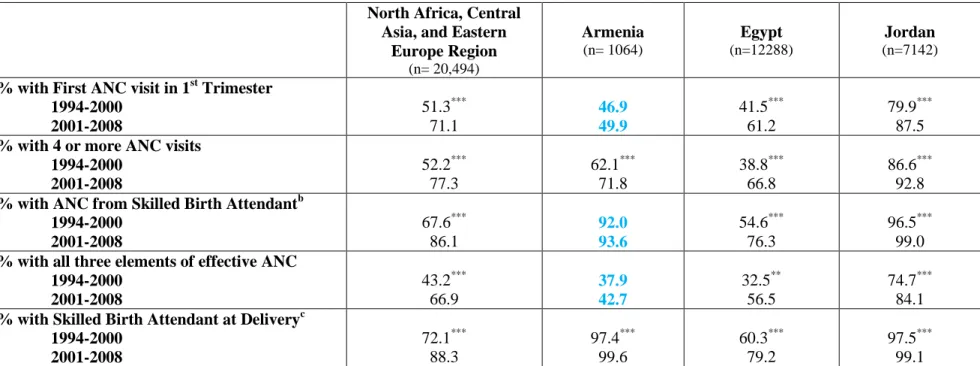
In Table 3, I present the results of the bivariate comparisons of antenatal and delivery
care outcomes between the period when the MCP was inactive (1994-2000) and when it was
active (2001-2008). These comparisons demonstrate two important points about the data. First,
in all regions except sub-Saharan Africa, indicators of antenatal and delivery care have uniformly
improved over time. In regions that began with comparatively high reported proportions of
skilled birth attendance and effective antenatal care – like the Latin America and Caribbean
region and the North Africa, Central Asia, and Eastern Europe region – the majority of countries
were still able to achieve significant improvements in both outcomes between 1994 – 2000 and
2001 – 2008. Likewise, in the South and Southeastern Asia region, where reported proportions
of effective antenatal care and skilled birth attendance began at much lower levels, all countries
made substantial, statistically significant gains in terms of both outcomes between 1994 – 2000
and 2001 – 2008. These regional comparisons also highlight the importance of interpreting the
degree of change in these outcomes in the context of their initial value in the 1994 – 2000 period.
The second important observation about the simple bivariate comparisons is that they do
not reveal any obvious relationship between progress on maternal health outcomes and exposure
to the MCP. In all regions except sub-Saharan Africa, improvements were evident regardless of
the degree of exposure to the policy. Even in sub-Saharan Africa, where progress was more
erratic, these comparisons do not suggest a clear relationship between a country’s degree of
21
of the seven sub-Saharan African nations that experienced a significant decrease in the reported
proportions of one or both outcomes, only two countries – Guinea and Mozambique – had a high
degree of exposure to the policy.
The results of the first two logistic regressions (Tables 4 and 5) reinforce the findings of
the bivariate comparisons. After adjusting for both individual and country characteristics,
women who reported a birth in the period when the policy was active had 1.36 (95% CI: 1.32 –
1.40) times the odds of reporting effective antenatal care (Table 4) and 1.36 (95% CI: 1.33 –
1.39) times the odds of reporting a skilled birth attendant (Table 5) compared to women who
reported a birth when the policy was inactive. This pattern of improving odds over time was also
evident at the regional level for both outcomes after adjusting for individual and country
characteristics. The odds of effective antenatal care and skilled birth attendance were higher in
some regions than others; however, in sub-Saharan Africa, the adjusted odds of effective
antenatal care (OR: 1.31, 95% CI: 1.25 – 1.36) showed some improvement over time and the
odds of skilled birth attendance (OR: 1.12, 95% CI: 1.08 – 1.15) made very slight progress.
Together these results serve as further evidence of the improved odds of having access to
high-quality antenatal and delivery care between 1994 – 2000 and 2001 – 2008 in most parts of the
world. The results also demonstrate that women in sub-Saharan African countries have not
benefited from the same degree of progress as have women in other regions.
By repeating these two regression models among respondents from high and low
exposure countries separately, we can begin to examine the effects of the MCP distinct from the
effects of progress over time. Among respondents from all the high exposure countries globally,
women who reported a birth during the period when the policy was active had 2.04 (95% CI:
22
– 1.78) times the odds of reporting a skilled birth attendant (Table 7) compared to women who
reported a birth when the policy was inactive. Among women from all low exposure countries,
however, the odds of effective antenatal care (OR: 1.09, 95% CI: 1.05 – 1.12) or a skilled birth
attendant (OR:1.12, 95% CI: 1.09 – 1.16) improved only slightly between the two time periods.
These results suggest that countries with a lower degree of financial support for
reproductive health between 1995 and 2000 made slower progress on maternal health outcomes
over time than did countries with a relatively higher degree of financial assistance from the
United States during that time. A higher degree of financial support seems to have promoted
progress on maternal health outcomes regardless of the change in aid policy in 2001. It is not
clear from these data if the change in policy blunted the potential degree of improvement that a
high exposure country may otherwise have achieved; however, it is clear that any negative
effects from the Mexico City Policy were not sufficient to outweigh the overall positive effect of
US financial support for reproductive health.
Many of the global trends are also born out at the regional level. In most regions, the
odds of effective antenatal care and skilled birth attendance improved over time, and countries
that received a higher degree of financial support from the United States between 1995 and 2000
made comparatively more progress. Although this pattern is evident in both outcomes, these
effects were more pronounced and consistent for effective antenatal care than for skilled birth
attendance. In sub-Saharan Africa, however, the positive effect of greater financial support on
the odds of effective antenatal care is less significant than in other regions. Sub-Saharan Africa
also demonstrates a unique and important break from the global trend in skilled birth attendance.
Among both high and low exposure countries in sub-Saharan Africa, there was no significant
23
These results reinforce the findings from the first models that suggest that despite a
global tendency toward improved maternal health outcomes over time, sub-Saharan African
countries have not advanced to the same degree as have countries in other regions. Furthermore,
these results suggest that a higher degree of financial support from the United States between
1995 and 2000 was not able to promote the same degree of progress in maternal health outcomes
in sub-Saharan Africa as in other regions. It is not clear based on these results whether the
stagnation in maternal health observed in sub-Saharan Africa is related to the 2001 change in
reproductive health aid policy. Many complex variables are at play, and I have only been able to
adjust for a small fraction of them in these models. The regional characteristics described in
Tables 1 and 2 suggest that sub-Saharan African countries have a lower capacity to support a
high-quality maternal health care system compared to other regions, and this lower capacity may
have contributed to making countries in the region both less equipped to effectively use the aid
money and more vulnerable to a change in US aid policy.
Overall, the results of this analysis suggest that access to antenatal and delivery care
improved over time in most parts of the world. The results also suggest that a higher degree of
financial support for reproductive health between 1995 and 2000 resulted in faster progress on
maternal health outcomes in many parts of the world. In sub-Saharan Africa, however, similar
progress on maternal health outcomes was not achieved. The results of this analysis do not
clearly elucidate the relationship between the Mexico City Policy and maternal health outcomes;
however, the results do suggest that countries with more resources and greater capacity are better
able to use reproductive health aid to achieve sustainable progress on maternal health outcomes
24
Discussion and Conclusion
As the single largest donor of reproductive health aid in the world, the United States
wields considerable influence over the global reproductive health policy agenda and as a result,
over the health of many of the world’s most vulnerable women. This influence demands
accountability from policy makers in the United States. Regardless of one’s political affiliation
or personal views on abortion, it is essential to understand that the effects of the Mexico City
Policy extend beyond the issue of abortion. At this point, there is clear evidence that the policy
has harmed the reproductive health infrastructure in a number of countries 7 and has contributed
to an increase in the rate of induced abortion in sub-Saharan Africa28 both of which may increase
maternal mortality. Although the present study was not able to identify a negative influence of
the Mexico City Policy on access to antenatal and delivery care, these results should not be
considered definitive evidence that the policy has no effect on maternal health outcomes.
The present study was designed to detect global and regional effects of the policy;
however, this approach may have been overly ambitious. Thus far, the documented effects of the
MCP on reproductive health infrastructure have been primarily isolated to rural areas and
particularly high-risk countries.1,2,7 A study designed to look more closely at the effects of the
policy in a specific region or country may have been able to detect changes in maternal health
outcomes that are not apparent on a global scale. This study does demonstrate that sub-Saharan
African countries have not made substantial progress on maternal health compared to that of
developing countries in other parts of the world. While this situation cannot be attributed to the
MCP, it suggests that countries in sub-Saharan Africa may be more vulnerable to a change in US
aid policy. As a result, these countries may have experienced more harm from the policy’s
sub-25
Saharan African nations lack the resilience to withstand donor policy changes. The data from this
study are not, however, sufficient to make that determination. Future studies focusing on
sub-Saharan Africa or a specific demographic group or geographical region within a single country
may be able to identify more nuanced effects of the policy on maternal health outcomes.
The results of the present study also indicate that in most parts of the world, a higher
level of financial support between 1995 and 2000 improved the odds of antenatal and delivery
care in the years that followed. This finding is in contrast to my original hypothesis that a high
level of exposure to the policy would increase a country’s risk for negative maternal health
outcomes after the policy’s reinstatement in 2001; however, the results seem to suggest a more
intuitive and encouraging relationship between reproductive health aid and maternal health
outcomes. Many resource poor countries can make effective use of financial assistance for
reproductive health even when donor restrictions are applied. Because a majority of
reproductive health NGOs elected to accept US funds after the MCP restrictions were reinstated,
implementation of the policy did not result in widespread loss of services in most parts of the
world6. Furthermore, for agencies that elected to accept US funds, the MCP’s restrictions applied
to abortion related services, which may not have directly influenced antenatal or delivery care.
These observations suggest that organizations that accepted USAID funds would have
experienced few changes in their maternity care services, allowing them to use the funds to
improve antenatal and delivery care.
In contrast to countries in other regions, the results of this study indicate that a higher
degree of financial assistance was not able to promote faster progress in achieving maternal
health goals in sub-Saharan Africa. Whether exposure to the MCP was high or low, progress on
26
2000 and 2001 – 2008. The results of this study do not provide much insight into why the
countries in this region were unable to make effective use of financial assistance for reproductive
health. Because little progress was observed in both high and low exposure countries, it seems
unlikely that the reinstatement of the MCP had a major effect on access to antenatal and delivery
care in the region. The concentration of extreme public health problems along with the often
limited internal capacity of sub-Saharan African nations to address these crises are likely to be
more important contributing factors. Although this study was not able to identify a regional
effect of the Mexico City Policy on maternal health, future studies focusing on this region or on
specific countries within the region may be better able to parse out the effects of the policy on
maternal health outcomes.
This study is the first effort to study the effects of the Mexico City Policy on indicators of
maternal health. The findings suggest that the Mexico City Policy did not impede progress on
maternal health outcomes in most parts of the world. Greater proportions of women across the
world now have access to effective antenatal care and skilled birth attendance than was true two
decades ago. The lack of apparent progress in access to these services in sub-Saharan Africa is
troubling, and US policy makers should make every effort to craft reproductive health aid policy
that will improve this situation. In the case of the Mexico City Policy, further evidence is needed
to determine the effects of this policy on maternal health in sub-Saharan Africa. Until more
evidence is available, policy makers should consider the potential unintended consequences of
27
References
1. Cohen SA. US overseas family planning program, perennial victim of abortion politics, is once again under siege. Guttmacher Policy Review. 2011;14(4).
2. Crane BB, Dusenberry J. Power and politics in international funding for reproductive health: The US global gag rule. Reprod Health Matters. 2004;12(24):128-137.
3. Population Action International. Global gag rule timeline. Population Action International Web site. http://populationaction.org/data-and-maps/global-gag-rule-timeline/. Published July 12, 2011. Updated 2011. Accessed June 5, 2012.
4. Mayhew SH. Donor dealings: The impact of international donor aid on sexual and
reproductive health services. International Family Planning Perspectives. 2002;28(4):pp. 220-224. http://www.jstor.org/stable/3088225.
5. Organization for Economic Cooperation and Development. OECD.StatExtracts.
http://stats.oecd.org/. Published 2012. Updated 2012. Accessed May 25, 2012.
6. McFarlane DR. Reproductive health policies in president bush's second term: Old battles and new fronts in the united states and internationally. J Public Health Policy. 2006;27(4):pp. 405-426. http://www.jstor.org/stable/4125182.
7. The Global Gag Rule Impact Project. Access denied: The impact of the global gag rule.
Population Action International. 2006.
8. WHO, UNICEF, UNFPA, and The World Bank. Trends in maternal mortality: 1990 to 2010.
Geneva: WHO. 2012.
9. Ronsmans C, Graham WJ. Maternal mortality: Who, when, where, and why. The Lancet. 2006;368(9542):1189-1200.
10. AbouZahr CL. Lessons on safe motherhood. World Health Forum. 1998;19(3):253-260.
11. United Nations. The state of the world's midwifery: Delivery health, saving lives. New York:
United Nations. 2011.
12. United Nations General Assembly. United nations millenium declaration New York: United
Nations. 2000(55).
13. Coeytaux F, Bingham D, Langer A. Reducing maternal mortality: A global imperative.
Contraception. 2011;83(2):95-98. doi: 10.1016/j.contraception.2010.10.009.
28
15. Hogan MC, Foreman KJ, Naghavi M, et al. Maternal mortality for 181 countries, 1980-2008: A systematic analysis of progress towards millennium development goal 5. Lancet.
2010;375(9726):1609-1623. doi: 10.1016/S0140-6736(10)60518-1.
16. Flowers RC, Floyd J, Weddington S. ROE et al. v. WADE, district attourney of dallas county appeal from the united states district court for the orthern district of texas. . 1973;410:US 113.
17. No Author Cited. The helms amendment. CHANGE: The Center for Health and Gender Equality Web site. http://www.genderhealth.org/the_issues/us_foreign_policy/helms/. Updated 2012. Accessed June 5, 2012.
18. Kulczycki A. Ethics, ideology, and reproductive health policy in the united states. Stud Fam
Plann. 2007;38(4, Ethical Issues in Reproductive Health):pp. 333-351.
http://www.jstor.org/stable/20454428.
19. Cincotta RP, Crane BB. The mexico city policy and U.S. family planning assistance. Science. 2001;294(5542):pp. 525-526. http://www.jstor.org/stable/3085167.
20. Center for Reproductive Rights. Breaking the silence: The global gag rule's impact on unsafe abortion. Center for Reproductive Right. 2003.
21. Kaiser Family Foundation. House appropriations committee releases FY 2013 state and foreign operations appropriations bills. US. May 8, 2012.
22. Population Action International. Omnibus spares international family planning from cuts and riders. Washington memo. Dec. 19, 2011.
23. Bogecho D, Upreti M. The global gag rule--an antithesis to the rights-based approach to health. Health Hum Rights. 2006;9(1):17-32.
24. Thapa S. Abortion law in nepal: The road to reform. Reprod Health Matters. 2004;12(24, Supplement: Abortion Law, Policy and Practice in Transition):pp. 85-94.
http://www.jstor.org/stable/3776119.
25. Rahman A, Katzive L, Henshaw SK. A global review of laws on induced abortion, 1985-1997. International Family Planning Perspectives. 1998:56-64.
26. Chávez S, Coe A. Emergency contraception in peru: Shifting government and donor policies and influences. Reprod Health Matters. 2007;15(29, Male Circumcision for HIV Prevention: Some Critical Responses. Taking on the Opposition to Sexual and Reproductive Rights: Strategies):pp. 139-148. http://www.jstor.org/stable/25475300.
27. Jones AA. Mexico city policy and its effects on HIV/AIDS services in subsaharan africa, the.
29
28. Bendavid E, Avila P, Miller G. United states aid policy and induced abortion in sub-saharan africa. Bull World Health Organ. 2011;89(12):873-880C. doi: 10.2471/BLT.11.091660.
29. No Author Cited. Measure DHS: Who we are. Measure DHS - Demographic and Health Surveys Web site. http://www.measuredhs.com/Who-We-Are/About-Us.cfm. Accessed May 30, 2012.
30. Making Pregnancy Safer - Department of Reproductive Health and Research. Making pregnancy safer: The critical role of the skilled attendant. World Health Organization, International Confederation of Midwives, and International Federation of Gynecology and
Obstetrics. 2004.
31. UNFPA, UN Development Programme, and UN Dept. of Economic and Social Affairs - Statistics Division. Indicators for monitoring the millenium development goals: Definitions, rationales, concepts, and sources. United Nations. 2003.
32. Integrated Management of Pregnancy and Childbirth - Department of Making Pregnancy Safer. Standards for maternal and neonatal care. World Health Organization. 2007.
33. United States Census Bureau. International data base.
http://www.census.gov/population/international/data/idb/informationGateway.php. Published
2012. Updated 2012. Accessed May 25, 2012, 2012.
34. Simkhada B, Teijlingen ER, Porter M, Simkhada P. Factors affecting the utilization of antenatal care in developing countries: Systematic review of the literature. J Adv Nurs. 2008;61(3):244-260.
35. Say L, Raine R. A systematic review of inequalities in the use of maternal health care in developing countries: Examining the scale of the problem and the importance of context. Bull
World Health Organ. 2007;85(10):812-819.
36. The World Bank. World DataBank. http://databank.worldbank.org/data/home.aspx. Published 2012. Updated 2012. Accessed June 17, 2012, 2012.
37. United Nations, Department of Economic and Social Affairs, Population Division. World fertility data 2008. (POP/DB/Fert/Rev2008).
http://www.un.org/esa/population/publications/WFD%202008/Main.html. Published 2009.
T
-1
Table 1a: Characteristics for DHS respondents from the Latin America and Caribbean region with a birth reported in the 12-24 months prior to the completion date of the survey, 1994 – 2008a,b
Latin America & Caribbean
Region
(n=44,639)
Bolivia
(n=7511)
Columbia
(n=6143)
Dominican Republic
(n=8384)
Haiti
(n=3780)
Nicaragua
(n=4235)
Peru
(n=14586)
Mean Age in years (St. Dev)*** 26.7 (6.9) 27.5 (7.0) 25.8 (6.5) 24.8 (6.0) 28.0 (7.1) 25.3 (6.7) 27.9 (7.0)
% Rural*** 48.8 49.8 32.0 43.8 68.9 55.9 51.0
Mean years of education (St. Dev)*** 6.6 (4.5) 6.5 (4.5) 7.4 (4.0) 7.7 (4.4) 3.1 (3.4) 4.8 (4.0) 7.0 (4.4)
% Currently Married*** 35.4 51.4 22.9 14.8 71.8 30.0 36.4
% with 4 or More Births*** 30.7 39.3 19.3 20.9 42.2 32.4 33.3
SOURCE: MEASURE DHS (www.measuredhs.com/) downloaded 05/27/2012. Data manipulations by first author, see Appendix 4. DHS, Demographic and Health Survey
a For continuous characteristics, one-way ANOVAs were used to test for significant differences between countries, and the Pearson’s chi-square tests were used for between country comparisons for categorical characteristics
b
All reported means and proportions are unweighted ***p<0.001, **p<0.01, *p<0.05
Table 1b: Characteristics for DHS respondents from the North Africa, Central Asia, and Eastern European region with a birth reported in the 12-24 months prior to the completion date of the survey, 1994 – 2008a,b
North Africa, Central Asia, and Eastern
Europe Region
(n= 20,494)
Armenia
(n= 1064)
Egypt
(n=12288)
Jordan
(n=7142)
Mean Age in years (St. Dev)*** 27.5 (6.0) 25.1 (5.0) 26.9 (5.8) 29.0 (6.0)
% Rural*** 50.5 44.0 62.5 30.9
Mean years of education (St. Dev)*** 8.1 (5.4) 10.3 (2.8) 6.7 (5.8) 10.3 (4.1)
% Currently Married*** 99.2 97.8 99.1 99.6
% with 4 or More Births*** 32.6 7.0 28.1 44.4
SOURCE: MEASURE DHS (www.measuredhs.com/) downloaded 05/27/2012. Data manipulations by first author, see Appendix 4. DHS, Demographic and Health Survey
a
For continuous characteristics, one-way ANOVAs were used to test for significant differences between countries, and the Pearson’s chi-square tests were used for between country comparisons for categorical characteristics
T
-2
Table 1c: Characteristics for DHS respondents from the South and Southeastern Asia region with a birth reported in the 12-24 months prior to the completion date of the survey, 1994 – 2008a,b
South & South-eastern Asia Region
(n=67,810)
Bangladesh
(n=5982)
Cambodia
(n=4082)
India
(n=26,676)
Indonesia
(n=17,820)
Nepal
(n=5272)
Philippines
(n=6288)
Vietnam
(n=1690)
Mean Age in years (St. Dev)*** 26.3 (6.1) 23.9 (6.0) 28.8 (6.9) 25.0 (5.3) 27.8 (6.3) 25.7 (6.1) 28.4 (6.5) 27.2 (5.7)
% Rural*** 71.2 73.5 83.9 69.2 69.5 88.3 57.9 80.3
Mean years of education (St. Dev)*** 5.4 (4.8) 4.0 (4.0) 2.9 (2.9) 4.7 (5.0) 7.2 (4.3) 1.8 (3.3) 9.1 (4.2) 7.0 (3.7)
% Currently Married*** 96.7 98.7 96.5 98.9 98.4 99.5 77.4 98.4
% with 4 or More Births*** 28.0 25.4 40.7 25.0 27.4 34.4 35.3 12.5
SOURCE: MEASURE DHS (www.measuredhs.com/) downloaded 05/27/2012. Data manipulations by first author, see Appendix 4. DHS, Demographic and Health Survey
a For continuous characteristics, one-way ANOVAs were used to test for significant differences between countries, and the Pearson’s chi-square tests were used for between country comparisons for categorical characteristics
b All reported means and proportions are unweighted ***p<0.001, **p<0.01, *p<0.05
Table 1d: Characteristics for DHS respondents from the sub-Saharan Africa region (Benin – Malawi) with a birth reported in the 12-24 months prior to the completion date of the survey, 1994 – 2008a,b
sub-Saharan African Region
(n=118,659)
Benin
(n=9407)
Burkina Faso
(n=5014)
Cameroon
(n=3375)
Chad
(n=4050)
Ethiopia
(n=5756)
Ghana
(n=3174)
Guinea
(n=3808)
Kenya
(n=3417)
Mada-gascar
(n=3517)
Malawi
(n=6681)
Mean Age in years (St.
Dev)*** 27.3 (6.9)
27.9
(6.5) 28.1 (7.2) 25.9 (6.6)
26.2 (6.6) 27.7 (6.8) 28.7 (6.8) 27.7 (7.2) 26.5 (6.5) 26.9 (7.1) 26.2 (6.7)
% Rural*** 74.4 67.0 85.3 63.2 60.3 85.7 71.8 77.0 78.8 67.7 84.7
Median years of education
(IQR) c*** 0 (0-6) 0 (0-0) 0 (0-0) 5 (0-7) 0 (0-0) 0 (0-0) 3 (0-9) 0 (0-0)
7
(4.5-8) 3 (0-5) 4 (0-7)
% Currently Married*** 79.2 85.8 86.4 70.3 92.1 93.2 78.5 92.1 77.6 61.4 84.9
% with 4 or More Births*** 46.5 46.7 50.6 41.8 49.8 48.9 41.5 51.7 39.7 43.8 40.2
SOURCE: MEASURE DHS (www.measuredhs.com/) downloaded 05/27/2012. Data manipulations by first author, see Appendix 4. DHS, Demographic and Health Survey; IQR, Interquartile Range
a For continuous characteristics, one-way ANOVAs were used to test for significant differences between countries, and the Pearson’s chi-square tests were used for between country comparisons for categorical characteristics
b All reported means and proportions are unweighted c
T
-3
Table 1d Continued: Characteristics for DHS respondents from included countries in the sub-Saharan Africa region (Mali – Zimbabwe) with a birth reported in the 12-24 months prior to the completion date of the survey, 1994 – 2008a,b
Mali
(n=11,017)
Mozambique
(n=6016)
Namibia
(n=2820)
Niger
(n=4765)
Nigeria
(n=13,730)
Rwanda
(n=5455)
Senegal
(n=5113)
Tanzania
(n=5358)
Uganda
(n=6281)
Zambia
(n=6248)
Zimbabwe
(n=3657)
Mean Age in years (St.
Dev)*** 27.2 (7.1) 26.6 (7.2) 27.4 (7.0)
27.2
(7.2) 27.8 (7.0)
29.4 (6.8)
27.6
(7.0) 27.3 (6.8)
26.6 (6.6)
26.6
(6.7) 26.3 (6.7)
% Rural*** 74.2 70.0 63.4 76.3 72.6 80.4 70.8 79.6 79.8 70.4 77.3
Median years of education
(IQR) c*** 0 (0-0) 1 (0-4) 5 (8-10) 0 (0-0) 0 (0-8) 4 (0-6) 0 (0-0) 7 (0-7) 4 (0-7) 6 (3-7) 7 (6-10)
% Currently Married*** 94.0 17.9 24.8 96.8 93.2 49.5 93.6 77.7 68.1 82.3 81.2
% with 4 or More
Births*** 53.0 41.8 29.5 55.2 48.7 47.6 47.5 45.5 49.6 45.8 31.5
SOURCE: MEASURE DHS (www.measuredhs.com/) downloaded 05/27/2012. Data manipulations by first author, see Appendix 4. DHS, Demographic and Health Survey; IQR, Interquartile Range
a For continuous characteristics, one-way ANOVAs were used to test for significant differences between countries, and the Pearson’s chi-square tests were used for between country comparisons for categorical characteristics
b All reported means and proportions are unweighted