A Review on Comparison of Techniques of Content
Based Image Retrieval
Harkirat Kaur Baljit Singh Khehra (M.Tech Student) CSE Deptt. BBSBEC,Fatehgarh Sahib BBSBEC,Fatehgarh Sahib
Email: [email protected] Email:[email protected]
Abstract— Content based image retrieval is the process which follows the searching of similar images from the database, based on visual content. The RGB color model algorithm used in the present work is not sufficient for better color description. Therefore in this paper comparison to various techniques is described in order to efficiently description of the colors in an image. The comparison between various techniques is done in order to define the unique tasks by various techniques in CBIR. The diff component is defined as the difference between the values of the parameters of the images.
Keywords: Content based, Image retrieval, Visual content.
1.INTRODUCTION
Content-based image retrieval (CBIR) has become an outstanding analysis topic as a result of the proliferation of video and image know ledge in digital type. The enlarged information measure convenience to acess the net within the close to future can enable the user to go looking for and browse through video and image database placed at remote sites. Therefore, fast and improved retrieval of pictures from agiant database is a vital downside that must be self-addressed. High retrieval potency and fewer machine quality area unit requires characteristics of CBIR system. In typical image database,pictures area unit text-annotated and image retrieval relies on keyword looking out. The transmission primarily based application became standard due to the rapid advancement of internet technology and therefore the digital devices. As a result, the capacity of digital image libraries obtained through different categories of sources like: social networking sites, multimedia, multimedia camera, multimedia mobiles, internet etc. So there requirement for
proper searching techniques to retrieve meaningful image data from that large volume of digital image libraries. Image retrieval techniques are used to maintain and retrieve the image in the database. Mainly the shape features are classified in to two types: boundary and region descriptors. Further they are classified as (a) Structural and (b) global. The global boundary descriptors also include the various Fourier descriptors, signatures and wavelet descriptors. CBIR performs retrieval process based on the visual content of the image data. The straight forward image to image searching mechanism is not considered in CBIR. Such approach is not the practically feasible to implement it in any real time applications because image data are comparatively huge in size. So in CBIR, we require suitable feature extraction techniques form the image data so that meaningful and relevant images can be retrieved based on those extracted image features. A number of CBIR techniques were developed based on considering the significant feature like colour, texture and shape. Colour feature is widely used in CBIR techniques since it is one of the most prominent low level features and it is also invariant to rotation, scaling, and other spatial transformations on the images. In general the histogram matching based CBIR techniques is relatively simple and faster. To retrieve image, it is essential to separate objects and background, since the objects are the key contents and the background usually weakens the retrieval accuracy. The difference between content and the text-based retrieval systems is that the human interaction is an indispensable part of the latter system. While the features are extracted using the computer vision of techniques which are mostly low-level features (colour, texture, shape, spatial layout, etc.)
(1) Low-level image feature extraction. (2) Similarity measure.
(3) ‘Semantic gap’ reduction.
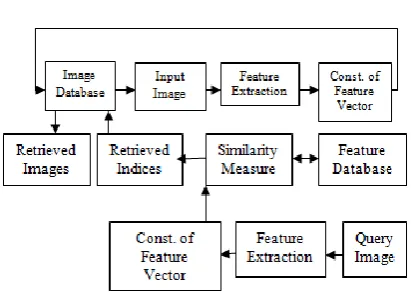
Fig.1.Content-based image retrieval system
In Fig.1, the process of work of content based image retrieval system is shown. Image is retrieved in CBIR system by following the particular steps shown in above figure. Various techniques can be practiced in CBIR using the steps of the above figure.
2.LITRATURE SURVEY
Varish and pal, [1] proposed a method, Content based image retrieval (CBIR), in which the process of retrieval of similar images from the database is proceeded on the basis of visual content of the given query image. In this paper, the authors have obtainable a CBIR technique using color based feature. Since color can be considered as one of the important features of the image data, so importance is given to all three colors, i.e. red, green and blue, is given during the image retrieving process. In this CBIR technique, firstly we have constructed three probability histograms i.e histogram is constructed for each color component and later the histograms are divided into various numbers of major bins and similarly from each bin, several statistical values like standard deviation, skewness and kurtosis are computed. The calculated statistical values are used as extract the features of the image data. The processing cost of the existing CBIR technique is considerably low. The experiment on technique has
been performed on the standard image databases and reasonable results have been achieved.
Singha and Hemachandran, [2] discussed on the topic, Content Based Image Retrieval using Color and Texture, This paper presents the content based image retrieval, in which the features like color and texture are defined, called Wavelet Based Color Histogram Image Retrieval (WBCHIR).The color and texture features are extracted through the wavelet transformations and the color histogram. The combination of the above various features is robust to translation and scaling of the objects in an image. The discussed system is a capable and faster retrieval method to test on a WANG image database, which contains 1000 general-purpose color images. The performance of this method has been evaluated by comparing the results with the existing systems.
Singha et.al. [3] proposed study on image retrieval technique which is based on the combinations of the Haar wavelet transformation which uses the lifting scheme and the Colour Histogram known as lifting wavelet-based colour histogram. The colour histogram i.e translation and rotation invariant describe its features. The texture features and the local characteristics of an image are extracted by the Haar wavelet transformation, this is done to increase the accuracy of the given retrieval system. The lifting scheme thus reduces the processing time to the retrieve images. The results of the prescribed experiment shows that the given technique outperforms the other schemes, in terms of the average recall, the average precision and the total average precision/recall.
back propagation or feed forward algorithm for the neural network classification and also to calculate cross relationship and apply weakening model for the feature matching.
Kushwah and Agrawal [5] discussed that the content-based image retrieval (CBIR) is a new but widely adopted method for finding images from the image database. Since, the network and development of multimedia technologies are becoming more popular, users are not much satisfied with the traditional information retrieval methods. So, the content based image retrieval (CBIR) is becoming a source of exaction and fast retrieval of the images from the database. Since nowadays, various techniques have been developed in order to improve the performance of CBIR. In this CBIR technique, image retrieval system inputs the query image and retrieves the relevent similar images accordingly by using the spatial coordinates which further uses the k means clustering algorithm for its segmentation and hence the image is retrieved.
Patel and Yerpude [6] proposed the algorithm, which basically uses two parameters i.e precision and recall for its evaluation. This algorithm works on the images of Wang database. With the advancement of Internet and Multimedia social networking technologies, the usage of such multimedia contents like images , video, audio etc are increased rapidly. So, there was the need to manage the retrieval of such vast data accordingly in an effective manner. Hence to carry out management & retrieval, an effective technique was required. This technique presented by this paper is a novel technique, used for the efficient retrieval of the required images from the large database of the image known as Content Based Image Retrieval (CBIR) system. Since from past many years, many techniques have been proposed for the same, But if the performance of those techniques is measured with respect to time, many of the techniques suffers from efficient retrieval accuracy. Hence, this paper introduces a method which uses the histogram and the color edge of an image with haar wavelet transform for the resourceful retrieval of similar images from the image database along with query image.
Mohamadzadeh and Farsi [7] suggested that Since, accuracy and the speed of image retrieval
are still the parameters of the preference of CBIR, but, the main task of various CBIR techniques of image retrieval systems is to perform the functions to assess, retrieve and characterize the image retrieval, according to the users demand. However, this study proposed a method based on iterative discrete wavelet transform and sparse representation. For the evaluate and comparison of the applicability of the feature-based sparse representation for an image retrieval technique, the precision at average normalized and percent recall modified retrieval rank are used as quantitative metrics. The experimental results proves that the proposed method provides better output as comparison to other methods.
color and texture fused features a CBIR system is designed based on the prescribed work by constructing various weights of the feature vectors of query image. The related retrieval experiments hence, illustrate that the fused features retrieval bring improved visual sense than the single feature retrieval, which indicates the better retrieval results.
3. Various techniques in image retrieval Content-based image retrieval (CBIR) has become an excellent analysis topic as a result of the propagation of video and the knowledge of image in digital type. The enlarged information measure becomes a convenienient source to access the net within the close to future which can enable the users to go and look for and browse the videos and the image databases, which are placed at remote sites.
3.1 Color Based Feature
Since a color image, consists of three basic color components, i.e. red, green and blue, so in this work, we have given the same importance on all three color components during image retrieving process. In the presented CBIR technique, initially we have constructed three probability histograms for each color component and subsequently the histograms are divided into several numbers of significant bins and from each bin, we have computed several statistical values like standard deviation, skewness and kurtosis. The computed statistical values are used as extracted features of the image data. The processing cost of the presented CBIR technique is significantly low. The technique has been tested on standard image databases and satisfactory results have been achieved.
𝑝(𝑟𝑖) =𝑛𝑜. 𝑜𝑓 𝑝𝑖𝑥𝑒𝑙𝑠 𝑖𝑛 𝑟𝑖
𝑤𝑒𝑖𝑔ℎ𝑡 × ℎ𝑒𝑖𝑔ℎ𝑡 (1) Where 𝑝(𝑟𝑖) represents the relative frequency or probability of r. -th intensity value and the range of intensity value is [0, 𝑙 − 1]
𝐵𝑖𝑛𝑖= ∑ 𝑃(𝑟𝑗) 𝑈𝐵
𝑗=𝐿𝐵
≤1
𝑛 (2)
Compute for each color component, the standard deviation, skewness and kurtosis from Bin,c ViE [0, n -1 ]where 'C' represents R, G and B color components respectively.
3.2 Haar Discrete Wavelet Transforms
The transformation of an image from one domain to another i.e from spatial domain into frequency domain is known as discrete wavelet transformation (DWT). The function of superposition of a family of the basis function is basically known wavelets and is thus represented by wavelet transformation. Wavelets generally provides various solutions which are capable of good energy compaction. Wavelets can easily capture both the texture and shape based information efficiently and hence are robust with respect to color intensity shifts. With the time, the wavelet transformation is computed linearly and thus allow the algorithm to process at a very high speed. Discrete wavelet transformation divides the signal between the wavelet function and the basic function . Multi-restoration is the another approach in which the wavelet transform computation of a two-dimensional image is used, which applies sub-sampling and recursive filtering. The image is divided into sub-bands of different four frequencies at every level or scale i.e HL, LL, LH, and HH .where L denotes the low frequency and H denotes the high frequency.
Histogram intersection distance:
𝑑𝐼𝐷=
∑𝑖=𝑛𝑚𝑖𝑛[𝑄[𝑖], 𝐷[𝑖]] 𝑖=1
[𝐼𝐷[𝑖]] (3) Smith and Chang extended the idea, by modifying the denominator of the original definition, to include the case when the cardinalities of the two histograms are different and expressed as:
𝑑𝐼𝐷
∑𝐼=𝑛𝑚𝑖𝑛[𝑄[𝑖], 𝐷[𝑖]] 𝐼=1
𝑚𝑖𝑛[|𝑄[𝑖]|, 𝐷[𝑖]] (4) and |Q| and |D| represents the magnitude of the histogram for query image and a representative image in the Database.
discovered and is put into work in accordance to the set of the data which auto calculates the feature weight with neural network. According to the retrieved contents of the images from the datasets there is the graph of precision and recall in gui. To apply back propagation or feed forward algorithm for neural network classification. To calculate the cross relationship and to apply the weakening model for feature matching.
Feature similarity matching formulae:
𝑑𝑖𝑑1= ∑ 𝑚𝑖𝑛[𝑄[𝑖]. 𝐷[𝑖]] 1
𝐷[𝑖] (5) 𝑛
1
𝑑𝑖𝑑2=
∑𝑛 𝑚𝑖𝑛[𝑄[𝑖], 𝐷[𝑖]] 𝑖=1
𝑚𝑖𝑛[∑ 𝑄[𝑖]. ∑𝑛 𝐷[𝑖] 𝑖=0 𝑛
𝑖=0 ]
(6)
where Q ¼ {Q1, Q2, . . . , Qn} and D ¼ {D1, D2, . . . , Dn} are the query and target feature vectors, respectively.
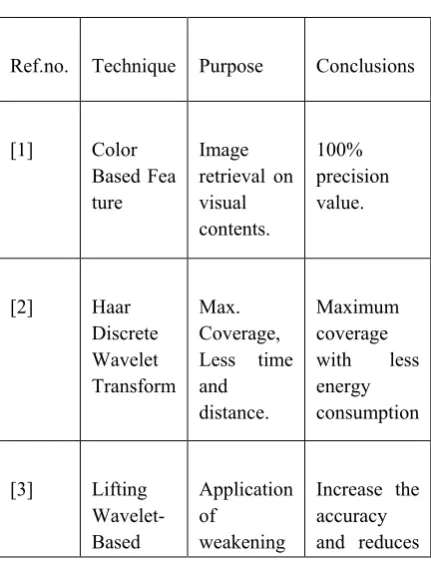
4.Comparative analytical table TABLE 1 Compare by Performance
Ref.no. Technique Purpose Conclusions
[1] Color Based Fea ture
Image retrieval on visual contents.
100% precision value.
[2] Haar Discrete Wavelet Transform
Max. Coverage, Less time and distance.
Maximum coverage with less energy consumption
[3] Lifting Wavelet-Based
Application of
weakening
Increase the accuracy and reduces
Colour Histogram
model for feature matching
the processing time.
5.CONCLUSION
A large number of content based image retrieval have been proposed in recent past. Still there is lot of work which is to be done and research is yet to be continued. We have stressed on many approaches, like Color Based Feature, Haar Discrete Wavelet Transforms Lifting Wavelet-Based Colour Histogram. Final observations can be drawn on the basis of different techniques of image enhancement. An increasing interest towards image retrieval system made it easy to retrieve images of similar type on basis of parameters required.
REFFERENCES
[1] Naushad Varish and Arup kumar pal, “Content-based image retrieval using statistical features of colour histogram,” searching similar images from an image IEEE, vol.22,no.15,pp.978-1-4673-6823,2015.
[2] Manimala Singha and K.Hemachandran, "Content Based Image Retrieval using Color and Texture," Signal & Image Processing : An International Journal (SIPIJ) vol.3, no.1,pp.39-57 February 2012.
[3] M. Singha, K. Hemachandran and A. Paul2, "Content-based image retrieval using the combination of the fast wavelet transformation and the colour histogram," vol. 6, pp. 1221–1226, 2012. [4] Sandeep Singh and Er.Rachna database based on the visual contents of the input query image,IEEE Transactions , vol.22,no.15,pp.978-1-4673-6823,2015.
[5] Vinita Kushwah and Arun Agrawal. "Study on Query Based Clustering Technique for Content Based Image Retrieval." IJREAT International Journal of Research in Engineering & Advanced Technology, vol. 2,pp. 1-6.feb-Mar 2014.
[6]Dileshwar Patel and Amit Yerpude. "Content Based Image Retrieval using Color Edge Detection and Haar Wavelet Transform." International Research Journal of Engineering and Technology (IRJET) e-ISSN: 2395-0056 vol.02, pp. 1906-1911,Dec-2015.
representation." IET Computer Vision ISSN 1751-9632 Received on 20th September 2014 Revised on 20th July 2015, vol.10,pp.1-8,2015.
[8] Subrahmanyam Murala , R. P. Maheshwari and R. Balasubramanian. “Directional local extrema patterns: a new descriptor for content based image retrieval content-based image retrieval system via sparse representation,” pp.1-8, 2012.
[9] Jun Yue , Zhenbo Li , Lu Liu and Zetian Fu," Content-based ima image retrieval using color and texture fused features," vol.54, no:3-4, pp.1121– 1127,2011.
[10] X. Y. Wang, Y. 1. Yong, and H. Y. Yang, "An effective image retrieval scheme using color, texture and shape features," Computer Standards & Interfaces, vol. 33, no. 1, pp. 59-68,2011.
[11] G. H. Liu, and 1. Y. Yang, "Content-based image retrieval using color difference histogram," Pattern Recognition, vol. 46, no. I, pp. 188-198, 2013.
[12] M. J. Swain and D.H. Ballard, "Color indexing," International Journal of Computer Vision, vol. 7, no. 1, pp. 11-32, 1991.
[13] M. Kokare, B. N. Chatterji, and P. K. Biswas. "A survey on current content based image retrieval methods. " IETE Journal of Research, vol. 48 no. 3-4, pp. 261-271, 2002.
[14] Li. Jia, and 1. Z. Wang, "Automatic Linguistic Indexing of pictures by a statistical modeling approach," Pattern Analysis and Machine Intelligence, IEEE Transactions, vol. 25, no. 9, pp. 1075-1088, 2003.
[15]M. Kokare, B. N. Chatterji, and P. K. Biswas. "A survey on current content based image retrieval methods. " IETE Journal of Research, vol. 48 no. 3-4, pp. 261-271, 2002.
[16] L. Ying, D. Zhang, Lu. Guojun, Ma. Wei-Ying. "A survey of content-based image retrieval with high-level semantics," Pattern Recognition,vol. 40, no. 1, pp. 262-282,2007.
[17] A. W. M. Smeulders, M. Worring, S. Santini and A. Gupta, and R. Jain, "Content-based image retrieval at the end of the early years," Pattern Analysis and Machine Intelligence, IEEE Transactions , vol. 22, no. 12, pp. 1349-1380,2000 [18] A. Vailaya, A. T. Figueiredo, A. K. Jain, and H. 1. Zhang, "Image classification for content-based indexing," Image Processing, IEEE Transactions, vol. 10, no. I, pp. 117-130, 2001. [19]N. Alajlana, I.E., Rube, M.S. Kamel and G. Freeman, "Shape retrieval using triangle-area representation and dynamic space warping," Pattern Recognition, vol. 40, no. 7, pp. 1911-1920,2007.