Modulation of sexual signalling by immune challenged male
mealworm beetles (
Tenebrio molitor
, L.): evidence for terminal
investment and dishonesty
B. SADD*, L. HOLMAN, H. ARMITAGE, F. LOCK, R. MARLAND & M. T. SIVA-JOTHY
Department of Animal and Plant Sciences, University of Sheffield, Sheffield, UK
Introduction
Honest sexual signalling is a cornerstone of theories that propose parasites drive sexual selection (Hamilton & Zuk, 1982; Andersson, 1994). This is because honest epigamic traits are believed to indicate their bearer’s ability to resist parasites and pathogens (Folstad & Karter, 1992; Sheldon & Verhulst, 1996). However, when parasites and patho-gens challenge an organism’s immune system they are also likely to alter the organism’s perceived survival probability since every infection is a potential threat to survival. If the probability of surviving the insult is perceived to be low the organism should make a last-ditch attempt to increase reproductive success (see Agnew et al., 2000) a central idea in the concept of terminal investment (see Clutton-Brock, 1984). Since males have higher fitness payoffs for such terminal
investment compared to females (Bateman, 1948), we expect males to be sensitive to this circumstance and predict they will shift resource allocation into mating success in response to a survival threat. Therefore, while greater investment in immunity will function to increase fitness through survival, increasing investment in epigamic traits will be to the male’s immediate fitness benefit especially in the face of uncertain survival. In organisms where epigamic signal traits are plastic we predict a large immune insult will result in increased investment in female-attracting traits because the male host may perceive the insult as a survival threat and divert resources into attractiveness traits in order to maximize mating prior to death. If this occurs the signal received by the female will be dishonest in terms of the male’s current condition. Under these conditions dis-honesty results from the fact that the animal no longer needs to balance investment between short-term and long-term fitness routes (mating success and survival, respectively) since the immune insult curtails the likeli-hood of the latter.
Both genders of the mealworm beetle,Tenebrio molitor
(Coleoptera: Tenebrionidae, L.), produce sex and aggregation pheromones (Happ, 1969; August, 1971; Correspondence:M. T. Siva-Jothy, Department of Animal and Plant
Sciences, University of Sheffield, Sheffield S10 2TN, UK. Tel.: +4411142224630; fax: +4411142220002; e-mail: [email protected]
*Present address:B. Sadd, Department of Ecology and Evolution, ETH Zu¨rich, CH-8092 Zu¨rich, Switzerland
Keywords: dishonest signal; epigamic signal; immunity; pheromones; terminal investment;
Tenebrio molitor.
Abstract
Organisms partition resources into life-history traits in order to maximise fitness over their expected lifespan. For the males of many species fitness is determined by qualitative and quantitative aspects of costly sexual signals: The notion that epigamic traits are costly forms the cornerstone of those theories that propose parasites drive sexual selection. Consequently studies examining this notion assume sexual signalling is honest (i.e. driven by cost) when they seek to identify correlations or causal links between male immune function and attractiveness. We demonstrate that immune challenged males of the mealworm beetle, Tenebrio molitor, increased their investment in epigamic pheromone signals: these males became significantly more attractive to females whilst increasing the activity of a key immune effector system. In other words males increase terminal reproductive effort (invest in attractive-ness) in response to a survival threat (immune insult). Consequently the signal preferred by the female is dishonest when considering the male’s condition.
Hurd & Fogo, 1991). The glandular production of the sex pheromones is known to reach effective levels by day 7 post-imaginal eclosion (Menon, 1976) and the phero-mones produced by males have been shown to stimulate locomotion, aggregation and copulatory behaviour in females (August, 1971; Hurd & Parry, 1991). Since the activity of pheromone producing glands can be relatively rapidly modulated [compared to cuticular signal traits such as eye-stalks (Wilkinsonet al., 1998) or wing spots (Siva-Jothy, 2000)], sex pheromone production will be a relatively plastic sexual signal. Examining sex phero-mone production also has an important logistic advant-age: the confounding effects of male behaviour and/or presence can be eliminated by presenting adsorbed odours. Pheromones can be collected and female prefer-ences assessed using established methods, which com-bine odour collection on filter paper with behavioural assays (e.g. Wordenet al., 2000).
In this paper we (i) demonstrate the importance of sex pheromones over aggregation pheromones in influen-cing female behaviour in our choice arenas, (ii) how an immune insult (implanted nylon monofilament) affects sexual signalling by males and (iii) how the experimen-tal immune insult affects the activity of phenoloxidase, an important immune system enzyme (Sugumaran, 2002).
Materials and methods
Insects
Adult beetles were obtained from stock cultures main-tained at the University of Sheffield on rat chow, fresh apple and water and kept at 26 ± 2C (mean ± SD) in a 12 : 12 h photo-cycle. Pupae were collected from stock tanks within 24 h of pupation and immediately weighed, sexed (Bhattacharyaet al., 1970) and isolated in individ-ual containers. Isolation ensured all adults in our proto-cols were virgins and had not come into contact with other adults or their pheromones. All insects used in these tests were virgins, were 7–8 days post-imaginal eclosion when they entered a protocol, and were of similar body size (i.e. all had a fresh, wet pupation weight of 0.10–0.11 g).
Experiment 1: female preference for male or female pheromones
On day 7 post-eclosion, a single virgin adult male or female beetle was placed on a 37 mm diameter filter paper disc (Whatman grade 1) in a clean glass Petri dish for 48 ± 2 h (mean ± SD) (Wordenet al., 2000; Rantala
et al., 2002). The beetle was prevented from moving off the paper by enclosing it under a wire mesh dome. We generated three types of discs: ‘male’ (exposed to male beetles), ‘female’ (exposed to female beetles) and ‘blank’ discs. Blank discs were drawn at random from the pool of
experimental filter paper discs and were handled in the same way as the others, but were not exposed to beetles, prior to inclusion in the experiment. Discs were uniquely labelled with a graphite pencil: researchers monitoring the choice tests (see below) did not have access to the disc codes. Each beetle only generated one ‘scented’ filter paper disc and each disc was only used in one preference test.
Disc preference was assessed by placing one disc from each treatment category (‘male’, ‘female’ and ‘blank’) equidistant from each other within a clean 140 mm glass Petri dish under red light illumination. An adult female beetle was placed in the centre of the dish under a small glass Petri dish for 8 min before the trial began. She was then released, the arena covered with a glass lid and the beetle’s movements and residency times on each disc recorded over a 15 min period.
Experiment 2: how does immune-challenge affect attractiveness?
The experiment was divided into separate gender trials in order to make the choice options within a chamber manageable. In both gender trials, virgin adult beetles were randomly allocated to one of three treatment groups. Beetles in the ‘treatment’ group were subjected to an immune insult 7 days after imaginal eclosion. They were immobilized on ice and then had a 2 mm piece of sterile nylon monofilament (diameter: 0.128 mm) inser-ted through a hole in the pleural membrane between the third and fourth abdominal sternite. This procedure allowed us to standardise the immune insult each beetle received. Beetles in the ‘treatment control’ group had a hole punctured in the pleural membrane between the third and fourth abdominal sternite but didn’t receive an implant. This group was present to control for the effects of wounding. Beetles in the ‘control’ group were handled similarly to other insects in the experiment but did not receive a puncture or implant. Experimental discs from each of these treatment groups were generated and used as described for experiment 1: a beetle was placed on a blank filter paper disc in a clean glass Petri dish for 48 ± 2 h (mean ± SD). ‘Blank’ filter paper discs were drawn at random from the pool of experimental discs and processed in the same way as other discs prior to inclusion in the experiment, but without exposing them to beetles. One disc from each of the four categories was placed in a clean glass Petri dish and female preference was assessed as for experiment 1.
We assessed the repeatability of this protocol by taking discs from ‘treatment’, ‘treatment control’, ‘control’ and ‘blank’ groups (from male beetles only,n¼10 for each group). Each disc was cut into thirds. Each third-of-a-disc was used in a different preference test (i.e. each test was conducted with a different female target) in which a filter-paper segment from each treatment was present. There was significant (repeated measures A N O V AA N O V A: F¼
4.0, d.f.¼39,P< 0.001) across-treatment repeatability of 0.75 ± 0.13 (mean ± SD) in the attractiveness of the discs.
Phenoloxidase assay
Male beetles, drawn from the same pool as those in the choice experiments, were allocated to one of two treatment groups. Beetles allocated to the ‘challenged’ group received an immune insult 7 days after imaginal eclosion. This insult consisted of a 2 mm piece of nylon monofilament inserted into the haemocoel as in experi-ment 2. Haemolymph was collected 24 ± 1 h (mean ± SD) later (i.e. to coincide with the mid-point of pheromone collection in previous experiments). Col-lection of haemolymph was made by perfusing the abdomen with 1 mL of sodium cacodylate buffer (0.01MM sodium cacodylate, 0.005MM CaCl2). Samples
were immediately frozen at)90C for 20 min to disrupt the haemocytes. The frozen haemolymph was thawed on ice, centrifuged (6500g, 15 min, 4C), and the super-natant collected. An amount of 20lL of supernatant was mixed with 140lL of ice-cold distilled water and 20lL of cold phosphate buffer saline. An amount of 20lL of 3 mM LML-Dopa solution was added to each sample and the
reaction was allowed to proceed at 30C in a spectro-photometer (Versamax: Molecular Devices). Readings were taken at 490 nm every 10 s for 20 min and analysed usingS O F T M A X P R OS O F T M A X P R Osoftware. Enzyme
concen-tration was measured as the slope of the reaction curve during the linear phase of reaction.
Results
Experiment 1: female preference for male or female pheromones
Females spent significantly different amounts of time on each of the three filter paper discs (Friedman’s test:v2
2¼
10.9,P< 0.005). The preference followed the following order: male > female¼blank disks (Nemenyi multiple comparison:P< 0.05) (Fig. 1).
Experiment 2: how does immune-challenge affect attractiveness?
Females spent significantly different amounts of time on each of the discs exposed to treatment males (Friedman’s test:v2
3¼31.51,P< 0.001), with a significant preference
for the discs exposed to immune-challenged males (Nemenyi multiple comparison: P< 0.05) (Fig. 2a). By contrast, females presented with discs exposed to females (subjected to the same treatments as the males above) showed a preference for discs from un-challenged females from the ‘control’ group (Friedman’s test:v2
3¼
13.74, P< 0.005, Nemenyi multiple comparison:
P< 0.05, Fig. 2b).
Blank Male Female 0
50 100 150 200 250 300 350 400 450 500 550
Time (sec) spent on experimental disc
Fig. 1 Time spent by females on experimental discs exposed to male
targets, female targets and blanks (total time of each preference trial: 900 s). Bars represent means ± 1 SE,n¼15 for each treatment.
Blank Control Treatment control
Treatment 0
100 200 300 400 500 600 700 (a)
(b)
Time (sec) spent on experimental disc
Blank Control Treatment control
Treatment 0
100 200 300 400 500 600 700
Time (sec) spent on experimental disc
Fig. 2 Time spent by females on experimental discs from (a) male or
(b) female targets (total time of each preference trial: 900 s). For each gender, trials were carried out separately and female choosers were only used once. In each gender-group experimental disc had been exposed to either no beetle, an immune naı¨ve beetle, a beetle with a puncture in the pleural membrane or an immune challenged beetle. Bars represent means ± 1 SE,n¼15 for each treatment.
Phenoloxidase activity
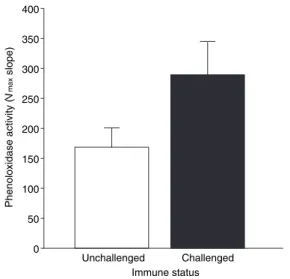
The phenoloxidase activity in immune insulted males was significantly higher than the activity in control males (t28¼2.17,P< 0.05, Fig. 3).
Discussion
Our results show that female beetles prefer male, rather than female odours adsorbed onto filter paper discs. Moreover, males that received an immune insult pro-duced more attractive odours and show higher phenol-oxidase activity. This pattern of attractiveness was not shown in female treatments.
These results produce two important insights into the pheromone signalling system of T. molitor. First, they suggest femaleT. molitorare attracted to gender-specific stimuli adsorbed onto filter paper rather than specifically to aggregation pheromones (see Hurd & Fogo, 1991). Second the results clearly show filter-paper discs exposed to implant-challenged males were significantly more attractive to females than filter paper discs from unchallenged males. The fact that this result is not duplicated in the female group suggests it is related to the production of sex-pheromones rather than aggregation pheromones.
Producing an immune response to a nylon implant is costly in T. molitor both in the context of short-term resource requirements (Siva-Jothy & Thompson, 2002) and in a life-history sense [survivorship is 15% lower in challenged beetles (Armitage et al., 2003)]. So why did males that produced this costly physiological response become more attractive than immunologically naı¨ve, healthy individuals? The most parsimonious explanation
is that males faced with a large haemocoelic immune challenge ‘perceive’ it to be a survivorship threat and, under this circumstance increase resource allocation to reproductive effort (pheromone production) in a last ditch attempt to gain fitness. This is essentially a form of ‘terminal investment’ (see Clutton-Brock, 1984). A host suffering from an infection that will affect its’ survival probability should preferentially allocate resources towards reproduction and in this way reduce the costs of parasitism. Elevated reproductive effort in animals infected with pathogens that reduce host survival is well documented. For example, snails infected with a castra-ting schistosome increase egg laying before they are sterilised (Thornhill et al., 1986), whilst mite-infested maleDrosophila nigrospiraculaincrease courtship activity (Polak & Starmer, 1998).Tenebrio molitoradults have also been studied in the context of infections with real parasites where insult has been shown to depresses pheromone production (Hurd & Parry, 1991; Worden
et al., 2000). There are several nonexclusive explanations for the difference between the outcome of studies using real parasites and ours. First, Worden et al. (2000) examined the effects of parasites over a period of 2 weeks, rather than 2 days. Consequently the effect they observed may have been based on greater depleted energy reserves. Second, Worden et al. (2000) did not control for the reduced nutritional consequences of ‘worm-infected’ relative to ‘uninfected’ beetles. Since starvation results in the down-regulation of sex phero-mone production (Rantalaet al., 2003) and the immune response (Siva-Jothy & Thompson, 2002) in T. molitor
Worden et al.’s(2000) protocol may have obscured the effects we report from ourad libitumfed beetles. Third, the difference in host response to real, as opposed to synthetic, parasites is that the former can manipulate the host to its own benefit (e.g. Poulin, 1994; Hoeg, 1995) whilst the later patently cannot. Males of the amphipod
Corophium volutator increase their investment in repro-duction on infection by the trematodeGynaecotyla adunca. This increase is prior to a reduction in reproductive effort resulting from behavioural manipulation by the parasite (McCurdyet al., 2000).
In addition to showing an example of terminal invest-ment in response to a survival threat, these results have a bearing on studies seeking to confirm Hamilton & Zuk’s (1982) work on parasite-mediated sexual selection. This theory predicts that sexual signalling (i.e. attractiveness) should honestly reflect an individual’s ability to resist parasites. A common assumption arising from this pre-diction is that individuals showing greater levels of immune function and attractiveness are of higher ‘qual-ity’ than individuals showing lower levels of either trait (see, e.g. Rantalaet al., 2002). Our results show that this assumption can be compromised in organisms that are able to rapidly modulate their attractiveness traits, in this case in response to uncertain survival. The same immune insult that precipitates the increase in attractiveness also Unchallenged Challenged
Immune status 0
50 100 150 200 250 300 350 400
Phenoloxidase activity (
V
max
slope)
Fig. 3 Haemolymph phenoloxidase (PO) activity in immune naı¨ve
male beetles and male beetles that had received an immune challenge 24 h before measuring PO. Bars represent means ± 1 SE,
results in an increase in phenoloxidase activity in the host’s body. Consequently, variation in infection status within a population of hosts could result in a correlation between immune trait expression and measured attract-iveness. This has implications for the interpretation of positive correlations between immune function and attractiveness, which are used as support for parasite-mediated sexual selection theories. The immune-depend-ent phenotypic plasticity in attractiveness we have demonstrated suggests these correlations can also arise from host life-history decisions. In short, our results suggest that in organisms where attractiveness can be modulated in response to survival threats male signals can dishonestly present the male’s current condition.
Acknowledgments
We thank Sophie Armitage, Yannick Moret, Richard Naylor, Klaus Reinhardt, Jens Rolff and two anonymous referees for help, advice and comments that improved the contents of this manuscript. M. T. Siva-Jothy was supported by NERC Grant GR3/12121.
References
Agnew, P., Haussy, C. & Michalakis, Y. 2000. Effectes of density and level competition on selected life history traits of culex pipiens quinqufasciatus (Diptera: Culicidae).J. Med. Entomol.,
37: 762–735.
Andersson, M. 1994. Sexual Selection. Princetown University Press, New Jersey.
Armitage, S.A.O., Thompson, J.J.W., Rolff, J. & Siva-Jothy, M.T. 2003. Examining the costs of induced and constitutive immune investment in Tenebrio molitor. J. Evol. Biol., 16: 1038–1044.
August, C.J. 1971. The role of male and female pheromones in the mating behaviour ofTenebrio molitor.J. Insect Physiol.17: 739–751.
Bateman, A.J. 1948. Intra-sexual selection inDrosophila.Heredity
2: 349–368.
Bhattacharya, A.K., Arneel, J.J. & Waldbauer, G.P. 1970. A method for sexing living pupal and adult yellow mealworms.
Ann. Entomol. Soc. Am.63: 1783.
Clutton-Brock, T.H. 1984. Reproductive effort and terminal investment in iteroparous animals.Am. Nat.123: 212–229. Folstad, I. & Karter, A.J. 1992. Parasites, bright males and the
immunocompetence handicap.Am. Nat.139, 603–622. Hamilton, W.D. & Zuk, M. 1982. Heritable true fitness and bright
birds: a role for parasites?Science218: 384–387.
Happ, G.M. 1969. Multiple sex pheromones of the mealworm beetle,Tenebrio molitor.Nature222: 180–181.
Hoeg, J.T. 1995. The biology and life cycle of the rhizocephala (Cirripedia).J. Mar. Biol. Assoc. UK75: 517–550.
Hurd, H. & Fogo, S. 1991. Changes induced by Hymenolepis diminuta(Cestoda) in the behaviour of the intermediate host
Tenebrio molitor(Coleoptera).Can. J. Zool.69: 2291–2294. Hurd, H. & Parry, G. 1991. Metacestode-induced depression of
the production of, and responses to, sex pheromone in the intermediate hostTenebrio molitor.J. Invert. Pathol.58: 82–87. McCurdy, D.G., Forbes, M.R. & Boates, J.S. 2000. Male amphipods increase their mating effort before behavioural manipulation by trematodes.Can. J. Zool.78: 606–612. Menon, M. 1976. Hormone-pheromone relationships in the
beetle,Tenebrio molitor.J. Insect Physiol.16: 1123–1139. Polak, M. & Starmer, W.T. 1998. Parasite-induced risk of
mortality elevates reproductive effort in maleDrosophila.Proc. R. Soc. Lond. B265: 2197–2201.
Poulin, R. 1994. The evolution of parasite manipulation of host behaviour: a theoretical analysis.Parasitology109: 109–118. Rantala, M.J., Jokinen, I., Kortet, R., Vainikka, A. & Suhonen, J.
2002. Do pheromones reveal male immunocompetence?Proc. R. Soc. Lond. B269: 1681–1685.
Rantala, M.J., Kortet, R., Kotiaho, J.S., Vainikka, A. & Suhonen, J. 2003. Condition dependence of pheromones and immune function in the grain beetle Tenebrio molitor. Funct. Ecol. 17: 534–540.
Sheldon, B.C. & Verhulst, S. 1996. Ecological immunology: costly parasite defences and trade-offs in evolutionary ecology.
Trends Ecol. Evol.11: 317–321.
Siva-Jothy, M.T. 2000. A mechanistic link between parasite resistance and expression of a sexually selected trait in a damselfly.Proc. R. Soc. Lond. B267: 2523–2527.
Siva-Jothy, M.T. & Thompson, J.J.W. 2002. Short term nutrient deprivation affects immune function. Physiol. Entomol. 27: 206–212.
Sugumaran, M. 2002. Comparative biochemistry of eumelano-genesis and the protective roles of phenoloxidase and melanin in insects.Pigment Cell Res.15: 2–9.
Thornhill, J.A., Jones, J.A. & Kusel, J.R. 1986. Increased oviposition and growth in immatureBiompalaria glabrataafter exposure toSchistostoma mansoni.Parasitology93: 443–450. Wilkinson, G.S., Kahler, H. & Baker, R.H. 1998. Evolution of
female mating preferences in stalk-eyed flies.Behav. Ecol.9: 525–533.
Worden, B.D., Parker, P.G. & Pappas, P.W. 2000. Parasites reduce attractiveness and reproductive success in male grain beetles.Anim. Behav.59: 543–550.
Received 12 April 2005; revised 28 July 2005; accepted 6 September 2005