Performance reporting( status reporting)
2)Project metrics: Software Ref.[4] metrics.doc Measurement, Size-Oriented
Metrics, Function-Oriented Metrics, Reconciling LOC and FP Metrics
3)Earned value Analysis Ref.[1] Page 186 -187 4)Communication Techniques or Ref.[2] page 65,66 ,41,178 approaches: Formal, impersonal
approaches, Formal, interpersonal procedures, Informal, interpersonal procedures, Electronic communication, Interpersonal networking
Risk management and change 5)Project Recovery: 5 actions Ref.[3] Project Recovery
control Strategies.pdf
6)Risk management: Risk Ref.[2] page 308-315 identification, Risk analysis, Risk
mitigation
7)Change control: software Ref.[2] page 112-117 configuration, controlling
versions, controlling changes, Auditing, communication changes, Guidelines for effective configuration management
8)Migration: Software Ref.[2] page 404-409 implementation,
implementation prerequisite, key implementation plan, implementation activities,
9)Post project Review: Post Ref.[2] page 411 mortem
10)Closing: project wind-Up Ref.[2] page 410 Reference:
1. EBookPressman__Software_Engineering.pdf 2. Software Project Management handouts.pdf 3. Project Recovery Strategies.pdf
1.
Controlling Process
Ensuring that project objectives are met by monitoring and measuring progress and taking corrective measures when necessary.
Project performance must be monitored and measured regularly to identify variances from the plan. Variances are fed into the control processes in the various knowledge areas. To the extent that significant variances are
observed (i.e., those that jeopardize the project objectives), adjustments to the plan are made by repeating the appropriate project planning processes. For example, a missed activity finish date may require adjustments to the current staffing plan, reliance on overtime, or tradeoffs between budget and schedule objectives.
Controlling also includes taking preventive action in anticipation of possible problems.
⇒Controlling Process Tasks 1. Integrated Change Control 2. Scope Verification
3. Scope Change Control 4. Schedule Control 5. Cost Control 6. Quality Control
7. Performance Reporting 8. Risk Response Control
The controlling process group contains core processes and facilitating processes.
1. Integrated Change Control —coordinating changes across the entire project.
2. Scope Verification—formalizing acceptance of the project scope.
3. Scope Change Control—controlling changes to project scope.
4. Schedule Control—controlling changes to the project schedule.
6. Quality Control—monitoring specific project results to determine if they comply with relevant quality standards and identifying ways to eliminate causes of unsatisfactory performance.
7. Performance Reporting—collecting and disseminating performance information. This includes status reporting, progress measurement, and forecasting.
8. Risk Response Control—keeping track of identified risks, monitoring residual risks and identifying new risks, ensuring the execution of risk plans, and evaluating their effectiveness in reducing risk.
3.9 Closing Process
Formalizing acceptance of the project or phase and bringing it to an orderly end.
⇒Closing Process Tasks
Contract Closeout —completion and settlement of the contract, including resolution of any open items.
Administrative Closure—generating, gathering, and disseminating
information to formalize phase or project completion, including evaluating the project and compiling lessons learned for use in planning future projects or phases.
2.
Process and Project Metrics
OverviewSoftware process and project metrics are quantitative measures that enable software engineers to gain insight into the efficiency of the software process and the projects conducted using the process framework. In software project management, we are primarily concerned with productivity and quality metrics. There are four reasons for measuring software processes, products, and resources (to characterize, to evaluate, to predict, and to improve).
Process and Project Metrics:
Metrics should be collected so that process and product indicators can be ascertained
Process metrics used to provide indictors that lead to long term process improvement
Project metrics enable project manager to o Assess status of ongoing project o Track potential risks
o Uncover problem are before they go critical o Adjust work flow or tasks
o Evaluate the project team’s ability to control quality of software
work products
Process Metrics:
Private process metrics (e.g. defect rates by individual or module) are only known to by the individual or team concerned.
Public process metrics enable organizations to make strategic changes to improve the software process.
Statistical software process improvement helps and organization to discover where they are strong and where they are week.
Statistical Process Control:
1.
Errors are categorized by their origin2.
Record cost to correct each error and defect3.
Count number of errors and defects in each category4.
Overall cost of errors and defects computed for each category5.
Identify category with greatest cost to organization6.
Develop plans to eliminate the most costly class of errors and defects or at least reduce their frequencyProject Metrics:
A software team can use software project metrics to adapt project workflow and technical activities.
Project metrics are used to avoid development schedule delays, to mitigate potential risks, and to assess product quality on an on-going basis.
Every project should measure its inputs (resources), outputs (deliverables), and results (effectiveness of deliverables).
Software Measurement:
Direct process measures include cost and effort.
Direct process measures include lines of code (LOC), execution speed, memory size, defects reported over some time period.
Indirect product measures examine the quality of the software product itself (e.g. functionality, complexity, efficiency, reliability,
Size-Oriented Metrics:
Derived by normalizing (dividing) any direct measure (e.g. defects or human effort) associated with the product or project by LOC.
Size oriented metrics are widely used but their validity and applicability is widely debated.
Function-Oriented Metrics:
Function points are computed from direct measures of the information domain of a business software application and assessment of its
complexity.
Once computed function points are used like LOC to normalize measures for software productivity, quality, and other attributes. The relationship of LOC and function points depends on the language
used to implement the software.
Reconciling LOC and FP Metrics:
The relationship between lines of code and function points depends upon the programming language that is used to implement the software and the quality of the design
Function points and LOC-based metrics have been found to be
relatively accurate predictors of software development effort and cost Using LOC and FP for estimation a historical baseline of information
Object-Oriented Metrics:
Number of scenario scripts (NSS) Number of key classes (NKC)
Number of support classes (e.g. UI classes, database access classes, computations classes, etc.)
Average number of support classes per key class Number of subsystems (NSUB)
Use Case-Oriented Metrics:
Describe (indirectly) user-visible functions and features in language independent manner
Number of use case is directly proportional to LOC size of application and number of test cases needed
However use cases do not come in standard sizes and use as a normalization measure is suspect
Use case points have been suggested as a mechanism for estimating effort
Web App Project Metrics:
Number of static Web pages (Nsp) Number of dynamic Web pages (Ndp)
Customization index: C = Nsp / (Ndp + Nsp) Number of internal page links
Number of persistent data objects Number of external systems interfaced Number of static content objects
Number of dynamic content objects Number of executable functions
Software Quality Metrics:
Factors assessing software quality come from three distinct points of view (product operation, product revision, product modification). Software quality factors requiring measures include
o correctness (defects per KLOC)
o maintainability (mean time to change) o integrity (threat and security)
o usability (easy to learn, easy to use, productivity increase, user attitude)
Defect removal efficiency (DRE) is a measure of the filtering ability of the quality assurance and control activities as they are applied through out the process framework
DRE = E / (E + D)
E = number of errors found before delivery of work product D= number of defects found after work product delivery
Integrating Metrics with Software Process:
Many software developers do not collect measures.
Without measurement it is impossible to determine whether a process is improving or not.
Baseline metrics data should be collected from a large, representative sampling of past software projects.
Getting this historic project data is very difficult, if the previous developers did not collect data in an on-going manner.
Arguments for Software Metrics:
If you don’t measure you have no way of determining any
By requesting and evaluating productivity and quality measures software teams can establish meaningful goals for process improvement
Software project managers are concerned with developing project estimates, producing high quality systems, and delivering product on time
Using measurement to establish a project baseline helps to make project managers tasks possible
Baselines:
Establishing a metrics baseline can benefit portions of the process, project, and product levels
Baseline data must often be collected by historical investigation of past project (better to collect while projects are on-going)
To be effective the baseline data needs to have the following attributes:
o data must be reasonably accurate, not guesstimates o data should be collected for as many projects as possible o measures must be consistent
o applications should be similar to work that is to be estimated
Metrics for Small Organizations:
Most software organizations have fewer than 20 software engineers. Best advice is to choose simple metrics that provide value to the
organization and don’t require a lot of effort to collect.
Even small groups can expect a significant return on the investment required to collect metrics, if this activity leads to process
Establishing a Software Metrics Program
1.
Identify business goals2.
Identify what you want to know3.
Identify sub goals4.
Identify sub goal entities and attributes5.
Formalize measurement goals6.
Identify quantifiable questions and indicators related to sub goals7.
Identify data elements needed to be collected to construct the indicators8.
Define measures to be used and create operational definitions for them9.
Identify actions needed to implement the measures3.
EARNED VALUE ANALYSIS
In Section 7.7.2, we discussed a number of qualitative approaches to project tracking. Each provides the project manager with an indication of progress, but an assessment of the information provided is somewhat subjective. It is reasonable to ask whether there is a quantitative
technique for assessing progress as the software team progresses through the work tasks allocated to the project schedule. In fact, a technique for performing quantitative analysis of progress does exist. It is called earned value analysis (EVA).
Humphrey [HUM95] discusses earned value in the following manner: The earned value system provides a common value scale for every [software project] task, regardless of the type of work being performed. The total hours to do the whole project are estimated, and every task is given an earned value based on its estimated percentage of the total. Stated even more simply, earned value is a measure of progress. It enables us to assess the “percent of completeness” of a project using quantitative analysis rather than rely on a gut feeling. In fact, Fleming and Koppleman [FLE98] argue that earned value analysis “provides accurate and reliable readings of performance from as early as 15 percent into the project.”
To determine the earned value, the following steps are performed:
1. The budgeted cost of work scheduled (BCWS) is determined for each work task represented in the schedule. During the estimation activity (Chapter 5), the work (in person-hours or person-days) of each software
engineering task is planned. Hence, BCWS is the effort planned for work task i. To determine progress at a given point along the project schedule, the value of BCWS is the sum of the BCWS values for all work tasks that should have been completed by that point in time on the project schedule. 2. The BCWS values for all work tasks are summed to derive the budget at completion, BAC. Hence,
BAC = (BCWS) for all tasks k
3.
Next, the value for budgeted cost of work performed (BCWP) is computed. The value for BCWP is the sum of the BCWS values for all work tasks that have actually been completed by a point in time on the project schedule. Wilkens [WIL99] notes that “the distinction between the BCWS and the BCWP is that the former represents the budget of the activities that were planned to be completed and the latter represents the budget of the activities that actually were completed.” Given values for BCWS, BAC, and BCWP, important progress indicators can be computed:Schedule performance index, SPI = BCWP/BCWS Schedule variance, SV = BCWP – BCWS
SPI is an indication of the efficiency with which the project is utilizing scheduled resources. An SPI value close to 1.0 indicates efficient execution of the project schedule. SV is simply an absolute indication of variance from the planned schedule.
Percent scheduled for completion = BCWS/BAC
provides an indication of the percentage of work that should have been completed by time t.
provides a quantitative indication of the percent of completeness of the project at a given point in time, t.
It is also possible to compute the actual cost of work performed, ACWP. The value for ACWP is the sum of the effort actually
expended on work tasks that have been completed by a point in time on the project schedule. It is then possible to compute
Cost performance index, CPI = BCWP/ACWP Cost variance, CV = BCWP – ACWP
A CPI value close to 1.0 provides a strong indication that the project is within its defined budget. CV is an absolute indication of cost savings (against planned costs) or shortfall at a particular stage of a project.
Like over-the-horizon radar, earned value analysis illuminates
scheduling difficulties before they might otherwise be apparent. This enables the software project manager to take corrective action before a project crisis develops.
4.
Communication techniques or approaches
Project status meetings
Project status meetings should be held periodically, usually once a week. A good time for status meetings is either at the end of the last day of the week, or at the beginning of the first day of the week. Status meetings also
contribute to the atmosphere of order and control within the project, and should be held regularly, at a fixed time. Participants who cannot participate in the project status meeting may, with the project manager's approval, delegate participation to another member of their team.
The project manager prepares for the status meeting by reviewing the status reports submitted by the key project members (particularly scrutinizing the problem section). Therefore the status reports should be submitted at least two to three hours before the status meeting. Project status meetings are attended by the key project members. The meeting begins with a report of project activities and general issues by the project manager. Then each
participant should be given about five to ten minutes to report on the activity of his or her team or area of responsibility. The discussion of problems should not be restricted to the person reporting the problem and the project manager. All problems may be addressed by all participants, with possible assistance offered between team leaders, thus making their experience available throughout the project. It is not the project manager's role to provide solutions to the problems, but rather to guide the team members toward solutions.
Solutions should be worked out whenever possible during the status
meeting. Any problem not resolved within five minutes should be postponed for discussion by the relevant parties after the status meeting. The
proceedings of all project status meetings must be recorded. Verbatim minutes are not required, though the following items should appear in the record:
1. Date of meeting 2. Name of meeting
3. Present (list of participants)
4. Absent (list of absent invited participants)
5. Action items (name, action, and date for completion) 6. Major decisions and items discussed
The record of the project status meeting should be typed and distributed as soon as possible, but no later than by the end of the day. This is particularly important when there are action items to be completed on the same day. When the project is sufficiently large to justify a secretary, then the record will be taken and typed by the secretary. In smaller projects, the project manager can rotate this task each week between the participants.
Software Project Management Framework
You all know that a project is much more than a collection of
methodologies, tasks, resources, and reviews. A project is a synchronized event where there is perfect harmony and understanding between the participants. The participants are equipped with the essential skills of planning, cooperating, helping, and communicating. However, the most important activity here is to orchestrate the movement of the participants.
The onus lies with the project manager to synchronize the activities of the project to result in a perfect presentation.
Although each project manager has a unique style of functioning, there are some fundamental approaches that guide a project manager. These
approaches are traditional project management concepts and software engineering concepts. To understand software projects and their dynamics, you must be aware of the environment in which a software project is
executed. This further requires an understanding of the larger framework of software project management.
In this chapter, you will learn to, build a connection between traditional project management concepts and software engineering concepts. Both traditional and software projects share the same methodologies, techniques, and processes.
However, managing software projects requires a distinct approach. In this, chapter, you will learn to apply traditional project management principles to software projects. Further, you will learn about the responsibilities of a software project manager. You will also learn about the phases in a software project and the activities within each phase. Finally, the chapter will provide you an overview of the problems that affect a software project and the myths prevalent about software project management.
Software Development Life Cycle (SDLC)
The development of a software project consists of many activities spread across multiple phases. Dividing a software project into phases helps you in
managing the complexities and uncertainties involved in the software project.
Phases of a Software project
Each phase represents the development of either a part of the software product or something associated with the software project, such as user manual or testing.
Each phase is composed of various activities. You can consider a phase complete when all activities are complete.
Project Communications Management
Project Communications Management includes the processes required to ensure timely and appropriate generation, collection, dissemination, storage, and ultimate disposition of project information. It provides the critical links among people, ideas, and information that are necessary for success.
Everyone involved in the project must be prepared to send and receive communications, and must understand how the communications in which they are involved as individuals affect the project as a whole.
Major processes include:
� Communications Planning—determining the information and
communications needs of the stakeholders: who needs what information, when they will need it, and how it will be given to them.
� Information Distribution—making needed information available to project stakeholders in a timely manner.
� Performance Reporting—collecting and disseminating performance information. This includes status reporting, progress measurement, and forecasting.
� Administrative Closure—generating, gathering, and disseminating information to formalize a phase or project completion.
These processes interact with each other and with the processes in the other knowledge areas as well. Each process may involve effort from one or more individuals or groups of individuals, based on the needs of the project. Each process generally occurs at least once in every project phase.
Communicating is a broader subject and involves a substantial body of knowledge that is not unique to the project context. For example:
Sender-receiver models—feedback loops, barriers to communications, etc.
Choice of media—when to communicate in writing versus when to communicate orally, when to write an informal memo versus when to write a formal report, etc.
Writing style—active versus passive voice, sentence structure, word choice, etc.
Presentation techniques—body language, design of visual aids, etc. Meeting management techniques—preparing an agenda, dealing
Communications management plan
A communications management plan is a document that provides:
• A collection and filing structure that details what methods will be used to gather and store various types of information. Procedures should also cover collecting and disseminating updates and corrections to previously
distributed material.
• A distribution structure that, details to whom information (status reports, data, schedule, technical documentation, etc.) will flow, and what methods (written reports, meetings, etc.) will be used to distribute various types of information.
This structure must be compatible with the responsibilities and reporting relationships described by the project organization chart.
• A description of the information to be distributed, including format, content, level of detail, and conventions/definitions to be used.
• Production schedules showing when each type of communication will be produced.
• Methods for accessing information between scheduled communications. • A method for updating and refining the communications management plan as the project progresses and develops. The communications management plan may be formal or informal, highly detailed or broadly framed, based on the needs of the project. It is a subsidiary component of the overall project plan.
5.
Project Recovery
Strategies for Project Recovery
WHAT’S AT STAKE?
The statistics regarding project failure are sobering. According to
this survey, firms on average manage $200 million in projects
each year. During that time these organizations will realize that
$74 million of their projects are at risk of failing.
About the Survey
Whether a troubled project ultimately succeeds or fails depends on the effectiveness of the actions taken to recover the project. Before these actions can be taken, however, organizations need to be able to recognize problems and prepare to take appropriate corrective measures. PM Solutions has conducted this benchmark of current practices in recovering troubled projects to help identify the factors that may lead to the development of strategies for successful project recovery:
» Can troubled projects be recovered, or are they doomed to fail? » What are the root causes of troubled projects?
» What is their cost to organizations?
» What do firms do, exactly, to successfully recover troubled projects?
About the Respondents
» Roles of Respondents: C-Level (11%), VP or Director-Level Business Management (6%), VP or Director-Level Program/Project Management (11%), Head of PMO (23%), Program/Project Manager (42%), Other (7%)
» Size of Organization: Large (39%), Mid-sized (25%), Small (36%) » Industries: Professional & Technical Services (23%), Manufacturing (13%), Information (13%), Finance & Insurance (12%), Healthcare & Social Services (7%), Utilities (7%), Public Administration (6%), Education (5%), Other (15%)
The statistics regarding troubled projects are sobering. According to this survey, firms on average manage $200 million in projects each year; and, in the course of that year, these organizations will realize that more than a third of their projects—$74 million worth—are at risk of failing. Jobs, and maybe the business itself, may be in jeopardy if nothing is done to mitigate the risks and actively attempt to recover these troubled projects.
Our research shows that when organizations take actions to recover troubled projects, they are highly successful. Almost three quarters (74%) of the troubled projects that underwent a recovery intervention in the past three years were recovered. In addition, 18% of these projects have recovery efforts that are still ongoing; the successful completion of these projects should boost the percentage of recovered projects substantially.
While there are many factors that enter into the success of project
recovery efforts, the research shows that the project manager is one of the most important. The project manager can play a significant role in
addressing the causes of troubled projects as well as in effectively managing the process to recover them.
» The project manager has the most influence in being able to proactively address the causes of troubled projects cited in the research to help mitigate the risks if not eliminate them altogether.
» It is usually the project manager who is responsible for taking the actions that successfully recover troubled projects.
» Survey respondents state unequivocally that the project manager was very important to the success of their project recoveries.
We hope you will use the results of this benchmark of current practices to help you design strategies to mitigate project risk and improve your
likelihood of success in recovering your troubled projects. In particular, these results address:
» The cost of troubled projects to organizations—how much money your
organization might lose if they don’t incorporate the practices of more
successful firms.
» The root causes of troubled projects—practices you need to focus your efforts on improving.
» The key success factors in recovering troubled projects—what’s working for other organizations.
Projects at Risk
Organizations spend a lot of money on projects. The average firm closed $200 million in projects last year (155 projects at $1.3 million per project on
average for each firm). And more than a third of these projects were troubled. Significant factors that affected the likelihood of success in recovering these troubled projects include whether the firm had a standard project management methodology or a project recovery process, the size of the firm, and the industry of the firm.
» Size of firm had a significant influence on the number of projects closed and the average cost per project. On average, small firms closed 68
projects, $.2 million per project; mid-size firms closed 103 projects, $1.2 million per project; large firms closed 287 projects, $1.6 million per project.
More than a third (37%) of those projects were troubled and at risk of failure. That means $74 million in projects were at risk of failure for each firm, on average.
» 12% of these projects failed ($24 million per firm on average). » 25% or these projects were recovered ($50 million per firm).
» Large firms had a significantly higher percentage of recovered projects than small and mid-size firms (32% of large firm projects vs. 22% for small firms and 18% for mid-size firms).
The Good News. Project recoveries are common. Nearly three quarters (72%) of firms surveyed had a project recovery intervention in the past three years.
» Information firms (90%) were far more likely to have had a project recovery intervention than finance (75%), manufacturing (71%), and professional services (62%) firms.
The projects undertaken by firms are fairly evenly distributed regarding their complexity—19% very complex, 31% complex, 26% somewhat complex, and 25% not very complex. Project complexity was not cited as a major cause of troubled projects and had no bearing on project recovery or project failure either.
The Positive Influence of Processes
Almost a quarter (22%) of the firms surveyed do not have a standard project management methodology for managing their projects.
» Small firms were the least likely to have a standard methodology (30% had no PM methodology); large firms were the most likely (only 18% were without a PM methodology), which may be why they had the highest percentage of projects that were recovered).
» Firms without a standard project management methodology saw a significantly higher percentage of project failures than those with (21% vs. 9%). They also had a significantly lower percentage of project successes than those with a PM methodology (43% vs. 61%). A third of the firms surveyed (32%) have no process, either formal or informal, for recovering troubled projects.
» Small firms were the least likely to have a process (40% had no process for recovering troubled projects).
» Manufacturing firms were the most likely to have a process (only 19% had no process for recovering troubled projects, compared with 35% of
professional services firms, 30% of finance firms, and 29% of information firms).
» Firms without a troubled project recovery process, either formal or informal, saw a significantly higher percentage of project failures than those with (20% vs. 6%).
Causes of Troubled Projects
A common thread in addressing the major causes of troubled projects is the ability of the project manager to effectively deal with these issues, mitigate some of the risk in these areas, and be a strong enough leader to stand up to senior management or go to bat to manage expectations and resources. The top five causes of troubled projects were:
1. Requirements: Unclear, lack of agreement, lack of priority, contradictory, ambiguous, imprecise.
2. Resources: Lack of resources, resource conflicts, turnover of key resources, poor planning.
3. Schedules: Too tight, unrealistic, and overly optimistic.
4. Planning: Based on insufficient data, missing items, insufficient details, and poor estimates.
5. Risks: Unidentified or assumed, not managed.
» In small firms, project governance (lacking, ineffective, different
priorities, no clear involvement) is one of the top five causes of troubled projects; planning drops off the list.
» The extent to which firms were challenged by these causes of troubled projects was far greater for firms with no standard project management methodology than those with Project Recovery
Although it is usually senior management that makes the decision to actively intervene in a troubled project to recover it, it’s the project manager who usually leads the execution of the recovery process. In fact, the project manager is often replaced with a new project manager or consultant,
someone more experienced to head the recovery effort. In any case, project recoveries are highly successful once firms decide to focus on addressing the issues that caused the project to become troubled in the first place.
» In half of the firms surveyed, it’s senior management who decides to implement a project recovery intervention; in fewer instances it’s the sponsor (16%), the PMO (16%) or the project manager (13%).
» In small firms, the sponsor (24%) or project manager (24%) is more likely to decide to implement the recovery intervention than in larger firms. In small firms it’s seldom a PMO (5%).
The top five actions most often taken in a project recovery intervention are: » Improving communication, stakeholder management (62%).
» Redefining the project—reducing the scope, re-justifying the project financially (60%).
» Adding and/or removing resources (58%). » Resolving problematic technical issues (49%).
» Replacing the project manager or bringing in a consultant to manage recovery (36%).
Firms without a standard project management methodology were far more likely to replace the project manager from outside the organization than those with a methodology (22% vs. 9%). They were also more likely to
bring in a consultant to manage the project recovery intervention (26% vs. 11%).
Project recovery interventions are highly successful. Almost three quarters (74%) of the troubled projects that underwent a recovery intervention were recovered, and many projects (18%) are still ongoing, so the results are not yet known. Only 4% of the projects failed (with another 3% terminated for business reasons).
Obstacles to project recovery are generally related to the original root causes of the trouble. Obstacles most often cited include:
» Getting stakeholders to accept the changes needed to bring the projects back on track—whether they are changes in scope, budget, resources, etc. » Poor communication and stakeholder engagement; lack of clarity and trust.
» Conflicting priorities and politics.
» Finding enough qualified resources needed to complete the projects. » Lack of a process or methodology to help bring the project back on track.
Key Success Factors
The Project Manager. The project manager is clearly one of the most important factors in the success of project recovery efforts. Almost all organizations surveyed (92%) rated the skill and knowledge of the project manager very important (64%) or important (28%) to the success of the recovery.
As cited earlier, it’s usually the project manager who is responsible for
effective project manager can play a significant role in mitigating or eliminating the causes of troubled projects.
Firms without a standard project management methodology were less likely to value the skill and knowledge of the project manager than those with (78% of firms without a methodology saw the PM as important or very important vs. 96% of firms with a methodology).
Other key success factors cited most often by firms include:
» Bringing in highly experienced program/project managers and giving them the clear authority to implement the changes needed.
» Adding additional, qualified resources. » Increasing the budget.
» Open communication, including clarifying expectations and rebuilding commitment from key stakeholders.
6.
Risk Management Process
Project Risk Management includes the processes concerned with conducting risk management planning, identification, analysis, responses, and control on a project. The objectives of Risk Management are to increase the probability and impacts of positive events and decrease the probability and impacts of events adverse to project objectives.
The process of risk management begins during the analysis phase of
software development life cycle. However, the actual process of managing risks continues throughout the product development phase. Risk
management is a dynamic process because it deals with the activities that are yet to happen. Risk management has a twofold agenda. First, deciding
actions for preventing risks from happening, and second, deciding actions for tackling risks that materialize. Therefore, risk management is all about pre-empting a risk, coming up with a plan for resolving the risk, and finally executing the plan.
Figure 6.1 displays the steps of the risk management process. Formally, articulated, risk management process consists of three steps:
1. Risk identification 2. Risk analysis 3. Risk mitigation
Figure 6.1: Risk Management Process
Risk Identification
In this step, the project manager gathers information about the potential risks in the project. The project manager plans the strategies for avoiding risks or controlling them.
The project team conducts brainstorming sessions and discussions among team members about the requirements document. They discuss the available technology, manpower, prevailing environment, and all project-related factors. The project manager picks up the thread from these and creates a risk log. After the risk log is prepared, the project manager calls a meeting within the team and technical experts to discuss the risk log and the
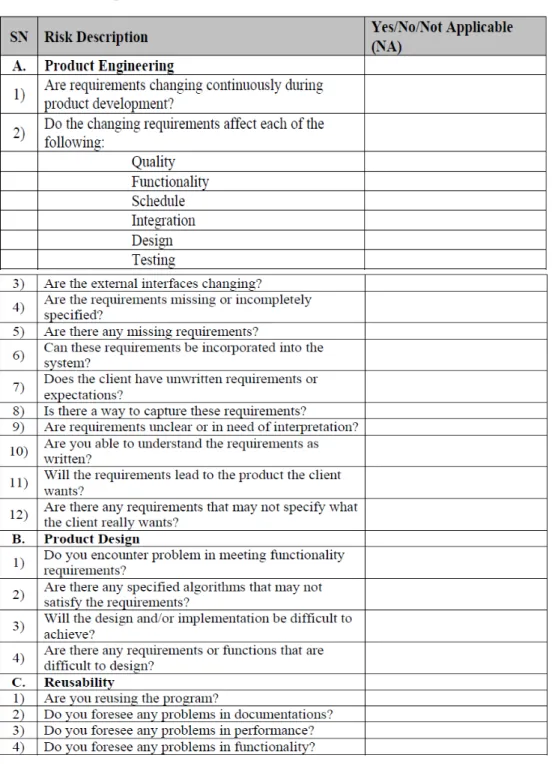
mitigation plans. An effective way of identifying' risks is using a questionnaire.
Table 6.1: Sample Risk Identification Questionnaire
The sample questionnaire in Table 6.1 includes an exhaustive list of risks that might be encountered during the progress of a project. The answers to the questions in the risk identification questionnaire enable the project manager to estimate the impact of risks. In the sample questionnaire Table
6.1, the risks are categorized under product engineering, product-design, and reusability. From this table, you obtain a list of risks that are relevant to each category. You compare the information obtained from this table with past results and estimate the criticality of risk. In short, during risk identification, you obtain answers to the following queries:
• Why is the risk important?
• What information is needed to track the status of the risk? • Who is responsible for the risk management activity? • What resources are needed to perform the activity?
• What is the detailed plan to improve the risk and / or mitigate it?
Risk Analysis
After identifying the risks, the project manager needs to analyze the risks. Uncertainty and loss are the two characteristics of risk. The uncertainty factor in risk means that the unknown event mayor may not happen. While analyzing risks, the project manager needs to quantify the level of
uncertainty and the degree of loss. Based on this, the project manager plans schedules and costs. During analysis, information on risk is converted into information on decision-making. Analysis provides the basis for the project manager to work on the “right” risks.
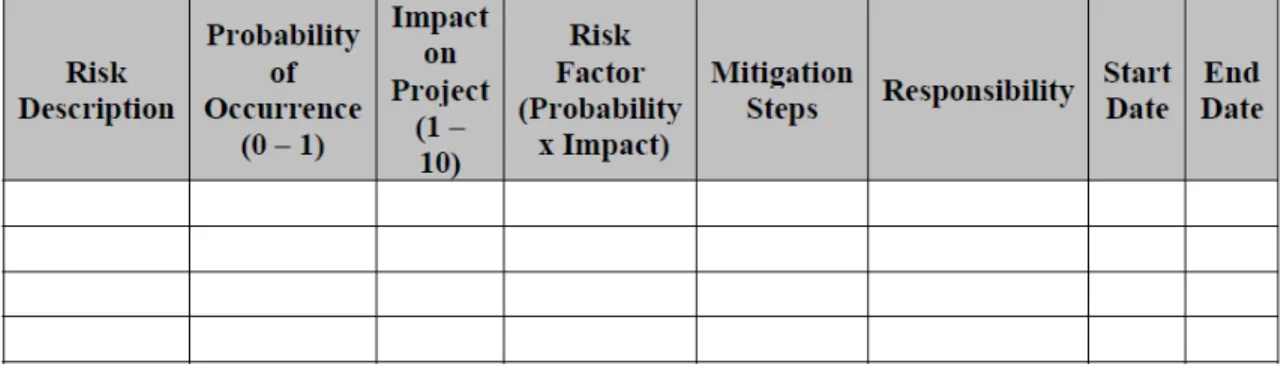
Table 6.2 displays a risk analysis format. There are various tasks involved in risk analysis. First, the WBS elements are identified. One of the tasks in the risk analysis phase is to describe the risk. The risk can be product-related, process-related, organization-related, client-related, or infrastructure-related. Second, the WBS elements are evaluated to determine the risk events. Then the project manager quantifies the probability of occurrence of risk. The project manager can assign probability values between 0 and 1. For example, a risk with a low probability of occurrence is marked 0.2 while that with a high probability of occurrence is marked 0.8.
The reason why a particular risk has a high or low probability depends on the actual circumstance of the project.
Third, the risks are rated depending on their probability of occurrence. Based on the probability of risk, the project manager identifies the impact of the risk. The impact of risk on cost, schedule, and quantity needs to be
calculated and graded. The impact of risk can be graded on a scale of 1 to 10, 1 being the lowest, and 10 being the highest.
Then the risk factor is calculated by multiplying the probability of risk and the impact of risk. Finally, each risk is prioritized relative to other risks. The risk factor is used to prioritize the identified risks. For example, the risk with a probability value 0.1 and an impact value 2 will have minimal impact. While risks close to probability value 0.8 and with an impact value 9 will have greater impact. Therefore, the project manager can prioritize risks based on the probability and the impact of risks. A risk that has a high impact and low probability will not absorb a significant amount of the project manager's time. However, high-impact risks with moderate to high probability will catch the attention of the project manager.
Risk Mitigation
Risk mitigation is the best possible approach adopted by the project manager to avoid risks from occurring. The probability of the risk occurring and the potential impact of the risk can be mitigated by dealing with the problem early in the project. Essentially, risk mitigation involves three possibilities and the project manager needs to adopt a risk mitigation strategy aimed at them. The three possibilities include:
• Risk avoidance • Risk monitoring • Contingency planning Risk Avoidance
To avoid risks from occurring, the project team prepares the risk plan before the commencement of the project. The project team identifies the potential risks and prioritizes them based on their probability of occurrence and impact. Then, the team prepares a plan for managing risks. In most software projects, this plan is popularly called the risk management plan. Table 6.3 displays the format of a risk management plan.
To prepare the risk management plan, the project team first identifies and assesses the risks associated with the project. Then, the probability of
occurrence of each risk is estimated and the possible impact is calculated. In the plan, the probable cost and damage is also quantified. The project team also identifies the contingency plans for all the identified risks. The
contingency plan for each risk is based on the project's defined operational software process. The plan is modified throughout the software development life cycle of the project based on the changes taking place. The contingency plan also includes the cost, in terms of effort, in carrying out the plan. The software risks identified are tracked, reassessed, and re-planned at the end of each phase. The project manager revisits the plan if significant changes are introduced in the software project.
Risk Monitoring
As the project proceeds, risk-monitoring activities commence. It is not
possible to monitor closely all the risks that are identified for the project. For example, if 100 risks are identified for a project, only top 20 risks are
monitored. There are re-planning checkpoints where the information
obtained from monitoring the risks is used to refine the risk assessments and management plan. The project manager monitors the top 20 percent of the factors that may indicate the status of the risks in the project. In the case of large teams, the project manager also needs to monitor the attitude of the team members and their problems. This helps the project manager monitor any possible team-related risks.
Besides monitoring the top 20 percent of the risks, the project manager needs to monitor the mitigation steps also. Consider an example. To ensure that particular software is browser- independent, the software is created on the lowest compatible browser. Such software will work on any browser
thus making it browser-independent. Therefore, mitigating a project risk involves working hard at reducing the possibility that the risk will ever occur. Mitigation includes nearly all actions that a project team takes to overcome risks. For example, choosing a more expensive but proven technology over, a newer, less expensive technology is a step toward mitigating project risks.
Contingency Planning
The possibility of contingency planning arises when mitigation efforts fail and risk becomes a reality. Contingency planning is used to monitor risks and invoke a predetermined response. According to the plan, a trigger is set up. If the trigger is reached, the contingency plan is put into effect.
Contingency planning involves maintaining an alternative plan if the original plan fails. A simple example could be the savings people make for a rainy day. Contingency plans are a must for the top 20 percent of the risks identified. These plans are put to use after the risks become a reality. The importance of contingency planning can be realized from this example. Despite the massive attack on WTC, the stock markets in the US resumed functioning within a few days. This was possible because the finance companies had backed up their data and information on computers
elsewhere. The contingency planning of finance companies prevented the risk of huge data loss for the stock market.
Managing Risks: Case Study
Consider a scenario. Your organization is a vendor of software solutions. A bus transport company the US wants you to develop a Schedule Adherence
system. The team that will develop this software is new and the platform selected for development is also new to your organization. The project team needs to be trained intensively for this.
During this project, the team is expected to manage a large volume of data. The team has never had any experience in managing such a large volume of data. The system also needs to use this data to generate various MIS reports related to delays or adherence of bus services.
The performance requirement is less than fifteen seconds for all popular browsers. Your organization is anticipating numerous requirement changes during the development process. The system needs to be implemented across several states in the country. The data related to the system is highly
confidential because it can provide an edge to the competitors.
Now, as a project manager, you need to prepare a risk management plan for this project.
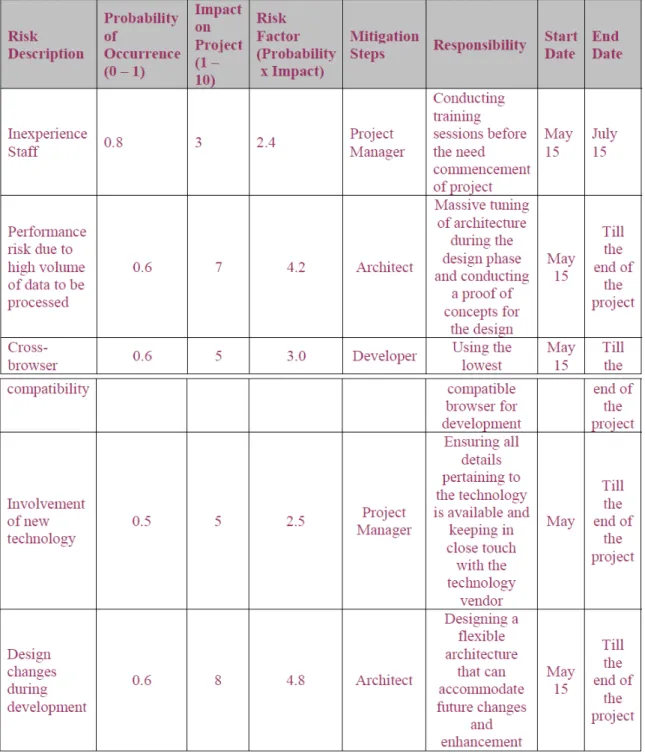
The project starts on May 15 and should be completed on November 15. First, you need to identify the potential risks involved in the project. The potential risks to the project are described in Table 6.4.
After identifying the risks, you need to estimate the probability of their occurrence and their impact on product development. Based on this, you calculate the risk factor and plan the mitigation steps.
Your risk management plan is displayed in Table 6.5.
In Table 6.5, the risk factors with high values are the high priority risks. Here, the high priority risks are design changes during development, performance risk due to high volume of data to be processed, and cross-browser compatibility. The high priority risks need to be monitored closely and continuously. The rest of the risks can be monitored periodically. Certain risks need contingency planning despite being low in the priority list. For example, the risk due to involvement of new technology is a low priority risk.
However, the probability of occurrence of this risk is 0.5, which is fairly high. This calls for contingency planning because you may not be aware of all the details of the new technology. Suppose the system fails to respond if the number of users exceeds a certain number. In such a situation, you need to have a contingency plan ready. You need to with the vendor regarding a workaround for such a situation. The workaround should be ready in the case of failure of the system.
Robert Charette [CHA89] presents a conceptual definition of risk: First, risk concerns future happenings, today and yesterday are beyond active concern, as we are already reaping what was previously sowed by our past actions, The question is, can we, therefore, by changing our actions today, create an opportunity for a different and hopefully better situation for ourselves tomorrow, This means, second, that risk involves change, such as in changes of mind, opinion, actions, or places…[Third] risk involves choice, and the uncertainty that choice itself entails, Thus paradoxically, risk, like death and taxes, is one of the few certainties of life, When risk is
considered in the context of software engineering, Charrette’s three
conceptual underpinnings are always in evidence. The future is our concern – what risks might cause the software project to go awry? Change is our concern -how will changes in customer requirements, development
technologies, target computers, and all other entities connected to the project affect timeliness and overall success? Last, we must grapple with choices - what methods and tools should we use, how many people should be
involved, how much emphasis on quality is "enough"?
What is it? Risk analysis and management are a series of steps that help a software team to understand and manage uncertainty. Many problems can plague a software project A risk is a potential problem - it might happen, it might not But regardless of the outcome, it's a really good idea to identify it, assess its probability of occurrence, estimate its impact, and establish a contingency plan should the problem actually occur.
Who does it? Everyone involved in the software process – managers, software engineers and customers - participate in risk analysis and management.
Why is it important? Think about the Boy Scout motto: "Be prepared" Software is a difficult undertaking. Lots of things can go wrong, and frankly, many often do. It's for this reason that being prepared, understanding the risks and taking preventive measures to avoid or manage them is a key element of good software project management.
What are the steps? Recognizing what can go wrong is the first step, called – risk identification. Next, each risk is analyzed to determine the likelihood that it will occur and the damage that it will do if it does occur. Once this information is established, risks are ranked by probability and impact. Finally, a plan is developed to manage those risks with high probability and high impact.
What is the work product? A risk mitigation monitoring and management (RMMM) plan or a set of risk information sheets is produced.
How do I ensure that I've done it right? The risks that are analyzed and managed should be derived from thorough study of the people, the product, the process and the project. The RMMM should be revisited as the project proceeds to ensure that risks are kept up to date. Contingency plans for risk management should be realistic.
7.
Software Configuration management
a. Controlling VersionsVersion control combines procedures and tools to manage different versions of configuration objects that are created during software product
development. To control versions, you can use Version Control Register. In Version Control Register, you enter the details of components, such as component identification numbers, their versions, and dates of validity. It is advisable to release a baseline after a version is released. Baseline is a specification or a product that is formally reviewed and agreed upon. This serves as the basis for further development. Baseline can be changed only through formal change control procedures. A baseline consists of a set of SCIs that are logically related to each other. Baselines are established when subsequent changes to the SCIs need to be controlled. Version control is essential so that everybody uses only the latest version. Any kind of version mismatch might result in rework.
b. Controlling Changes
Uncontrolled change can lead to chaos. Change control combines human procedures and automated tools to provide a mechanism for controlling change. The purpose of change control is to monitor and control changes in order to baseline SCIs. There are various reasons that trigger changes. A problem report might call for a change. Similarly, suggestions or ideas from brainstorming sessions and feedback from clients can result in change.
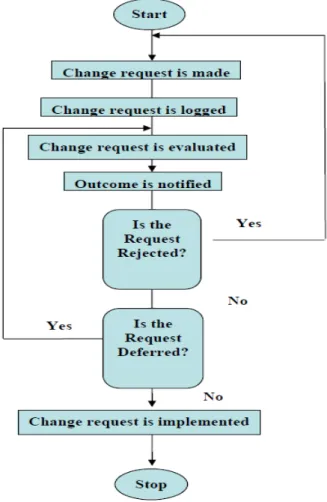
Modifications or addition to functionality and changes in environment can also cause changes. The Figure 1 explains the formal change control process using a flow chart.
Figure 1: Formal Change Control Process
A request for change triggers that change control procedure. Then request is logged in the change request register. Next, the change request number is recorded in the change request evaluation plan. The request is evaluated and analyzed to check if the change is valid. Change request is also evaluated in terms of the number of items affected and the effort involved in effecting the
change. Finally, the possible outcome of the change request is communicated.
The request for change is rejected, deferred, or approved. If the request for change is rejected, the requestor needs to log a fresh request. A deferred change request is evaluated at a later date while the change request that is approved is implemented.
There are tools that provide facilities to check in and check out so that the same version of the object is not updated more than once. The check-in and checkout facilities provide synchronization control. Synchronization control helps to ensure that parallel changes performed by two different people do not overwrite one another.
c. Auditing
Configuration audit is conducted formally by the SQA group in projects where SCM is a formal activity. The identification, version control, and change control tasks help the developer maintain order and decorum in an environment of change. However, the control mechanisms track a change only until an item is generated. FTRs and software configuration audits (SCA) are conducted to ensure that change is properly implemented. FTR verifies the technical correctness of the SCI that is subjected to change. SCA assesses those characteristics of an SCI that are not considered during FTRs. Audit verifies whether the changes specified in the request for change are made and additional modifications, if any, are also noted. Audits ensure that FTRs are conducted to check for technical correctness. Audits verify that changes made are highlighted in the SCI. The change date and change author are specified and the attributes of SCI reflect the change. The SCM
procedures for noting, recording, and reporting change are also followed. Audits also ensure that related SCIs are updated.
d. Communicating Changes
Another task of SCM is communicating changes. This task ensures communication between different members in the project. It notes the activities performed, the time when they are performed, those involved in the activities, and those affected by the activities. In short, the task is all about status reporting. In a large project, there is a possibility of
miscommunication among various people involved in the project. This is usually done using configuration status report shown in Table 11.7. The table contains the name of the SCI, the latest released version, the date of release, brief description of changes performed, and associated change request. Further details of the changes can be obtained from the associated change request. There can be instances where two developers may be trying to modify the same software configurable item with different and conflicting intentions. Absence of status reporting could result in incorrect decisions being taken or important decisions not being communicated. At times, those who should be pointing out the serious side effects caused by a change are not aware of the implementation of the change. There are also instances of version mismatch when teams are unaware of the latest version to be followed. To avoid such hazards due to lack of communication among the project team, changes are communicated among team members. Therefore, status reporting provides information about each change to those who need to know. Software configuration management takes care of changes in a software process. SCM identifies controls, audits, and reports modifications
that occur during software development. SCM helps maintain the integrity of configurable items produced during software development.
⇒Software Configuration Management Vs Software Maintenance
SCM is an integral part of SQA. SCM involves assessing the impact of the changes made during SQA activities and making decisions based on cost and benefit analysis. SCM can be defined as the art of identifying, organizing, and controlling changes in a software project with the objective of
minimizing mistakes. SCM is different from software maintenance.
Software maintenance is required after the software is delivered to the client and is put into operation. As opposed to this, SCM is a set of tracking and controlling activities that begins when a software project begins and ends only when the software is taken out of operation.
⇒Baselines vs. Interim Versions
SCM differentiates between baselines and interim versions. A baseline is a tested and certified version of a system. Baselines can be assigned version numbers such as 1.0, 2.0, 3.0, and so on. A baseline usually undergoes intensive testing. Interim versions, on the other hand, have version numbers, such as 1.1 or 1.2. The interim version is a temporary version. Interim
versions have a short life and survive only during bug fixing, testing, or debugging. However, interim versions also have a unique version number or name. Baselines are more visible with the marketing team and the vendors than the interim versions. However, as part of SCM, all versions of changes are saved, clearly labeled, and archived. Archiving is the process of
maintaining controlled copies of prior versions. Archiving helps in recreating earlier versions in the event of data loss or data corruption.
⇒Effective Configuration Control
Effective configuration control requires effective and well-defined organization. Any configuration control method must be based on the following four concepts:
1. A clearly defined configuration management authority must be established. Configuration control standards, procedures and guidelines must be produced and distributed to the developers. 2. Configuration control cannot be effective without the necessary tools
and facilities.
3. A configuration management plan must be developed at the beginning of the project.
4. The configuration management environment consists of the resources necessary for the implementation of the configuration control plan.
Configuration control tools, including:
Automatic version control and
Change control tools
Monitoring, auditing and registration support utilities
Storage facilities; a safe repository for all approved configuration items, including:
On-site storage for the day to day development process
Off-site storage for catastrophe recovery
⇒Guidelines for effective configuration management
The following are some additional guidelines for effective configuration management. Some of these guidelines are equally applicable to other management support functions.
Configuration management requires authority in order to be effective. This authority must be clearly delegated by the project manager to the responsible engineers. Any configuration management plan will become meaningless if the plan cannot be enforced.
Blunt enforcement of any plan policy or standard is best avoided, whenever possible. One of the qualities of a good manager is the ability to apply policy with minimal enforcement. Whenever policies and standards are readily accepted by the developers, they are more willingly followed and there are fewer rejections of submitted material. This leads to a more efficient development process.
Configuration management should be implemented from the start of a software project. Many of the formal documents issued during the initial concept phase are crucial for the requirements and design phases, and must be placed under configuration control.
The early application of configuration management is especially important in rapid prototyping, spiral models, or other iterative
development methodologies. These development approaches initially produce several versions of each product. Many different versions can become an engineering nightmare without orderly configuration
control.
Occasionally some software configuration control activities may overlap with software quality assurance activities. In small projects, these two functions may be assigned to a single support engineer. Even in large projects, these two functions are sometimes performed by a single support group.
⇒Misapplication of Guidelines
It should be noted that configuration management can be greatly
exaggerated. The various configuration control activities are not an objective in themselves, they are a means.
A typical example of the misapplication of configuration management (and misguided quality control), is a requirement to modify reused software to comply with current standards and procedures.
Reused software is software developed previously in another project, and found suitable to be incorporated into the current project. In such cases it rarely makes sense to modify a complete and working product in order to make it comply with administrative standards intended to make it a complete and working product.
8.
Migration
Software Implementation
After the software product is developed, the challenge lies in seeing the system work successfully at the user-end. Product implementation is the crucial activity of actually handing over the product to the users. The
product moves from the theoretical environment of the development team to the practical environment of the user. Implementation begins with the
preparatory activities of planning, training the user staff, and testing the system. After the preparatory activities are complete, the new system is installed and configured at the user end. Implementation marks the end of product development. After this, the product is handed over to the
maintenance team.
Implementation Prerequisites
The purpose of implementation is to organize and implement the new or updated system. Most of the time, implementation is a contract-based activity. The contract provides details of the implementation activity. Implementation procedure includes details such as the scope, method, and duration of implementation. There are some prerequisites of implementation. They are finalizing the number of licenses, procedures for error logging, scheduling system changeover, and procedure for maintaining data backups. However, the primary task is to organize a team to monitor implementation. An implementation coordination committee is set up to monitor
implementation committee. Other committee members include line managers of other departments and members of the development team.
The committee performs various activities. It identifies various requirements of implementation process, such as arranging for software licenses, project software, and other standby facilities. The committee looks into the
implications of the system environment, staff allocation for implementation tasks, and internal communication. The committee also devises alternative methods facilitating system changeover.
Key Implementation Plans
The various activities performed during implementation are preparing an implementation plan, a raining plan, an acceptance plan, and a system support plan.
a. Implementation Plan
The first task of implementation is the creation of the implementation plan. The implementation plan contains details of the methods of system transfer and the timescale for implementation. Details of hardware and software needed for implementation are also mentioned in the plan. The plan contains details of date, location, and timescale for implementation. The plan also mentions the prerequisites of implementation, such as the existing network environment and the availability of related software. You can look at an implementation plan in Table 12.1.
Table 12.1: Implementation Plan
In the implementation plan, Implementation Schedule section records details such as location and duration of implementation. The Resource List section has a list of the resources and their contact numbers. The plan has details of the server and clients in the Components of Installation section. Finally, the plan also contains data migration details.
b. Training Plan
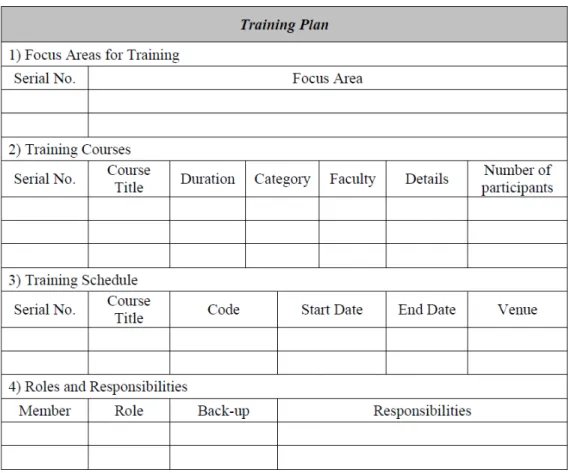
Preparing a training plan is one of the tasks of implementation. The training plan contains details of the participants to be trained. It also mentions the focus area arid .The audience for die training session. Training schedule containing the training venue, training name, start date and end date is a part of the training plan. The plan conveys budgetary details and the roles and responsibilities of participants as well as the faculty. A training plan is displayed in Table 12.2. The plan has details of the focus areas of training, courses identified for training, and training schedules. Roles and
responsibilities of trainer are also included in the training plan. Table 12.2: Training Plan
c. Acceptance Plan
The purpose of an acceptance plan is to determine the details of acceptance testing. The plan contains details such as the order of testing of functions, location, date, and duration of testing. Details of participating members, coordinators, and users are also mentioned in the plan. The acceptance plan lists the procedure for bug fixing, version control, and verification and validation details. Procedure for the creation of acceptance test cases and setting up software and hardware environment is also mentioned in the plan. The acceptance plan in Table 12.3 contains details of the acceptance
schedule, acceptance criteria, list of resources, and a bug report form.
d. System Support Plan
The implementation team prepares the system support plan either during or before product installation. The system support plan contains details of how the system will be supported after it is implemented. Typically, the support plan has a warranty clause. The warranty clause usually lasts for a year. The
warranty covers details of people in the support activities, details of agreement, the response time, and support details.
Implementation Activities
After the prerequisites are in place, implementation activities begin in right earnest. Now, all the plans created for implementation are put into practice. Implementation activities include acceptance testing, user and operator training, data migration, installation and configuration, product sign-off, product wind-up, post mortem, and product delivery.
i. User Acceptance Testing
You must have heard the proverb, "the proof of the pudding lies in the eating.
This applies for software product also. The success of the software product depends on how the user responds to the product. One of the important implementation activities is user acceptance. This aims at ensuring that the system is working according to the user requirements. UAT is done to ensure that the desired product design matches the actual product design. UAT is the final testing performed by the end user after using the product over a limited period me. As part of the implementation process, the project manager prepares the User Acceptance Test plan. The UAT plan is the last stage of the testing process where the user tests the product. The user tests the product and identifies whether it is acceptable or not.
Ideally, UAT is conducted in the same environment as the one in which the product is designed. UAT plan consists of the activities to be conducted, functions to be tested, the time, and environment in which software will be tested. Often test cases are attached with the plan. The user validates the software based on the test cases.