by
Daniel A. LaHue
A Master's paper submitted to the faculty of the School of Information and Library Science of the University of North Carolina at Chapel Hill
in partial fulfillment of the requirements for the degree of Master of Science
in Library Science.
Chapel Hill, North Carolina June, 1999
Approved by:
I. INTRODUCTION
I-1. Problem
Communication networks, especially those used in the infrastructure of digital libraries, are currently challenged by the latest technological developments to provide timely and coherent transmission of bandwidth intensive multimedia applications involving video conferencing, video/audio telephony or real-time video and audio products. Unlike asynchronous data, such as text, numerics, graphics and still images, these digital sources have interactive and/or time-dependent requirements that are of an isochronous nature, indicating that the data must be received by a network terminal at the same rate wherein the data was recorded, with negligible variation in the
transmission rate. Consequently isochronous video and audio demand that the data be transmitted within performance bounds--normally 30 frames per second for video and 44,100 16-bit samples per second for high-fidelity audio--and that this transmission occur uniformly to facilitate synchronization and permit intelligible viewing or listening at the receiving end. Video recorded at 30 frames per second must be continuously transmitted at the same rate of 30 fps with minimal, consistent delays, since either sporadic lowering or raising the number of frames per second will cause disruption of the contents when played back.1
To ensure constancy in the transmission rate during playback is no easy task, illustrated by the bandwidth requirements of 30 frame per second video which, when recorded at 640 x 480 pixels for 24 bit resolution (low to moderate quality), requires 550-Kbps bandwidth at MPEG compression and 27-Mbps when transmitted uncompressed. Considering that common local area networks operate at 10 to 16-Mps, user requests for the provision of single let alone multiple isochronous streams of data can be a
tremendous network challenge.2
The nature of isochronous video and audio processing is particularly challenging for networks utilizing time-division multiplexing (TDM), a connectionless technique that allocates bandwidth throughout the network by fragmenting signals into packets and transmitting packets for individual signals at different times over a single connection. When the connection is used to transmit a packet, all the other stations waiting to transmit must wait their turn to be able to transmit the next packet, thus introducing some degree of delay for subsequent packets. TDM is commonly found in local area networks (LANs) and is in contrast to other methods of signal modulation used for network connectivity, such as connection-oriented, circuit-switch multiplexing, which uses a central switch to establish point-to-point connections for separate signals, e.g. telephone networks, or connection-oriented, frequency-division multiplexing used in cable television, whereby a single connection is divided into multiple, point-to-point frequencies and the different signals separated by frequency. TDM-based networks are popular and widely applied because of TDM's economical and efficient transfer of asynchronous data,3 but the dependency upon time-dependent signaling instead of circuit or frequency modulated point-to-point connections causes variable delays as utilization increases, delays that become problematic for networks such as digital libraries where a substantial requirement is the fulfillment of isochronous multimedia requests.4
I-2. Research Question
3The exception in the TDM family is Asynchronous Transfer Mode (ATM), an expensive, complex and connection-oriented approach that operates at gigabit speeds and is highly effective for isochronous multimedia due to the fragmenting of its signals into miniature, fixed-size packets called cells. Notwithstanding its name, however, ATM is not cost-effective for time-insensitive asynchronous data and thus has limited
Although time-division multiplexing operates with an inherent utilization/delay ratio, there are variations in the TDM paradigm at the data link layer, known as the media access protocol, that can optimize performance involving isochronous multimedia. The most common protocol variants used in network architectures are the statistical-based contention of Carrier Sense Multiple Access (Ethernet) and the deterministic-based token-passing of token ring. For both media access protocols the primary network performance parameters with respect to isochronous video and audio are (1) the mean transmission rate as a function of the playback rate or throughput, with the mean throughput rate being equal to or less than the playback rate; (2) the delay in transmitting each packet and the variance in this delay, e.g. latency and jitter,
respectively, with acceptable values for latency ranging from 20 to 400 milliseconds and that of jitter being less than 80 milliseconds; and (3) the rate of lost packets due to buffer overflow or media protocol factors, with acceptable values ranging from 0.01--0.001.5 Based upon these performance parameters of throughput, message delay as defined by latency and jitter, and packet loss, an excellent research question to explore is which type of TDM media access protocol, Ethernet or token ring, most closely meets the above defined requirements needed to effectively process the isochronous multimedia loads demanded of the LAN infrastructures in digital libraries?
I-3. Outline
To answer the above research question it will be necessary to compare the strengths and weaknesses of both Ethernet and token ring. This comparison will first be treated in a theoretical fashion, providing (1) a literature review covering network
evaluation, multimedia requirements in networks, and LANs applications in electronic
and digital libraries; and then (2) developing a primer of local area network terminology and concepts, such as cabling, topologies, and media access protocols in general; afterwards (3) focusing on the pros and cons of Ethernet and token ring individually and (4) in relation to each other as regards isochronous multimedia transmission.
Preliminary comparative conclusions about the two media access protocols will be propounded, including recommendations for overcoming the weaknesses of each access protocol.
I-4. Project
Complementing the theory will be a practical component of tests comprised of a computer program coded in C++, designed around an integrated set of network
performance analytical tools, that permits the comparison of Ethernet and token ring networks at an optimized state to best determine which is most appropriate for isochronous multimedia. The structure of the application is as follows:
Menu
Ethernet Token Ring
Output
File Storage
All Choices Exit
Comparison Test Database
Documentation Review PriorResults Simulation
1. The maximum achievable data rate of each node under heavy conditions, with heavy conditions defined as all nodes attempting to transmit
simultaneously.
2. The message arrival rate per node to measure when network saturation occurs (with subsequent loss of packets).
3. The average message queuing delay.
4. The average number of data bits in the output buffer of a node. 5. The minimum, mean, and maximum expected latency and jitter.
6. The estimated packet loss rate, as a probabilistic function of the collision detection mechanism and buffer overflow in Ethernet or merely buffer overflow in token ring.
7. The maximum number of nodes the network can support when the network is at a certain level, determined as a factor of the average message arrival rate. The algorithms used to define and calculate these parameters are described in the source code contained in Appendix A and stored with the attached software.
This evaluation will be accomplished in an optimized mode, which is the maximum attainable packet rate achieved when all network nodes simultaneously attempt to transmit one packet. This optimized mode assumes the following conditions:
a) The network is homogeneous, with all nodes having the same properties and average message load.
b) All nodes have exponentially distributed message interarrival times.
c) Time of message arrival to individual nodes on the network are statistically independent.
d) All packets are the same size.
e) A node can only transmit one packet each time it has access to the network. f) All models assume steady-state operation.
g) All nodes have equal (non-prioritized) access to the network. h) There is no idle time on the medium.
i) All transient events such as lost token, network reconfiguration, transmission error and recovery, and excluded from the analysis.
The results of the optimized mode will be stored in a file for comparison, with these findings and the preliminary, theoretical-based conclusions forming the framework for elucidating a final determination about the suitability of either Ethernet or token ring over its counterpart for isochronous multimedia purposes.
I-5. The Digital Library
networking, i.e. the linkage of two or more computers in some fashion to facilitate
communication, had been primarily restricted to LANs serving a limited clientele. A need to interconnect these individual LANs, however, led to the development of networked networks, such as metropolitan area networks (MANs) and WANs, covering regional and even national distances. At first comprised of a single long-range communication
'backbone' WAN with select users, such as the military and scientific researchers, within a decade the potential of extended networking had been identified by commercial interests and WANs proliferated. With multiple isolated sites connected electronically to each other regardless of local, regional or even global distances, a world-wide
information network emerged and in its wake brought about many new innovations. One such innovation was the precursor of the digital library, the electronic library.6
The electronic library was the first introduction of networks in the library setting, and manifested itself either as a LAN interconnecting the departments of an individual library for enhanced data and resource sharing, such as administrative tasks, or as public access catalog to the bibliographic citations available on an online version of the card catalog, e.g. Online Public Access Catalogs (OPACs), which often were connected to a larger state or regionally-operated WAN supporting a consortium of cooperating libraries. The availability of online catalogs to the public caused a surge in user demand, since the medium involved permitted greater user access than physically possible under traditional card catalogs. As computer technology continued to improve in the areas of processing/storage capabilities, particularly with the introduction of the personal
technological development, the digital library.7
All digital libraries are electronic libraries; not all electronic libraries are digital ones.8 Unlike its predecessor, the mature digital library is a repository of collections stored entirely in digitized format and composed of all types of media, whether instances or combinations of text, images, video, or audio; and these diverse formats are accessed entirely through information transfer via networking, whether on-site or at a remote location. By design digital libraries are uniquely situated to provide access to not only conventional information of data or text, but also information previously considered to be difficult to access because of lack of geographic distance, format or rarity, such as historical collections, regional depositories, maps, architectural drawings, or rare books; or information with a high rate of change or currency-dependent value, such as scientific journals and news articles.9 There has even been an extension to non-traditional, ephemeral collections, such as those generated from wire services and list-serves. Moreover the networked environment whereby the digital library subsists and
interconnects with other digital libraries permits its users to work cooperatively with each other even when separated by extreme geographical distances.10 In all cases the digital library's electronic collection requires immense storage, computational, and transmission capabilities, tasks accomplished by the network infrastructure..
I-6. The Art of Digital Library Design
Notwithstanding a digital library's utilization of precise, high-technology tools in acquiring, managing, and distributing its electronic collection, such as optical scanning of documents, hyper-linked object-oriented indexing, stratified database design, and
7Jack Kessler, The International Dimension, Artech House Computer Science Series, (Boston, MA : Artech House, 1996), p. 20-24.
extremely fast connectivity between workstations, the process of designing the network for a digital library is much less exact--indeed, in many ways it is an art. For the mere fact of technology's scientific provenance does not ensure that a particular technology can in practice be applied scientifically, since the extensive range of available equipment and applications, as well as the uncertainty introduced by new products and services, may often make it impossible to precisely determine which technology and in what form is best. Although the science behind the technology should enable one to design an 'optimal' network for each particular application, in practice, the analytical tools for networks in practice provide at best an estimate of performance and tend to be so theoretical in nature as to be of little use to most information professionals involved in selecting a network for a digital library.11 Thus the field of digital libraries is one still very much in flux, making the usefulness of any technological standards limited in
effectiveness to mere guidelines.
Furthermore the inability to adequately anticipate the response of the people for whom the system is built, whether in terms of current or future demand for a collection, forces the designer of a digital library to again estimate rather than precisely select a technology application.12 There is also the variability in resource-demand exhibited by the actual collection, which being comprised of multimedia components requires a support system sufficiently powerful enough to efficiently process the most complex and resource-hungry media, such as isochronous video and audio. The difficulty here is that any improvement in these media is accompanied by a counter-balancing demand for greater quality, forcing the high-end threshold of technological performance required of networks ever-upward.13 Consequently network media access protocols that were
11Dennis S. Mok, "A Software Tool for Performance Analysis and Evaluation of Local Area Networks," IEEE Proceedings: 11th Conference on Local Computer Networks, 1986, p. 77.
previously deemed superior for most applications are relegated to being merely
acceptable, even inferior, when considered for significant multimedia purposes such as digital libraries. For these reasons, the selection of a network in a digital library is combination of art and science, with the latter's analytical tools facilitating an
approximation of performance but the experiential-based wisdom of the former ultimately dictating the final decision.
I-7. The Scope of This Paper
The focus for this paper's comparison of Ethernet versus token ring is local area networks in general and specifically when incorporated into the network design of a digital library. A comparative question of the 'best' media access protocol is especially important to digital libraries since, due to their intensive use of a mix of asynchronous and isochronous medias, the quality of a digital library's collection is dependent on not only the original source but also upon the local network infrastructure providing
electronic access to its users with delays and lost packet rates consistently held within acceptable bounds. Moreover the favorable identification of one media access protocol over another would be a long-term benefit in terms of standardization, since
standardized technologies tend to aid the diffusion of the technology and widespread adoption leads to lowering of per unit costs and ensures future support by vendors in the marketplace. Lastly, any effort to standardize network technologies through comparative evaluation will aid the reduce the proportion that digital library design is dependent upon a nebulous "art". In providing a software application, data and conclusions contrasting one media access protocol over another, this paper assists future designers of digital libraries, as well as multi-purpose networks carrying video or audio traffic, in making intelligent selection decisions that effectively match the capabilities of a media access protocol to its setting.
II. LITERATURE REVIEW
II-1. Terminology
Before perusing the selected articles in the literature review, it would be helpful for the sake of comprehension to define some key terms, such as:
Bandwidth: the maximum capacity of the network media as expressed in megabits per second, e.g. a 10-Mbps Ethernet network has a bandwidth equal to 10,000,000 bits or 1,250,000 bytes per second.
signal propagation speed and media access protocol, (3) and the difference between the two, service waiting time, which is comprised of collision rates, error rates, queuing models, and network topology. Out of the three, service waiting time contributes most to overall delay since service capacity, dependent upon random and/or external factors, is the most variable.15 For multimedia data, the latency experienced by transmitted packets must be within minimum and maximum bounds to prevent, or at least discourage, loss of fidelity.
Signal Propagation: the speed at which data is transmitted from node-to-node along a network physical layer. Electrical signals travel at the speed of light in a vacuum but their progress is slowed by the characteristics of the physical transmission media, whether it be copper or fiber cable, or the air. The actual speed of the electrical signal when considered in relation to its transmission media is the propagation speed. Topology: the physical layout of the connections from node to node comprising the network. Common approaches are the linear bus, the centralized star, and the circular ring.
Throughput: also called channel utilization, throughput is defined as the amount of useful data that is transmitted in a duration of time, expressed in megabits per second (Mbps). The throughput for a given network at a particular time is dependent upon many factors, including maximum available bandwidth or channel capacity, for
example 10-Mbps Ethernet or 16-Mbps token ring, number of active nodes, and size of the message packets. Overhead is also restrictive, since such factors as control information, packet header size, and retransmission due to error or collisions (Ethernet only) can rapidly detract from total throughput. To avoid significant distortion of video, audio and/or conferencing data, the network throughput must on average be of
sufficient capacity to enable the data stream to arrive at the receiving node at essentially the same rate wherein the media was originally recorded.
Utilization: percentage of the bandwidth that is in use at any particular time or for a duration of time, expressed as a measure of the difference between maximum bandwidth capacity and the total load on the network.
II-2. Network evaluation
The compilation below represents only a small sample of the theoretical studies pertinent to network comparison and real-time or isochronous transmission
requirements. The articles, arranged by publication date, were selected to be
representative of the comparative essentials of CSMA-CD protocols such as Ethernet and token rings, in general and specifically addressing isochronous applications.
Bux, 1981
In an informative study of Ethernet and token ring,16 Bux provides a comparison of these media access protocol variants based upon the measure of average packet latency. Defined as the average time required to transmit a message as determined by throughput, a low latency is emphasized in this study for its real-time necessity. The concern for minimal delay rates anticipates the introduction of isochronous multimedia applications and is in contrast to similar studies of the period, which stress bursty, bulk-transfer performance instead of the constant data streams particular to video and audio message packets. Judging by Bux's findings, the use of latency as measure of
performance favors token ring to the detriment of Ethernet, although the specification of shorter packet lengths on a CSMA-CD network can alleviate this deficiency.
Liu, Hilal, and Groomes, 1982
This study by Liu, Hilal and Groomes,17 evaluates the performance of a variety of media access protocols, from the statistical contention protocols of ALOHA,18 CSMA, CSMA-CD, to demand-assignment or deterministic protocols of token passing ring, slotted and register-insertion.19 Using analytical models of throughput, response time, i.e. latency, and reliability, a simulated performance of the various protocols determines (1) that the deterministic protocols, especially register-insertion and secondly token passing, surpass in terms of throughput their contention-based counterparts for real-time applications; (2) that the former are also superior in terms of maximum worst-case
17Ming T. Liu, Wael Hilal and Bernard H. Groomes, "Performance Evaluation of Channel Access Protocols for Local Computer Networks," Proceedings COMPCON, Fall '82, (September 20-23), p. 417-426.
transmission delay when operating at high loads; and (3) that CSMA/CSMA-CD with its bus topology provides greater fault tolerance or reliability than ring loops. Overall it is the opinion of the authors, supported by their findings, that the group of deterministic protocols in general provide higher performance in terms of latency at moderate to high utilization.
Mok, 1986
Mok20 offers a pragmatic network performance analysis software program that compares CSMA-CD bus systems, e.g. Ethernet, to other bus and ring systems using token passing, such as Arcnet and Ringnet (token ring). Designed to aid selection of a network to fit an application, Mok utilizes a series of analytical tools that enable
performance characteristics of each system to be identified and evaluated under similar conditions. While non-conclusive for the most part, being devoted to elucidating the performance measures and logical structure of the software, this paper does indicate that Ethernet has a higher data throughput level when using long packets of over 1000 bits, while Ringnet achieves this performance when the bits per packet are from 10-1000 bits. Since minimization of latency is related to shorter packet sizes, the evidence is again biased against Ethernet for multimedia purposes.
Suda and Bradley, 1987
This paper by Suda and Bradley,21 examines the effect of data traffic on voice transmission performance by a token ring. First a general distinction is made between the types of data traffic, being either (1) interactive and of a "bursty nature", consisting of short messages that demand low latency values; or (2) bulk data, which is comprised of long messages that are more bandwidth intensive and do not require bounded delays. In both cases errors must be negligible to ensure accurate replication of the data source.
Secondly, these qualities of data traffic are compared to the words, sentences, and pauses of voice traffic, where the messages vary in length, possibly consuming large quantities of bandwidth, and are highly interactive, with periods of bursts punctuated by silence between transmittals. Due to the interactive nature of voice traffic, the latency must be kept within reasonable bounds, typically estimated at 150-200 milliseconds, and the total packet loss rate is less strict, being less than 1%, since the intelligibility of voice messages are not affected by a small proportion of lost packets. Lastly, the simulation model used for the study is outlined and then a series of tests are performed, with the resulting data indicating that token passing in a ring network can simultaneously process both data and voice traffic within the necessary performance constraints. In summary, the authors state that token passing provides lower overall latency and jitter values than other network designs, especially for high utilization applications since the operational delays of token passing do not exhibit as much sensitivity to fluctuations in traffic loads. Sato, Nakada, and Sato, 1988
An elucidation on a new coding method for voice traffic and the analytical tools needed to conduct network delay analysis,22 Sato, Nakada, and Sato's work focus on ATM networks limits the applicability of their study but their outline of the components to network delay is of universal value. Total node-to-node latency consists of:
Coding and packetizing
Nodal processing due to computational time incurred in preparing packet Queuing or reception at the nodal buffers
Propagation speed due to cable characteristics and topology Delay smoothing and de-packetizing
The necessity of coding before packetizing voice data and, for that matter, video and audio, arises from the tremendous bandwidth requirements of uncompressed
multimedia, a characteristic that has made the reduction of the bits needed to transmit such data not only an attractive goal but a widely implemented one as well. When
coding the data, however, there is introduced an intrinsic delay of about 20ms, which must be accounted for in the total latency requirement for message transmittal;
moreover there is additional latency, variable in nature, incurred by the decoding/delay smoothing process upon receipt of the message packets. Therefore, when evaluating network performance, the time involved in preparing isochronous data for transmission and reception must be considered if potential latency is to be accurately estimated. Gonsalves and Tobagi, 1989
This comparative simulation by Gonsalves and Tobagi,23 examine the
performance of voice and data traffic on bus topologies using CSMA-CD, e.g. Ethernet, and token passing, e.g. Token Bus and a folded bus variant, Expressnet. Although the study is restricted to buses, the authors state that the findings for Token Bus and the ring-like Expressnet are indicative of the performance of ring topologies employing token passing, such as token ring. The parameters set forth for effective voice transmission are an end-to-end latency of 10-20ms for telephone quality speech and upwards of 200ms for network conferencing, with acceptable packet loss values of 1-2 percent. Voice encoding delay is estimated at a maximum of 20ms. Based upon these
requirements, the performance measures of throughput, latency, jitter, and packet loss are evaluated for each bus type, and in the comparison it is clear that, notwithstanding similar performance, Ethernet is less capable for voice traffic than Expressnet under the same conditions.
In regards to throughput, Expressnet achieves a higher total data throughput than either Ethernet or Token Bus regardless of the number of nodes, with Ethernet coming in a close second. Although the lowest total latency is produced by Ethernet, since the number of collision-less transmissions at low loads compensates for contention
delays at higher loads, the variation in delay, i.e. jitter, favors Expressnet over Ethernet, which actually improves in constancy of response time as higher utilization occurs. Moreover while the packet loss value is within bounds for all bus types, the manner in which the losses sporadically occur in Ethernet, varying in the number of lost packets, is more detrimental for end-use performance than the regular, frequently occurring packet losses in the token passing protocols. For their conclusion, Gonsalves and Tobagi assert that Ethernet is preferred for networks with low signal propagation delays and handling low loads, since the overhead of token passing impairs its efficiency under these conditions. In the case of heavy utilization or poor signal performance caused by topology or cabling, token passing especially as configured in Expressnet is the
preferred model.
Jeffay, Stone, Talley, and Smith, 1992
An innovative approach to the problem of providing high-quality isochronous data is supplied by Jeffay, et al,24 wherein an existing interconnected network comprised of ethernets, token rings, and Fiber Distributed Data Interconnect (FDDI) rings, is evaluated for real-time conferencing using a new suite of software techniques designated MTP (Multimedia Transport Protocol). Designed to maximize performance and minimize latency even during congestion caused by high utilization, the transport protocol approach of MTP shifts the burden of multimedia transmission performance from the hardware to computational manipulation of the data at the sending/receiving processors. Central to MTP is the successful use of variable synchronization of audio/video streams as needed to compensate for latency and variations in this delay or jitter; furthermore large buffers are employed at the receiving nodes to modulate the flow of incoming data and thus smooth out any discrepancies in transmission rate.
Under simulated isochronous data transmission, the integration of MTP into the
transport layer effectively reduces the differences between the 3 disparate media access protocols comprising the internetwork, resulting in a homogenized data flow achieved at only moderate cost. While not explicitly stated by the authors, an implicit conclusion from this study is the use of similar software approaches for an individual Ethernet or token ring to improve its capability to handle isochronous applications.
Amer, Christensen, Toher, 1993
This experimental study by Amer, Christensen, and Toher,25 and corroborated by the later work Bisdikian, et. al.,26 enumerates the advantages of carrying multimedia traffic over 16-Mbps token ring, primarily those of (1) a determined and low-variance latency due to the predictability of the token passing operation, and (2) the activation of a priority mechanism indigenous to token ring that permits higher priority of token access to be assigned to isochronous data, thus enabling bandwidth to be reserved for
immediate and constant transmission.27 Although the use of a priority mechanism is not restricted to token passing networks, the capacity to reserve bandwidth is an advantage that Ethernet's contention system lacks.28 Simulating a token ring of 40 nodes covering 4 kilometers, and assuming multimedia traffic being generated by 12 stations at 1.2--Mbps each, Amer and his colleagues discovered that using priority schemes enabled effective multimedia transmission with delays for each message packet held to under 5ms at over 90% utilization. In contrast, without assigning priority the latency increased sharply to near 20ms at the same usage level. Furthermore the delays experienced by
25Khaled Amer, Ken Christensen, and Tora Toher, "Experiments with
Client/Server Multimedia on Token Ring," IEEE Proceedings: 18th Conference on Local Computer Networks, 1993, p. 2-6.
27It is noteworthy that, while the datalink layer of token ring and similar systems offers priority capability, the integration and activation of these priority schemes have more often than not been neglected at the upper network layers, specifically the applications driving the message transmissions. See William J. Cronin, Jerry D.
the isochronous streams at high priority were unaffected by occurrences of "bursty" data, illustrating how priority mechanisms in effect isolate one data structure from another. Cronin, Hutchison, Ramakrishnan, and Yang, 1994
Addressing the problems that low-speed LANs such as 10-Mbps Ethernet and 16-Mpbs token ring encounter in a network environment replete with multimedia applications,29 this paper by Cronin, et. al., describes and contrasts four high speed network options that perform at 100-Mbps or greater. The technologies covered by the authors are all based upon common and inexpensive Unshielded Twisted Pair (UTP) cable, and include an Ethernet upgrade of Fast Ethernet (100BASE-T), the hybrid 100VF-AnyLAN,30 a token ring upgrade of FDDI, and the gigabit, cell-based ATM. Using the comparative factors of implementation cost and latency control, 100BASE-T and VG-AnyLAN are, due to their simpler media access protocols, more inexpensive to install than either FDDI or ATM; in regards to latency, however,
100BASE-T is at a disadvantage since it alone lacks a priority mechanism for allocating or reserving bandwidth. Using switches with 100Base-T can compensate for this lack, since switches connect/disconnect each node from the connecting media in response to demand, creating a series of point-to-point links with each node having access to the full bandwidth capacity. In contrast a shared network has the total bandwidth divided
among all the nodes, reducing the available bandwidth at any particular time to a proportion of the total. All four network technologies excepting ATM allows for either shared or switched performance, with FDDI in the authors' estimation outperforming overall its counterparts in handling isochronous data. The size of the network is also a consideration, with networks of less than 200 meters being adequately served by Fast Ethernet and AnyLan, for distances of up to 2 kilometers FDDI's accelerated token passing protocol achieves the highest efficiency, and for larger, regional distances ATM
is the best contender as a multimedia backbone network. Dalgic, Chien, and Tobagi, 1994
In this simulated comparison of 10Base-T and 100Base-T Ethernets,31 Dalgic, Chien and Tobagi investigate the performance of hub-based CSMA-CD topologies for supporting isochronous data streams. Implicit to the author's significant research is an interest in maintaining Ethernet as a viable network architecture even under increasingly demanding multimedia applications, since Ethernet status as the most popular and widespread type of network used today affords advantages in terms of market support and infrastructure dependence that its millions of users have come to rely upon, and that only costly expenditures in other technologies could replace. The efficient transmission of isochronous traffic, however, requires that the packets be delivered within user-acceptable delays, bounds that Ethernet cannot guarantee due to its contention protocol and lack of a priority mechanism. One approach explored by Dalgic and his colleagues to overcome the inherent limitations of CSMA-CD is to restrict the number of nodes that may at any one time transmit multimedia streams.
To evaluate the performance of Ethernet/Fast Ethernet, simultaneous
transmissions of "bursty" traffic and isochronous stream traffic are simulated, assuming latency values stringently bounded at 20ms and at a relaxed 100ms,32 delays suitable for all types of isochronous data including time-sensitive interactive conferencing
applications. Packet loss rate values, caused by either exceeding the specified delay bounds or through the contention process, are selected at 0.01 and 0.001. The results indicate that 10-Mbps Ethernet, with a pre-existing data load of 500-kbps, 20ms delay bound, and 0.001 packet loss rate, can handle up to 11 video streams of 384-kbps each; at the more relaxed 100ms bound and loss rate of 0.01, a total of 18 video streams can
be supported. As the data traffic becomes heavier or experiences "bursts", less
isochronous streams are supported and their packet sizes must become smaller to meet the latency requirements. For 100-Mbps Ethernet, with a pre-existing data load of 15000-kbps (15-Mbps) under stringent conditions and transmitting video packets of an impressive 1536-kbps each, the number of supported streams is 27.33 Under relaxed conditions and dedicated isochronous use a total of 52 video streams at 1536-kbps are possible.
Deriving their conclusions from these results, the authors hold that Ethernets are capable of handling multimedia-intensive applications within user-acceptable parameters as long as the number of isochronous nodes are kept within a minimum and the data traffic activity is regulated so that the total load and the size of the bursts does not impair the isochronous streams already in service. Moreover the use of streams that have variable packet sizes that fluctuate to correspond with the intensity of the data traffic facilitates achieving transmission within the required latency and loss rate bounds. Implemented under these conditions, Ethernet and especially Fast Ethernet remains a viable network architecture in a rapidly changing multimedia environment.
Elsaadany, Singhal, and Liu, 1995
Elsaadany, Singhal and Liu,34 examine the effect of network configuration upon multimedia applications, especially the difference between a shared and switched network environment. Acknowledging that isochronous transmission requires extensive bandwidth resources and low latency, the authors evaluate the extent to which switching hubs can increase the effective bandwidth and minimize delays on an Ethernet network. In switching a single LAN is separated via the switches into individual network domains, either as multiple nodes to a switch to retain a shared bandwidth schema, or as a single
node per switch port creating a dedicated bandwidth hub-to-node connection. In the course of their simulation involving a network of 32 nodes, Elsaadany and his colleagues report that response time drops 50% from 8ms to 4ms with the introduction of only 4 switches, or 8 nodes per switch; and that effective bandwidth increases proportionally to the number of switches, so that data throughput achieved at 80 percent utilization is accomplished at only 20 percent utilization with 4 switches, providing a savings of 60% in available bandwidth. Because of these gains in throughput and reduction in latency, the use of switched over shared bandwidth is clearly a suitable technique to
accommodate the intensive isochronous demands of multimedia.
III. LOCAL AREA NETWORK CONCEPTS
III-1. Cablingselecting network cabling include network topology, type and speed of data transmission, cost, ease of installation, and future ability to add more nodes, or scalability.
III-1-1. Twisted-Pair
Commonly found as the connecting medium in telephone systems, twisted-pair cabling has become popular for network connectivity due to its inexpensive and
malleable properties, especially as concerns installation. Fabricated from two, insulated copper wires that are twisted together to reduce noise, or cross-talk, when an electrical current passes through, twisted-pair wire is an effective medium when network
performance specifications are less exact and can deal with a modicum of signal degradation.
Figure 1. Unshielded Twisted Pair Wire
This first type of twisted-pair is unshielded twisted-pair (UTP), but there is a second type known as shielded twisted-pair (STP), which uses additional insulation to interference from external electromagnetic forces and thus is better suited for greater transmission distances. The concern for signal distortion arises out of the nature of copper cable itself and its limitations as a communication medium, such as:
Attenuation: an indication of a loss of signal strength, with signal intensity decreasing in proportion to the distance traveled and in relation to the propagation speed of the medium. To reduce attenuation, repeaters are used at periodic intervals to refresh and retransmit the signal.
Capacitance: the amount of residual energy that is retained by a cable, with longer cable lengths causing higher capacitance values. Capacitance can interfere with transmission by impeding processing of the signal.
Impedance: delay that occurs due to the resistance generated by the cable at certain signal frequencies.
experienced on the telephone as hearing multiple conversations and occurs because of electro-magnetic interference from the twisted-pair wires themselves.35
The primary problem with twisted-pair cable is cross-talk and a narrow bandwidth capability caused by poor signal performance, both areas being of concern for high-speed networks.36 Despite its failings, the advantages of twisted-pair have led to its widespread adoption, including the development of five standardized types of UTP network cabling:
Category Definition 1 Telephone wire
2 Four twisted-pairs that support speeds up to 4-Mbps.
3 Supports speeds up to 10-Mbps for Ethernet and 4-Mbps token ring. 4 Designed for 16-Mbps token ring.
5 Supports speeds up to 100-Mbps.37 III-1-2. Coaxial
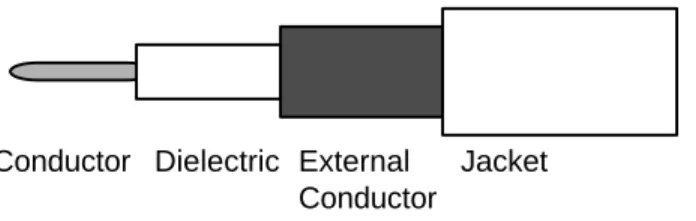
In an attempt to avoid the inherent drawbacks to twisted-pair and improve transmission performance, coaxial cable was developed using two cylindrical copper conductors, one in the core and another externally, with an insulating dielectric separating the two and the entire unit covered by an protective jacket.
Figure 2. Coaxial Cable
Conductor Dielectric External Conductor
Jacket
The result is a sturdy cable that is relatively immune to electromagnetic noise and provides excellent signal transmission, i.e. low cross-talk, attenuation, etc., across long communication spans. Consequently the signal propagation speed, or the rate at which data is transmitted, is extremely high, enabling wider bandwidths or broadband potential. Broadband is the multiple transmission of simultaneous messages, as compared to
35Joseph R. Matthews and Mark R. Parker, "Local Area Networks and Wide Area Networks For Libraries," Library Technology Reports vol. 31, no. 1 (January-February, 1995), p. 20.
baseband media such as twisted-pair which handles single messages only. There are disadvantages to coaxial cable, such as its bulk and rigidity, which complicate
installation, as well as its higher cost.38 Furthermore a disconnected but still open tap in the cable can cause a length of coaxial cable to act as a mile-long radio receiver.39 Despite these weaknesses it is due to coaxial cable's greater performance potential, especially for intensive data, video, and audio applications, that has made this cable the connecting medium most often used in networks.40
III-1-3. Fiber Optic
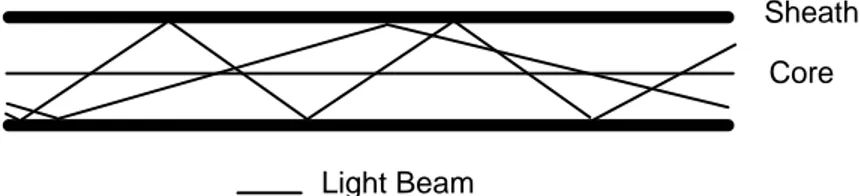
Abandoning the copper conducting base for concentrated laser beams, fiber optic cable is no light-weight connecting media. Fiber optic media is created around a slender glass or plastic core with a high refractive index, and surrounded by a glass sheath of a low refractive index. The core and its sheath are then covered with a protective jacket.
Figure 3. Fiber Optic Cable41
Sheath
Core
Light Beam
When there is only a single core, the optic cable is a monomode fiber; in contrast, when several of these cores are bundled together in their protective enclosure, it is a
multimode fiber. Digital data is converted at the sending end into pulses of light by a laser or light-emitting diode, the pulses are transmitted at a slight angle against the boundary of the core and its sheath throughout the length of the optic core, and at the
39Cited from a class lecture. James Gogan, INLS 184-01, Network Protocols and Management, School of Information and Library Science, (Chapel Hill, NC : University of North Carolina at Chapel Hill, Spring 1999).
receiving end the pulses are translated once again into data.42 While not strictly a cable in traditional sense, fiber optic cable fulfills all network cabling requirements: broadband capability, fantastic bandwidth permitting data transfer upwards of a billion bits per second, minimal signal interference, and security from unwanted access.43 These gains are achieved at a cost, however, in terms of manufacturing expense, since the optic cable is engineered to high-quality specifications, and in regards to installation, which is complicated by the need to often use expert installers and sophisticated equipment. Continued reductions in cable cost per foot, optic components such as lasers, as well as recent innovations in installation, have alleviated some of the above disadvantages and subsequently fiber optic cable has enormous potential for future network applications, especially for high-speed networks operating at over 100-Mbps per second.44
Figure 4. Comparison of Twisted-Pair, Coaxial and Fiber Performance45
Category 3 UTP STP Coaxial (10Base2) Multimode Fiber
Impedance 100 ohms 150 ohms 50 ohms
----Propagation Speed 0.4 c 0.6 c 0.65 c 0.67 c
Attentuation < 70 dB/km < 40 dB km < 33 dB km < 0.8 dB km
Noise > 45 dB > 70 dB km ----
----III-2. Topologies
The logical arrangement of a network's hardware components is its essential structure, or topology. Forming part of the physical layer along with the connecting media, the topology defines the manner wherein the nodes access and communicate on the network. Since a given topology can be crucial to network performance, it is
important to match the right topology to the anticipated demands that a network will experience once in operation. The two primary topological types are (1) logical
43Kim, "Local Area Networks," p. 16.
45Data for UTP, STP and coaxial cable courtesy of Heinz-Gerd Hegering and Alfred Lapple, Ethernet: Building a Communications Infrastructure, translated by
structures based on point-to-point links, e.g. the ring and star, or (2) those permitting multiple access, e.g. the bus and the tree.
III-2-1. Star
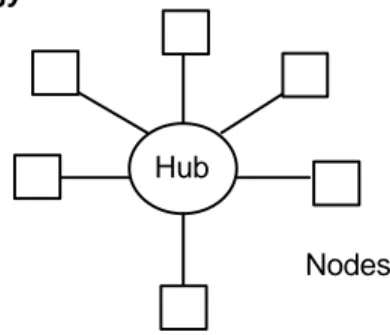
A logical structure using a central controlling element with all the nodes radiating off from this location in centrifugal fashion is the star topology. Point-to-point links connect each node to the central element, or the hub, which controls access to the connecting medium and between all the nodes through a polling mechanism.
Figure 5. Star Topology
Hub
Nodes
collapse. III-2-2. Ring
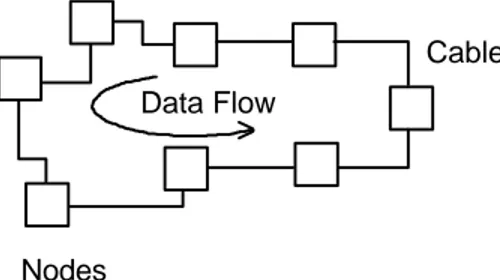
Another method involving point-to-point links but with the nodes connected in series is the ring topology, a looped network. In a ring network, the nodes have immediate communication with their upstream/downstream neighbor and each node is responsible for repeating the network signal.
Figure 6. Ring Topology
Nodes
Cable
Data Flow
To accomplish the task of transmission, some means of regulating access is employed, normally via a token. Given the overall performance of the ring is dependent upon the individual performance of the nodes, a highly-tuned media access protocol must be used to permit efficient, distributed transfer of data. Benefits of the ring topology include handling near maximum utilization (> 90) without degradation of performance, consistent latency values at all load levels, managerial reporting based on system generation of statistics, and a high level of security. These benefits are attained at the price of complexity, in terms of software (the access scheme) and hardware (nodes double as repeaters), and introduce potential instability into the network, since each node is critical to the operation of the network.
III-2-3. Bus
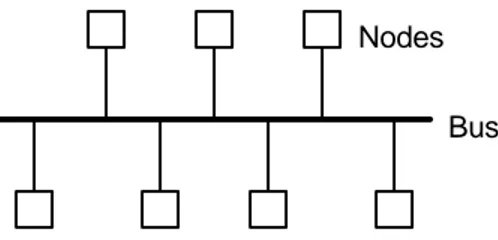
The bus topology utilizes a central trunk connecting medium, with attached nodes lined up along the sides of the trunk like leaves, and a signal that propagates freely from one end of the cable to the other.
Bus Nodes
The interaction between the nodes and the connecting medium upon the transmission of a signal is transparent, as the nodes either passively receive messages addressed to them or wait for the medium to clear so another signal may be sent. Because one or any of the nodes may access the bus trunk, a media access protocol must regulate the manner in which access occurs so that signal collisions are minimal and to ensure fair use for all the nodes. The bus topology has advantages in that it permits a simple, efficient access method, the centralized trunk enables many nodes to connect to relatively short cable lengths, and nodal transparency disengages network operation from dependence upon any one node. Disadvantages of the bus, however, are difficulties accessing the network under heavy loads, resulting in disparities in distribution, and poor security due to the use of a shared medium.
III-2-4. Tree
Combining the other topologies, a tree topology is for larger network applications where the advantages of more than one topology is required or where pre-existing networks are being configured together into an intranet. Joined together by hubs and/or repeaters, which refresh the transmission signal, the tree topology allows for networks to cover greater distances than otherwise possible without discarding the benefits of a particular network type or incurring the cost of building an entirely new network.
Normally the bus and star logical structures comprise a tree topology, but ring topologies can also be used.46
Figure 8. Tree Topology
Bus Hub
Ring
Star
Repeater
III-3. OSI and Media Access Protocols
The Open System Interconnection Reference Model (OSI) was developed by the International Standards Organization in 1977 as an attempt to introduce flexible
standardization to the network design field. OSI provides a theoretical framework of network communication flow that divides the flow between various subcomponents, or layers, within the model with each subcomponent addressing a specific type of network activity. The 7 layers from top to bottom, with the lowest layer representing the physical transmission media and means of modulation, are
Layer Function
Application Higher level end-user and application purposes. Presentation Data transformation from bits to readable display.
Session Oversees communication processes during
session between two users.
Transport Ensures for end-to-end integrity control to prevent loss and ensure quality of services.
Network Handles the routing and switching of information, as well as packet assembly/disassembly.
Data Link Transfers packets between the ends of a physical link through medium modulation.
Physical The hardware rules that permit transparent transmission of packets as represented at the bit
level.
The advantages of OSI are the specificity of function and independence applied to each layer, attributes that permit ease in testing the integrity of a sub-system layer, and that the hierarchical communication flow of the 7-layer open systems model provides a blueprint of network design while allowing for modifications of a particular layer. The result is that interoperability is ensured between other, dissimilar variations of sub-components or even entire networks due to variations caused by technical
innovations or vendor modifications. Based upon OSI, it is conceivable to have one sub-system removed and replaced by another sub-sub-system accomplishing the same task but in a different manner and yet not compromise network service.
Within the 7-layer framework of the OSI is the data link layer, which receives messages from the higher layers and prepares them for transmission by encapsulating the messages into frame packets. To interface with the connecting medium comprising the physical layer, the data link layer uses a controlling mechanism, the media access protocol. Media access protocols determine the manner in which network nodes obtain access to the medium so as to transmit and controls the length and relative importance of that transmission in relation to pending jobs. Essential to the integration of the physical layer medium and upper-layer network protocols, the type of media access protocol chosen for a particular network determines to a large degree the performance that will be achieved on that network. Since network access is either achieved through statistical-based contention or deterministic noncontention methods, the media access protocols can be categorized accordingly.
III-3-1. CSMA (Statistical)
could transmit when the carrier was free for use and access by any particular station was governed by a probabilistic process of contention, which allocates access based on a statistical distribution. Relatively inefficient, with a maximum output of 37%,47 ALOHA became the foundation for CSMA, which retained the idea of "carrier sense" even though for cable-linked networks there was no longer any true carrier medium.
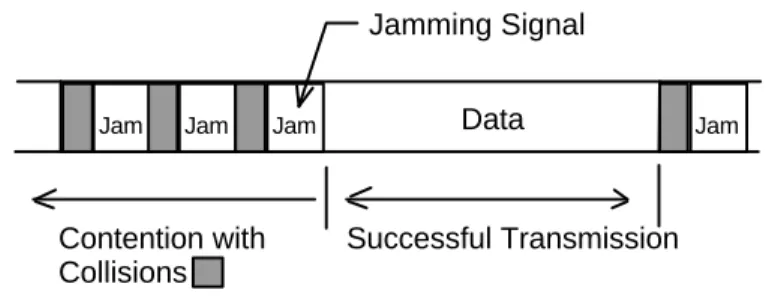
CSMA relies upon the characteristic of each node on the network to listen to the medium, e.g. the carrier, and transmit when the channel is free. The media access protocol is "multiple access" because every node has the right to access the media at any point in time, as long as the channel is clear, with access controlled via contention. Once a node begins transmitting, the other nodes must wait for an idle period before transmitting their data. Due to contention's lack of assigned priorities or privileges, it is conceivable that two or more nodes will sense when the media's channel is free and all involved nodes will try to transmit, resulting in the collision and subsequent loss of the transmission signals. The proportion of these collisions increases in direct relation to utilization, thus impairing effective throughput at heavier loads.
Figure 8. CSMA Contention Cycle48
Contention with Successful Transmission
Jam Jam Jam Jam
Collisions
Jamming Signal
Data
To compensate for the possibility of collisions on a CSMA network, two
alternative algorithms were devised for non-ALOHA applications, such as Ethernet, that of Collision Detection (CD) and Collision Avoidance (CA). In CSMA-CD, a detection mechanism is employed that, upon a collision, clears the media by sending a jamming
signal throughout the network, a signal that alerts all nodes to withhold transmission for a randomly generated holding period.49 This holding period is controlled by binary exponential backoff, so that the first collision causes a wait of n seconds, the second collision n*2, and so forth for a maximum of 16 attempts, at which point the node discards the packet. Collision Avoidance, on the other hand, has all the nodes
monitoring the medium and refraining from transmitting during the moments a collision is most likely to occur. As Collision Avoidance involves greater delay periods between transmissions, its counterpart of CSMA-CD is more widely used. In both cases, however, the disadvantages of a contention media access protocol and frequency of collisions cannot be fully overcome.
In CSMA-CD, the average number of collisions in any network cycle (assuming optimized conditions) may be estimated using the following algorithm:
Example 1.50
1 - A / A
where,
A = (1 - (1 / nodes))nodes-1
In C++, this formula is encoded in a subfunction as:
result = (1 - (1 / x)) * pow(x, -1); // computes A as a factor of the number of // nodes (x)
result = (1 - result) / result; // average number of collisions
return result; // returns the value to the "collisions" variable
The contention value is the product of collisions plus total detection time, i.e. the elapsed duration to detect a collision, and the delay introduced by the jamming signal transmitted at each collision, so that:
contention = collisions * (detect + jam);
Combining contention with the message transmission time, Ttran, which is the minimum time necessary to transmit a frame, the network cycle is established:
cycle = (nodes * (Ttran + contention));
An important variable in the CSMA process is the size of the message packet, an administrative structure designated a frame, ranging from 64 to 1518 bytes in size and containing 18 bytes of control data at the fore of the frame that contains a variety of information, including the hardware addresses of the sending/destination nodes, the protocol type and/or length of the frame, and a frame check sequence (FCS) that alerts the receiving node of any transmission errors.
Figure 9. Frame Composition
Destination Source
Protocol Type or Frame Length
Data (46-1500) FCS
Excluding the control bytes, each frame may carry as little as 46 bytes of data to as much as 1500 bytes. For example a message 1 Mbyte in length would require either a high of 21,739 or a low of 667 frames, depending upon whether 64 or 1518 byte frame sizes were used. The overhead is 18 bytes per frame and itself can be a significant value, such as the above example where the 64 bytes frames generate 391,302 bytes in overhead and 1518 bytes frames create 12,006 in overhead. Frame size becomes an important issue when there are more than a few nodes contending for network access, since larger frames occupy the medium for longer durations than shorter frames, thus increasing the delay that other nodes experience in attempting to access the network. Moreover there are some applications, such as video and audio isochronous data, that benefit from a smaller frame size, due to the decreased latency between frame
transmits, even though smaller frames require more frames per message and transfer less data per frame with more overhead. CSMA incorporates the advantages of variable frame sizes to suit the most efficient frame to the actual application.51
Although the overall approach of CSMA-CD/CA is simplicity at low cost and efficiency at low utilization, the contention nature of the access protocol or the selected
frame size can result in less than ideal network performance at higher loads or for applications where minimal latency is a necessity.52 For these reasons, the CSMA protocol is best suited for networks with sporadic transmissions, as this type of traffic volume incurs the lowest probability of collisions and produces the greatest throughput.53 III-3-2. Token Passing (Deterministic)
The concept of token passing can be traced to the early work of Newhall, Pierce, and others in the late 1960s, wherein a control signal or token is generated to
continuously loop throughout a ring or bus network. The purpose of the token is to identify who has control over the connecting medium and to transfer this control at regulated times to ensure equal access. As the token travels along its path, it is subsequently retrieved, regenerated, and returned to the connecting medium by each and every node on the network. This process of repeating the signal is accomplished for all signals transmitted on the network, making the nodes a vital part of the
communication process. Furthermore one node is selected as an active monitor and charged with ensuring the integrity of the token as it circulates through the network cycles. Upon monitor failure, the other nodes select a new monitor using a voting
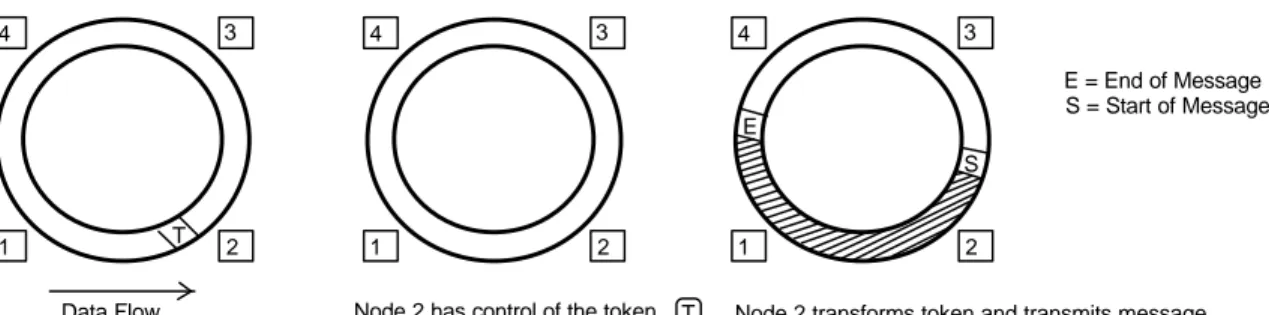
mechanism. To transmit a message, a node removes a circulating token, modifies it into a data packet, and replaces on the network for transmission to its destination. Once the recipient node receives the data packet, an acknowledgment is sent in the modified token to the sending node, which converts the packet into the original token and returns the token to the network. As each node can only hold a token for a specified duration, the repetition of this cycle results in a deterministic, predictable access to the medium for all node on the network.
Figure 9. Token Passing54
1 2
3 4
E
S
E = End of Message S = Start of Message
1 2
3 4
Data Flow T
1 2
3 4
Node 2 has control of the token T Node 2 transforms token and transmits message
Because in token passing there is no contention or possibility of collision, the only delays introduced in a network cycle are those necessary expenditures incurred in transmitting the token, repeating the signal at each node, and copying of data at the receiving node. The algorithm for the token ring cycle is:
Example 2.55
Tpropnet = ((Lring / Vprop) + (nodes * interface_delay) + copy_delay + Btoken);
where,
Lring is the average signal distance (in meters),
Vprop is the signal propagation speed (in meters per second), Interface delay is the nodal delay in repeating a signal, Copy delay is the delay in receiving a message frame, and Btoken is the time taken to transmit the token.
The combination of these variables, along with the time taken by a destination node to detect a token,
Ttoken = Btoken + (Lpass / Vprop) + interface_delay;
forms the basis of the network cycle: cycle = (nodes * (Ttran + Ttoken));
where,
Ttran is the larger of the Tpropnet variable or the minimum message transmission time.
In token passing there are two primary types of transmission packets that may circulate on the network--the token and the data frame. The token consists of 3 bytes with the first byte indicating the token start, the second indicating control information such as priority access, reserved status, active monitor preference, etc., and the last byte indicating the end of the token. When seized by a node for message purposes, the token's 3 bytes are retained but converted into a frame format of a minimum 21 bytes. Included with this frame is the data,
Figure 10. Token and Frame Format.
Start Access End
Start Access Frame
Control Destination Source Data (4500 - 18000) FCS End FrameStatus Token
Frame
which may range from 0 to a maximum of 4,500 bytes (4-Mbps token ring) or 18,000 bytes (16-Mbps token ring). A 1 Mbyte message transmitted on a token ring network would require either 222 or 56 frames, depending upon the speed, with generated overhead of only 4,662 or 1,176 bytes, respectively, a savings of at least 98% compared to the CSMA access protocol.56
Nonetheless the use of the token produces mixed results. On the negative side,
the dependence upon the token can be a potential problem, since the loss or corruption of the token could bring down the entire network; a similar issue arises with the
dependence upon the nodes as in-line repeaters. In fact, the use of a nodal repeater chain in token passing is a potential source of signal distortion, since each node's station generates a certain percentage of random noise that naturally introduces a probability of error in the refreshing/regeneration of the signal. As the network cycle progress, this distortion accumulates through the noise added by each node, a phenomena known as correlated jitter, and must be kept within a minimal level to ensure the integrity of
transmissions. Furthermore, to avoid a network melt-down caused by the loss of a token or node, a complex and expensive system of checks and balances have to employed at the hardware and software levels, including automatic token monitoring and
regeneration, node-to-node communication to ensure flow control, multiple connecting media paths for some systems, and self-healing mechanisms that permit a damaged node to remove itself from the network amidst continued operation. Often such complex internal management tools do not operate effectively, requiring time-consuming
intervention on the part of the human operators.57
On the positive side, however, the advantages of token passing are predictable network access, with the elimination of contention disputes and variable delays caused by collisions as in CSMA-CD, and minimal degradation in performance as network utilization increases. Latency and jitter are consistently low, except at extreme loads, and the large frame sizes and low overhead make it possible for ring networks under certain configurations to develop throughput levels that exceed the actual bit data rate given in the available bandwidth, in otherwords values greater than 100% utilization.58 The use of a token also permits larger frame sizes than allowed in CSMA and the
incorporation of priority access, so that certain nodes or types of messages, such as isochronous data, are granted rights of access before other devices or messages. Lastly, the complexity of the hardware/software relationships enables automatic data-gathering and error reporting on the condition of the cabling and network nodes. III-3-3. Polling (Deterministic)
Polling is a noncontention protocol that uses a central controller to
deterministically allocate access of the connecting medium to all other nodes through a pre-arranged sequence. To achieve access, a node waits until the polling master
generates its regularly-occurring query and then responds with an affirmative; otherwise, the transmit turn is given to the next node. The advantage to polling is predictable access and elimination of conflict between nodes, but these gains can be achieved with token passing with greater efficiency.59
IV. ETHERNET
Originally developed under license from Xerox Corporation, the network
architecture of Ethernet is based upon CSMA-CD and almost from its inception has been the inexpensive way to network. Ethernet is named for the hypothetical substance thought to fill all space, i.e., the 'ether', and was designed to provide low cost, high-speed 10-Mbps connectivity to a large number of potential users. Supporting up to 1024 nodes, Ethernet utilizes a shared network that allocates bandwidth equally among all the nodes via a bus trunk or star topology, with access to the network provided through contention. Due to the potential for collisions as utilization increases, the highest
efficiency occurs when only a few nodes are accessing the medium at any one period of time, for under these conditions the proportion of bandwidth among those active nodes is generous and throughput is high. Since the primary task of networks in office
environments is the handling of bursty data, e.g., intermittent text, numerical data, or bulk file transfers, the characteristics of CSMA have lent themselves well to such applications.60 The combination of affordable, reliable performance networking has propelled Ethernet over its competitors in the marketplace.
Figure 11. Network Market Shares.61
Ethernet (59.0%) Fast Ethernet (24.0%) Token Ring (12.0%) VGAnyLAN (2.0%) ATM (2.0%) FDDI (1.0%)
Ethernet is inexpensive and reliable because it uses a simple media access protocol and hardware components, the hardware consisting of a connecting medium, a transceiver, a repeater, and a network controller card for each workstation. The original
Ethernet, designated 10Base5,62 uses a connecting medium of coaxial cable up to 500 meters in length per network segment, with a total of 5 interconnected segments permitted, or a total network span of 2500 meters. Along the length of the cable, every 2.5 meters, a marking indicated where a tap, an electronic interface known as the
transceiver, could be installed. The transceiver is a combination transmitter and receiver that houses the electronics necessary to interact with or modulate the connecting
medium, including the carrier sensing and collision detection mechanisms. In turn the transceiver was connected via a transceiver cable to the workstation's network controller card, which transmits and receives data to and from the network. Although the
transceiver and to some extent the controller card perform complex tasks, the manufacturing of these devices is not cost-intensive. At the end of each network segment, with a maximum of 4 per total network span, a simple amplifying device, or repeater, is installed to refresh and retransmit the signal.63
Later versions of Ethernet retain the low cost and simplicity of the
hardware/software but modify the operating parameters to attain different performance characteristics. Primarily the determining factor in the different versions is the type of connecting medium employed, with thin coaxial and twisted-pair cabling being the predominant options, although fiber optic solutions are available. Ethernet versions include:
• 10Base2, also known as "cheapernet", is a less expensive and more compact option that uses a cheaper coaxial cable with less distance capacity. In 10Base2, the maximum network segment is only 185 meters and permits a total of 30 potential nodes per segment, with the workstations attached not via a transceiver but directly to the cable segment. Expansion of the network span is allowed up to 925 meters or 5 network segments.
• 10Broad-36 uses a premium-quality coaxial cable capable of broadband, multiple channel transmission of distances spanning up to 3600 meters. Effective in performance, the higher costs associated with cable expense and the necessity of more intelligent circuitry in the transceivers have limited the application of
36.64
• 10Base-T, on the other hand, achieves even lower costs through dependence upon a star topology and a connecting medium of unshielded twisted-pair wiring. Utilizing a hub and radiating nodes, 10Base-T offers point-to-point links and ease of
installation since the UTP cable of lengths up to 100 meters is directly connected between workstations and the central multiport repeater in the hub. One benefit of point-to-point links is, under switched hub scenarios, the allocation of the full 10-Mbps bandwidth per switched port, thus modifying the shared network into a series of dedicated connections with greater throughput, lower latency values, and full-duplex capability. A 10Base-T network can be expanded to a maximum of 5, 100 meter segments connected by 4 hubs. While a 500 meter network span is
significantly smaller than that offered by either 10Base5/2, the drastically reduced costs and availability of UTP have made 10Base-T a popular Ethernet version.65 • 100Base-T achieves a 10-fold increase in data rate and is known as Fast Ethernet,
for this class offers 100-Mbps performance using category 5 UTP cabling. Built upon the star topology with switched hubs, 100Base-T offers both half and full-duplex options with total network spans ranging from a limited 250 meters with 2.5 100 meter network segments, to greater distances of 2000 meters with 100Base-FX, a fiber optic derivative of the 100Base class. Furthermore it is possible to upgrade an existing 10-Mbps Ethernet network into a 100Base model, a factor along with low cost and quality performance that makes Fast Ethernet a strong contender for the high-speed network market.66
• 1000Base class Ethernet is a gigabit-speed hybrid that utilizes the essential Ethernet media access protocol but with modifications to permit 1000-Mbps data rates.
Although it is possible to operate Gigabit Ethernet as a 1000Base-T version over UTP, the total network span is restricted to 100 meters due to the poor performance of twisted-pair at these speeds. Better performance is obtained using one the fiber optic variants, 1000Base-X, which support network spans up to 5000 meters.67 IV-1. Advantages of Ethernet
Ethernet is popular because its CSMA-CD protocol on an easily installed bus topology offers equal access for all nodes accomplished at low managerial overhead and low hardware/software costs, with high performance in terms of throughput achieved at low to moderate utilization (< 50%), with the best performance obtained at less than 35% percent utilization. Frame sizes are variable with reasonable ratios of throughput to overhead and can be tailored to match the application data. Latency and jitter is minimal at light loads, and under switched environments continue to be reasonably low values
65Ibid., p. 95-103.