Predicting Clinical Performance in Medical School: The Contribution of Academic and Non-Academic Characteristics
By William Poe
A Master’s Paper submitted to the faculty of the University of North Carolina at Chapel Hill in
partial fulfillment of the requirements for the degree of Master of Public Health in the Public Health Leadership Program.
Chapel Hill 2012
Date
Abstract
Background: Medical school admissions committees need accurate and precise screening
tools to select among well-qualified applicants. Traditional academic performance indicators, such as grade-point average (GPA) and Medical College Admission Test (MCAT) scores, correlate with standard measures of academic success in medical school, such as pre-clinical grades and scores on National Board examinations. In contrast, valid and reliable predictors of clinical performance during clerkships are lacking.
Objective: To compare the power of two admissions tools – one based on previous
academic achievement (MCAT scores and GPA) and another based on a content analysis of self-reported biographical information – to predict clerkship performance during the third year of medical school.
Methods: A retrospective cohort study of 109 students at the University of North Carolina
at Chapel Hill School of Medicine (UNC-SOM) was performed to evaluate the relationship between various pre-admission tools and clinical performance as assessed by faculty preceptor ratings. The two main predictors were an aggregate academic achievement index derived from MCAT scores and GPA and a “non-academic” index derived by coding self-reported biographical information on the medical school application. Ratings on these two indices were correlated with likert-type preceptor ratings on third year clerkships. I
analyzed the data using Pearson’s correlation coefficients and multiple linear regression to determine the independent, predictive validity of traditional “academic” variables and “non-academic” variables.
Results: Considered as independent predictors, BCPM and MCAT scores did not correlate with
predicted performance on Pediatrics (standardized β = 0.18, p=0.09) but did not predict
performance in Internal Medicine or Family Medicine. In contrast, the academic achievement index predicted clinical skills ratings in Family Medicine (standardized β = 0.18, p=0.07) but not performance ratings in the other clerkships. Neither admissions tool reached statistical
significance at the 0.05 level. Ceiling effects limited the size of the correlations among predictors and criterion measures.
Conclusion: This study adds to the growing body of literature suggesting that traditional
Acknowledgements
I would like to thank my advisor, Dr. Tolleson-Rinehart, and my second reader, Dr. Warren Newton, for their willingness to support such an ambitious project. Their
encouragement and faith in my ability, despite my lack of experience with original research, was an inspiration and made this study possible.
I would like to thank Dr. Jane Brice, whose thoughtful approach to the medical school admissions process provided the foundation for this research. Her willing investment of time and energy on my behalf was extraordinary and demonstrates her outstanding commitment to medical education and lifelong learning.
Table of Contents
Original Manuscript
Abstract………..ii
Acknowledgements………...iv
Table of Contents………...v
Introduction………1
Methods………..9
Results………..14
Discussion………18
References………23
Tables………...………26
Appendix A Systematic Review………...………29
References………44
Introduction
Over the past decade, graduate medical education (GME) and continuing medical education (CME) have reorganized around the six ACGME-endorsed core competencies. Mirroring this trend, medical schools have begun reframing their curricula along the same competency-based model. The proposed rollout of a newly revised MCAT in 2015, with a newly added focus on the social and behavioral determinants of health, manifests that the entire physician-training pipeline – beginning with the selection of medical students – is undergoing realignment upon common standards.
A sea change in the goals, design, and evaluation of an educational system demands an assessment of its raw-material inputs. Two important questions arise: What criteria do we currently use to select students for medical school? More importantly, do these criteria attract and matriculate students who possess the capacity to develop and maintain the core
competencies?
To address the first question: admission practices at U.S. medical schools rely heavily upon measures of academic achievement such as standardized test scores and premedical GPA12 3. Selection committees also evaluate applicants through personal interviews, biographical
sketches, personal essays, and letters of reference 45.
At present, the evidence is insufficient to answer the second question. The move toward competency-based undergraduate medical education (UME) is a recent shift, and a paucity of research links admissions processes to competency-based outcomes. The majority of medical admissions research focuses on pre-admission variables that correlate with measures of academic achievement. Robust evidence demonstrates that previous academic performance and
respectively – correlate moderately with grades during the preclinical years and scores on subsequent licensure examinations 23.
In contrast to their predictive validity for pre-clinical grades and licensure exam scores, pre-medical GPA and standardized test scores correlate inconsistently with clinical performance. Numerous studies have found that MCAT scores and pre-medical GPA do not predict clinical performance in medical school or in residency 67,89,10.
Why should we be interested in identifying predictors of clinical performance during medical school? One reason is that the six core competencies – medical knowledge, patient care, professionalism, interpersonal and communication skills, practice-based learning, and systems-based practice – are designed to be assessed in a clinical context. If these are the criteria by which we aim to judge success in medical school, it follows that the outcomes of admissions-related research should include competency-based, clinical assessments.
Another reason to search for better predictors is that the ultimate goal of the admissions process is to select applicants with the potential to practice effective clinical medicine. The performance of doctors in practice involves both intellectual knowledge and a variety of
professional and interpersonal qualities such as communication skills, empathy, compassion, and integrity. As board scores and preclinical grades during medical school primarily measure intellectual knowledge, they provide only intermediate, partial surrogates for the full range of abilities necessary to practice clinical medicine. In order to complement these measures, the effectiveness of admissions criteria should also be assessed over a longer time horizon that includes clinically based performance endpoints beyond medical school.
written examinations. Thus, it is not surprising that many studies have found that clinical performance in medical school predicts performance in residency 111213-15. Evidence also supports a relationship between clinical performance and long-term physician behavior.
Numerous studies have linked unprofessional behavior in a clinical setting during medical school to subsequent disciplinary action by medical boards 161718. In the same studies, MCAT scores and undergraduate GPA were not associated with disciplinary action. These findings suggest that correlates of clinical performance at the UME level could serve as valid and reliable predictors of long-term competence and success.
Altogether, this chain of evidence manifests the value of searching for valid and reliable predictors of clinical performance at the level of UME. In turn, the medical school admissions process could benefit greatly from tools that identify those applicants most likely to succeed in a competency-based, clinical environment. To this end, I conducted a pilot study at the UNC School of Medicine (UNC-SOM) to evaluate the predictive validity of “non-academic” components of the medical school application for clinical performance as assessed by the ACGME competencies. In this study “non-academic” refers to applicant qualities apart from MCAT scores and undergraduate GPA, as found in applicants’ biographical sketches of
activities. I conducted a first test of their predictive validity of these criteria by comparing their association with third year clinical performance to that of traditional admissions benchmarks such as MCAT scores and pre-medical GPA.
Evidence Of Predictors of Clinical Performance in Medical School
I conducted a systematic review of the literature to determine what is known about predictors of clinical performance in medical school (further details of the review are in
Appendix A, including the search strategy and a critical appraisal of the articles). Recent, well-conducted reviews address the relationship of academic, or ‘cognitive’ predictors (e.g. tests scores and pre-med GPA) and clinical performance2,3. Therefore, my review focused on studies assessing portions of the application other than test scores and pre-medical GPA – namely personal interviews, biographical sketches, personal essays, and letters of reference. Personality measures and learning styles were not addressed in this review for two reasons: recent, good quality reviews deal with these variables 7,19, and Medical schools do not routinely use these measures in evaluating and selecting students.
I reviewed and evaluated the quality of 18 articles published from 1978 to 2011.
Numerous methodological problems complicate analysis of the studies I included. One difficulty is that using populations of only admitted students means that ceiling effects restrict the range of predictor variables. By the same token, clinical performance measurements are frequently skewed, limiting the range of the criterion measure. Ceiling effects not only weaken the
correlation among predictors and outcomes but also make it difficult to extrapolate the results of a particular study to a population of potential medical school students – the ultimate goal of medical admissions research.
test scores (i.e. clerkship shelf exams). This heterogeneity in clinical performance measures makes it difficult to compare the results between studies. The lack of a common standard of assessing clinical performance in the literature is not surprising and reflects a challenge in medical education that the competency system is designed to address.
The literature also lacks a common approach to the measurement of predictor variables. For instance, among studies that examined the predictive value of interviews, interview formats ranged from unstructured to semi-structured, and each study used a different technique to derive interview ratings. Similar measurement variance characterized other predictor variables in the included studies; these inconsistencies make it difficult to compare the correlations between predictors and clinical performance across studies. Furthermore, many of the included studies had small sample sizes and nearly all were conducted at a single medical school, both of which result in poor generalizability.
Despite these limitations, we can find meaningful trends, depending on the type of predictors and the criterion variables used to measure clinical performance. I identified three general categories of predictor variables: Interviews, narrative portions of the application (letters of reference, personal essays, and the biographical list of activities), and educational background and life experience (e.g. undergraduate major or military experience). I use these categories to organize the rest of the review.
Overall, the evidence for the predictive validity of interview ratings for clinical performance is inconsistent. Studies using structured interviews tended to find reasonable correlations (0.20-0.60) 202122 with clinical performance; unstructured interviews, not
performance.” Specifically, interviews consistently predict clinical performance as measured by preceptor clinical ratings 20,21,23,24 but this correlation is attenuated or disappears altogether when the clinical performance metric includes standardized test scores 21,23,25-27. These findings suggest that standardized tests of clinical knowledge and preceptor ratings evaluate distinct but
interrelated aptitudes or skill sets. The observation that MCAT scores and pre-medical grades correlate relatively well with NBME shelf exam scores, whereas interview ratings do not, provides empirical support for this theory.
Further evidence to support the predictive validity of interviews comes from studies using proxy measures of clinical performance including dean’s letter ratings or residency match
rankings 22,28,29. Two studies found small but significant correlations between interview ratings and dean’s letter ratings (r = 0.22-0.37) 28,29. A third study found a significant relationship between interview scores and family medicine residency rankings for senior medical students. 22 In contrast to the waning predictive validity of academic measures over the course of medical school, these results suggest that interviews may capture stable, long-term information relevant to an individual’s clinical performance.
Objective structured clinical exams (OSCE’s) theoretically provide a more direct and accurate means of measuring clinical proficiency. Few studies have used OSCE scores as an outcome, but the trend is that structured interviews correlate moderately with OSCE scores 21 whereas unstructured interviews do not 22,30. Research demonstrates that both OSCE scores and preceptor ratings positively correlate with residency director ratings 31. It is therefore interesting
answers. In addition, OSCEs test a limited range of clinical skills, but preceptors might be assessing a wider range of abilities. One hypothesis to explain the different findings is that the method of assessment (standardized vs. open-ended) influences the relationship between predictor and outcome; this hypothesis would predict that unstructured interviews do not correlate with OSCE scores.
Information derived from the narrative components of the application – the biographical sketch, letters of reference, and the personal essay – does not consistently predict clinical performance21,22,32,33. Some studies show promising results 22,32,33 while others have found no significant association between these variables and clinical performance. 21 The literature offers no guide to whether some narrative components are better predictors than are others, and the inconsistent findings once again impel us to develop studies using both both comparable predictor variables and clinical performance measures.
The robust pre-medical curriculum and emphasis on basic science during the preclinical years – Abraham Flexner’s legacy – naturally leads to interest in whether educational
Study Rationale
My review underscores several gaps in the literature. I address the areas for future research in detail in Appendix A, but several in particular provided the rationale for the present study. One salient issue is that the most promising predictive admissions tools for clinical performance (e.g. the MMI) tend to be the most time and resource intensive. Unfortunately, admissions committee participation is frequently voluntary, and time and effort is already stretched at many U.S. medical schools (and perhaps especially so at public institutions). Most schools do not have the personnel to conduct a content analysis of each applicant’s personal statements, and there will likely never be a standardized, multiple-choice test for the
interpersonal characteristics desirable in future physicians. Hence the need for research that pilots efficient and scalable admissions screening tools for clinical performance. All applicants at U.S. medical schools are required to submit a common application through the American Medical College Application Service (AMCAS). The AMCAS application contains both academic data (MCAT scores, pre-medical GPA) and non-academic, or narrative, information including a personal essay and a biographical sketch of experiences. Therefore, a predictive admissions tool derived from the systematic, efficient evaluation of the AMCAS application could provide a standardized, scalable method of comparing the anticipated clinical performance of applicants. Moreover, this type of common assessment would not require a fundamental alteration of the current admissions process.
and medical training systems?. Studies designed to predict clinical performance in an explicitly American contextwould help address this need.
Finally, I did not identify any predictive studies that assessed clinical performance among U.S students using competency-based metrics, despite the obvious need for evidence linking admissions criteria to policy-related outcomes.
Considering these gaps in evidence, I developed a rating scheme for the narrative portions of the AMCAS application and tested its ability to predict clinical performance. The study compares the predictive validity of this tool to MCAT scores and GPA, the traditional predictors of medical school performance. The UNC School of Medicine, one of the nation’s leading public medical institutions, is an ideal setting in which to pilot a generalizable clinical performance prediction tool among U.S. students.
Methods
Participants
of Medical Education who served as data custodians, I had a final database that included students beginning the M.D. program in August, 2008 who completed the first three years of the program consecutively, performing their 3rd year clinical rotations in the 2010-2011 academic year. Thus, those who chose to take a leave of absence after their third year in order to pursue a research fellowship, an alternative degree such as an M.P.H. (which about 20% of the UNC medical school class does) or for other reasons were included.. Interview data were missing for 17 students; therefore these students were excluded during analysis. The total remaining study population was 92 students, whose admissions and clinical performance data were linked with a unique identifier held by the data custodian, and not known to the study team.
Predictor/Admissions Variables
Academic Achievement: MCAT& Undergraduate Grade Point Average: The Medical College Admissions Test (MCAT) is a standardized test consisting of multiple-choice questions in 3 subsection: Biological Science (BS), Physical Science (PS) and Verbal Reasoning (VR). Each subsection is scored on a scale of 1-15; the total MCAT score is the overall score out of 45. The AMCAS application subdivides undergraduate GPA into two cumulative averages – one for courses taken in biology, chemistry, physics, and math (BCPM), and one based on courses taken in all other subjects (AO). For this study I used BCPM, since it is used in practice by the UNC admissions committee as a way to compare GPAs among applicants of different undergraduate concentrations or Majors. Both the total MCAT score and the BCPM were converted into single digit scores using pre-determined cutoffs (appendix x) on a scale of 0-3. These two scores were added to form a composite academic achievement variable, which ranged from 0-6. This
Other Achievement: Non-academic Variables: The American Medical College
Application Service (AMCAS) includes a section in which applicants may list and describe up to 15 activities relevant to their motivation, qualification, and capacity to become an effective physician. The study authors developed a rating methodology for this portion of the application containing six dimensions: Motivation for and exposure to clinical medicine, service orientation, research experience, maturity, capacity for leadership and teamwork, cultural awareness and appreciation of diversity, and evidence of dedication or commitment to activities. The first three dimensions were rated on a scale of 0-3 (with 0 being the lowest score and 3 being the highest), whereas the latter four each were collapsed into a binary scale (0 being average or poor evidence of the particular quality or attribute and 1 being the strong presence of, or excellence in, the quality or attribute.) Interview ratings for each student were converted into single digit-scores on a scale of 0-3 and added to the total application rating. Therefore the composite “non-academic’ rating ranged from 0-16. The study author rated the biographical sketch. The composite
numerical score was analyzed as a continuous variable and compared with the composite academic achievement variable for its ability to predict clinical performance ratings.
Demographic Variables and Potential Confounders: Potential confounders or variables known to influence medical school performance 7 including age, race, and sex, were also
Clinical Performance Measures
UNC students complete 8 mandatory clerkships (Adult Ambulatory Medicine, Family Medicine, Internal Medicine, Obstetrics and Gynecology, Neurology, Pediatrics, Surgery, and Psychiatry) over a 12-month period during their third year. In each clerkship, residents and attending physicians evaluate the individual learner’s clinical performance. These evaluations include quantitative ratings and qualitative summary comments in numerous competency-aligned domains such as medical knowledge, patient care, interpersonal and communication skills, and professionalism. Each domain contains subcategories. For instance, within the category of clinical skills, preceptors are asked to rate an individual’s ability to elicit an appropriate history, perform an appropriate physical exam, develop and critically evaluate a differential diagnosis, among other skills. In internal medicine and pediatrics, students may receive multiple clinical evaluations. For these clerkships, multiple ratings within each subdomain were averaged. These subdomain averages were then averaged across domains to create composite scores for Clinical Skills, Medical Knowledge, and Professionalism. Figure 1 presents the conceptual methodology for deriving these summary statistics for the Internal Medicine clerkship. These composite scores were treated as continuous outcomes.
This study was conducted prior to the rollout of UNC’s common clinical assessment form; therefore, not all clerkships had realigned their assessments with the core competencies during the period in which the study cohort completed their clinical rotations. As a result, I used performance evaluations from the clerkships that did have competency-based clinical
well as in the numerical scale – performance in Internal medicine is evaluated on a scale of 1-5, Family medicine is evaluated on a scale of 1-8, and Pediatrics are rated on a scale of 1-9. Family medicine professionalism was rated as binary and had no range. Therefore this variable was dropped from analysis.
Data
The Office of Medical Education at UNC maintains records of student AMCAS application information for internal purposes. Data on all predictor variables were stripped of any unique identifiers and extracted from extant databases into excel files; no data were obtained directly from the online AMCAS portal. UNC uses a commercial product (one45 software) to record clinical performance ratings. These one45 quantitative ratings, without qualitative comments, were stripped of all unique identifiers and exported into excel files. All excel files were linked by a single 3 digit random ID, held in the sole possession of the data custodian for the project. Study investigators remained blinded to the clinical ratings until the AMCAS-derived predictor scores were completed.
Statistical Analysis
All statistical analyses were performed using STATA version 10.1 statistical software (Stata Corporation, College Station, TX). I calculated descriptive statistics (mean, standard deviation, range, percentages) for predictor variables and clinical ratings.
Wilcoxen rank sum) tests. I used multiple linear regression to determine the independent predictive validity of the two admission indices – Academic Achievement vs. Non-Academic Achievement – for clinical performance ratings when all potential confounders were taken into account. I also determined the proportion of variance in clinical performance ratings explained by each predictor.
Results
Descriptive Statistics
Means for academic, demographic and the two admissions predictor indices are shown in Table 1. The study population was more likely to be Caucasian and female. The distribution of grade point averages (BCPM) was skewed. Since this variable was a component of the academic achievement index, the index scores also clustered towards their upper limit (Table 1). In
contrast, the MCAT scores were more normally dispersed. Scores on the “non-academic” index were not heavily skewed but were restricted in range; 75% of scores were greater than 9 (scale 0-16). The 17 students who were excluded from analysis based on missing interview data were not systematically different from the remaining cohort in terms of age, sex, race, BCPM, MCAT scores, or clinical ratings (data not shown).
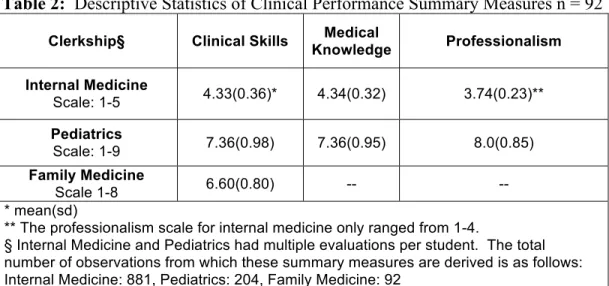
Internal Medicine, in which 75% of students received an average clinical skills rating of 4 or higher on a scale of 1-5. Despite different rating scales, (Table 2) ratings in each clerkship spanned approximately 60% of their possible range. The summary measures were derived from integer value ratings; therefore the individual evaluations in each clerkship took on the following whole numbers: Internal Medicine 3-5, Family Medicine 4-8, Pediatrics 5-9. These limited ranges created significant ceiling effects for the linear regression analysis.
Demographics Variables
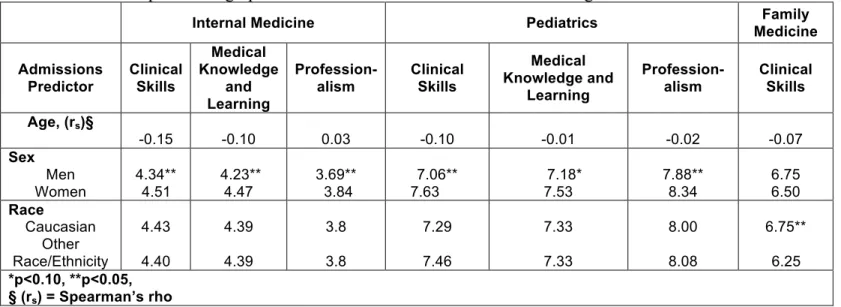
Table 3 presents the relationship between demographic variables and clerkship summary measures. Since most summary measures and predictor variables were not normally dispersed, these relationships were analyzed with parametric (ANOVA or t-tests) and non-parametric (Kruskal-Wallis or Wilcoxen rank sum) tests. Both methods of analysis gave similar results in terms of statistical significance (with one exception, discussed below). Means are reported here since they are more interpretable.
Table 4 shows the correlations between admission predictors and clinical performance summary measures. When treated as independent predictors, neither total MCAT scores nor BCPM correlated with average clinical ratings in any clerkship. In contrast, the composite academic achievement index correlated significantly with average clinical skills ratings in Family Medicine (rs = 0.23, p<0.05). This suggests a possible interaction between test scores and grade point average; in other words, the combination of these statistics may be more useful than either alone. Pediatrics ratings demonstrated the opposite trend; in this clerkship, scores on the non-academic index correlated significantly with clinical skills (rs = 0.22, p<0.05), and more weakly with medical knowledge and learning (rs = 0.19, p<0.10). Neither predictor index correlated with Internal Medicine clinical ratings.
Regression Analysis
Both admission indices and three demographic variables were entered stepwise into multiple linear regression models to predict ratings on the clinical performance dimension. Table 5 summarizes the standardized beta coefficients and the total proportion of variance explained by the combination of the variables. The unique proportion of the total variance explained by each predictor can be determined by comparing adjacent models. For example, race, sex, and the two admissions indices explained 17% of the variance in clinical skills ratings for Internal Medicine. Dropping race from the model, sex, the academic achievement index, and the non-academic index explained 14% of the variance in clinical skills ratings, suggesting that race accounted for 3% of the total variance in clinical skills ratings on this clerkship.
into account, men received, on average, clinical skills ratings that were 0.4 points lower than did women. Considering that 75% of students received scores within a 1-point range (either a 4 or 5 out of 5), this statistically significant difference translates to a practically meaningful difference in terms of the ratings. Sex was also important, albeit to a lesser extent, in determining clinical skills ratings in Pediatrics (standardized β = -0.23, p<0.05). Thus, men scored approximately one-fifth of a point lower on average than did women, controlling for other variables.
In contrast, clinical skills ratings in Family Medicine were influenced significantly by age (standardized β = -0.35, p<0.05) and race (standardized β = 0.17, p<0.10). This means that older students received lower ratings on average than did younger students; specifically, clinical skills ratings decreased by 0.35 points for each 1-year increase in age at matriculation. Regarding race, the beta coefficient means that Caucasians received scores nearly one-fifth of a point higher on average than did students of other races and ethnicities. Sex was not a statistically significant predictor of Family Medicine ratings.
Discussion
Demographic Variables
A common finding in the literature is that women tend to perform better than do men during the pre-clinical years and on clinical assessments. 40-43 This study’s results support that
trend. Sex was the only significant predictor of clinical performance across multiple clerkships. If women consistently performed better on average than men, one would expect this difference to be reflected the Family Medicine ratings as well. However, the lack of a correlation between sex and performance on this clerkship may reflect the low statistical power of this study rather the absence of a true difference.
Older age predicted lower ratings in Family Medicine; this finding is at odds with extant research. Studies have shown either no difference in performance between older and younger students, or that older students tend to outperform younger ones.40,44 Intuitively, this makes sense – one might expect older students to be more mature and have more work experience in a
professional setting than their younger counterparts.
Some evidence exists that ethnic minorities have a greater likelihood of academic difficulty than do non-minorities. 45,46 Therefore it is not altogether surprising that Caucasians
received higher average ratings than did students of other ethnic backgrounds in Family Medicine, but our definition of race was crude, and the study was not designed to detect differences in performance based on racial or ethnic background. The absence of interaction between race and ratings on the other clerkships makes it unlikely that race plays a stable or significant role in determining clinical performance.
In keeping with past studies, traditional measures of academic achievement had minimal predictive validity for clinical performance. Considered as independent predictors, BCPM and MCAT scores did not correlate with clinical performance ratings on any of the three clerkships. However, when combined, these measures were a significant predictor of performance in Family Medicine. This finding was not robust – i.e. not stable across clerkships – but nevertheless warrants attention. Previous work has shown that both grade point average and standardized test scores independently predict performance, and that the effects of these measures are additive. In contrast, this study implies an interaction between the two variables. Some evidence suggests that GPA may be a better indicator of work ethic than of native intelligence 47, In contrast, the MCAT is commonly thought of as more of an aptitude test, although it certainly requires discrete foundational knowledge. The two metrics likely reflect overlapping but distinct traits and
abilities. An effect-modification type interaction between the GPA and MCAT scores is both conceivable and worth further study.
performance ratings. Moreover, this was a pilot study using a single rater - a serious threat to validity of the findings. Therefore the results reported here must be interpreted with caution.
The marked range restriction in clinical ratings speaks to an underlying issue in the evaluation of clinical performance. The ratings clustered towards the upper end of their range and, in practical terms, served as a pass/fail standard rather than a fluid spectrum reflecting differential degrees of clinical competency. One explanation is that the vast majority of students truly performed above average, exhibiting only minor differences in competence. If this is the case, the ratings should be redesigned with greater sensitivity in their upper ranges. Alternatively and more likely, preceptors err on the side of grade inflation and simply do not give average or poor ratings unless there are glaring deficiencies in performance. Furthermore, clerkship
evaluations are standardized, but this does not minimize subjectivity on behalf of the preceptors. One would expect students of exceptional clinical skills to perform well across clerkships. However, only 4 out of 92 students received ratings above the 75th percentile on all three
rotations. This finding could reflect true differences in performance. For example, a student who performs well in Internal Medicine may not do as well in an outpatient setting and consequently receive lower ratings in Family Medicine. Residual confounding could also explain this finding: the analysis did not control for the effects of rotation number – e.g. the order of clerkships during the third year – a variable known to influence clerkship performance. These points
notwithstanding, since the student was the common denominator across clerkships, this variance likely issues from inter-rater subjectivity. The evaluation forms do contain comments to clarify each rating; still, one preceptor’s definition of “excellent” may be equivalent to another’s
common evaluation standards is a daunting and logistically challenging task. The time and space for workshops or formal training on evaluation is already scarce.
Perhaps the most intriguing finding is that non-overlapping variable sets predicted
performance in Family Medicine versus performance in Internal Medicine and Pediatrics. To our knowledge, no studies report an interaction between clerkship specialty and demographic
variables. Since race and age are not modifiable, one would expect their effect on performance (if one exists) to be stable across rotations, similar to the trend for sex discussed earlier.
Therefore the observed difference in this study may reflect artifacts of UNC’s third year curriculum. Superficially, the Internal Medicine and Pediatrics clerkships are more similar to each other than either is to the clerkship in Family Medicine. The former two are inpatient rotations that require teamwork with residents; the latter is exclusively outpatient based, and students work in a one-on-one format with a single preceptor. Reflecting these differences, there are multiple evaluations for students in Internal Medicine and Pediatrics but only a single
The underlying assumption in this study was that of linearity – a straightforward correlation between the admission indices and clinical performance ratings. While simplistic, this model mimics the rationale of the medical school admissions process, in which many screening criteria explicitly use a linear scale and imply a simple, dose-response relationship between predictor and future performance. For instance, it is generally assumed that an applicant who scores a 37 on the MCAT is a more desirable than is one who scores a 30, all other things being equal. However, our crude scale for rating academic achievement employed crude cutoffs. That this tool had predictive validity for family medicine ratings suggests that, above a certain threshold, the predictive validity of the test dissipates. In other words, moving from a score of 26 to 30 likely reflects a greater change than moving from a 36 to 40.
Moreover, professional performance of any type is influenced by personality, learning styles, life circumstances, and other contextual variables. Thus, while the linear model is easy to grasp, the relationship between preadmission variables and outcomes is considerably more complex. Most importantly, a linear model ignores qualitative differences among applicants. For example, in terms of medical exposure, both quantitative and qualitative differences between a student who has worked over 1,000 hours as an EMT and one who has shadowed physicians and worked at several health fairs should be considerable. In other words, it is not only the
References
1. Salvatori P. Reliability and validity of admissions tools used to select students for the health professions. Advances in health sciences education : theory and practice. 2001;6(2):159-‐175.
2. Donnon T, Paolucci EO, Violato C. The predictive validity of the MCAT for medical school performance and medical board licensing examinations: a meta-‐analysis of the published research. Acad Med. Jan 2007;82(1):100-‐106.
3. Julian ER. Validity of the Medical College Admission Test for predicting medical school performance. Acad Med. Oct 2005;80(10):910-‐917.
4. Albanese MA, Snow MH, Skochelak SE, Huggett KN, Farrell PM. Assessing personal qualities in medical school admissions. Acad Med. Mar 2003;78(3):313-‐321.
5. Siu E, Reiter HI. Overview: what's worked and what hasn't as a guide towards predictive admissions tool development. Advances in health sciences education : theory and practice. Dec 2009;14(5):759-‐775.
6. Callahan CA, Hojat M, Veloski J, Erdmann JB, Gonnella JS. The predictive validity of three versions of the MCAT in relation to performance in medical school, residency, and licensing examinations: a longitudinal study of 36 classes of Jefferson Medical College. Acad Med. Jun 2010;85(6):980-‐987.
7. Ferguson E, James D, Madeley L. Factors associated with success in medical school: systematic review of the literature. BMJ. Apr 20 2002;324(7343):952-‐957.
8. Kreiter CD, Kreiter Y. A validity generalization perspective on the ability of undergraduate GPA and the medical college admission test to predict important outcomes. Teach Learn Med. Spring 2007;19(2):95-‐100.
9. Silver B, Hodgson CS. Evaluating GPAs and MCAT scores as predictors of NBME I and clerkship performances based on students' data from one undergraduate institution. Acad Med. May 1997;72(5):394-‐396.
10. White CB, Dey EL, Fanone JC. Analysis of Factors that predict clinical performance in medical school. Advances in health sciences education : theory and practice. Oct 2009;14(4):455-‐464.
11. Alexander GL, Davis WK, Yan AC, Fantone JC, 3rd. Following medical school graduates into practice: residency directors' assessments after the first year of residency. Acad Med. Oct 2000;75(10 Suppl):S15-‐17.
12. Dirschl DR, Campion ER, Gilliam K. Resident selection and predictors of
performance: can we be evidence based? Clinical orthopaedics and related research. Aug 2006;449:44-‐49.
13. Boyse TD, Patterson SK, Cohan RH, et al. Does medical school performance predict radiology resident performance? Academic radiology. Apr 2002;9(4):437-‐445.
14. Harfmann KL, Zirwas MJ. Can performance in medical school predict performance in residency? A compilation and review of correlative studies. Journal of the American Academy of Dermatology. Nov 2011;65(5):1010-‐1022 e1012.
16. Papadakis MA, Hodgson CS, Teherani A, Kohatsu ND. Unprofessional behavior in medical school is associated with subsequent disciplinary action by a state medical board. Acad Med. Mar 2004;79(3):244-‐249.
17. Papadakis MA, Teherani A, Banach MA, et al. Disciplinary action by medical boards and prior behavior in medical school. The New England journal of medicine. Dec 22 2005;353(25):2673-‐2682.
18. Teherani A, Hodgson CS, Banach M, Papadakis MA. Domains of unprofessional behavior during medical school associated with future disciplinary action by a state medical board. Acad Med. Oct 2005;80(10 Suppl):S17-‐20.
19. Doherty EM, Nugent E. Personality factors and medical training: a review of the literature. Medical education. Feb 2011;45(2):132-‐140.
20. Donnon T, Paolucci EO, Violato C. A predictive validity study of medical judgment vignettes to assess students’ noncognitive attributes: A 3-‐year prospective
longitudinal study. Medical Teacher. 2009;31:e148-‐155.
21. Reiter HI, Eva KW, Rosenfeld J, Norman GR. Multiple mini-‐interviews predict clerkship and licensing examination performance. Medical education. Apr 2007;41(4):378-‐384.
22. Peskun C, Detsky A, Shandling M. Effectiveness of medical school admissions criteria in predicting residency ranking four years later. Medical education. Jan
2007;41(1):57-‐64.
23. Meredith KE, Dunlap MR, Baker HH. Subjective and objective admissions factors as predictors of clinical clerkship performance. Journal of medical education. Oct 1982;57(10 Pt 1):743-‐751.
24. Vu N, Dawson-‐Saunders B, Barrows H. Use of a Medical Reasoning Aptitude Test To Help Predict Performance in Medical School. Journal of medical education.
1987;62(4):325-‐335.
25. DeVaul RA, Jervey F, Chappell JA, Caver P, Short B, O'Keefe S. Medical school
performance of initially rejected students. JAMA : the journal of the American Medical Association. Jan 2 1987;257(1):47-‐51.
26. Elam CL, Johnson MM. Prediction of medical students' academic performances: does the admission interview help? Acad Med. Oct 1992;67(10 Suppl):S28-‐30.
27. Smith SR. Medical school and residency performances of students admitted with and without an admission interview. Acad Med. Aug 1991;66(8):474-‐476.
28. Hall FR, Regan-‐Smith M, Tivnan T. Relationship of medical students' admission interview scores to their dean's letter ratings. Acad Med. Dec 1992;67(12):842-‐845.
29. Murden R, Galloway GM, Reid JC, Colwill JM. Academic and personal characteristics as predictors of clinical success in medical school. Annual Conference on Research in Medical Education. Conference on Research in Medical Education. 1977;16:181-‐186.
30. Basco WT, Jr., Gilbert GE, Chessman AW, Blue AV. The ability of a medical school admission process to predict clinical performance and patients' satisfaction. Acad Med. Jul 2000;75(7):743-‐747.
32. Ferguson E, James D, O'Hehir F, Sanders A, McManus IC. Pilot study of the roles of personality, references, and personal statements in relation to performance over the five years of a medical degree. BMJ. Feb 22 2003;326(7386):429-‐432.
33. Urlings-‐Strop LC, Themmen AP, Stijnen T, Splinter TA. Selected medical students achieve better than lottery-‐admitted students during clerkships. Medical education. Oct 2011;45(10):1032-‐1040.
34. Benor D, Hobfoll SE. Prediction of clinical performance: the role of prior experience. Journal of medical education. Aug 1981;56(8):653-‐658.
35. Dawson-‐Saunders B, Doolen DR. An alternative method to predict performance: canonical redundancy analysis. Journal of medical education. Apr 1981;56(4):295-‐ 300.
36. Dickman RL, Sarnacki RE, Schimpfhauser FT, Katz LA. Medical students from natural science and nonscience undergraduate backgrounds. Similar academic performance and residency selection. JAMA : the journal of the American Medical Association. Jun 27 1980;243(24):2506-‐2509.
37. Hall ML, Stocks MT. Relationship between quantity of undergraduate science preparation and preclinical performance in medical school. Acad Med. Mar 1995;70(3):230-‐235.
38. Sade RM, Lancaster C. The relation of undergraduate major to medical school
admission and medical school performance. J S C Med Assoc. Jul 1983;79(7):401-‐404.
39. Smith SR. Effect of undergraduate college major on performance in medical school. Acad Med. Sep 1998;73(9):1006-‐1008.
40. Ramsbottom-‐Lucier M, Johnson MM, Elam CL. Age and gender differences in
students' preadmission qualifications and medical school performances. Acad Med. Mar 1995;70(3):236-‐239.
41. Mawhinney BS. The value of ordinary and advanced level British school-‐leaving examination results in predicting medical students' academic performance. Medical education. Mar 1976;10(2):87-‐89.
42. Oggins J, Inglehart M, Brown DR, Moore W. Gender differences in the prediction of medical students' clinical performance. J Am Med Womens Assoc. Nov-‐Dec
1988;43(6):171-‐175.
43. Weinberg E, Rooney JF. The academic performance of women students in medical school. Journal of medical education. Mar 1973;48(3):240-‐247.
44. Haist SA, Wilson JF, Elam CL, Blue AV, Fosson SE. The Effect of Gender and Age on Medical School Performance: An Important Interaction. Advances in health sciences education : theory and practice. 2000;5(3):197-‐205.
45. McManus IC, Richards P, Winder BC, Sproston KA. Final examination performance of medical students from ethnic minorities. Medical education. May 1996;30(3):195-‐ 200.
46. Campos-‐Outcalt D, Rutala PJ, Witzke DB, Fulginiti JV. Performances of underrepresented-‐minority students at the University of Arizona College of Medicine, 1987-‐1991. Acad Med. Jul 1994;69(7):577-‐582.
Table 1: Descriptive Characteristics of Study Population at Matriculation n=92
Table 2: Descriptive Statistics of Clinical Performance Summary Measures n = 92
Clerkship§ Clinical Skills Medical
Knowledge Professionalism Internal Medicine
Scale: 1-5 4.33(0.36)* 4.34(0.32) 3.74(0.23)**
Pediatrics
Scale: 1-9 7.36(0.98) 7.36(0.95) 8.0(0.85)
Family Medicine
Scale 1-8 6.60(0.80) -- --
* mean(sd)
** The professionalism scale for internal medicine only ranged from 1-4.
§ Internal Medicine and Pediatrics had multiple evaluations per student. The total number of observations from which these summary measures are derived is as follows: Internal Medicine: 881, Pediatrics: 204, Family Medicine: 92
Mean (sd) or N(%) Min Max
BCPM* 3.62 (0.32) 2.5 4.0
MCAT** 33(3) 24 42
Age 24(3) 20 38
Female 62(57%) - -
White 86(81%) - -
Total Academic Achievement
4.46(1.34) 0 6
Total Apps 10.5(2.28) 5 16
* BCPM is the cumulative grade point average on a 4-point scale for courses taken in Biology, Chemistry, Physics and Math
Table 3: Relationship of Demographic Variables and Clinical Performance Ratings
Internal Medicine Pediatrics Family
Medicine Admissions Predictor Clinical Skills Medical Knowledge and Learning Profession-alism Clinical Skills Medical Knowledge and Learning Profession- alism Clinical Skills
Age, (rs)§
-0.15 -0.10 0.03 -0.10 -0.01 -0.02 -0.07
Sex Men Women 4.34** 4.51 4.23** 4.47 3.69** 3.84 7.06** 7.63 7.18* 7.53 7.88** 8.34 6.75 6.50 Race Caucasian Other Race/Ethnicity 4.43 4.40 4.39 4.39 3.8 3.8 7.29 7.46 7.33 7.33 8.00 8.08 6.75** 6.25 *p<0.10, **p<0.05, § (rs) = Spearman’s rho
Table 4: Bivariate Correlations between Admissions Predictors and Clinical Performance Ratings
Internal Medicine Pediatrics Family
Medicine Admissions Predictor Clinical Skills Medical Knowledge and Learning Profession-alism Clinical Skills Medical Knowledge and Learning Profession-alism Clinical Skills
BCPM -‐0.12 -0.13 -0.11 -0.010 -0.04 -0.07 0.07
MCAT 0.06 -0.01 -0.03 0.02 0.05 0.05 0.17
Composite Academic Achievement
-0.08 -0.06 -0.09 0.01 0.02 0.02 0.23**
Composite Non-Academic Rating
0.06 0.05 0.05 0.22** 0.19* 0.17 0.11
*p<0.10 **p<0.05
Table 5: Multivariate Regression between Admissions Predictors and Ratings for the Clinical Skills Dimensions
Internal Medicine Pediatrics Family Medicine
Admissions Predictor
Model 1
Model 2
Model 3
Model 4
Model 1
Model 2
Model 3
Model 4
Model 1
Model 2
Model 3
Model 4
Age
-0.16 -- -- -- -0.09 -- -- -- -0.35** -- -- --
Race 0.23 0.24 -- -- -0.03 -0.04 -- -- 0.20** 0.23** -- --
Sex -0.39** -0.39** 0.34** -- -0.18 -0.19** -0.23* -- -0.08 -0.10 -0.03 --
Composite Academic
Rating
-0.10 -0.07 -0.07 -0.03 0.01 0.02 0.02 0.02 0.18* 0.23** 0.22** 0.22**
Composite Non-Academic
Rating
0.12 0.11 0.10 0.10 0.18* 0.18* 0.18* 0.18* 0.11 0.10 0.10 0.09
Overall R2 0.19 0.17 0.13 0.01 0.09 0.09 0.08 0.04 0.25 0.13 0.06 0.06
Appendix A: Systematic Review and Comprehensive Results
Methods
Search Strategy
A literature search was performed to identify the available evidence regarding
predictors of clinical performance within medical school. The literature generally uses the
terms ‘cognitive’ and ‘non-cognitive’ to refer to applicants’ academic achievement and
personal qualities or other traditionally less standardized, testable characteristics. These
terms therefore appear in this review. A recent systematic review and a meta-analysis
address academic, or ‘cognitive’ predictors of clinical performance including the MCAT
and GPA. 2,3 Therefore, this review sought to determine what is known about
‘non-cognitive’ predictors of clinical performance. I searched PubMED (MEDLINE) with the
following terms: selection OR admission OR non-cognitive AND (clinical performance
OR clinical success) AND medical school; school admission criteria AND (clinical
clerkship or non-cognitive). I also searched Web of Science using the terms: admissions
AND medical school AND clinical performance AND non-cognitive. Searches were
limited to English language articles. Given the paucity of literature on this subject, no
date limits were set on the searches.
Study Selection
The literature searches returned 141 unique articles. I reviewed the titles and
abstracts of these articles to identify research likely to address the study question. I
included articles if they represented original research, if the independent variables
measured aspects of the application other than standardized test scores and/or grade point
dependent variable was clinical performance. Given the scarcity of research on this
subject, I included studies of U.S. allopathic medical students as well as studies
conducted in medical schools outside the U.S. (e.g. the United Kingdom, Australia,
Canada, and Israel).
The focus of this review and the associated original study was to identify
non-academic qualities useful in the selection of medical students – i.e. prior to matriculation.
Therefore, studies that measured predictor variables after the start of medical school (e.g.
personality tests taken by 2nd or 3rd year students) were excluded. Since I aimed to
identify non-academic variables that correlate with undergraduate medical school
performance, I excluded studies that measured clinical performance only as an outcome
in residency. Articles that used achievement-based metrics (e.g. GPA and MCAT) as
independent variables were included as long as they also included a well-defined,
non-academic measure among the predictor variable set. I also excluded studies conducted on
non-medical school populations (e.g. dental school, nursing school, and other health
profession students). Finally, two studies were excluded because their full text was not
accessible through UNC databases. 48,49 A recent, well-conducted systematic review
examined the relationship between personality traits and clinical performance. 19 My
search did not identify any new studies beyond the publication date of this review;
therefore, I excluded articles that examined personality and clinical performance.
Data Abstraction and Quality Assessment
Through title and abstract review, 16 articles met the inclusion criteria. The
references of these articles were hand-searched and reviewed to yield an additional two
design, population studied, and by assessing the results and evaluating the internal and
external validity on a scale of poor, fair and good. Some studies measured outcomes
other than clinical performance, but only those results pertaining to clinical performance
were included. The internal validity, external validity, and the strength and
appropriateness of the statistical analysis were the primary criteria used to evaluate the
overall quality of each study.
Table 1 summarizes the included studies in terms of their research design, study
population, independent variables, outcome measures and results. It also presents the
overall quality assessment for each article based on the internal and external validity.
Results
Interviews
Characteristics of Reviewed Studies: Eleven studies published from 1978-2011
evaluated the correlation between interview ratings and clinical performance. Six of
these studies used a retrospective cohort design; five followed students prospectively
(need citations). Study populations ranged from 26 to 660 students. Seven studies were
conducted at U.S. allopathic medical schools23-25,27-30 three studies were conducted at
medical schools in Canada 20-22 and one study was conducted at an unidentified
institution.26 Overall quality ranged from poor to good. A variety of methodological
issues, which are discussed below, made it difficult to evaluate the internal validity of
several studies.
The independent variable of ‘interview ratings’ was considerably heterogeneous;
no two studies used the same interview format or rating system to evaluate applicants.
Interviews formats ranged from completely open-ended 25-27 to semi-structured. 20,21
Some studies provided elaborate detail regarding the interview process and scoring
methodology, 20,21,23,29 whereas others provided only an opaque description of what
comprised an interview rating. 25,27,30 This lack of transparency made it hard to assess the
potential for confounding.
Importantly, several studies specified that interviewers were blinded to applicants’
academic record and test scores during the rating process; others stated that interview
ratings included a composite assessment of personal qualities and academics (e.g
MCAT’s and uGPA) or did not specify. In such cases it was difficult to account for the
influence of academic achievement on the assessment of non-academic qualities.
Consequently, these studies bear a greater potential for bias.
The outcome of ‘clinical performance’ was measured in a number of ways:
preceptor ratings or narrative clerkship evaluations, OSCE scores, overall grades in
required clerkships, Dean’s letter ratings, and residency rankings.
Predictive Validity: The majority of included studies found low to moderate
correlations between interview ratings and clinical performance. The significance and
magnitude of these associations varied by both interview format and the criterion
measures used for clinical performance. I identified four distinct criterion measures for
clinical performance: narrative interviewer comments, clerkship grades, dean’s letter or
residency ranking, and OSCE scores. The study findings are grouped and reviewed
Studies that defined clinical performance in terms of narrative preceptor
evaluations or likert-scale clerkship ratings reported small to moderate correlations
between these measures and interview ratings (r = 0.2 – 0.6).20,21,23,24 Within this group of
studies, there was an interaction between interview format and clinical performance; in
general, structured interviews correlated more strongly with performance than did
unstructured interviews. The best evidence to support this conclusion comes from two
prospective studies that directly compared unstructured and structured interviews within
their respective study populations. 20,21Both studies found small, non-significant
correlations between unstructured interviews and clinical ratings. In contrast, both found
moderate, statistically significant correlations between structured interview scores and
clinical evaluations (r = 0.39-0.62). 20,21
Importantly, the associations between interview ratings and clinical performance
are likely underestimated given that all of the included studies examined only accepted
applicants. While the small number of studies reviewed doesn’t permit definitive
conclusions, these data suggest that structured interviews hold greater promise for
predicting future clinical performance than do unstructured interviews. Further studies
comparing unstructured vs. structured interviews are needed to confirm this trend.
Multi-school, prospective studies with larger numbers would also strengthen the validity and
applicability of these findings. None of the reviewed studies used the interview in the
actual selection of applicants (as one of the purposes of each study was to validate an
innovative interview method). Therefore, prospective studies employing structured
interviews to make admission decisions could more accurately estimate the ability of
In contrast, studies that defined clinical performance in terms of clerkship grades
reported minimal to no correlation between these measures and interviews ratings. 25-27
Among these studies, ‘clerkship grades’ refers to a composite grade based on subjective
clinical preceptor ratings and end-of-course examination scores. The extent to which this
combined outcome reflects medical knowledge and/or clinical skills – communication,
teamwork, and clinical reasoning, etc – is unclear. Given the strong evidence
demonstrating a lack of correlation between interview ratings and shelf-exam scores 21,23,
this combined outcome complicates the interpretation of the study findings.
All studies in this group25-27 used unstructured interviews. One fair quality study
compared the clinical performance of students who were accepted after interview to those
students who were initially rejected following the interview (but were later accepted
under unusual circumstances); the authors found no significant differences in clinical
performance between the groups. 25 Another fair quality study compared the performance
of students who were accepted using an interview as part of the admissions process to the
performance of students admitted without the use of an interview. 27 The authors
reported no differences in clinical performance between the two groups and proposed that
medical schools should consider eliminating the interview as part of the admissions
process. Notably, this institution still uses the interview in its selection efforts. 50 Both of
these studies were limited by a failure to eliminate selection bias and a small sample size.
Altogether, this group of studies suggests that unstructured interviews have little
practical value in predicting clinical performance. Higher quality evidence is needed to
confirm this conclusion. Prospective studies using validated, reliable interview methods
Three studies used proxy measures for clinical performance. Two of these studies
correlated interview ratings with used dean’s letter. 28,29 To the extent that dean’s letters
correlate with specific clinical performance measures, they can be taken as valid and
reliable surrogates for direct clinical performance ratings. Murden et al reported a
correlation of 0.77 between the dean’s letter rating and the clinical performance
evaluations; this study found a small correlation (r = 0.22, p< 0.01) between interviewer
ratings and dean’s letter rankings. 29 The other reviewed study did not report a
correlation between clinical performance ratings and dean’s letter ratings. 28 The authors
of this study reported a moderate correlation of (r = 0.37, p=0.014). These modest
correlations are not surprising given that the outcome was not a pure measure of clinical
performance but rather a composite metric that included contributions from preclinical
grades. Both of these studies were limited by small sample sizes. Additionally, these
correlations were found only for the extremes of the distribution and not for the entire
study cohort.
In a fair quality study, Peskun et al reported that interview scores correlated
significantly with family medicine rankings for graduating students. 22 The rationale for
using residency rankings as proxy measures of clinical performance is that these rankings
are heavily weighted towards perceived clinical skills. However, the authors reported the
slope of the linear regression model; thus, it is unclear whether this statistically
significant finding translates to a practically meaningful difference in clinical
performance or ability.
As a group, these studies suggest that interviews can capture some enduring traits
with studies that used narrative preceptor comments as the clinical performance criterion.
However, given their quality and design, these studies do not provide convincing
evidence that interviews can predict clinical performance.
Several studies used OSCE scores as measures of clinical performance. 21,22,30
Two fair quality studies reported no significant correlations between interview ratings
and clinical performance 22,30 Neither of these studies used structured interview formats,
and one of the studies was underpowered (60% power to detect a 15% difference). 22,30
Interestingly, a good quality study by Reiter et al found no correlation between
unstructured interview ratings and OSCE scores but a significant correlation between
structured interview ratings and OSCE scores (standardized beta = 0.4, p<0.05). 21 The
authors did not discuss the extent to which the beta coefficient translates to a practical
difference in overall performance or final grades therefore. Still, this finding echoes the
trend described earlier among studies that used narrative preceptor comments as the
clinical performance metric – the more structured the interview, the stronger its
predictive validity for clinical performance.
The inconsistent correlations and variable quality of evidence do not permit firm
conclusions about the overall predictive power of interviews for clinical performance.
Nonetheless, several inferences stand to reason. The predictive validity of interviews
varies significantly according to both the interview format and the criterion measure of
clinical performance. If interviews are used to anticipate clinical performance,
structured, rather than unstructured interviews, are preferable.
Interestingly, all included studies that found weak correlations between interview
use in selecting applicants. However, this conclusion presupposes the validity and
reliability our clinical assessment tools – in reality the lack of correlation among these
measures is likely bidirectional. In other words, the clinical assessment tools used in
these studies may not be sensitive and specific measures of performance. Therefore, this
group of studies points to the need to develop both more sophisticated interview tools as
well as better methods of clinical assessment.
Research demonstrates that both OSCE scores and preceptor ratings positively
correlate with residency director ratings. 31 It is therefore interesting that interviews
correlate differentially with preceptor ratings and OSCE scores. OSCE’s are more
standardized and lend themselves to discrete (often correct vs. incorrect) responses
whereas personal interviews tend to be more open-ended and permit and array of equally
meritorious answers. In addition, OSCE’s test a limited range of clinical skills whereas
preceptors often asses a wider range of abilities. Therefore, one hypothesis to explain this
observation is that the method of assessment (standardized vs. open-ended) influences the
relationship between predictor and outcome. The finding that that structured interviews
correlated with OSCE scores whereas unstructured interviews supports this hypothesis.
Components of Medical School Application: Biographical Sketch, Letters of References, and the Personal Statement
Characteristics of Reviewed Studies: A handful of studies examined the
relationship between clinical performance and various components of the medical school
application including the biographical sketch, letters of reference, and the personal
statement. 21,22,32,33 Most of these studies used a ‘non-cognitive assessment’ as the