Hilary Zelko. Reasoning About Relevance. A Master’s Paper for the M.S. in I.S degree. April, 2013. 51 pages. Advisor: Diane Kelly
This study focuses on how non-expert assessors judge relevance guided by mental models of relevance developed and applied during the assessment process. Components of relevance models are identified as well as challenges and changes associated with their construction and use. Study participants evaluated the relevance of news articles with respect to an assigned search topic. They commented on their reasoning in assessing each article, challenges they experienced in determining relevance and changes in their ability to assess relevance over the course of the evaluation session. Content analysis of these comments revealed that relevance models are derived from participants’ understandings of the search topic, the documents they viewed and the relationships between them. Relevance manifestations (topical, situational, cognitive) and criteria (information scope, specificity and detail) guide the development and application of the relevance models, which may also be influenced by situational, cognitive and motivational factors.
Headings:
Information Retrieval
Relevance Assessment
REASONING ABOUT RELEVANCE
by Hilary Zelko
A Master’s paper submitted to the faculty of the School of Information and Library Science of the University of North Carolina at Chapel Hill
in partial fulfillment of the requirements for the degree of Master of Science in
Information Science.
Chapel Hill, North Carolina
April 2013
Approved by
Table of Contents
Table of Contents ... 1
Introduction and Literature Review ... 2
1.1 Definitions and Conceptualizations of Relevance ... 2
1.2 Relevance Assessment Criteria and Dynamics ... 5
1.3 Mental Models ... 10
Methods... 15
2.1 Study Participants ... 17
2.2 Data Collection ... 17
2.3 Participant Demographics ... 18
2.4 Data Analysis ... 19
Results ... 20
3.1 Prior Knowledge, Searches and Interest in the Topic ... 20
3.2 Confidence in Relevance Assessments ... 22
3.3 User Relevance Ratings ... 22
3.4 Reasoning about Relevance ... 23
3.5 Challenges in Assessing Relevance Levels ... 28
3.6 Changes in Assessment Abilities over Time ... 32
Discussion & Limitations ... 35
Conclusion ... 41
Bibliography ... 43
Appendix A: Topics ... 47
Appendix B: Pre-Test Questionnaire ... 48
Introduction and Literature Review
Ever since Cleverdon (1966) conducted the first evaluations of information
retrieval systems in his Cranfield experiments, relevance has been a central concept used
by IR researchers to understand the information search process as well as to design and
evaluate IR systems. Relevance after all, is at the heart of information search, which is
predicated on the identification and selection of information that is “relevant” to a
searcher’s information need or search task. But, what does it actually mean for
information to be “relevant” to a need or task? How do people decide what is relevant
and what are the most important factors that guide these decisions? Efforts to answer
these questions have lead to a multitude of conceptualizations of relevance and no single
all-encompassing definition or theory has been adopted, though IR researchers today
accept that relevance is multidimensional, situational and dynamic (Borlund, 2003;
Schamber, Eisenberg & Nilan, 1990; Saracevic 2007a; Saracevic 2007b).
1.1 Definitions and Conceptualizations of Relevance
Definitions and conceptualizations of relevance abound in the field of IR and
extensive reviews have been written that analyze the different theories, types, aspects or
manifestations of relevance (Schamber et al., 1990; Mizzaro, 1998; Cosijn and
Ingwersen, 2000; Saracevic, 2007a; Hjorland, 2010; Huang and Soergel, 2013). In
Saracevic’s highly influential and widely cited review of the nature and manifestations of
relevance (2007a), he draws on his earlier work as well as that of Cosijn and Ingerwersen
relevance including algorithmic, topical, cognitive, situational and affective. Algorithmic
relevance is associated with the behavior of the search system that is designed to identify
matches between queries and a corpus of documents. Topical relevance is concerned with
the “aboutness” or subject matter relationship between a query and a corpus of
documents. It can either be associated with the behavior of a system or the humans that
interact with the system. Cognitive relevance refers to the relationship between a user’s
“cognitive state of knowledge” and the information within documents or other
information objects. It is associated with criteria such as informativeness, novelty, and
quality. Situational relevance is the relationship between the situation, task,
problem-at-hand and the information objects retrieved. It pertains to things like usefulness for
decision-making and uncertainty reduction. Finally, affective relevance is the relationship
between the intents, goals, motivations of the user and the information retrieved.
Saracevic noted that affective or motivational relevance may not be a separate
manifestation, but rather underlie other types of relevance, particularly situational
relevance.
Saracevic states, “relevance is a tangled affair involving interaction between and
among a host of factors and variables” (2007a, p. 1926). He explains that there has been
a divide in the research literature between system-based views of relevance and
user-based views of relevance. The system view is primarily concerned with algorithmic or
topical relevance, which is achieved by matching query terms or concepts to documents.
The user view focuses on topical, cognitive, situational or affective relevance which may
involve a variety of cognitive/psychological, or contextual factors that shape how human
they encounter at a particular time and in a particular situation or context. In an effort to
bridge the divide between these two perspectives, Saracevic proposed a stratified model
that represents relevance “in terms of a set of interdependent, interacting layers...”
(2007a, p. 1926) consisting of different “elements” or “processes” pertaining to humans
and computers that shape the search process. Furthermore, different types of “relevances”
are manifest in the different interdependencies or “relations” between these different
strata (2007a). While the model has appeal for its integrative characteristics and has been
embraced by many researchers, it has been difficult to operationalize and a challenge to
specify exactly how these different types of relevances interact during the search process.
More recently, Huang and Soergel (2013) proposed a conceptual framework
focused on topical relevance, which they argue “lies at the heart of” relevance (p. 18).
Huang and Soergel emphasize the relational aspects of relevance discussed early on by
Saracevic and incorporate situational and dynamic aspects identified by user-based
researchers. Taking to heart Hjorland’s (2010) criticism of the system/user dichotomy,
they make an important distinction, not between systems and users, but rather between
“relevance-as-is” and “relevance-as-determined” in order to “separate the conceptual
definition of relevance from the measurement aspects of judging relevance or the
operational aspects of computing relevance scores” (Huang and Soergel, 2013, p. 20).
Relevance-as-is is a “relationship between an information object and a user's information
need such that the information object has the potential of providing assistance in solving
a problem, performing a task, producing a new document, learning about a given topic,
satisfying curiosity, providing entertainment and so on” (p. 20). Relevance-as-is cannot
which is “the result of the assessment or determination of relevance-as-is by a
determining agent (person or computer system) based on representations of the
information object and the information need made before, during or after use of the
information” (p. 20). In Huang and Soergel’s (2013) model, information objects can
include text or multimedia documents, images, speech, database tables, etc. and may be
represented in a variety of ways such as title, author, abstract, passage, full-text etc.
Information needs are complex and may include a topic or subject, user variables such as
domain knowledge, search experience, cognitive style, problem/task variables such as
purpose/intent/goal, task complexity, and situation/context variables such as situational
constraints, and broader social/economic context. Determining agents may be people
(subject matter experts, end users) or computer systems. The strength of this model is that
it integrates a number of different conceptualizations of relevance that have been
discussed in the literature and distinguishes between the definition of relevance and the
process of determining relevance which depends on variable factors associated with
representations of information needs and objects. In this study, the focus is on the
relevance assessment process in an effort to better understand
“relevance-as-determined.”
1.2 Relevance Assessment Criteria and Dynamics
Understanding the process of relevance assessment and the impact it has on the
evaluation of IR systems has been an ongoing challenge in the field of IR. The
experimental evaluation paradigm that began with Cranfield and evolved through Text
judgments and adopted a set of five core assumptions about relevance judgments
(Saracevic, 2007b) that consisted of the following premises:
1. relevance judgments involve identifying a topical match between a query and information object
2. information objects are relevant or not relevant (binary)
3. relevance judgments can be made independently of one another
4. relevance judgments are stable and don’t change significantly over time 5. relevance judgments are generally consistent and don’t vary significantly across judges
Clearly, these assumptions are problematic and even early IR researchers (Cleverdon,
1970; Cuadra & Katter, 1967a; Cuadra & Katter, 1967b; Rees & Schultz, 1967)
recognized that relevance judgments were variable and shaped by a wide variety of
factors. Saracevic (2007b) documents a wide range of IR studies that challenge each of
these assumptions. For example, he cites studies by Wang and Soergel (1998), Xu and
Chen (2006) and Xu (2007) that found factors such as quality, novelty, and
understandability to be important aspects of relevance judgments in addition to topicality.
Other studies (Eisenberg, 1998; Janes, 1993; Spink, Greisdorf & Bateman, 1998) found
evidence that people understand relevance along a continuum that includes degrees or
levels of partial relevance. This nuance is not captured in binary relevance assessment
and it has been suggested that graded or scaled measures of relevance should be used
(Kekӓlӓinen & Jӓrvelin, 2002). A number of studies have found that relevance judgments
are not independent and may vary depending on the ordering or size of documents
presented (Eisenberg & Barry, 1988; Huang & Wang, 2004; Xu & Chen, 2006). In
response to many of these challenges, IR researchers today are looking more closely at
impact that variation has on relevance ratings and evaluation measures (Bailey, 2008;
Yilmaz, 2012). A recent study of relevance assessment by Scholer, Kelly, Wu, Lee and
Webber (2013) found that threshold priming (seeing varying degrees of relevant
documents) impacted relevance assessments such that long sequences of irrelevant
documents caused assessors to lower their thresholds and provide higher average
relevance ratings than those who were exposed to highly relevant documents early in the
assessment process. However, these effects diminished as people adjusted or
“re-calibrated” their internal relevance models upon encountering documents with more
diverse relevance levels. Scholer et al. (2013) also found a low level of self-agreement in
ratings among individuals over time, which they suggested could either be a result of
changes in peoples’ internal relevance models or a result of other situational factors such
as mental fatigue.
To better understand how the relevance assessment process actually works and
how variations in relevance ratings come about, a number of researchers have examined
relevance criteria that people draw on when assessing relevance. This area of research
was inspired by the early work of Cuadra and Katter (1967) and Rees and Schultz (1967)
who identified many factors that shaped relevance judgments of expert judges and was
advanced by Schamber et al. (1990) who focused on how non-expert end-users evaluated
relevance in the process of search. These studies lead to the identification of numerous
variables that were associated with the information objects being evaluated (type, subject
matter, level of difficulty), characteristics of the judges (experience, background,
knowledge) and judgment conditions (time available, order of presentation, document
Schamber (1990, 1994), Park (1993), and Cool, Belkin and Kantor (1993) were
among the first to explore relevance criteria among non-experts or “users” of IR systems
as part of a larger effort to move outside of the traditional experimental paradigm and
identify cognitive, dynamic and contextual factors that shape the interactions people have
with systems during search. They identified a multitude of relevance criteria that were
associated with user characteristics, the search topic/task, or the information
objects/documents retrieved. Park (1993) identified 3 broad categories of factors
including: 1) internal context or characteristics of users such as expertise in the problem
area, previous research experience, education, 2) external context or aspects of the search
such as goals or anticipated end product of search, stage of search, priority of information
needs and 3) problem context or characteristics of the information problem such as
intended use of the citation, and repetitiveness of information. Schamber (1991) grouped
criteria based on aspects related to the information objects such as accuracy, specificity,
and reliability. Cool et al. (1993) grouped criteria associated with both the user and the
information objects. In an effort to identify the most important factors, Barry and
Schamber (1995) compared criteria across their studies and identified areas of overlap
including depth/scope/specificity, accuracy, clarity, and currency, which also
corresponded with criteria, identified by Cool et al. (1993) and Park (1993). Recognizing
the impracticality for further research of having so many different criteria and the lack of
a consensus regarding the most important factors, Xu and Chen (2006) drew on Grices’
theory of communication and earlier relevance work to conduct a factor analysis that
identified a set of core relevance judgment criteria including, topicality, novelty,
to be the most significant factors. In a recent study using the TREC legal track, Chu
(2011) found that topicality was the most important relevance criterion.
Relevance criteria have also been used to shed light on the dynamics of relevance
assessment and “can be tied to changing cognitive states of users and changing situations
involving users in the dynamic process of information retrieval” (Schamber et al.,
1990). Taylor, Zhang and Amadio (2009) looked at how people may rely on different
kinds of relevance criteria depending on their stage in the search process. For example,
they found that people cited specificity as an important criterion early in the search
process, while novelty become became more important later on. Taylor (2012) extended
this work with a more detailed model of information search stages and found again, that
different criteria were employed at different stages. However, for Taylor, changing
relevance criteria are not important so much for what they say about the dynamics of
relevance assessment per se, but rather that they reflect changes in peoples’ cognitive
states. He states, “As users retrieve documents, they make relevance judgments about
documents reviewed based on various criteria. As the users’ cognitive state changes, the
criteria, which are important to their relevance judgments, may also change... Identifying
associations between relevance criteria choices, relevance judgments, and search stage
would provide insights into changes in the users’ cognitive state” (2012, p. 136-137).
While relevance criteria are certainly important factors in relevance judgments
and good indicators of changing cognitive states during search, the work focused on
criteria so far does not really explain what these cognitive changes entail, how they shape
(Tang & Solomon, 1998; Zhang, 2008). How is a mental model of relevance formulated?
How might that model change as people encounter and integrate new information?
1.3 Mental Models
Kenneth Craik first used the term mental model in 1943 to describe a “small
scale” internal representation of reality used in human reasoning. The concept was later
elaborated by Philip Johnson Laird who defined it as “...an iconic representation that is a
structural, behavioral, or functional analog of a real-world or imaginary situation, event,
object, or process” that is used to interpret and reason about the world (as cited in
Nersessian, 2008). Mental models have been used in a wide variety of fields such as
education, organizational behavior, and medicine to explain learning, reasoning and
decision-making.
Mental models have been investigated in the human computer interaction (HCI)
and information retrieval (IR) literatures primarily to understand how people learn and
use information systems. This work has generally been directed toward improving the
design of information systems as well as enhancing peoples’ understanding and ability to
use information systems. Borgman (1983) looked at how mental models could be used in
training users about a system, which she later found enhanced people’s search
performance. In her study of web searching behavior, Slone (2002) found that mental
models shaped peoples’ search approaches, the web sites they visited and the sources
they used. Westbook (2006) provided a theoretical overview of how mental models could
be applied in information studies research more generally and presented results from an
exploratory study that looked at patterns and components of mental models for
a definition that focused on how people represented and modeled information systems
and how those models impacted the information seeking process more generally. In a
user study focused on how mental models were constructed during web-based search,
Zhang (2008) found that models were constructed based on both peoples’ internal
cognitive states and external factors such as the system and the search task. She also
found that mental models were dynamic and early models shaped the development of
later models.
Tang and Solomon’s (1998) study of the dynamics of relevance judgment is one
of the few that explicitly uses the concept of mental models to explore how relevance
judgments change during the search process. Using a naturalistic, case study approach
with one searcher they explore from a “cognitive and situational perspective how
relevance judgments evolve during the information retrieval process (1998, p.
254). While they find evidence of a “dynamic model of relevance” (p. 254) that evolved
as their participant developed topical knowledge, they neither specify the components of
the model nor how the relevance criteria fit in. Like Taylor (2012), they see changing
relevance judgments and changing relevance criteria as indicators of “cognitive
restructuring” but it is unclear what those cognitive structures consist of and how they
might shape and be shaped by the relevance assessment process.
What are the components of a relevance model, how is it formed and transformed
during the assessment process? Drawing on Huang and Soergel (2013) we can imagine a
mental model of relevance that might involve a topic or need component based on an
assessor’s understanding or internal representation of the information need or a search
object encountered and a relationship component in which a relevance relationship is
identified between the topic and object In the process of determining relevance, the
relationship between topic and object is evaluated to determine the extent or degree to
which the information encountered is relevant. If there is a large portion of content in the
document that is related to the topic or need, then a higher relevance rating is likely,
whereas documents with few contents addressing the topic would likely receive marginal
or not relevant scores (Borlund, 2003). Of course with each encounter of a new
document, there may be iterative modification of the model’s topic component, the object
component, or the relationship component, leading to adjustments in the relevance model
as one progresses through a search. As Belkin (1982) has shown many search processes
begin with “anomalous states of knowledge” in which a person has an ambiguous
understanding of what they might be looking for and what kind of information may be
relevant. As a result, they are likely to have a partially formed relevance model or
possibly no model at all. As they develop topical knowledge, the relevance model may
become clearer or more elaborate which could enhance a person’s ability to identify a
relationship (or lack thereof) between new information encountered and the topic of
interest.
Because the relevance model may be adjusted as people encounter new
information objects, it is likely that situational factors such as the type or sequencing of
information presented may impact the contents, scope or application of the relevance
model at any given time. For example, if documents that are highly relevant and rich in
information about the topic are presented early in the process, a user may construct a
marginalize documents with redundant information later on. This constitutes a “learning
effect” (Xu & Wang, 2008; Harter, 1992) that may lead a person to use “more stringent
topicality and novelty standards in judging documents in later stages as the user looks for
more specific, more pertinent documents” (Xu & Wang, 2008, p. 1267). The learning
effect may impact the degree of relevance that is determined at a given point in time as
well as over time. On the other hand, as people read documents and learn about a topic,
their information needs are satisfied and they could become less motivated to continue
searching or reading about a topic. At the same time they are using up cognitive
capacity, which could lead them to be less thorough in their assessment toward the end of
the search process (Xu & Wang, 2008). This can result in what Xu and Wang (2008)
refer to as a “cursoriness effect” in which documents encountered at the end of a search
session might be evaluated on less stringent criteria because of fatigue, lower motivation
and drained cognitive capacity that may set in during the course of a session. Therefore,
the ordering of information during search may significantly shape how quickly and
elaborately the relevance model is constructed and how it is applied at different points
during an evaluation session.
Other situational factors such as peoples’ existing knowledge about or interest in
the search topic can affect how they judge relevance (Ruthven et al., 2007). Peoples’
confidence in their relevance assessments may also be associated with the numbers of
relevant documents identified and the level of relevance (Ruthven et al., 2007). The idea
that situational factors may impact relevance judgments is not new. Drawing on Park
(1992; 1993), Harter (1996) explains that because relevance judgments are shaped by the
that conceptualization is shaped by the citations encountered during search: “Thus,
relevance of an individual citation [document, information object] is time-, order-, and
situation-dependent” (1996, p. 39).
In this study, the focus is on how people develop relevance models that inform
their decisions about relevance, the challenges they experience in developing or applying
the models and the changes that occur in their models over time. In essence, that goal is
to gain insight into “relevance-as-determined” (Huang and Soergel, 2013) by people
during the process of assessing relevance by examining the reasons they use to explain
their judgments as they evaluate a set of documents. These insights may help us to better
explain the dynamics and variability of relevance assessments and guide how systems can
Methods
The study was designed as a between subjects laboratory experiment with three
conditions which varied in the number of non-relevant, marginally relevant and highly
relevant documents that were presented. Initially one of the goals was to examine
whether peoples’ relevance models evolved differently according to condition, but due to
time constraints and the large number of qualitative responses, the data were analyzed as
a set rather than by condition.
All subjects were provided with one of three different search topics and then
asked to evaluate a set of 48 newspaper articles with respect to the topic description. The
three search topics, 385 (hybrid auto engines), 396 (sick building syndrome) and 415
(drug trafficking) were selected from a subset of the Trec-7 and Trec-8 collections
developed by Sormunen (2002). The topic statements are included in Appendix A.
Topics were chosen based on several factors. First, articles on the topic had to represent a
sufficient mix of relevance levels. Second, topics that were unlikely to be familiar to
study participants were chosen to minimize variation in existing knowledge participants
might have about the topic. Finally, topics were chosen for their potential interest to
study participants. Articles were presented one at a time and participants were asked to
rate them using a 4-point categorical scale: not relevant, marginally relevant, relevant and
highly relevant. Definitions for each relevance category were provided by the system.
The experimental conditions were embedded in the list of articles presented to
study participants. Variations in the treatments occurred within the first twenty
documents shown to participants. Ten of the documents were non-relevant documents
documents were anchored in the same position, but varied across treatments. In the first
treatment, 10 non-relevant documents appeared in these positions. In the second
treatment, 10 marginally relevant documents appeared in these positions and in the third
treatment, 10 relevant or highly relevant documents appeared in these positions.
Participants were told that the documents were not in rank order according to relevance,
but rather represented a random subset of documents retrieved by the search system. The
21st-48th articles shown to subjects were exactly the same, regardless of treatment and
consisted of a mixture of documents with each of the 4 relevant rating types
(non-relevant, marginally (non-relevant, relevant and highly relevant) and three duplicate documents
in positions 46, 47 and 48. The search topic and the documents came from a previously
developed test collection, where several ‘oracle judges’ determined the relevance of the
documents for each topic using the 4-point scale described above.
In addition to providing a relevance score, participants were asked to provide
comments explaining their score and describe any changes they noticed about how they
assessed the relevance of documents. These comments were analyzed using content
analysis techniques in order to identify patterns and themes in users’ relevance models
during the evaluation.
A pre-test questionnaire was used to gather data for several contextual variables
including familiarity with the topic, number of previous searches on the topic, interest in
the topic and relevance of the topic to one’s life. An exit questionnaire gathered basic
demographic information (gender, age, level of schooling, major) and asked participants
to comment on aspects of the relevance assessment process that were challenging as well
evaluation. These comments were analyzed using qualitative content analysis techniques
in order to better understand any factors that shaped the formulation and application of
users’ mental models of relevance.
2.1 Study Participants
Thirty-six study participants were recruited from the University of North Carolina
Chapel Hill student body using a mass email to the student listserv. Participants were
given a choice to enroll in one of six 1.5 hour evaluation sessions conducted over a
period of one week. All participants were compensated $15.00 for their participation.
2.2Data Collection
Upon arrival to the session, the researcher briefed participants on the goals of the
study and ensured them that all data collected would remain confidential. Participants
were given an informed consent form that acknowledged: that participation was
voluntary, that participation might cease at any time and that the privacy of identification
would be safeguarded. Each participant was given the URL for the online assessment
system and a unique study ID and log-in. Participants were randomly assigned to
treatments using a random number generator. The researcher addressed participant
questions before the evaluation began.
Each participant completed a brief online training session built into the relevance
assessment system to learn about the evaluation task and how to use the system. They
then completed a pre-test questionnaire (see Appendix B) designed to gather information
about previous searches they had conducted about the topic, knowledge and interest in
As mentioned above, all participants were presented with 48 documents. They
were asked to rate the relevance of each document on a 4-point categorical scale as well
as select any portions of the documents that were relevant to the topic using a copy and
paste function built into the system. In order to better understand how participants arrived
at their relevance rating, all participants were given the following instruction:
Please enter comments about why you chose this particular relevance level for the document. You might like to include reflections about your decision-making process, or if you have any difficulties in coming to a decision. If you selected text segments in Step 2, you might like to include a short explanation of how they helped your relevance decision.
After assessing all documents, participants completed an exit questionnaire (see
Appendix C) where they were asked to rate their confidence in their relevance
judgments, explain any difficulties or challenges in determining the relevance of
documents, as well as any differences in their assessment process between the beginning
and the end of the session. Finally, participants provided basic demographic data
including age, gender, student type (graduate, undergraduate, other), and major and
whether or not they were native English speakers.
2.3 Participant Demographics
All participants except for two were native English speakers. The sample was
composed of twenty-three females (64%) and thirteen males (36%). Twenty-eight (78%)
participants were undergraduate students and eight (22%) were graduate students.
Participant age ranged from 19 to 49 years old, though most participants (78%) were
between the ages of 19 and 21. A wide variety of majors were represented across the
Professional School (33%). Some participants listed two majors, so they were counted
once for each major, which resulted in a total of 42 responses.
2.4Data Analysis
Qualitative content analysis is a research method used for interpreting text data
through the “systematic classification process of coding and identifying themes or
patterns” (Hsieh, 2005). It involves an inductive reasoning approach that allows
categories, patterns or themes to “emerge from the data through the researcher’s careful
examination and constant comparison” (Wildemuth, 2009, p. 309). A major advantage of
this approach is that it does not impose preconceived categories on the data and
information generated from the analysis is based on participants’ perspectives and
grounded in the data (Hsieh, 2005).
The units of analysis in this study included participant comments explaining the
relevance rating for each document as well as open-ended responses to two questions
from the exit questionnaire that asked about challenges experienced in determining the
relevance level and any differences experienced in assessing relevance from the
beginning of the evaluation session to the end.
All comments were iteratively reviewed and coded for emerging themes and
patterns. Multiple reviews of the data were conducted to identify codes and categories
that emerged from the raw data and were not pre-determined. Categories were then
examined to determine to what extent they exemplified or contradicted existing concepts
Results
3.1 Prior Knowledge, Searches and Interest in the Topic
This section includes results from the pre-test questionnaire that asked about
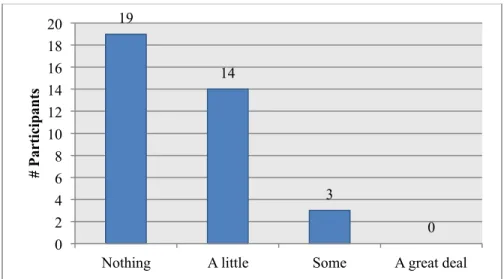
participants’ prior knowledge, searches and interest in the topic. As shown in Figure 1,
the vast majority of participants (92%) had little or no prior knowledge about the topic
they were assigned.
Figure 1: Knowledge about the topic
In addition to not knowing about the assigned topics, most participants (91%) had
never searched for information about the topic as shown in Figure 2.
Figure 2: Past Searches on the topic 19 14 3 0 0 2 4 6 8 10 12 14 16 18 20
Nothing A little Some A great deal
# P ar ti ci p an ts 29 6
1 0
0 5 10 15 20 25 30 35
Never 1-2 times 3-4 times 5 or more times
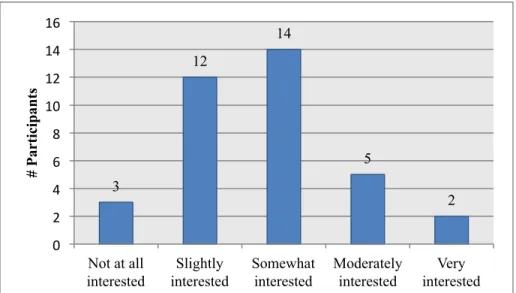
Despite having no knowledge and never having searched on the topics, a large majority
of participants expressed some level of interest in the topic as shown in Figure 3, though
most felt the topic was only slightly or not relevant to their lives as shown in Figure 4.
Figure 3: Interest in Topic
Figure 4: Relevance to ones' life 3
12
14
5
2
0 2 4 6 8 10 12 14 16
Not at all interested Slightly interested Somewhat interested Moderately interested Very interested # P ar ti ci p an ts 13 10
6 6
1
0 2 4 6 8 10 12 14
3.2 Confidence in Relevance Assessments
As part of the exit questionnaire administered at the conclusion of the evaluation
session, participants were asked to rate how confident they were in the relevance
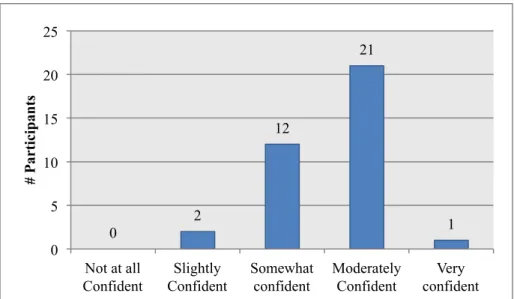
judgments they made during the session. As shown in Figure 5, the majority of
participants (58%) were moderately confident in their judgments while one third of
participants were somewhat confident. Only one person felt highly confident in their
judgments, which aligns with the qualitative findings that indicate the process of
assessing relevance is far from straightforward and often challenging.
Figure 5: Confidence in Relevance Assessments
3.3 User Relevance Ratings
Participants rated each document using a categorical scale of Not Relevant,
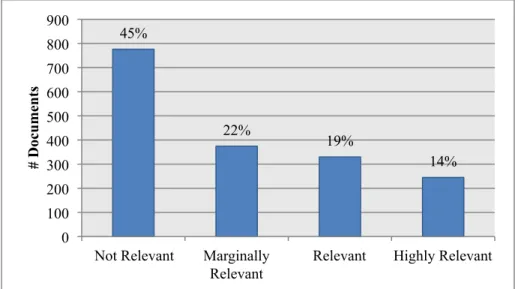
Marginally Relevant, Relevant and Highly Relevant. The distribution of each rating
across all participants and all documents is shown in Figure 6. Overall, 45% of
documents were rated as not relevant while 55% were rated as relevant to some degree.
0 2
12 21 1 0 5 10 15 20 25
Among those rated as relevant, documents were most frequently rated as “marginally
relevant” (22%) and least frequently rated as “highly relevant” (14%).
Figure 6: User Relevance Ratings
3.4Reasoning about Relevance
In addition to rating the level of relevance of each document with respect to the
specified search topic, participants explained the reasoning behind their rating. Each
participant evaluated 48 documents for a total of 1729 documents in the study. While
participants were asked to provide a comment for each document, the system allowed
them to proceed to the next document without leaving a comment. There were a total of
1447 comments provided by all study participants. Overall, the comment response rates
for each participant were high, suggesting that most participants took the task seriously.
Twenty-four participants (67%) provided comments for at least 95% of the documents
they evaluated, eight participants (22%) provided comments for 50-94% of documents
45%
22%
19%
14%
0 100 200 300 400 500 600 700 800 900
Not Relevant Marginally
Relevant
Relevant Highly Relevant
# D
oc
u
me
n
and four participants (11%) provided comments for less than 50% of the documents they
evaluated.
Content analysis of these open-ended comments revealed several patterns in the
way people model relevance that were shaped by their understanding of the topic and its
various facets as well as the information presented in the documents and its relationship
to those facets. While the study design emphasized topical relevance it was clear that
participants drew on other kinds of relevance such as situational, cognitive and affective
in making their assessments. Also, a few key relevance criteria including level of detail
or specificity, information scope and information type were frequently cited in
participants’ reasoning about their relevance ratings.
It was evident from participants’ explanations that their understanding of the topic
statement was a key component of their relevance models. This topic component
consisted of various aspects or facets that included a “main topic” (i.e. hybrid engines,
sick building syndrome, drug trafficking) and various “subtopics” or “subthemes” (i.e.
health effects of sick building syndrome, costs to consumers of hybrid engines), which
were inferred from the specific keywords and concepts expressed in the topic statement.
Documents were evaluated based on the extent to which they were “about” or
“addressed/discussed” either the main topic and some or all of the different “subtopics”.
Aside from stopwords such as “and”, “the” and “to” the term “about” was the most
frequently used term in the explanations. Participants frequently specified which aspects
of the topic were addressed and which were not. For example, one participant wrote, “It
addresses most of the sub-topics with good detail but doesn’t cover health benefits or
contain some relevant information about the topic of sick-building syndrome; however,
the information only described the disease and how it occurs without giving relevant
information about how it is affecting the employees.” These kinds of explanations were
coded in a category of partial information scope and were often associated with lower
relevance ratings. Participants distinguished these partial scope documents from those
that discussed most or all of the aspects or subtopics mentioned in the topic statement.
For example, one participant noted that a document “touches on alternative fuel, cost to
the consumer, comfort, horsepower, everything! Very relevant to the topic,” while
another person stated “this is a very relevant article because it has details about different
car models, power trains, economical impacts and the outlook of alternative fuel
vehicles.” These kinds of explanations were coded in a category of full information
scope and were associated with higher relevance ratings.
Another important pattern in the reasons associated with partial relevance
assessments was reference to both topical and situational relevance. This was reflected in
comments that indicated an article addressed some aspect of the topic, usually on a broad
level, but in a different context than that specified in the topic statement, which made it
less relevant. For example, one participant noted that an article “talks about
hydrogen-fueled engines but within the context of aircraft engines, not automobile engines” while
another article “talks about gasohol but not within the context of hybrid auto engines.”
Another participant stated, “Even though the document addresses drug trafficking, it
does not mention the Golden Triangle which is the main point to look at.” So even
though an article may be “on topic” either in general or with respect to some subtopic, it
Overall, comments about the scope of information addressed in a document and
its relationship to the topic and its various subcomponents were among the most frequent
explanations for relevance assessments. Documents that addressed only some aspects of
the topic were rated less relevant than those that addressed most or all of the
aspects/subtopics/subthemes that were mentioned in the topic statement.
In addition to the information scope or context, the level of detail, specificity or
“informativeness” of the information in the documents emerged as important criteria in
assessing relevance. Participants frequently distinguished between documents that
provided “good” or “adequate” detail, “thoroughly” or ”exhaustively” “discussed”,
“made direct/clear reference to” the main topic or subtopics versus those that only
“marginally touched on”, “briefly” or “vaguely” “mentioned/referenced” the topic or
some aspect of the topic. Other comments relating to this theme focused on how an
article was “too broad” or “vague”, provided only a “summary that doesn’t give great
detail”, “doesn’t offer anything substantial” or “talked about the broader issue, but gives
no specifics.” Several comments noted that articles “mentioned” or “talked about” a
topic but “not in an informative way.” One participant noted that an article, while on
topic, would not be useful for a paper, “It is about drug trafficking, but I probably
wouldn’t use this in a paper I was writing on the Golden Triangle.” Speaking of a highly
relevant article one participant stated, “The entire article was relevant to the topic
statement. It gave specific facts and direct quotes… I feel like I learned something
through this article” while another stated “this article is full of useful information…”
“informative” or “useful” were associated with higher relevance ratings than those that
did not.
The final major theme to emerge from the explanations involved the kind or type
of information that was presented in the articles, which also impacted the relevance
rating. For example, articles that discussed “pros and cons”, “costs and benefits”, “causes
and effects” were often deemed relevant or highly relevant. Additionally, articles that
“cited research”, provided “sufficient examples” or provided “facts” or “data” were
considered more relevant than those that were “opinion-heavy”, expressed only “one
persons perspective” or did not provide “in-depth analysis.” Speaking of a highly relevant
article, one participant stated “… Specific numbers and dates are given frequently
through the article…” Interestingly, a couple participants noted that some articles were
relevant because they provided high level or overview information even though they may
not have had detail or lacked description. For example, one participant remarked that an
article provided “an expansive review of electric car development in Europe” while
another person stated an article was “highly relevant because it give an overview of the
syndrome, although it is not very descriptive.” On the other hand, documents that did not
have enough “facts” or “evidence” were deemed less relevant as illustrated in the
following comments: “it’s on topic, but doesn’t really give evidence”, “offers a few
facts, but not extensive”, “…spoke about the search topic but offered little to no data
regarding research about sick building syndrome.” Some participants noted articles that
only addressed “the legal side” or just talked about “regulations” were not considered
very relevant. For example, one person stated an article “talks more about the legal
the legal side and does not include information about lung cancer a side effect of
disease.”
Overall, it was apparent from the explanations that topicality or “aboutness” was
central to participants’ relevance models, but topicality was multi-faceted which could
explain multidimensionality in the relevance models. A key difficulty in assessing
relevance was not knowing the exact boundaries of those facets which could also lead
assessors to consider other kinds of relevance. Because assessors were given no
information about situational relevance it was hard for them to know what kinds or types
of information should be considered relevant, which was especially problematic in the
face of vague, technical or specialized information. On the other hand, information that
was highly “specific” or “detailed” helped to clarify those boundaries and made assessing
relevance easier.
3.5Challenges in Assessing Relevance Levels
The exit questionnaire included an open-ended question asking what challenges
participants encountered when deciding the level of relevance associated with documents.
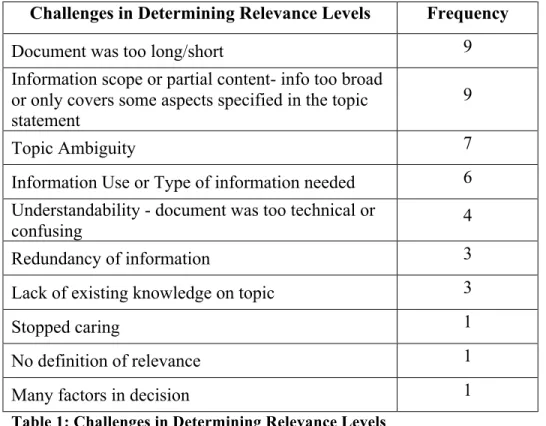
A breakdown of responses is shown in Table 1. Since this was an open-ended question,
some participants provided multiple challenges. Each of these responses was counted in
Challenges in Determining Relevance Levels Frequency
Document was too long/short 9
Information scope or partial content- info too broad or only covers some aspects specified in the topic statement
9
Topic Ambiguity 7
Information Use or Type of information needed 6 Understandability - document was too technical or
confusing 4
Redundancy of information 3
Lack of existing knowledge on topic 3
Stopped caring 1
No definition of relevance 1
Many factors in decision 1
Table 1: Challenges in Determining Relevance Levels
These challenges reflected difficulties that were associated not only with topical
relevance, but also situational, cognitive and motivational relevance. The most common
challenges expressed by participants were the length of the documents and the scope of
information contained within them, which made it hard to assess topical relevance.
Several participants mentioned that some of the documents were too long and they only
skimmed long documents or found it difficult to “tease apart” information in a long
document. On the other hand, short documents could also be difficult to assess if they did
not contain enough information or the information presented was too “vague”.
As with the explanations, information scope emerged as an important challenge in
assessing relevance. Participants mentioned that it was especially difficult to determine
the appropriate level of relevance when a document addressed only parts of the topic. For
when they were very close to being relevant. Some articles were completely about
asbestos or pollution, but then never mentioned the health risks or how people working in
exposed buildings can suffer as a result” and another said, “it was hard to determine
whether I should consider the article relevant if it was just talking about the contaminants
or what was wrong with a building but it didn’t refer to any sicknesses caused by it.” One
person felt “compelled” to mark any document discussing a key figure mentioned in the
topic statement as relevant even if the document did not address other aspects of the topic
as illustrated in following statement, “The line between relevant and highly relevant was
the most difficult to determine. Many documents discussed Khun Sa, who due to his
position and reputation is intrinsically relevant to the topic statement, so I felt compelled
to make almost any document involving him at least relevant, even if it did not go into
detail on drug trafficking.”
The next most commonly identified challenges were associated with evaluating
both topical and situational relevance. Ambiguity about the terms and boundaries of the
topic as well as uncertainty about the type of information that was needed made it hard to
know how relevant a document was. Confusion or ambiguity about the keywords and
concepts expressed in the topic statement was a challenge that made it difficult to
determine the relationship between information presented and the topic. For example,
one person mentioned they did not know exactly “what constituted ‘data’ about the
diseases and illnesses”, while another said, “the definition of hybrid was unclear. I wasn’t
certain if I should include electric cars, as they are not hybrids.” One person noted that
because the topic was “broad” it was “hard to distinguish if legal or examples were
Speaking more generally, one participant stated that it was difficult not having a “clear
definition about how each of these terms should be interpreted.”
Not having a clear sense of the topic terms and boundaries is related to another
common challenge associated with situational relevance - not knowing how the
information would be used. For example one participant stated, “the term relevance was
used without reference to a specified goal e.g. medical treatment, investigative reporting,
etc.” while another said, “It was difficult to determine whether slight irrelevant
information that talked about drug trade elsewhere, or relations between the countries
outside of drugs, was relevant. I didn't know exactly what the information was going to
be used for, so that made it a little difficult.” The following statement expressed
uncertainty over whether technical or “news” information was more important, “I wasn’t
sure exactly what I was looking for. The prompt did not specify whether I should be
looking for technical information on engines, or more "newsy" reports.”
Other challenges such as not having any background knowledge on the topic or
not understanding the information presented reflected problems with cognitive relevance
while difficulties assessing redundant information or losing interest and getting tired
reflected motivational relevance. Several participants stated that not having any existing
knowledge made it difficult to assess relevance and one person remarked that because of
the lack of knowledge at the beginning it felt like “almost anything could be relevant.”
Four people mentioned that some articles were too “technical” or “confusing” which
made them hard to understand. Others noted that it was difficult to assess redundant
information either because they did not want to “read through repetitive information” or
be relevant to someone just starting a search.” Another participant explained that because
there were many non-relevant articles at the beginning, it was hard to assess a “somewhat
relevant” article when it appeared because it was unknown “how much more information
was out there.” One participant “stopped caring” while another said he/she would “skim”
long and seemingly irrelevant articles to avoid getting too “tired” and not
“understanding” things “later on.” One person noted that there were “many different
factors” in deciding between marginally relevant and relevant which could not be
communicated.
3.6 Changes in Assessment Abilities over Time
The exit questionnaire also included an open-ended question asking participants
to indicate whether they noticed a difference in their ability to assess relevance from the
beginning to the end of the session. Almost all participants indicated that there was some
change in their ability to assess relevance over the course of the session. These changes
largely fell into two groups, those associated with a positive impact involving cognitive
factors that produced a “learning effect” in which it became “easier” to assess relevance
and those associated with a negative impact and a “cursoriness effect” in which
motivational factors such as mental strain or loss of interest diminished the ability to
assess relevance. As shown in Table 2, the majority of participants (18) indicated there
was a positive effect on the ability to assess relevance from the beginning to the end of
the session while a substantial number of participants (11) indicated that there was a
negative effect. A few participants indicated that there was both a positive and negative
effect, while two participants indicated that there was no difference and two participants
Changes in Assessment Ability over Time Frequency Positive impact – “improved”, “easier”, “better”
over time 18
Negative impact – “tired”, “bored” over time 11
Both positive & negative – “knew more, but
became tired or stopped caring” 3
No difference 2
No answer 2
Table 2: Relevance Assessment Dynamics
Comments associated with a positive impact largely emphasized that it was
“easier” to “decide” or “determine” relevance as they progressed and “learned/knew
more” about the topic and “became familiar with the subject matter.” Some comments
suggested that with time they became more stringent in applying the relevance model and
it became easier to “narrow down important information”, “sort out extraneous info”,
“rule things out” or more easily identify/recognize “key phrases, topics and keywords”
or “key people and places.” Others suggested that “knowing more” and “having a better
understanding” of the topic helped them to “know what to look for”, “open up more” or
“understand the language better and figure out the terms.” A few participants indicated
that they became more “confident” and could “skim” documents looking for keywords
rather than “exhaustively going through each.” A couple participants simply mentioned
they “improved” or “performed better” by the end. While most participants indicated that
knowing more about the topic had a positive impact on their ability to assess relevance,
one participant mentioned that it was harder to determine relevance as they went
“…because I became more familiar with the material, and was able to infer more about
On the other hand, a number of participants felt that their abilities to assess
relevance had diminished from the beginning to the end of the session largely due to
factors associated with cognitive strain or losing motivation. A number of participants
stated that they became “tired”, “distracted” or “lost interest” by the end, which made it
more difficult to “analyze relevance”, “tease apart information”, keep “focus” and “read
through” documents, particularly those with “repetitive” or “monotonous” information.
One participant mentioned, “my criteria slacked and I was more willing to connect
something as relevant when it may not have been considered relevant toward the
beginning.” Another participant stated that it became harder to determine relevance as
he/she became more familiar with the topic and that he/she may have “inferred more
about the article than it explicitly stated.”
A few participants suggested that there was both a positive and negative effect
over time. While they had a better sense of “what to look for” over time, they also
became “tired” or “bored.” One person stated, “I think my ability peaked about half an
hour into the session as I learned to sort through extraneous information, and dropped as
the information became repetitive and I got fatigued.”
Overall, it was clear that participants felt their ability to assess relevance can
improve over time due to learning which presumably enables them to clarify their
relevance models and apply them more confidently. On the other hand, the ability to
assess relevance may also degrade over time as cognitive strain or boredom set in causing
people to make errors, become careless or take shortcuts (i.e. skim or read only parts of
Discussion & Limitations
The study results provide further evidence that relevance is indeed
multidimensional, situational and dynamic even within a controlled experimental setting.
While participants were instructed to assess documents independently from one another,
it was clear in their reasoning process that they struggled to do so. Also, using assigned
topic statements, the study was designed with an emphasis on topical relevance, yet
assessors frequently referred to other manifestations of relevance (situational, cognitive,
motivational) when explaining their ratings and discussing the challenges and dynamics
of relevance assessment. These results lend weight to Saracevic’s assertion that
relevance must be understood in terms of tangled, interacting “relevances” (2007a) that
shape how people make decisions about relevance and shift over time.
Huang and Soergel’s (2013) conceptual model of relevance is evident in the study
findings in that people formulated models of relevance based on their understandings of
the search topic, the documents and the relationships among them. The topic component
of the model was based on the specific keywords and concepts expressed in the topic
statement. It was multifaceted and consisted of a “main” or “broad” topic with subtopics
or subthemes, which can in part explain the multidimensional aspects of relevance. The
object component was formulated as participants reviewed articles and then compared it
to the topic to see if there was a relevance relationship. The relationship was not an “all
or nothing” affair, but varied based on the extent or degree to which the documents
addressed the topic facets or whether they provided the right kind of information. Even
when there was no relevance relationship found, participants often summarized the
Reading the documents caused participants to learn about the topic, which helped them to
update and further develop their relevance models. It is likely that exposure to more
highly relevant documents facilitated the development of clearer, more coherent models.
This could lead these participants to have a higher relevance threshold resulting in lower
average relevance ratings as was found in the study of threshold priming by Scholer et al.
(2013). On the other hand, exposure to less relevant documents is likely to leave
participants with less elaborate and more uncertain models that could lead them to a
lower relevance threshold, resulting in higher average relevance ratings. Further analysis
of the relevance ratings in this study could shed light not only on how threshold priming
might impact the development of relevance models but the assessments themselves, and
would contribute to the literature on the dynamics of relevance assessment.
Comments about the challenges associated with assessing relevance indicated that
many participants had difficulty understanding or characterizing the relevance
relationship, which caused them to wonder exactly how the information would be used.
This suggests there might be a link between topical and situational relevance in the sense
that unclear or complex relationships between information needs/topics and documents
might lead people to consider how the information will be used rather than focusing on
exactly what it is about. The study design could have amplified this finding because
unlike a “real-world”, user-initiated search scenario, participants had no basis on which to
assess situational relevance since the topics were assigned and included no information
about how the information would be used or why the search was being conducted. This
could have contributed to the development of “fuzzy” models with respect to different
or exposure to many irrelevant documents), which made it especially difficult to
determine the level of relevance and could have resulted in errors. These finding have
implications for both the design and evaluation of information retrieval systems. With
respect to design, it could mean that a system containing highly specialized or complex
types of documents and search topics, may be easier to use if it presents views of that
information organized around information use or users rather than purely on topicality or
subject matching. With respect to evaluation, it suggests that in the context of assigned
topics, it would be useful to provide assessors information relating to topical, situational
and other kinds of relevance in order to facilitate the formulation of richer and more
coherent relevance models.
Another outcome of this study was further evidence that different relevance
criteria and manifestations shape the formulation and application of the relevance model.
Topicality was central and it was evident that the “aboutness” of documents with respect
to the topic statement was one of the most important components in applying the model
and determining the rating. But “aboutness” can be multidimensional or multi-faceted
particularly if topic concepts or boundaries are unclear, which could spur participants to
consider other kinds of relevance such as situational or cognitive relevance in making
their assessment. Information scope, specificity and detail were key criteria in
determining relevance, and highly relevant documents were almost always accompanied
by comments that emphasized they had good “detail” or fully covered all aspects of the
topic. It seems likely that these criteria may be so important because they have direct
are easier to understand, are likely to enhance one’s understanding of the topic and could
make it easier to recognize the relevance relationship.
Situational, cognitive and motivational factors also impacted participants’ abilities
to assess relevance. A number of participants mentioned challenges associated with
ambiguity over the definition of terms in the topic statement, the definition of relevance
itself, and lack of existing topic knowledge, which presumably made it difficult to
construct the topic component and identify relationships between document information
and the topic. It could be that concerns about how the information would be used
(situational relevance) were related to the inability to formulate a clear topical relevance
model, which may have been exacerbated by a lack of exposure to relevant documents
that provided topical knowledge. On the other hand, exposure to relevant or highly
relevant documents was likely to produce a strong “learning effect” that clarified the
relevance model and made it easier to “recognize”, “identify”, “narrow down” relevant
information and “rule out” extraneous information later on. While it was not mentioned
as frequently, a substantial number of participants experienced the cursoriness effect and
indicated that mental fatigue and loss of interest by the end of the session diminished
their ability to assess relevance. Further research that explores the onset of these effects,
how they interact and how they are impacted by the kinds and ordering of documents
would be valuable in advancing our understanding of the dynamics of relevance
assessment.
One of the main limitations of the study is inherent in the qualitative method used
to analyze results. There is no prescribed “right way” to conduct inductive content
researcher (Elo, 2008). Also, because comments were completely open-ended and
entered into an online system, some comments were inherently ambiguous, vague or
uninterpretable and the researcher had no opportunity to follow-up or clarify what may
have been meant by study participants. Although a systematic approach was used to code
responses, and multiple reviews were conducted to ensure consistency, the large number
of relevance explanations (~1450 comments) presented the possibility that some
comments were miscoded or overlooked in the analysis process. Furthermore, because of
time and financial constraints the study permitted only one analyst. Therefore, the
reliability of results cannot be guaranteed.
Another limitation of the study was the fairly small and homogeneous sample that
consisted entirely of college students. The results of the study may not be generalizable to
the student population as a whole, people in general or other populations that are
frequently involved in evaluating relevance such as expert assessors or non-academic
users. Also, these student assessors were asked to articulate their reasoning for each
rating which may have cause them to behave differently than assessors who are asked
only to provide a rating.
Finally, while the experimental, lab-based study design was important in order to
control the conditions of assessment process, the assignment of topics and the
requirement that participants read a large number of documents during a lengthy, single
session are unlikely to match the shorter, user-initiated, multi-session searches that are
more typical of the student population. However, the findings of the study could be useful
development, machine learning or legal research settings in which assessors have
Conclusion
The purpose of this study was to explore how people reason about and model
relevance during the relevance assessment process as well as to identify factors that may
challenge or alter their ability to do so. More specifically, the study aimed to identify
different components of and influences on the relevance model by examining how people
explain their assessments, the challenges they encounter and changes in assessment
abilities over time. Qualitative content analysis methods were used to evaluate over 1500
open-ended comments describing reasoning processes, challenges and changes in
relevance assessments made by student assessors during lab-based evaluation sessions.
The study results show that while relevance models vary across individuals and
change over time, they are shaped by several core relevance manifestations and criteria
and have common components derived from information topics/needs, documents and
their relationships. Challenges in assessing relevance were spread across these
components. Some participants found it most difficult to understand the terms and
concepts of the topic and where its boundaries lay, some had trouble sorting out
information in the documents and others struggled with understanding the relationship.
In reasoning about their relevance assessments, participants cited factors
associated with different relevance manifestations and key criteria such as scope, context,
detail or specificity and type of information, which aligns with existing research on
relevance. These criteria may work via the different components of the relevance model
and impact how it is formulated, modified and applied as people learn and encounter new
information. For example, encountering highly detailed or specific information may help