Caswell County
Fresh Fruit and Vegetable Access Project
Health Behavior Capstone Team:
Rebecca Chávez
Charla Hodges
Casey Horvitz
Tiffany Williams
Capstone Partner Organization:
North Carolina Community Transformation Grant Project (Region 5)
Capstone Preceptors:
Candace West, M.Ed.
Annie Martinie, B.A.
Capstone Faculty Advisor:
Deborah Tate, PhD
Abstract
Background
A lack of access to and consumption of diverse, healthy, fresh fruits and vegetables is linked to negative health outcomes. Caswell County, North Carolina is a rural food desert, and its low-income residents are vulnerable to diet-related illnesses, particularly cardiovascular disease and obesity.
Methods
The Capstone team completed four deliverables culminating in recommendations for sustainable improvements to access to fresh fruits and vegetables in Caswell County. Each product represented a sequential phase of data collection necessary to make evidence-based recommendations. The first deliverable was an in-depth, qualitative community assessment, informed by key informant
interviews, online survey data, and extensive field observation. The second deliverable consisted of a mixed-methods assessment of 22 retail food outlets in the county, based on the pricing, promotion, placement, and product availability of fruits and vegetables. Following this fieldwork, the Capstone team reviewed four categories of existing intervention models to inform a recommendation of the most appropriate fit for Caswell County. The fourth and last deliverable laid the foundation for a pilot implementation of the recommended intervention model. The Capstone team conducted interviews with four storeowners to determine their readiness to implement a healthy corner store pilot program in Caswell County.
Results
The community assessment, food outlet survey, and review of intervention models informed the Capstone team’s recommendation of a healthy corner store initiative for Caswell County. This recommendation was made based on limited funding and dedicated staffing, and was designed to build on Caswell’s existing food system infrastructure. The storeowner interviews laid out first steps in the implementation of a pilot project to be conducted by the Community Transformation Grant Project, the Capstone partner organization in Caswell County.
Discussion
The assessment tools and guidance for adapting intervention models developed by the Capstone team laid the foundation for enhancing access to fresh fruits and vegetables in Caswell County via healthy corner* stores. The findings from this project have implications for rural food deserts around
the county by contributing to the evidence base for best practices in limited resource settings.
Acknowledgements
This project would not have been possible without the dedication and cheerleading of the Capstone teaching team: Meg Landfried and Melissa Cox. The team owes the inspiration for and leadership of this project to Capstone preceptors Candace West and Annie Martinie. Faculty advisor Deborah Tate provided expert feedback around key deliverables. The collaboration of CTG project staff and consultants was invaluable to the production of high-quality deliverables and the team wishes to thank: Shea Cox, Lauren DeSimone, Mark Smith, Russell Smith, Erin Sullivan White, Christina Walsh, and Marcy Williams. The ongoing feedback of the Local Foods Council was critical to the forward movement of this project.
Finally, the Capstone team would like to thank the citizens of Caswell County, to whom this project is dedicated in the hopes of contributing to sustainable improvements in access to fresh and locally sourced fruits and vegetables.
Acronyms & Public Health Terms
CFL Community Food Lab
CNP Community Nutrition Partnership
CTG Community Transformation Grant
CSA Community Supported Agriculture
FFV Fresh Fruits and Vegetables
KII Key Informant Interviews
LFC Local Foods Council
MPH Master of Public Health
SNAP/EBT Supplemental Nutrition Assistance Program
UNC The University of North Carolina at Chapel Hill
Table of Contents
Introduction ... 1
Capstone Partner Organization ... 1
Capstone Project Work ... 1
Capstone Deliverables ... 3
Report Structure ... 3
Background ... 3
Significance of the Problem ... 3
Existing Intervention Models ... 4
Rationale for Methods ... 5
Methods ... 6
Partner Organization Orientation ... 6
Stakeholder Engagement ... 7
Deliverable Methods ... 7
Skills Acquired and Lessons Learned ... 10
Results ... 11
Outcome: Understanding Perceptions, Barriers, Behaviors, & Resources for Purchasing Healthy Produce ... 11
Outcome: Understanding Existing Food Access Intervention Models ... 12
Outcome: Understanding Capacity, Support, & Readiness to Implement a Healthy Corner Store Initiative .. 13
Discussion ... 14
Project Limitations ... 15
Next Steps ... 16
Sustainability ... 16
Professional Development ... 17
Conclusion ... 17
References... 19
Introduction
This report serves to document an eight-month collaboration between University of North Carolina at Chapel Hill (UNC) second-year Master of Public Health (MPH) students and the North Carolina
Community Transformation Grant (CTG) Region 5 project staff, in service of the residents of Caswell County. This project constitutes a service-learning experience that provides MPH students with the opportunity to apply technical skills to public health practice and substitutes a Master’s thesis in the Health Behavior program. The project proposal designed by CTG project staff required the Capstone team to conduct an in-depth needs assessment of fresh fruit and vegetable (FFV) access of Caswell County residents and, based on assessment results, recommend an evidence-based intervention model to improve access to FFV.
Capstone Partner Organization
The North Carolina CTG Project is an initiative funded by the Centers for Disease Control and Prevention (CDC) with a goal to reduce preventable, chronic diseases by promoting (1) healthy eating, (2) active living, (3) tobacco-free living, and (4) access to preventive services (All in 4 Health, 2013). The CDC granted an implementation award to the North Carolina Division of Public Health in 2011 to improve community health and wellness throughout the state (CDC, 2013). Funding was allocated to ten regions; Region Five includes Caswell County and seven neighboring counties. Work in this region is part of the “All in 4 Health” project, dedicated to supporting and strengthening individuals and organizations in building and sustaining healthy lifestyles and communities. Strategies currently in place for Caswell County include
developing a farmers’ market, a food policy council, tobacco-free living policies, and comprehensive plan that outlines strategies for growth (All in 4 Health, 2013).
Capstone Project Work
Caswell County for convenient and affordable access to FFV, and the capacity to answer that need. Caswell County’s rates of obesity, chronic disease, and poverty are higher than the state and national averages
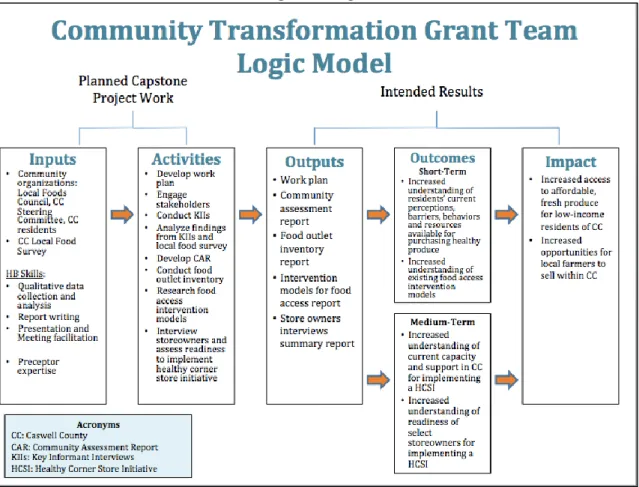
(Caswell County Health Department, 2012). Meanwhile, there is an abundance of local farms, selling a variety of FFV, but there is a lack of both an established customer base and physical marketplace in Caswell County. The results of this project are three-fold, as illustrated in the logic model (Figure 1) below. First, the short-term outputs are the Capstone deliverables, which include: qualitative assessments of Caswell County residents, resources, and food system infrastructure, as well as evidence-based reports on existing models to increase food access. Second, intermediate outcomes are an increased understanding of residents’ current perceptions, barriers, behaviors, and resources around purchasing FFV; an increased understanding of the existing intervention models for enhancing access to FFV; and an increased understanding of the capacity of Caswell community partners, farmers, and storeowners to participate in a healthy corner store intervention.
Finally, the long-term impact is to increase access to affordable FFV for Caswell County residents.
Capstone Deliverables
The deliverables for this project are cumulative in nature; each one informs the next and forms part of the step-by-step process of assessing Caswell County’s food environment and developing sustainable recommendations for a future intervention:
Community assessment report: to determine residents’ FFV purchasing behaviors as well as available resources and infrastructure to support increasing access to FFV.
Food outlet inventory report: to determine availability of FFV in grocery, corner, and convenience stores throughout the county.
Intervention models report: to identify existing models to increase access to FFV in rural communities and determine their fit for Caswell County.
Storeowner interviews: to assess the readiness of Caswell County food outlets to participate in the recommended healthy corner store intervention.
Report Structure
This summary report opens with an examination of the significance of the public health concern addressed through this project: access to FFV. The report further summarizes the methods and processes utilized to produce each deliverable, integrates key results and findings, and concludes with a discussion of the significance of the Capstone project as a whole.
Background
Significance of the Problem
as frequently as those with annual incomes greater than $60,000 (Weill et al., 2011). As reported in Caswell County’s 2012 State of the County Health Report, 21.7% of county residents live below the poverty line from 2006-2010 compared to 15.5% statewide (2012). The rurality of the county and the high percentage of Caswell residents living in poverty suggests significant access barriers to FFV.
Access to healthy foods like FFV is associated with lower rates of obesity, diabetes, and other chronic diseases (O’Malley, 2013). Limited access to, and therefore low consumption of, FFV can lead to obesity and weight management issues, diabetes, cancers, heart disease, stroke, and harmful nutritional deficiencies (CDC, 2010). These health outcomes arise because limited access to FFV is associated with increased exposure to more “empty calorie,” energy dense foods at convenience stores and fast food restaurants (Walker, 2010). Residents of North Carolina, and Caswell County specifically, experience barriers to accessing FFV. As surveyed from 2008-2010, 8.4% of all households in North Carolina and 8% of households with children report difficulty accessing affordable FFV regularly (Weill et al., 2011). In 2013, the Robert Wood Johnson Foundation reported that 16% of households in Caswell County have limited access to healthy foods, meaning they are located more than ten miles away from a grocery store, defined as living in a food desert (2013). Over 69% of children in Caswell County are enrolled in free and reduced lunch compared to 56% in the state, indicating the need in Caswell County for increased access to healthy and affordable foods (Caswell County Health Dept., 2012). When FFV access and affordability issues are compared to self-reported health status, those with more difficulty accessing FFV report significantly poorer health status, more feelings of stress, and higher rates of obesity. Improving FFV access for a rural, vulnerable population like Caswell County is key to improving residents’ overall health and wellbeing.
Existing Intervention Models
Mobile markets: Similar to a farmers’ market, a mobile market offers opportunities for community residents to purchase fresh, local goods and produce. Since these markets are mobile, however, they typically operate out of a van, bus, or truck. Mobile markets are able to serve more than one community in a short time span or change locations on short notice. This model has become popular in rural areas where residents travel long distances to purchase fresh foods (Healthy Food Access Portal, 2013a).
Community Supported Agriculture: CSA refers to a system in which a group of consumers purchase food directly from a local farm or farm aggregator and distributer. The farmer or distributer sells weekly or monthly shares of goods to individuals before the start of the season to ensure income for the farmer and to share the risks associated with farming with consumers. CSA exchanges usually happen at a designated pick-up point, but some programs deliver boxes to customers’ homes or workplaces. CSAs are popular in both rural and urban communities (Healthy Food Access Portal, 2013b).
Farmers’ markets: This traditional model is built around established, central locations where farmers and local food producers gather regularly to sell to a recognized customer base. Most markets occur on a weekly basis either year-round or during peak growing seasons, in the spring and summer months. Many markets operate in neighborhoods that are underserved by grocery stores or healthy markets and allow shoppers to use Supplemental Nutrition Assistance Program (SNAP/EBT) benefits to purchase FFV (Healthy Food Access Portal, 2013c).
Healthy Corner Stores: In many neighborhoods around the country, families do not have easy access to a comprehensive supermarket. Instead, they depend on corner stores or other small-scale retailers for their food purchasing. Many of these stores have only packaged food and very little or no fresh produce. Healthy Corner Store programs build partnerships between FFV vendors and storeowners to increase the availability of healthy foods in small-scale food retail outlets (Healthy Food Access Portal, 2013d).
Rationale for Methods
informs the next. Available evidence on best practices for improving FFV access is limited, particularly for rural contexts, and thus the project relied heavily on primary data collection to inform the development of tools and resources. The goal of this project was to gain an in-depth understanding of residents’ knowledge and behavior around FFV access as well as the county’s existing food system infrastructure to inform recommendations for a sustainable intervention model to increase FFV access for residents of Caswell County. An appropriate model will be generalizable to rural areas, have a low start up cost, incorporate plans for sustainability, and source FFV from local or regional farms.
The development and use of the work plan for this project was an iterative process continually informed by the involvement of community members as participants in active research and planning. The Capstone team took an ecological approach to the issue of FFV access in Caswell County by recognizing that the individuals we spoke with were embedded in larger social and economic systems that shaped their access to FFV and improved health statuses. This participatory method has been shown to lead to more effective, less expensive, and more sustainable interventions, a particular priority for the project (Cornwall and Jewkes, 1995; Israel et. al., 1998). By including Caswell citizens in each step of the process, the Capstone team hoped to come to an easily accepted and community integrated plan to increase FFV access for county residents. The Capstone team’s community-based engagement with project stakeholders is discussed further in the next section.
Methods
Partner Organization Orientation
CTG project staff, as the primary partner organization, introduced the Capstone team to the three stakeholder groups that played a role in the project: LFC, Caswell County residents, and Community Food Lab (CFL). CTG created both the LFC and the Caswell County Steering Committee. The LFC was
preservation, as prioritized by its members. Finally, CTG contracted with CFL to provide consultant services, primarily in the development of resources for a Region 5 strategy for a healthy corner store initiative.
Stakeholder Engagement
The Capstone team sought to gain an understanding of community needs through participatory research and to utilize that understanding to inform the development of the work plan and even to redirect the project. The original Capstone project proposal included two partner agencies: CTG and the Community Nutrition Partnership (CNP). CNP operates a mobile CSA, the Veggie Van program, with the mission of delivering produce to low- to middle-income individuals in Durham, Orange, and Wake Counties
(Community Nutrition Partnership, 2013). The proposed Capstone project involved adapting the Veggie Van program for Caswell County. The priorities of project stakeholders such as the LFC, to connect residents with local farming as a means of improving FFV access, was not reflected in CNP’s programming. The Capstone team also recognized that a program such as Veggie Van presented concerns from a sustainability perspective; a mobile CSA would require additional funding for staff, a produce supplier, a mobile unit, and gas mileage for Caswell County, all of which were not feasible given CTG funding. The Capstone team, in collaboration with CNP and CTG, reevaluated the direction and goals of the project. Consequently, CTG was designated as the sole partner agency to allow the team to conduct further research that would identify a model for FFV access tailored to the unique needs of Caswell County.
The Capstone team found the most effective method for engaging with Caswell County stakeholders during the project was to be physically present, as initial attempts to connect with county residents via email or telephone were not as productive. The team engaged with stakeholders by participating in monthly meetings of both the LFC and the Steering Committee in Yanceyville, the county seat. Throughout the project, Capstone team members attended as many community events as possible, both to better understand the community’s wants and to inform residents of the project.
Deliverable Methods
sample of nineteen individuals was initially identified based upon their ties to the community (i.e. employment in a governmental office or leadership position) or role as a key player in the local food system. The Capstone team created an informal, semi-structured Key Informant Interviews (KII) guide consisting of eleven
questions. The primary goal of the formative research was to identify barriers and facilitators to Caswell County residents’ FFV access.
The Capstone team conducted interviews via telephone, written survey, and in person. Interviews conducted via telephone were audio recorded. The Capstone team visited community organizations in Caswell County, including the Senior Center, the Farm and Flea Market, TABS farm stand, South Elementary School, and Caswell Parish to conduct in-person interviews. During and after each interview, the interaction and main themes were written in interview notes. The Capstone team conducted interviews in pairs as a quality control measure in the collection and analysis of data. Written surveys integrating questions from the online survey with interview questions were distributed to members of the Caswell County Steering
Committee. The group conducted a thematic analysis of all qualitative data and compiled major findings into a summary report as well as a brochure for the LFC and CTG project staff. The brochure format was chosen for its informality and easy distribution to other Caswell County residents.
Deliverable Two [Food Outlet Inventory]: Informed by the KII and online local food survey data regarding FFV quality and access in Caswell County from the first deliverable, the Capstone Team conducted a Food Outlet Inventory assessment. Two primary retail food outlets exist within Caswell County – Wal-Mart Express and Food Lion – yet many convenience stores throughout the region serve as secondary sources for food purchasing. The Capstone Team developed an assessment tool based on models put forth by experts in the field of food environment assessments, such as The Food Trust. The Capstone team tailored content to be specific to access infrastructure and for a rural setting. The tool was designed to systematically examine the presentation and availability of food products in these stores using the four P’s of Marketing: price,
promotion, placement, and product (CDC, 2011).
store,” in combination with “Caswell County.” Telephone calls were made to verify that stores were in operation and located within county borders. The Capstone team split into pairs to conduct in-person assessments of each identified store. Pictures of stores and food products were taken to assist in the analysis of assessment results. The Capstone team ranked a total of 22 stores based on the variety and amount of FFV available, creating four tiers of produce diversity: (i) five or more types, (ii) three or four types, (iii) one or two types, and (iv) no fresh produce. The team consulted with a CTG project staff GIS Specialist, who created spatial maps highlighting the tiers of FFV available throughout the county overlaid with health indicators. Maps were included in the final food outlet inventory, discussed in executive summary reports, and were shared with project stakeholders.
Deliverable Three [Food Access Models Report]: The Capstone team first created a protocol document to guide the research strategy for identifying intervention models that would be generalizable to Caswell County. The protocol stated that models should exist in rural areas, have a low start up cost, incorporate plans for sustainability, and source FFV from local or regional farms. Ten models were identified through a search of peer-reviewed literature databases and online resources published and circulated by food access experts, such as the CDC and the United States Department of Agriculture. Food access models were reviewed and critiqued based on their applicability to and fit with the unique needs and available resources of Caswell County. The Capstone team analyzed the advantages and disadvantages of each type of model and made a preliminary recommendation of a healthy corner store initiative as representing the best fit for the benefit of Caswell County residents. This decision was based on recognizing the opportunity to build on the existing food system infrastructure of Caswell County by enhancing the FFV options at existing convenience stores across the county. The Capstone team aligned their next action steps with the CFL to conduct foundational research for the implementation of a pilot healthy corner store project in Caswell County.
maintenance and atmosphere, (3) available space and inventory, and (4) owner’s knowledge and attitude (Community Food Lab, 2014a). CTG project staff finalized store selection to ensure stores 1) were
geographically dispersed around the county, 2) accessible to places of interest, such as schools, 3) maintained high customer demand, and 4) had a storeowner that would champion the healthy corner store initiative (A. Martinie, personal communication, March 24, 2014).
The Capstone team tailored a semi-structured storeowner interview guide developed by CFL. The guide assessed: (1) storeowners’ community ties; (2) customer demand; (3) SNAP and Women, Infant, and Children (WIC) food assistance sales; (4) product offerings and inventory systems, (5) healthy product offerings; and (6) willingness to increase in-store FFV availability. Four in-person interviews were conducted with storeowners and/or managers. The interviews were framed as informal conversations and field notes were taken to inform a thematic analysis of findings. The Capstone team shared the final report, which highlighted the advantages and disadvantages of partnering with each store, and recommended three stores as a good fit for the pilot intervention.
Skills Acquired and Lessons Learned
The most salient skill that emerged from this project was that of managing relationships and engaging with diverse stakeholders. The Capstone team collaborated with: CTG project staff, supervisors, and various consultants; CNP staff; LFC; Caswell County Steering Committee; CFL; Caswell County convenience storeowners; and local community-based organizations. Each stakeholder has a distinct perspective, goals, and resources to offer; it has been the task of the Capstone team to discern these while building productive relationships. The Capstone team learned to navigate the competing requests made by stakeholders by contributing to community activities and initiatives without deviating significantly from the work plan.
casual conversations. Similarly, the team designed presentation materials to be easily digestible and found that handouts were a more effective method of dissemination than PowerPoint presentations.
The Capstone team’s skills in adaptability and teamwork were crucial to the success of this project. Given the restructuring of the work plan, the amount of time to complete deliverables was significantly reduced. The Capstone team dealt with the loss of time by being flexible with project needs and dividing the labor amongst members. This strategy allowed the team to complete deliverables concurrently, while giving team members the opportunity to take leadership roles and facilitate co-ownership of work products. Each Capstone team member also utilized skills in survey design, qualitative interviewing, data analysis, and Internet and database research.
Results
Outcome: Understanding Perceptions, Barriers, Behaviors, and Resources for Purchasing Healthy Produce
The community assessment of barriers and facilitators to FFV access in Caswell County in terms of residents’ attitudes and the local food system infrastructure was based on KII, online and written survey data, and a sample of 22 food outlets. Thematic analysis (1) centered on access and availability, cost and quality, and staying local, and (2) integrated the four P’s of marketing (promotion, product, placement, and price) (CDC, 2011).
Access and availability: Although Caswell County residents are heavily involved in agriculture, their produce is not largely sold within the county, but rather in areas such as the farmers’ market in Danville, Virginia, approximately 14 miles from Yanceyville. Based on KII data and conversations with residents, community members also grow their own produce and obtain FFV from family and friends. Residents cite concerns about not having a local farmers market and not being able to purchase at food stands because of the inconvenient or irregular hours of operation. Many residents simply do not know where to purchase local FFV. The main sources of produce for the residents are the two large, chain grocery stores located in
produce in the stores, with peaches, fruit cocktail, pineapples, beans and tomatoes being the most abundant. FFV is the second most available type of produce. The two grocery stores also offer frozen produce and some dried fruit (Chávez et al., 2014b).
Cost and Quality: Caswell County residents note that local food is not reasonably priced and that cost is a barrier to purchasing FFV. Affordably priced produce is primarily available at Wal-Mart Express and Food Lion, yet consumers mention that food quality is often less than ideal. High-quality, homegrown FFV would encourage consumers to purchase locally (Chávez et al., 2014c). Twelve stores accept SNAP/EBT benefits, and nine of these stores advertise their acceptance of benefits (Chávez et al., 2014b).
Staying local: Consumer demand and the lack of an established market hinder the capacity for farmers to sell locally. Local farmers often sell their FFV at farmers’ markets outside of the county where they have established a customer base. Farmers report being unsure about moving their point of sale because of the potential loss of customers and because of the time it would take to attract new customers and establish a base at a different site (Chávez et al., 2014c). Retail food outlets that represent a local alternative to the two major grocery stores include convenience stores, corner stores, and gas stations. One out of 22 stores advertises FFV in the parking lot and seven have in-store advertisements (Chávez et al., 2014b).
Outcome: Understanding Existing Food Access Intervention Models
A review of potential models that could be implemented in Caswell County to increase access to FFV includes mobile markets, CSA, farmers’ markets, healthy corner stores, and other innovative models. The advantages and disadvantages of each type were analyzed to foster a better understanding of which model would most benefit Caswell County residents.
The Capstone team recommended the healthy corner store model as a “best fit” for Caswell County. This model builds easily upon the purchasing habits of established customers at existing convenience stores, leveraging community relationships to enhance FFV access. Maintenance costs to the owner are minimal once initial improvements are made to the food environment to encourage healthy purchasing, particularly of FFV. Drawbacks to the model include necessary start-up funding and technical assistance to modify the food environment. Some stores may need extra equipment, such as a refrigeration unit to ensure maximum shelf life of FFV, and some locations may need to create shelf space for FFV. Locally sourced FFV will likely not be offered at competitive prices and cost may be a barrier to consumers (Chávez et al., 2014a).
Outcome: Understanding Capacity, Support, and Readiness to Implement a Healthy Corner Store Initiative
The Capstone team identified three stores as potential sites to pilot CFL’s healthy corner store project: Chandlers Country Convenience, Teddy Bear’s Video and Suntannery,and Trang’s Mini Mart and Grill. The owner of Hill Top Grill and Grocery was also interviewed but did not wish to participate further.
Chandlers Counter Convenience: Located in northeast Caswell County, in the town of Blanch, Chandlers has been family-owned and -operated since 2009, serves 100 to 130 regular customers, and has established some existing partnerships with local farmers to sell corn, soybeans, wheat, and tomatoes.
Teddy Bear’s Video and Suntannery: Located in downtown Yanceyville, Teddy Bear’s has been a strong presence in the community for twenty-five years, serving 150 daily customers (up to 400 at the beginning of the month because of their bill payment services), and has some informal arrangements with local farmers who occasionally park their trucks in front of the store to sell FFV. The storeowners are currently in the process of diversifying their product offerings, as they will be expanding to include a grill.
Discussion
The ultimate goal of this project was to increase access to affordable, fresh produce for low-income residents of Caswell County while increasing opportunities for local farmers to sell within the county. The Capstone team produced materials that both contribute to and enhance evidence-based best practices for increasing access to FFV in Caswell County. The deliverables produced in this project were designed to be replicable by diverse stakeholders and the work can be applied to similar settings and other rural food deserts. Community leaders in rural counties across the country can utilize the tools and methodologies outlined in each project
deliverable to improve FFV access in their own areas. This project’s focus on locally grown FFV is a unique component and improves on standard practices; increasing access to FFV does not necessarily entail the integration of local foods. The Capstone team’s partnership with the LFC, which is partly composed of local farmers, adds a layer of richness to the project that could function as a recommended best practice for interventions in similar settings. The focus of farmers on the economic development of Caswell County by creating a market for locally grown FFV contributes to the overall wellbeing of the region.
Access to FFV: The project focused on the local food system infrastructure as key to improving access to FFV in Caswell County. Access and infrastructure are closely linked and this project highlights the
intersection of those concerns. The systematic analysis of availability of FFV in 22 retail food outlets provided insights into the realities of a rural food desert and the unique needs of Caswell County. The Capstone team ranked retail food outlets based on the availability of FFV; the tiers included stores that offered no FFV, one or two varieties of FFV, between three and five varieties of FFV, and six or more varieties of FFV. The majority of stores do notoffer any FFV at all and the few that do are clustered in Yanceyville. The only two stores that offer more than six types of FFV are Food Lion and Wal-Mart Express (Chávez et al., 2014b). A key implication of these findings is that an effective food access intervention model must combat the centralization of FFV in Yanceyville. Corner stores are located across the county and represent an opportune point of intervention.
been implemented across the country, building on existing food system infrastructure and requiring little start up funding or maintenance once implemented, making them ideal for Caswell County. This model also facilitates the enhancement of consumers’ existing purchasing habits to include more FFV through in-store promotions, advertisements, and increased availability and diversity of products. The Capstone team’s review and critique of existing models served to highlight the need for further research. There is little peer-reviewed literature on intervention models for increasing access to fresh produce in rural food deserts, and practice in this particular field is nascent enough that a gold standard model has not yet been established (Chávez et al., 2014a). While the final recommendations focused on corner stores as opposed to a farmer-driven model, there are opportunities for partnerships between storeowners and farmers. The three recommended stores are all family-owned and are dispersed throughout the county, making them easily accessible to various local farms. The storeowners have been identified as champions for the healthy corner store initiative, through their enthusiasm for local FFV (Chávez et al., 2014d). These stores represent not only an ideal point of intervention for increasing FFV offerings, but also potential points of sale for locally sourced produce.
Project Limitations
This project could have been strengthened by increased communication among partner agencies and stakeholders. The barriers to the original proposal of adapting the Veggie Van could have been identified earlier on in the CTG-CNP partnership through more in-depth conversations regarding project ownership, particularly in terms of funding and staffing an expansion into Caswell County. Transparent communication to achieve consensus among goals of diverse stakeholders was equally crucial throughout the project. This would have allowed for more effective identification of opportunities for collaboration, such as the modification of the final deliverable to align with the development CFL’s healthy corner store pilot project guidance materials.
collection. The team’s frequent travel to Caswell County represented a significant time commitment; each trip from Chapel Hill posed a challenge to managing schedules and the timely completion of project deliverables. The project could have been strengthened by incorporating designated time to be spent in Caswell County into the proposal and into the structure of the class.
Next Steps
The Capstone deliverables will inform a pilot healthy corner store initiative outlined by consultant CFL and implemented by CTG project staff. The foundational work done by the Capstone team will inform the next phase towards corner store conversion. CTG project staff will collaborate with community partners to identify a “project manager” for each store, identify and roll out product changes, develop promotional product placement and signage, and engage in ongoing evaluation through soliciting storeowner and
customer feedback and accessing technical assistance (Community Food Lab, 2014b). CTG project staff will continue to develop relationships with the three recommended stores and expects to achieve full conversion of at least one corner store by September 2014 (C. West, personal communication, April 8, 2014).
Sustainability
While sustainability is a critical component to any public health initiative, it is particularly salient for this project due to unexpected cuts in CTG project funding. CTG project staff is now focused on supporting current activities, rather than beginning any new initiatives in the community (C. West, personal
communication, February 24, 2014).
The deliverables produced in this Capstone project can be utilized by Caswell County residents and adapted for use in other rural counties. The recommendations made in the Intervention Models Report, for example, were developed based on limited funding and staffing. The Capstone team determined the “fit” of intervention models for Caswell County with those limitations in mind, prioritizing models that could be built around existing relationships and resources. This approach was intended to mitigate the negative impacts of funding cuts on FFV access in Caswell County.
success of this initiative beyond the pilot project will depend on storeowner promotion of FFV and the strength of the relationships established with local farmers to supply FFV.
Professional Development
This project allowed the Capstone team to comprehensively examine the issue of food access in a rural community through exposure to the diverse perspectives of various community stakeholders. The Caswell County Steering Committee, LFC, CTG, and CNP each understand food access differently and have distinct priorities for addressing limited access to FFV. Learning how to manage these relationships and how to piece together the big picture was key to the team’s professional development. Developing the capacity to integrate diverse perspectives into a unifying project mission will serve the team in future professional settings to achieve stakeholder buy-in.
The team gained valuable experience in community development work and coalition building. A significant lesson learned was that the pace of this work seems slow at times, but the hours spent building relationships with community stakeholders is time well-spent, and ultimately makes the outcome more rewarding and sustainable. This project also highlighted the value of a strengths-based approach to public health (Public Health Ontario, 2014). The skill of building relationships and creatively identifying assets in low-income settings will be useful to the Capstone team in future community-based work in underserved areas.
Conclusion
make positive change. During this project, the Capstone team encountered a motivated and diverse group of people who are passionate about improving the wellbeing of their community. It is the Capstone team’s sincere hope that FFV advocates take advantage of the tools described in this summary report and in the deliverables to increase FFV access for the residents of Caswell County.
References
All in 4 Health. (2013). Community Transformation Grants. Retrieved from
http://www.allin4health.com/#!about/c1ens.
Caswell County Health Department. (2012). Caswell County State of the County Health Report. Vol II, Issue 1. Yanceyville, NC.
Centers for Disease Control and Prevention. (2013). Community Transformation Grant (CTG) Fact Sheet. Retrieved from
http://www.cdc.gov/nccdphp/dch/programs/communitytransformation/funds/index.htm#Imple mentation.
Centers for Disease Control and Prevention. (2010). Health effects of limited access to healthy food: Obesity, chronic disease, and poor nutrition. Retrieved February 25, 2014, from
http://www.cdc.gov/healthyplaces/healthtopics/healthyfood/obesity.htm
Centers for Disease Control and Prevention. (2011). Health Communication Basics. Retrieved March 27, 2014 from http://www.cdc.gov/healthcommunication/healthbasics/whatishc.html
Chávez, R., Hodges, C., Horvitz, C. & Williams, T. (2014a). Intervention Models Report. Unpublished manuscript, University of North Carolina at Chapel Hill.
Chávez, R., Hodges, C., Horvitz, C. & Williams, T. (2014b). Caswell County Food Outlet Inventory Report. Unpublished manuscript, University of North Carolina at Chapel Hill.
Chávez, R., Hodges, C., Horvitz, C. & Williams, T. (2014c). Community Assessment Report: Caswell County Residents and Fruits and Vegetables. Unpublished manuscript, University of North Carolina at Chapel Hill.
Chávez, R., Hodges, C., Horvitz, C. & Williams, T. (2014d). Storeowner Interview Summary Report. Unpublished manuscript, University of North Carolina at Chapel Hill.
Common Capital. (2013). Case study: Delivering farm fresh produce to residents of low-income HUD housing projects. Retrieved October 26, 2013, from
http://healthyfoodaccess.org/library/browse/case-study-delivering-farm-fresh-produce-residents-low-income-hud-housing-projects
Community Food Lab. (2014a). Store Conversion Potential Rating Criteria. Raleigh: White and DeSimone.
Community Food Lab. (2014b). Timeline to Healthy Corner Store Conversion. Raleigh: White and DeSimone.
Community Nutrition Partnership. (2013). Veggie Van. Retrieved March 31, 2014 from
http://www.cnpnc.org/veggie-van.
Cornwall, A., & Jewkes, R. (1995). What is participatory research? Social Science & Medicine, 41(12), 1667-1676.
http://www.digdeepcsa.com/policies.html
Healthy Food Access Portal. (2013a). Mobile markets. Retrieved October 26, 2013, from
http://healthyfoodaccess.org/retail-strategy/alternative-market/mobile-markets.
Healthy Food Access Portal. (2013b). CSAs. Retrieved October 26, 2013, from,
http://healthyfoodaccess.org/retail-strategy/alternative-market/csa.
Healthy Food Access Portal. (2013c). Farmers’ Markets. Retrieved April 19, 2014, from
http://healthyfoodaccess.org/retail-strategy/farmers-market.
Healthy Food Access Portal (2013d). Corner Stores. Retrieved April 19, 2014, from http://healthyfoodaccess.org/retail-strategy/corner-store.
Israel, B. A., Schulz, A. J., Parker, E. A., & Becker, A. B. (1998). Review of community-based research: assessing partnership approaches to improve public health. Annual review of public health, 19(1), 173-202.
Mobile markets-applying the food truck model to food access. Alexandria, Virginia: Arcadia Center for Sustainable Food and Agriculture. Retrieved October 26, 2013, from
http://arcadiafood.org/news/mobile-market-report
Morton, L. W., Bitto, E. A., Oakland, M. J., & Sand, M. (2008). Accessing food resources: Rural and urban patterns of giving and getting food. Agriculture and Human Values, 25(1), 107-119. Policy Link. (2008). Designed for disease: The link between local food environments and obesity and diabetes. California Center for Public Health Advocacy, PolicyLink, and the UCLA Center for Health Policy Research.
O’Malley, K., Gustat, J., Rice, J., & Johnson, C. C. (2013). Feasibility of increasing access to healthy foods in neighborhood corner stores. Journal of community health, 38(4), 741-749.
Public Health Ontario. (2014). PHO Grand Rounds: Mapping a pathway for embedding a strengths- based approach in public health practice. Retrieved from
http://www.publichealthontario.ca/en/LearningAndDevelopment/Events/Pages/Mapping_pathwa
y_for_strengths-based_approach.aspx#.UyCwced5PK4.
Robert Wood Johnson Foundation. County Health Rankings and Roadmaps.
www.countyhealthrankings.org. Updated 2013. Accessed October 26, 2013.
U.S. Department of Health and Human Services & U.S. Department of Agriculture. (2010).
Dietary Guidelines for Americans, 2010. 7th ed. Washington, DC: US Government Printing Office.
Walker, R. E., Keane, C. R., & Burke, J. G. (2010). Disparities and access to healthy food in the United States: a review of food deserts literature. Health & place, 16(5), 876-884.
Weill J, Cooper R, Hartline-Grafton H, Burke M. A half-empty plate: fruit and vegetable affordability and access challenges in America. Food Research and Action Center. 2011(December).
Appendix A: Deliverables
Deliverable 1: Community Assessment Report Format: 4-page narrative report and 2-page tri-fold brochure
Purpose: To determine (1) residents’ current perceptions and behaviors as they relate to purchasing and consuming fresh produce, (2) resources available for accessing fresh produce, and (3) infrastructure to support access to fresh produce.
Intended Audience(s): CTG Project Team and LFC
Activities: Reviewed available data on healthy food perceptions and behavior (including community health assessment and local food survey).
Conducted two rounds of telephone and in-person key informant interviews (KII) with Caswell County residents and stakeholders identified by CTG.
Analyzed findings and emergent themes from KII via a themes matrix.
Submitted narrative report to CTG project team.
Presented brochure summary of report at a monthly LFC meeting.
Recommendations: Could inform tailored promotion of healthy food products to Caswell County residents.
Deliverable 2: Food Outlet Inventory Report Format: 5-page narrative report and executive summary
Purpose: To determine fruit and vegetable options available in food outlets in Caswell County and their proximity to areas of need.
Intended Audience(s): CTG Project Team and select consultants, LFC, and Caswell residents.
Activities: Reviewed CTG Fruit and Vegetable Outlet Inventory.
Identified existing food retails outlets in Caswell County (farm stands, grocery stores, and convenience stores).
Developed food retail outlet assessment tool and conducted environmental scan of 22 stores.
Analyzed data on access to FFV, specifically: product, price, placement, and promotion. Created and applied a ranking system to stores.
GIS maps of food retail outlets with Caswell County health indicator overlays created by expert CTG consultant.
Submitted food outlet inventory report to CTG project team and discussed findings during monthly LFC meeting.
Deliverable 3: Food Access Models Report Format: 3-page narrative report
Purpose: To identify program intervention models for food access in rural areas.
Intended Audience(s): CTG Project Staff and LFC
Activities: Developed systematic search strategy for peer-reviewed and gray literature on intervention models.
Designed evidence table to capture and evaluate methods, resources, and results of each intervention model (mobile markets, community supported agriculture, farmers’ markets, healthy corner stores, and other models).
Reviewed literature on 17 intervention models.
Summarized findings and submitted intervention models report to CTG project team.
Recommendations: Could inform future adaptation of alternative food access models beyond the recommended healthy corner store initiative.
Deliverable 4: Store Owner Interviews Format: 3-page narrative report
Purpose: To identify and assess the readiness of storeowners to participate in CFL’s pilot healthy corner store initiative
Intended Audience(s): CFL and CTG Project Staff
Activities: Identified 4 storeowners for interviews based on geographic location, consumer demand, existing relationships with farmers and sale of FFV, and storeowner willingness and enthusiasm.
Conducted in-person informal interviews.
Conducted thematic analysis of field notes.
Summarized findings and recommendations of 3 stores as potential partners for healthy corner store intervention.