Onset and Time Course of Priming in Spanish-English Bilinguals Jihane Jadi
University of North Carolina at Chapel Hill Spring 2017
A thesis presented to the faculty of The University of North Carolina at Chapel Hill in partial fulfillment of the requirements for the Bachelor of Science degree with Honors in Psychology.
Advisor________________________ Dr. Peter C. Gordon
Reader________________________ Dr. Jennifer E. Arnold
Abstract
Onset and Time Course of Priming in Spanish-English Bilinguals
Research on the structuring of a bilingual’s lexicon has raised questions about the different levels that two languages are connected in the brain. The two languages in a bilingual’s lexicon can be connected on different levels of analysis such as orthographic, phonological, morphological, and semantic levels. Different models describe the structure of a bilingual’s lexicon using these different levels of analysis. Priming methods can be used to assess the overlap of words for distinct languages in the minds of bilingual individuals.
Translation Equivalents: Cognate, Non-Cognate, and Repetition Priming
Several studies have used priming methods to explore the connectivity of languages in a bilingual lexicon. Patterns of priming are used as a way to determine the similarity of representation of languages in the minds of bilingual people. There are multiple priming tasks including the lexical decision task, the episodic task, and the ocular recognition task. These tasks collect measures such as gaze duration and reaction time, which are used to determine the extent of priming. The reasoning is that the quicker the reaction time or the shorter the gaze duration, the greater the priming effect. For example in semantic priming, if doctor is seen before nurse, the response time will be faster than if ocean is seen before nurse. The lexical decision task, a word recognition task where participants look at words one at a time and respond based on whether it is a real word or a nonword, has been used in studies to determine differences in magnitude between different types of priming.
equivalents that have the same meaning but different orthographic and phonological features, for example belt and cinturon. Cognates are translation equivalents that have the same meaning and similar orthographic and phonological features, for example blouse and blusa. Repetition pairs are words that have the same meaning and identical
phonological and orthographic features.
Different types of translation priming are compared in order to determine the levels of connectivity between languages. Cognate priming results in greater facilitation as measured by shorter reaction times on the target word in the lexical decision task (Davis et al, 2010; Dunabeitia et al., 2009). Non-cognate pairs are only similar semantically and provide a point of comparison. Since cognate priming occurs to a greater magnitude than non-cognate priming, it suggests that orthographic and
phonological similarity contribute to the facilitated retrieval of target words for prime-target cognate pairs.
When cognate priming and repetition priming are compared a similar magnitude of priming is observed (Davis et al. 2010, Bowers et al 2000). While there is an
advantage for orthographically similar pairs when compared to orthographically different pairs, this advantage is not replicated when comparing orthographically identical and orthographically similar pairs. These results are consistent with an experiment done by Cristoffanini et al (1986), which showed significant priming for all conditions where there was any form of orthographic overlap and no priming for orthographically unrelated conditions. While the study by Cristoffanini et al (1986) showed that orthographic
necessary it is not sufficient. For the full activation of cognate pairs to occur phonological and semantic overlap are also needed.
Models of Language
The joint listing model proposes that morphological relations are what determine how a lexicon is structured. This model suggests that cognates, words that are
semantically and orthographically similar, are jointly represented in the bilingual lexicon because of their morphological similarity. Based on this model, the magnitude of cognate priming should equal that of repetition priming because both the prime and target are morphologically related. The joint listing model also supports the finding that cognate and non-cognate priming have different magnitudes (Sanchez-Casas et al., 1992).
The sense model assumes that each sense or meaning of a word has a distinct mental representation. Studies have shown that the number of senses shared between the prime and target words affect the speed of response time for participants. (Rodd, Gaskell, & Marslen-Wilson, 2002). The more senses two words have in common the more they will activate each other and the more priming will occur (Finkbeiner et al., 2004).
phonological, and task information in addition to the orthographic information present in the original BIA model. In this updated version, visual input activates sublexical
orthography while simultaneously activating sublexical phonology. The orthographic and phonological representations of the whole word are then activated resulting in the
activation of the proper language node, which indicates the language of the words being read (Dijkstra & Van Heuven, 2002).
The revised hierarchical model suggests that two languages are connected on both the lexical (word form) and conceptual levels. At the lexical level each language has a separate lexicon. Translation equivalents are directly connected through lexical links at the lexical level. The conceptual level contains the meaning of words and all language lexicons are connected to a shared conceptual system through conceptual links (Kroll & Stewart, 1994).
Ocular Response Task:
during natural reading. The simulating of natural reading through eye movement
recording allows for faster responses and reaction times than manual LDT (Hoedemaker & Gordon, in press). The use of ocular response tasks has also never been used for bilingual priming research, past studies have used slower manual tasks. The recording of faster responses will make it possible to observe differences in reaction times. The existence of priming will result in quicker reaction times.
The Present Study
The goal of this experiment was to study the basis of cognate and repetition priming by determining their onset and time course. The ocular response task was used to collect gaze durations and number of fixations to differentiate and understand the
difference between cognate and repetition priming. There were three hypotheses that were explored during this experiment. (1) Repetition priming will have the same magnitude as cognate priming. (2) Gaze durations for target words will be significantly faster than gaze durations for prime words across both conditions. (3) English words will be processed at the same speed as Spanish words.
Method Participants
A total of 33 undergraduate students at the University of North Carolina at
Chapel Hill participated in this experiment. All participants were Spanish-English bilinguals and had normal or corrected to normal vision.
Materials and Design
responses were used to discard any participant who was not a balanced Spanish-English bilingual. Having a participant pool of balanced Spanish English bilinguals would prevent one language from being processed faster than the other. The participant’s composite self-rating scores were very high for both Spanish and English. Based solely on the language questionnaire responses it appeared that the participants were balanced Spanish-English bilinguals who were highly fluent in both languages.
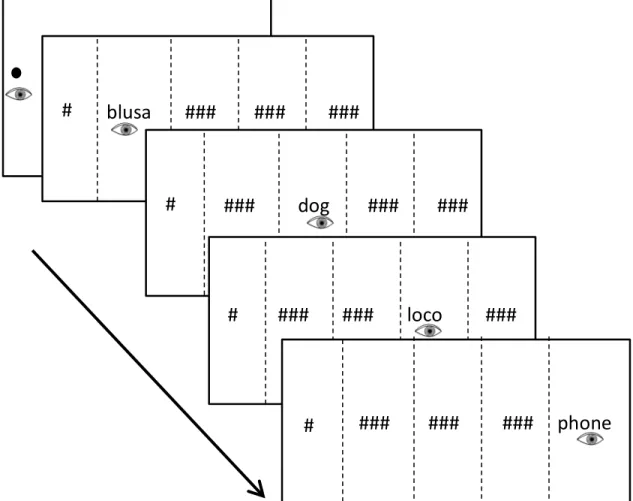
After the language questionnaire, participants completed the ocular response task during which their eyes were being tracked in order to record gaze duration and the number of fixations. During this task a series of four words were presented to the
participant. Each trial consisted of two sets of four words where the second or third word of the first trial was the prime and the second or third word of the second trial was the target. The prime and target never had the same position. There were 120 pairs of trials and since each trial consisted of four words each participant looked at 240 sets of four words. The filler words consisted of 50% English and 50% Spanish words that were randomly selected. No words were repeated throughout the experiment unless they were chosen repetition pairs.
The experimental stimuli had four different counterbalancing conditions. The prime and target were shown in both the second and third position for both the cognate and repetition pairs resulting in four possible conditions. Each condition had an equal number of trials from each counterbalancing. This was done in order to ensure word position did not play a role in the priming that was observed.
Cognate and repetition pairs used during the experiment were selected from Dunabeita (2016), Hernandez et al. (1996), and Comesana (2015). English filler words were selected from the English lexicon project database and the Spanish filler words were translated words obtained from that same database.
Procedure
An SR EyeLink 1000 system was used to record participant eye movements. The participant’s dominant eye was determined using the “hole in the hand” test and
whichever eye was determined to be dominant was the one that was tracked throughout the experiment. The participant’s head was stabilized using a chin and forehead rest in order to ensure proper recording of eye movements and minimize head movement. The monitor used was a 22” Samsung LCD monitor with a 1680x1050 display resolution. The viewing distance was set at 57cm and the font used was a 20-point monospace font.
Each participant was administered the language questionnaire in order to determine language proficiency prior to starting the experiment. The participant’s eye was calibrated using a 9-point calibration procedure in order to ensure proper tracking of the eye. A calibration point was also presented before every trial to ensure proper
over the 240 experimental trials were presented in a random order. The total of 250 trials lasted on average 40 minutes.
Figure 1: Ocular Response Task showing the sequence of events and eye movements during each trial.
Results
A total of three participants were excluded from the analysis. Two of them scored too low on the administered language questionnaire and one of them had gaze durations that were abnormally long. The average self-report scores for English and Spanish abilities are listed in Table 1. Average composite scores on the seven-point scale were 6.33 (sd= .40) for Spanish ability and 6.87 (sd= .07) for English ability. No participants were excluded for scoring too low on the recognition probes with the mean accuracy across subjects being 97%. Mean gaze durations were correlated with word frequency for both Spanish and English words. Frequency effects were looked at to ensure that the
blusa ### ### ###
#
#
### dog ### ###
#
### ### loco ###
experiment was successful in studying word recognition. As Spanish word frequency increased, gaze duration decreased, r= .22, R2= .050 p< .05 (N=115). The same trend was observed with English word frequency r= .20, R2= .042 p< .05 (N=118).
Table 1:
Responses For Language Ability Rated on Likert Scale (1=none, 7=native)
Measure N Mean Std. Dev.
Spanish:
Writing 30 5.8 1.09
Comprehension 30 6.7 .58
Reading 30 6.3 .70
Speaking 30 6.5 .73
English:
Writing 30 6.8 .57
Comprehension 30 6.9 .58
Reading 30 6.9 .25
Speaking 30 6.9 .43
There was a significant language switching effect on gaze duration for Spanish words but not for English words. Literature on language switching shows that switching from one language to another results in longer reaction times than staying in the same language. As seen in Table 2, the gaze durations for English words were longer when the preceding word was in Spanish than when it was in English but the difference was not significant F (2, 84) = .235, p = .629. For Spanish words the gaze duration was
impact the language switching effect. There was no interaction between language switching and condition F (2, 31) = .485, p = .491.
Table 2
Effects of Language Switching on Gaze Duration (ms)
The mean gaze durations for filler words across positions for each language are shown in Table 3. There was a main effect of position, so that words in later positions had shorter gaze durations than earlier positions F (1, 31) = 15.09, p < .001. A main effect of language was also observed where English words had shorter gaze durations than Spanish words F (1, 31) = 17.52, p < .001. An interaction between position and language was obtained F (2, 31) = 14.66, p < .001.
Table 3
Gaze Duration (ms) by Word Position and Language
Measure N Mean Std. Dev.
English:
Position 2 31 420 110
Position 3 31 388 96
Position 4 31 381 75
Spanish:
Position 2 31 477 145
Position 3 31 402 129
Position 4 31 405 92
Measure' N' Mean' Std.'Dev.'
NoSw.Engl' 84# 389# 109#
Swit.Engl' 107# 396# 117#
' # # #
NoSw.Span' 162# 412# 98#
Swit.Span' 169# 399# 130#
Table 4 shows the mean gaze durations for primes and targets in both conditions. There was a significant difference in gaze duration between cognate primes and cognate targets F (1, 31) = 7.293, p = .011. A near significant difference in gaze duration was also observed between repetition primes and repetition targets F (1, 31) = 3.309 p = .079. In addition, cognate primes had faster gaze durations than repetition primes F (1, 31) = 8.02, p = .008. This significant difference can be attributed to the fact that cognate primes were in English while repetition primes were in Spanish. The gaze durations for target words in the cognate and repetition conditions showed no significant difference F (1, 31) = 1.00, p = .325.
Table 4
Prime and target gaze durations for cognate and repetition pairs.
Word Position
Measure Condition Prime Target Priming
GZD Cognate 397 407 -10*
Repetition 410 401 +9
* Indicates significant priming, p< .05
Discussion
This study used the ocular response task to determine the patterns of cognate and repetition priming in Spanish English bilinguals. The ocular response task provided gaze durations, which were used as measures of processing and retrieval. The language history questionnaire provided information on the language background and level for all
participants. Combined, this information was used to determine level of bilingualism, frequency effects, language switching, language effects, position effects, priming patterns, and gaze duration distributions.
Prime and target gaze durations were used to determine whether cognate and repetition priming occurred during the experiment. The prime for the cognate pair was in English while the target was in Spanish. Both the prime and the target for the repetition pair were in Spanish. A significant reverse priming effect was found for the cognate condition. The priming found is in the opposite direction than the priming pattern that was hypothesized for the cognate condition. A near significant priming effect in the correct direction was found for the repetition condition.
asked to recall as many of them as possible on a sheet of paper. During the test phase, words were shown one by one on a screen and participants were asked to decide if the word on the screen was presented during the earlier phase. The results of this experiment showed significant priming in the correct direction for the lexical decision task but not for the episodic recognition task. A reverse priming effect similar to what was found in the current study was seen in Jiang & Forster (2001).
The lack of cognate priming found in the current study may be due to the nature of the ocular response task. The time elapsed between the presentation of the prime and target for the lexical decision task lasts between 50-150ms in the studies that have found significant cognate priming. The amount of time between the presentation of the prime and target in this experiment is much longer than that and may result in the loss of any spreading activation that may have occurred.
Based on the literature, the cost of language switching should result in a word having a slower gaze duration or reaction time than if it was preceded by a word of the same language. Grainger & Beauvillain (1988) compared reaction times in mixed language experiments and pure language experiments. They found that when bilinguals switch from one language to the other, the load on processing causes slower reaction times. This effect was seen for English words while the reverse is seen for Spanish words.
The average gaze duration for Spanish and English filler words were compared to determine if there was a language effect. A significant main effect showed that English words had significantly shorter gaze durations than Spanish words. This may be an indication that participants were not balanced Spanish-English bilinguals but were actually English dominant bilinguals. Although the self-report scores indicated their Spanish and English abilities were similar, the gaze durations suggest otherwise. Davis et al (2010) studied the differences in groups of bilinguals that varied in level of
proficiency. When looking at their reaction times for the English dominant group it can be seen that the English words had shorter reaction times than Spanish words.
In addition to language effects, position effects were also found. Positions later in the sequence had shorter gaze durations than positions earlier in the sequence. This may be because of the nature of the task and the eyes adjustment to the task when going from left to right.
participants affected the gaze durations of English and Spanish words which may have affected the priming patterns particularly for the cognate pair which had an English prime and Spanish target. There was also substantial variation in the overall gaze durations of participants, which made finding priming patterns difficult. The language questionnaire responses for participants were very homogenous in terms of everyone having a similar language level so the great variation in gaze durations on words was unexpected. The frequencies of Spanish and English words were also not matched because of differences in the frequency calculation for each language. Not being able to match average
frequencies for English and Spanish words may also have resulted in the gaze durations for one language being shorter than the other due to the frequency effect.
In order to determine if the lack of priming is due to the loss of activation, this experiment could be repeated while decreasing the time between the prime and the target by getting rid of the attention check. Instead of four words being presented followed by a fifth word, series of four words will be presented consecutively with no interruption. In order to still have a measure of participant attentiveness, the fifth word attention check will be presented randomly throughout the experiment to make sure the participant still has an incentive to fully process the words.
Since this study only looked at priming in one direction, future experiments could look at priming going the other direction, Spanish to English instead of English to
Spanish. This would provide additional information on whether or not language direction has an effect on the priming patterns found. Cognate priming was not found in the
non-cognate priming in addition to non-cognate and repetition priming would be helpful in understanding the roles phonology and orthography have in priming.
Acknowledgements
I would like to first thank my faculty advisor, Peter Gordon, who has provided me with guidance and support allowing me to successfully complete my honors thesis. Second I would like to thank the Language, Cognition, and Brain lab members for their help collecting data for my honor thesis. I would also like to thank the psychology thesis advisors Dr. Beth Kurtz-Costes and Dr. Peter Ornstein for all their help throughout the process. Next I would like to thank the members of my committee Giulia Pancani and Jennifer Arnold. Lastly I would like to thank the Summer Undergraduate Research
References
Bowers, J. S., Mimouni, Z., & Arguin, M. (2000). Orthography plays a critical role in cognate priming: Evidence from French/English and Arabic/French cognates. Memory & Cognition, 28(8), 1289-1296. doi:10.3758/bf03211829
Chen, H., & Ng, M. (1989). Semantic facilitation and translation priming effects in Chinese-English bilinguals. Memory & Cognition, 17(4), 454-462.
doi:10.3758/bf03202618
Comesaña, M., Ferré, P., Romero, J., Guasch, M., Soares, A. P., & García-Chico, T. (2015). Facilitative effect of cognate words vanishes when reducing the orthographic overlap: The role of stimuli list composition. Journal of
Experimental Psychology: Learning, Memory, and Cognition, 41(3), 614-635. doi:10.1037/xlm0000065
Cristoffanini, P., Kirsner, K., & Milech, D. (1986). Bilingual lexical representation: The status of spanish-english cognates. The Quarterly Journal of Experimental Psychology Section A, 38(3), 367-393. doi:10.1080/14640748608401604 Davis, C., Sánchez-Casas, R., García-Albea, J. E., Guasch, M., Molero, M., & Ferré, P.
(2010, November 13). Masked translation priming: Varying language experience and word type with Spanish–English bilinguals. Bilingualism: Language and Cognition, 13(02), 137-155. doi:10.1017/s1366728909990393
Duñabeitia, J. A., Perea, M., & Carreiras, M. (2010). Masked Translation Priming Effects With Highly Proficient Simultaneous Bilinguals. Experimental Psychology, 57(2), 98-107. doi:10.1027/1618-3169/a000013
Duyck, W., & Warlop, N. (2009). Translation Priming Between the Native Language and a Second Language. Experimental Psychology, 56(3), 173-179. doi:10.1027/1618-3169.56.3.173
Finkbeiner, M. (2004). The role of polysemy in masked semantic and translation priming. Journal of Memory and Language, 51(1), 1-22.
doi:10.1016/s0749-596x(04)00011-7
Grainger, J., & Beauvillain, C. (1987). Language blocking and lexical access in
bilinguals. The Quarterly Journal of Experimental Psychology Section A,39(2), 295-319. doi:10.1080/14640748708401788
Groot, A. M., & Nas, G. L. (1991). Lexical representation of cognates and noncognates in compound bilinguals. Journal of Memory and Language, 30(1), 90-123.
doi:10.1016/0749-596x(91)90012-9
Hoedemaker, R.S., & Gordon, P.C. (2014). It takes time to prime: Semantic priming in the ocular lexical decision task. Journal of Experimental Psychology: Human Perception and Performance, 40, 2179-2197.
Jiang, N., & Forster, K. I. (2001). Cross-Language Priming Asymmetries in Lexical Decision and Episodic Recognition. Journal of Memory and Language,44(1), 32-51. doi:10.1006/jmla.2000.2737
Kroll, J., & Stewart, E. (1994). Category Interference in Translation and Picture Naming: Evidence for Asymmetric Connections Between Bilingual Memory
Representations. Journal of Memory and Language, 33(2), 149-174. doi:10.1006/jmla.1994.1008
Li, P., Zhang, F., Tsai, E., & Puls, B. (2013). Language history questionnaire (LHQ 2.0): A new dynamic web-based research tool. Bilingualism Bilingualism: Language and Cognition, 17(03), 673-680. doi:10.1017/s1366728913000606
Peeters, D., Dijkstra, T., & Grainger, J. (2013). The representation and processing of identical cognates by late bilinguals: RT and ERP effects. Journal of Memory and Language, 68(4), 315-332. doi:10.1016/j.jml.2012.12.003
Sáchez-Casas, R. M., García-Albea, J. E., & Davis, C. W. (1992). Bilingual lexical processing: Exploring the cognate/non-cognate distinction. European Journal of Cognitive Psychology, 4(4), 293-310. doi:10.1080/09541449208406189
Schoonbaert, S., Duyck, W., Brysbaert, M., & Hartsuiker, R. (2009). Semantic and translation priming from a first language to a second and back. PsycEXTRA Dataset, 37(5), 569-586. doi:10.1037/e520562012-707
Thomas, M. S., & Allport, A. (2000). Language Switching Costs in Bilingual Visual Word Recognition. Journal of Memory and Language,43(1), 44-66.