Lester J Smith III. Information Behaviors of Ethical Hackers. A Master’s Paper for the M.S. in IS degree. December, 2016. 54 pages. Advisor: Barbara Wildemuth
Ethical hackers emulate the processes of cyber-criminals in controlled settings in order to test the security posture of their clients. One common part of this process is testing the susceptibility to social engineering. This study explores the information seeking habits of Ethical Hackers during the reconnaissance phase of a social engineering attack in order to better understanding the strategies involved in cyber-crime.
Eight ethical hackers with social engineering experience were interviewed using contextual inquiry. Participants were asked to walk through their process for gathering information in two-three social engineering scenarios as well as asked to describe the scenario they most often encounter. The study revealed a semi-structured, cyclic approach to information gathering that used many of the same tools as everyday life social search. The results of this study should help businesses and individuals better understand the risk of posting information in public forums.
Headings:
Hackers (Computing) Cybercriminals
INFORMATION BEHAVIORS OF ETHICAL HACKERS
by
Lester J Smith III
A Master’s paper submitted to the faculty of the School of Information and Library Science of the University of North Carolina at Chapel Hill
in partial fulfillment of the requirements for the degree of Master of Science in
Information/Library Science.
Chapel Hill, North Carolina December 2016
Approved by
Contents
Information Behaviors of Ethical Hackers ... 2
Introduction ... 3
Literature Review... 7
Social Engineering ... 7
Information Gathering ... 8
Relationship development ... 9
Exploitation and Attack ... 11
Hacker Information Search ... 12
Selecting a Victim ... 12
Searching for Techniques ... 14
Everyday Life Information Seeking ... 15
Summary ... 17
Methods... 19
Participants ... 19
Interview... 19
Results ... 23
Key Findings ... 23
Most Common Scenarios ... 25
Social Engineering Search Tools ... 27
Social Media Searching ... 27
Search Engines ... 28
Specialized tools/Websites ... 28
Social Engineer Search Strategies ... 29
Ethical Concerns ... 32
Summary of Results ... 33
Discussion ... 35
Implications for Social Engineers ... 35
Implications for Potential Victims ... 36
Limitations ... 36
Future Research ... 38
Conclusion ... 39
Appendix A: Interview Guide ... 41
Appendix B: Verbal Consent Form ... 43
Appendix C: Glossary of Terms ... 46
Introduction
The world today is a mesh of people, products, and information. The availability of online information has increased exponentially since the advent of the World Wide Web in 1989, and continues to grow as the world is introduced to new technologies and new capabilities to store and transmit information. With the growth of the web, however, also came the growth of cybercrime.
Cybercrime is defined as any criminal act involving computers and networks (called hacking) and also includes traditional crimes conducted through the internet (Beal, 2016). The allure of cybercrime for criminals lies in the difficulty of attribution. Attribution can best be described as “determining the identity or location of an attacker or an attacker’s intermediary” (Wheeler, Larsen, Leader, 2003). Thanks to the ability to mask one’s source address on the internet and the lack of a globalized effort to stop cybercrime, the arrest rates for cybercrimes are significantly lower than those of
traditional, non-computer based, crimes. In 2010 over 300,000 internet crime complaints were received by the Department of Justice’s Internet Crime Complaint Center
(IC3),which resulted in only 31 arrests and 6 convictions (2010). The 2014 IC3 reported a total monetary loss of $800,492,073 with an average of $6,472 dollars lost per
become victims. This can be difficult, however, as the surge of information availability and requirements for social availability require people to publish more information about themselves online.
As a result of the increased availability of online information, the ease with which information about people can be found has also changed. Simple searches for products can return millions of similar results and the onus is on the searcher to find the solution that is best for them. In order to facilitate this selection, however, the information owner takes steps to improve their chances of being selected. In terms of marketing this means that companies need to ensure that they have the information online that sways a
consumer in their direction. A simple search for a high school friend on social media might return thousands of people with the same name. In order to make searching easier, people must add additional data to narrow the search. Information such as their friend’s hometown, where they went to school, and places they’ve worked are stored in the website’s database and used to make people easier to find. Employers seeking the best possible candidates publish information about the workplace online: technologies used, company contact information, programming languages used, etc. In order to be successful in the maelstrom of information that is the web, people and organizations must provide enough information about themselves to be unique, and make sure that information is readily available.
Being available on the web, however, also means being available to
Engineering techniques attempted to get personal information from unsuspecting victims. Attackers would call, impersonating a person’s bank, for example, and request that a user “authenticate” themselves in order to get their banking information. Since then phishing and spear-phishing campaigns have evolved into very deliberate and targeted attacks. Revisiting the examples above, it is easy to see how this is made possible. The information the marketing team shares can be used to craft attacks against customers. This is especially true if the organization is known to send out marketing emails. Making information available to the public on social media means that attackers can get to know a person, almost on a personal level, without ever actually meeting them. Overly
descriptive job postings allow specific attacks that target vulnerabilities in technologies that a company uses. Most organizations write security policies and invest in security services and applications in order to meet security requirements. Many recognize a need to test their security policies and procedures in order to ensure that their procedures are working and their employees will not be exploited. Instead of waiting for a real life event, these companies will request the services of an ethical hacker. Ethical hackers are people who hack into computer networks in order to test or evaluate their security, rather than with malicious or criminal intent (Oxford Dictionaries, 2016). Ethical hackers are trained to emulate the techniques of cybercriminals and are used to test an organization’s
defenses. Ethical hackers allow organizations to validate their security practices, but not without limitations.
cybercriminal counterpart, the ethical hacker must perform under restrictions that the cybercriminal does not. Ethical hackers face limitations to scope, time, access, and methods (Limitations of Penetration Testing, 2016). Ethical hackers must perform their assessments only on the systems defined by their customers. This means, unlike
cybercriminals, the people and systems that are easiest to exploit may be unavailable during their assessment. This is especially important in Social Engineering during ethical hacking where end-user privacy may be an issue (Stouffer, Falco, and Scarfone, 2008) Despite these limitations, however, ethical hacking still provides the best means for companies to test their security practices, and the search strategies used by ethical hackers provide a best approximation of the strategies used by cybercriminals.
Literature Review
This chapter looks at existing literature and documentation surrounding Social Engineering and social search. It begins by defining Social Engineering and the steps of the Social Engineering attack cycle in order to better define the actions and motivations for Social Engineers. Both the technical and psychological aspects of Social Engineering and hacker searching are addressed before a brief comparison to Social Engineering social search and everyday life information seeking social search. The goal of this discussion is to fully define Social Engineering and to begin exploring techniques Social Engineers may use to complete their tasks.
Social Engineering
Mitnick and Simon (2002) define Social Engineering as the use of “influence and persuasion to deceive people by convincing them that the Social Engineer is someone he is not, or by manipulation…to obtain information…with or without the use of
technology”(iv) . The goal of Social Engineering is to bypass the need to hack complex security systems by instead targeting the individuals who use the systems or can provide the information contained within. While Social Engineering attacks can be very technical in nature they are rooted in psychological concepts of influence and deception.
focus of this research is the information gathering phase of the attack, all phases must be described in order to fully understand the motives in phase one.
Information Gathering
This phase is commonly referred to as the reconnaissance phase. It is during this phase that the attacker attempts to gather information about the victim. This phase creates the foundation for the rest of the attack, as the information gathered will need to be sufficient enough to build the trust relationship in phase two. There are multiple methods attackers can use to gather information about their victims; these techniques are usually done without contacting the individual directly. Hadnagy (2010) describes some of the ways attackers gather information. These include, but are not limited to, using online search engines, social media, and dumpster diving. These topics are introduced here and will be expounded upon in greater detail in the section on Social Engineering search strategies.
Search Engines
Social Media
Social media websites present a venue for people to connect with one another and, according to Rosenblum (2007), have become the “preferred forum for social
interactions” (40). Social media sites contain information about a person’s likes and interests, places they’ve visited or visit frequently, pictures of them and their family, etc. This provides a wealth of information for the attacker to build an attack profile with information that will help them build rapport. Multiple studies have been done that show the risks of social networking focusing primarily on privacy concerns (Krishnamurthy, 2013, Rosenblum, 2007). Studies have also shown the effects of social media on
self-disclosure (Stutzman, Gross and Acquisti, 2013). Dumpster Diving
One man’s trash is another man’s treasure. The objective of dumpster diving is to find sensitive information that has not been properly discarded. This includes invoices, letters, CDs, USB Keys and sometimes even computers (Hadnagy, 2010). It is even possible in some cases to reconstruct documents that have been shredded especially if the document has been shredded one way.
Relationship development
During the relationship development phase, the attacker attempts to establish trust between themselves and their victim. At its core the trust is built on psychological
principles. The most frequent citations in psychology and Social Engineering literature are made to Cialdini’s “Influence: Science and Practice” (2001). Cialdini found 6
a request” (see Table 1). According to Mitnick and Simon (2002), Social Engineers use these principles in their attempts to manipulate their victims. These principles, as well as Social Engineering applications, are listed in table 1.
Table 1: Principles of Influence/Social Engineering
Principle Cialdini (2001):
Summarized Description
Example Summarized by Mitnick and Simon (2002)
Consistency People feel obligated to follow through with commitments.
A Social Engineer calls the victim and, after reminding them of their agreement to follow company policies, advises them on a strong-password technique that actually makes it easier for the Social Engineer to guess future passwords. The victim is more likely to comply in order to stay consistent with company policies.
Reciprocation People feel they should repay debts and return favors.
A Social Engineer calls the victim pretending to be within the company in offering to help them secure their system from a made up risk. In a follow up call the Social Engineer asks the victim to install some malware disguised as security software. The victim is more likely to comply since the Social Engineer has recently helped them.
Social Proof People’s perceptions of what is right can be strongly influenced by the extent to which others around them view it as right.
A Social Engineer calls the victim with a survey and convinces the victim that other members of the staff have already
participated. Despite the survey revealing sensitive information about the victim they participate because they believe others have.
Authority People are more likely to comply with someone whom we perceive in a position of authority
A Social Engineer can obtain authority by pretending to be a member of the IT department or an executive.
Liking People are more likely to agree with/assist someone that they like
Principle Cialdini (2001):
Summarized Description
Example Summarized by Mitnick and Simon (2002)
Scarcity People’s perception of value is influenced by the perceived rarity of an item
A Social Engineer contacts the victim offering a limited availability prize for those who sign up with their website. The victim, enticed by the scarcity of the prize signs up and the attacker is able to gain sensitive information about the victim during the sign up.
Exploitation and Attack
The Social Engineer’s goal in the exploitation and the attack phase is to get the desired information or achieve the desired effect. This could be credit card numbers retrieved from a dumpster dive, or the installation of malicious software on a computer device. There is some overlap between the information gathering stage and the
exploitation stage. Krombholz et al. (2013) define Social Engineering attacks as being multi-faceted and including: “physical, social, and technical aspects which are used in different stages of the actual attack” (29).
Physical Attacks
Physical attacks include dumpster diving, shoulder surfing, where an attacker gathers information by watching an unknowing victim enter information into a
computing system, and other approaches. The important factor of a physical approach is that it is done in person and is not usually technology mediated (Krombholz et al., 2013).
Social Attacks
Technical attacks
Technical attacks are ones that do not require direct contact with the victim and instead are mediated by computing systems (Krombholz et al., 2013). The most common technical attack is the phishing email. These emails, designed with rapport building in mind, trick the user into clicking a malicious link or replying with sensitive information. In many cases the goal of Social Engineering is not simply to gain information but also to gain access to computing systems that the victim may use. In these cases viruses and backdoors may be installed through phishing emails in order to perform other cyber-attacks.
Hacker Information Search
As mentioned above, the majority of a hacker’s information searching is done during the information gathering phase. The next section reviews, in greater detail, the approaches used during this phase. Focus will be placed primarily on web based searches.
Selecting a Victim
Hacker information seeking begins by identifying a victim. In many cases, if a target company has been selected, then the search begins by using search engines to identify targets within the company. In some cases the Social Engineer started with an email list retrieved online (from sites like pastebin.com) or used a snowball technique attempting to attack contacts of another victim (Irani et al., 2011). While this selection varies is it important to realize that the rationale for these decisions may not be too different than those of other criminals. Dermot Walsh details the rationale behind an economic criminal’s selection of victims (Cornish and Clarke, 2014, 39-49). The
selection for cybercriminals when searching for victims. Attackers will seek elderly people, for example, to minimize risk because they are less likely to report (FBI, 2016).
Once a victim has been selected the next step is to find out as much information about them as possible to build a profile. This may not always be necessary, especially in the case of mass phishing emails, but as anti-phishing technology and Social Engineering user training become more efficient, the need for user specific attacks such as spear phishing also increases (Hong, 2012). Attackers have multiple avenues to gather more information about their victims, but with the wealth of information that can be found on social media, it is a common starting point.
Research done on social media information gathering for Social Engineers has shown high success rates in building a successful phishing profile using data found on the victims’ profiles (Huber et al., 2009). This research has shown success automating the information gathering process and creating a realistic phishing profile using a bot. Huber et al.’s research took advantage of lax privacy settings and data mining techniques to create not only a profile but also a chat bot that was able to successfully solicit
information from Facebook users. This demonstrates how legitimate functions of social media are used in nefarious ways to gain information. Another example of this can be found in Irani et al. (2011), where researchers realized that searching for a user by email address would likely recommend you as a friend to them and used that to encourage Facebook users to request their fake profile. Social engineers may also use tools to search multiple social media sites at once for their targets. An example of a commonly used tool for this is the open source intelligence (OSINT) gathering tool
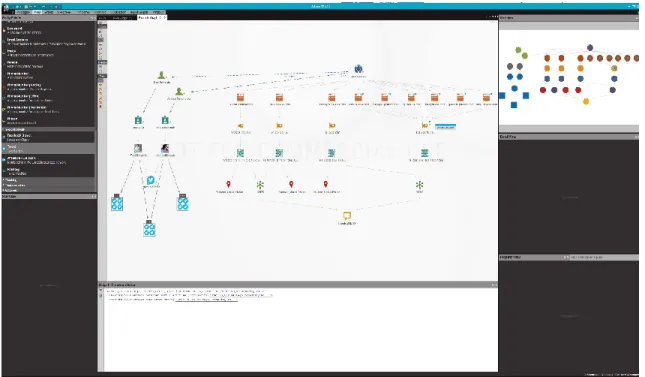
tool used is Paterva’s Maltego (https://www.paterva.com/web7/) which allows a user to search for related content on the web and provides a graphical representation of the results (Bradbury, 2011). An example from Maltego’s community edition (CE) can befound in Figure 1 below.
Searching for Techniques
Another aspect of Social Engineering information seeking is the search for training and other resources. A simple web search for Social Engineering techniques reveals a plethora of resources that can be used for training. There is also an abundance of training manuals (mostly designed for ethical hackers) that can be used by any Social Engineer to develop an attack. These resources include tips for all four phases of the Social Engineering attack cycle. However, just like the everyday information seeker would sometimes prefer to speak directly with an expert, Social Engineers also search for experts and exchange information amongst each other.
Sarma and Matheus (2015) explore the social groups that exist for hackers. This research focused on “a particular type of virtual community, the hybrid hacker
community” (102) and discussed participation, knowledge generation and innovation focusing on factors including, but not limited to, technology, secrecy and membership fluidity. Moilanen (2012) defines hackerspaces as “autonomous micro-communities” that have both real and virtual bodies(112). Both of these articles examine spaces that exist for hackers to collaborate and share information as well as to stay current on hacker news and exploits, not unlike other hobbies. Certain aspects may change (an increase in the need for anonymity, for example), but others stay the same. Benjamin and Chen (2012) study the effects of reputation in online hacker communities. The importance of
reputation found in this study means that cyberspaces have the equivalent of experts and attackers are able to identify experts based on their reputations.
The techniques that cyber criminals use are not too different from those used in everyday life information seeking. The next section reviews techniques used for everyday life information seeking (ELIS) and social search, and shows parallels between those techniques and the techniques used by cybercriminals.
Everyday Life Information Seeking
Not unlike Social Engineering, research has shown a high percentage of people rely on social networking sites for information seeking. Sin and Kim (2013) found that “x of the respondents (97%) had used social networking sites for ELIS”(4). Looking at these high values of usage it is increasingly clear why social media is used as both an
information gathering tool and an attack surface. An important question, however, is how these users get their information and find connections, and how this differs from Social Engineering techniques.
Adamic and Adar (2005) found that, in email networks, forwarded messages “reached most of their targets in a small number of steps, and using information about the target outperformed simply choosing the highest degree neighbor”(202). This is
consistent with the Social Engineering technique of spear phishing in which a targeted email is sent to the victim. This technique, where individuals in small networks are able to quickly pass messages to “the individual most like the target” can also be used by Social Engineers by establishing trust with someone other than the victim and using that intermediary to create a relationship of trust with targets of interest. This technique is seen in reverse Social Engineering.
Another study conducted at Michigan State University sought to examine the use of social media by students (Lampe, Ellison and Steinfield, 2006). This study found that very few of the participants believed that “total strangers who [weren’t] affiliated with any college or school” (168) looked at their profiles. It also found that there was a relatively high likelihood of participants using social media to get information about people that live near them. A study on the usage of social network sites by higher
uses of social networks included gaining up-to-date information, learning new
information and knowledge, and communicating frequently with peers. This is consistent with hacker communities’ use of social networking to stay abreast of techniques they can use in their exploits. Since users of social media do not expect strangers to contact them a well-crafted fake profile like the profile created in Irani et al. (2011) will likely pass as that of an interested peer who is reaching out. This information is consistent with Social Engineers’ use of social networks and explains the effectiveness of Social Engineering.
Research done on expert search in social networks also shows similarities between normal ELIS and information seeking done by Social Engineers. Joung et al. (2013) found that an actor “with a high degree of connections…has a higher chance of knowing the answer.”(966) This is consistent with Benjamin and Chen (2012) and shows that in both instances users with higher reputations (in one case indicated by a high number of friends) are perceived as the best sources of information. It is also safe to assume, in the case of Social Engineering, that someone with a high number of friends is more likely to accept a new friend request. This means that similar search logic for finding experts online can be used to find victims.
Summary
Existing literature can be used to define social engineering and the social
Methods
To complete this study, eight Social Engineers were selected for contextual interviews. The interviews were conducted online and recorded using screen sharing software. Participants were asked two-three social engineering scenarios and asked to show the researcher how they would complete the tasks required for each one. Appendix A details the full interview with the presented scenarios.
Participants
The intended population for this study are Social Engineers. Eight ethical hackers and penetration testers who use Social Engineering in their engagements were recruited to participate. The initial five participants were selected from penetration testers with whom the researcher has worked previously and already has a working relationship with. Snowball sampling was used from there (Wildemuth, 2009, 121). While it was possible to recruit based on ethical hacker listings, participation was likely to be higher if
participants are referred by someone they trust. In order to help ensure anonymity no demographic data was collected however, it was noted that all participants were male. Interview
were presented two to three scenarios and asked to show the researcher how they would gather information to complete the task for each one. Most participants chose to demonstrate on well-known company or one that they worked for. Some participants chose to target the researcher to show how they would gather their information. Appendix A contains complete interview guide used during the research.
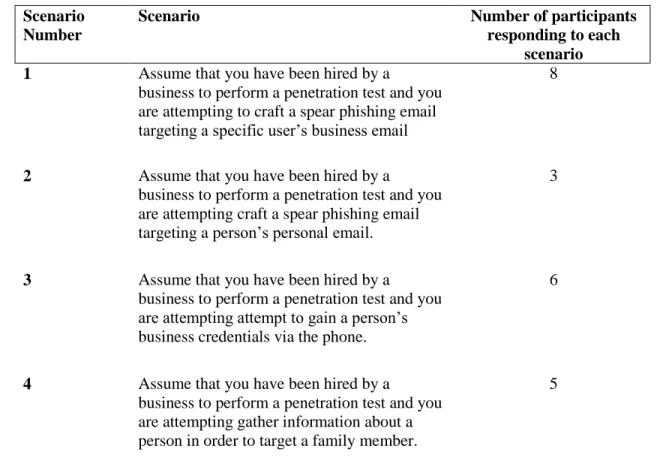
Table 2: Interview Scenarios
Scenario Number
Scenario Number of participants
responding to each scenario 1 Assume that you have been hired by a
business to perform a penetration test and you are attempting to craft a spear phishing email targeting a specific user’s business email
8
2 Assume that you have been hired by a
business to perform a penetration test and you are attempting craft a spear phishing email targeting a person’s personal email.
3
3 Assume that you have been hired by a
business to perform a penetration test and you are attempting attempt to gain a person’s business credentials via the phone.
6
4 Assume that you have been hired by a
business to perform a penetration test and you are attempting gather information about a person in order to target a family member.
5
Engineer intends to target only the business emails, that is, emails that are owned by the company who has hired them for the penetration test. The second scenario asks the participant to target the personal emails of the company’s employees. This scenario was included to attempt to identify if the attacker would require different information to build trust with the user. In theory emails targeting business emails would be business centric whereas emails targeting a personal email would require more information about the target’s personal life. The third scenario takes the requirement for personalization even further and requires the Social Engineer to plan for a direct call to a user. During this call the Social Engineer is attempting to illicit the user’s username and passwords for a business asset over the phone. Theoretically this would require the Social Engineer to know enough about the target user and their acquaintances ahead of time in order to pass themselves off as a trusted agent. The final scenario is the most invasive and was selected due to the assumption that it would be off limits to ethical hacking personnel. In this scenario, instead of targeting employees of the business directly, the Social Engineer attempts to go through a family member first. This can be targeting the family member in order to gather more information about the actual target or in an attempt to use the family member to establish trust with the target and serve as a pivot point.
Interviews were conducted online using GoToMeeting software. GoToMeeting allowed the researcher to record audio and all actions taken on the participant’s screen. The captured screen and audio data was saved in order to allow the researcher to review and analyze post interview.
Data from the interviews was analyzed inductively and followed a conventional content analysis approach (Hsieh and Shannon, 2005). The interviews were not fully transcribed. Instead, the researcher took handwritten notes during the interview and reviewed the recordings for any information missed and to allow for more robust analysis in the areas in which initial notes were taken. Interview questions focused on search strategies used by the Social Engineer. Information about techniques, motives, and search issues was addressed. After each interview the collected data was reviewed and analyzed. The primary goal of this review was to list out the steps of the information gathering process as well as the tools/techniques used at each step. Additionally, the researcher searched for mentions of ethics/legality and any other themes that may have arisen from the dataset. The responses were compiled and compared to each other for similarities and differences. The ultimate goal of the interviews was to establish trends among the Social Engineers to discover what techniques are used most commonly amongst Social
Results
The purpose of this research was to identify information search strategies for Social Engineers. In order to do that contextual interviews with open-ended questions were asked in the form of a “Social Engineering scenario”; this chapter presents the results of these interviews. The breakdown of interview questions will be presented first, followed by key findings, a detailed search strategy breakdown, and, finally, the results of the participants’ answers to the question about their most common scenario.
Key Findings
The results of this research can be summarized into five key findings.
1. There exists no noticeable difference between how different Social Engineers search for information between scenarios.
2. There was a wide array of “most common scenarios;” however, they could be grouped into two main categories: scenarios focused on external business contacts, and scenarios targeting employees via business emails.
3. Social Engineer search strategies can be defined as a semi-structured cyclic approach to their information with two steps: data discovery and data refinement. 4. The primary search tools used by social engineers could be grouped into three
5. Ethics and legality played a role in what some Social Engineers were willing to do. However, not all of them had the same concerns in the greyer areas of their jobs.
Similar Techniques Between Scenarios
As stated above, one interesting result of this research was that regardless of the scenario being presented, the Social Engineers’ processes for gathering information did not change. Of the eight participants, when asked how they would proceed in a second, or third scenario, all either stated explicitly that there would be no differences in the
information gathering or described the same process again. The only noticeable difference wasn’t in the technique used for searching, but instead in the amount of information required before moving to the next step. For example, one participant, when asked about scenario three, said he would “combine phishing and phone calls”. This type of explanation was common amongst all participants. When the scenario focused only on emailing, then the information required to target an individual would be limited to their personal interests, contact information, and possibly an event (within the company or from the media) that would spark their interest. For the scenario that required a phone call however, they also needed a business number for the victim as well as, in many cases, the name of someone from IT that they could use as a cover story for the call. The techniques used to gather this additional information, however, did not change.
specialized tools and websites. It is important to note as well that individual techniques did vary slightly between participants, just not between scenarios for individual
participants.
Most Common Scenarios
Each participant, after answering the initial scenario question, was asked to describe their most commonly complete Social Engineering scenario. This question was open ended and none of the participant’s answers fell within the scope of the researchers prepared scenarios. Upon initial review of the participants’ responses to their most common scenarios, they seemed to vary widely. Ultimately, they can be broken down into two groups of similar scenarios: 1) scenarios focusing on external businesses, and 2) internal “wide-net” phishing.
In the case of business-related reconnaissance, the data retrieved was used either to learn more about a business contact or check on the vulnerability status of a newly purchased company. In these scenarios the goal of the information gathering was
different, as there was no intent to exploit anyone, however the information was gathered in the exact same way. For example, one participant stated that one his primary duties included researching other businesses that a customer may be interested in partnering with. His process was nearly identical to another participants process for identifying targets within an organization.
case the Social Engineer is not using data specific to the victim, like he/she would in spear phishing, but instead is using current events within the company or news to elicit a response. A common example of this among participants was the use of shipping requests during the holidays. One scenario that bordered the line between scenario groups was the scenario of targeting newly acquired subsidiaries. In this scenario a participant’s
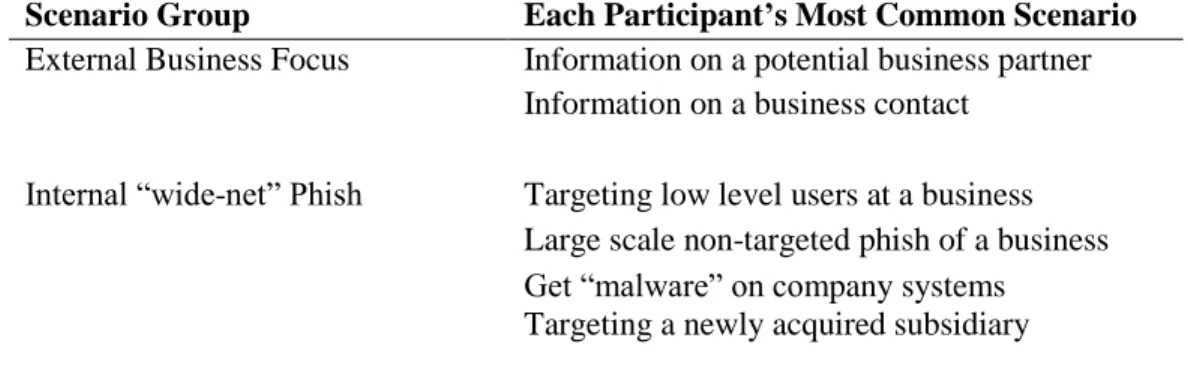
company merges with and acquires smaller companies his primary job is to perform social engineering on the new employees in order to identify gaps in their security posture. Ultimately, since the participant actually targeted a business that his employer now owned it was considered an internal instead of external focused scenario. An interesting internal “wide-net” phishing scenario was the attempt to get malware on the company systems. This is interesting because it would require more safety measures to ensure vulnerabilities introduced by the ethical hacker are not then used for nefarious reasons. One participant mentioned the risk of inadvertently attacking bring your own device (BYOD) systems as well, which makes the use of malware even more dangerous. Table 3 shows a breakdown of participants’ responses.
Table 3: Common Scenarios
Scenario Group Each Participant’s Most Common Scenario External Business Focus Information on a potential business partner
Information on a business contact
Internal “wide-net” Phish Targeting low level users at a business Large scale non-targeted phish of a business Get “malware” on company systems
Social Engineering Search Tools
Throughout the interview process, the participants described using three types of tools: social media searching, the use of search engines, and the use of specialized tools specific to hacking. These tools were used at varying levels by the participants with most focusing more on social media. All eight participants used social media, seven
participants used some type of search engine, and six participants used specialized tools.
Social Media Searching
The primary search method of all participants was the use of social media to gather information. This included primarily the searching of commonly used websites such as Facebook and LinkedIn, but some participants stated they would attempt to correlate as many profiles as possible in order to get the most complete data on their targets. Primarily Facebook was used to confirm identities, gather information on interests, and look for additional contacts. One interesting example of misusing a “helpful” feature was shown when a participant used the reset password option of Facebook in order to gain partial information about a target’s email accounts. Facebook provided all email addresses associated with the account and masked them by replacing characters with asterisks. This form of masking is effective in keeping the average person from guessing contact information; however, the participant cross referenced these email addresses to those he discovered in Maltego in order to find one with matching length and known character set. LinkedIn was used similarly; however, instead of searching for information on interests a large focus was placed on identifying roles within the
Search Engines
The most commonly used search engine among participants was of Google. Many used it in the traditional way, searching for a company website or information about a business. Google led the participants to company websites where they could retrieve contact information and emails. Additionally, some of the automated tools discussed in the section below use Google searches in order to gather information. Outside of Google, some participants used people search engines to discover and refine data. Three people search engines were used: Spokeo(http://www.spokeo.com/), PIPL(https://pipl.com/), and White Pages. These sites aggregate not only information on social media but public information such as age and location. They allow a Social Engineer to not only get more personal data on a target but also allow him/her to refine their user data and eliminate false matches between targets’ social media profiles. The one participant who did not use search engines explicitly instead relied on specialized tools, as seen below. These tools however, have built in search engine and web scraping capabilities.
Specialized tools/Websites
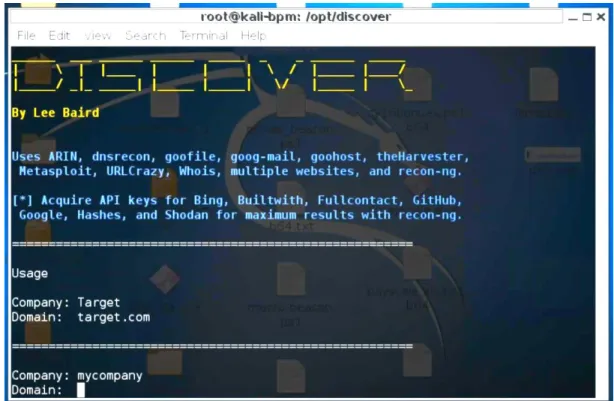
In addition to the two tools mentioned in the literature review, Paterva’s Maltego and Michael Bazzell’s OSINT tool, two additional specialized tools were identified during the research: the Discovery Tool in Kali Linux (https://www.kali.org/) and Tim Tome’s Recon-ng (https://bitbucket.org/LaNMaSteR53/recon-ng). The main
them locally. The information returned from these automated searches is often extremely robust but can contain a lot of unnecessary data. This falls directly in line with the search strategy, however, as it allows the Social Engineer to perform discovery rapidly and then focus in on refinement. Below (Figure 2) is a screenshot of one participant loading up the Kali Linux discovery tool.
Figure 2: Kali Linux Discovery Tool
Social Engineer Search Strategies
the different participants varied; however, they all used social media and Google with six of the eight also mentioning the use of hacker-specific tools and websites.
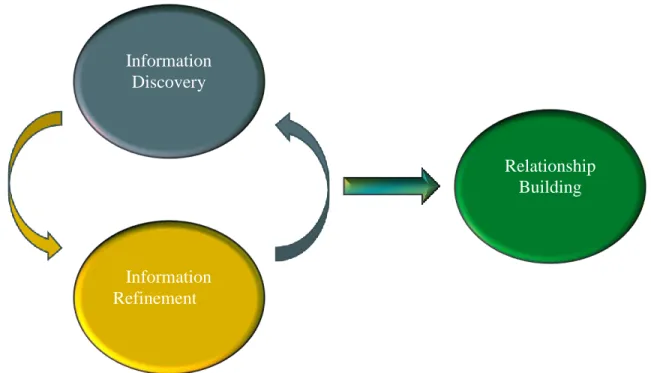
All participants seemed to use a semi-structured cyclic approach to their information with two defined steps: information discovery and information refinement (see Figure 3). The participants would typically start with the tool of their choice (for many it was Google while some preferred specialized tools) and “gather as much information as [they] could”. From there they would focus in on the information that seemed valuable to them and take that information and input it into another searching mechanism.
Figure 3: Social Engineer Search Model
The process is defined as semi-structured for two reasons: 1) there did not appear to be any preset criteria for deciding when the cycle was complete, other than when the participant felt they had enough information, and 2) the cycle seemed to be more dependent on what type of information was found as opposed to a preset, rigid process.
Information Discovery
Relationship Building
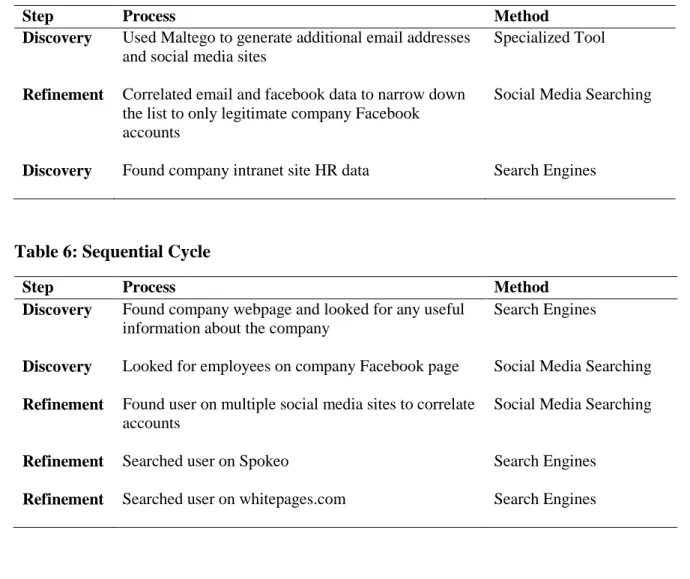
Tables 4-6 below shows the processes as explained by three different participants. These tables demonstrate the three approaches to the cycle most commonly seen:
Table 4 depicts a relatively pure cycle with a focus on discovering data, refining the data and then discovering again based on refinement. Table 5 depicts a strategy based primarily on discovery with limited
refinement.
Table 6 depicts a process where the discovery phase is completed first and as much information as possible is gathered with refinement following after sufficient amounts of data have been recalled.
Table 4: Rotating Cycle
Step Process Method
Discovery Searched for user using inteltechniques.com’s Facebook search
Specialized Website
Refinement Found Facebook profile and recorded useful information interests, potential email addresses, etc
Social Media Searching
Discovery Input email data into Maltego to discover possible email addresses
Specialized Tool
Refinement Googled email addresses Search Engines Refinement Searched email addresses on PIPL Search Engines
Refinement Searched for associated LinkedIn account Social Media Searching
Table 5: Discovery-Focused Cycle
Step Process Method
Discovery Searched Google business to get employment information, company email addresses, and associated company social media sites
Step Process Method Discovery Used Maltego to generate additional email addresses
and social media sites
Specialized Tool
Refinement Correlated email and facebook data to narrow down the list to only legitimate company Facebook accounts
Social Media Searching
Discovery Found company intranet site HR data Search Engines
Table 6: Sequential Cycle
Step Process Method
Discovery Found company webpage and looked for any useful information about the company
Search Engines
Discovery Looked for employees on company Facebook page Social Media Searching Refinement Found user on multiple social media sites to correlate
accounts
Social Media Searching
Refinement Searched user on Spokeo Search Engines
Refinement Searched user on whitepages.com Search Engines
Ethical Concerns
One of the primary concerns with this research was due to the limitations of Social Engineers from a legal and ethical perspective. A big difference between ethical hackers and the cybercriminals they emulate is the requirement to do no harm. Scenarios two and four were selected to test the Social Engineers’ willingness to perform the potentially unethical tasks of targeting personal assets, emails and personnel that did not belong to the company.
Surprisingly, of the eight participants, only three explicitly mentioned not
boundaries or “scope” of the engagement, stating that business owners didn’t have any right to target personal emails, and that targeting family members would be unethical and it was the obligation of the ethical hacker to say so and refuse. One interesting similarity among the three participants whose responses involved ethical concerns was that they all had experience performing penetration testing for the military. One participant, when asked in a follow-on conversation about why he did not express ethical concerns, stated that he assumed that the business who hired him would not ask for any illegal actions to be performed on their employees and also stated that, since he did not have “nefarious intentions,” he did not mind working in the greyer areas. This falls in line with another participant who, while he did not explicitly mention ethical or legal concerns, stated that he, as a white hat hacker, “only used [his] powers for good”.
Summary of Results
The results of this research began to define how Social Engineers gather
information during the reconnaissance phase of their attacks. It found that, regardless of the scenario, the same tools and techniques were used by individual Social Engineers. The research also found that, while there was plenty of diversity in what they define as the most common scenario, participants most often performed a wide-net, non-targeted phishing attack.
explicitly use a search engine although that participants tools automated search engine searching for him.
Discussion
Implications for Social Engineers
One of the most important implications of this research is the idea that Social Engineers generally use the same searching tools and techniques to locate information on their targets as ELIS social searchers. The same way that Lampe, Ellison, and Steinfeld (2006) found that college students often use social media sites to “get information about people that live in [their] dorm, fraternity, or sorority” (169). Social Engineers are using the same social searching techniques to gather information about targets they do not know. The same study found that respondents “reported high confidence that their Facebook portrayals described them accurately” (168) which means that the information that the Social Engineers retrieve will be useful and accurate. Additionally, the use of people search engines such as white pages and PIPL showed that even seemingly innocuous information, when aggregated properly, can lead to a much bigger threat.
Implications for Potential Victims
In order to limit the attack surface that can be leveraged against them, individuals should focus on controlling how much information about themselves is available to the public. While they cannot easily control websites like White Pages, they should ensure that their own social media profiles have strong privacy settings and they are only accepting people who they know. In terms of privacy settings individuals should share only the information needed to positively identify them on their public profile. This should ideally be limited to their name and profile picture (if applicable). This will keep Social Engineers from being able to identify key information about them such as their employer, and their interests which can be used against them. Additionally best practice would be to set social media contacts as private as well, this will keep attackers from adding your friends in an attempt to build trust around you.
This technique, however, while protecting against spear phishing will be less effective against the more common wide-net phishing attacks. For wide-net phishing it is important that businesses limit the amount of business specific data that is available from the public internet. This can be difficult because a business will want to make it easy for potential customers to find them but also because they want to make it easy for
employees to get to pertinent information. The use of two-factor authentication for accessing internal documents and/or the use of a company virtual private network (VPN) would help limit risk.
Limitations
allowed for interpretation. Additionally, since the responses needed to be open ended, and analyze individually, a small sample size was used for the research.
A second limitation of this research is that it was conducted on ethical hackers instead of actual cybercriminals. While this limited the experience of the participants, in that many had not attempted to target personal emails and families, it did not affect the findings. Since there was very little deviation in search strategies regardless of scenario, it is somewhat unlikely that the passive reconnaissance phase would be different for cybercriminals. Nevertheless, caution should be exercised in generalizing these findings to cybercriminal searching behaviors.
Another limitation of this study was the sample. Since convenience sampling was used, the participants were not as diverse as would have been preferred. One participant stated, when discussing a scenario similar to scenario two from his own experience, that “people sympathize more with women”. He described a situation where a female Social Engineer used an audio recording of a baby crying to get sympathy and was able to elicit information from a customer service representative about her target. It is possible that female Social Engineers have a different process than males or perhaps some other demographic may have been a variable in search techniques.
Since this research was conducted in such a way as to minimize risk to the participants and the general public, the searching was also slightly unrealistic.
from walking through the steps of their process it did make it less realistic and more disjoint at times.
Future Research
Conclusion
This research sought to identify information search strategies used by Social Engineers by first defining Social Engineering through current literature and exploring information currently available about hacker information seeking strategies and everyday life information seeking/social search. Using that information as a starting point and interviewing eight Social Engineers, the following five key points came out of the research
1. There exists no noticeable difference between how different Social Engineers search for information between scenarios.
2. Social Engineer search strategies can be defined as a semi-structured cyclic approach to their information with two primary steps: data discovery and data refinement.
3. The primary search tools used by Social Engineers could be grouped into three types: social media, search engines, and specialized tools/websites.
4. There was a wide array of “most common scenarios.” However, they could be grouped into two main categories: scenarios focused on external business contacts, and scenarios targeting employees via business emails.
This research added to the current field by identifying key similarities and
Appendix A: Interview Guide
Begin with the verbal consent form (in Appendix B). This will introduce you and the
research.
I am going to present you with a couple scenarios and ask that you show me how you would gather information to complete the tasks in each one. For the first scenario assume that you have been hired by a business to perform a penetration test and you are
attempting to craft a spear phishing email targeting a specific user’s business email. How would you gather information in this situation?
As the participant walks through this process be sure to ask for further details on any
steps that he/she does not explain fully. Take note of any assumptions they make or
questions they ask of you. After they have completed this task move on to the next.
Next I want you to think of the most common Social Engineering scenario that you see at work. Can you describe that scenario to me and walk through your workflow for
completing this task?
If the participant says that their most common scenario was the one shown already ask
them to perform another scenario from the list below. As the participant walks through
this process be sure to ask for further details on any steps that he/she does not explain
Additional scenarios:
1. Assume that you have been hired by a business to perform a penetration test and you are attempting craft a spear phishing email targeting a person’s personal email.
2. Assume that you have been hired by a business to perform a penetration test and you are attempting attempt to gain a person’s business credentials via the phone.
3. Assume that you have been hired by a business to perform a penetration test and you are attempting gather information about a person in order to target a family member.
As the participant walks through this process be sure to ask for further details on any
steps that he/she does not explain fully. Take note of any assumptions they make or
questions they ask of you. After they have completed this task move on to the next.
Thank you so much for your participating in my research. Is there any else regarding passive information gathering that you would like to add? Would you be willing to be contacted with follow-up questions? Can you suggest a peer or colleague in the field for me to interview next? If yes ask if they would be willing to forward the recruitment information.
Appendix B: Verbal Consent Form
Hello, my name is Lester Smith I am a student from the University of North Carolina at Chapel Hill conducting research about information search strategies for social engineers. Your participation in this research is completely voluntary. This means that you do not have to participate in this research unless you want to.
Would you be willing to answer some questions to help me determine if you are eligible for this study? (If yes, proceed; if no thank them for their time and end the call).
Thank you.
Do you have ethical hacking experience that includes passive reconnaissance for the purpose of social engineering? (If yes, proceed; if no thank them for their time and end the call).
Were you able to review the information fact sheet prior to this call? (If yes, ask if they have any questions or concerns and answer any that they provide; if no proceed to the interview description)
The purpose of this research study is to explore the methods in which ethical hackers gather the information they need for social engineering. For this study the research will be limited to the passive reconnaissance phase. The study focuses on person to person search in order to identify commonalities between everyday social search and searches done for social engineering purposes.
We estimate that approximately 7-10 participants will enroll in this study. During the interview, you will be asked to demonstrate your process for information gathering based on a presented scenario and a scenario of your choice. We’ll use the screen sharing feature in GoToMeeting, so that I can see exactly what you’re doing while you explain it.
There is a small chance that some of the questions may make you feel uncomfortable. You don't have to answer those questions if you don't want to. In fact you don't have to answer any question that you choose not to answer. And that is fine. We will just skip that question and go on to the next one. We can pause or stop the recording at any time at your request however, all data that will be included in the research will be recorded.
finish with all the interviews from everyone who has agreed to participate, I will group all the answers together in any report or presentation. There will be no way to identify individual participants.
The only risk to you might be if your identity were ever revealed. But I will not even record your name with your responses, so this cannot occur. There are no other expected risks to you for helping me with this study. There are also no expected benefits for you individually. Once the research is complete the final results can be shared, via email, by request.
Do you have any questions?
You can also call me at 9102805612 with questions about the research study. All research on human volunteers is reviewed by a committee that works to protect your rights and welfare. If you have questions or concerns about your rights as a research subject you may contact, anonymously if you wish, the Institutional Review Board at 919-966-3113 or by email to [email protected].
Appendix C: Glossary of Terms
Attribution – Finding where an attack originated from
Backdoors – Unauthorized entry points into computing systems Bot – Automated computing “robot”
Bring Your Own Device (BYOD) – Process in which businesses allow users to user their own devices on the company network
Cyber Threat Actors – A person or group that commits cyber crimes Cybercrime – crimes involving computers or conducted over the internet Dumpster Diving – The act of going through discarded items in order to gather
unauthorized information,
Ethical Hackers – Individuals certified to emulate cyber criminals in order to increase a customer’s security posture
Hackerspaces – Online spaces where hackers gather Inheritance Factor – Something you are (biometric factor)
Kali Linux – Unix based operation system that aggregates multiple hacker tools into a single suite
Knowledge Factor – Something you know such as a pin
Malicious Software – Software designed to do harm to a computing system Maltego – Forensics and data mining application
Malware – See malicious software
Non-targeted Phish – See Mass Phishing
Open Source Information – Information that is publicly available
Phishing – The process through which someone gains unauthorized access to a system or information by posing as an authorized individual online
PIPL – Online people search engine
Possession Factor – Something you have such as an smart card Recon-NG – Forensics and data mining application
Shoulder Surfing – Watching over another person’s shoulder in order to gain unauthorized information
Social Engineering Attack Cycle – Sequence of events for a social engineering attack Spear-phishing – Phishing attacks that target a specific person or group
Spokeo – Online people search engine
Two-Factor Authentication – Authentication that uses two of the three factors: knowledge factors, possession factors, and inheritance factors.
Virtual Private Networks(VPN) – Allows users outside of a network to connect to internal resources by having their traffic encrypted over the internet
Works Cited
1. FBI (2016). Fraud Against Seniors. Retrieved from https://www.fbi.gov/scams-and-safety/common-fraud-schemes/seniors.
2. Ethical Hacker Def 1. In Oxford Dictionaries, Online. Retrieved from https://en.oxforddictionaries.com/definition/ethical_hacker
3. Penetration Testing Tools (2015) Limitations of Penetration Testing. Retrieved March 10, 2016 from http://www.pen-tests.com/limitations-of-penetration-testing.html. 4. Adamic, L., & Adar, E. (2005). How to search a social network. Social networks,
27(3), 187-203.
5. Allen, M. (2006). Social engineering: A means to violate a computer system. SANS Institute, InfoSec Reading Room. Retrieved from
http://citeseerx.ist.psu.edu/viewdoc/download?doi=10.1.1.600.7419&rep=rep1&type =pdf
6. Bazzell, M. (2014). Open source intelligence techniques: resources for searching and analyzing online information. CCI Publishing.
7. Beal, Vangie. (2016) “What is Cyber Crime? A Webopedia Definition.” Webopedia.
QuinStreet Inc. Retrieved from
http://www.webopedia.com/TERM/C/cyber_crime.html
9. Bradbury, D. (2011). In plain view: open source intelligence. Computer Fraud & Security, 2011(4), 5–9. doi:10.1016/s1361-3723(11)70039-2
10. Cialdini, R. B. Influence: Science and Practice. 4th ed. Boston, MA: Allyn and Bacon, 2001.
11. Cornish, D. B., & Clarke, R. V. (Eds.). (2014). The reasoning criminal: Rational choice perspectives on offending. Transaction Publishers.
12. Hadnagy, C. (2010). Social engineering: The art of human hacking. John Wiley & Sons.
13. Hong, J. (2012). The state of phishing attacks. Communications of the ACM, 55(1), 74-81. doi:10.1145/2063176.2063197
14. Hsieh, H.-F. (2005). Three Approaches to Qualitative Content Analysis. Qualitative Health Research, 15(9), 1277–1288. doi:10.1177/1049732305276687
15. Huber, M., Kowalski, S., Nohlberg, M., & Tjoa, S. (2009). Towards Automating Social Engineering Using Social Networking Sites. 2009 International Conference on Computational Science and Engineering. (pp. 117-124) doi:10.1109/cse.2009.205 16. Internet Crime Complaint Center (2010), 2010 Internet Crime Report USA: National
White Collar Crime Center, Bureau of Justice Assistance, and the Federal Bureau of Investigation. Retrieved from https://pdf.ic3.gov/2010_IC3Report.pdf.
18. Irani, D., Balduzzi, M., Balzarotti, D., Kirda, E., & Pu, C. (2011). Reverse Social Engineering Attacks in Online Social Networks. Lecture Notes in Computer Science, 55–74. doi:10.1007/978-3-642-22424-9_4
19. Joung, Y. J., Chen, S. M., Wu, C. C., & Chiu, T. H. Y. (2013, March). A Comparative Study of Expert Search Strategies in Online Social Networks. In Advanced Information Networking and Applications (AINA), 2013 IEEE 27th International Conference on (pp. 960-967). doi:10.1109/aina.2013.86
20. Krishnamurthy, B. (2010). I know what you will do next summer. ACM SIGCOMM Computer Communication Review, 40(5), 65-70. doi:10.1145/1880153.1880164 21. Krombholz, K., Hobel, H., Huber, M., & Weippl, E. (2013, November). Social
engineering attacks on the knowledge worker. In Proceedings of the 6th International Conference on Security of Information and Networks (pp. 28-35). ACM.
doi:10.1145/2523514.2523596
22. Lampe, C., Ellison, N., & Steinfield, C. (2006, November). A Face (book) in the crowd: Social searching vs. social browsing. In Proceedings of the 2006 20th anniversary conference on Computer supported cooperative work (pp. 167-170). ACM. doi:10.1145/1180875.1180901
23. Long, J., Gardner, B., & Brown, J. (2011). Google hacking for penetration testers (Vol. 2). Syngress.
25. Moilanen, J. (2012, September). Emerging hackerspaces–peer-production generation. In IFIP International Conference on Open Source Systems (pp. 94-111). Springer Berlin Heidelberg.
26. Rosenblum, D. (2007). What anyone can know: The privacy risks of social
networking sites. IEEE Security and Privacy, 5(3), 40-49. doi:10.1109/msp.2007.75 27. Sarma, M., & Matheus, T. (2015). Knowledge Creation in Virtual Communities–
Exploring Practices in Open Source Software Hacker Communities. The International Technology Management Review, 5(2), 94-104. doi:10.2991/itmr.2015.5.2.4
28. Savolainen, R., & Kari, J. (2004). Conceptions of the Internet in everyday life information seeking. Journal of Information Science, 30(3), 219-226.
doi:10.1177/0165551504044667
29. Savolainen, R. (1995). Everyday life information seeking: Approaching information seeking in the context of “way of life”. Library & information science
research, 17(3), 259-294. doi:10.1016/0740-8188(95)90048-9
30. Sin, S. C. J., & Kim, K. S. (2013). International students' everyday life information seeking: The informational value of social networking sites. Library & Information Science Research, 35(2), 107-116. doi: 10.1016/j.lisr.2012.11.006
31. Scarfone, K. A., Souppaya, M. P., Cody, A., & Orebaugh, A. D. (2008). Technical guide to information security testing and assessment. doi:10.6028/nist.sp.800-115 32. Stutzman, F., Gross, R., & Acquisti, A. (2013). Silent listeners: The evolution of
33. Wheeler, D. A., & Larsen, G. N. (2003). Techniques for cyber attack attribution (No. IDA-P-3792). INSTITUTE FOR DEFENSE ANALYSES ALEXANDRIA VA. Retrieved from
34. Wildemuth, B. M. (2016). Sampling for Extensive Studies. Applications of Social Research Methods to Questions in Information and Library Science, 116-128. 35. Allen, M. (2006). Social engineering: A means to violate a computer system. SANS
Institute, InfoSec Reading Room. Retrieved from
http://citeseerx.ist.psu.edu/viewdoc/download?doi=10.1.1.600.7419&rep=rep1&type
36. Usluel, Y. K. (2016). Social Network Usage. In Social Networking and