Background:
Necrotizing Enterocolitis (NEC) is a serious condition that occurs in
approximately 3 to 10% of very low birth weight infants1. Devastatingly, there is a 50%
case-fatality rate among those diagnosed with NEC2. The additional cost of hospital
charges directly related to medical and surgical treatment of NEC in the very low birth
weight infant is $6.5 million a year, or $216,666 per survivor3. Human milk (HM), both
maternal and donor, provides protective benefits against many morbidities, particularly
NEC. Mother’s breastmilk (MBM) is the gold standard for enteral feedings because it is
most protective. In the absence of MBM, the AAP supports the use of pasteurized,
fortified donor human milk (DBM) as a second choice. The US Surgeon General’s Call
to Action to Support Breastfeeding declares that HM, including MBM and DBM, should
be utilized more frequently4. Formula is considered the third best choice –the last option.
The aim of this study is to determine if pasteurized DBM is protective against necrotizing
enterocolitis in very low birth weight (VLBW) infants even when fortified with
bovine-derived human milk fortifier (HMF).
Feeding unfortified DBM versus preterm infant formula (PTF) in VLBW infants
is associated with a lower risk of NEC5,6. However, risk reduction of morbidities, such as
NEC, only account for one of the major goals in the neonatal intensive care unit (NICU).
Supporting growth and development during hospitalization and after discharge are two
other important goals. Optimal growth and development requires adequate nutrition.
Pasteurized DBM is not nutritionally adequate for optimal growth and development of
components that are too low. To meet the needs of a premature VLBW infant, HMF as an
additive is required. HMF increases nutritional content of the enteral feedings and thus
supports improved long-term growth and physiological development in premature
infants7.
There is conflicting data on the benefits of fortified DBM compared to PTF8. This
is partially due to the ingredient differences that exist between available HMFs. DBM
fortified with human-milk-derived HMF, but not bovine-derived HMF, has been shown to
be protective against NEC when compared to PTF9. Additionally, there is limited
evidence from both observational studies and randomized controlled clinical trials, that
an exclusive HM and human-milk-derived diet reduces both incidence and severity of
NEC10,11.
Due to the limited amount of the evidence and high purchasing costs,
human-milk-derived HMF ($6.25/mL) has yet to be identified as the standard of care. Fortifying 50ml of HM (20kcal/ounce) to standard preterm energy requirements (24kcal/ounce)
requires either 10ml of human milk-derived HMF ($62.50) or two packets of
bovine-derived HMF ($2.60)12. The costs of DBM ($0.10/mL) and PTF ($0.03/mL) also
influence the budgeting decisions of many hospitals13. Moreover, there is a research gap
on whether there are benefits to feeding diets that are only partially HM in preterm
infants. In an era when preterm births are increasingly common and bovine-derived HMF
remains the standard fortification choice, it is paramount to investigate the NEC risk
Objective:
To determine differences in NEC rates between preterm infants fed predominantly MBM,
DBM, or PTF.
Methods:
Sample and Setting
The total sample size is 665 infants; 72 infants were not included due to transfer
to another facility or death prior to receiving enteral feeds for greater than 3 days. Of the
study population that included the remaining 593 infants, 445 infants were discharged to
home, 109 infants were transferred to another hospital for subspecialty care or to be
closer to home prior to discharge home. Sixty-eight (68%) of the 593 infants had a length
of stay greater than 28 days. The sample included 57 sets of twins, 5 sets of triplets, and 2
sets of quadruplets. It is known that risk of NEC is greater in higher order pregnancies
only for the reason that they are at greater risk of lower gestational age (GA) and smaller
size of birth14. Nonetheless, a sensitivity analysis was completed which demonstrated that
the addition of higher order births did not change the relationship between the exposure
and prevalence of NEC. Therefore, each infant in each set was considered to be an
individual subject during analysis.
The study was conducted in Winston-Salem, North Carolina, at Novant Health
Forsyth Medical Center (FMC), a referral center for women at high risk for obstetric
complications. Information on enteral feeding, infant characteristics and health outcomes
one year prior (2008) and two years after (2009-2010) a practice change to offer DM as
an alternative to PTF. The practice change occurred in January 2009. Recruitment of
infants for this study was not required because data were retrospectively analyzed
through patient charts. Data were collected and utilized as part of a unit policy change
evaluation that extended over three consecutive years.
Research Design
The study identified infant feeding type and health outcomes by utilizing a
retrospective chart review. Inclusion criteria were infants with a birth weight <1500
grams and receipt of enteral feedings for at least 4 days during hospitalization. For all
infants, parenteral nutrition was begun within two hours of life and initiated at any time
during the hospitalization if enteral feedings were not tolerated for more than 24 hours.
Enteral feedings were begun when the infant was regarded as stable by the attending
neonatologist and advanced according to an established protocol for feeding for this
neonatal intensive care unit (NICU). When approximately 100 to 120 ml/kg/day of
enteral feeding were achieved and subsequently tolerated, parenteral nutrition was
discontinued and HMF was added, 1 packet to 25 ml of either MBM or DM. Powder
HMF was used and the brand did not change throughout this study period. HMF was
continued until the infant’s weight reached 2500 grams or until hospital discharge.
Bovine milk exposure was defined as receiving either PTF or HMF.
All mothers of the VLBW infants, regardless of pre-delivery feeding plans, were
encouraged and counseled by an International Board Certified Lactation Consultant
North American Human Milk Banking Association procedures for collection, storage,
and handling of MBM and DBM were followed when counseling the mother and in
handling milk in the NICU15. Beginning in January 2009, mothers were also educated
about and subsequently offered donor milk, as an alternative to preterm formula, if
quantity of maternal milk was insufficient to meet infant needs until post-menstrual age
of 34 weeks. Written informed consent was obtained and placed on the infant’s chart
when the mother agreed. PTF was given if refused to provide consent for DBM and there
were insufficient volumes of MBM for infant feedings or if the mother chose to formula
feed and refused to consent to donor milk.
Group classification was based on predominant feeding type, which was informed
by proportion of total feeding volume received during first 28 days of life. Nutritional
intake was recorded daily. Predominant feeding type was defined as the type that
comprised greater than a 50% proportion of enteral feeding volume. Each infant was
categorized into one of the following groups: Group A (>50% proportion of MBM),
Group B (>50% proportion of DBM), or Group C (>50% proportion of PTF) during the
first 28 days of life. Eight of the infants in the original study sample could not be
categorized into a predominant feeding type as neither MBM, DBM, or PTF comprised
>50% proportion.
When subspecialty care was required that was not provided at FMC, such as
surgery, infants were transferred to Brenner Children’s Hospital at the Wake Forest
University Baptist Medical Center in Winston-Salem, North Carolina. Nutritional intake
The institutional review boards of Wake Forest Health Sciences and Forsyth
Medical Center (FMC) approved this study.
Outcome Measures
The primary outcome of interest was necrotizing enterocolitis (NEC). NEC was
defined using Modified Bell’s staging criteria of two or greater, indicating the presence of
pneumatosis intestinalis or pneumoperitoneum.16 Two pediatric radiologists, who were
blinded to the type of feeding that was being received by the infant, confirmed diagnosis
of NEC. All cases of stage 2 or greater NEC were treated with ten consecutive days of
antibiotics and bowel rest.
Secondary outcome measures include differentiation between NEC that requires
medical and pharmaceutical intervention, and the more severe form of NEC that requires
more invasive surgical therapies. Feeding type as a continuous variable, feeding
advancement rates and weight gain velocity, were also documented and observed in this
sample population across the predominant feeding groups.
Data Analysis
Data were analyzed with the use of SPSS Statistics 21software (Armonk, New
York, USA). Chi-square was used to assess group differences. Logistic regression was
used to estimate odds ratios (OR) and 95% confidence intervals. To adjust for potentially
confounding variables, analysis of covariance was used for continuous variables and
logistic regression [odds ratios (OR) with 95% confidence intervals (CI)] was used for
through research17 as risk factors for NEC and those significantly different in bivariate
analyses, were entered into the model.. These included gestational age (GA) or birth
weight, 5-minute Apgar score<6, small for gestational age classification, Medicaid
participation, first feeding type, predominant feeding group, and time to full enteral
feedings. GA and birth weight were highly correlated and therefore all statistical
analyses were conducted adjusting for gestational age and then again for birth weight.
The results were similar and therefore only the results with GA are included. Group A,
the MBM predominant feeding group, was identified as the reference group since it is
considered the optimal method for feeding infants.
Results:
The study sample consisted of 593 VLBW infants. Twenty-six infants were
diagnosed with NEC in this study population. Incidence of NEC was significantly
negatively associated with proportion of maternal milk exposure in enteral feedings
during the first 28 days of life [Odds ratio 0.23 (95% CI 0.07, 0.69), p = 0.009]. For every
25% increase in MBM proportion the odds of NEC decreased by 77%. Formula
exposure in enteral feedings was significantly associated with incidence of NEC [OR
3.268 (95% CI 1.224 - 8.727), p = 0.018]. In other words, the greater the proportion of
formula, the greater the risk of NEC. DBM exposure in enteral feedings appears to be
protective against NEC; however, this association was not significant [OR 0.495 (95% CI
0.151-1.621), p > 0.05). These data were calculated by conducting a bivariate association
Infants were grouped according to the predominate feeding type during the first
28 days of life: Group A (>50% proportion of MBM, n = 347), Group B (>50%
proportion of DBM, n = 135), or Group C (>50% proportion of PTF, n = 111). Infant
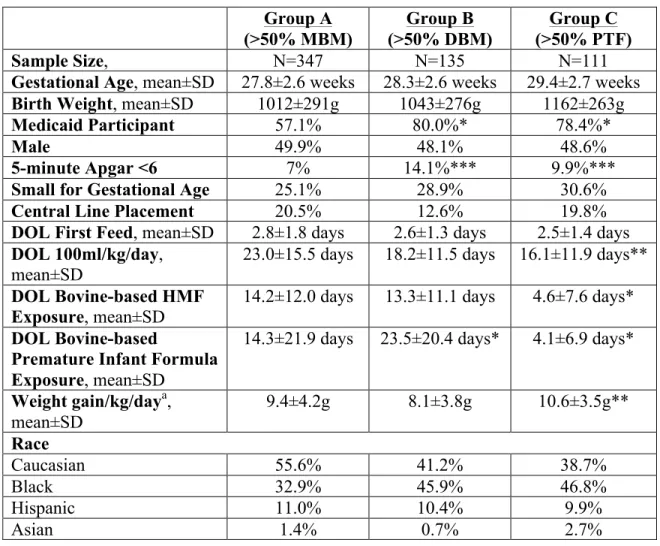
characteristics by predominant feeding type are presented in Table 1. The 28-day feeding
composition and rate of NEC in each group is shown in Figure 1. There were nine (2.5%)
cases of confirmed NEC in Group A, seven (5.3%) cases in Group B and ten (9.1%)
cases in Group C. Infants in Group C had significantly higher birth weights (Group A:
1012±291g MBM, Group B: 1043±276g DBM, Group C: 1162±263g) and GA (Group A:
27.8±2.6 MBM, Group B: 28.3±2.6 DBM, Group C: 29.4±2.7wk).
No differences in gender, race, small for gestational age classification, central line
placement indications, or day of life (DOL) of first enteral feed administration were
observed between the three groups. Groups B and C had significantly higher Medicaid
participation rates than Group A (p<0.001). Infants in both Group A took longer to
achieve 100ml/kg/day (p<0.01). Bovine HMF and PTF exposure occurred approximately
9.5 days earlier in Group C compared to Group A and B (p<0.001). Weight gain (g/kg)
per day was greater in Group C and Group A when compared to Group B (p<0.01). After
controlling for gestational age, the group differences between the DOL that100ml/kg/day
was achieved and weight gain at 28 days of life were no longer significant.
Results of the logistic regression analyses are shown in Table 2. After controlling
for group differences and previously identified risk factors for NEC, GA and Medicaid
participation remained significant independent risk factors for NEC along with feeding
group. Compared to Group A, Group B was associated with a three-fold increase (OR
– 17.00), p<0.01) in the odds of developing NEC. Moreover, of the infants in each
predominant feeding type, NEC surgery was required in 1% (4/350) of Group A, in 0%
(0/133) of Group B, and 3.6% (4/109) of the Group C.
Discussion:
HMF addition to HM is vital for VLBW infants due to reduced volume intake and
increased nutritional needs of these premature infants. Human-derived HMF is
inaccessible to many hospitals due to cost. This research study suggests that adding
bovine-derived HMF does not significantly increase the risk for NEC, and is considerably
lower in risk for NEC than preterm infant formula. To our knowledge, no other study has
assessed risk of NEC using enteral feeding type as a continuous variable for the first 28
days of life using MBM, DBM, and PTF. The benefit of a study like ours is that we can
start to understand the dose relationship between risk of NEC and type of enteral feeding.
Our analysis shows that even a minor increase in MBM can considerably reduce an
infant’s risk of NEC. This has previously been shown to indirectly reduce healthcare
costs and directly increases the infant’s and the family of the infant’s quality of life12.
Our data suggests that although the incidence of confirmed NEC cases in the
DBM group was not statistically different than PTF group, DBM may serve to protect
infants by lessening the severity of NEC and thus reducing surgical interventions. In our
study, fortified DBM appears to provide limited benefit over PTF in reducing the risk of
NEC. This may be due to small sample size of infants who were received predominately
those whose predominant feeding type was PTF had an approximately four-fold risk of
requiring NEC surgery compared to DBM group.
The finding of this study contributes to the knowledge available for enteral
feeding in VLBW preterm infants and the knowledge available for bovine-derived HMF
use in the NICU. The strengths and limitations of this study are important to understand
when comparing our findings to those of other studies. Strengths include the fact that
there is complete data on volume and composition of all enteral feeds for infants in the
study population prior to hospital discharge to home or another institution, and that the
data were collected consecutively at the same hospital pre and post donor milk policy
procedures. Additionally, FMH NICU has a standardized feeding regime informed by an
infant’s gestational age to which every attending neonatologist abides. This provided
consistency among infant enteral feeding prescriptions.
Limitations that reduce generalizability of this data include the fact that this is a
single institution study, enteral feeding data were not obtained for those infants who
transferred institutions, and that this is a retrospective study design thus examination of
complete maternal factors such as maternal chorioamnionitis is not possible due to
incomplete chart documentation. This study relied on existing data for maternal
characteristics. As is true in all non-randomized studies, the observed association may
have arisen because of group differences in variables that were not measured, not
accurately measured, or incorrectly specified in multi-variate analyses.
Our findings are consistent with a similar study by Schanler et al.6 that compared
DBM or PTF with MBM as the reference. This was a randomized controlled trial that
supplement to fortified MBM when MBM was not available. Similar to our study, the
Schanler et al. study also used bovine-derived HMF. Enteral feeding data for entire
hospital stay was the exposure, rather than the first 28 days as used in our study. In
summary, that study concluded that DBM, as a MBM substitute, offers limited benefits
such as lower rates of NEC, diarrhea and other infections, when compared to PTF. Earlier
studies have found that unfortified DBM is protective against NEC5,8,10,11. However, unfortified DBM will not support growth and physiological development in extremely
premature infants18 and therefore is not a viable option and would be unethical to repeat. Areas for future research would require a randomized trial of VLBW infants with
DBM with bovine HMF or PTF with a larger sample size than what has been previously
conducted5. In the future, it would also be beneficial to include other secondary factors in order to assess the difference in DBM with human milk-derived HMF and DBM with
bovine-derived HMF. For instance, research studies have shown that DBM alone can
improve feeding tolerance, reduce risk of lung disease and improve lipoprotein profiles19.
Unfortified DBM is not nutritionally adequate and therefore it would not be ethical to
randomly assign infants to DBM alone.
Our study provides additional data on the use of DBM and bovine derived HMF
and the risk of NEC. These data should encourage health care providers to educate
mothers about benefits of her own milk for her baby and about how to express milk for
her baby even if she does not plan to breastfeed. NEC diagnoses are closely associated
Acknowledgements:
I would like to thank Dr. Polly Sisk for granting me the opportunity to collaborate
with her research team and take this project under my wing so that I may be able to
complete my Master’s Thesis on this interesting and timely NICU nutrition topic. I am
forever grateful. Additionally, I greatly appreciate the guidance and support provided my
Appendix
Table 1: Infant Characteristics By Predominant Feeding Type Group
MBM = Mother’s Breastmilk DBM = Donor Breastmilk PTF = Preterm Infant Formula DOL = Day of Life
*Significantly different, p<0.001 **Significantly different, p<0.01 ***Significantly different, p<0.05
aExcluded infants who were transferred to another facility prior to discharge home.
Group A (>50% MBM) Group B (>50% DBM) Group C (>50% PTF)
Sample Size, N=347 N=135 N=111
Gestational Age, mean±SD 27.8±2.6 weeks 28.3±2.6 weeks 29.4±2.7 weeks Birth Weight, mean±SD 1012±291g 1043±276g 1162±263g
Medicaid Participant 57.1% 80.0%* 78.4%*
Male 49.9% 48.1% 48.6%
5-minute Apgar <6 7% 14.1%*** 9.9%***
Small for Gestational Age 25.1% 28.9% 30.6%
Central Line Placement 20.5% 12.6% 19.8%
DOL First Feed, mean±SD 2.8±1.8 days 2.6±1.3 days 2.5±1.4 days DOL 100ml/kg/day,
mean±SD
23.0±15.5 days 18.2±11.5 days 16.1±11.9 days**
DOL Bovine-based HMF Exposure, mean±SD
14.2±12.0 days 13.3±11.1 days 4.6±7.6 days*
DOL Bovine-based
Premature Infant Formula Exposure, mean±SD
14.3±21.9 days 23.5±20.4 days* 4.1±6.9 days*
Weight gain/kg/daya, mean±SD
9.4±4.2g 8.1±3.8g 10.6±3.5g**
Race
Caucasian 55.6% 41.2% 38.7%
Black 32.9% 45.9% 46.8%
Hispanic 11.0% 10.4% 9.9%
Table 2: Incidence of NEC
Odds Ratio Confidence Interval P value
GA 1.21 1.02-1.41 0.02
Medicaid 2.94 1.26-7.14 0.01
Predominant Feeding Group Group A
>50% MBM 1.0 (reference) Group B
>50% DBM
3.00 1.04-8.63 0.04
Group C >50% PTF
References
1 Grave GD, Nelson SA, Walker WA, Moss RL, Dvorak B, Hamilton FA, et al. New
therapies and preventive approaches for necrotizing enterocolitis: report of a research planning workshop. Pediatr Res 2007;62:510– 514.
2
Shah TA, Meinzen-Derr J, Gratton T, Steichen J, Donovan EF, Yolton K, Alexander B, Narendran V, Schibler KR. Hospital and neurodevelopmental outcomes of extremely low-birth-weight infants with necrotizing enterocolitis and spontaneous intestinal perforation. Journal of Perinatology 2012; 32:552-558.
3
Bisquera JA, Cooper TR, Berseth CL. Impact of necrotizing enterocolitis on length of stay and hospital charges in very low birth weight infants. Pediatrics 2002
Mar;109(3):423-8.
4
US Department of Health and Human Services and the Surgeon General’s Call to
Action to Support Breastfeeding. http://www.surgeongeneral.gov/topics/breastfeeding/
5
Sisk PM, Lovelady CA, Dillard RG, Gruber KJ, O’Shea TM. Early human milk feeding is associated with a lower risk of necrotizing enterocolitis in very low birth weight infants. Journal of Perinatalogy 2007; 27:428-433.
6
Schanler R, Lau C, Hurst N, O’Brian Smith E. Randomized trial of donor human milk versus preterm formula as substitues for mothers’ own milk in the feeding of extremely premature infants, Pediatrics 2005; 116:400-406.
7
Schanler RJ. Evalulation of the evidence to support current recommendations to meet the needs of premature infants: the role of human milk. Am J Clin Nutr, February 2007; 85(2): 6255-6285.
8 Cochrane Quigley M, McGuire W. Formula versus donor breast milk for feeding
preterm or low birth weight infants. Cochrane Database of Systematic Reviews 2014, Issue 4. Art. No.: CD002971. DOI: 10.1002/14651858.CD002971.pub3
9 Schanler RJ, et al. Randomized trial of donor human milk versus preterm formula as
substitutes for mothers’ own milk in the feeding of extremely premature infants. Pediatrics 2005;116:400-406.
10 Sullivan S, Schandler RJ, Kim JH, Patel AH, Trawoeger R, KiechlKohlendorfer U, et
al. An exclusively human milk-based diet is associated with a lower rate of necrotizing enterocolitis than a diet of human milk and bovine milk-based products. J Pediatr 2010;156:562-7.
11
McGuire W, Anthony M. Donor human milk versus formula for preventing necrotizing enterocolitis in preterm infants: systematic review. Arch Dis Child Fetal Neonatal Ed 2003; 88: F11-F14.
12 Ganapathy V, Hay JW, Kim JH. Costs of Necrotizing Enterocolitis and
Cost-Effectiveness of Exclusively Human Milk-Based Products in Feedings Extremely Premature Infants. Breastfeeding Medicine 2012; 7(1):29-37.
13
Morbidities in Very-Low-Birth-Weight Infants. Reviews from ASN EB 2013 Symposia. American Society for Nutrition. Adv. Nutr. 2014; 5:207-212..
14
Zampieri N, Zamboni C, Campglio FS. Necrotising enterocolitis in multiple gestations: comparison with singletons. Minerva Pediatr. 2012 Feb; 64(1):1-6.
15
Jones F, Tully M. Best practice for expressing, storing and handling human milk in
hospitals, homes and child care settings. 2nd
ed. Raleigh (NC): Human Milk Banking Association; 2006.
16
Bell M, Ternberg J, Feignin R. Neonatal necrotizing enterocolitis: therapeutic decisions
based upon clinical staging. Ann Surg 1978; 187: 1-7.
17
Drenckpohl D, Knaub L, Schneider C, McConnel C, Wang H, Macwan K. Risk Factors That May Predispose Premature Infants to Increased Incidence of Necrotizing
Enterocolitis. Clinical Research Reports. ICAN: Infant, Child, & Adolescent Nutrition 2010; 2(1): 37-44.
18 Colaizy TT, Carlson S, Morriss FH. Growth in VLBW infants fed predominantly
fortified maternal and donor human milk diets: a retrospective cohort study. BMC Pediatrics 2012; 12:124.
19