Pharmacophore
ISSN-2229-5402
Journal home page: http://www.pharmacophorejournal.com
Corresponding Author:Aghakhani N,Faculty of Nursing and Midwifery, Urmia University of Medical Sciences, Urmia, Iran. Email: [email protected]
A STUDY OF THE EFFECT OF SELF -CARE PROGRAM BASED ON
OREM’S MODEL ON THE QUALITY OF LIFE IN PATIENTS WITH
HEART FAILURE
Alizadeh S, Aghakhani N
2*, Hemmati Maslakpak M
3, Khademvatan K
41. Msc in Nursing, Urmia University of Medical Science
2. Assistant Professor of Nursing, Patient Safety Research Center, Urmia University of
Medical Sciences
3. Associate Professor of Nursing, Faculty of Nursing, Urmia University of Medical
Sciences
4. Associate Professor of Medical, Urmia University of Medical Sciences
A R T I C L E I N F O A B S T R A C T
Received: 18th Nov 2017
Received in revised form: 20th Mar 2018
Accepted: 25th Mar 2018 Available online: 28th Apr 20
Keywords: Heart Failure, Orem’s Self-Care Model, Quality Of Life
Background & Aims: Heart failure is one of the most common cardiovascular disorders and raised as a chronic, progressive and debilitating disorder causing deterioration of physical ability, disruption of personal and social relations, decreased ability to perform job responsibilities, economic and livelihood problems and finally, compromising quality of life of patients with heart failure. In order to solve these problems, nursing interventions, including new teaching methods are needed. This study aimed to investigate the effect of self-care program based on Orem’s model on the quality of life in patients with heart failure.
Materials & Methods: In present clinical trial on 60 patients with heart failure admitted to Seyyed al-Shohada Hospital in Urmia, the samples were selected by using convenience sampling method and randomly divided into two 30-patient experimental and control groups. Data collection tools were Orem’s self-care model-based needs assessment forms and MacNew quality-of-life questionnaire. The data was collected before and three months after implementing the self-care program. Data was analyzed using chi-square test, independent t-test, Man-Witney U test and variance analysis.
Results: after intervention, in experimental and control groups, the total mean of quality of life was reached from 92.83±5.35 to 101.13±7.89 and from89.73±8.48 to 89.72±5.69, respectively. There was a significant difference between the two groups after intervention in all aspects of quality of life including the physical, psychological and social dimensions and this result demonstrated the increased quality of life in the experimental groups (p=0.000).
Discussion and Conclusion: given the positive effect of implementation of Orem’s self-care model on improving the quality of life of patients with heart failure, it is recommended that nurses and other healthcare providers implement self-care program in patients with heart failure based on nursing theories and health care programs to improve their quality of life.
Copyright © 2013 - All Rights Reserved - Pharmacophore
To Cite This Article: Alizadeh S Aghakhani N, Hemmati Maslakpak M, Khademvatan K, (2018), “a study of the effect of self
-care program based on orem’s model on the quality of life in patients with heart failure”, Pharmacophore, 9(2), 97-102.
Introduction
second most common reason for admitting to doctors' offices [2]. The frequency of patients who admit to emergency department and repeated hospitalizations at hospital are also high [2]. About 24 percent of patients with heart failure discharged after treatment, were hospitalized again after 30 days [3]. It was estimated that the economic burden of treating heart failure is more than 39 billion dollars per year, including direct and indirect costs and increase in it is expected [4]. In Iran, the number of heart failure patients is estimated about 3500 per 100 thousand people and annual cost of hospitalization of these patients in Iran is estimated at 400 billion Rials that must be considered [5]. Heart failure causes deterioration of physical ability, disruption of personal and social relations, decreased ability to perform job responsibilities, economic and livelihood problems. Additionally, patients will face with increased costs of treatment and all of these factors affect the quality of life [6]. Patients with heart failure have a lower quality of life are [1, 7, 8]. Quality of life is a concept related to nursing and Nurses have always tried to promote it so that they always provide medical services and participate in nursing research to try to improve patients’ quality of life [9]. There are many options to control heart failure that self-care is one of these options [10].Self-care, including activities that humans specifically do to survive and have convenient performance, continuous improvement and well-being [11]. Orem’s self-care model is one of the most complete self-care theories that provide a proper clinical guide to plan and implement self-care principles [12]. Orem knows man as self-care factor and he does required cares for his health and thereby he save his life and health and permanently has the feeling of well-being [13]. Inadequate care leads to poor health outcomes and frequent hospitalizations [14, 15]. It was found that at least 50 percent of patients with heart failure do not follow medical advices and this will be led to their readmission [16] and in contrast, effective self-care is a significant factor in improving positive health outcomes and preventing frequent hospitalizations [17]. Self-care in heart failure implies on some items such as diet and medication management, sodium and fluid restriction, daily weighing, regular exercise, monitoring signs and symptoms of disease exacerbation, search and decision-making for appropriate medical measures [18]. Promotion of self-care helps patients to have more control over their daily lives and they can handle their social performance and thereby, they can improve their quality of life [19]. Given that the high prevalence and consequences of this disease as a chronic, progressive and debilitating disorder cause deterioration of physical ability, disruption of personal and social relations, decreased ability to perform job responsibilities, economic and livelihood problems and finally, reduced quality of life of patients with heart failure, nursing interventions, including new teaching methods will be needed. This study aimed to investigate the effect of self-care program based on Orem’s model on the quality of life in patients with heart failure.
Method
extracted from Orem’s model-based needs assessment questionnaire, the participants received a program of 4 to 6 30-45 min sessions [24] of individual training and nursing care measures related to each of him/her needs according to needs assessment. For the patients who were discharged from the hospital and for whatever reason, they were not able to commute to the hospital, the researcher went to their homes and the sessions of individual training were held and related nursing care measures were performed at their homes. In these sessions, self-care training and nursing care measures were performed based on nursing measures written in comprehensive nursing books. During this program, control group was received usual nursing care. This program lasted three months and the participants were asked to do the care at home and if they wanted to be guided, they would call the researcher and fix their problems. Three months after implementing self-care program, quality of life questionnaire was completed for both experimental and control groups and the data was analyzed using chi-square test, independent t-test, Man-Witney U test and variance analysis.
Results
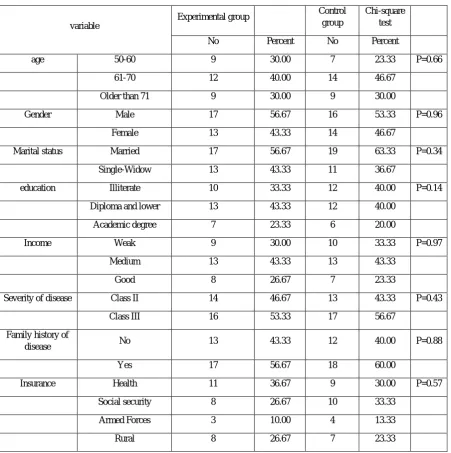
The results showed that the majority of patients of experimental group (56.67%) and control group (53.33%) were male. Majority of experimental group (40%) and control group (46.67%) were in the 61 to 70 age group. Chi-square test showed that there were not statistically significant differences between the two experimental and control groups in the variables of age, gender, marital status, education, income, severity of disease, family history of the disease, insurance status and employment status (Table 1).
Table 4-1. The frequency of demographic variables of patients with heart failure admitted to Seyyed al-Shohada Hospital in Urmia Town in 2016
variable
Experimental group Control
group
Chi-square test
No Percent No Percent
age 50-60 9 30.00 7 23.33 P=0.66
61-70 12 40.00 14 46.67
Older than 71 9 30.00 9 30.00
Gender Male 17 56.67 16 53.33 P=0.96
Female 13 43.33 14 46.67
Marital status Married 17 56.67 19 63.33 P=0.34
Single-Widow 13 43.33 11 36.67
education Illiterate 10 33.33 12 40.00 P=0.14
Diploma and lower 13 43.33 12 40.00
Academic degree 7 23.33 6 20.00
Income Weak 9 30.00 10 33.33 P=0.97
Medium 13 43.33 13 43.33
Good 8 26.67 7 23.33
Severity of disease Class II 14 46.67 13 43.33 P=0.43
Class III 16 53.33 17 56.67
Family history of
disease No 13 43.33 12 40.00 P=0.88
Yes 17 56.67 18 60.00
Insurance Health 11 36.67 9 30.00 P=0.57
Social security 8 26.67 10 33.33
Armed Forces 3 10.00 4 13.33
Employment status Unemployment 5 16.67 6 20.00 P=0.08
Housewife 5 16.67 4 13.33
Employee 3 10.00 4 13.33
Disabled 3 10.00 4 13.33
Retired 4 13.33 3 10.00
Self-employment 10 33.33 9 30.00
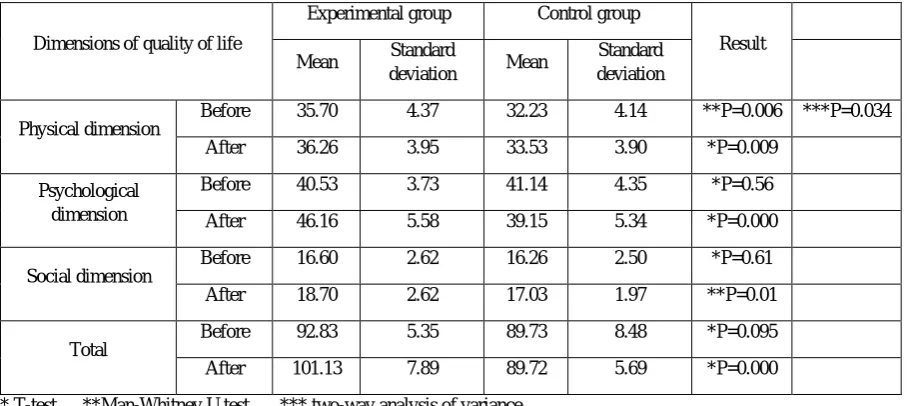
The results showed that before intervention, 70% of experimental group and 73.3% of control group and after intervention, 93.4% of experimental group and 76.66% of control group were independent in terms of self-care. These results showed that after intervention, the experimental group’s need decreased. According to the research goal, initial assessment of the quality of life was conducted in two groups before intervention. Before intervention, the average quality of life in experimental and control groups were 92.83±5.35 and 89.73±8.48, respectively and the results of t-test showed that there was no significant difference between the two experimental and control groups before intervention (p=0.095). After intervention, the mean quality of life of experimental and control groups reached 101.13±7.89 and 89.72±5.69, respectively. This showed significant difference between the two experimental and control groups in terms of quality of life after intervention (p=0.000). According to the assessment of quality of life in terms of three dimensions, significant differences were observed between the two experimental and control groups in psychological (p=0.000), social (p=0.01) and physical (p=0.009) dimensions. According to the significant difference in mean physical aspect before and after intervention, the results of two-way analysis of variance showed that p-value was 0.034 and this significant difference showed the effect of intervention (Table 2).
Table 2. Comparison of total mean of quality of life and the means of its dimensions before and after intervention
Dimensions of quality of life
Experimental group Control group
Result
Mean Standard
deviation Mean
Standard deviation
Physical dimension
Before 35.70 4.37 32.23 4.14 **P=0.006 ***P=0.034
After 36.26 3.95 33.53 3.90 *P=0.009
Psychological dimension
Before 40.53 3.73 41.14 4.35 *P=0.56
After 46.16 5.58 39.15 5.34 *P=0.000
Social dimension
Before 16.60 2.62 16.26 2.50 *P=0.61
After 18.70 2.62 17.03 1.97 **P=0.01
Total
Before 92.83 5.35 89.73 8.48 *P=0.095
After 101.13 7.89 89.72 5.69 *P=0.000
* T-test **Man-Whitney U test *** two-way analysis of variance
Discussion and conclusion
[26]. Stewart et al. showed that if the treatment of heart failure is performed by heart failure specialist nurses, it will improve the quality of life of patients so that the patients act according to their therapeutic regimen and their readmission rates will decrease [27]. The study entitled “the effect of comprehensive rehabilitation programs on the quality of life in patients with heart failure” by Mir et al. is consistent with present study. In their study, 51 male and female patients were treated within 12 weeks. Interventions were medication, exercise and physical activity, counseling and education. Statistical results showed significant improvement of quality of life and increased activity capacity within 12 weeks of comprehensive rehabilitation [28]. These studies confirm the results of present study.
Conclusion
The results of present study showed that application of this model, apart from the patients’ individual differences in terms of studied variables, can be effective in improving the quality of life of all the patients. On the other hand, regarding the frequency of cardiovascular disease and the development of heart failure and its devastating effects on quality of life, it is important that nurses seek to find new ways to improve the quality of life in patients with heart failure. Accordingly, Orem’s Self-Care Model can be a useful tool for achieving the goal of improving the quality of life of patients.
Acknowledgment
This study was extracted from the master’s thesis defended in the School of Nursing and Midwifery at Urmia University of Medical Sciences. We hereby thank all the patients who participated in present study, faculty of nursing of the School of Nursing and Midwifery as well as the personnel of Seyyed al-Shohada Hospital in Urmia Town and all those who helped us to conduct this study better.
References
1. Jaarsma T, Halfen R, Tan F, Abu-Saad HH, Dracup K, Diederiks J. Self-care and quality of life in patients with advanced heart failure: the effect of a supportive educational intervention. Heart & Lung: The Journal of Acute and Critical Care. 2000; 29(5):319-30.
2. Smeltzer Suzanne C, Bare Brenda G, Hinkle Janice L, Cheever Kerry H. Brunner & Suddarth’s textbook of medical-surgical nursing. 13rd, editor2014.
3. Hernandez AF, Greiner MA, Fonarow GC, Hammill BG, Heidenreich PA, Yancy CW, et al. Relationship between early physician follow-up and 30-day readmission among Medicare beneficiaries hospitalized for heart failure. Jama. 2010; 303(17):1716-22.
4. Norton C, Georgiopoulou VV, Kalogeropoulos AP, Butler J. Epidemiology and cost of advanced heart failure. Progress in cardiovascular diseases. 2011; 54(2):78-85.
5. Hekmatpour D, Mohammadi E, Ahmadi F, Arefi S.H, Rafie M. . The Effectiveness of Applying “Making Sensitivity to Re-admission Caring Model" on Controlling Congestive Heart Failure Complications Among Hospitalized Patients in Tehran Cardiovascular Centers. Journal of Iran University of Medical Science & Health Services 2010; 17(75):33-50.
6. Dunderdale K, Thompson DR, Miles JN, Beer SF, Furze G. Quality‐of‐life measurement in chronic heart failure: do we take account of the patient perspective? European journal of heart failure. 2005; 7(4):572-82.
7. Calvert MJ, Freemantle N, Cleland JG. The impact of chronic heart failure on health‐related quality of life data
acquired in the baseline phase of the CARE‐HF study. European journal of heart failure. 2005; 7(2):243-51.
8. Ditewig JB, Blok H, Havers J & van Veenendaal H. Effectiveness of self-management interventions on mortality, hospital readmissions, chronic heart failure hospitalization rate and quality of life in patients with chronic heart failure: a systematic review. Patient Education & Counseling. 2010; 78:297–315.
9. Sammarco A. Perceived social support, uncertainty, and quality of life of younger breast cancer survivors. Cancer Nursing. 2001; 24(3):209-12.
10. Albert NM. Promoting self-care in heart failure. Journal of Cardiovascular Nursing. 2008; 23(3):277-84.
11. Dickstein K, Cohen-Solal A, Filippatos G. Guidelines for the diagnosis and treatment of acute chronic heart failure. Eur Heart J 2008; 29(19):2388-442.
12. Alligood MR. Nursing theorists and their work: Elsevier Health Sciences; 2014.
14. Cameron J, Worrall-Carter L, Page K, Stewart S. Self-care behaviors and heart failure: Does experience with symptoms really make a difference? European Journal of Cardiovascular Nursing. 2010; 9(2):92-100.
15. Heo S, Moser DK, Lennie TA, Riegel B, Chung ML. Gender differences in and factors related to self-care behaviors: a cross-sectional, correlational study of patients with heart failure. International journal of nursing studies. 2008; 45(12):07-15.
16. Venner GH, Seelbinder JS . Team management of congestive heart failure across the continuum. Journal of Cardiovascular Nursing. 1996; 10(2):71-84.
17. Mast C. Personal and environmental factors affecting self-care behaviors of patients with heart failure. 2008.
18. Deaton C, Grady KL . State of the science for cardiovascular nursing outcomes: heart failure. Journal of Cardiovascular Nursing. 2004; 19(5):329-38.
19. Artinian NT, Magnan M, Christian W, Lange MP. What do patients know about their heart failure? Applied Nursing Research. 2002; 15(4):200-8.
20. Hofer S, Lim L, Guyatt G, Oldridge N. The MacNew heart disease health-related quality of life instrument. Health Qual Life Outcom. 2004; 2(3).
21. Asadi-Lari M, Javadi H, Melville M, Martin R, Oldridge N, Gray D. Adaptation of the MacNew quality of life questionnaire after myocardial infarction in an Iranian population. Health Qual Life Outcome. 2003; 1(23):1-6.
22. Daskapan A, Hofer S, Oldridge N, Alkan N, Muderrisoglu H, Tuzun E. The validity and reliability of the Turkish version of the MacNew heart disease questionnaire in patients with angina. J Evalu Clin Practice. 2008; 14(2):209-13.
23. Bagheri H. Effects of group counseling program on quality of life of patients with myocardial infarction referred to Clinics affiliated to Tehran Medical Universities' Hospitals [Master Thesis]. Tehran Tarbiat Moddares University. 2001.
24. Rostami M, Baraz SH, Farzianpour F, Rasekh A. Effect of Orem self-care model on elderlies' quality of life in health care centers of Masjed Solaiman in 2007-2008. Arak Medical University Journal. 2009; 12(2):51-9.
25. Rezayi luyeh HA, Dalvandi A, Hosseini MA, M. R. The effect of self-care education on quality of life in patients with heart failure. Rehabilitation Journal. 2008; 10(2):21-6.
26. Scott LD, Kline KS, Brittan A. The effect of nursing intervention to enhance mental health & quality of life among individuals with heart failure. Appl Nurs RES. 2004; 17(4):248-56.
27. Stewart M. clinical service frame work for heart failure 2003; 2: available from: http://www.health.nsw.gov.av.