Abstract
In this paper, Health at Every Size (HAES) and Intuitive Eating (IE) approaches are evaluated in relation to their effect on patterns of dieting in college aged women. The mechanism by which health at every size and intuitive eating interventions affect dieting and health
behaviors is explored, and interventions utilizing this approach are evaluated. 3 papers were identified in the literature which either studied associations between intuitive eating and health behaviors in college students, and 4 interventions that utilized this approach were identified. Though more information is needed to further understand this approach, all evidence shows that HAES/IE interventions are valuable in this population in that they reduce pathologic eating and dieting behaviors and improve other health outcomes. It is important to study this approach in other populations to further understand its functionality among different individuals.
Background
Dieting is very prevalent on college campuses and disproportionately occurs in women. By the time adolescents reach college, 46% of adolescents report that they have attempted to lose weight (Field, Aneja, Shrier, de Moore, & Gordon-Larson, 2007), and studies show that 60-80% of young college women have been on a diet within the past year. Of those women, many have a BMI within the ‘normal’ range (Ackard, Croll, & Kearney-Cooke, 2002). According to recent twin studies, the mean age of dieting onset for women is 20.8 years, which coincides with college years for many women (Enriquez et al., 2014).
Restrictive dieting has been linked to many adverse health consequences. Evidence also shows that it is usually ineffective in producing sustained weight loss or sustained health
Aphramor, 2011). This is especially significant in college women, since college-aged women have higher levels of body image concerns and desire for thinness than males or than women of other ages, and since eating disorders are highly prevalent on college campuses, affecting as many as 10-20% of college women (Hawks, Madanat, Smith, & De La Cruz, 2010; Taylor & Gibson, 2016). Women in larger bodies are particularly at risk in this group, since they are more likely to engage in dieting behaviors than women of other body sizes, and are also at higher risk for eating disorder symptoms than women who are ‘normal’ on the BMI scale (Lipson & Sonneville, 2017).
Since dieting seldom produces sustained results, many individuals who pursue weight loss begin to undergo patterns of weight loss behaviors followed by weight regain, which has been called weight cycling. Several large-scale observational studies have linked weight cycling to increased all-cause mortality, risk of cardiovascular disease, stroke, diabetes, increased systolic and diastolic blood pressure, and decreased immune function (Mann et al. 2007, French et al., 1997; Olson et al, 2000; Kajioka, Tsuzuku, Shimokata & Zato 2002; Shade et al. 2004). Some studies suggest that the health risks that are often attributed to obesity could be the result of weight cycling. A 2007 paper connected that in both the National Health and Nutrition Examination Survey and Framingham Heart Study, two large-scale prominent cohort studies, “all excess mortality associated with obesity was accounted for when the impact of weight cycling was considered” (Robison, Putnam, & McKibbin 2007; Diaz, Mainous, & Everett, 2005; Lissner et al., 1991). Enriquez et al. (2014) found that women who begin dieting earlier are more likely to undergo more episodes of weight cycling, engage in risky dieting behaviors, and reach a higher BMI than women who do not diet or who begin to diet past adolescence.
Due to the a) lack of evidence that dieting is useful in this population, b) evidence showing that dieting and weight cycling is harmful to the body, and c) implications of dieting and weight cycling on the development of eating disorders in young women, it is important to understand how these behaviors can be minimized in order to foster healthy eating and the reduction of dieting behaviors in young women. The Health at Every Size (HAES) approach and the Intuitive Eating (IE) approaches have both shown to reduce dieting behaviors in other
Introduction to HAES and IE
Intuitive Eating and Health at Every Size are both movements that promote weight-neutral approaches to health promotion. The HAES approach advocates that weight is not a primary indicator of health status, could distract individuals from achievable health goals, and therefore should not be the primary outcome of wellness promotion. Rather, HAES emphasizes that all people can improve their health regardless of changes in weight, and that weight loss may or may not be a side effect of improved health status, rather than the outcome (Bacon & Aphramor, 2011). Similarly, the Intuitive Eating approach provides steps for connecting with and eating in response to internal hunger and fullness/satiety cues as well as exercising for enjoyment, stopping dieting behaviors, and viewing all foods as neutral (Tribole & Resch, 1995).
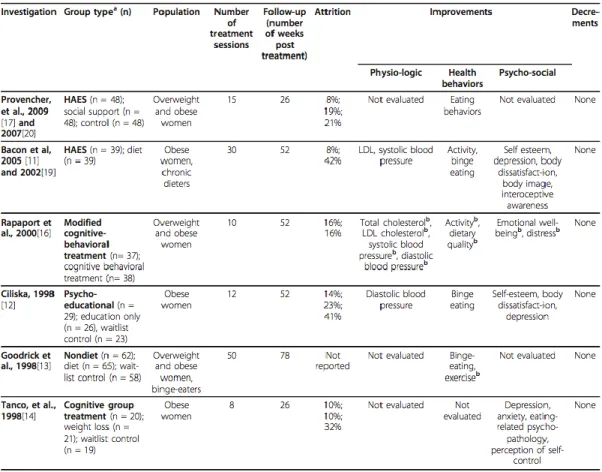
Intuitive eating and Health at Every Size go hand-in-hand, as they incorporate principles from one another. Both techniques aim to promote health by connecting individuals to internal signals of hunger and satiety, reducing disordered eating behaviors, and fostering positive body image. Both frameworks are commonly used in the treatment of eating disorders. Numerous eating disorder groups including The Academy for Eating Disorders, the Binge Eating Disorder Coalition, the International Association for Eating Disorder Professionals, and the National Eating Disordered Association Practitioners all support these approaches. (Bacon & Aphramor, 2011). Many other interventions use HAES and IE approaches by other names. For example, mindful eating, non-diet, and weight-neutral interventions also use HAES and IE components. HAES and IE interventions have been associated with healthy eating behaviors, improved physical and mental health, and improved body image in adult women, as shown in Figure 1.
Review of the Literature
Mechanism of HAES/IE
Two scales, which are prominent in studying dieting and intuitive eating behaviors, were analyzed in this review. The first is the Intuitive Eating Scale (IES), which measures three aspects of intuitive eating: reliance on internal hunger and satiety cues (RIH), unconditional permission to eat when hungry (UPE), and eating for physical rather than emotional reasons (EPR) (Tylka, 2006). Because intuitive eating does not involve dieting, individuals who score more highly on the IES are less likely to engage in dieting behaviors, and individuals who score lowly tend to rely more heavily on external signals to eat other than hunger and fullness, and are more likely to be restrained eaters. The other is the Cognitive Behavior Dieting Scale, or CBDS, which measures food thoughts and dieting behaviors within the past 2 weeks. The higher the CBDS score, the more dieting behaviors or thoughts have occurred in the past 2 weeks (Martz, Sturgis, & Gustafson, 1996). These scales were used as a proxy to identify the presence of dieting thoughts and behaviors, as is often done in the literature.
between body acceptance (i.e. appreciation of body function, less attention paid to body appearance, and the cessation of dieting behaviors) and intuitive eating behaviors (eating
according to hunger and satiety cues). The authors proposed that their model revealed that “when women emphasize the functionality of their bodies more so than their appearance, they are more likely to hold positive feelings toward their bodies and eat according to their bodies’ internal hunger and satiety signals.” These findings differ from current health promotion messages, which often communicate that ignoring cravings, hunger signals, and other body signals can be helpful. Rather, the authors supported the notion that increasing body appreciation and
connection with internal hunger and fullness signals is more likely to result in “individuals who…are more likely to be at a weight that is appropriate for their body type and have higher levels of psychological well-being”.
Gast, Nielson, Hunt, & Leiker (2015) conducted a cross-sectional study among 200 undergraduate women to understand the relationship between intuitive eating scores, body mass index, and internal motivation for exercise. They found that women who score higher on the IES had significantly lower BMI scores than women who score low on the IES. Intuitive eaters were also more likely to report higher levels of internally motivated physical activity. This means that they are more likely to exercise for enjoyment and self-care rather than view exercise as a chore or a punishment, as it can often be viewed in weight loss or restrictive dieting programs.
Although this paper was not an intervention, it is important to consider this association, as research has shown that intuitive eating behaviors can be relearned (Bacon, Stern, Van Loan, & Keim, 2005).
Finally, Spoor & Madanat (2016) conducted a cross-sectional study among 44 college women to further understand the relationship between body image, body image discrepancy, and IES scores. They found that women who experience more positive body image and less body image discrepancies (discrepancies between what they think their body looks like and what it actually looks like) have higher IES scores.
These studies suggest that the mechanism of intuitive eating and health at every size works is that by promoting positive body image and increasing messaging about health as a self-care method rather than as a punishment or as a means to change one’s natural body size,
weight-cycling, and promote body dissatisfaction, which can make it difficult for individuals to increase health behaviors out of self-care. This mechanism of intuitive eating enhancing
nutritional choices holds for individuals who have disease states or dietary needs that require additional consideration. For example, research shows that intuitive eating is associated with improved glycemic control in adolescents with type 1 diabetes (Wheeler et al. 2016) as well as in adults with type 2 diabetes (Miller, Kristeller, Headings, Nagaraja, & Miser, 2012). A HAES approach has been shown to improve fitness and metabolic risk among premenopausal women with metabolic syndrome (Carroll, Borkoles, & Polman, 2007).
Review of Interventions
The use of educational courses has been used as an intervention method to introduce HAES and IE principles to college women. Humphrey, Clifford, & Morris (2015) designed and held a college course in which HAES principles were introduced to 45 undergraduate students (76% female). The authors used a quasi-experimental design by employing a comparison traditional nutrition course with some HAES concepts (n = 66; 74% female) as well as a control group that took a basic nutrition course (n = 46, 68% female). The non-diet (HAES/IE) paradigm employed messages that promoted enjoyable physical activity, respecting diverse body sizes, and eating in response to hunger and satiety cues. The comparison and control group used messages such as that individuals aiming to lose weight should aim for a 5-10% reduction in body weight, that calories consumed should be less than those expended through intentional physical activity to achieve a negative energy balance, and that choice of food quantity and quality should be guided by calorie needs. All three groups took the CBDS and the IES before and after the intervention. The authors found that overall IES scores increased and CBDS scores decreased significantly in the HAES group in comparison with the comparison and control groups.
However, no difference was found in the 3 groups from pretest to posttest for the IES subscale of eating for physical rather than emotional reasons (EPR) as well as the body-food choice
Figure 2. Table 3 from Humphrey, Clifford, & Morris (2015) showing changes in IES-2 subscales, CBDS scores, and other scales between students following a HAES intervention, a comparison intervention, and a control group with no intervention.
Hawks, Madanat, Smith, & De La Cruz (2010) conducted a college course intervention in 29 college women with a history of dieting behaviors that emphasized improving body image, reinforcing nonrestrictive, hunger-based eating patterns, and debunking fad diets, among other HAES/IE approaches, using the Health Belief Model. The CBDS and IES tests were taken prior to and after the course, and were used to separate students into a low-dieting group and high-dieting group. Both groups completed the same intervention, but they were separate to show how ingrained diet beliefs and behaviors affect the groups differently. Total IES scores also increased in both groups. The authors also found that CBDS scores decreased significantly in the
total improvement in the scales used. The authors concluded that the experience used “may be most efficacious for individuals whose eating styles, body image concerns, and dietary restraint are not as fully entrenched, whereas more aggressive interventions may be necessary for those who are deeply involved with dietary restraint.”
Brown (2009) taught a singular HAES course to 129 undergraduate students (71%
female) enrolled in an introductory nutrition course. Though students did not complete the IES or CBDS, they completed a pre- and posttest regarding their views of the HAES movement as future health and fitness professionals. 7 of the 8 items on the test changed significantly from pre to post, with 77% of students reporting having improved attitudes on HAES and 76% reporting that they recognized HAES as being evidence-based on the post-test. Brown also found that many students reported that they greatly valued the instruction and said it changed their
perspective on weight loss dieting and respect for all body sizes. Although this course was taught from the perspective of students using this approach to counsel others in the future, it is logical to suggest that it also changed their personal perspectives on dieting. For example, one female student commented:
“I am a chronic dieter, and so are most of the women in my family. This article changed my views on size and helped me to realize that I am healthy even though I am not ‘model’ thin. This study showed that the lab tests for those women who were intuitively eating came back within normal limits [or] even better than the lab tests of those women who were dieting. This article made me see that a person can be healthy at any size if he/she is eating right and exercising.’’
This quote exemplifies how messages promoting body acceptance and the prioritization of healthy behaviors over appearances can affect future dieting behaviors.
group consumed at least 1 more cup per day of fruits and vegetables than the control group, and maintained at least ½ cup more per day of fruits and vegetables at 15-month follow-up, both of which were statistically significant findings. The intervention group also scored higher on eating competence scores. The Eating Competence Scale was developed by Ellyn Satter to measure intuitive eating behaviors, which are marked by the absence of restrictive and/or rigid dieting behaviors (Satter, n.d.). This means that this group also decreased in dieting behaviors and mentality. Another notable finding was that the intervention group decreased slightly in
cardiorespiratory fitness and physical activity, but that both groups declined in physical activity, and the intervention group maintained a smaller decrease in physical activity than the control group, suggesting that the intervention reduced the natural decline in physical activity that is common during the freshman year of college.
The Greene et al. (2012) paper presents notable findings that suggest that in addition to reducing dieting thoughts and behaviors, and decreasing mindsets indicative of the development of eating disorder thoughts, weight-neutral interventions result in improved dietary intake in addition to eating competence. Tylka & Homan (2015) found that an intuitive eating and body acceptance model is linked to increased functional exercise motives. Similar findings have been demonstrated in the literature in other populations. A literature review of 6 HAES randomized controlled trials conducted in adult overweight and obese women found improvements in
physical activity, eating behaviors, dietary quality, biomarkers of health (LDL cholesterol, blood pressure) and psychosocial health, as shown in Figure 1. Additionally, none of the interventions reviewed found any decrements in health parameters studied (Bacon & Aphramor, 2011).
Discussion
Authors Study Design Messages and Approach Related to HAES/IE
Outcomes Humphrey, Clifford, & Morris (2015)
Quasi-experimental, n = 45 (76% female)
• Promotion of enjoyable physical activity
• Respect of diverse body sizes • Eating in response to hunger
and satiety cues
• Significant increase in IES scores in comparison with comparison/control groups • Significant decrease in
CBDS scores in comparison with comparison/control groups
Hawks, Madanat, Smith, & De La Cruz (2010)
Case study, n = 29 (100% female)
• Improvement of body image • Reinforcement of
nonrestrictive hunger-based eating
• Debunking fad diets
• Significant decrease in CBDS scores in low- and high-dieting groups
(significantly larger decrease in high-dieting group) • Increase in IES scores, with
significant changes in several subscales Brown
(2009)
Case study, n = 129 (71% female)
• Explanation of HAES
paradigm and misconceptions • Review of relevant literature
• Significant increase in ratings on 7 of 8 items on a pre/post-test regarding understanding of HAES paradigm and willingness to use HAES framework for health promotion in patient populations
• 77% report having
improved attitudes on HAES • 76% report recognizing
HAES as being evidence-based on the post-test. Greene et al.
(2012)
Randomized controlled trial, n = 1689 (68% female)
• HAES and body size acceptance (of self and of others)
• Mindful eating, eating according to hunger and fullness
• Tuning in and examining factors that influence internal regulation of eating
• Using gentle nutrition (an IE principle) when choosing foods to buy and eat • Enjoyable exercise • Food acceptance and
increased diet variety
• Increase in Eating
Competence scores among intervention group • Increased fruits/vegetable
consumption: at least 1 more cup per day than control during intervention, and at least ½ cup more per day than control at 15-month follow-up
• Significantly higher amount of physical activity than control group during intervention
• Lower rate of decline of cardiorespiratory fitness than control group
The literature also suggests that in addition to decreasing dieting behaviors, HAES/IE interventions also have the potential to sustainably increase health behaviors such as fruit and vegetable intake and maintenance of regular physical activity as well as exercise motivation and functional exercise motives (i.e. exercise for improved physical function and health rather than physical appearance). Although these findings have been well researched in adult overweight women, more randomized controlled trials are needed to support these findings in the population of college women.
The articles discussed in this paper have an important limitation to consider, which is that many of the interventions in this course were conducted on a homogeneous group of white individuals. Although research has found that that women of different socio-demographic backgrounds/identities often do not differ in intuitive eating patterns, it is important to further study understand this relationship as well as existing intervention literature in women of all races/ethnicities and socioeconomic statuses. Research has found that men have different intuitive eating patterns and that they respond differently to intuitive eating interventions
(Denny, Loth, Eisenberg, & Neumark-Sztainer, 2013). Because of those differences, as well as a dearth of literature conducted on men, this paper solely focused on women. However, it is important to expand and understand this relationship in men, since men are less likely to seek help for disordered eating concerns (Collier 2013).
One limitation of this literature review in particular was the utilization of literature that contained college men in the study, as the purpose of the intervention was to understand this relationship in college women. Research has identified that men score differently on the intuitive eating scale than women and. This means that some of the findings from the literature search could have been different if the study had only been comprised of women. However, all of the literature used contained at least 68% women, which minimizes large shifts in findings.
larger proportions of the American diet. Although the two are not mutually exclusive, it is important for public health nutrition interventions and movements to address concerns and consider approaches that aim to restructure the food environment.
Conclusion
As the Health at Every Size and IE approaches have become more popular, the dietetics field has begun to change to accommodate them. A 2017 cross-sectional survey completed by 18,622 US RDNs found that dietitians who work in weight management tend to use intuitive eating and nonrestrictive practices more than traditional restrictive weight loss practices (Schaefer & Zullo 2017). There is no data on how many dietitians tend to use this approach in other areas of dietetic practice. It is arguable that dietitians in other areas of practice outside of weight management should learn more about this approach and how it can be used to serve the populations they work with, including young adults and college students.
There has been controversy over the addition of a HAES framework into curricula for registered dietitians as well as other healthcare professionals. The Academy of Nutrition and Dietetics has not taken an official stance on HAES or incorporated HAES into any of its certifications. In 2016, dietitian Jennifer McGurk petitioned to include HAES in the AND Obesity and Weight Management Certification for dietitians. Her petition gained 778 supporters yet no changes were made to the dietetic certification in Obesity and Weight Management
curriculum (Change.org, 2016). In 2018, the Academy of Food and Dietetics’ Food and Nutrition Conference Expo featured a debate between a dietitian who practices nutrition counseling from a HAES approach and a medical doctor who backed a calorie counting approach to health and wellness promotion (Academy of Nutrition and Dietetics, n.d.). Nonetheless, there are several certifications approved for continuing education units available for dietitians who wish to
incorporate these methods into their practice. For example, Evelyn Tribole, one of the authors of the Intuitive Eating book, offers an Intuitive Eating certification for registered dietitians and health professionals as well as Intuitive Eating PRO Teleseminars for continuing education (Helm Publishing, n.d.; Evelyn Tribole, n.d.).
behaviors. It is important for dietitians and all healthcare/wellness professionals to advocate for this intervention approach to be used on college campuses, where dieting is rampant, and where many women toe the line of disordered eating. It is also important to gather more data on this intervention approach in women of color, men, and other age groups. Most HAES and IE
Works Cited
1. Academy of Nutrition and Dietetics FNCE 2018. (n.d.). 432. Debate: A Conversation on Weight Management and Health at Every Size ® [webpage]. Retrieved from
https://eatrightfnce.org/sessions/669455/
2. Ackard D.M., Croll J.K., Kearney-Cooke A. (2002). Dieting frequency among college females: Association with disordered eating, body image, and related psychological problems. Journal of Psychosomatic Research 52: 129-136.
3. Avalos C.A., Tylka T.L. (2006). Exploring a Model of Intuitive Eating with College Women. Journal of Counseling Psychology 53(4): 486-497.
4. Bacon, L. (2008). Health at Every Size: The Surprising Truth about your Weight. Dallas, TX: BenBella Books.
5. Bacon L. & Aphramor, L. (2011). Weight Science: Evaluating the Evidence for a Paradigm Shift. Nutrition Journal 10(9): doi: 10.1186/1475-2891-10-9
6. Bacon L., Stern J.S., Van Loan M.D., Keim N.L. (2005). Size acceptance and intuitive eating improve health for obese, female chronic dieters. Journal of the American Dietetic Association 105: 929–936.
7. Brown L.B. (2009). Teaching the “Health at Every Size” Paradigm Benefits Future Fitness and Health Professionals. Journal of Nutrition Education and Behavior 41(2): 144-145.
8. Carroll S., Borkoles E., Polman R. (2007). Short-term effects of a non-dieting lifestyle intervention program on weight management, fitness, metabolic risk, and psychological well- being in obese premenopausal females with the metabolic syndrome. Applied Physiology, Nutrition, and Metabolism 32: 125-142.
9. Collier R. (2013). Treatment challenges for men with eating disorders. Canadian Medical Association Journal 185(3): E137-E138.
10.Denny K.N. Loth, K., Eisenberg, M.D, Neumark-Sztainer, D. (2013). Intuitive eating in young adults: Who is doing it, and is it related to disordered eating behaviors? Appetite 60(1): 13-19. doi: 10.1016/j.appet.2012.09.029
11.Diaz, V. A., Mainous, A. G., III, & Everett, C. J. (2005). The association between weight fluctuation and mortality: Results from a population-based cohort study. Journal of Community Health 30(3): 153- 165.
12.Enriquez E., Duncan G.E., Schur E.A. (2013). Age at dieting onset, body mass index, and dieting practices: A twin study. Appetite 71: 301-306. doi: 10.1016/j.appet.2013.09.001 13.Evelyn Tribole, MS, RD.: The Original Intuitive Eating Pro. Intuitive Eating Pro Skills
Training [webpage]. Retrieved from
https://www.evelyntribole.com/professionals/intuitive-eating-pro-skills-training/ 14.Field A.E., Aneja P., Austin S.B., Shrier L.A., de Moor C., Gordon-Larson P. (2007).
Race and gender differences in the association of dieting and gains in BMI among young adults. Obesity 15: 456–464.
15.French S. A., Folsom A. R., Jeffery R. W., Zheng W., Mink P. J., & Baxter J. E. (1997). Weight variability and incident disease in older women: The Iowa Women’s Health Study. International Journal of Obesity and Related Metabolic Disorders, 21, 217–223. 16.Gast, J., Nielson, A.M., Hunt, A. & Leiker, J. Intuitive Eating; Associations with Physical
17.Greene G.W., White A.A., Sharon L.H., Lohse B., Shembre S.M., …Phillips B.W. (2012) Impact of an Online Healthful Eating and Physical Activity Program for College Students. American Journal of Health Promotion 27(2). doi: 10.4278/ajhp.110606-QUAN-239
18.Hawks S.R., Madanat H., Smith T., De La Cruz N. (2008). Classroom Approach for Managing Dietary Restraint, Negative Eating Styles, and Body Image Concerns Among College Women. Journal of American College Health 56(4). doi:
10.3200/JACH.56.44.359-368
19.Helm Publishing. Intuitive Eating – 37 CE Hour Online Course [webpage]. Retrieved from https://www.helmpublishing.com/intuitive-eating-certificate-of-training-1891 20.Humphrey L., Clifford D., Neyman Morris, M. (2015). Health at Every Size College
Course Reduces Dieting Behaviors and Improves Intuitive Eating, Body Esteem, and Anti-Fat Attitudes. Journal of Nutrition Education and Behavior 47(4): 354-360. 21.Change.org (2016). Include Health at Every Size® principles in the Obesity & Weight
Management certification [webpage]. Retrieved from
https://www.change.org/p/commission-on-dietetic-registration-include-health-at-every-size-principles-in-the-obesity-weight-management-certification
22.Lebenstedt M., Platte P., Pirke M. (1999). Reduced resting metabolic rate in athletes with menstrual disorders. Medicine & Science in Sports & Exercise 31(9): 1250-1256.
23.Lipson S.K., Sonneville K.R. (2017). Eating disorder symptoms among undergraduate and graduate students at 12 U.S. colleges and universities. Eating Behaviors 24: 81-88. 24.Lissner L., Odell P. M., D’Agostino R. B., Stokes J. S., Kreger B. E., Belanger A. J., et
al. (1991). Variability of body weight and health outcomes in the Framingham population. New England Journal of Medicine 324(26): 1839-1844.
25.Martz D.M., Sturgis E.T., Gustafson S.B. (1996). Development and preliminary validation of the cognitive behavioral dieting scale. International Journal of Eating Disorders 19(3): 297-309.
26.Miller C.K., Kristeller J.L., Headings A., Nagaraja H., Miser F. (2012). Comparative Effectiveness of a Mindful Eating Intervention to a Diabetes Self-Management
Intervention among Adults with Type 2 Diabetes: A Pilot Study. Journal of the Academy of Nutrition and Dietetics 112(11): 1835-1842.
27.Penney T.L., Kirk S.F. (2015). The Health at Every Size Paradigm and Obesity: Missing Empirical Evidence may Help Push the Reframing Obesity Debate Forward. American Journal of Public Health 105(5): e38-e42.
28.Platte P., Wurmser H., Wade S.E., Mercheril A., Pirke K.M. (1996). Resting metabolic rate and diet‐induced thermogenesis in restrained and unrestrained eaters. International Journal of Eating Disorders 20(1): 33-41.
29.Satter, Ellyn (n.d.). Eating Competence. Retrieved from
https://www.ellynsatterinstitute.org/family-meals-focus/21-eating-competence/
30.Schaefer J.T., Zullo D.M. (2017). US Registered Dietitian Nutritionists’ Knowledge and Attitudes of Intuitive Eating and Use of Various Weight Management practices. Journal of the Academy of Nutrition and Dietetics 117(9): 1419-1428.
32.Spoor K.D., Madanat H. (2016). Relationship Between Body Image Discrepancy and Intuitive Eating. International Quarterly of Community Health Education 36(3): 189-197. 33.Stice E., Hayward C., Cameron R.P., Killen J.D., Taylor C.B. (2000). Body-image and
eating disturbances predict onset of depression among female adolescents: A longitudinal study. Journal of Abnormal Psychology, 109(3): 438-444.
34.Taylor J.V., Gibson D.M. (2016). Crisis on campus: Eating disorder intervention from a developmental-ecological perspective. Journal of American College Health 64(3): 251-255.
35.Tribole E., Resch E. (1995). Intuitive Eating: A Revolutionary Program that Works. New York, NY: St. Martin’s Press.
36.Tylka T.L., Homan K.J. (2015). Exercise motives and positive body image in physically active college women and men: Exploring an expanded acceptance model of intuitive eating. Body Image 15: 90-97.