OPERATING LIMITATIONS
CERTIFICATION STATUS
This airplane is certified in accordance with FAR 25.
WEIGHT LIMITATIONS
Maximum Design Ramp Weight . . . 20,200 Pounds Maximum Design Takeoff Weight . . . 20,000 Pounds Maximum Design Landing Weight . . . 18,700 Pounds Maximum Design Zero Fuel Weight . . . 15,000 Pounds Minimum Flight Weight . . . 12,400 Pounds Maximum Tailcone Baggage Weight . . . 700 Pounds
Takeoff weight is limited by the most restrictive of the following requirements:
Maximum Certified Takeoff Weight . . . 20,000 Pounds Maximum Takeoff Weight Permitted by Climb
Requirements . . . Refer to Procedures for Use of Takeoff Performance Tables in Section IV Takeoff Field Length . . . Refer to Procedures for Use of Takeoff
Performance Tables in Section IV Landing weight is limited by the most restrictive of the following requirements:
Maximum Certified Landing Weight . . . 18,700 Pounds Maximum Landing Weight Permitted by Climb Requirements
or Brake Energy Limit . . . Refer to Procedures for Use of Approach and Landing Performance Tables in Section IV Landing Distance . . . Refer to Procedures for Use of Approach and Landing Performance Tables in Section IV
CENTER-OF-GRAVITY LIMITS
Center-of-Gravity Moment Envelope . . . Refer to Figure 2-1
WEIGHT AND BALANCE DATA
The airplane must be operated in accordance with the approved loading schedule. Refer to Weight and Balance Data Sheet and Model 560XL Weight and Balance Manual.
CERTIFICATION AND OPERATIONAL LIMITATIONS ARE CONDITIONS OF THE TYPE AND AIRWORTHINESS CERTIFICATES AND MUST BE COMPLIED WITH AT ALL TIMES AS REQUIRED BY LAW.
NOTICE
FAA APPROVED
Figure 2-1
CENTER-OF-GRAVITY LIMITS ENVELOPE GRAPH
FORM NUMBER 2008A, 17 November 1999
FAA APPROVED
OPERATING LIMITATIONS
CERTIFICATION STATUS
This airplane is certified in accordance with FAR 25.
WEIGHT LIMITATIONS
Maximum Design Ramp Weight . . . 20,200 Pounds Maximum Design Takeoff Weight . . . 20,000 Pounds Maximum Design Landing Weight . . . 18,700 Pounds Maximum Design Zero Fuel Weight . . . 15,000 Pounds Minimum Flight Weight . . . 12,400 Pounds Maximum Tailcone Baggage Weight . . . 700 Pounds
Takeoff weight is limited by the most restrictive of the following requirements:
Maximum Certified Takeoff Weight . . . 20,000 Pounds Maximum Takeoff Weight Permitted by Climb
Requirements . . . Refer to Procedures for Use of Takeoff Performance Tables in Section IV Takeoff Field Length . . . Refer to Procedures for Use of Takeoff
Performance Tables in Section IV Landing weight is limited by the most restrictive of the following requirements:
Maximum Certified Landing Weight . . . 18,700 Pounds Maximum Landing Weight Permitted by Climb Requirements
or Brake Energy Limit . . . Refer to Procedures for Use of Approach and Landing Performance Tables in Section IV Landing Distance . . . Refer to Procedures for Use of Approach and Landing Performance Tables in Section IV
CENTER-OF-GRAVITY LIMITS
Center-of-Gravity Moment Envelope . . . Refer to Figure 2-1
WEIGHT AND BALANCE DATA
The airplane must be operated in accordance with the approved loading schedule. Refer to Weight and Balance Data Sheet and Model 560XL Weight and Balance Manual.
CERTIFICATION AND OPERATIONAL LIMITATIONS ARE CONDITIONS OF THE TYPE AND AIRWORTHINESS CERTIFICATES AND MUST BE COMPLIED WITH AT ALL TIMES AS REQUIRED BY LAW.
NOTICE
FAA APPROVED
Figure 2-1
CENTER-OF-GRAVITY LIMITS ENVELOPE GRAPH
20,200 POUNDS MAXIMUM RAMP WEIGHT
20,000 POUNDS
MAXIMUM TAKEOFF WEIGHT
MAXIMUM LANDING WEIGHT 18,700 POUNDS 12 14 16 18 20 22 24 26 28 30 32 34 36 38 40 316 318 320 322 324 326 328 330 332 334 336 338 340 18 17 16 14 13 12 11 10 15 19 20 21
MAXIMUM ZERO FUEL WEIGHT 15,000 POUNDS
MINIMUM FLIGHT WEIGHT 12,400 POUNDS
FORM NUMBER 2008, 17 April 1998 REVISED 14 August 1998
FAA APPROVED
POWERPLANT LIMITATIONS
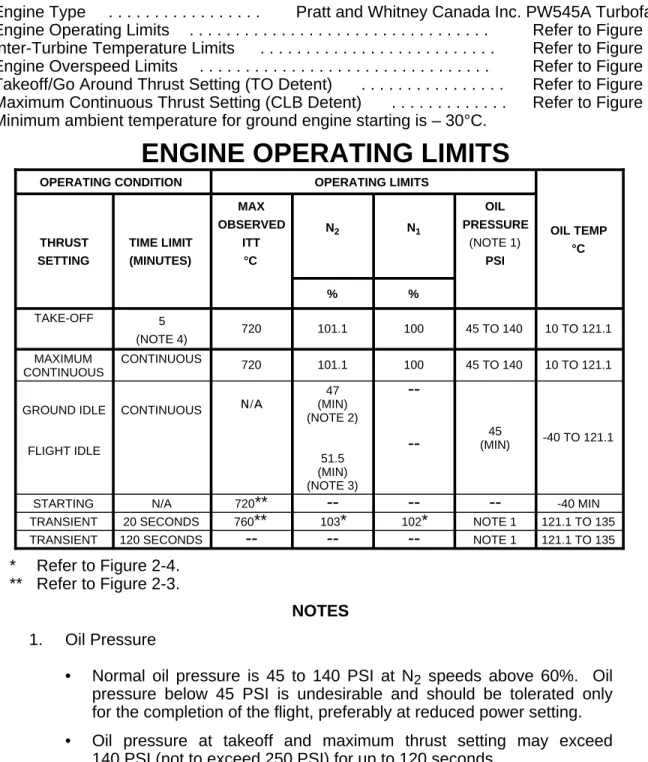
Engine Type . . . Pratt and Whitney Canada Inc. PW545A Turbofan Engine Operating Limits . . . Refer to Figure 2-2 Inter-Turbine Temperature Limits . . . Refer to Figure 2-3 Engine Overspeed Limits . . . Refer to Figure 2-4 Takeoff/Go Around Thrust Setting (TO Detent) . . . Refer to Figure 4-8 Maximum Continuous Thrust Setting (CLB Detent) . . . Refer to Figure 4-9 Minimum ambient temperature for ground engine starting is – 30°C.
ENGINE OPERATING LIMITS
NOTES
1. Oil Pressure
• Normal oil pressure is 45 to 140 PSI at N2 speeds above 60%. Oil pressure below 45 PSI is undesirable and should be tolerated only for the completion of the flight, preferably at reduced power setting. • Oil pressure at takeoff and maximum thrust setting may exceed
140 PSI (not to exceed 250 PSI) for up to 120 seconds. 2. Ground Idle is available in EEC mode only.
3. Flight idle is available in EEC or Manual modes.
4. Take-off ratings that are nominally limited to 5 minutes duration may be used for up to 10 minutes for One Engine Inoperative operations without adverse effects upon engine airworthiness.
Figure 2-2 * Refer to Figure 2-4. ** Refer to Figure 2-3. OPERATING CONDITION THRUST SETTING TIME LIMIT (MINUTES) OPERATING LIMITS MAX OBSERVED ITT °C N2 % N1 % OIL PRESSURE (NOTE 1) PSI OIL TEMP °C TAKE-OFF 5 (NOTE 4) 720 101.1 100 45 TO 140 10 TO 121.1 MAXIMUM CONTINUOUS CONTINUOUS 720 101.1 100 45 TO 140 10 TO 121.1 GROUND IDLE FLIGHT IDLE CONTINUOUS N/A 47 (MIN) (NOTE 2) 51.5 (MIN) (NOTE 3)
>>
>>
(MIN)45 -40 TO 121.1STARTING N/A 720**
>>
>>
>>
-40 MIN TRANSIENT 20 SECONDS 760** 103* 102* NOTE 1 121.1 TO 135 TRANSIENT 120 SECONDS>>
>>
>>
NOTE 1 121.1 TO 135FAA APPROVED
INTER-TURBINE TEMPERATURE LIMITS
NOTE
Inter-Turbine Temperatures shown make no allowance for correction factors or instrument errors but allow for some typical instrument lag.
Figure 2-3
AREA A - NO ACTION REQUIRED
AREA B (1) DETERMINE CAUSE AND CORRECT (2) INSPECT HOT SECTION USING
BORESCOPE IN ACCORDANCE WITH PRATT & WHITNEY INSTRUCTIONS AREA C - PERFORM INSPECTION/REPAIRS
IN ACCORDANCE WITH PRATT & WHITNEY INSTRUCTIONS.
AREA A - NO ACTION REQUIRED AREA B (1) DETERMINE CAUSE AND
CORRECT
(2) INSPECT HOT SECTION USING BORESCOPE IN ACCORDANCE WITH PRATT & WHITNEY INSTRUCTIONS
AREA C - PERFORM INSPECTION/REPAIRS IN ACCORDANCE WITH PRATT & WHITNEY INSTRUCTIONS.
A
B
C
A
B
C
FAA APPROVED 2-6 U.S. Configuration AA 56XFM-07ENGINE OVERSPEED LIMITS
N1 and N2 Overspeed Limits Figure 2-4
ENGINE FAN INSPECTION
To assure accurate fan speed thrust indication, inspect the fan for damage prior to each flight in accordance with the exterior inspection in the Normal Procedures Section of the manual.
ELECTRONIC ENGINE COMPUTER
Dispatch with either, or both, engines operating in manual mode is prohibited, except when conducted in accordance with limitations and procedures contained in Supplement 9, Dispatch with Electronic Engine Computer(s) Inoperative.
BATTERY AND STARTER CYCLE LIMITATIONS
Starter Limitation . . . Three engine starts per 30 minutes. Three cycles of operation with a 90-second rest period between cycles is permitted.
Battery Limitation . . . Three engine starts per hour. Refer to notes 2 and 3.
(Continued Next Page)
AREA A - NO ACTION REQUIRED
AREA B - RECORD IN ENGINE LOG BOOK AREA C - PERFORM INSPECTION/REPAIRS
IN ACCORDANCE WITH PRATT & WHITNEY INSTRUCTIONS
FAA APPROVED
BATTERY AND STARTER CYCLE LIMITATIONS
(Continued)NOTE
1. If battery limitation is exceeded, a deep cycle including a capacity check must be accomplished to detect possible cell damage. Refer to Chapter 24 of the Maintenance Manual for procedure.
2. Three generator assisted cross starts are equal to one battery start. 3. If an external power unit is used for start, no battery cycle is counted.
4. Use of an external power source with voltage in excess of 28 VDC or current in excess of 1000 amps may damage the starter. Minimum 800 amps for start.
GROUND OPERATION
Continuous engine ground static operation up to and including five minutes at takeoff thrust is limited to ambient temperatures not to exceed 39°C above ISA. (Refer to Figure 2-6).
Limit ground operation of pitot/static heat to two minutes to preclude damage to the pitot tubes and angle-of-attack vane.
AVIONICS AMBIENT TEMPERATURE LIMIT
Figure 2-4A
Electrical load is limited to 200 amps per generator during ground operations (transients up to 250 amps are permissible for up to 4 minutes).
FAA APPROVED
HYDRAULIC FLUID
Use Skydrol 500A, B, B-4, C, or LD-4; or Hyjet, Hyjet W, III, IV, IVA or IVA Plus only.
APPROVED OILS
The following oils are approved for use:
MOBIL JET OIL II EXXON TURBO OIL 2380 AEROSHELL TURBINE OIL 500
MOBIL JET OIL 254 * ROYCO TURBINE OIL 500 AEROSHELL TURBINE OIL 560*
CASTROL 5000
Oils denoted with an asterisk are “THIRD GENERATION” lubricants.
CAUTION
WHEN CHANGING FROM AN EXISTING LUBRICANT FORMULATION TO A “THIRD GENERATION” LUBRICANT FORMULATION (AEROSHELL TURBINE OIL 560 OR MOBIL JET 254), THE ENGINE MANUFACTURER STRONGLY RECOMMENDS THAT SUCH A CHANGE SHOULD ONLY BE MADE WHEN AN ENGINE IS NEW OR FRESHLY OVERHAULED. FOR ADDITIONAL INFORMATION ON USE OF THIRD GENERATION OILS, REFER TO ENGINE MANUFACTURER’S PERTINENT OIL SERVICE BULLETINS.
Should it be necessary to replenish oil consumption losses when oil of the same brand (as tank contents) is unavailable, then the following requirements apply:
For contingency purposes, oil replenishment using any other approved oil brand listed is acceptable provided:
1. The total quantity of added oil does not exceed two U.S. quarts in any 400-hour period.
2. If it is required to add more than two U.S. quarts of dissimilar oil brands, drain and flush complete oil system and refill with an approved oil in accordance with Engine Maintenance Manual instructions.
Should oils of nonapproved brands or of different viscosities become intermixed, drain and flush complete oil system and refill with an approved oil in accordance with Engine Maintenance Manual instructions.
SINGLE POINT REFUELING LIMITATION
Single point refueling operations must be accomplished per the procedures contained on the placard installed on the single point refueling access door. Refueling pressure range is 10 to 55 PSI, maximum defueling pressure is -10 PSI.
FAA APPROVED
FUEL LIMITATIONS
FUEL BOOST Pumps - ON; when low fuel lights illuminate or at 400 pounds or less indicated fuel.
The following fuels are approved for use in accordance with Figure 2-5.
COMMERCIAL KEROSENE JET A, JET A-1, JET B, JET 3, JP-4, JP-5 and JP-8 per CPW 204 specification.
NOTE
EGME and DIEGME fuel additives are approved for use, but are not required. Refer to Normal Procedures, Anti-Ice Additives for blending instructions.
FUEL LIMITATIONS
* MAXIMUM LATERAL FUEL IMBALANCE IS 400 POUNDS. A LATERAL FUEL IMBALANCE OF 800 POUNDS HAS BEEN DEMONSTRATED FOR EMERGENCY RETURN.
** REFER TO FIGURE 2-5A
Figure 2-5
UNUSABLE FUEL
Fuel remaining in the fuel tanks when the fuel quantity indicator reads zero is not usable in flight.
JET A, JET A-1,
JET 3, JP-5 & JP-8 JET B & JP-4
MINIMUM FUEL TEMPERATURE –40°C –45°C
MAXIMUM FUEL TEMPERATURE +57°C **
MAXIMUM ALTITUDE 45,000 FEET **
MAXIMUM ASYMMETRIC FUEL DIFFERENTIAL
FOR NORMAL OPERATIONS 400 POUNDS 400 POUNDS EMERGENCY ASYMMETRIC FUEL DIFFERENTIAL * 800 POUNDS 800 POUNDS
FAA APPROVED
JET B/JP-4 FUEL OPERATING LIMITATIONS
Figure 2-5A
SPEED LIMITATIONS
Maximum Operating Limit Speeds
MMO (Above 26,515 Feet) . . . 0.75 Mach (Indicated) VMO (Between 8000 and 26,515 Feet) . . . 305 KIAS VMO (Below 8000 Feet) . . . 260 KIAS The maximum operating limit speeds may not be deliberately exceeded in any phase of flight (climb, cruise or descent) unless a higher speed is authorized for flight test or pilot training.
Maximum Maneuvering Speeds - VA . . . Refer to Figure 2-7 Full application of rudder and aileron controls as well as maneuvers that involve angles-of-attack near the stall should be confined to speeds below maximum maneuvering speed.
(Continued Next Page)
FAA APPROVED
SPEED LIMITATIONS
(Continued) Maximum Flap Extended Speed - VFEFull Flaps - LAND Position (35°) . . . 175 KIAS Partial Flaps - T.O. (7°) and T.O. & APPR Position (15°) . . . 200 KIAS Maximum Landing Gear Extended Speed - VLE . . . 250 KIAS Maximum Landing Gear Operating Speed - VLO (Extending) . . . 250 KIAS - VLO (Retracting) . . . 200 KIAS Maximum Speed Brake Operation Speed - VSB . . . No Limit Minimum Control Speeds (VMCA and VMCG) Refer to Section IV, Performance General Autopilot Operation . . . 305 KIAS or 0.75 MACH
TAKEOFF AND LANDING OPERATIONAL LIMITS
Maximum Altitude Limit . . . 14,000 Feet Maximum Tailwind Components . . . 10 Knots Maximum Ambient Temperature . . . ISA +39°C (Refer to Figure 2-6) Minimum Ambient Temperature . . . –30°C The autopilot and yaw damper must be OFF for takeoff and landing.
Michelin part number 031-613-8 nose tire and OM13701 main tire are the only tires approved. The nose tire must be inflated to 130±5 PSI with the weight on the wheels.
Maximum Tire Ground Speed . . . 165 Knots The lavatory doors must be latched open for takeoff and landing.
Engine Sync must be off for takeoff and landing.
Takeoff and landings are limited to paved runway surfaces.
Takeoff from a wet runway, when using thrust reversers for performance credit, is limited to a minimum runway width of 75 feet.
Antiskid must be operational for takeoff and landing.
Rudder bias and the rudder bias heater must be operational for takeoff, and a satisfactory preflight test must be performed in accordance with Section III, Normal Procedures.
PERFORMANCE CONFIGURATION
The airplane configuration must be as presented under Standard Performance Conditions, Section IV, Performance.
ENROUTE OPERATIONAL LIMITS
Minimum airspeed for sustained flight in icing
(except approach and landing) . . . 160 KIAS Maximum Operating Altitude . . . 45,000 Feet Maximum Operating Altitude With 1-3 Vortex Generators Missing . . . 41,000 Feet Maximum Ambient Temperature . . . Refer to Figure 2-6 Minimum Ambient Temperature . . . Refer to Figure 2-6 Generator Load . . . 300 Amperes in Flight
OPERATIONS AUTHORIZED
This airplane is approved for day and night, VFR, IFR flight and flight into known icing conditions. This airplane is not approved for ditching under FAR 25.801.
FAA APPROVED
JET B/JP-4 FUEL OPERATING LIMITATIONS
Figure 2-5A
SPEED LIMITATIONS
Maximum Operating Limit Speeds
MMO (Above 26,515 Feet) . . . 0.75 Mach (Indicated) VMO (Between 8000 and 26,515 Feet) . . . 305 KIAS VMO (Below 8000 Feet) . . . 260 KIAS The maximum operating limit speeds may not be deliberately exceeded in any phase of flight (climb, cruise or descent) unless a higher speed is authorized for flight test or pilot training.
Maximum Maneuvering Speeds - VA . . . Refer to Figure 2-7 Full application of rudder and aileron controls as well as maneuvers that involve angles-of-attack near the stall should be confined to speeds below maximum maneuvering speed.
(Continued Next Page)
FAA APPROVED
SPEED LIMITATIONS
(Continued) Maximum Flap Extended Speed - VFEFull Flaps - LAND Position (35°) . . . 175 KIAS Partial Flaps - T.O. (7°) and T.O. & APPR Position (15°) . . . 200 KIAS Maximum Landing Gear Extended Speed - VLE . . . 250 KIAS Maximum Landing Gear Operating Speed - VLO (Extending) . . . 250 KIAS - VLO (Retracting) . . . 200 KIAS Maximum Speed Brake Operation Speed - VSB . . . No Limit Minimum Control Speeds (VMCA and VMCG) Refer to Section IV, Performance General Autopilot Operation . . . 305 KIAS or 0.75 MACH
TAKEOFF AND LANDING OPERATIONAL LIMITS
Maximum Altitude Limit . . . 14,000 Feet Maximum Tailwind Components . . . 10 Knots Maximum Ambient Temperature . . . ISA +39°C (Refer to Figure 2-6) Minimum Ambient Temperature . . . –30°C The autopilot and yaw damper must be OFF for takeoff and landing.
Michelin part number 031-613-8 nose tire and OM13701 main tire are the only tires approved. The nose tire must be inflated to 130±5 PSI with the weight on the wheels.
Maximum Tire Ground Speed . . . 165 Knots The lavatory doors must be latched open for takeoff and landing.
Engine Sync must be off for takeoff and landing.
Takeoff and landings are limited to paved runway surfaces.
Takeoff from a wet runway, when using thrust reversers for performance credit, is limited to a minimum runway width of 75 feet.
Antiskid must be operational for takeoff and landing.
PERFORMANCE CONFIGURATION
The airplane configuration must be as presented under Standard Performance Conditions, Section IV, Performance.
ENROUTE OPERATIONAL LIMITS
Minimum airspeed for sustained flight in icing
(except approach and landing) . . . 160 KIAS Maximum Operating Altitude . . . 45,000 Feet Maximum Operating Altitude With 1-3 Vortex Generators Missing . . . 41,000 Feet Maximum Ambient Temperature . . . Refer to Figure 2-6 Minimum Ambient Temperature . . . Refer to Figure 2-6 Generator Load . . . 300 Amperes in Flight
OPERATIONS AUTHORIZED
This airplane is approved for day and night, VFR, IFR flight and flight into known icing conditions. This airplane is not approved for ditching under FAR 25.801.
FAA APPROVED
VORTEX GENERATORS/BOUNDARY LAYER ENERGIZERS
Up to three vortex generators may be missing for dispatch provided the aircraft is limited to FL410 for enroute operations. There are typically a total of 52 vortex generators installed, 26 per wing. All boundary layer energizers must be present for dispatch (11 per wing).
Figure 2-6
5684T1003
TAKEOFF/LANDING/ENROUTE
TEMPERATURE LIMITATIONS
NOTE: Ambient Air Temperature Limit is indicated Ram Air Temperature (RAT)
adjusted for Ram rise (refer to Figure 4-2).
FAA APPROVED
Figure 2-7
6684T1001
EXAMPLE:
PRESSURE ALTITUDE - 37,000 FEET WEIGHT - 13,500 POUNDS
MAXIMUM MANEUVERING SPEED - 200 KNOTS
MAXIMUM MANEUVERING SPEEDS
FAA APPROVED
MINIMUM CREW
Minimum Flight Crew for All Operations . . . 1 Pilot and 1 Copilot
LOAD FACTOR
In Flight
Flaps UP Position (0°) . . . –1.2 to +3.0G at 20,000 Pounds Flaps T.O., T.O. & APPR to LAND Position
(7° To 35°) . . . 0.0 to +2.0G at 20,000 Pounds
NOTE
These accelerations limit the angle-of-bank in turns and limit the severity of pull-up maneuvers.
Landing . . . 0.0 to +2.0G at 18,700 Pounds
NOTE
These accelerations limit the airplane to landing sink rate of 600 feet-per-minute.
CABIN PRESSURIZATION LIMITATIONS
Normal Cabin Pressurization Limitations . . 0.0 to 9.3 PSI, +0.1 or –0.1 PSI Differential Pressure Relief Valve . . . 9.5 PSI, +0.1 or –0.1 PSI Differential Pressure Gauge Redline . . . 9.7 PSI, +0.0 or –0.1 PSI Differential
MANEUVERS
No acrobatic maneuvers, including spins, are approved. No intentional stalls permitted above 25,000 feet.
PASSENGER COMPARTMENT
For all takeoff and landings, seats must be fully upright and outboard, and passenger seat belts and shoulder harnesses must be fastened. Maximum number of passenger seats is twelve. The lavatory door must be latched open for taxi, takeoff, and landing.
ANGLE-OF-ATTACK/STICK SHAKER SYSTEM
The angle-of-attack system may be used as a reference system but does not replace the airspeed display in the PFD as a primary instrument.
The angle-of-attack system can be used as a reference for approach speed (1.3 VS1) at all airplane weights and center-of-gravity locations at zero, takeoff/approach and landing flap positions. 1.3 VS1 is indicated by approximately .6 on the AOA gage and by the top of the white tape on the pilot’s and copilot’s airspeed indicators.
The angle-of-attack and stall warning system must be operable and a satisfactory preflight test must be performed in accordance with Section III, Normal Procedures.
FAA APPROVED
AIRPLANE BATTERY
If the BATT O’TEMP light illuminates during ground operation, do not take off until after the proper maintenance procedures have been accomplished.
INSTRUMENT MARKINGS
Left and Right Oil Pressure Indicators . . . Red Line (Min) - 20 PSI Yellow Band - 20 to 45 PSI Green Band - 45 to 140 PSI Red Line - 140 PSI Red Triangle (Max) - 250 PSI Left and Right Turbine RPM
Indicators . . . Flashing Red Light - f101.2% RPM Normal Operating - 47 to 101.1% RPM Left and Right Oil Temperature Indicators . . . Red Line - 121°C
Green Band - 10 to 121°C Airspeed Indicator . . . Red Bands - 260 KIAS
- 305 KIAS - 0.75 Mach
Standby Airspeed Indicator Red Bands - 260 KIAS
- 305 KIAS - 0.75 Mach Left and Right Inter-Turbine Temperature Indicators . . . Red Line - 720°C
Green Band - 0 to 720°C Left and Right Fan RPM Indicators . . . Red Line - 100.0%
(Refer to Section IV for thrust setting limits) Green Band - 20 to 100.0% Left and Right Ammeter Indicators . . . Red Line - 300 Amps Red Triangle - 200 Amps Cabin Differential Pressure Indicator . . . Red Line - 9.7 PSI
Green Arc - 0.0 to 9.6 PSI Oxygen Pressure Indicator . . . Red Line - 2000 PSI
Yellow Arc - 0.0 to 400 PSI Green Arc - 1600 to 1800 PSI Brake and Gear Pneumatic Pressure Indicator
(In Nose Compartment) . . . Per Placard Brake Hydraulic Accumulator Pressure
Indicator (In Nose Compartment) . . . Per Placard
FAA APPROVED
AUTOPILOT
1. One pilot must remain in his seat with the seat belt fastened during all autopilot operations.
2. Autopilot operation is prohibited if any comparison monitor annunciator illuminates inflight.
3. Minimum use height: 1000 Feet AGL - Enroute
300 Feet AGL - Non-precision Approach 180 Feet AGL - Category I ILS Approach
HONEYWELL PRIMUS-1000 FLIGHT GUIDANCE SYSTEM
1. The Pilot’s Manual for the Honeywell P-1000 Integrated Avionics System for the Cessna Citation Excel airplanes equipped with IC-600, part number A28-1146-120-00, revision 0, or later applicable revision, must be immediately available to the flight crew. For airplanes equipped with IC-615, part number A28-1146-137-00, revision 0, or later applicable revision, must be immediately available to the flight crew.
2. Category II approaches are not approved.
3. EFIS ground operation with the pilot’s RADOME FAN FAIL annunciator light
illuminated is limited to 30 minutes or until either IC-1 HOT or IC-2 HOT annunciator light illuminates, whichever occurs first.
4. Dispatch is prohibited if either the IC-1 HOT or IC-2 HOT annunciator light is illuminated.
5. Dispatch in instrument meteorological conditions is prohibited with the RADOME FAN annunciator light illuminated. Dispatch in visual meteorological conditions is allowed with the RADOME FAN annunciator illuminated, provided the DISPLAY GUIDANCE COMPUTER COOLING FAN FAILURE abnormal procedures are followed.
6. Dispatch is prohibited following a flight where either a IC-1 HOT or IC-2 HOT annunciator light was illuminated, until the condition is identified and corrected.
7. The pilot’s and copilot’s PFD’s must be installed and operational in the normal (non-reversionary) mode for takeoff.
8. The P-1000 system must be verified to be operational by a satisfactory preflight test as contained in Section III, Normal Procedures.
9. Reversion of both PFD’s to the MFD is prohibited.
10. VOR approaches without a valid DME signal are prohibited with autopilot coupled or with flight director only.
NOTE
Enroute VOR navigation without a valid co-located DME signal may result in significantly degraded course tracking when utilizing the flight director or autopilot. The flight crew should monitor the CDI for excessive deviation and select HDG mode as required to manually track the desired course.
STANDBY FLIGHT DISPLAY
1. A satisfactory preflight test must be accomplished on the STBY PWR system in accordance with Section III, Normal Procedures.
2. The standby flight display (including ATT, ALT and ASI) and HSI must be functioning prior to takeoff.
3. Use of the approach mode (APR) on the standby flight display is prohibited.
FAA APPROVED
SUPPLEMENTAL OXYGEN SYSTEM
The following aircraft certification requirements are in addition to the requirements of applicable operating rules. The most restrictive requirements (certification or operating) must be observed:
Crew and passenger oxygen masks are not approved for use above 40,000 feet cabin altitude. Prolonged operation of passenger masks above 25,000 feet cabin altitudes is not recommended.
WARNING
PASSENGER MASKS ARE INTENDED FOR USE DURING AN EMERGENCY DESCENT TO AN ALTITUDE NOT REQUIRING SUPPLEMENTAL OXYGEN.
The pressure demand crew oxygen masks must be properly stowed in their containers to qualify as a quick-donning oxygen mask.
NOTE
Headsets, eyeglasses or hats worn by the crew will interfere with the quick-donning capabilities of the oxygen masks.
THRUST REVERSERS
Reverse thrust power must be reduced to the idle reverse detent position at 60 KIAS on landing roll.
Maximum reverse thrust setting is limited to 75% of takeoff thrust.
Maximum allowable thrust reverser deployed time is 3 minutes in any 10 minute period. Engine static ground operation is limited to idle power (if thrust reversers are deployed). Use of thrust reversers is prohibited during touch and go landings.
The thrust reverser(s) must be verified to be operational by the Taxi test in Section III Normal Procedures.
The use of thrust reversers to back the airplane is prohibited.
TRIM
Prior to takeoff the elevator trim check in Section III, Normal Procedures, must be satisfactorily completed.
AHRS SLAVING
NOTE
To prevent precession of attitude information, once AHRS is selected in flight to DG MODE, AHRS must remain in DG MODE for the remainder of the flight. AHRS may be returned to SLAVE MODE after landing or prior to next flight if appropriate.
(Continued Next Page)
FAA APPROVED
AUTOPILOT
1. One pilot must remain in his seat with the seat belt fastened during all autopilot operations.
2. Autopilot operation is prohibited if any comparison monitor annunciator illuminates inflight.
3. Minimum use height: 1000 Feet AGL - Enroute
300 Feet AGL - Non-precision Approach 180 Feet AGL - Category I ILS Approach
HONEYWELL PRIMUS-1000 FLIGHT GUIDANCE SYSTEM
1. The Pilot’s Manual for the Honeywell P-1000 Integrated Avionics System for the Cessna Citation Excel airplanes equipped with IC-600, part number A28-1146-120-00, revision 0, or later applicable revision, must be immediately available to the flight crew. For airplanes equipped with IC-615, part number A28-1146-137-00, revision 0, or later applicable revision, must be immediately available to the flight crew.
2. Category II approaches are not approved.
3. EFIS ground operation with the pilot’s RADOME FAN FAIL annunciator light
illuminated is limited to 30 minutes or until either IC-1 HOT or IC-2 HOT annunciator light illuminates, whichever occurs first.
4. Dispatch is prohibited if either the IC-1 HOT or IC-2 HOT annunciator light is illuminated.
5. Dispatch in instrument meteorological conditions is prohibited with the RADOME FAN annunciator light illuminated. Dispatch in visual meteorological conditions is allowed with the RADOME FAN annunciator illuminated, provided the DISPLAY GUIDANCE COMPUTER COOLING FAN FAILURE abnormal procedures are followed.
6. Dispatch is prohibited following a flight where either a IC-1 HOT or IC-2 HOT annunciator light was illuminated, until the condition is identified and corrected.
7. The pilot’s and copilot’s PFD’s must be installed and operational in the normal (non-reversionary) mode for takeoff.
8. The P-1000 system must be verified to be operational by a satisfactory preflight test as contained in Section III, Normal Procedures.
9. Reversion of both PFD’s to the MFD is prohibited.
10. VOR approaches without a valid DME signal are prohibited with autopilot coupled or with flight director only.
NOTE
Enroute VOR navigation without a valid co-located DME signal may result in significantly degraded course tracking when utilizing the flight director or autopilot. The flight crew should monitor the CDI for excessive deviation and select HDG mode as required to manually track the desired course.
STANDBY FLIGHT DISPLAY
1. A satisfactory preflight test must be accomplished on the STBY PWR system in accordance with Section III, Normal Procedures.
2. The standby flight display (including ATT, ALT and ASI) and HSI must be functioning prior to takeoff.
FAA APPROVED
SUPPLEMENTAL OXYGEN SYSTEM
The following aircraft certification requirements are in addition to the requirements of applicable operating rules. The most restrictive requirements (certification or operating) must be observed:
Crew and passenger oxygen masks are not approved for use above 40,000 feet cabin altitude. Prolonged operation of passenger masks above 25,000 feet cabin altitudes is not recommended.
WARNING
PASSENGER MASKS ARE INTENDED FOR USE DURING AN EMERGENCY DESCENT TO AN ALTITUDE NOT REQUIRING SUPPLEMENTAL OXYGEN.
The pressure demand crew oxygen masks must be properly stowed in their containers to qualify as a quick-donning oxygen mask.
NOTE
Headsets, eyeglasses or hats worn by the crew will interfere with the quick-donning capabilities of the oxygen masks.
THRUST REVERSERS
Reverse thrust power must be reduced to the idle reverse detent position at 60 KIAS on landing roll.
Maximum reverse thrust setting is limited to 75% of takeoff thrust.
Maximum allowable thrust reverser deployed time is 3 minutes in any 10 minute period. Engine static ground operation is limited to idle power (if thrust reversers are deployed). Use of thrust reversers is prohibited during touch and go landings.
The thrust reverser(s) must be verified to be operational by the Taxi test in Section III Normal Procedures.
The use of thrust reversers to back the airplane is prohibited.
TRIM
Prior to takeoff the elevator trim check in Section III, Normal Procedures, must be satisfactorily completed.
AHRS SLAVING
NOTE
To prevent precession of attitude information, once AHRS is selected in flight to DG MODE, AHRS must remain in DG MODE for the remainder of the flight. AHRS may be returned to SLAVE MODE after landing or prior to next flight if appropriate.
(Continued Next Page)
FAA APPROVED
AUTOPILOT
1. One pilot must remain in his seat with the seat belt fastened during all autopilot operations.
2. Autopilot operation is prohibited if any comparison monitor annunciator illuminates inflight.
3. Minimum use height: 1000 Feet AGL - Enroute
300 Feet AGL - Non-precision Approach 180 Feet AGL - Category I ILS Approach
HONEYWELL PRIMUS-1000 FLIGHT GUIDANCE SYSTEM
1. The Pilot’s Manual for the Honeywell P-1000 Integrated Avionics System for the Cessna Citation Excel airplanes equipped with IC-600, part number A28-1146-120-00, revision 0, or later applicable revision, must be immediately available to the flight crew. For airplanes equipped with IC-615, part number A28-1146-137-00, revision 0, or later applicable revision, must be immediately available to the flight crew.
2. Category II approaches are not approved.
3. EFIS ground operation with the pilot’s RADOME FAN FAIL annunciator light
illuminated is limited to 30 minutes or until either IC-1 HOT or IC-2 HOT annunciator light illuminates, whichever occurs first.
4. Dispatch is prohibited if either the IC-1 HOT or IC-2 HOT annunciator light is illuminated.
5. Dispatch in instrument meteorological conditions is prohibited with the RADOME FAN annunciator light illuminated. Dispatch in visual meteorological conditions is allowed with the RADOME FAN annunciator illuminated, provided the DISPLAY GUIDANCE COMPUTER COOLING FAN FAILURE abnormal procedures are followed.
6. Dispatch is prohibited following a flight where either a IC-1 HOT or IC-2 HOT annunciator light was illuminated, until the condition is identified and corrected.
7. The pilot’s and copilot’s PFD’s must be installed and operational in the normal (non-reversionary) mode for takeoff.
8. The P-1000 system must be verified to be operational by a satisfactory preflight test as contained in Section III, Normal Procedures.
9. Reversion of both PFD’s to the MFD is prohibited.
10. VOR approaches without a valid DME signal are prohibited with autopilot coupled or with flight director only.
NOTE
Enroute VOR navigation without a valid co-located DME signal may result in significantly degraded course tracking when utilizing the flight director or autopilot. The flight crew should monitor the CDI for excessive deviation and select HDG mode as required to manually track the desired course.
STANDBY FLIGHT DISPLAY
1. A satisfactory preflight test must be accomplished on the STBY PWR system in accordance with Section III, Normal Procedures.
2. The standby flight display (including ATT, ALT and ASI) and HSI must be functioning prior to takeoff.
3. Use of the approach mode (APR) on the standby flight display is prohibited.
FAA APPROVED
SUPPLEMENTAL OXYGEN SYSTEM
The following aircraft certification requirements are in addition to the requirements of applicable operating rules. The most restrictive requirements (certification or operating) must be observed:
Crew and passenger oxygen masks are not approved for use above 40,000 feet cabin altitude. Prolonged operation of passenger masks above 25,000 feet cabin altitudes is not recommended.
WARNING
PASSENGER MASKS ARE INTENDED FOR USE DURING AN EMERGENCY DESCENT TO AN ALTITUDE NOT REQUIRING SUPPLEMENTAL OXYGEN.
The pressure demand crew oxygen masks must be properly stowed in their containers to qualify as a quick-donning oxygen mask.
NOTE
Headsets, eyeglasses or hats worn by the crew will interfere with the quick-donning capabilities of the oxygen masks.
THRUST REVERSERS
Reverse thrust power must be reduced to the idle reverse detent position at 60 KIAS on landing roll.
Maximum reverse thrust setting is limited to 75% of takeoff thrust.
Maximum allowable thrust reverser deployed time is 3 minutes in any 10 minute period. Engine static ground operation is limited to idle power (if thrust reversers are deployed). Use of thrust reversers is prohibited during touch and go landings.
The thrust reverser(s) must be verified to be operational by the Taxi test in Section III Normal Procedures.
The use of thrust reversers to back the airplane is prohibited.
TRIM
Prior to takeoff the elevator trim check in Section III, Normal Procedures, must be satisfactorily completed.
FAA APPROVED
AUTOPILOT
1. One pilot must remain in his seat with the seat belt fastened during all autopilot operations.
2. Autopilot operation is prohibited if any comparison monitor annunciator illuminates inflight.
3. Minimum use height: 1000 Feet AGL - Enroute
300 Feet AGL - Non-precision Approach 180 Feet AGL - Category I ILS Approach
HONEYWELL PRIMUS-1000 FLIGHT GUIDANCE SYSTEM
1. The Pilot’s Manual for the Honeywell P-1000 Integrated Avionics System for the Cessna Citation Excel airplanes equipped with IC-600, part number A28-1146-120-00, revision 0, or later applicable revision, must be immediately available to the flight crew. For airplanes equipped with IC-615, part number A28-1146-137-00, revision 0, or later applicable revision, must be immediately available to the flight crew.
2. Category II approaches are not approved.
3. EFIS ground operation with the pilot’s RADOME FAN FAIL annunciator light
illuminated is limited to 30 minutes or until either IC-1 HOT or IC-2 HOT annunciator light illuminates, whichever occurs first.
4. Dispatch is prohibited if either the IC-1 HOT or IC-2 HOT annunciator light is illuminated.
5. Dispatch in instrument meteorological conditions is prohibited with the RADOME FAN annunciator light illuminated. Dispatch in visual meteorological conditions is allowed with the RADOME FAN annunciator illuminated, provided the DISPLAY GUIDANCE COMPUTER COOLING FAN FAILURE abnormal procedures are followed.
6. Dispatch is prohibited following a flight where either a IC-1 HOT or IC-2 HOT annunciator light was illuminated, until the condition is identified and corrected.
7. The pilot’s and copilot’s PFD’s must be installed and operational in the normal (non-reversionary) mode for takeoff.
8. The P-1000 system must be verified to be operational by a satisfactory preflight test as contained in Section III, Normal Procedures.
9. Reversion of both PFD’s to the MFD is prohibited.
10. VOR approaches without a valid DME signal are prohibited with autopilot coupled or with flight director only.
NOTE
Enroute VOR navigation without a valid co-located DME signal may result in significantly degraded course tracking when utilizing the flight director or autopilot. The flight crew should monitor the CDI for excessive deviation and select HDG mode as required to manually track the desired course.
STANDBY FLIGHT DISPLAY
1. A satisfactory preflight test must be accomplished on the STBY PWR system in accordance with Section III, Normal Procedures.
2. The standby flight display (including ATT, ALT and ASI) and HSI must be functioning prior to takeoff.
FAA APPROVED
SUPPLEMENTAL OXYGEN SYSTEM
The following aircraft certification requirements are in addition to the requirements of applicable operating rules. The most restrictive requirements (certification or operating) must be observed:
Crew and passenger oxygen masks are not approved for use above 40,000 feet cabin altitude. Prolonged operation of passenger masks above 25,000 feet cabin altitudes is not recommended.
WARNING
PASSENGER MASKS ARE INTENDED FOR USE DURING AN EMERGENCY DESCENT TO AN ALTITUDE NOT REQUIRING SUPPLEMENTAL OXYGEN.
The pressure demand crew oxygen masks must be properly stowed in their containers to qualify as a quick-donning oxygen mask.
NOTE
Headsets, eyeglasses or hats worn by the crew will interfere with the quick-donning capabilities of the oxygen masks.
THRUST REVERSERS
Reverse thrust power must be reduced to the idle reverse detent position at 60 KIAS on landing roll.
Maximum reverse thrust setting is limited to 75% of takeoff thrust.
Maximum allowable thrust reverser deployed time is 3 minutes in any 10 minute period. Engine static ground operation is limited to idle power (if thrust reversers are deployed). Use of thrust reversers is prohibited during touch and go landings.
The thrust reverser(s) must be verified to be operational by the Taxi test in Section III Normal Procedures.
The use of thrust reversers to back the airplane is prohibited.
TRIM
Prior to takeoff the elevator trim check in Section III, Normal Procedures, must be satisfactorily completed.
FAA APPROVED
AHRS SLAVING
(Continued)Figure 2-8
FAA APPROVED