GROWING AND GROWING: PROMOTING FUNCTIONAL THINKING WITH
GEOMETRIC GROWING PATTERNS
Kimberly A. Markworth
A dissertation submitted to the faculty of the University of North Carolina at Chapel Hill in
partial fulfillment of the requirements for the degree of Doctor of Philosophy in the School of
Education.
Chapel Hill
2010
ii
©2010
iii
ABSTRACT
Kimberly A. Markworth: Growing and growing: Promoting functional thinking with
geometric growing patterns
(Under the direction of Susan N. Friel)
Design research methodology is used in this study to develop an
empirically-substantiated instruction theory about students‘ development of functional thinking in the
context of geometric growing patterns. The two research questions are:
1.
How does students‘ functional thinking develop in the context of geometric growing
patterns?
2.
What are effective means of support to facilitate functional thinking?
A conjectured local instruction theory about students‘ development of functional thinking in
the context of geometric growing patterns was identified. Based on a review of the literature,
figural reasoning, i.e., attention to the physical structure of the geometric growing pattern in
reasoning about the functional relationship, was found to be important to students‘
development of functional thinking. The theoretical framework identified a possible learning
progression for the development of students‘ functional thinking in the context of geometric
growing patterns and potential means of support. A hypothetical learning trajectory was
developed, including a sequence of geometric growing pattern tasks designed to support
students‘ development of functional thinking through pattern exploration.
iv
sequence was implemented in two classroom-based teaching experiments in the second
macrocycle. The data analysis identifies ways in which students‘ functional thinking
progressed through the sequence of geometric growing pattern tasks, effective means of
support for students‘ learning, and challenges to students‘ development of functional thinking
and the design of the instructional sequence.
v
ACKNOWLEDGMENTS
Although my name alone stands as author of this document, it is through the work of
many that it has been completed. First and foremost I would like to thank Dr. Susan N. Friel.
Without her support, guidance, and endless encouragement, this research would not have
been possible. She ―gave it legs‖, taught me how to run with them, and cheered me on as I
ran my race. It has been an honor to learn from her wisdom, and I am proud to call her both
colleague and friend.
I would also like to extend my sincere appreciation to the four teachers who opened
the doors of their classroom to me. I am in their debt for their generosity with both time and
support. To their students, it was a pleasure to work with you. Thank you for grappling with
these patterns, sharing your thoughts and insights, and welcoming me as your temporary
teacher.
I also owe a debt of gratitude to the members of my committee and research team for
their input and guidance with this research. Susan Edwards, thank you for seeing me through
the program from end to end; Pat Sickles, thank you for being there each day. Your listening
ears and continual support were invaluable.
vi
vii
TABLE OF CONTENTS
LIST OF TABLES ... xiii
LIST OF FIGURES ... xv
CHAPTER 1 : INTRODUCTION ... 1
The Purpose of this Study ... 6
CHAPTER 2 : REVIEW OF THE LITERATURE ... 9
Geometric Growing Patterns and Functional Thinking ... 11
A Vignette ... 13
Geometric Growing Patterns and Functions ... 17
Variable Use with Geometric Growing Patterns ... 22
Generalization ... 26
Research on Students‘ Reasoning with Geometric Growing Patterns ... 28
Classifying Students‘ Solution Strategies ... 29
Figural and Numerical Reasoning ... 31
Means of Support for Functional Thinking ... 38
The Design of Geometric Growing Pattern Tasks ... 38
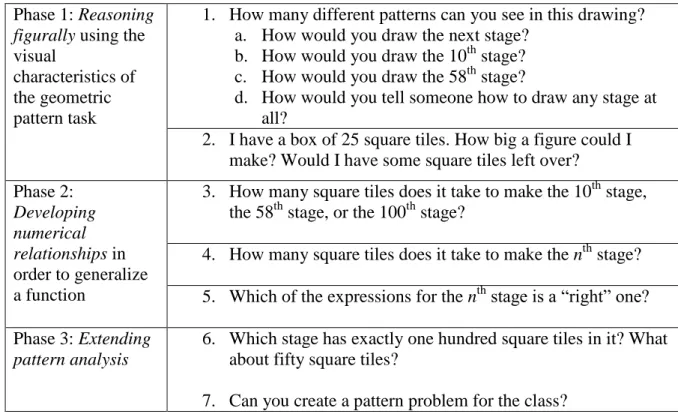
Promoting Figural Reasoning through a Problem Solving Process ... 39
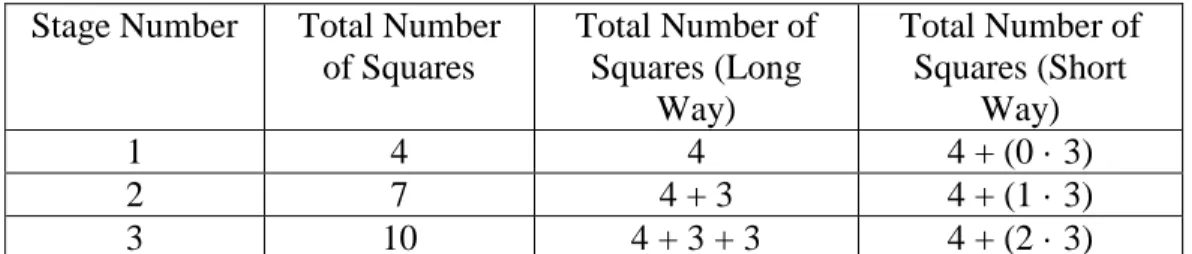
Promoting Explicit Thinking through Three-Column Tables ... 41
Promoting Explicit Thinking through Position Cards ... 44
Using Non-Seductive Numbers for Near and Far Generalization ... 45
Sequencing and Pattern Complexity ... 46
viii
Sociomathematical Norms ... 50
Mathematical Discourse... 51
CHAPTER 3 : DESIGN RESEARCH ... 56
Design Research... 56
Local Instruction Theory... 60
Three Phases of Design Research ... 61
Theoretical Framework: Conjectured Local Instruction Theory ... 64
Hypothetical Learning Trajectory ... 67
Learning Goal and Hypothetical Learning Progression... 67
Instructional Materials ... 69
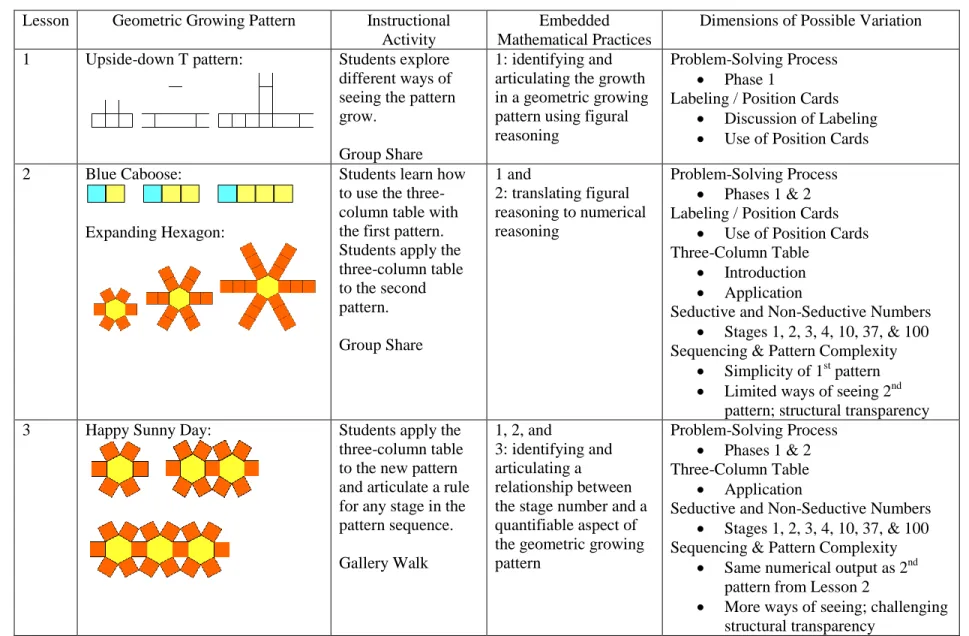
Lesson 1 ... 72
Lesson 2 ... 73
Lesson 3 ... 74
Lesson 4 ... 74
Lesson 5 ... 75
Lesson 6 ... 76
Mathematical practices of the classroom community ... 77
CHAPTER 4 : METHODOLOGY ... 80
Overview of this Study ... 80
Design Research Protocol for this Study ... 82
Research Team ... 88
Participants ... 88
Teacher Participants/Witnesses ... 91
Student Participants ... 92
ix
Pretest and Posttest ... 96
Pretest/Posttest design ... 97
Scoring rubric... 98
Daily Instruction Minicycles ... 99
Student Interviews ... 101
Artifact Collection: Student Classwork and SMART board files ... 102
Daily Minicycle Analyses ... 102
Retrospective Analyses ... 104
Retrospective Analysis 1 – First Macrocycle ... 104
Retrospective Analysis 2 – Second Macrocycle ... 106
Data management and transcription ... 107
Qualitative coding ... 108
Pilot Study ... 111
Pilot Instructional Sequence ... 111
Data Collection ... 112
Pretest and Posttest ... 112
Daily Instruction Minicycles ... 112
Artifact Collection ... 113
Reflection ... 113
CHAPTER 5 : FINDINGS ... 114
Students‘ Development of Functional Thinking ... 117
Using Figural Reasoning to Identify and Articulate Growth in a Geometric Growing
Pattern ... 118
Translating Figural Reasoning to Numerical Reasoning ... 129
Identifying and Articulating a Functional Relationship... 139
x
Final Assessments ... 157
Lesson 6: Create Your Own Pattern ... 158
Pretests and Posttests ... 164
Means of Support for Students‘ Functional Thinking ... 170
Five Dimensions of Possible Variation... 171
The Problem Solving Process ... 171
The Three-Column Table ... 176
Attention to Labeling and Position Cards ... 181
Seductive and Non-Seductive Numbers ... 184
Pattern Sequencing and Complexity ... 187
Mathematical Practices of the Classroom Community ... 194
Sociomathematical Norms ... 195
What counts as a mathematically different answer ... 195
Figural support for numerical responses ... 197
Mathematically-focused student challenge or disagreement ... 200
Mathematical Discourse... 202
Applying the levels of discourse to the teaching experiment classrooms ... 203
Five practices for facilitating mathematical discourse ... 206
CHAPTER 6 : CONCLUSION ... 218
Development of Students‘ Functional Thinking ... 220
Figural Reasoning and Functional Thinking... 220
Figural Reasoning and Students‘ Strategies ... 220
Functional Thinking ... 224
Challenges ... 225
xi
Challenges ... 231
Effective Means of Support ... 234
Integrating Means of Support for Students‘ Learning ... 234
Figural Reasoning ... 234
Effective Strategies ... 236
Functional Thinking ... 238
Representation of the Functional Relationship ... 240
Mathematical Discourse and Discourse Practices ... 241
Challenges ... 243
Revised Local Instruction Theory ... 244
Revised Hypothetical Learning Trajectory ... 249
Learning Goal and Learning Progression ... 250
Instructional Materials ... 256
Lesson 1 ... 259
Lesson 2 ... 259
Lesson 3 ... 260
Lesson 4 ... 262
Lesson 5 ... 263
Lesson 6 ... 263
Mathematical practices of the classroom community ... 264
Conclusions, Limitations, and Future Research ... 265
APPENDIX A ... 271
APPENDIX B ... 272
APPENDIX C ... 276
xii
APPENDIX E ... 281
APPENDIX F... 287
APPENDIX G ... 290
APPENDIX H ... 293
APPENDIX I ... 301
APPENDIX J ... 303
APPENDIX K ... 314
xiii
LIST OF TABLES
Table 1.1: Average number of Carnegie units earned by high school graduates by
race/ethnicity ... 2
Table 2.1: Framework of students‘ solution strategies for generalization tasks (adapted from
Lannin, et al., 2006, p. 303) ... 33
Table 2.2: A problem solving process for geometric growing pattern tasks (modified from
Friel & Markworth, 2009, p. 28)... 41
Table 2.3: A two-column tabular representation of the Upside-down T pattern ... 42
Table 2.4: A four-column table for the Upside-down T pattern ... 43
Table 2.5: A three-column table for the Upside-down T pattern based on the way of seeing in
Figure 2.6A ... 43
Table 2.6: Levels of Discourse in a Mathematics Classroom (C. C. Stein, 2007, p. 288) ... 53
Table 3.1: Overview of the instructional sequence of tasks ... 70
Table 4.1: Student demographics for four teaching experiment classrooms ... 93
Table 4.2: Student participants in teaching experiments ... 94
Table 4.3: Data sources and their main points of analysis ... 96
Table 5.1: Geometric growing patterns used in the instructional sequence ... 115
Table 5.2: Student solution strategy codes ... 120
Table 5.3: Examples of students‘ responses and coding in Lessons 1 and 2 ... 121
Table 5.4: Figural and numeric strategies evidenced on students‘ worksheets (Lessons 1 & 2)
... 122
Table 5.5: Frequency of recursive and explicit strategies in general descriptions of two
patterns ... 124
Table 5.6: Frequency of recursive and explicit strategies in specific descriptions of two
patterns ... 125
Table 5.7: Frequency of figural recursive and figural explicit segments in whole-class
discussion (TE1 and TE3) ... 127
Table 5.8: Students‘ functional thinking with the Expanding Hexagon pattern ... 141
xiv
Table 5.10: Results from the pretest and posttest for the four teaching experiments ... 165
Table 5.11: Students‘ solution strategies from the pretest and posttest ... 168
Table 5.12: Pretest/Posttest results for communicating the functional relationship ... 170
Table 5.13: First phase of the problem solving process ... 171
Table 5.14: Student responses from Lesson 1, Phase I of the problem solving process ... 173
Table 5.15: Student responses from Lesson 4, Phase I of the problem solving process ... 174
Table 5.16: Pretest responses demonstrating a numeric whole-object approach ... 186
Table 5.17: Mean points scored for kite and Flying V patterns on the pretest and posttest . 192
Table 5.18: Levels of Discourse in a Mathematics Classroom (C. C. Stein, 2007, p. 288) . 203
Table 5.19: Primary uses of five discourse practices ... 208
Table 6.1: Using the three-column table to identify two variables ... 232
Table 6.2: Overview of the revised instructional sequence of tasks ... 257
Table J.1: A priori coding scheme ……….………305
xv
LIST OF FIGURES
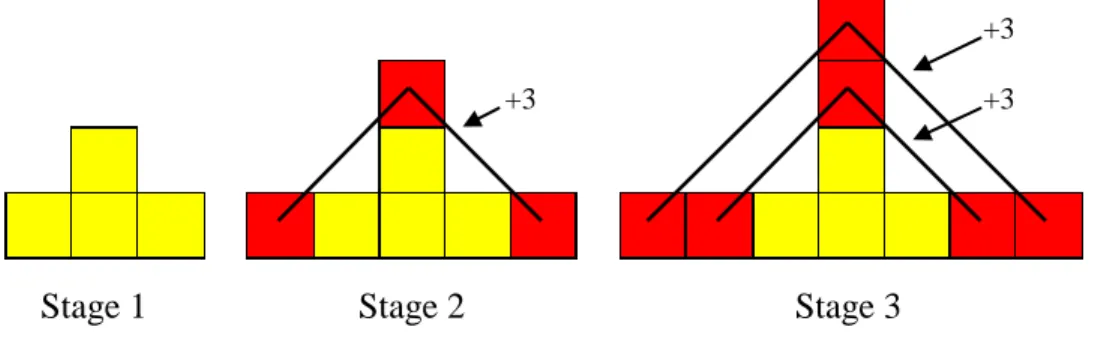
Figure 1.1: The first three stages of a geometric growing pattern sequence (Friel &
Markworth, 2009) ... 7
Figure 2.1: Three examples of geometric growing patterns ... 12
Figure 2.2: Claire and DaQuon's way of seeing the Upside-down T pattern ... 14
Figure 2.3: Ayla's way of seeing the Upside-down T pattern ... 15
Figure 2.4: Luis and Shantia‘s ways of seeing the Upside-down T pattern ... 16
Figure 2.5: A recursive way of seeing the Upside-down T pattern ... 19
Figure 2.6: Three explicit ways of seeing the Upside-down T pattern ... 20
Figure 2.7: A recursive counting all way of seeing the Upside-down T pattern ... 22
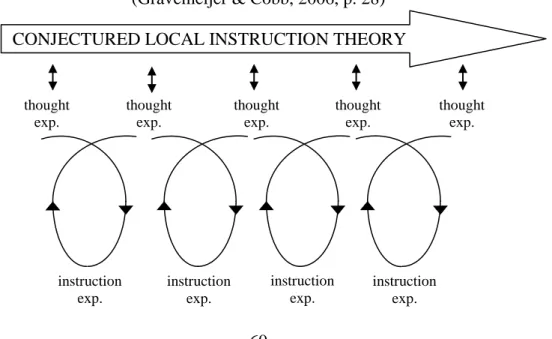
Figure 3.1: "Reflexive relation between theory and experiments" ... 60
Figure 3.2: Macrocycles and daily minicycles ... 61
Figure 4.1: "Reflexive relation between theory and experiments" ... 81
Figure 4.2: Macrocycles and daily minicycles ... 82
Figure 4.3: Original, proposed study design based on three macrocycles ... 84
Figure 4.4: Diagrammatic representation of this study‘s final design ... 86
Figure 5.1: Introduction of the three-column table using the Blue Caboose pattern ... 131
Figure 5.2: A numerical representation of the Expanding Hexagon pattern (6n + 1) ... 132
Figure 5.3: Structural representation of numerical reasoning in Figure 5.2 ... 132
Figure 5.4: A numerical representation of the Expanding Hexagon pattern (n · 6 + 1) ... 133
Figure 5.5: Structural representation of numerical reasoning in Figure 5.4 ... 133
Figure 5.6: A recursive representation of the Expanding Hexagon pattern (NEXT = NOW +
6) ... 134
Figure 5.7: A recursive counting all approach to the Happy Sunny Day pattern ... 135
Figure 5.8: Structural representation of recursive reasoning in Figure 5.7 ... 135
xvi
Figure 5.10: An example of implicit mental math ... 137
Figure 5.11: Making mental math explicit with intervention ... 138
Figure 5.12: The Restaurant Tables pattern ... 139
Figure 5.13: Transition to variables, TE1 Day 6 ... 149
Figure 5.14: Transition to variables, TE1 Day 7 ... 151
Figure 5.15: Transition to variables, TE2 Day 7 ... 151
Figure 5.16: Transition to variables, TE3 Day 5 ... 153
Figure 5.17: Three-column table with symbolic functional relationship, f x 5 + 1 + f ... 155
Figure 5.18: Three-column table with symbolic functional relationship, f x 6 + 1 ... 155
Figure 5.19: One example of a complete Lesson 6 poster ... 160
Figure 5.20: Create your own geometric growing pattern ... 161
Figure 5.21: One group‘s struggle with articulating the functional relationship ... 163
Figure 5.22: Box and whisker plot of pretest and posttest scores by group ... 166
Figure 5.23: Scatterplot of individual pretest and posttest scores (x and y axes, respectively)
... 167
Figure 5.24: Question 8 on Tatiana‘s posttest (TE3) ... 180
Figure 5.25: A three-column table used with the Exposed Stickers pattern ... 181
Figure 5.26: Application of the three-column table to the Blue Caboose pattern ... 190
Figure 5.27: Comparison of two ways of seeing the Expanding Hexagon pattern ... 196
Figure 5.28: Figural analysis of the Happy Sunny Day pattern ... 199
Figure 5.29: Researcher‘s proposed method for calculating exposed stickers ... 200
Figure 5.30: Anastasia‘s way of calculating exposed stickers – 8 groups of 4 stickers ... 211
Figure 5.31: Ashton‘s way of calculating exposed stickers – 4 groups of 8 stickers ... 211
xvii
CHAPTER 1: INTRODUCTION
Mathematics is the key to opportunity. No longer just the language of science,
mathematics now contributes in direct and fundamental ways to business, finance,
health, and defense. For students, it opens doors to careers. For citizens, it enables
informed decisions. For nations, it provides knowledge to compete in a technological
economy. To participate fully in the world of the future, America must tap the power
of mathematics. (National Research Council, 1989, p. 1)
Everybody Counts (NRC, 1989), published at the beginning of the current mathematics
reform movement, calls attention to the importance of mathematics for all citizens. This call
has been echoed in successive documents of mathematics education reform which emphasize
the need to teach mathematics for understanding, such that knowledge learned in the
mathematics classroom can be utilized meaningfully and effectively later in life (National
Council of Teachers of Mathematics, 1989, 1991, 2000, 2006). Furthermore, the National
Council of Teachers of Mathematics (NCTM, 2000) maintains that all students can learn
mathematics for understanding, regardless of race, gender, or ethnicity. This equity principle
provides a foundation for the vision of mathematics teaching and learning that is espoused by
the mathematics reform movement. Mathematics should open the doors to opportunity for all
students.
2
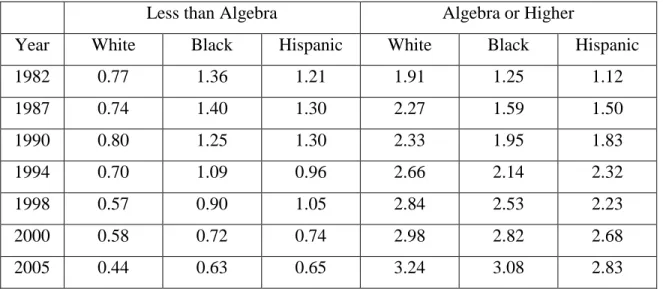
Center for Education Statistics, 2008). The average number of Carnegie units (credits)
1earned by high school graduates in select years from 1982 to 2005 is provided in Table 1.1.
A desirable trend is noted in the data; over time, students have enrolled in fewer ―Less than
Algebra‖ courses and more ―Algebra or Higher‖ courses. However, the data demonstrate a
tenacious enrollment gap – the disproportionate representation by race and ethnicity in lower
level and higher level mathematics courses. Since the typical pre-collegiate mathematics
preparation involves two years of algebra, one of geometry, and one of pre-calculus, Black
and Hispanic populations are disproportionately underprepared to continue with collegiate
mathematics or to prepare for careers for which basic mathematical knowledge, algebra in
particular, is a prerequisite.
Table 1.1: Average number of Carnegie units earned by high school graduates by
race/ethnicity
Less than Algebra
Algebra or Higher
Year
White
Black
Hispanic
White
Black
Hispanic
1982
0.77
1.36
1.21
1.91
1.25
1.12
1987
0.74
1.40
1.30
2.27
1.59
1.50
1990
0.80
1.25
1.30
2.33
1.95
1.83
1994
0.70
1.09
0.96
2.66
2.14
2.32
1998
0.57
0.90
1.05
2.84
2.53
2.23
2000
0.58
0.72
0.74
2.98
2.82
2.68
2005
0.44
0.63
0.65
3.24
3.08
2.83
Note: Adapted from Table 140 of Digest of education statistics: 2007 (National Center for
Education Statistics, 2008).
3
Algebra is no longer a subject to be avoided. In the history of mathematics, algebra‘s
prominence is relatively recent. Five centuries ago, the field of mathematics was dominated
by geometry. Currently, the college preparation track in high school typically includes two
full years of algebra, and the other courses of geometry, pre-calculus, and calculus are
dominated by its use. Algebra now pervades all areas of mathematics (Derbyshire, 2006).
Because algebra is essential to the further study of mathematics, students‘ success in algebra
is critical for both access to and success in higher mathematics. Kaput (1999) states:
Although algebra has historically served as a gateway to higher mathematics, the
gateway has been closed for many students in the United States, who are shunted into
academic and career dead ends as a result. And even for those students who manage
to pass through the gateway, algebra has been experienced as an unpleasant, even
alienating event—mostly about manipulating symbols that do not stand for anything.
(p. 134).
Not only do students need greater and more equitable access to algebra, algebra also needs to
be experienced as meaningful mathematics.
4
authentic algebra course—and should prepare more students than at present to enroll in such
a course by Grade 8‖ (NMAP, 2008, p. 23).
Algebra has garnered significant attention in the mathematics community over the
past two decades of mathematics reform. The Principles and Standards for School
Mathematics (National Council of Teachers of Mathematics, 2000) lists algebra among its
five content standards, including number and operations, geometry, measurement, and data
analysis and probability. The various forms of algebraic reasoning are addressed by the
Algebra Standards (NCTM, 2000):
Understand patterns, relations, and functions
Represent and analyze mathematical situations and structures using algebraic
symbols
Use mathematical models to represent and understand quantitative
relationships
Analyze change in various contexts (p. 394)
Algebra is no longer simply a high school level course. Expectations for this content standard
are specified for grades Pre-Kindergarten through Grade 12. Children at all levels should be
exposed to various forms of algebraic reasoning in age-appropriate ways. Although many
may scoff at children in the elementary grades doing algebra, it is not the explicit solving of
equations with unknowns that is expected. Instead, children are encouraged in their algebraic
thinking in various ways, some of which are not new to mathematics instruction. For
example, writing a number sentence to characterize the mathematical actions in the problem,
―Sam has 8 gumballs. He gives some gumballs to his friends and now has 3 gumballs. How
many gumballs did Sam give to his friends?‖ is a form of algebraic reasoning that is common
for early elementary students.
5
2008). The position emphasizes the significance of the subject and the importance of
educating all:
Algebra is a way of thinking and a set of concepts and skills that enable students to
generalize, model, and analyze mathematical situations. Algebra provides a
systematic way to investigate relationships, helping to describe, organize, and
understand the world. Although learning to use algebra makes students powerful
problem solvers, these important concepts and skills take time to develop. Its
development begins early and should be a focus of mathematics instruction from
pre-K through grade 12. pre-Knowing algebra opens doors and expands opportunities,
instilling a broad range of mathematical ideas that are useful in many professions and
careers. All students should have access to algebra and support for learning it.
(NCTM, 2008, p. 2)
Algebra is complex in its abstractions, and its concepts cannot be minimized or taken to
abstraction too quickly. However, it is possible for students to learn complex algebraic
concepts and understand them in ways that provide a solid foundation for more rigorous
mathematics. If successful experiences are provided for students prior to formal algebra,
there will be greater access to algebra for all. Kepner, the current president of NCTM,
elucidates the role of the mathematics teacher well: ―As adults, we recognize algebra and its
applications as important gateways to expanded opportunities. Our challenge is to give all
students the necessary preparation and opportunities to make learning algebra a successful
experience‖ (2008, p. 3). An essential task of the mathematics educator is to investigate and
develop ways in which algebraic reasoning can be promoted with all students.
Blanton and Kaput (2005) provide the following definition for algebraic reasoning:
We take algebraic reasoning to be a process in which students generalize
6
Algebraic reasoning, as it is broadly defined, takes multiple forms. The incorporation of each
of these forms of algebraic reasoning into the mathematics curriculum has undergone
considerable research in the past two decades (see, for example, Carpenter, Franke, & Levi,
2003). The specific form of algebraic reasoning that is the subject of this dissertation is
functional thinking. For the purpose of this research, functional thinking is defined as
―representational thinking that focuses on the relationship between two (or more) varying
quantities‖ (E. Smith, 2008, p. 143).
In the mathematics education literature, various mathematical contexts have been
explored to promote students‘ functional thinking prior to a formal course in algebra. Some
of these contexts include function machines (e.g., Warren, Cooper, & Lamb, 2006), word
problems (e.g., Blanton & Kaput, 2004), repeating patterns (e.g., Warren & Cooper, 2006),
and geometric growing patterns (e.g., Rivera & Becker, 2009). Studies have reported success
with students demonstrating functional thinking at very early ages. For example, Blanton and
Kaput (2004) indicate that children in the first grade are capable of describing how two
quantities correspond in a word problem context. This study uses the mathematical context of
geometric growing patterns to promote functional thinking with sixth grade students, prior to
a formal course in algebra.
The Purpose of this Study
7
and the shapes and their configurations can range from very simple to exceedingly complex
(see Figure 1.1). Growing patterns have characteristics which make them unique and ideal
for supporting students‘ development of functional thinking.
Figure 1.1: The first three stages of a geometric growing pattern sequence (Friel &
Markworth, 2009)
This dissertation uses design research to contribute to the literature on geometric
growing patterns. The purpose of design research is to develop a local instruction theory: ―a
theory about the process by which students learn a given topic in mathematics and theories
about the means of support for that learning process‖ (Gravemeijer & van Eerde, 2009, p.
510). This methodology provides the basis for two research questions:
1.
How does students‘ functional thinking develop in the context of geometric growing
patterns?
2.
What are effective means of support to facilitate functional thinking?
The first research question involves the development, experimentation, and revision of a
hypothetical learning trajectory around students‘ learning about linear functions in this
particular mathematical context. The second question, which is highly integrated with the
first, addresses multiple aspects of the instructional activities and the socio-mathematical
norms which support students‘ learning.
8
students; the relevant research literature on student thinking around geometric growing
patterns; and potential means of support for promoting functional thinking with these kinds
of pattern tasks. In Chapter 3, the design research approach is discussed and a conjectured
local instruction theory about students‘ learning of linear functions in the context of
geometric growing patterns is articulated, based on the review of the literature.
CHAPTER 2: REVIEW OF THE LITERATURE
Algebra is the gateway to higher mathematics (Kaput, 1999). Thus, students who do
not complete an algebra course in middle school or high school are essentially closing the
door to higher education and opportunities later in life. Access to algebra has not been
equitable (NCES, 2008), and for many of those who do take algebra, the mathematics lacks
relevance and meaning (Kaput, 1999). It is critical that mathematics educators strive to make
algebra accessible for all students (NCTM, 2008). One way this can be done is through the
age-appropriate introduction to algebraic concepts and thinking prior to a formal course in
algebra.
The purpose of this dissertation research is to develop an empirically-based
instruction theory about students‘ development of functional thinking in the context of
geometric growing patterns. The research questions guiding this research are:
1.
How does students‘ functional thinking develop in the context of geometric growing
patterns?
2.
What are effective means of support to facilitate functional thinking?
10
The first step in the design research process is the development of a conjectured local
instruction theory, i.e., ―a theory about the process by which students learn a given topic in
mathematics and theories about the means of support for that learning process‖ (Gravemeijer
& van Eerde, 2009, p. 510). Therefore, a synthesis of the current literature addressing
functional thinking and geometric growing patterns is required. Rather than identifying gaps
in the literature, this review attempts to clarify what is currently known in order to inform the
development of this conjectured local instruction theory.
In section one, the mathematical affordances of geometric growing patterns are
discussed. This includes a definition of geometric growing patterns and an articulation of the
mathematical potential of these patterns for learning to reason about functional relationships.
In the second section, research about the promotion of students‘ figural reasoning in the
context of geometric growing pattern tasks is addressed. Finally, the third section of the
literature review summarizes research around potential means of support for students‘
development of functional thinking in this mathematical context. These means of support
include considering the design of the tasks themselves, as well as classroom contextual
factors such as mathematical discourse and sociomathematical norms.
11
Geometric Growing Patterns and Functional Thinking
A geometric growing pattern
2can be defined as ―a sequence of figures in which the
objects in the figure change from one term
3to the next, usually in a predictable way. [The
pattern] typically involves two variables; some quantifiable aspect of this pictorial pattern of
objects (the dependent variable) is coordinated with an indexing or counting system (the
independent variable) that provides an identification of the position of the figure in the
pattern‖ (Huntzinger, 2008, p. 280). Figure 2.1 provides three examples of geometric
growing patterns. Notice the indexing or counting system with respect to position of a given
figure in a pattern sequence. Also take note of changes within each pattern as it grows by
looking for what changes and what stays the same. In the first pattern, the number of red
trapezoids and orange squares increases by one from stage to stage; the green triangle at the
top of each figure stays the same. The second pattern grows by three squares from stage to
stage, as a square is added to each leg of the upside-down T. The final pattern is similar to
the second pattern, in that it adds a square to each leg from stage to stage. As a result, six
squares are added at each stage, and the yellow hexagon in the center stays the same.
2 Huntzinger (2008) offers this definition for pictorial growth patterns. These kinds of patterns are also called geometric and visual growing patterns in relevant literature. The term geometric growing pattern is used throughout this dissertation.
12
Figure 2.1: Three examples of geometric growing patterns
Stage 1
Stage 2
Stage 3
Stage 1
Stage 2
Stage 3
Stage 1
Stage 2
Stage 3
Indexing
System
Indexing
System
13
Geometric growing patterns have characteristics which make them unique and ideal
for bridging pattern exploration with the development of functional thinking. E. Smith (2008)
defines functional thinking as ―representational thinking that focuses on the relationship
between two (or more) varying quantities, specifically the kinds of thinking that lead from
specific relationships (individual incidences) to generalizations of that relationship across
instances‖ (p. 143). The individual instances are the figures as they are seen or constructed in
the pattern sequence. The functional relationship is the relationship that can be identified
between the stage number and some aspect of the geometric growing pattern (e.g., the total
number of pattern blocks or square tiles in each stage).
Figural reasoning is identified later in this chapter as a critical component to the
development of functional thinking. A figural mode of reasoning ―relies on relationships that
could be drawn visually from a given set of particular instances‖ (Rivera & Becker, 2005, p.
199). This is particularly useful with geometric growing patterns, since a functional
relationship can be derived based on the concrete nature of the pattern. Thus, it is important
to consider the promotion of figural reasoning in this mathematical context. Before turning to
the abstraction of functional relationships from geometric growing patterns, consider first
how exploration of a pattern might play out in a classroom that is focused on figural
reasoning as a route to functional thinking.
A Vignette
14
the pattern itself to help them generalize the functional relationship. Ms. Roberts accepts
some responsibility for this and is looking forward to trying a different approach. Instead of
translating the pattern directly into a two-column table as she has done previously, she plans
to try to focus her students‘ attention on the physical structure of the pattern.
―What do you notice about this pattern?‖ she asks her students after they have gotten
settled and quiet. Her students look at the pattern displayed; some hands immediately go in
the air, but other students look perplexed by the question. After waiting several more
seconds, Ms. Roberts calls on Claire.
―It‘s going up by three,‖ Claire states. Ms. Roberts asks for clarification, and Claire
indicates that the pattern is increasing by three squares from stage to stage by adding a square
at the end of each leg.
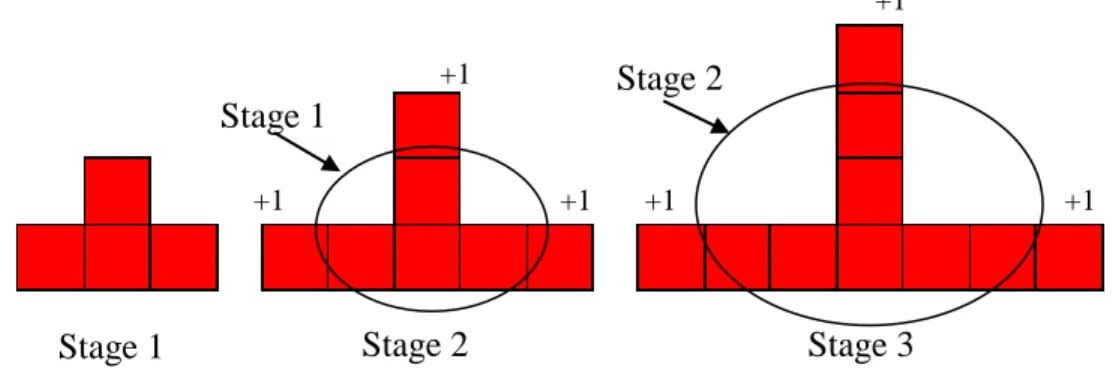
―Each stage is made up of the stage before, plus three additional squares. You can see
the stage before in each stage,‖ DaQuon states. Ms. Roberts tries to synthesize Claire and
DaQuon‘s thinking, and draws on the pattern in an effort to represent their statements (see
Figure 2.2).
Figure 2.2: Claire and DaQuon's way of seeing the Upside-down T pattern
Stage 1
Stage 2
Stage 3
Stage 1
+1
+1 +1
Stage 2
+1 +1
15
―Does that represent your thinking correctly?‖ Ms. Roberts asks of Claire and
DaQuon. They both nod in agreement. ―OK, well that‘s one way of seeing this pattern. Did
anyone notice anything different about this pattern?‖
―I noticed that it‘s an upside-down T, and each leg of the T has the same number of
squares as the stage number,‖ Ayla says. A few students look confused, and Ms. Roberts asks
Ayla to show her thinking on a clean display of the pattern. Ayla restates her thinking as she
draws on the SMART board (see Figure 2.3).
Figure 2.3: Ayla's way of seeing the Upside-down T pattern
Other students are impressed with Ayla‘s observation, and Ms. Roberts clarifies
through discussion that there is one additional square at the center of the three legs in each
figure. Ms. Roberts considers stopping the discussion of the pattern at this point, but instead
decides to push the class a little bit further: ―Did anyone else see something different with
this pattern?‖
The class is energized now, and several more hands stretch into the air. Ms. Roberts
calls on two more students to explain and represent their thinking on the SMART board (see
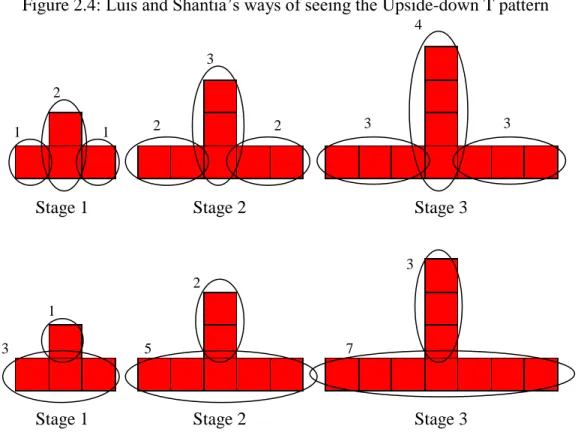
Figure 2.4). Luis demonstrates that he saw the figures as one long middle column of squares
and two equal sets of squares to the right and the left. Shantia, in contrast, saw the figures as
Stage 1
Stage 2
Stage 3
2
2 2
3
3 3
1
16
one long row of squares (increasing by two from stage to stage) with a column of squares
coming up from the center of the row (increasing by one from stage to stage).
Figure 2.4: Luis and Shantia‘s ways of seeing the Upside-down T pattern
Ms. Roberts is excited by all the ways of seeing that her students have generated, and
she continues the discussion by taking each way of seeing and asking her students how they
might use this description to describe other stages of the pattern, such as the 4
th, 10
th, 37
th,
and 100
th. Some students aren‘t comfortable with all of the ways of seeing, but each student
has at least one way he or she can access and use to make meaning of the growing pattern.
Ms. Roberts is confident that she can build on this foundation to functional thinking. Perhaps
now, all of her students will be able to understand the elements of functional relationships.
This vignette is a hypothetical classroom scenario, in which both the geometric
growing pattern task and the classroom discussion serve to support students‘ initial
exploration into functional thinking. Although it may seem simplistic, the mathematics is rich
Stage 1
Stage 1
Stage 2
Stage 2
Stage 3
Stage 3
22 2
2
3
3
3
3 3
1
1 1
4
17
and foundational to the learning of algebra. In the next three sections, the relevant literature
is used to detail how geometric growing patterns support students‘ functional thinking,
learning of variables, and mathematical generalization. In doing so, the instructional potential
of these patterning tasks for developing algebraic competence prior to a formal course in
algebra is emphasized.
Geometric Growing Patterns and Functions
A function is defined as a rule that assigns to each element of a domain a unique
element in the co-domain. The algebra standard of Principles and Standards for School
Mathematics (National Council of Teachers of Mathematics, 2000) explicates how patterns,
relations, and functions should be learned. In particular, middle grades students should be
able to:
represent, analyze, and generalize a variety of patterns with tables, graphs,
words, and, when possible, symbolic rules;
relate and compare different forms of representation for a relationship;
identify functions as linear or nonlinear and contrast their properties from
tables, graphs, or equations. (p. 222)
Geometric growing pattern tasks provide opportunities for students to analyze concrete
representations of patterns, generalize from these patterns, investigate multiple
representations of relationships, and explore different types of functional relationships.
The same algebra standard also outlines how middle grades students‘ conception of
algebraic symbolism should develop. Regarding the representation of problem situations, the
National Council of Teachers of Mathematics (NCTM) asserts that students should:
develop an initial conceptual understanding of different uses of variables;
explore relationships between symbolic expressions and graphs of lines,
paying particular attention to the meaning of intercept and slope;
18
recognize and generate equivalent forms for simple algebraic expressions and
solve linear equations. (2000, p. 222)
Geometric growing patterns provide opportunities to address these areas. They offer a
context for students to make meaning of variables and how they can be used.
Geometric growing patterns can represent both linear functions and nonlinear
functions, including quadratic, cubic, and exponential. With growing patterns, the pattern
may grow by a fixed number of parts in each stage (linear relationship), or by an increasing
number of parts in each stage (nonlinear relationship). The Upside-down T pattern in Figure
2.1 grows by a fixed number of squares in each stage. This is called a constant difference and
generates a linear function for the number of squares in any stage of the pattern. The
function, in its simplest, explicit form, is
in which t represents the total number
of squares in the figure and n represents the stage number. This is not the only way that this
functional relationship can be correctly represented.
In Claire‘s initial description of the Upside-down T pattern, one way to describe this
geometric growing pattern was discussed. There are multiple ways of seeing (Lee &
19
Figure 2.5: A recursive way of seeing the Upside-down T pattern
Both children and adults tend to use a recursive approach when they are solving
geometric growing pattern tasks (Bezuszka & Kenney, 2008; Moss, Beatty, Barkin, &
Shillolo, 2008; Orton, Orton, & Roper, 1999). However, developing a recursive formula that
matches this way of visualizing the pattern is difficult. One example of a recursive formula
for the approach in Figure 2.5 is NEXT = NOW + 3. In this formula, the number of squares
in the next stage is calculated by adding 3 to the current stage (NOW). This type of notation
is simplistic and user-friendly. Another way to notate this relationship is
. This
equation is called a recurrence relation, and some posit that middle school students are
capable of using this notation and should be expected to do so (Bezuszka & Kenney, 2008).
Other ways of seeing the Upside-down T pattern can lead to expressions of explicit
formulas which demonstrate more advanced functional thinking. An explicit formula is a rule
which states the covariational relationship between the independent variable and the
dependent variable. In the recursive formula, the stage number is almost inconsequential. In
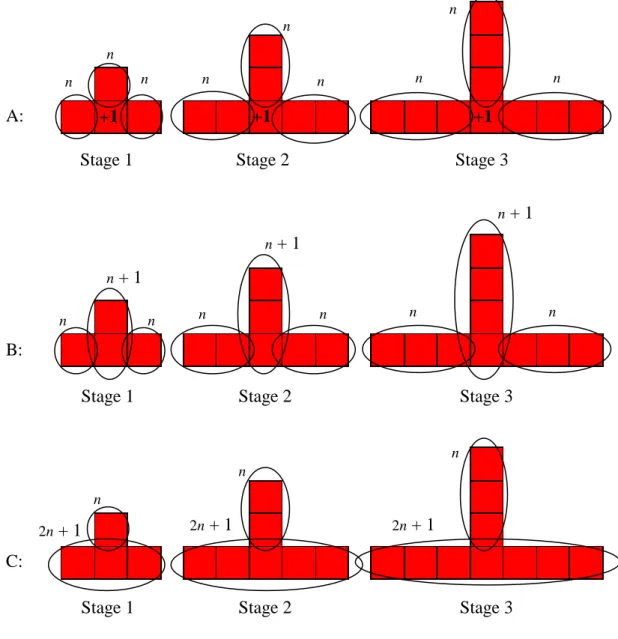
an explicit formula, the stage number (n) is used as a distinct variable. Three other ways of
seeing the pattern in this sequence are illustrated in Figure 2.6; these correspond to Ayla,
Luis, and Shantia‘s ways of seeing identified previously. In the first progression (A), there
are three arms, each consisting of n squares, and one additional square at the center of the
Stage 1
Stage 2
Stage 3
Previous Stage
+1
+1 +1
Previous Stage
+1 +1
20
figure. This way of seeing would yield an explicit formula of
or
. The second progression (B) illustrates one middle column of squares – one more than
the stage number, with two rows of squares to each side – equal to the stage number. This
yields an explicit formula of
. Finally, the third way of seeing this pattern
(C) recognizes one row of
squares with a column of n squares perpendicular to it.
The respective explicit formula is
. Each of these formulas simplifies
algebraically to
.
Figure 2.6: Three explicit ways of seeing the Upside-down T pattern
Stage 1
Stage 2
Stage 3
n
n n
n
n n
n
n n
Stage 1
Stage 1
Stage 2
Stage 2
Stage 3
Stage 3
n
+ 1
n n n n n n n n n
n
+ 1
n
+ 1
2n
+ 1
2n+ 1
2n+ 1
A:
B:
C:
21
Explicit rules are generally considered more useful and applicable than recursive
rules (Lannin, Barker, & Townsend, 2006). Recursive rules are easy to discern, but limited in
utility. When a student needs to make a far generalization (e.g., the number of squares in the
50
thstage), using a recursive rule becomes laborious and arithmetic problems are likely.
Explicit rules, on the other hand, are more effective for far generalization tasks. Using
explicit rules, it is not necessary to generate all of the in-between stages to respond to the
task. Thus, it is easier to calculate using an explicit rule. However, explicit rules can be more
difficult to generate. Several mathematics educators argue that familiarity and proficiency
with explicit function rules are necessary for competence in algebra (Bezuszka & Kenney,
2008; Lannin, et al., 2006).
Since the majority of people who approach geometric growing patterns do so using
recursive thinking, it is important to help them see how recursive ways of seeing can
transform into explicit relationships. Garcia-Cruz and Martinon (1998) distinguish between
two different recursive approaches: counting all and counting on. The counting on strategy is
the recursive approach illustrated previously in Figure 2.5. The counting all strategy is a
slightly different way of seeing the geometric growing pattern and lends itself to an explicit
rule for the functional relationship.
Using the counting all approach, students recognize that Stage 1 of the pattern is
nested within each successive stage and the constant difference is added to that stage multiple
times. For example, with the Upside-down T pattern, Stage 3 would be recognized as
22
differences added to Stage 1 is always one less than the target stage number, the explicit rule
that can be derived is
, in which 4 represents the number of squares in the
first stage.
Figure 2.7: A recursive counting all way of seeing the Upside-down T pattern
It is possible that an emphasis on the counting all recursive strategy may lead to better
facility with explicit rules. For students who view a pattern using the counting on strategy,
perhaps instructional emphasis can bring them to modify their counting on way of seeing to a
counting all way of seeing, thus making an explicit rule possible and the connection between
explicit and recursive relationships clearer.
Of course, throughout this discussion of geometric growing patterns and functions, it
has been necessary to use variables to convey the functional relationships. Thus, geometric
growing patterns also provide mathematics teachers and their students the opportunity to
develop conceptual understanding of variables.
Variable Use with Geometric Growing Patterns
The algebra standard of Principles and Standards for School Mathematics (NCTM,
2000) also outlines how middle grades students‘ conception of algebraic symbolism should
develop. Regarding the representation of problem situations, the National Council of
Teachers of Mathematics (NCTM) asserts that students should:
+3 +3 +3
23
develop an initial conceptual understanding of different uses of variables;
explore relationships between symbolic expressions and graphs of lines,
paying particular attention to the meaning of intercept and slope;
use symbolic algebra to represent situations and to solve problems, especially
those that involve linear relationships;
recognize and generate equivalent forms for simple algebraic expressions and
solve linear equations. (2000, p. 222)
Geometric growing patterns provide opportunities to address these areas. They offer a
context for students to make meaning of variables and how they can be used.
English and Warren (1999) state, ―Variables are the basic tool for expressing
generalizations. An understanding of the concept of variable is fundamental to our students‘
success with algebra‖ (p. 141). However, variables are exceedingly complex, and the
difficulty of the concept is often underestimated (English & Warren, 1999; Schoenfeld &
Arcavi, 1999). Like algebra generally, it is important not to take the development of this
concept too quickly or to take its understanding for granted. Instead, recognition of how
variables are used with geometric growing patterns is required in order to understand how the
concept can be developed in the context of these patterning tasks.
24
one quantity, three, i.e., the quantity in this context does not vary as the name variable
implies.
Although Philipp (1999) identifies seven different uses for symbols in mathematics,
only three apply in the context of geometric growing patterns. Variables as varying quantities
may be the most useful for this mathematical context; however, in doing these patterning
tasks, variables as unknowns and parameters may also apply. For example, consider the
Upside-down T pattern in Figure 2.1. Variables as varying quantities will be used when
students generate a functional relationship,
, where t represents the total number
of squares and n represents the stage number. As the stage number varies, so does the total
number of squares.
These patterning tasks may lead to variable use as unknowns. If a question asks, ―If
there are 31 squares, what stage number is it?‖, an equation may be set up as
.
In this situation, the n represents only one unknown quantity. Because the number of squares
has been set at 31, the stage number has been set at 10, but represented by n. Finally, the
instructional use of several of these patterning tasks may lead to the parameter use of
variables. In the formula
y mxb, m represents the slope of a linear relationship and b
represents the y-intercept or constant. Students may come to understand that m is the
parameter for the constant difference in a linear relationship (i.e., adding three squares in
each stage), and b is the parameter for how many of the dependent variable (i.e., number of
squares) would exist in stage zero. It is obvious from this example that our uses of variables
are blurry and fluid.
25
transition for students:
Another idea that seems difficult for students to apprehend fully is the notion that a
single symbol can represent many quantities at the same time. In the case of variables,
students work first with (single-valued) unknowns and with expressions, in which
only one value at a time can be substituted, so it is not surprising that the leap to
relational variables is cognitively exactly that—a leap, not a small step. (p. 222-223)
Mason (1996) posits that algebra instruction has been characterized by a rush to symbolic
representation. For students to understand variables as indeterminate quantities (Radford,
2008), varying quantities (Philipp, 1999), or relational variables (Wagner & Kieran, 1989),
careful instruction must promote conceptual understanding.
There is extensive evidence that students develop misconceptions about variables that
may hinder their success in algebra (Booth, 1984). MacGregor and Stacey (1997) have
confirmed Booth‘s (1984) analysis and indicate that students may interpret variables as labels
or as general referents. The misconception about variables as labels may extend from the
standard use of labels, e.g., 5m means 5 meters. Students can incorrectly generalize this
usage, such that they interpret 5c as 5 cats, for example. Similarly, students may interpret
variables as general referents, such that they represent broad categories, rather than specific
referents. For example, students could interpret h as any person‘s height, and therefore derive
an equation such as h = h + 10 to represent one person being ten inches taller than another
person. What are actually necessary for this situation are two different variables, one to
represent the first person‘s height and the other to represent the second person‘s height.
26
mathematical task that challenges another misconception that different variables in the same
context cannot represent the same value (i.e., r and s are not allowed to represent the same
value). Geometric growing pattern tasks provide a mathematical context that can both
challenge some common misconceptions about variables and how they are used and extend
students‘ experiences with variables beyond contexts in which they represent single values.
English and Warren (1999) recommend providing students with experience in
articulating relationships verbally and carefully demonstrating the translation from verbal to
symbolic form. This is possible with geometric growing patterns. Students can describe how
the pattern progresses both verbally and numerically. Teachers can then demonstrate how
these verbal and numeric expressions translate to the symbolic language of algebra.
Schoenfeld and Arcavi (1999) echo English and Warren‘s (1999) recommendation for
verbalization: ―Variables are tools for expressing mathematical generalizations. It should
help, therefore, if students had the habit of verbalizing such generalizations before they were
asked to formalize those generalizations using the language of mathematics‖ (p. 155). In this
statement, the importance of variables for the generalization process is articulated. The
process of generalization is discussed next.
Generalization
27
concept of flower before learning the individual types of flowers (Vygotsky, 1986). For those
who do learn a more specific type first (i.e., rose), they erroneously apply this specific type to
the more general category until their conceptual categorization is rectified.
Although Vygotsky wrote primarily of objects, concepts, and language,
generalization is vital to mathematics as well. In fact, Mason (1996) states, ―Generalization is
the life-blood, the heartbeat of mathematics‖ (p. 74). Kaput (1999) identifies the role of
generalization in mathematics:
Generalization involves deliberately extending the range of reasoning or
communication beyond the case or cases considered, explicitly identifying and
exposing commonality across cases, or lifting the reasoning or communication to a
level where the focus is no longer on the cases or situations themselves but rather on
the patterns, procedures, structures, and the relations across and among them (which,
in turn, become new, higher-level objects of reasoning or communication). (p. 136)
In this statement, the importance of abstraction is evident. An individual‘s generalization
process begins with the concrete, or the ―cases or situations themselves‖, and the individual
identifies what these cases or situations hold in common. These commonalities are then
generalized into an abstract process, concept, or representation.
The process of abstraction is described by Mason (1996) as ―seeing a generality
through the particular‖ (p. 65). This process can be illustrated in work with geometric
28
Radford (2008) suggests the following definition for algebraic generalization:
―Generalizing a pattern algebraically rests on the capability of grasping a commonality
noticed on some particulars (say
p1,p2,p3...,pk); extending or generalizing this
commonality to all subsequent terms (
pk1,pk2,pk3,...), and being able to use the
commonality to provide a direct expression of any term of the sequence‖ (p. 84, emphasis
original). This definition synthesizes the mathematical potential in the geometric growing
pattern tasks. The patterns are concrete representations of functional relationships, through
which students can identify the commonalities of the particulars (i.e., each figure in the
pattern) by asking what changes and what stays the same. Recognizing the commonalities
permits the pattern to be extended and generalized, and variables can be used to describe the
generalized functional relationship.
The instructional potential for geometric growing patterns to support the development
of functional thinking appears to be quite powerful. Geometric growing patterns are ideal for
introducing functional thinking to students. Students can develop functional thinking by
directly observing variables and change, and generalizing from a verbal or written
representation of the functional relationship to a symbolic representation. Through geometric
growing patterns, students‘ understanding of functions and variables can be built, and their
ability to generalize can be fostered. In the next section, research about students‘ thinking is
discussed as a foundation for understanding how students‘ functional thinking might progress
in the context of geometric growing patterns.
Research on Students‘ Reasoning with Geometric Growing Patterns
29
which these patterns contribute to students‘ functional thinking, have analyzed and
categorized students‘ correct and incorrect approaches to generalization in different ways.
Classifying Students’ Solution Strategies
Stacey (1989) used two figural and one numerical linear pattern (of the form
bax n
f( )