TIR-only protein RBA1 recognizes a pathogen effector
to regulate cell death in
Arabidopsis
Marc T. Nishimuraa,b,1,2,3, Ryan G. Andersona,1, Karen A. Cherkisc,1, Terry F. Lawa,b, Qingli L. Liua, Mischa Machiusd, Zachary L. Nimchuka, Li Yanga, Eui-Hwan Chunga,b, Farid El Kasmia, Michael Hyunha, Erin Osborne Nishimurae,3, John E. Sondekd,e,f, and Jeffery L. Dangla,b,c,g,h,2
aDepartment of Biology, University of North Carolina, Chapel Hill, NC 27599;bHoward Hughes Medical Institute, University of North Carolina, Chapel Hill,
NC 27599;cCurriculum in Genetics and Molecular Biology, University of North Carolina, Chapel Hill, NC 27599;dDepartment of Pharmacology, University of
North Carolina, Chapel Hill, NC 27599;eLineberger Comprehensive Cancer Center, University of North Carolina, Chapel Hill, NC 27599;fDepartment of
Biochemistry and Biophysics, University of North Carolina, Chapel Hill, NC 27599;gCarolina Center for Genome Sciences, University of North Carolina,
Chapel Hill, NC 27599; andhDepartment of Microbiology and Immunology, University of North Carolina, Chapel Hill, NC 27599
Contributed by Jeffery L. Dangl, December 30, 2016 (sent for review November 29, 2016; reviewed by Blake C. Meyers and Ryohei Terauchi)
Detection of pathogens by plants is mediated by intracellular nucleotide-binding site leucine-rich repeat (NLR) receptor pro-teins. NLR proteins are defined by their stereotypical multido-main structure: an N-terminal Toll–interleukin receptor (TIR) or coiled-coil (CC) domain, a central nucleotide-binding (NB) domain, and a C-terminal leucine-rich repeat (LRR). The plant innate im-mune system contains a limited NLR repertoire that functions to recognize all potential pathogens. We isolated Response to the bacterial type III effector protein HopBA1 (RBA1), a gene that en-codes a TIR-only protein lacking all other canonical NLR domains. RBA1 is sufficient to trigger cell death in response to HopBA1. We generated a crystal structure for HopBA1 and found that it has similarity to a class of proteins that includes esterases, the heme-binding protein ChaN, and an uncharacterized domain ofPasteurella multocidatoxin. Self-association, coimmunoprecipitation with HopBA1, and function of RBA1 require two previously identified TIR–TIR dimer-ization interfaces. Although previously described as distinct in other TIR proteins, in RBA1 neither of these interfaces is sufficient when the other is disrupted. These data suggest that oligomerization of RBA1 is required for function. Our identification of RBA1 demonstrates that “truncated”NLRs can function as pathogen sensors, expanding our understanding of both receptor architecture and the mechanism of activation in the plant immune system.
plant immunity
|
NLR|
Toll–interleukin-1 receptor homology domain|
oligomerization|
type III secretionP
lants lack an adaptive immune system and thus must rely on a limited innate immune system to detect and defeat potential pathogens. Exactly how plant innate immune receptors form a functional immune system is not well understood. There are two large classes of plant immune receptors (1). The first contains extracellular domains that detect microbial-associated molecular patterns (MAMPs) and activate MAMP-triggered immunity (MTI). These MTI receptors are sufficient to induce resistance to most microbes. However, evolutionarily adapted pathogens have evolved sophisticated systems to suppress MTI. Gram-negative bacterial pathogens such asPseudomonas syringaeuse a molecular needle, the type III secretion system, to inject a set of bacterial virulence proteins (type III effectors; T3Es) directly into the host cytoplasm to suppress MTI and promote pathogen proliferation (2). In response, plants evolved a second class of immune receptors, the intracellular nucleotide-binding site leu-cine-rich repeat (NBS-LRR) receptors (NLRs) (3). NLRs di-rectly or indidi-rectly detect the presence of T3Es. The referenceArabidopsisgenome (from the inbred accession Col-0) contains roughly 160 NLR proteins (4). These receptors are characterized by a multidomain architecture consisting in plants of either an N-terminal coiled-coil (CC) or Toll–interleukin (TIR) domain, a central AAA ATPase nucleotide-binding site domain (NBS), and C-terminal leucine-rich repeats (LRRs). Current models propose that NLR proteins switch from a closed“off”conformation to an
open“on” conformation. The off conformation is thought to be maintained by intramolecular folding of C-terminal NBS and LRR domains to regulate signaling via the N-terminal TIR or CC domain negatively (5, 6). Upon pathogen detection, intra-molecular negative regulation is released by unknown mecha-nisms, resulting in conformational changes in the NBS associated with nucleotide exchange. Homodimerization of the N-terminal domain is thought to activate downstream effector-triggered immunity (ETI). The mechanistic activation of NLRs and how they trigger downstream ETI remain obscure, although recent structural studies of animal analogs have begun to provide im-portant details and support NLR oligomerization as a key fea-ture of activation (7–9).
Both animal and plant TIR domains form homo- and heter-odimers. In the case of animal transmembrane Toll-like receptors (TLRs), intracellular TIR homodimerization forms a nucleating site that recruits additional TIR domain-containing adaptors to
Significance
Multicellular organisms must have complex immune systems to detect and defeat pathogens. Plants rely on nucleotide binding site leucine rich repeat (NLR) intracellular receptors to detect pathogens. For hundreds of years, plant breeders have selected for disease-resistance traits derived from NLR genes. Despite the molecular cloning of the first NLRs more than 20 y ago, we still do not understand how these sensors function at a mechanistic level. Here, we identified a truncated NLR protein that activates cell death in response to a specific pathogen effector. Understanding how truncated NLRs function will provide a better mechanistic understanding of the plant im-mune system and an expanded toolkit with which to engineer disease resistance rationally in crops.
Author contributions: M.T.N., R.G.A., K.A.C., Q.L.L., J.E.S., and J.L.D. designed research; M.T.N., R.G.A., K.A.C., T.F.L., Q.L.L., L.Y., E.-H.C., F.E.K., and M.H. performed research; Z.L.N. contributed new reagents/analytic tools; M.T.N., R.G.A., K.A.C., Q.L.L., M.M., E.O.N., and J.L.D. analyzed data; and M.T.N., R.G.A., K.A.C., M.M., and J.L.D. wrote the paper.
Reviewers: B.C.M., Donald Danforth Plant Science Center; and R.T., Iwate Biotechnology Research Center.
The authors declare no conflict of interest.
Freely available online through the PNAS open access option.
Data deposition: Crystallography, atomic coordinates, and structure factors reported in this paper have been deposited in the Protein Data Bank database (PDB ID code5T09).
1M.T.N., R.G.A., and K.A.C. contributed equally to this work.
See Commentary on page 2445.
2To whom correspondence may be addressed. Email: [email protected] or dangl@
email.unc.edu.
3Present address: Department of Biochemistry and Molecular Biology, Colorado State
University, Fort Collins, CO 80526.
This article contains supporting information online atwww.pnas.org/lookup/suppl/doi:10. 1073/pnas.1620973114/-/DCSupplemental.
PLANT
BIOLO
GY
PNAS
PLUS
SEE
COMMENT
NLRs, TIR-domain homodimers are often sufficient to signal for immune responses (11). Plant and animal TIR-domain crystal structures support the existence of a variety of dimer interfaces (12). There are two distinct interfaces from crystal structures of plant TIRs, defined by the homodimeric flax NLR L6 TIR domain and the homo- and heterodimericArabidopsis RPS4/RRS1 TIR domains (13–16). Overexpression of either the L6 or RPS4 TIR domain is sufficient to trigger cell death (13, 17). Mutation of the putative dimer interface in either L6 or RPS4 demonstrates that the corresponding dimer orientation is required for their function (13, 14). Although structural and genetic data are consistent with TIR domain dimerization, whether NLR proteins are limited to dimerization or higher-order oligomeric structures exist remains an open question. How these structurally distinct dimers (or any NLRs, for that matter) become activated by effectors and signal downstream to activate defense responses remains unknown.
The function of many bacterial T3Es is still not understood, but several either suppress important parts of the host immune system or alter host metabolism to promote pathogen success (18, 19). Because T3Es are evolved tools, understanding their targets and function should reveal unique insights into the host’s biology. We screened a large collection ofP.syringaeeffectors to uncover effector-dependent phenotypes on a wide range of
Arabidopsisgenotypes. We discovered that the T3E HopBA1 is recognized by a TIR-only immune receptor that we call“RBA1” (for“response to HopBA1”) and that the ensuing immune re-sponse requires canonical TIR-NBS-LRR (TNL) signaling components. Additionally, we solved the crystal structure of HopBA1 and found striking resemblance to a bacterial heme scavenger protein. We characterized the HopBA1–RBA1 in-teraction and provide genetic data suggesting that a plant TIR domain can simultaneously engage multiple self-association in-terfaces. Our findings demonstrate immune function for a pre-viously uncharacterized “truncated” NLR, thus expanding the known capabilities of plant intracellular receptors to recognize signals of microbial invasion.
Results
Screening Natural Variations ofArabidopsisRevealed a Polymorphic Response to HopBA1.Previously, we identified a large collection of
P. syringae T3Es (20, 21). We sought to identify host-poly-morphic phenotypes by delivering each T3E individually to leaves from a panel of inbred Arabidopsis accessions. We de-livered the T3Es from a modifiedPseudomonas fluorescensstrain that lacks endogenous effectors but expresses a heterologous
P. syringae type III delivery system (Pf0-1 EtHAn, hereafter Pf0-1) (22). We screened 58 effectors across 89 inbredArabidopsis
accessions (Fig. S1). HopBA1, previously undescribed, triggered a cell-death phenotype on two accessions of Arabidopsis. The strongest and most consistent cell-death response to HopBA1 was in the accession Ag-0 (Fig. 1A).
HopBA1 Is Recognized by the Host Immune System.HopBA1 triggered cell death on Ag-0 leaves when delivered from the Pf0-1 system. To test if HopBA1 had an effect when delivered from a plant pathogen, we performed growth assays using the virulent strainP.syringaepv. tomato (Pto) DC3000 (virulent on Arabidopsis). Pto DC3000 expressing HopBA1 grew 10- to 100-fold less than Pto DC3000 containing an empty vector (EV) (Fig. 1B). Surprisingly, HopBA1 was able to restrict pathogen growth on both the Ag-0 and Col-0 accessions, despite the lack of a visible cell-death phenotype on leaves of the latter (Fig. 1B).
Phylogenetic Distribution of hopBA1. HopBA1 was originally de-fined as a T3E from twoP.syringaestrains isolated from wheat (pv. japonica) or sugar beet (pv. aptata), respectively (20). To expand our collection of alleles, we searched public databases for
variants of HopBA1 or HopBA1-similar proteins (Table S1; alignment available on request). In addition to P. syringae, we identified HopBA1-related proteins in multiple species of the plant pathogen genusErwinia. We found more divergent HopBA1 family members in two strains of enterobacteria: in Ag1, a mosquito gut microbiome strain (23), and in Cedecea davisae, an emerging pathogen from immunocompromised humans (24). We cloned several of the plant pathogen HopBA1 variants and tested their Fig. 1. HopBA1 triggers host genotype-dependent cell death. (A) Delivery of HopBA1 via Pf0-1 triggers cell death inArabidopsisaccession Ag-0 but not Col-0. Bacteria were injected at OD 0.1 in 10 mM MgCl2on one half of each
leaf (across the midrib from the indicating ink marks). The red dashed line highlights the region of HopBA1-triggered necrosis in Ag-0. Images were taken 24 h postinoculation. (B) HopBA1 restricts the growth ofPtoDC3000 on both Ag-0 and Col-0. Day 0 and Day 4, 0 and 4 d after inoculation; i, inoculum.PtoDC3000 was injected at OD 0.0002 (∼105cfu) in 10 mM MgCl
2.
ability to trigger cell death in Ag-0. AllP.syringaealleles tested were recognized, but more divergent alleles remain ambiguous because they were not translocatable using aP.syringaetype-III secretion system (Table S2).
Genetic Analysis inArabidopsisDefines a TIR-Containing, Truncated NLR Protein That EncodesRBA1.To determine what genes are re-quired for Arabidopsis to recognize HopBA1, we positionally cloned RBA1 using interaccession variation in the cell-death response as the mapping phenotype. In an F2 population of
∼3,100 Ag-0×Ler-0 individuals, cell death segregated as a sin-gle, dominant Mendelian trait to an interval containing a single gene: At1g47370 (Fig. S2A). Sequencing of Ag-0 revealed some structural variations relative to the reference genome Col-0 (Fig. S2A) but no novel genes, and it was consistent with subsequent public resequencing data (25). At1g47370 was predicted to en-code a novel TIR-X protein in the reference Col-0 genome containing a NLR-like TIR domain followed by an unknown“X domain”lacking homology to known proteins (Fig. S2B). Our molecular reannotation of At1g47370 in Ag-0 and Col-0 in-dicated that it encodes a TIR-only protein, lacking any“X do-main”or NB-LRR domains (Fig. 2AandFig. S2B). Homology modeling indicates that RBA1 is structurally most similar to the TIR domain of the immune receptor RPS4, a full-length
TIR-NBS-LRR protein (Phyre2 100% confidence, 41% sequence identity) (Fig. 2B).
The TIR-Only Ag-0RBA1Allele Complements Col-0 for Cell Death in Response to HopBA1.We generated a complementation construct that contains 725 bp of upstream promoter region, a single HA epitope tag, and 1,733 bp of genomic Ag-0 DNA corresponding to the TIR-only form of RBA1. When transformed into Col-0, this construct conferred a cell-death response in response to HopBA1 delivered from Pf0-1, validating our reannotation of the locus (Fig. 2CandSI Materials and Methods). In addition, we generated two rba1 mutants with nonsense alleles in the first exon via CAS9 mutagenesis in the Ag-0 genome (Fig. S2C–E). Bothrba1mutants displayed a decreased cell-death response to HopBA1 at 24 h postinfection, as assessed qualitatively (by leaf collapse) and quantitatively (measured via ion leakage) (Fig. 2D
andE). Collectively, these results indicated that RBA1 is a TIR-only NLR-like protein, which, despite the lack of canonical NBS and LRR domains, functions to activate cell death in response to a pathogen virulence effector. Public expression data (Geneves-tigator) of the Col-0 accession indicated that RBA1Col-0is likely a
pseudogene, potentially controlled via cytosine methylation, be-cause it is expressed in the met1-3 mutant that is deficient in transcription-repressing CG-methylation (Fig. S2F). Consistent
Fig. 2. RBA1encodes a TIR-only truncated NLR-like protein. (A) Full-length RBA1 (At1g47370) is equiv-alent to the TIR domain of TIR-NBS-LRR immune re-ceptors. (B) Homology modeling of RBA1 indicates that it is most similar to the RPS4 TIR domain crystal structure (PDB ID code 4C6R). (C) A native promoter-driven, N-terminal 1×HA-tagged genomic fragment of RBA1 from Ag-0 complements Col-0’s lack of cell-death response to Pf0-1 expressing HopBA1. Pf0-1 was injected at OD 0.1 in 10 mM MgCl2, and leaves
were imaged after 24 h. Asterisks indicate leaves with cell death in the injected half. Native promoter HA-RBA1 Col-0 transgenics accumulate RBA1 in response to Pf0-1 expressing HopBA1. BA, Pf0-1 expressing HopBA1; EV, Pf0-1 empty vector control; Ln. #, genetically independent transgenic lines; Mg, MgCl2control. Total protein loading was assessed by
Ponceau S staining of the membrane. (D) Two in-dependent CAS9-generated Ag-0rba1mutants showed reduced cell death 24 h after inoculation with Pf0-1 expressing HopBA1. Asterisks indicate WT leaves with cell death in the injected half. (E) Quantitative measurement of decreased con-ductivity in response to HopBA1 inrba1mutants. (F) Dexamethasone-inducible RBA1 triggers cell death in Col-0. (G) Agrobacterium-delivered RBA1 ectopic cell death is suppressed in EDS1-silencedN.tabacum plants. The asterisk indicates a WT leaf with cell death in the RBA1-expressing half. (H) RBA1-HopBA1 cell death inArabidopsisis dependent on known immune-related genes. Plants are representative genotyped double-mutant F3 progeny of F2 plants previously fixed for RBA1Ag-0and heterozygous for an immune
mutant in the Col-0 background. Asterisks indicate leaves with cell death in the injected half. Numbers indicate the number of collapsed leaves relative to the total number of leaves. The sid2mutant displayed suppressed cell death but had a weak chlorosis phe-notype in response to HopBA1. See alsoFig. S2.
PLANT
BIOLO
GY
PNAS
PLUS
SEE
COMMENT
∼830 bp section immediately upstream ofRBA1is methylated to a lower extent in Ag-0 than in Col-0 (Fig. S2G) (26). This region contains the 725-bp promoter used to drive our native promoter
RBA1construct and thus is sufficient for function. We speculate that the distinct Col-0/Ag-0 RBA1 phenotypic response to HopBA1 is an expression polymorphism. Consistent with this interpretation, we were able to amplify RBA1 cDNA from Ag-0 but not from Col-0. Additionally, as is consistent with expression being the causal difference between the alleles, the protein se-quence of RBA1Col-0is highly conserved relative to RBA1Ag-0(98.4%
identical) and was functional when expressed ectopically with the 35S promoter inNicotiana benthamiana(Fig. S2H).
RBA1 Is Autoactive and Enhanced Disease Susceptibility 1-Dependent When Overexpressed. The TIR domains of several typical TIR-NLR immune receptors (L6, RPS4, RPP1) are autoactive, trig-gering cell death in the absence of pathogens when ectopically overexpressed as truncated TIRs (13, 17, 27). Ectopic dexa-methasone- or 35S promoter-driven overexpression of RBA1 in
Arabidopsis,N.benthamiana, andNicotiana tabacumresulted in host cell death in the absence of HopBA1, suggesting that RBA1 functions similarly to TIR domain truncations (Figs. 2FandG
and 3 C and D). The ectopic cell-death phenotypes driven by overexpression of TIR-NLR and/or derived single-domain TIRs typically are dependent on the Enhanced disease susceptibility1 (EDS1) signaling module (17, 28). We found that RBA1-medi-ated cell death was also EDS1 dependent in the context of either transient overexpression (ineds1-silencedN.tabacum) or when expressed from its endogenous locus in anArabidopsis eds1mutant background (Fig. 2GandH). RBA1-mediated cell death also was dependent on PAD4, which is part of the EDS1 signaling complex (29), and was partially dependent on SID2, but was independent of
based disease-resistance responses (Fig. 2H) (30).
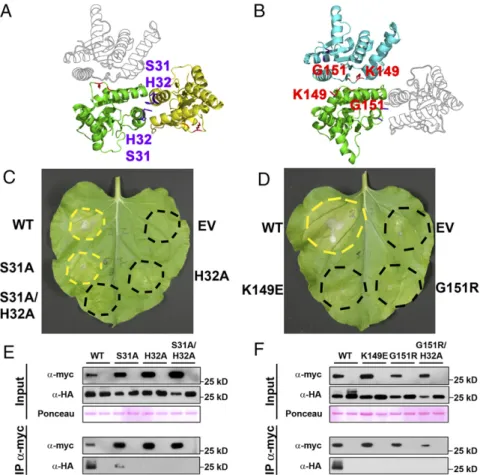
Predicted RBA1 Dimer Interface Mutants Affect Both Function and Homotypic Interaction.To date, we have been unable to purify RBA1 protein and determine its structure experimentally. To put RBA1 into the context of existing TIR structures, we gen-erated homology models with published RPS4 and L6 TIR do-main structures. Modeling of RBA1 generated high-confidence tertiary structure predictions consistent with both RPS4 and L6 TIR dimer interface types (Fig. S3). Similar to the RPS4 and L6 TIR domains, RBA1 can self-associate, as measured by both yeast two-hybrid (Y2H) and coimmunoprecipitation assays of differentially epitope-tagged RBA1 proteins (Fig. 3 andFig. S4). To determine which interface was used for RBA1 self-associa-tion, we generated RBA1 mutations predicted to be at or near either the RPS4-type or the L6-type dimer interface (Table 1 and
Fig. S3). Interestingly, mutation of particular RBA1 residues at either interface blocked RBA1-dependent cell death in transient overexpression assays (Fig. 3, Table 1, andFig. S3). Mutation of conserved residues required for the function of RPS4/RRS1 (H34/H26) and L6 (G201) also resulted in loss of function for RBA1 (H32A and G151R). RBA1 S31A had a weaker effect than H32A, as is consistent with equivalent mutants’effects on RRS1 function (14). The nonconserved RBA1 L6-type mutant K149E (L199 in L6) was also required for autoactivity. As is consistent with the loss of autoactivity, RBA1 dimer interface mutants also lost self-association as measured by coimmuno-precipitation (Fig. 3). Some, but not all, RBA1 mutants that lost the ability to be coimmunoprecipitated also lost Y2H interactions (Table 1 andFig. S4). We also observed changes in localization in the RBA1 mutants. Functional YFP-RBA1 fusion proteins formed aggregate-like cyto-nucleoplasmic puncta (Fig. S5). However,
nonfunctional YFP-RBA1 dimer interface mutants became delocalized and indistinguishable from coexpressed TagRFP (Fig. S5). YFP-RBA1 loss-of-function mutants accumulated higher levels of protein than WT YFP-RBA1 (Fig. S5C). Mi-crosomal fractionation of transiently overexpressed RBA1 in
N.benthamianaindicated that RBA1 was associated with a de-tergent-sensitive membrane fraction, whereas much of the RBA1 interface S31A H32A double mutant accumulated in the soluble fraction (Fig. S5D). This result was consistent with the differential localization of the fluorescently tagged RBA dimer interface mutants.
HopBA1 Is Structurally Similar to ChaN, a Heme-Binding Protein, and an Uncharacterized Domain of PMT, a Type III-DeliveredPasteurella multocidaToxin.Because the primary sequence of HopBA1 was uninformative, and T3Es are prokaryotic proteins that often evolve to mimic eukaryotic folds, we determined the 3D struc-ture of HopBA1 to a resolution of 2.0 Å (SI Materials and Methods,Fig. S6andTable S3). We used the HopBA1 structure to search the Protein Data Bank for structural homologs using the DALI server. This search indicated that HopBA1 is struc-turally related to the erythromycin esterase (EreA)-like/ChaN superfamily of proteins, sharing a similar α/βfold with an all– β-strand core as defined by SCOP (31). This superfamily (Fig. S6)
consisted of ChaN, a heme-binding protein fromCampylobacter jejuni(32), the EreA-like esterase Bcr136 fromBacillus cereus
(33), and a portion of the C2 domain ofPasteurella multocida
dermonecrotic toxin (PMT) (34). Modeling of HopBA1-like
P.syringaeeffector proteins revealed that the T3E HopB1 (Fig. S6G) is also similar to ChaN/Bcr136/PMT-C2. Interestingly, excluding its disordered N-terminal type three secretion signal, HopBA1 represents a minimal fold present in all family members (Fig. S6C–E).
Structurally Informed Mutagenesis of HopBA1 Identifies Residues Required for RBA1-Mediated Host Cell Death. To test the rele-vance of the HopBA1 structural resemblance to Bcr136 and ChaN, we identified residues in HopBA1 that were in positions similar to those of the putative catalytic residues in Bcr136 and the heme-binding residues from ChaN (Fig. S6 F–H). We mutagenized these residues to alanine or to more conservative alternate residues and assayed the mutants for the ability to trigger cell death in Ag-0 after delivery from Pf0-1. Mutation of putative Bcr136 catalytic residues and several sites near the ChaN heme-binding–related surface resulted in the loss of the ability to trigger host cell death (Fig. 4AandBandTable S2). The four HopBA1 loss-of-function mutants that translocated into the host plant cell (H56F, W112A, Y158A, and R162A) (Table S2) were of particular interest, because their defect oc-curs in planta. As compared with the strong loss of cell-death phenotype, these four mutants had a weaker effect on pathogen growth restriction (Fig. 4C).
HopBA1 Coimmunoprecipitates RBA1 and Enhances RBA1 Self-Associationin Planta.NLRs can detect pathogen effectors either directly, as nominal ligands, or indirectly, via the activity of an effector on a host target or the decoy of a target (35). To test whether RBA1 directly or indirectly sensed HopBA1, we assayed for physical interactions between the two proteins. HopBA1 and RBA1 did not interact directly when assayed in a Y2H sys-tem (Fig. S4C). However, HopBA1 was able to coimmunopre-cipitate RBA1 either in transient coexpression experiments in
N. benthamiana or from Arabidopsistissue infected with Pf0-1 (HopBA1) (Fig. 5 A and B). Although these results suggest a close physical proximity, they do not rule out the possibility of bridging molecules in a larger complex that contains both RBA1 Table 1. Summary ofRBA1 mutant phenotypes
Genotype
Putative
interface Cell death Y2H self Co-IP self Co-IP HopBA1
WT Na + + + +
R26A Na + + Nt Nt
G28A RPS4 + + Nt Nt
G28R RPS4 − + Nt Nt
S31A RPS4 + + + +
H32A RPS4 − + − −
S31A/H32A RPS4 − − − Nt
D35K RPS4 ± Nt Nt Nt
E38A RPS4 + Nt Nt Nt
E38K RPS4 + Nt Nt Nt
R39A RPS4 + Nt Nt Nt
R39E RPS4 ± Nt Nt Nt
L56A Na + + Nt Nt
R109D L6 + + Nt Nt
R111D L6 + + Nt Nt
S114A L6 + Nt Nt Nt
K149E L6 − + − −
M150K L6 + + Nt Nt
G151R L6 − − − −
D156R L6 + + Nt Nt
R158A L6 + Nt Nt Nt
R158D L6 + + Nt Nt
R158E L6 + + Nt Nt
E160A RPS4 − Nt Nt Nt
E160K RPS4 − Nt Nt Nt
A161D RPS4 − Nt Nt Nt
A161L RPS4 +/− Nt Nt Nt
D162K L6 + + Nt Nt
K165E L6 + + Nt Nt
E166K L6 + + Nt Nt
K169E L6 + + Nt Nt
E170K L6 + + Nt Nt
R173E L6 + + Nt Nt
“Putative interface”indicates that the residue lies in a hypothetical RPS4-or L6-like dimer interface. Data fRPS4-or cell death and Y2H self-association are fromFig. S4. Data for co-IP self are from Fig. 3. Data for co-IP HopBA1 are from Fig. 5. Co-ip, coimmunoprecipitation; Na, mutations not in predicted RPS4- or L6-type interfaces; Nt, not tested.
Fig. 4. Mutagenesis of HopBA1 reveals residues required for the Ag-0 RBA1 cell-death response. (A) Mutagenesis of HopBA1 revealed four residues, shown in yellow, required for functionin planta. (B) HopBA1 mutants lose the ability to trigger cell death in accession Ag-0. The asterisk indicates a leaf with WT HopBA1-triggered cell death in the injected half. (C) HopBA1 mutants (genotype indicated below) partially lose the ability to restrict the growth ofPto DC3000 on Ag-0. White bars show growth on the day of inoculation; black bars show growth 4 d after inoculation. See alsoFig. S6.
PLANT
BIOLO
GY
PNAS
PLUS
SEE
COMMENT
shift on SDS/PAGE gels that is enhanced by (but not dependent upon) the presence of HopBA1 (Fig. 5B). In coimmunopreci-pitations from Arabidopsis, HopBA1 preferentially associates with the higher molecular weight form of RBA1 (Fig. 5A). The RBA1 size shift is correlated with function and is absent in RBA1 dimer mutants (it is still present in the functional, autoactive S31A single mutant) (Fig. 5D). To test if this shift could be caused by phosphorylation, cell lysates from N. ben-thamianaexpressing RBA1 and HopBA1 were incubated with or without lambda phosphatase (λ-PPase), which has activity for phosphorylated serine, threonine, and tyrosine. The addition of λ-PPase to samples containing both RBA1 and HopBA1 effec-tively eliminated the observed larger molecular weight band, strongly suggesting that RBA1 is phosphorylated (Fig. 5C). Coimmunoprecipitation of RBA1 and HopBA1 was abrogated by the loss-of-function RBA1 dimer interface mutations (Fig. 5D). Conversely, the ability to coimmunoprecipitate WT RBA1 was re-duced by loss-of-function HopBA1 mutations (Fig. 5E). This partial loss of interaction is consistent with the partial loss of disease re-sistance we observed for the HopBA1 mutants (Fig. 4). Based on the requirement of RBA1 self-association for its interaction with HopBA1, we measured RBA1 self-association in the presence of HopBA1. Transient coexpression and subsequent coimmunopre-cipitation of RBA1 with HopBA1 promoted enhanced RBA1
or carried the inactive HopBA1 H56F mutant (Fig. 5F).
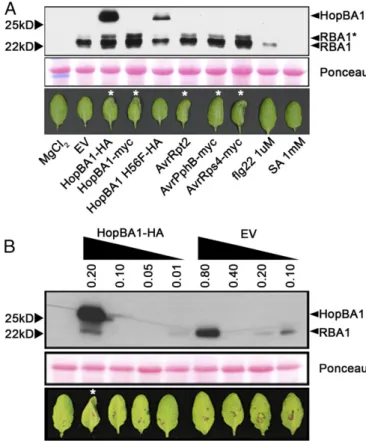
RBA1 Accumulates During Immune Responses Activated by a Variety of NLR Proteins. We noted that native promoter-driven RBA1 protein is undetectable in transgenic plants (Fig. 2C). However, RBA1 protein accumulated to high levels after Pf0-1 delivery of HopBA1 (Figs. 2C and 6A). Accumulation of RBA1 after Pf0-1 delivery of the loss-of-function allele HopBA1 H56F was equivalent to that triggered by Pf0-1 (EV) control. To address whether RBA1 accumulation is HopBA1 specific, we used Pf0-1 to deliver other ETI-inducing T3Es (AvrRpt2 to activate RPS2, AvrRps4 to activate RPS4, and AvrPphB to activate RPS5). All ETI-inducing treatments induced RBA1 accumulation (Fig. 6). Pf0-1 weakly induced RBA1 accumulation, but flg22 elicitors were able to induce RBA1 accumulation only slightly, and SA elicitors were unable to do so (Fig. 6A). These results show that RBA1 accumulation is correlated with cell death triggered broadly during ETI, with MTI triggers having a much weaker effect.
Because RBA1 was autoactive at high expression levels in both
N. benthamiana and Arabidopsis, we asked whether HopBA1 triggers RBA1 activity at lower expression levels or if cell death was merely correlated with higher levels of RBA1 protein ac-cumulation. Therefore we compared RBA1 expression after high-titer inoculation with Pf0-1 (EV) with that induced by lower-level treatments of Pf0-1 (HopBA1) (Fig. 6B). Although
Pf0-1 (HopBA1) triggered leaf collapse at anAgrobacterium in-oculation density of OD 0.2, Pf0-1 (EV) was unable to trigger collapse even at OD 0.8. It is notable that the lack of response after high-dose Pf0-1 (EV) inoculation was accompanied by an induced accumulation of RBA1 protein well in excess of that induced by the cell-death–triggering lower-dose inoculation of Pf0-1 (HopBA1) (Fig. 6B, Lower Band). Thus, increased ex-pression of RBA1 driven by its native promoter is insufficient in this context to activate cell death in the absence of HopBA1.
Discussion
The ability to monitor signals of microbial invasion is universally the first step in mounting an immune response. In plants, the intracellular “sensor” proteins of the NLR family are critical components for activating plant immunity. These sensors moni-tor a reliable indicamoni-tor of pathogenesis: the presence of pathogen effector proteins. These pathogen effector proteins can be thought of as evolved tools that manipulate critical, and often conserved, components required for host immunity (36).
Here we define and characterize a type of NLR-like protein that consists of only a functional TIR domain, RBA1. We pro-vide a crystal structure for the T3E protein, HopBA1, that trig-gers an RBA1-dependent cell-death response and show that it resembles a bacterial heme-scavenger protein. Mutations in and around the putative heme-binding site of HopBA1 result in loss
of coimmunoprecipitation with RBA1 and loss of RBA1-dependent cell death. HopBA1 enhances RBA1 self-association, which is necessary for ectopic autoactivation of host cell death. Surprisingly, mutations in either of two previously characterized TIR dimerization interfaces abolished RBA1 autoactivity, its self-association, and its interaction with HopBA1. Our data demon-strate that neither of the previously characterized plant TIR dimer interfaces alone is sufficient for effective RBA1 signaling.
To identify components of the host immune system, we used a genetic approach exploiting natural variations in both the host and the pathogen. We identified HopBA1 as a trigger of RBA1 activity. Like many pathogen virulence effectors, HopBA1’s biochemical function is not revealed by its primary protein se-quence. In combination with a genetic dissection of HopBA1-triggered responses in the host, we took a structural approach and determined the crystal structure of HopBA1. Bacterial vir-ulence proteins are often structural mimics of eukaryotic pro-teins. However, the structure of HopBA1 that we solved was most similar to the bacterial heme-binding protein ChaN and the bacterial esterase Bcr136. We were not able to demonstrate any heme-binding or esterase activity using in vitro-purified HopBA1 protein. However, using ChaN and Bcr136 as a guide, we gen-erated HopBA1 mutants that lose the ability to trigger RBA1 cell deathin planta.
Recently, thePtoDC3000 effector HopB1 was proposed to be a novel type of serine protease (37). Secondary structure analysis in Li et al. (37) showed no homology to known proteases. However, our structure-based homology searches indicated that HopB1 is actually a HopBA1-like protein most similar to the PMT-C2 domain (Fig. S6G). Li et al. proposed that HopB1 H413, T370, D435, and D436 form a catalytic core. Based on the HopB1 homology model, the proposed HopB1 catalytic histidine (H413) is conserved in HopBA1 (H193), in the heme scavenger ChaN (H220), and in the EreA-like esterase Bcr136 (H309), but not in PMT (L1045). The HopB1 catalytic threonine and as-partates (T370/D435/D436) proposed by Li et al. are not con-served in HopBA1/ChaN/Bcr136 and do not appear to be in a position likely to promote catalysis involving HopB1 H413, based on modeling to the structure of the PMT-C2 domain (Fig. S6G). In contrast to HopB1, structural and biochemical analyses of EreA/Bcr136 by Morar et al. (33) indicate that the Bcr136 pro-posed catalytic histidine is likely to be H84, rather than H309, and that its catalysis is not dependent on serine or threonine. This proposed Bcr136 catalytic histidine is also conserved across the family of HopBA1-like proteins. The residue in HopB1 (H274) corresponding to the proposed Bcr136 catalytic histidine was not tested for HopB1 catalytic activity in Li et al. (37). Both HopBA1 H56 (analogous to the proposed Bcr136 esterase cat-alytic residue) and H193 (proposed HopB1 serine protease catcat-alytic residue) are required for HopBA1-triggered cell death. Despite considerable conservation at both of these histidines across the family, HopBA1-like proteins appear to have quite diverse bio-chemical functions. These proteins also have been proposed to be ancient relatives of the human TIKI metalloprotease (38).
HopBA1-like proteins may be important virulence factors for both plant and animal pathogens. Intriguingly, the structure of HopBA1 is similar to a domain of the Pasteurella multocida
toxin, PMT. PMT has acetyltransferase activity that modifies the animal cytoskeleton. However, PMT is a large, multidomain protein, and its HopBA1/Bcr136/ChaN-like domain has no de-scribed function. The presence of a HopBA1-like protein in a mosquito microbiome strain also hints at a conserved role for HopBA1-like proteins as effectors in both plants and animals. The precise role of HopBA1 in virulence remains obscure. To date, we have been unable to demonstrate a virulence function for hopBA1, by either the addition of hopBA1 into the Arabi-dopsis/PtoDC3000 system or the deletion ofhopBA1 from the sugar beet/P.syringaepvaptatapathosystem. Recently, deletion Fig. 6. Accumulation of RBA1 protein is induced during effector-triggered
immunity; HopBA1 contributes to RBA1 cell death posttranslationally. (A, Upper) Western blot (anti-HA) showing accumulation of HA-RBA1 in Col-0 RBA1Ag-0native promoter transgenic (lower band,∼22 kDa) and HopBA1-HA
(upper band,∼25 kDa) in response to various treatments. (Lower) Images taken 24 h after injection of bacteria, flg22, or SA. Asterisks indicate leaves with cell death in the injected half. AvrRpt2 triggered strong cell death earlier than hopBA1, whereas AvrPphB-injected leaves had collapsed at 24 h postinoculation. (B) High levels of HA-RBA1 induced by high-dose Pf0-1 EV are not sufficient to trigger cell death inArabidopsisin the absence of HopBA1. The asterisk indicates a leaf with cell death in the injected half.
PLANT
BIOLO
GY
PNAS
PLUS
SEE
COMMENT
especially in the context of a hopBA1/hopA2/hopAZ1 triple mutant (39). A full understanding of the mechanism of HopBA1 function will require genetic and biochemical characterization of additional components beyond HopBA1 and RBA1, including HopBA1 virulence targets and unknown genes required for im-mune perception and activation (see discussion below).
A critical unsolved question in plant innate immunity is how NLRs actually signal downstream to activate cell death and disease resistance as measured by pathogen growth restriction. Although the direct and indirect pathogen-recognition events activating NLRs are increasingly well understood, the down-stream events remain obscure (40). In the case of TIR-NLRs, ectopic cell death triggered by the expression of truncated TIR domains in the absence of pathogens indicates that they are likely sufficient to trigger disease resistance (13, 17). A requirement for dimerization is typically reported for TIR-truncation phenotypes, even though the reported dimers (L6 and RPS4/RRS1) are struc-turally distinct (13, 14). Homology modeling to structures of TIR domains from the full-length NLRs RPS4 and L6 guided our RBA1 mutagenesis. Mutations in RBA1 that reflect alterations in either the L6 or the RPS4 dimerization interfaces resulted in the loss of RBA1 activity and self-association. This genetic evidence strongly suggests that a WT RPS4 interface is insufficient to support self-association in the former set of mutants and that a WT L6 interface is insufficient to support self-association in the latter. Additionally, RBA1 mutants in either of the two interfaces expressedin transdo not self-associate (Fig. 3F).
Our results are consistent with speculative models in which RBA1 either has a unique TIR structure or forms functional multimers that are dependent on both interfaces (Fig. S3). RBA1 self-association could be stabilized by cooperativity, as reported for TIR domains during activation of the Toll signaling complex (41). The requirement for both TIR interfaces in plants is likely a generalizable observation, because equivalent RPS4 dimer interface mutations made in the L6 TIR domain and vice versa result in loss of function, indicating the general importance of both interfaces (42). Like the RBA1 mutants, these L6 and RPS4 mutants present a result not expected from the published crystal structures. The hypothesis that interfaces are simulta-neously engaged could resolve the puzzle presented by the dis-tinct dimer interfaces found in the L6 and RPS4 crystals. Potentially, these crystals are incomplete, and each represents only part of a larger complex that is bigger than simple dimers. Consistent with this model, Zhang et al. (42) have generated two new plant TIR domain crystal structures [of Successor of npr1-1, constitutive 1 (SNC1) and RPP1] that support our speculation that two interaction surfaces are engaged simultaneously. Con-sistent with these results, Hyun et al. (43) also found both L6 and RPS4-like interfaces within a SNC1 TIR crystal. To test if a TIR multimer is at least sterically feasible, we generated a model of a hybrid RBA1 TIR oligomer structure containing simultaneous L6 and RPS4-type interfaces (Fig. S3C–E). Although the structure of full-length NLRs remains obscure, this hybrid TIR structure also would be sterically feasible for full-length NLRs because it distrib-utes both the N and C termini around the outer surface of the helix (Fig. S3E). Whether such a structure actually occurs remains to be determined, but in animals TIR domains are known to oligomerize and heterodimerize to transmit signals (44). Analogous to this hy-pothetical RBA1 oligomer, the animal TIR protein MyD88 is proposed to form a helical homo-oligomer (with multiple, distinct interaction surfaces) as part of a larger complex of TIR-containing proteins (45). Thus, it is possible that plant TIR domain oligo-merization and/or heterodioligo-merization regulate the formation of functional signaling macrocomplexes.
Importantly, the loss of RBA1 self-association is correlated with the loss of RBA1 interaction with HopBA1. Coimmuno-precipitation is not sufficient to demonstrate a direct interaction
sibility that additional host-derived molecules may bridge HopBA1 and RBA1. Indeed, Y2H assays failed to demonstrate a direct HopBA1–RBA1 interaction. Exactly how HopBA1 trig-gers RBA1 remains unknown. The absence of typical NLR negative regulatory domains in RBA1 presents a puzzle as to how RBA1 is regulated. Treatment of native promoter-driven RBA1 transgenics with high-titer Pf0-1 (EV) induces RBA1 expression. However, this expression does not trigger cell death as efficiently as the weaker RBA1 accumulation triggered by lower titers of Pf0-1 (HopBA1). Thus, a low level of RBA1 in the presence of HopBA1 triggers cell death more strongly than a high level of RBA1 in the absence of the effector. This finding strongly supports a direct mechanistic link between HopBA1 recognition and RBA1 activation. The presence of HopBA1 leads to a molecular weight shift in RBA1 that is sensitive to λ-PPase. This sensitivity suggests that HopBA1 enhances RBA1 phosphorylation and that phosphorylation may be required for full RBA1 activity. We observed that other ETI-inducing treat-ments (and Pf0-1, to a lesser extent) also lead to a molecular weight shift in RBA1, so the shift is likely caused by the activa-tion of an endogenous phosphorylaactiva-tion pathway downstream of pathogen recognition rather than by a specific response to HopBA1. Consistent with this notion, the lack of phosphoryla-tion in the RBA1 self-associaphosphoryla-tion mutants suggests that phos-phorylation is either coincident with or downstream of RBA1 self-association. Intriguingly, we found inArabidopsisthat HopBA1 interacted preferentially with the higher molecular weight, pre-sumably phosphorylated, form of RBA1. This observation sug-gests that the RBA1 size shift is functionally relevant to activation; to test this hypothesis, we are pursuing mass spectrometry to identify the exact modifications. Future identification of which residues of RBA1 are modified, and how, is likely a fertile ground for understanding downstream events at or after NLR activation. We note that the full-length TIR-NLR RPP1 also may be post-translationally modified (27), indicating that posttranslational modification of TIR domains is not an RBA1-specific event but rather may be a general event during NLR activation and/or sig-naling. The promotion of RBA1 self-association by HopBA1 sug-gests a simple model wherein HopBA1 lowers a threshold for RBA1 oligomerization, dependent on both the RPS4- and L6-type interfaces, to activate cell death.
In this work, we demonstrate that a TIR-only protein can de-termine the response to a pathogen effector. In addition to RBA1, there are ∼50 TIR, TIR-X, and TIR-NB genes present in the
Arabidopsis Col-0 reference genome (50). Although RBA1 ap-pears to be a pseudogene in the Col-0 genome, most of the TIR-X and TIR-NB genes are expressed (50). Interestingly, several of these are transcriptionally induced by the defense hormone sali-cylic acid, suggesting a role in disease resistance (28). Like RBA1 or TIR domains truncated from full-length TNLs, overexpression of TIR-X and TIR-NB proteins can trigger EDS1-dependent cell death (28). Loss-of-function mutations in TN2, a TIR-NB protein lacking LRRs, were isolated as genetic suppressors of cell death triggered by loss-of-function alleles of EXO70B1, a component of the exocyst vesicle trafficking complex (51). These phenotypes are consistent with a model wherein EXO70B1 is a guardee, moni-tored by the immune receptor TN2 and targeted by as yet unknown pathogen effectors. This model is analogous to the classical RPS2/ RIN4 NLR/guardee model, except that the NLR is a truncation lacking the canonical LRR domain (52, 53). There is also pre-cedence for TIR-NB proteins regulating full-length TNLs. The
chs1-2(a TIR-NB) mutant phenotype of temperature-dependent cell death requires the neighboring full-length TNL geneSOC1
(54). Truncated NLR proteins also have been reported to arise from a single full-length TNL gene via alternative splicing (55, 56). In the case of the tobacco N gene, analysis of alternative cDNA products suggests that a truncated TIR-NB splice variant is required for full function (56). Our studies of RBA1 provide a conclusive answer that TIR-containing truncated NLRs can regulate immune responses in response to pathogens and furthermore suggest a more complex model of TIR oligomerization using distinct structural in-terfaces. These observations expand our view of the diversity of the plant immune system in terms of both receptor architecture and mechanisms of activation.
Materials and Methods
Plant Materials and Growth Conditions.Arabidopsis was grown in walk-in rooms maintained at 21 °C/18 °C (day/night) with a 9-h/15-h day/night cycle. Tobacco was grown in walk-in growth rooms maintained at 26 °C/22 °C with a 12-h/12-h day/night cycle. TransgenicArabidopsisstrains were generated using standard floral dip techniques (57). Ag-0 defense mutant plant lines were generated by introgressing mutant alleles from Col-0 into Ag-0. The Ag-0 mutant plants used were progeny of plants fixed for RBA1 Ag-0 and heterozygous for the defense gene, thus allowing cosegregation analysis. Correlation of genotypes and phenotypes was verified using standard PCR markers (oligonucleotides are available upon request).
Generation of Expression Plasmids.Gateway-compatible Entry clones and Des-tination clones were generated by BP and LR cloning (Invitrogen) or by direct synthesis (GenScript). Site-directed mutants were generated by overlap ex-tension PCR or site-directed, ligase-independent mutagenesis (SLIM) (58). Oli-gonucleotides used for cloning are available upon request. RBA1 is N-terminally epitope tagged throughout the paper, because C-terminal tags have reduced function. Agrobacteria 35S-promoter expression plasmids included pGWB615 (3×HA), pGWB618 (4×MYC), pGWB642 (eYFP), and pGWB661 (TagRFP). Pseu-domonasexpression plasmids used were pJC531 (native promoter:1×HA) and pJC532 (native promoter:ΔavrRpt2). The RBA1 native promoter HA:RBA1 ge-nomic complementation construct was generated in pGWB616. Dexametha-sone-inducible RBA1 was expressed from the pBUD vector. pGWB vectors are from the Nakagawa laboratory (59).
Bacterial Strains and Growth Conditions.Escherichia coliTop10 and Agro-bacterium tumefaciensstrain GV3101/pMP90 were grown in LB medium at 37 °C and 28 °C, respectively.Pseudomonasstrains were grown at 28 °C in King’s B medium. TheE.coliantibiotic concentrations used (in micrograms per milliliter) were ampicillin 100, kanamycin 30, gentamycin 25, and spec-tinomycin 50.Agrobacteriumantibiotic concentrations used (in micrograms
per milliliter) were gentamycin 50, kanamycin 100, rifampicin 100, and spectinomycin 100.Pseudomonasantibiotic concentrations used (in micro-grams per milliliter) were gentamycin 25, kanamycin 30, and rifampicin 50.
Bacterial Assays and Conductivity Measurements. P.fluorescens(Pf0-1) ef-fector delivery assays were performed as described (22). Typically, Pf0-1 was grown overnight, washed, and diluted in 10 mM MgCl2to an OD600of 0.1.
These cultures were hand-injected with needleless syringes into 4- to 6-wk-oldArabidopsisrosette leaves between 10 AM and noon and were pheno-typed 24, 36, and/or 48 h after infiltration.P.syringaebacterial growth assays were performed as described (60). Briefly,PtoDC3000 was grown overnight and washed in 10 mM MgCl2, resuspended to OD=0.0002, and
then injected as described above. Leaves were cored (no. 4 cork borer), ground, and dilution plated to assess recovered colony-forming units. Each experiment contained six biological replicates per genotype, and statistical significance was assessed using a one-way ANOVA and post hoc Tukey’s honestly significant difference (HSD) test (P≤0.05) (SigmaPlot). To measure conductivity, four leaf discs were collected with a no. 4 corer from four independent plants infiltrated 18 h earlier. Leaf disks were added to clear tubes with 6 mL of distilled water at room temperature under continuous light (three replicates per sample). Changes in water conductivity were measured at the indicated time points with an Orion Model 130.Agrobacterium(GV3101/pMP90) transient assays were performed similarly but were resuspended in 10 mM MgCl2 amended with 10 mM Mes (pH 5.0) and 150μM acetosyringone. Agrobacteria were injected at a total OD of 0.8 (including OD 0.1 of 35S:P19) into 5- to 6-wk-oldN.benthamianaleaves. Ectopic RBA1 chlorosis and tissue collapse typically appeared∼36–48 h postinoculation.
Structural Modeling of RBA1.Homology modeling of RBA1 was done using the Phyre2 suite (61). When using the intensive modeling setting, the RPS4 TIR domain [Protein Data Bank (PDB) ID code 4C6R] is the highest hit returned (100% confidence, 41% sequence identity), and the L6 TIR domain (PDB ID code 3OZI) is the second (100% confidence, 30% sequence identity). Hypo-thetical RBA1 dimers and oligomer were generated by using the ALIGN function of PyMOL (version 1.4.1; Schrodinger, LLC).
Coimmunoprecipitation and Western Blots.A combination ofAgrobacterium strains harboring the correct vectors were infiltrated into two separate halves ofN.benthamianaleaves that were subsequently flash frozen 36 h postinoculation. Frozen leaf tissue was collected and ground in a mortar and pestle with liquid nitrogen and resuspended in 2 mL of extraction buffer [50 mM Hepes-KOH (pH 7.5), 50 mM NaCl, 10 mM EDTA (pH 8.0), 0.2% Triton X-100, 5 mM DTT with 1×plant protease inhibitor mixture (Sigma-Aldrich)]. Soluble supernatants were cleared twice by centrifugation at 10,000×gfor 10 min at 4 °C and were incubated for 2 h with end-over-end turning at 4 °C with 50μL ofα-myc–orα-HA–conjugated magnetic beads (Miltenyi Biotec) for Myc-HopBA1 or HA-RBA1 precipitation or with 100μL ofα-T7 agarose beads (Novagen) for T7-HopBA1. Samples were captured with MACS sepa-ration columns (Miltenyi Biotec) and were washed three times with washing buffer (extraction buffer with 0.1% Triton X-100 and 150 mM NaCl). Bound proteins were eluted in elution buffer [50 mM Tris·HCl (pH 6.8), 50 mM DTT, 1% SDS, 1 mM EDTA (pH 8.0), 0.005% bromophenol blue, and 10% glycerol]. T7 agarose beads were collected by centrifugation at 1,000×gfor 5 min at 4 °C and were washed three times with washing buffer. The bound proteins were eluted in 100μL of elution buffer. Samples were resolved by electro-phoresis on 12% SDS/PAGE, transferred to PVDF, and blotted with primary antibodies overnight at 4 °C in TBS with 1% Tween (TBST) and 5% nonfat dry milk. The following concentrations were used:α-Myc, 1:1,000 (Santa Cruz Biotechnology);α-HA, 1:1,000 (Sigma);α-T7, 1:10,000 (Novagen).
ACKNOWLEDGMENTS. We thank Robin Allen, Victor Baillif, and Joseph Woodruff for technical assistance; Cris Argueso for access to Colorado State University facilities; and Drs. Sarah Grant and Freddy Monteiro for critical reading of the manuscript. Tim Denny providedP.syringaeB76. David Baltrus providedP.syringaeFF5. Barbara Baker providededs1-silencedN.tabacum. Detlef Weigel provided Ag-0 prerelease genome resequencing data. This work was supported by National Science Foundation Grant IOS-1257373 (to J.L.D.). J.L.D. is an Investigator of the Howard Hughes Medical Institute (HHMI) and is supported by the HHMI and by Gordon and Betty Moore Foundation Grant GBMF3030. R.G.A. was supported by NIH Ruth L. Kirschstein National Research Service Award Fellowship F32GM108226.
1. Jones JD, Dangl JL (2006) The plant immune system.Nature444(7117):323–329. 2. Lindeberg M, Cunnac S, Collmer A (2012) Pseudomonas syringae type III
ef-fector repertoires: Last words in endless arguments.Trends Microbiol20(4): 199–208.
3. Jacob F, Vernaldi S, Maekawa T (2013) Evolution and conservation of plant NLR functions.Front Immunol4:297.
4. Meyers BC, Kozik A, Griego A, Kuang H, Michelmore RW (2003) Genome-wide anal-ysis of NBS-LRR-encoding genes in Arabidopsis.Plant Cell15(4):809–834.
PLANT
BIOLO
GY
PNAS
PLUS
SEE
COMMENT
worlds.BioEssays38(8):769–781.
6. Takken FL, Goverse A (2012) How to build a pathogen detector: Structural basis of NB-LRR function.Curr Opin Plant Biol15(4):375–384.
7. Hu Z, et al. (2015) Structural and biochemical basis for induced self-propagation of NLRC4.Science350(6259):399–404.
8. Zhang L, et al. (2015) Cryo-EM structure of the activated NAIP2-NLRC4 inflammasome reveals nucleated polymerization.Science350(6259):404–409.
9. Bentham A, Burdett H, Anderson PA, Williams SJ, Kobe B (2016) Animal NLRs provide structural insights into plant NLR function.Ann Bot, 10.1093/aob/mcw171. 10. Botos I, Segal DM, Davies DR (2011) The structural biology of Toll-like receptors.
Structure19(4):447–459.
11. Maekawa T, Kufer TA, Schulze-Lefert P (2011) NLR functions in plant and animal immune systems: So far and yet so close.Nat Immunol12(9):817–826.
12. Valkov E, et al. (2011) Crystal structure of Toll-like receptor adaptor MAL/TIRAP re-veals the molecular basis for signal transduction and disease protection.Proc Natl Acad Sci USA108(36):14879–14884.
13. Bernoux M, et al. (2011) Structural and functional analysis of a plant resistance pro-tein TIR domain reveals interfaces for self-association, signaling, and autoregulation. Cell Host Microbe9(3):200–211.
14. Williams SJ, et al. (2014) Structural basis for assembly and function of a heterodimeric plant immune receptor.Science344(6181):299–303.
15. Chan SL, Mukasa T, Santelli E, Low LY, Pascual J (2010) The crystal structure of a TIR domain from Arabidopsis thaliana reveals a conserved helical region unique to plants. Protein Sci19(1):155–161.
16. Ve T, Williams SJ, Kobe B (2015) Structure and function of Toll/interleukin-1 receptor/ resistance protein (TIR) domains.Apoptosis20(2):250–261.
17. Swiderski MR, Birker D, Jones JDG (2009) The TIR domain of TIR-NB-LRR resistance proteins is a signaling domain involved in cell death induction.Mol Plant Microbe Interact22(2):157–165.
18. Macho AP, Zipfel C (2015) Targeting of plant pattern recognition receptor-triggered immunity by bacterial type-III secretion system effectors.Curr Opin Microbiol23: 14–22.
19. Le Fevre R, Evangelisti E, Rey T, Schornack S (2015) Modulation of host cell biology by plant pathogenic microbes.Annu Rev Cell Dev Biol31:201–229.
20. Baltrus DA, et al. (2011) Dynamic evolution of pathogenicity revealed by sequencing and comparative genomics of 19 Pseudomonas syringae isolates.PLoS Pathog7(7): e1002132.
21. Chang JH, et al. (2005) A high-throughput, near-saturating screen for type III effector genes from Pseudomonas syringae.Proc Natl Acad Sci USA102(7):2549–2554. 22. Thomas WJ, Thireault CA, Kimbrel JA, Chang JH (2009) Recombineering and stable
integration of the Pseudomonas syringae pv. syringae 61 hrp/hrc cluster into the genome of the soil bacterium Pseudomonas fluorescens Pf0-1.Plant J60(5):919–928. 23. Jiang J, Alvarez C, Kukutla P, Yu W, Xu J (2012) Draft genome sequences of Enter-obacter sp. isolate Ag1 from the midgut of the malaria mosquito Anopheles gambiae. J Bacteriol194(19):5481.
24. Peretz A, et al. (2013) A rare bacteremia caused by Cedecea davisae in patient with chronic renal disease.Am J Case Rep14:216–218.
25. Cao J, et al. (2011) Whole-genome sequencing of multiple Arabidopsis thaliana populations.Nat Genet43(10):956–963.
26. Kawakatsu T, et al.; 1001 Genomes Consortium (2016) Epigenomic diversity in a global collection of Arabidopsis thaliana accessions.Cell166(2):492–505. 27. Schreiber KJ, Bentham A, Williams SJ, Kobe B, Staskawicz BJ (2016) Multiple domain
associations within the Arabidopsis immune receptor RPP1 regulate the activation of programmed cell death.PLoS Pathog12(7):e1005769.
28. Nandety RS, et al. (2013) The role of TIR-NBS and TIR-X proteins in plant basal defense responses.Plant Physiol162(3):1459–1472.
29. Rietz S, et al. (2011) Different roles of Enhanced Disease Susceptibility1 (EDS1) bound to and dissociated from Phytoalexin Deficient4 (PAD4) in Arabidopsis immunity.New Phytol191(1):107–119.
30. Holt BF, 3rd, Belkhadir Y, Dangl JL (2005) Antagonistic control of disease resistance protein stability in the plant immune system.Science309(5736):929–932. 31. Murzin AG, Brenner SE, Hubbard T, Chothia C (1995) SCOP: A structural classification
of proteins database for the investigation of sequences and structures.J Mol Biol 247(4):536–540.
32. Chan AC, et al. (2006) Cofacial heme binding is linked to dimerization by a bacterial heme transport protein.J Mol Biol362(5):1108–1119.
33. Morar M, Pengelly K, Koteva K, Wright GD (2012) Mechanism and diversity of the erythromycin esterase family of enzymes.Biochemistry51(8):1740–1751. 34. Kitadokoro K, et al. (2007) Crystal structures reveal a thiol protease-like catalytic triad
in the C-terminal region of Pasteurella multocida toxin.Proc Natl Acad Sci USA 104(12):5139–5144.
35. Cui H, Tsuda K, Parker JE (2015) Effector-triggered immunity: From pathogen per-ception to robust defense.Annu Rev Plant Biol66:487–511.
36. Mukhtar MS, et al.; European Union Effectoromics Consortium (2011) Independently evolved virulence effectors converge onto hubs in a plant immune system network. Science333(6042):596–601.
37. Li L, et al. (2016) Activation-dependent destruction of a co-receptor by a Pseudo-monas syringae Effector dampens plant immunity.Cell Host Microbe20(4):504–514.
fold for cell signaling from bacteria to metazoa?Dev Cell25(3):225–227. 39. Dudnik A, Dudler R (2014) Virulence determinants of Pseudomonas syringae strains
isolated from grasses in the context of a small type III effector repertoire.BMC Microbiol14:304.
40. Qi D, Innes RW (2013) Recent advances in plant NLR structure, function, localization, and signaling.Front Immunol4:348.
41. Bovijn C, et al. (2013) Identification of binding sites for myeloid differentiation pri-mary response gene 88 (MyD88) and Toll-like receptor 4 in MyD88 adapter-like (Mal). J Biol Chem288(17):12054–12066.
42. Zhang X (2017) Multiple functional self-association interfaces in plant TIR domains. Proc Natl Acad Sci USA114:E2046–E2052.
43. Hyun KG, Lee Y, Yoon J, Yi H, Song JJ (2016) Crystal structure of Arabidopsis thaliana SNC1 TIR domain.Biochem Biophys Res Commun481(1-2):146–152.
44. Gay NJ, Symmons MF, Gangloff M, Bryant CE (2014) Assembly and localization of Toll-like receptor signalling complexes.Nat Rev Immunol14(8):546–558.
45. Vyncke L, et al. (2016) Reconstructing the TIR side of the myddosome: A paradigm for TIR-TIR interactions.Structure24(3):437–447.
46. Guven-Maiorov E, et al. (2015) The Aachitecture of the TIR domain signalosome in the Toll-like receptor-4 signaling pathway.Sci Rep5:13128.
47. Heidrich K, et al. (2011) Arabidopsis EDS1 connects pathogen effector recognition to cell compartment-specific immune responses.Science334(6061):1401–1404. 48. Iakovidis M, et al. (2016) Effector-triggered immune response in Arabidopsis thaliana
is a quantitative trait.Genetics204(1):337–353.
49. Coll NS, Epple P, Dangl JL (2011) Programmed cell death in the plant immune system. Cell Death Differ18(8):1247–1256.
50. Meyers BC, Morgante M, Michelmore RW (2002) TIR-X and TIR-NBS proteins: Two new families related to disease resistance TIR-NBS-LRR proteins encoded in Arabidopsis and other plant genomes.Plant J32(1):77–92.
51. Zhao T, et al. (2015) A truncated NLR protein, TIR-NBS2, is required for activated defense responses in the exo70B1 mutant.PLoS Genet11(1):e1004945.
52. Mackey D, Belkhadir Y, Alonso JM, Ecker JR, Dangl JL (2003) Arabidopsis RIN4 is a target of the type III virulence effector AvrRpt2 and modulates RPS2-mediated re-sistance.Cell112(3):379–389.
53. Axtell MJ, Staskawicz BJ (2003) Initiation ofRPS2-specified disease resistance in Arabidopsis is coupled to the AvrRpt2-directed elimination of RIN4.Cell 112(3): 369–377.
54. Zhang Y, et al. (2016) Temperatudependent autoimmunity mediated by chs1 re-quires its neighboring TNL gene SOC3.New Phytol213(3):1330–1345.
55. Zhang XC, Gassmann W (2007) Alternative splicing and mRNA levels of the disease resistance gene RPS4 are induced during defense responses.Plant Physiol145(4): 1577–1587.
56. Dinesh-Kumar SP, Baker BJ (2000) Alternatively spliced N resistance gene transcripts: Their possible role in tobacco mosaic virus resistance.Proc Natl Acad Sci USA97(4): 1908–1913.
57. Clough SJ, Bent AF (1998) Floral dip: A simplified method for Agrobacterium-medi-ated transformation of Arabidopsis thaliana.Plant J16(6):735–743.
58. Chiu J, March PE, Lee R, Tillett D (2004) Site-directed, Ligase-Independent Mutagen-esis (SLIM): A single-tube methodology approaching 100% efficiency in 4 h.Nucleic Acids Res32(21):e174.
59. Nakagawa T, et al. (2007) Development of series of gateway binary vectors, pGWBs, for realizing efficient construction of fusion genes for plant transformation.J Biosci Bioeng104(1):34–41.
60. Morel JB, Dangl JL (1999) Suppressors of the arabidopsis lsd5 cell death mutation identify genes involved in regulating disease resistance responses.Genetics151(1): 305–319.
61. Kelley LA, Mezulis S, Yates CM, Wass MN, Sternberg MJ (2015) The Phyre2 web portal for protein modeling, prediction and analysis.Nat Protoc10(6):845–858. 62. Peterson BA, et al. (2016) Genome-wide assessment of efficiency and specificity in
CRISPR/Cas9 mediated multiple site targeting in Arabidopsis. PLoS One 11(9): e0162169.
63. McPherson A (1982)Preparation and Analysis of Protein Crystals(Wiley, New York), p vii, 371 pp.
64. Winn MD, et al. (2011) Overview of the CCP4 suite and current developments.Acta Crystallogr D Biol Crystallogr67(Pt 4):235–242.
65. Emsley P, Lohkamp B, Scott WG, Cowtan K (2010) Features and development of Coot. Acta Crystallogr D Biol Crystallogr66(Pt 4):486–501.
66. Murshudov GN, Vagin AA, Dodson EJ (1997) Refinement of macromolecular struc-tures by the maximum-likelihood method.Acta Crystallogr D Biol Crystallogr53(Pt 3): 240–255.
67. Winn MD, Murshudov GN, Papiz MZ (2003) Macromolecular TLS refinement in REFMAC at moderate resolutions.Methods Enzymol374:300–321.
68. Adams PD, et al. (2010) PHENIX: A comprehensive Python-based system for macro-molecular structure solution.Acta Crystallogr D Biol Crystallogr66(Pt 2):213–221. 69. Chen VB, et al. (2010) MolProbity: All-atom structure validation for macromolecular
crystallography.Acta Crystallogr D Biol Crystallogr66(Pt 1):12–21.