CREATING A COLLECTIVE CONSCIOUSNESS OF PUBLIC SCHOOLING INEQUITIES: PARTICIPATORY ACTION RESEARCH WITH COMMUNITY COLLEGE STUDENTS
Kathleen M. Nichols
A dissertation submitted to the faculty at the University of North Carolina at Chapel Hill in partial fulfillment of the requirements for the degree of Doctor of Philosophy in the School of
Education (Culture, Curriculum, and Change).
Chapel Hill 2014
ii ©2014
iii ABSTRACT
Kathleen M. Nichols: Creating a Collective Consciousness of Public Schooling Inequities: Participatory Action Research with Community College Students
(Under the direction of George Noblit)
iv
Major themes identified that have contributed to failing urban schools included: increasing cruelty, distractive blaming, and severely unjust disparities between the quality of educational experience provided to suburban students and urban students. Solutions identified were multi-pronged and primarily included eliminating disparities between suburban and urban school districts, forming a collective effort in solving schooling problems, inviting and
respecting student voice in decisions that shape school experience, implementing effective methods for increasing compassion for and acceptance of diverse people in schools, and
v
ACKNOWLEDGEMENTS
There were moments throughout this six-and-a half-year PhD journey, especially during the four-and-a-half-year dissertation endeavor, which could have been nice times to pack up and call it a day. It is due to the gracious encouragement I received from many people, from dearest loved ones to complete strangers with whom I mentioned my goal in passing, that I am able to type this message now. Thank you, all of you, for believing in me and for telling me that I could finish. I agree with my students/co-researchers’ deduction that educating an individual
meaningfully necessitates a caring and dedicated community effort. I was able to complete this work thanks to support from countless individuals and organizations. Please know, while I am not naming every person and group individually, I greatly appreciate the unique ways you have provided me with the strength to achieve completion.
To the students/co-researchers at the Central New Jersey community college who participated passionately and tirelessly in our CPAR study and to these same individuals and additional community members who shared their stories openly with the hope that airing their wounds would prevent others from having to endure similar pains, I thank you.
To the beneficent professor at the Central New Jersey community college who mentored me, co-taught with me, and made me always feel like a respected colleague and friend, I thank you.
vi
To all of the educators who communicated to me that I matter and who taught me how empowering learning can be, I thank you.
To my teachers and colleagues in academic institutions, educational programs,
conferences, institutes, and workshops who shared scholarship and research and who invited me to engage in critical dialogue with them so that I could make sense of all of the research, the academy, and myself as a researcher, I thank you.
To my committee members and professors who took time out of their busy schedules to guide me through the processes and challenges of conducting my own study, I thank you.
To Julie Justice and Janice Anderson, who welcomed me into their study and illustrated how researchers can work collaboratively to conduct and report research, I thank you.
To Madeleine Grumet, who integrated unforgettable moments of experiential learning into our program by planning course trips into the mountains and research studies in local schools, I thank you.
To Jocelyn Glazier and Melissa Miller, who never faltered in expressing compassion and skillfully energized me, especially when I was feeling defeated, I thank you.
To James Trier, who encouraged me to think outside the box as a researcher and conduct research that had not been attempted in the program, I thank you.
To Cassandra Davis, who took a leap of faith in committing her time and energy to supporting me, I thank you.
vii
To George Noblit, who accepted me as his advisee despite the fact that his advisee commitment runneth way over, brought laughter and warmth in moments of cheer and dread, never gave up on me, and guided me through the dissertation process to the end, I thank you.
To my loyal family and friends who always gave me a reason to keep working, provided me with strength and guidance whenever I struggled, and told me consistently that they knew I would finish, even when I had my doubts, I thank you.
To my partner in life, who patiently waited for me while I traveled a journey that took me away from our family and generously and tirelessly gave me the time, space, support, and
viii
“I suffered with deep seemingly interminable depression and anxiety about how to write up this fluid, sometimes incoherent, sometimes harmonious project in a linear, ‘scholarly’ way
ix PREFACE
One of the greatest challenges I experienced while writing this dissertation can be captured beautifully in the words of participatory action research scholar Monique Guisard. Apart from the writing of this dissertation, all other aspects of this research process were highly collaborative, which is not only essential in a PAR project for reasons detailed throughout this paper, but also is the manner of learning in which I thrive. It was deeply troubling and difficult to transition from the rich plurality of epistemological growth felt in the collective research settings to the isolating, one-dimensional reporting of this meaning-packed journey. I worry that I will not do it justice, and know I will miss moments and discoveries that were meaningful to participants. There is not enough time or pages to capture the complexities of the lived
experiences of the incredible students with whom I worked, learned, and grew, throughout the semester-long courses in which we investigated public schooling inequities in central New Jersey.
One of the biggest lessons I learned as a researcher facilitating a PAR project was that I could not expect my participants to share their intimate struggles, their pains, their
vulnerabilities, if I remained a silent observer and hid mine safely and securely from them. Therefore, I share with you, the few perhaps, who read these words I have struggled to find for months. If I do not force myself to accept the best I can do at this moment, as mediocre as it feels at times, this collective journey of discovery will not respectful report the hard work of 24
x My Impetus to Conduct Research
I hated high school… not the people (the teachers, students, administrators, or staff) and not learning itself (my curiosity was insatiable). High school seemed to sterilize learning, like an R-rated film edited for network television, such that all of the provocativeness and inspiration for further inquiry had been gutted. I counted every tick of the second hand on that clock until that blessed day that harbingered my freedom. College had to be better and, for the most part, it was. Yet, after college, I ended up in a very unexpected place. As I mentioned mere sentences ago, I hated high school… so much so that my friends and family were a bit shocked when I chose to work as a high school Special Education teacher in a public high school in New York City. My goal had been to de-sterilize the learning process and invite student control and choice over the curriculum (the what and how they learned). Students seemed to like my class, and we could celebrate growth each marking period. However, every year, there were students who did not receive their high school diplomas. The high school I worked at was one of the better, with higher graduation rates than most. Throughout New York City, the graduation rates hovered around 60% for a four-year cohort (Appendix 1). Which meant that 40% of the high school students in each cohort were either not graduating within four years, or at all. After 6 years, it appeared to be the case that 25-30% were not earning high school diplomas (Appendix 1). It was a horrifying realization. As a teacher, and an educator cognizant of the necessity of having a high school diploma in order to be marketable in a competitive job market, not to mention the
xi
teaching classes, I decided to pursue a PhD in Education because I wanted to explore ways to improve public schooling experiences for students who were systemically failed, i.e. the system of public schooling set them up for failure. Many students in special education, students of color, students living in poverty, students without homes, students who were non-native English
speakers, were struggling to survive high school, and many did not.
xii
TABLE OF CONTENTS
LIST OF FIGURES ... xviii
LIST OF TABLES ... xix
CHAPTER 1 – OUR CPAR STUDY ... 1
1.1. Achieving Access is Not Enough ... 1
1.2. Theoretical Framework ... 3
1.3. The Purpose of Our CPAR Study in Greater Detail ... 5
1.4. Participants and Recruitment ... 6
1.5. Study Sites ... 6
1.6. Procedures ... 7
1.6.a. Negotiating My Power as Teacher ... 10
1.6.b. The Power of Story ... 13
1.6.c. Community College Students Become CPAR Co-Researchers ... 19
CHAPTER 2 – OUR RESULTS ... 23
2.1. CPAR Groups’ Final Presentations ... 23
2.2. Our Collectively Identified Themes and Subthemes ... 28
2.2.a. Data, Data, So Much Data… ... 29
2.3. Cruelty in Schools ... 31
2.3.a. Physical Violence and Physical Abuse ... 32
2.3.b. Bullying (all forms) ... 35
xiii
2.3.d. Racism, Discrimination, Prejudice ... 42
2.3.e. Diffability: looking/appearing different, disability, dress ... 47
2.3.f. Sexual Abuse/Harassment, Teen Pregnancy, and Sexual Orientation ... 47
2.3.g. Harmful Language, Name Calling, and Rumors ... 49
2.3.h. Unkind Treatment and the Lack of Compassion ... 52
2.3.i. Emotional Response to Cruelty: fear, pain, isolation, victimization ... 53
2.3.j. Being/Becoming a Bully ... 54
CHAPTER 3 – PEOPLE AND GROUP INVOLVEMENT ... 55
3.1 School/Community ... 55
3.1.a. Community Involvement ... 55
3.2.b. Parent/Home Involvement ... 56
3.1.c. Blame Parents ... 57
3.1.d. Sympathize with Parents ... 58
3.1.e. School’s Responsibility ... 59
3.1.f. Administrator Involvement ... 61
3.1.g. Teacher Involvement ... 63
3.1.h. Blame Teacher ... 64
3.1.i. Sympathize with Teachers... 66
3.1.j. Government Involvement ... 67
3.1.k. Shared Responsibility ... 68
3.2 Students ... 70
3.2.a. Student Responsibilities... 70
xiv
3.2.c. Onus on the Student, Challenges made the Student Stronger ... 73
3.2.d. Sympathize with the Student ... 75
3.2.e. Academic Versus Social Needs ... 76
3.2.f. Peer Pressure ... 78
3.2.g. Cruelty has lasting impacts on the student ... 79
CHAPTER 4 – URBAN SCHOOLING PROBLEMS ... 81
4.1.a. Disparities between Urban and Suburban Schools ... 83
4.1.b. Funding ... 86
4.1.c. Lack of Resources and Support ... 88
4.1.d. Value of Education ... 90
4.1.e. Dropout Rates High, Not Uncommon ... 94
4.1.f. Moving a lot from School to School ... 97
4.1.g. Overcrowding and High School/Class Sizes ... 98
4.1.h. Transportation Challenges (confusing and unsafe) ... 100
4.1.i. School Food Unhealthy and Expensive... 103
4.1.j. School Buildings/Learning Spaces are Unsafe ... 104
4.1.k. Urban AND Suburban School Problems ... 105
4.1.l. Poverty / Low Socioeconomic Status ... 107
4.1.m. High-Stakes Testing ... 111
4.1.n. The Business of Educating Children ... 115
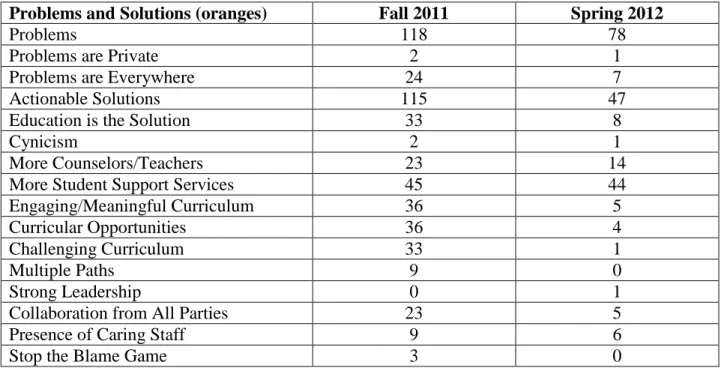
CHAPTER 5 – PROBLEMS, SOLUTIONS, AND CPAR ... 117
5.1 Problems and Solutions... 117
xv
5.1.b. Problems are perceived as intimate and private ... 120
5.1.c. Problems are perceived as timeless, ubiquitous, everywhere ... 120
5.1.d. All the Actionable Solutions ... 121
5.1.e. Education is the Solution ... 124
5.1.f. Cynical about whether solutions will work ... 126
5.1.g. More Counselors and Increased Time with Students ... 127
5.1.h. More Student Support Services and Programs ... 130
5.1.i. Curriculum - More Engaging, More Meaningful to Students ... 133
5.1.j. Multiple Schooling Paths with Influential Student Input ... 135
5.1.k. Strong Leadership ... 138
5.1.L Collaboration from All ... 138
5.1.m. Caring and Supportive School Staff ... 139
5.1.n. Stop the Blame Game ... 141
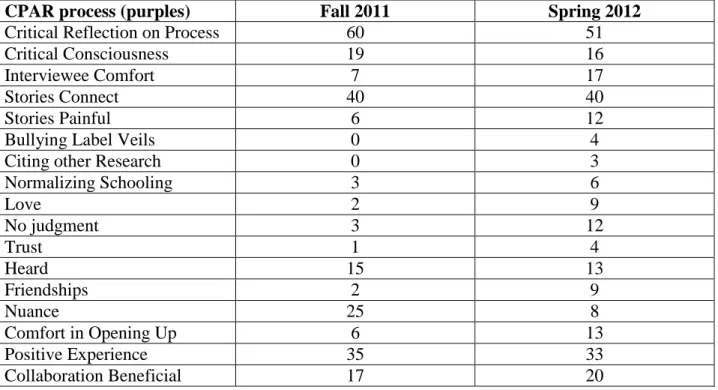
5.2 The CPAR Process ... 143
5.2.a. Raised Critical Consciousness – Conscientization ... 143
5.2.b. Desire for Interviewee to Feel Comfortable ... 147
5.2.c. Sharing Stories Creates Connections ... 152
5.2.d. Sharing Stories can be Painful and Uncomfortable ... 154
5.2.e. Bullying Label Erases Underlying Prejudice ... 156
5.2.f. Co-Researchers Integrated Other Research in their Discourse ... 157
5.2.g. Normalizing Schooling Experiences ... 157
5.2.h. Love ... 159
xvi
5.2.j. Trust is Important ... 160
5.2.k. We All Need to be Heard, Acknowledged, Respected, and Accepted ... 161
5.2.l. CPAR Built Friendships ... 163
5.2.m. Noted Nuance ... 163
5.2.n. Comfort Found in Opening Up, Sharing, Receiving Support ... 165
5.2.o. CPAR was a Positive Experience ... 166
5.2.p. Collaboration was Beneficial ... 168
CHAPTER 6 – PROBLEMS SET THE STAGE FOR CPAR ... 173
6.1 Public Schooling Problems ... 173
6.2 The Purpose of Our CPAR Study ... 176
6.3 Providing a Space for Student Voice in Collaborative Research ... 177
6.4 Critical Participatory Action Research (Critical PAR or CPAR) ... 178
6.4.a PAR Studies that Informed Our Study ... 180
6.4.b Grounding Our Study in the Research ... 185
CHAPTER 7 – A CENTRAL NEW JERSEY COMMUNITY... 186
7.1 Segregated New Jersey ... 186
7.2 Schooling “Options” ... 191
7.3 School District Demographics in the Central New Jersey Community ... 191
7.4 Community College and Participating Classes’ Demographics ... 201
CHAPTER 8 – DISCUSSION ... 207
8.1 Reflective Summary of the CPAR Process ... 207
8.1.a Critical Participatory Action Research (CPAR) as Critical Pedagogy ... 207
xvii
8.2 Our Findings Support those of the Opportunity Gap Project ... 213
8.3 Conclusions ... 216
8.3.a Media’s Destructive Role: Blaming and Bullying... 216
8.3.b Everyone is Overworked and Overwhelmed ... 219
8.4 Suggestions for Future Research ... 221
APPENDIX 1: NYC GRADUATION RATES ... 226
APPENDIX 2: CPAR RESEARCH PROJECT OVERVIEW ... 227
APPENDIX 3: CRITICALLY REFLECTIVE WRITING PROMPTS ... 228
APPENDIX 4: SAMPLE RESEARCH/INTERVIEW QUESTIONS ... 230
APPENDIX 5: CRUELTY IN SCHOOLS TABLE AND FIGURE ... 233
APPENDIX 6: SCHOOL/COMMUNITY FIGURE ... 234
APPENDIX 7: STUDENTS FIGURE ... 235
APPENDIX 8: URBAN SCHOOL PROBLEMS FIGURE ... 236
APPENDIX 9: PROBLEMS AND SOLUTIONS FIGURE ... 237
APPENDIX 10: CPAR PROCESS FIGURE ... 238
APPENDIX 11: IRB APPROVAL LETTER ... 239
xviii
LIST OF FIGURES
Figure 7.1: B/H Students and F/R Lunch in 9 Districts ... 198
Figure 7.2: Correlation between Race and Poverty ... 199
Figure A.1: Cruelty in Schools ... 233
Figure A.2: School/Community ... 234
Figure A.3: Students ... 235
Figure A.4: Urban School Problems ... 236
Figure A.5: Problems and Solutions ... 237
LIST OF TABLES
Table 2.3: Cruelty in Schools... 31
Table 3.1: School/Community ... 55
Table 3.2: Students... 70
Table 4.1: Urban School Problems ... 81
Table 5.1: Problems and Solutions ... 117
Table 5.2: The CPAR Process ... 143
Table 7.1: Racial/Ethnic Breakdown of School Districts ... 193
Table 7.2: Special Programs in School Districts ... 195
Table 7.3: Correlation between Race and Poverty ... 197
Table 7.4: Community College Race/Ethnicity ... 201
Table 7.5: Community College Age Demographics ... 202
1
CHAPTER 1 – OUR CPAR STUDY
1.1. Achieving Access is Not Enough
Critical participatory action research (CPAR) requires that co-researchers are engaged and invested in the study. An ideal scenario might be that community members collectively determine they would like to investigate local issues and find neighbors with expertise in qualitative and quantitative research methods. With guidance provided by experienced researchers, they conduct their study together. In this situation, local community members inspired the impetus to critically examine the complex problems in the community. It would be difficult to argue against the authenticity of the CPAR process. Power, privilege, and authority would still exist in nuanced ways; however, the project would be unquestionably directed and controlled by the community members.
2
miles from these organizations and could not finance the travel expenses that would incur daily, easily a couple thousand dollars in a few months.
I explored a couple of local sites in Central New Jersey, including K-12 schools in suburban districts and an alternative school in the urban district; however, state budget cuts and aggressive political tactics forced them into a survival mode that consumed all of their time and energy. A fortunate ramification of this arduous journey, and my ongoing efforts to attain not just access but fiscal feasibility and an environment capable of being receptive to a CPAR project, was that I stumbled upon local community college classrooms as a fitting place to integrate CPAR into the course curriculum. While this setting did not illustrate the ideal one I detailed earlier, it became clear to me that community colleges can be perfect locations for investigating and unpacking local issues. Most community college students lived close to our community college, and they understood local problems because they lived them. Exploring critical thinking in a hands-on way, created relevancy and meaning to the remedial English curriculum. While advantages surfaced, I agonized over my position as the instructor facilitating the study and reminded students that I was aware of my role and hoped that it would not prevent them from taking ownership, control, and direction over their projects. After reflecting
3 1.2. Theoretical Framework
I implemented the Critical Participatory Action Research (CPAR) epistemology in this study. As mentioned in the CPAR literature review, CPAR’s epistemological approach is a blending of Lewinian Action Research, critical theory, and methods deemed most appropriate for the participants/co-researchers. “The main methodological consideration in PAR is that the principles guiding processes must be participant-centered and non-alienating” (Udas, 1998, p. 604). Freirean Critical Pedagogy (Freire, 2000; Freire, 2005) informed the curricular and pedagogical design because students/co-researchers and I engaged in respectful dialogue with one another and community members.
In order to establish an environment of respect and open-mindedness, we used our critical thinking textbook as a platform to co-create tenets needed to ensure members were heard,
4
uncomfortable, such as racism, homophobia, sexual abuse, social injustices, politics, and more. Our findings speak to the fullness and depth to which we felt comfortable sharing intimately troubling social phenomena. This journey and these results would not have been possible without uniform, collaborative, and explicit efforts in sincerely nurturing and supporting each other in every moment of every interaction.
In addition to critically-informed yet compassionate dialogue, we also performed critical reflection and action, to achieve praxis and hopefully a developed sense of conscientization. Our approach to gathering information from the community to create a picture of the oppression that exists aligned with Freire’s concept of codification.
Our study incorporated methodological aspects of critical participatory action research (CPAR), participatory action research (PAR), and youth participatory action research (YPAR) (Cammarota, & Fine, 2008; Cannella, 2008; Creswell, 2008; Guishard, 2009; Morrell, 2008; Rogers, 2008; Torre & Fine, 2006) – and all of the studies explored in Section 1.4.A CPAR Studies that Informed Our Study - and the constructivist grounded theory model (Charmaz, 2000, 2003, 2008). Participants/students/co-researchers performed collaborative inductive analyses of the empirical data collected, which included: students/co-researchers’ narratives about their experiences in their public schools, interviews/recorded conversations with other community members’ about their schooling experiences, students/co-researchers’ critical dialogue and ongoing reflective writings about the contrasted educational settings and the research process, and students/co-researchers’ final presentation work (with a collectively-created critique of local schooling problems, research themes and results, and actionable solutions).
5
methodology for our study (Bowen, 2006; Charmaz, 2000, 2003, 2006, 2008; Creswell, 2008). Cited in Bowen, 2006: “Inductive analysis means that the patterns, themes, and categories of analysis come from the data; they emerge out of the data rather than being imposed on them prior to data collection and analysis” (Patton, 1980, p. 306). Thus, we focused our efforts on the emergent process and the discovery of patterns, themes, and categories that emerged from the data, in an overt and explicit attempt to prevent each other from jumping hastily to theoretical conclusions. This approach was of utmost importance since we followed the constructivist grounded theory model.
1.3. The Purpose of Our CPAR Study in Greater Detail
The purpose of this study was to create a context for critical dialogue among community college students about the meaningful, worthwhile experiences they have had in their urban and suburban public schools. The student-centered dialectic occurred in two community college Remedial English classrooms (one course taught in the Fall of 2011 and the second course taught in the Spring of 2012). A central tenet of this study, a PAR tenet, was to invite students to direct the learning process, i.e. CPAR studies as group projects. Students' interests, needs, and strengths defined the curricula and pedagogies, and I acted as a facilitator in the learning process. The stories, dialogues, and projects created can be used to understand the unique ways in which students and families experience urban and suburban public schools in Central New Jersey, and the themes and solutions identified can be used to shape discourse surrounding local reform decisions.
The research question I wrote for the IRB process was: How do community
6
aims to be student-led? This was the research question that inspired the Critical Participatory Research CPAR study I facilitated. However, CPAR requires that the students/co-researchers create questions that are meaningful to them; some of these questions are listed later in the paper. Since these questions changed (some were edited, some omitted, some added) throughout the semester, those questions presented here are intended to provide an understanding of where groups were in a particular moment during the semester. The constant accruement of new data, fresh perspectives, and unique experiences continuously challenged our grasp of the complex problems and phenomena present in surrounding public schools.
1.4. Participants and Recruitment
The participants included 25 adult community college students, all 18 years and older, who signed consent forms giving me permission to quote them and share their stories in this paper. Their names have been changed to pseudonyms. There were more than 25 students enrolled in the two semesters (15 Fall 2011 students and 25 Spring 2012 students). All of the students enrolled in the remedial reading courses participated in the CPAR projects and were invited to participate in the study at the end of each semester after their work was graded; however, not all students signed consent forms. I have only shared quotes from the 25
students/co-researchers who gave their consent. The problems, themes, and solutions came from the collective work of the entire class each semester, and these ideas and findings are reported in this paper.
1.5. Study Sites
7
to share their CPAR work (their narratives, reflective writings, discussions, and projects) in this paper.
In the fall semester, I co-taught with the primary professor of the remedial reading course, and in the spring semester, I was the primary instructor of the remedial reading course. Students/co-researchers conducted and completed their CPAR projects (their reflective writings, interviews, and group meetings) inside their remedial English classrooms and throughout their community.
1.6. Procedures
Each semester, Fall 2011 and Spring 2012, there were 15 classes that met once a week for three hours. Half of each class was dedicated to reading and analyzing scholarly articles and literature and the other half was dedicated to students’ CPAR projects, which provided students with the opportunity to practice and develop the critical reading skills that were a major aspect of the course design as well as to mobilize Freire’s praxis (action and reflection).
8
engaged in critical discourse and critical reflection throughout the CPAR process. They synthesized their findings in a final group presentation at the end of each semester.
The CPAR block included:
class discussions and dialogue concerning articles we had read together about struggling
schools and students,
moments devoted to critical reflection independently and collectively and to making the
CPAR process explicit and transparent, activities to build community and trust,
blocks of time dedicated to teaching students the methods for collecting data (mainly
practice with interviewing or facilitating meaningful conversations with family and friends about their areas of interest regarding schooling experiences) and for analyzing data.
Said analysis consisted of an iterative process of chunking out themes from reflective journals and interviews/conversations, individually and collectively, throughout the second half of the semester). We followed a grounded theory model approach to analyzing the data we collected. The bulk of the rest of this paper will detail the process of these CPAR projects, particularly the great breadth of the students/co-researchers’ findings and their critically reflective responses to the CPAR process.
9
accordance with historical conditions and the level at which the oppressed perceive reality” (Freire, 2000, p. 65). Whether all students/co-researchers achieved a state of awareness
according to their specific, intimate stage of struggle and whether they achieved a raised critical consciousness, conscientization, could not be confirmed with certainty; however, there were hints of possibilities, which are explored in the findings.
In our study, to satisfy the goal of action, we strived to collect and co-create actionable solutions that we could share with members of the class and community. In addition to their own stories, students/co-researchers wrote reflectively throughout the CPAR process and conducted one or two individual interviews/conversations with fellow classmates and/or community members about their schooling experiences. In groups, students/co-researchers discussed each other’s narratives and interviews/conversations, and they identified themes and instances of shared experiences and unique experiences. Throughout the semester, the students/co-researchers and I read and shared articles and media that explored schooling issues so that participants could analyze and critique these additional perspectives about educational experiences and could contrast them with their personal educational experiences and the community members’
experiences that had been collected. I facilitated the ongoing dialogues and reflections that took place in the community college classroom, with the ever-present CPAR goal that the students/co-researchers made the decisions during each step of the process. I provided guidance with the research tools.
All students enrolled in the remedial reading classes participated in the CPAR project and were graded not on content but on participation. Tests, quizzes, and written responses to
10
students to demonstrate their critical thinking capabilities through reading and writing. Students analyzed the critical thinking process in this course and implemented it in the culminating project. The CPAR project satisfied the critical thinking project component of the remedial reading curriculum. I facilitated the semester-long project that encouraged students to engage in critical dialogue about their schooling experiences. As part of the class project, students
completed ongoing reflective writings, interviewed each other and/or members of their
community, and created a final product and group presentation that synthesized what they had learned from thinking critically about their schooling experiences and local community
members’ schooling experiences. At the end of each semester, I invited students/co-researchers to share their schooling narratives, reflective writings, and final presentations with me so that they could be reported in this paper. The quotes provided came from students/co-researchers who gave their consent formally. Their names have been replaced with pseudonyms.
1.6.a. Negotiating My Power as Teacher
As mentioned elsewhere in this paper, it cannot be ignored that I had great power as an instructor of these remedial English classes. I facilitated the classes and graded students’ work. I was inarguably in the position of power and authority in the classroom. I chose critical pedagogy and critical participatory action research as frameworks to direct and inform my teaching
because I hoped to position myself as a facilitator in my students learning and not an expert of it. I have struggled to define critical pedagogy, other than to acknowledge that it requires the teacher and students to constantly question and critique how people are positioned socially and systemically. I was comforted when I read that Matthew Smith and Peter McLaren (2010) wrote:
11
constant evolution and re-invention by numerous communities and collective struggles worldwide. Critical pedagogy demands that people repeatedly question their roles in society as either agents of social and economic transformation, or as those who
participate in the asymmetrical relations of power and privilege and the reproduction of neoliberal ideology. (p. 332)
I had been looking for a sound bite that would capture a process complexly fluid and malleable. Critical pedagogy must be respectfully connected to the needs of struggling people. As a teacher, I cannot deny that I have power and authority, which I did acknowledge openly with my students. I also explained to the students that I could not be considered an expert in students’ experiences of their schools and in their learning. Students were the experts. I told them that I hoped to be a facilitator of learning in class and the CPAR study. My goal was to provide them with the tools and support they needed to become stronger readers, writers, and critical thinkers so they could comfortably challenge, question, critique, and investigate the dynamic texts they interact with daily, including research, literary works, media, and the stratifying social systems they navigate in their communities.
12
possibilities for them. I strived not to by participating in active, on-going reflection and open communication with my students/co-researchers. I wrote reflectively about my role as the teacher throughout each semester, and I communicated openly with my students/co-researchers about my role in the classroom as a facilitator and supporter and not a director or an expert.
Another problem that arose was that students/co-researchers sometimes expressed discomfort or resistance about the sharing of power: “most groups who engage in PAR are themselves acculturated into traditional understandings of relational hierarchies; they may resist the sharing of power that the researcher offers (McTaggart, 1997; Rahman, 1991)” (Kidd and Kral, 190). Positioning myself as a facilitator, collaborator, and learner created greater
discomfort for students earlier in each of the semesters because, during the first few weeks, students/co-researchers indicated that they wanted me to tell them exactly what to do and wanted to know what the right answer was. Students also waited for my lead at times and wanted to know what I thought before they shared what they thought. As a teacher sharing my power and authority with the students, I had disrupted social convention and students’ expectations, and we had to work together to create a collaborative class environment. When students/co-researchers requested guidance, I repositioned myself as a co-learner when discussing data and lived experience and a facilitator when supplying students with tools they could use to become
13
It should be noted that discussing power in participatory, community-based research efforts is highly important and warrants deep scrutiny. As Michelle Fine (2008) elucidates, “While the processes of PAR have been grossly appropriated by the International Monetary Fund, World Bank, oil and pharmaceutical companies to try to co-opt ‘locals’ to ‘buy into’ corporate takeover of lands and resources, critical participatory projects are designed to unveil the ideological and material architecture of injustice” (pp. 215-216). If CPAR projects silence the co-researchers and perpetuate injustices, that power is being abused. It is possible that I silenced students/co-researchers in these remedial English courses because I was the instructor and evaluator. I communicated daily that they were the experts of their CPAR projects and the local community problems they experienced, and I was a facilitator and learner. Nonetheless, the power dynamic inherent cannot, not should not, be ignored. CPAR studies require that power and authority be explicitly acknowledged and discoursed, and CPAR projects must be
collaboratively, and completely, controlled and directed by the co-researchers. 1.6.b. The Power of Story
14
Story was supposed to aid in the strengthening of our community - as bell hooks (2010) wrote, “One of the ways we become a learning community is by sharing and receiving one another’s stories; it is a ritual of communion that opens our minds and hearts. Sharing in ways
that help us connect, we come to know each other better.” Instead, story threatened to destroy
our community. The student left class because she was forced to feel vulnerable and share her
vulnerabilities, not what she expected when registering for a remedial reading class at her
community college. I realized quickly that if I hoped to salvage any chance for fostering a
healthy community necessary for a CPAR project, I would have to share my troubled schooling
experiences. Doing so would “lay the foundation for building an authentic learning community”
(hooks, 2010). My vulnerability communicated to the students “that they can take risks, that they can be vulnerable, that they can have confidence that their thoughts, their ideas will be given appropriate consideration and respect” (hooks, 2010).
Sharing was difficult because wearing my vulnerabilities openly could have been viewed by my students as a sign of weakness. While it is required in CPAR, and inherently good
teaching practice, to participate willingly in any task required of the student, particularly difficult ones, I knew I must share my troubling educational experiences with my students if I expected them to feel comfortable enough to share theirs with their classmates and me. As I mentioned earlier, sharing my story came sooner than I had anticipated in the fall semester. After
reflectively on this pivotal moment in the study, I learned from my mistake in the fall semester and led with my story in the spring semester.
15
to share their stories. Initially, some students shared eagerly and openly, and some students did not. We discussed commonalities, striking moments, and gratitude. As more students shared stories, the students began to create connections between each other’s experiences and
acknowledged other students’ struggles as shared. Some of them noted that it was not right or it was unfair that students endured such hard time in their schools. Students warmed up, smiled at one another, and relaxed. Students struggled in their schools for many different reasons: they experienced racist attacks by other students or faculty; they had poor health and had trouble keeping up with school work when they were absent frequently; their families moved frequently and they had to frequently code-switch socially, culturally, and academically in each new environment; they did not speak English as a first language and language barriers impacted all areas of learning; and they were attacked or victimized because they were perceived as weak or different (due to their perceived race, ethnicity, sexuality, gender, disability, religious affiliation, size, athleticism, physical (un)attractiveness, social class, intelligence, social acceptance, and social/emotional/physical/academic abilities.
It seemed as though the sharing of their stories had immediately improved our sense of trust and community in our classroom, until we asked the student who had not written if there was anything she wanted to share. She stood up and shouted that she had been the bully, she had slept around, she had gotten pregnant, and she had dropped out of high school. She said she was not the victim, like these other students. She was the aggressor. She was the problem. Then she stormed out.
16
break. When we all returned, including the student who had walked out, I apologized for making anyone feel as though they had to share and reminded them that writing about the schooling problems they had experienced might bring up uncomfortable moments, and they were never required to share. They could step out if they needed to, and they were not graded on the content of these stories. They also were invited to write about anything they wanted. They were never required to respond to any of the prompts. The prompts were provided as guides in the critically reflective writing process, and were supposed to be helpful for moments when students could not think of anything to write, a writer’s block tool.
I also shared that part of the reason we were doing this project in a remedial English class that stressed the importance of critical thinking was that literacy and language, like human beings and lived experiences, are complex and dynamic but are often packaged and distributed to classrooms in simple, linear, and compartmentalized ways. Stories can be powerful because they offer us a collective understanding and rich description of how we have experienced public schooling in our communities. These stories certainly cannot capture all lived moments and they do not define us or restrict our capacity to exist as dynamic beings. If we did something we thought was lazy, that does not mean we are lazy? Sometimes students are described as lazy, does that mean they are lazy? Or do they appear to be lazy but are actually confused, scared, tired, overwhelmed, sick… I imagine I rambled nervously a bit.
17
recommended. As a result, students opened up to me, quickly, warmly, and genuinely. In the spirit of responding to students’ vulnerabilities by providing my own, I shared the following story:
It was March of my 11th grade year, and my community was enduring a brutal Minnesota winter. Given my family’s economic circumstance, I had no money for college, so I studied diligently in the hope that I might earn GPA that would make me eligible for scholarship
18
That summer, I was talking with a co-worker, a close family friend of the teacher’s, and learned more about the teacher’s decision-making process. The student informed me
nonchalantly that his grade had been bumped up, and not mine, because this teacher favored male students and students who were not from “broken homes.” The latter hurt a bit more - maybe because I knew there were other female students who had tolerated the teacher’s sexism in that class, so I was not alone in that experience. The “broken home” quip was a direct shot at my family and me. My family had problems, financial struggles and familial conflicts, which made us socially and economically undesirable to some members of our community. I was sometimes comforted by imagining that we did not have the issues we did, but I had never perceived my family as broken. My parents were hardworking and loving, and they taught me from a young age that my education was important.
While a few teachers overtly communicated that I was innately undeserving of the advantages provided to other students, there were countless, many more, teachers who inspired and encouraged me, who believed in me and my potential to be more than my discredited societal position, my family problems, and our socioeconomic struggles. My public schooling experience was not defined by those difficult moments, but it was certainly shaped by them. If my self-esteem had not been boosted by these other teachers, I might have given up on school.
19
love. Not a word that often appears in classroom conversations, and certainly not spoken as comfortably and casually as it did.
Story, the power of story, transformed our space and played a significant role in fostering trust, compassion, understanding, and love. This power should not be ignored.
1.6.c. Community College Students Become CPAR Co-Researchers
In the Fall of 2011 and Spring of 2012, each semester began with students gaining a general understanding of the CPAR process and an understanding of the steps we would follow as a class. An overview of the CPAR research project is located in Appendix 2. We read
scholarly articles and literary pieces, from their course texts and from online, about
20
Students had opportunities to reflect on their own schooling experiences in their reflective writings. The reflective writing prompts are posted in Appendix 3. In their first
writing, their prompt was: “Reflect on your schooling experiences and your experience of access to quality education (particularly obstacles and roadblocks you experienced in your schools).” These writings were brought to class only a few weeks after the start of the semester. If they felt comfortable, they shared their initial reflective writing, their narratives about their schooling experiences, with the class. In the discussion section of this paper, I explore the difficulties I had early in the fall semester when I asked students to share their stories. I had asked students to engage in a potentially painful process of discussing difficult moments of their lived experiences, and I should have been the first to make myself a vulnerable participant. In the spring semester, I learned from my mistake and shared first. In both semesters, at the very beginning of the
semester, we discussed the importance of listening to each other with an open mind and
challenging ideas and not people. The course curriculum included readings and discussions about fostering a trusting and compassionate class community. We stressed the importance of
respecting people and their experiences but welcomed the practice of challenging ideas that caused harm. This approach was integrated into the remedial English course because we read controversial articles and literature. We needed a space where we could explore these texts respectfully and critically. We respected people and allowed them to feel heard, but we also challenged ideas that could silence other people. The respectful, critically-engaged environments created were ideal for the integration CPAR projects.
21
searched for patterns and identified themes in their experiences and the experiences of their fellow researchers. Naming, renaming, and organizing the themes they identified was an on-going, iterative aspect of the CPAR process. It began with their first reflective writing and continued throughout the rest of the semester. Once students analyzed their initial reflective writing, they noticed that their stories included certain collectively-created themes and not others. At this point, five weeks into the semester, students/co-researchers organized into groups based on the themes that were central to their own experiences of schooling, from which they could create questions they wanted answered.
The groups listed below were formed in each of the semesters: Fall 2011
Group 1: Racism in Education
Group 2: Urban vs. Suburban Schooling Group 3: Community’s Impact on Schooling Spring 2012
Group 1: Home life, poorer communities, overcrowding in the schools
Group 2: Disabilities, learning disabilities, disorders, groupings (cliques, self-esteem, bullying, peer pressure)
Group 3: Overworked students (sports, jobs, lack of sleep, drug abuse)
Students/co-researchers then wrote reflectively about the discussions they had about their group topics with their newly-formed groups. (See Appendix 3 for the Formal Reflective Writing Prompts).
22
by this group included) Disabilities, learning disabilities, disorders, groupings (cliques, self-esteem, bullying, peer pressure). There are 8 people in my group, which is very good because it is 4 guys & 4 girls. Since I’m the oldest in the group to listen to their problems on being bullied, peer pressured, and pressured from family members, I think they feel very comfortable to have an older adult in the group.” From the very start, this student/co-researcher noted the value of diversity in her group and immediately positioned herself within her group as a valuable, contributing member.
After the CPAR groups identified themes in their narratives, they wrote research questions they wanted to answer as a result of conducting the CPAR process. They also wrote interview questions they planned to ask classmates, friends, family, and community members in order to gain a better understanding of how the schooling problems they were investigating impacted the people in their communities (See Appendix 4).
23
CHAPTER 2 – OUR RESULTS
2.1. CPAR Groups’ Final Presentations
Each semester culminated with CPAR groups’ final presentations. Drawing from their own schooling narratives, interviews with community members, class dialogues, and their critical reflections, students/co-researchers shared their understandings of schooling problems in the local community, the themes and findings they identified in the iterative and emergent process of analysis, and the actionable solutions they recommended for immediate
implementation. Below are summaries, with some direct quotes, of the CPAR groups’ final presentations.
Fall 2011
24
strategies to support families new to the area and to encourage community members to accept newcomers with warmth, compassion, and understanding.
Group 2 (Urban vs. Suburban Schooling) final presentation summary: Group 2 mentioned that while these problems were present to some extent in both suburban and urban schools, it was evident through their research that the severity of these problems was greater in the urban schools. They shared, “These are the problems my group members came up with: lack of attendance, racism, large class sizes, lack of parental involvement, lack of interest, and lack of resources.” At the start of the semester, students/co-researchers in Group 2 thought there might be some discrepancies in the functioning of urban public schooling systems versus suburban public schooling systems; however, by the end of the semester, Group 2 deemed the
discrepancies deplorable, unacceptable, and offensive. The grand scope of the disparities necessitates immediate action to rectify the unconstitutional differences in the quality of
education delivered in the urban public schools, as compared to the quality of education received in the suburban public schools. In the Spring 2012 semester, groups also made this discovery and reacted in a similar fashion.
Group 3 (Community’s Impact on Schooling) final presentation summary: Group 3 began the semester aggressively demonizing teachers. To a lesser extent, yet still significant, they attacked students. They thought the primary problem in school was that teachers and students were lazy and apathetic. As they engaged more extensively in discursive practices with community members and fellow students, their interview processes, their narratives and
25
to figure out what the main problem in schools was and we realized it isn’t just students or teachers, it’s really everyone: the curriculum, parents, the environment that the students are in, the socioeconomic disparities. This is what we realized from doing the research that we did.” These students/co-researchers discovered that there are problems in all facets of schooling that can hinder a child’s ability to succeed, and attention must be heeded to all of these areas. Futhermore, they determined that without committed collaboration from all people and all groups in a community, schools will not function as effectively as they could. In communal efforts to improve local public schools, everyone must feel welcome, heard, and respected. Spring 2012
Group 1 (Home life, poorer communities, overcrowding in the schools) final
presentation summary: At the start of their presentation, Group 1 showed a video of a recent outburst at a high school in the urban school district. It captured a visibly overcrowded school with too many students. They conjectured that there was a fire alarm, students were sent out onto the lawn, and chaos ensued. They shared, “So that's one problem: overcrowding.” Plus, a:
26
they were so many kids, there were like 30 kids per classroom with one teacher. (Spring 2012, Group 1, final presentation)
Students in this group discovered, just as Group 2 in the fall semester had, that students in the urban district were receiving a grossly subpar education as compared to the students in the surrounding suburban districts.
They concluded, “(After completing this CPAR project) we know so many problems as well, about poverty and schools. Getting a quality education is every child's right. But in our society all children are not getting a quality education.” They stressed that most of the children living in poverty are attending urban schools. These underserved youngsters are struggling to achieve a poor education in buildings that are dangerous schools and overwhelmed while privileged students in surrounding suburban schools enjoy a higher quality education in safe, clean buildings with an abundance of supplies, resources, and social and academic support services and programs. They believed this was a serious injustice to children who had so little to begin with and thought the government should act immediately to improve these schools.
27
communities had serious implications. They asked, “What are the effects of bullying?” Citing research, they informed:
Firstly, bullying can lead to changes in students' appearances and personalities, work ethic inside and outside of school. For example, grades begin to drop, kids show up to school less, and it can start to become, kids can start to become depressed… Effects of bullying in the community (include that) parents feel they start to lose connection with their child. There could be an increase in violence throughout the community; high schoolers’ dropout rate will increase; and a decrease in test scores and a lack of work ethic. (Spring 2012, Group 2, final presentation)
Their presentation illustrates the interconnectedness of a community, as expressed by Group 3 in the fall semester. Whether acknowledged or not, when students suffer vicious attacks of cruelty and other schooling problems, a ripple effect occurs such that one student’s
experiences can impact other members in the school and community at large. These problems affect us all and should not be ignored.
They recommended the following actionable solutions:
28
Group 3 (Overworked students (sports, jobs, lack of sleep, drug abuse) findings: Group 3 came to similar conclusions as Group 2. They reported that students are overworked and desperately need greater academic and social support in their schools to guide them through healthy ways of managing their work, home/peer conflicts, and stress/anxiety/fear regarding building demands on students in a complicated world: a lack of money, exam pressure,
competition to get into and afford college, lack of quality/affordable childcare, etc. They stressed that it is extremely important that public schools immediately increase student access to
supportive, caring people (guidance counselors, teacher, support service staff, etc.) and academic and social support services and programs (child care, tutoring, exam prep, scholarship programs, counseling, internships, etc.).
2.2. Our Collectively Identified Themes and Subthemes
This section is organized according to the themes and subthemes that were identified by the students/co-researchers and me. The overarching themes I created to organize the many themes and subthemes identified by the students/co-researchers include: cruelty in schools, school and community (i.e. positioning them within schooling problems), students (i.e.
29
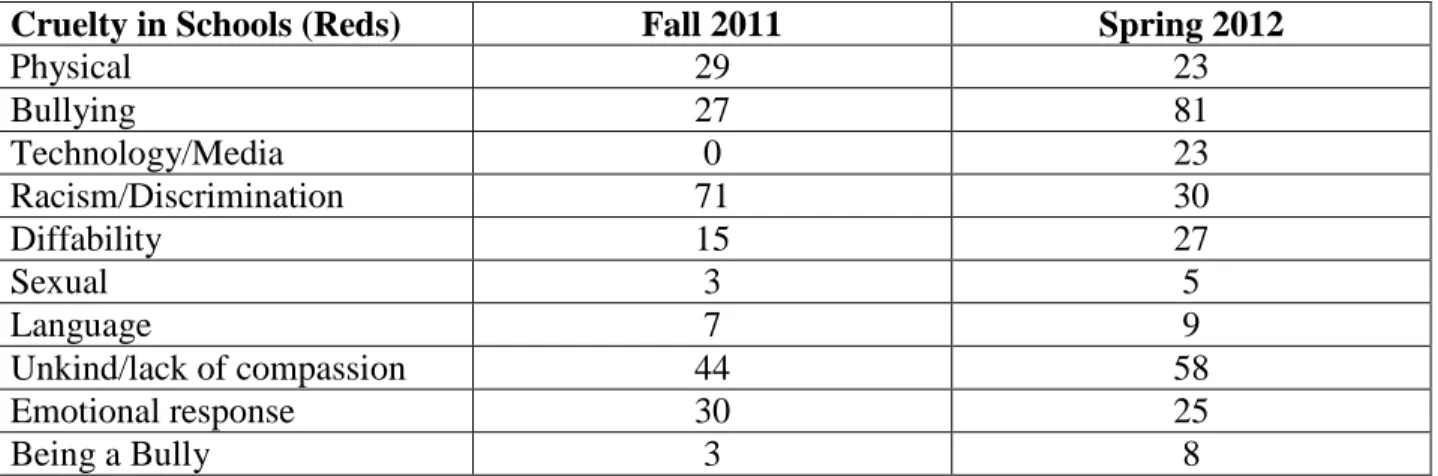
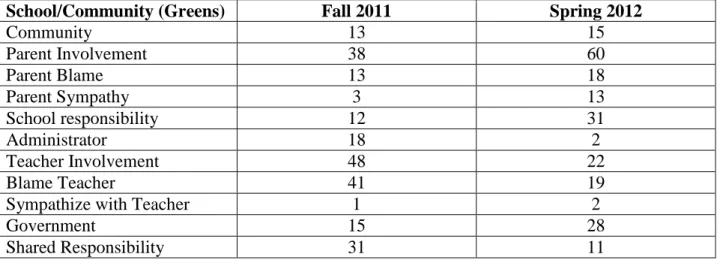
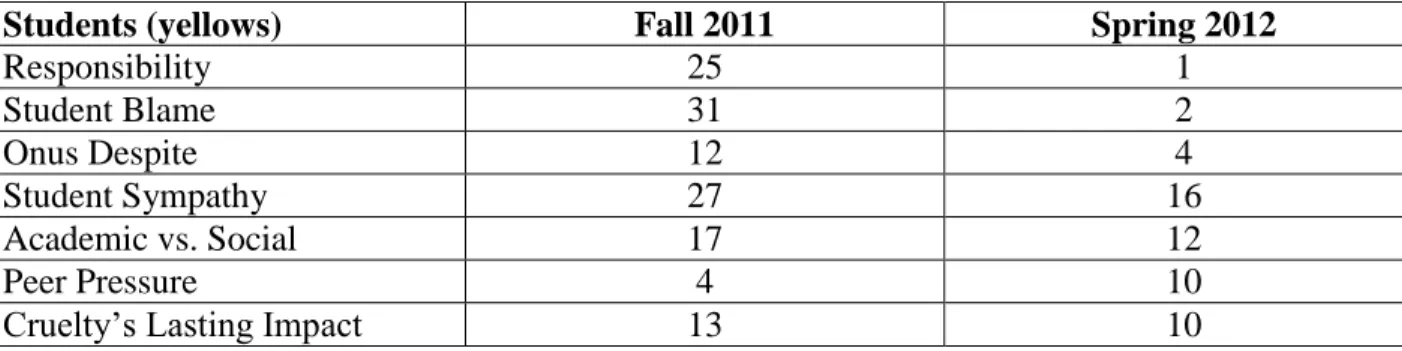
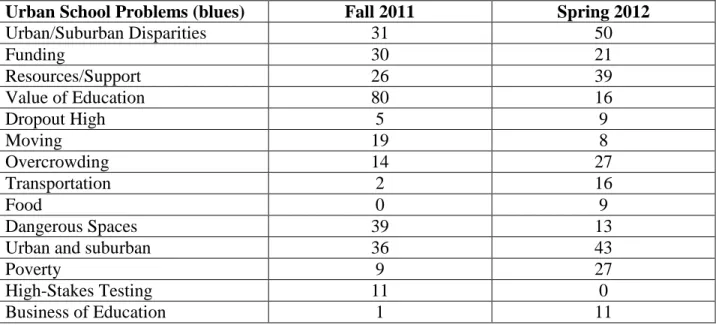
Tables are incorporated into the results sections, and figures of these tables are in the appendices (Appendices 5-10). These numerical and visual representations are included in order to illustrate how often these topics came up in written and performed work in each of these semesters and across these semesters. I provide details concerning my rationale for including these numbers and visuals, and a few disclaimers, in the next section.
2.2.a. Data, Data, So Much Data…
The previous section provides a glimpse at our findings and themes. In the remaining sections of this chapter, I provide a plethora of student/co-researcher quotes which capture the many, often overlapping, themes and subthemes identified throughout the CPAR process. While some themes and subthemes could potentially be collapsed into others, I decided not to do this because doing so would remove nuance and our individual and collective processing of an overwhelming amount of data. I strived to communicate transparency and unadulterated representations of students’/co-researchers’ narratives, experiences, and discoveries by presenting as much of their language, thoughts, and discourse as I could. To achieve this, I decided not to merge similar themes and subthemes. At times I have also noted relevant research that relates to students/co-researchers’ findings, to respect and support their work and position it within the context of germane academic scholarship.
30
into an excel spreadsheet so that codes co-created by the co-researchers and me could be used to analyze the findings across both semesters. Some of the themes were named by the student/co-researchers, and some were named or renamed by me so that both semesters’ data could be analyzed together. There were moments of synchronicity across the semesters that are interesting to note, as well as topics that were more or less prevalent. In order to illustrate the breadth of topics explored, basic descriptive charts are provided at the end of this paper in Appendices 5-10.
Throughout the chapters reporting our results, quotes (shorter moments as well as longer narratives) capture the depth and humanness (lived experience) of these topics. All of our gatherings were dynamic and often hard to record, so it is important to note that there may have been moments in which these topics were mentioned and missed in either semester.
Regarding the tables at the start of each major theme and charts in the appendices, the purpose of reporting the number of times these subjects appeared in recorded discourse and writings was not to identify certain topics or areas of discussion as more important than others because they occurred at a higher frequency on record, but to illustrate how often the groups mentioned these topics in their writings and recorded discussions in each of the semesters in order to note that there existed numerous moments of connection across the semesters. In other words, there appeared to be shared experiences across semesters. There were also topics that students/co-researchers wrote about and presented in one semester and not the other, so those differences are noted numerically and visually as well.
31
however, they were connected by their shared communal existence as co-members in the surrounding community and their experiences exploring and traversing CPAR pathways respectively.
Another word of caution concerning the charts, while certain areas tended to be discussed and brought up more often in each of the semesters, another topic might have been brought up toward semester’s end so that students/researchers only engaged with it a few times.
Nonetheless, that discovery was a meaningful and important issue. Therefore, again, it is key to approach the visual representations of topics as an additional method for creating connections and noting nuance across the semesters and not as a tool used to determine the worth or value of the themes identified and topics discussed. Reporting the data in this manner also makes it much easier to organize, illustrate, and digest the incredible work (data collected, analyses conducted, findings reported, etc.) that was collectively accomplished by these remarkable community college students/co-researchers throughout the two semesters.
2.3. Cruelty in Schools
Table 2.3: Cruelty in Schools
Cruelty in Schools (Reds) Fall 2011 Spring 2012
Physical 29 23
Bullying 27 81
Technology/Media 0 23
Racism/Discrimination 71 30
Diffability 15 27
Sexual 3 5
Language 7 9
Unkind/lack of compassion 44 58
Emotional response 30 25
Being a Bully 3 8
32
on bullying, Mateo listed the problems he, his group members, and their interviewees experienced when they were in school, which included: bullying in high school, harassment, abuse, being judged on appearance, being judged based on race, and being judged based on a special problem someone had. Cruelty included the overt and covert behaviors and practices of certain members of the school or greater community that inflicted pain and caused suffering (physical, emotional, psychological, and social) in individuals or collective groups of people. In the schooling experiences investigated, student researchers reported the prevalence of bullying and violence, a lack of interest in student’s sense of safety and belonging, and the silencing of student voice. Students described the occurrence of these acts of cruelty in both urban and suburban public school settings and in public and private realms across the communities in the area. The cruelty, which impacted students’ physical, emotional, and sexual well-being, appeared to know no bounds. In both semesters, students/co-researchers stressed the importance of
creating diverse learning environments and the need to explicitly teach students how to approach people who are different with open hearts and open minds.
2.3.a. Physical Violence and Physical Abuse
Stories about physical violence and abuse were plentiful in both semesters.
Students/researchers shared the experiences of community members and detailed bloody fights that were motivated by difference: racial, ethnic, socioeconomic, religious, gender, dress, appearance, ability, sexuality, etc.
One of Emma’s interviewee’s attended an urban high school. Emma reported:
33
mixed so not a lot of racism. Two kids got into a fight, one pulled out a knife and killed the other one. It left a big impression on everyone because they were both really quiet and no one expected it. Everyone was scared, and everyone was curious as to what would happen to this kid. (Fall 2011, Emma)
Emma and her interviewee viewed school diversity as a positive attribute and thought racism was curbed as a result. Nonetheless, students in this urban school had to make sense of the horrors of student homicide at the hands of another student.
The groups that investigated bullying also noted the occurrence of violence begets violence. Shani explained:
That's why (bullying is) really a cycle, and it's a bad cycle. Because you probably was bullied, but here it is, you took it in, and you didn't feel like it was going to be a little problem, but later down that line, you start bullying the next one. You keep it all inside of you, and you're bullying the next one. And you're going to get one over on this one because he's younger than you, or he looks like a wimp, or he just don't do right. That's just bullying right there. (Spring 2012, Shani)
The group identified the spider web effect of the spreading violence, too. During their bullying presentation, Mateo shared the effects of bullying in the community. These included: “parents feel they start to lose connection with their child. There could be an increase in violence throughout the community. High schoolers’ dropout rate will increase. Decrease in test scores and a lack of work ethic” (Spring 2012, Mateo).
34
Gomez et al., 2014; Sticca & Perren, 2013; Weber, 2015); however, statistics illustrate that rates of school violence in the U.S. are declining, apart from cities like Detroit, San Francisco and Cleveland (Neuman, 2012).
Students/co-researchers questioned their sense of safety in Central New Jersey’s urban areas. A prominent local news story reported on September 16, 2011 that “Today, 108 Trenton police officers will lose their jobs. The biggest blow to the department in its history has residents wondering how safe their streets will be tomorrow” (Zdan, 2011). Students/co-researchers voiced concerns that the state seemed to be pulling safety services and support from not only the communities in and surrounding New Jersey’s Capitol but also from vulnerable families in underserved neighborhoods in other urban areas of the state. Community members insisted that they experienced an immediate crime spike when local police officer presence disappeared. Perhaps they are unfazed, and sadly validated, by the August 29, 2013 local news article
announcing “Trenton becomes 'numb' to near-constant violence; new murder record set in capital city” (Zdan & Pizzi, 2013). Adding insult to injury, Governor Chris Christie has praised
Camden, New Jersey, for reduced rates of violent crimes, which he credits to replacing local police officers with regional officers. Some view this move as a union-busting tactic.
35
Trenton Mayor Tony Mack's office issued the following statement, calling for state aid to hire more officers immediately: Our administration is open to hearing ideas on how we can reduce crime in the City of Trenton. Nevertheless, it is important to point out that the regional police force was proposed for Camden City in early 2011 while new hires only just started this year. We have a very real issue with telling our residents to wait two years for basic quality of life that other communities enjoy all day every day. Trentonians need relief now and we stand by our earlier proposal, whereby the State increases our funding so we may hire an additional 75 police officers. (Portnoy, 2013) Local community members believed that violence was getting worse in their
communities and in their schools. They worried that families, organizations, and local businesses would flee their neighborhoods, and criminal activity would run rampant. Without adequate state aid and support, they did not think a reprieve from the violence was possible.
2.3.b. Bullying (all forms)
Bullying became the catch-all term for describing situations when students were verbally, physically, emotionally, and psychologically attacked. The prevalence of bullying was
mentioned frequently, and bullies seemed to target students who were perceived as different. Therefore, students were picked on because of differences related to perceived: race, ethnicity, religious affiliation, disability (or diffability based on perceived academic, social, physical, emotional, and cognitive/intellectual abilities), sexuality, appearance, dress, socioeconomic status, and more.
36
constantly teased him because of the way he walked. They would call him Frankenstein, something he really didn't like. Malik loved sports but he couldn't play sports because of his leg. He went from therapy and everything to see how he could redevelop and walk but he couldn't. The best part about Malik (Shani gets choked up) the best part about Malik, he is in an ivy league school right now. The three bullies were suspended from school. Malik, he takes my breath away, because Malik is very smart. They actually skipped him to another grade in another school. His mom didn't want any publicity from anyone, so I won't tell you his last name, his real name is Malik, and he lives in (the urban school district). He is going to other schools to share his story, and he wants to write a book about his story. (Spring 2012, Shani)
Malik was targeted because of his illness and his disability. Students/co-researchers expressed shock and disgust that a child struggling to overcome complications from serious health problems would then have to surmount cruel, targeted attacks from his classmates. It appeared that bullying had hit an all-time low because the unspoken, discomforting question in the group was “Who picks on a cancer kid?”
37
about who was in the best well known group, who had the best fashion, who had the best sports team of the pro’s, and who had the hottest car” (Spring 2012, Shani). While Asha is in a younger generation than Shani, she communicated that, even today, the social pressure of consumerism, i.e. being the right kind of consumer, persists in determining a student’s value. In her reflective writing she stated:
For my group’s topic, we will be talking about bulling in schools as well as outside of school. My personal experience with this topic was not good. During middle school and part of high school, I was bullied a lot. This was because I didn’t have nice clothes or brand name sneakers like the other girls. Also, I had messed up teeth. However, in my junior year it stopped because I started to dress like the other girls, but I never changed who I was. (Spring 2012, Asha)
For Asha, conforming to consumerist pressures provided relief from the taunting, ridicule, and ostracization. Thus, students who can afford to appease bullies by conforming might experience acceptance, but students who cannot afford the goods or cannot transform themselves as needed seem to be at a loss.
Asha explained during the Spring 2012 bullying presentation that while many freshmen are afraid of juniors bullying them:
38
By the end of the semester, her group thought that bullying could be getting worse and starting younger, but the focus on bullying in the media and political discourse, and the use of technology to publically humiliate students in front of a global audience, certainly complicated the issue. Cyberbullying appeared to change students’ experiences of bullying and cruelty, for the much worse.
2.3.c. Technology and Media Influence
Students/co-researchers also discovered that technology and the media were used to reinforce cruel messages that troubled students, and their understandings of themselves and their social positioning. Tegan asked the group presenting on bullying “Do you think the media and television influences bullying? Like, there's a certain image they have of people, everybody should be skinny, so when they see somebody that's fat they're going to start (bullying that person)?” The group members presenting responded with a strong yes. They believed that the media did fuel bullying and the cruel ways in which students, and people in general, are treating one another and themselves. To which Tegan asked, “Well, how do you stop bullying if it's all over. If it's on TV and all over the media…?” Later in the presentation, the group shared their actionable solutions, which are listed under that theme later in this paper. Dan supported Tegan’s position about bullying and cruelty becoming more prevalent due to widespread use of
technology, and the isolation and anonymity it creates. With cyberbullying, “you really don't know who the bully is. Half of the people in this room could be bullied but they hide it so well because it's so accepted now” (Spring 2012, Dan). The pervasiveness and ambiguity of