EFFECTS OF THE WEIGHT-TO-STRESS PRINCIPLE IN ENGLISH SPEAKERS LEARNING JAPANESE PROSODY
Anna Powers
A thesis submitted to the faculty at the University of North Carolina at Chapel Hill in partial fulfillment of the requirements for the degree of Master of Arts in the Department of Linguistics.
Chapel Hill 2014
Approved by: Jennifer L. Smith Elliott Moreton Katya Pertsova
© 2014 Anna Powers
ALL RIGHTS RESERVED
ABSTRACT
Anna Powers: Effects of the Weight-to-Stress Principle in English Speakers Learning Japanese Prosody
(Under the direction of Jennifer L. Smith)
This thesis explores the effect of the Weight-to-Stress Principle (WSP) in second
ACKNOWLEDGEMENTS
An extra-special thank you to my advisor, Jen Smith, for all of her patience, inspiration, and guidance in becoming a better linguist. A big thank you to my committee members Elliott Moreton and Katya Pertsova for their guidance, as well. Thank you to Chris Wiesen from the Odum Institute for statistical advice. Thanks to my colleagues in the Linguistics department, especially my office-mates and the members of P-side, for all of their encouragement and support.
This research was supported by the Juanita A. Melchert Graduate Excellence Fund for funding this experiment. Thanks to Becca Kim for providing original sketches for the
experiment, and to Sachi Hamana for recording the stimuli.
TABLE OF CONTENTS
LIST OF TABLES...ix
LIST OF FIGURES...x
LIST OF ABBREVIATIONS AND SYMBOLS...xi
CHAPTER 1. INTRODUCTION...1
CHAPTER 2. BACKGROUND...5
2.1 Introduction...5
2.2 Theoretical Assumptions: General...5
2.2.1 Universal Grammar...5
2.2.2 Optimality Theory...6
2.2.3 SLA and Full Transfer/Full Access...7
2.2.4 English/Japanese transfer and Weight-to-Stress...9
2.3 Theoretical Assumptions: Prosody...10
2.3.1 Prosodic hierarchy...10
2.3.2 Prosodic systems...12
2.3.2.1 Stress Accent...13
2.3.2.2 Pitch Accent...13
2.3.3 A potential case of English SA and Japanese PA transfer...14
2.4 The Nature of Pitch Accent...16
2.6 Summary...21
CHAPTER 3. RESEARCH QUESTIONS...23
3.1 Overview...23
3.2 Proposed model...23
3.2.1 English grammar...24
3.2.2 Japanese grammar...26
3.2.3 Interlanguage grammar...27
3.2.4 WSP and accent insertion...29
3.2.5 The issue of final accent...29
3.3 Justification for RQ2 hypothesis...29
3.4 Summary of research questions and hypotheses ...30
CHAPTER 4. METHODS...32
4.1 Overview of Experiment...32
4.2 Materials...32
4.2.1 Prosodic categories...32
4.2.2 Segmental restrictions...33
4.3 Procedure...34
4.3.1 Participants...34
4.3.2 Experimental Procedure...35
4.4 Measurement...38
4.4.1 Finding the average mora duration...38
4.4.2 Finding the maximum pitch...39
4.4.4 Support for local slope metric...41
4.4.5 Measurement issues...42
4.5 Summary...44
CHAPTER 5. RESULTS...45
5.1 Overview...45
5.2 How accented was each speaker for each category?...46
5.2.1 Methodology...46
5.2.2 Summary of significant contrasts...48
5.2.3 Heavy > Light: speaker 14...49
5.2.4 3µ > 4µ: speakers 8 and 11...49
5.2.5 A caveat...50
5.2.6 Summary...51
5.3 How likely were speakers to insert accents for a particular category?...51
5.3.1 Methodology...52
5.3.2 Speakers who appear to be more likely to insert pitch accents on Heavy words...54
5.3.3 Speakers who appeared to be treating all of the categories the same way...57
5.3.4 Speakers who appeared to be inserting accents on LLL items...62
5.3.5 Summary of categorical analysis...65
5.4 Summary...65
CHAPTER 6. DISCUSSION...66
6.1. Summary of results...66
6.3 Results that didn't support hypotheses...68
6.3.1 Inconsistent speakers...68
6.3.2 3µ > 4µ...68
6.4 Another interlanguage grammar to consider...70
CHAPTER 7. CONCLUSION...73
7.1 Overview...73
7.2. Issues with design...73
7.2.1 Issues with subjects...73
7.2.2 The pitch slope metric...74
7.3 Ideas for further study...74
7.3.1 Stress and accent...74
7.3.2 Location of accent...75
7.3.3 Different types of pitch accent...76
7.4 Summary...77
APPENDIX A: RAW DATA TABLE...78
APPENDIX B: TEST MATERIALS...87
APPENDIX C: QUESTIONNAIRE...97
LIST OF TABLES
Table 2.1 - Accent distribution among trimoraic accented Sino-Japanese words...10
Table 5.1 - Potential contrasts between stimulus categories, sorted by parameter...47
Table 5.2 - Results summary: significant contrasts...48
Table 5.3 - Category contrasts for speaker 14...49
Table 5.4 - Category contrasts for speakers 8 and 11...50
Table 5.5 - Speaker 14 Accent Proportions...55
Table 5.6 - Speaker 9 Accent Proportions...56
Table 5.7 - Speaker 13 Accent Proportions...57
Table 5.8 - Speaker 12 Accent Proportions...58
Table 5.9 - Speaker 3 Accent Proportions...60
Table 5.10 - Speaker 7 Accent Proportions...61
Table 5.11 - Speaker 10 Accent Proportions...62
Table 5.12 - Speaker 8 Accent Proportions...63
LIST OF FIGURES
Figure 4.1 - Target word nanama...35
Figure 4.2 - Target word: nanama; adjective: atsui 'hot'...37
Figure 4.3 - Native speaker data...41
Figure 4.4 - Spectrogram showing consonant perturbation...43
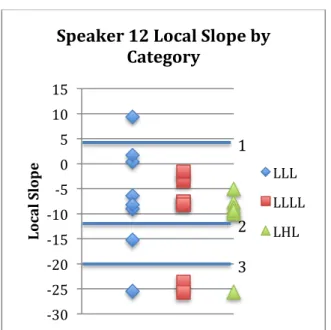
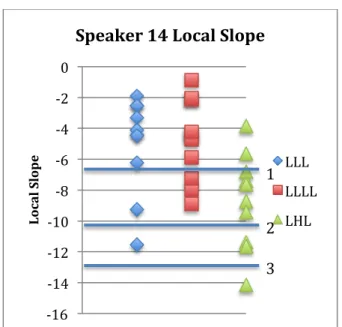
Figure 5.1 - Speaker 12 Data Continuum (all items)...53
Figure 5.2 - Speaker 12 Data (separated by category; boundaries included)...53
Figure 5.3 - Speaker 14 Local Slope by Category...54
Figure 5.4 - Speaker 9 Local Slope by Category...55
Figure 5.5 - Speaker 13 Local Slope by Category...57
Figure 5.6 - Speaker 12 Local Slope by Category...58
Figure 5.7 - Speaker 3 Local Slope by Category...60
Figure 5.8 - Speaker 7 Local Slope by Category...61
Figure 5.9 - Speaker 10 Local Slope by Category...62
Figure 5.10 - Speaker 8 Local Slope by Category...63
LIST OF ABBREVIATIONS AND SYMBOLS FTFA Full Transfer/Full Access
Ft Foot
L1 First language L2 Second language
NOM Nominative case particle OT Optimality Theory P-Wd Prosodic word
PA Pitch accent
SA Stress accent TBU Tone-bearing unit
UG Universal Grammar
WSP Weight-to-Stress Principle
µ Mora
σ Syllable
CHAPTER 1 INTRODUCTION
Second language acquisition requires a speaker to learn features and structures of a new language. However, it has long been known that second language learners are not building their understanding of the new language from the ground up, but instead building on the structures they already have available (Lado 1957). According to the Full Transfer/Full Access Hypothesis (FTFA) (Schwartz/Sprouse 1994/1996), those available structures include the entirety of their L1 (transfer) and the entirety of Universal Grammar (full access to UG).
Effects of transfer can occur at all levels of the grammar, including phonological. Many studies of phonological transfer have focused on segmental transfer from the language learner's first language (L1) to their second language (L2), rather than stress and intonation. However, second language acquisition of an unfamiliar prosodic system is an area where we may easily expect to find transfer effects under the theoretical assumptions of FTFA.
This thesis explores one such case between English and Japanese, as their respective treatments of word-level accent are fundamentally different. Both languages contain
to unaccented Japanese words, as the structure of their language requires every prosodic word to contain an accent.
This particular effect has been demonstrated in previous experiments (Ueyama 2000; Tsurutani 2011), but not in conjunction with the Weight-to-Stress Principle (Chomsky & Halle 1968; Prince 1990), a constraint that attracts accent to heavy syllables and is active in English. An English speaker may have learned not to insert accents into unaccented words in Japanese, but will the effect of Weight-to-Stress cause them to insert them erroneously into words containing a heavy syllable?
An Optimality Theory (OT) (Prince & Smolensky 1993; McCarthy & Prince 1995) model of Japanese and English predicts that this is an effect we expect to see. OT assumes that all speakers have access to the same universal set of constraints, and that speakers will apply their current constraint grammar to any input as per Richness of the Base, making it an ideal model for looking at language acquisition under the assumptions of FTFA. If phonological acquisition is modeled by gradually reranking constraints, then interlanguage grammars are represented by constraint rankings intermediate between the two languages.
A small constraint set that captures a subset of the differences between Japanese and English can be ranked such that accents would be inserted into words containing heavy syllables, but not into words consisting of only light syllables. Furthermore, this interlanguage grammar is plausibly intermediate between English and Japanese. Therefore, this model predicts that at least some English speakers learning Japanese should insert accents more often in words that contain heavy syllables than in ones that do not.
The research questions of this thesis are the following:
Research Question 2: Does word length (whether in morae or in syllables) affect how likely English speakers are to insert a pitch accent into an unaccented Japanese word?
I performed an elicitation experiment where native speakers of English who had studied some Japanese were asked to produce unaccented nonce words in sentences. Some of these nonce words contained only light syllables, which would not attract stress for English-speaking Japanese learners, and others contained heavy syllables, which would attract stress for these learners.
For research question 1, the model predicts that English speakers would be more likely to insert stress on words containing a heavy syllable (Heavy words). The results indicate that this may be a pattern for some English speakers. One participant (speaker 14) did appear to accent Heavy words more, and two more (speakers 9 and 13) showed a weaker effect in this direction as well.
The results suggest that English-speaking learners of Japanese may indeed show Weight-to-Stress effects. In addition, a few other speakers appear to support the model by behaving consistently with the model's predictions for the English grammar, as well as a near-nativelike Japanese grammar. While this does support the proposed model of Japanese acquisition by English speakers, the additional observed tendency to insert accents on 3-mora words warrants further investigation.
CHAPTER 2 BACKGROUND 2.1 Overview
This thesis will be focusing on a specific transfer effect of English in Japanese, so it is important to first outline assumptions about the nature of second language phonology, prosody, and experimental context. §2.2 looks at the general theoretical assumptions about the nature of phonology and second language acquisition: Universal Grammar, Optimality Theory, and Full Transfer/Full Access; §2.3 looks at theoretical assumptions about the nature of prosodic typology and the differences between the prosodic systems of English and Japanese; §2.4 looks at the nature of pitch accent in Japanese, specifically; finally, §2.5 provides a brief overview of two previous studies of the acquisition of Japanese prosody.
2.2 Theoretical Assumptions: General 2.2.1 Universal Grammar
Following the assumptions of Universal Grammar (UG) (Chomsky 1965, Pinker 1984), this thesis assumes that a) humans are born with an innate set of universal principles of
Language, and that b) each language shares certain constraints on the possible structures that can occur in the language. The specific structures themselves can vary widely within those
project is based on two theories in particular which make use of Universal Grammar: Optimality Theory (see §2.2.2) and the Full Transfer/Full Access model of L2 acquisition (see §2.2.3).
2.2.2 Optimality Theory
Optimality Theory (OT) (Prince & Smolensky 1993/2004; McCarthy & Prince 1995) is a theory that attempts to capture the implications of UG by proposing that the mental grammar contains a set of innate universal, violable constraints on linguistic behavior. When a speaker goes to produce a form from a certain input, a set of possible outputs is generated. These outputs are then evaluated by the constraints and marked for each constraint they violate. The constraints are ranked such that a violation of a lower-ranked constraint is preferable to a violation of a higher-ranked constraint. The optimal output is chosen as the speaker's production.
(1) Optimality Theory
/input/ Constraint A Constraint B Candidate A *!
☞Candidate B *
There are two broad categories of constraints: faithfulness and markedness constraints (Prince & Smolensky 1993/2004). Faithfulness constraints penalize candidates that differ from the
Under this model, the properties of possible human grammars are (ideally) captured by the set of constraints, but the properties of a specific language's phonology are determined by the ranking of constraints in that particular language.
2.2.3 SLA and Full Transfer/Full Access
Previous studies on second language acquisition have proposed two major views on how the L2 grammar develops. The first is that the L2 grammar is deficient: a speaker learning an L2 must acquire new features of the L2 that are not already present in their L1, rather than having access to those features through UG (eg. the Minimal Trees model (Vainikka & Young-Scholten 1994, 1996); Representational Deficit Hypothesis (Hawkins & Chan 1997)). The second, which the model proposed in this thesis is based on, states that the interlanguage grammar between L1 and L2 conforms to the properties of natural language. The interlanguage contains all of the features, constraints, and structures necessary to form a complete language, whether those come from UG or from the speaker's first language.
To put this in Optimality Theoretic terms, a speaker is using the same constraints in L1 as in L2 (as per the assumptions of OT and UG), and the L1 transfer effects are a result of the constraint ranking of L1. Under this theory, the effects that do not come clearly from either language are a result of the constraint reranking process itself, when certain markedness constraints that are normally ranked low in both languages come to be ranked high enough to effect a preference for an unmarked structure.
Some evidence in favor of FTFA is related to The Emergence of the Unmarked (TETU) (McCarthy & Prince 1994), where a low-ranked markedness constraint affects the output only in certain contexts, when constraints that would normally overrule that markedness constraint become inactive.
(2a) Faithfulness vs Markedness
Faithfulness
Constraint Markedness Constraint Unmarked Candidate *!
☞Faithful Candidate *
(2b) Faithfulness vs Markedness
Faithfulness
Constraint Markedness Constraint
☞Unmarked Candidate
Faithful Candidate *!
markedness constraint being ranked high enough for its effects to be detected. This is evidence for the Full Transfer/Full Access Hypothesis, as the participants in these studies showed access to UG by employing universal constraints not visibly active in their native language.
2.2.4 English/Japanese transfer and Weight-to-Stress
This thesis investigates whether a particular effect occurs in the Japanese productions of English-speaking learners; specifically, the effect of a heavy syllable on English speakers' production of Japanese accent (for a discussion of assumptions regarding the relationship of English stress and Japanese accent, see §2.3).
The Weight-to-Stress Principle (WSP) stipulates that heavy syllables must bear stress (Chomsky & Halle 1968; Prince 1990; formalized as a constraint in Prince & Smolensky 1993). In English, it shows effects by causing stress to gravitate towards heavy syllables.1 This is evidenced by the Latin Stress Rule for stress assignment, where primary stress falls on the penultimate syllable if it is heavy and on the antepenultimate syllable if the penultimate is light (compare "árrogant" and "relúctant") (Chomsky & Halle 1968). However, faithfulness to lexical stress can override this for many lexical items (Pater 2000).2
In Japanese, the effects of WSP appear in certain contexts, particularly loanword accent.3 Kubozono (2006) argues that in trimoraic accented Sino-Japanese words (LLL, LH, HL), accent falls on the final syllable more than expected when the final syllable is heavy. The distribution of accent types for trimoraic accented Sino-Japanese words is displayed below.
1 For a more thorough discussion, see chapter 3.
2 Pater (2000) argues that this is due to an indexed faithfulness constraint that outranks WSP.
3 For the purposes of this thesis, Japanese accent and English stress are the same kind of phonological entity. See
Accent Pattern
Syllable Structure Initial Accent Medial Accent Final Accent
LLL (n=390) 83% 14% 3%
HL (n=1,763) 99% --- 1%
LH (n=274) 84% --- 16%
Total (n=2,427) 95% 2% 3%
Table 2.1. Accent distribution among trimoraic accented Sino-Japanese words (from Kubozono 2006:14)
Kubozono argues that this unusually high number of final accents on heavy syllables implicates an effect from WSP. However, in Japanese, there are plenty of unaccented words containing heavy syllables, indicating that WSP is not fully active in the Japanese grammar, although it is present.
Speakers of both English and Japanese have access to WSP; however, the ranking of WSP in the different languages results in differing effects. Therefore, we may expect WSP to be visible and productive in the L2 Japanese of native L1 English speakers.
2.3 Theoretical Assumptions: Prosody
In order to clarify the predictions of this thesis for prosodic transfer, this section outlines assumptions about the nature of word-level prosody, specifically stress and accent. §2.3.1 will describe the prosodic hierarchy, then §2.3.2 will outline the typology of prosodic systems.
2.3.1 Prosodic hierarchy
The prosodic hierarchy organizes prosodic constituents into nested units, with the mora as the lowest constituent and the Intonational Phrase as the highest (eg. Selkirk 1978; Beckman & Pierrehumbert 1986).
(3) The Prosodic Hierarchy Intonational Phrase
|
Phonological Phrase4 |
(Major Phrase) |
(Minor Phrase) |
Prosodic Word (P-Wd) |
Foot (Ft) |
Syllable (σ) |
Mora (µ)
The relevant constituents in this thesis are the mora (µ), the syllable (σ), the foot (Ft), and the prosodic word (P-Wd). In each constituent, one of its sub-constituents directly below it in the hierarchy serves as the head. For this particular set of constituents, each foot has a head syllable, and each prosodic word has a head foot. The head syllable in a foot is marked at the
phonological surface level with a phonological entity, which will be referred to throughout this
4 The phonological phrase is sometimes divided into two smaller constituents, the Major Phrase (called the
paper by the term "phonological accent."5 The head syllable of the head foot in a prosodic word bears the main accent of that prosodic word, which translates into the highest level of phonetic prominence in that word.
These phonologically accented syllables manifest as phonetically prominent, but the nature of that prominence depends on the kind of prosodic system in which it is expressed. Broadly speaking, the main phonetic correlates of a syllable bearing accent in a stress system are greater intensity, higher duration, and perhaps some sort of pitch prominence (Fry 1955,
Lieberman 1960, Sluijter & van Heuven 1996). A syllable bearing phonological accent in the pitch-accent system of Tokyo Japanese will manifest primarily with pitch prominence (Beckman 1986).
2.3.2 Prosodic systems
This thesis deals with two prosodic systems that both have the metrical properties outlined above, but treat the "accent" differently. Following Hyman (2006/2009), the three common categories of prosodic system are broadly defined as follows: A "tonal" system is one in which "an indication of pitch enters into the lexical realization of at least some morphemes" (Hyman 2006:229); a "stress accent" system is one in which "every lexical word has at least one syllable marked for metrical prominence" (Hyman 2006:231); and a "pitch accent system" displays properties of both. Tone is defined over the morpheme, and stress is defined over the
5 The term "accent" is used to refer to both this phonological marking as well as the phonetic entity of pitch accent, often because there is no need to distinguish them. However, for the purposes of this thesis, stress and pitch accent are defined as both phonetic forms of prominence that indicate the presence of phonological accent. Thus, I have
word. Neither English nor Japanese is tonal, so the focus will now shift to defining "stress accent system" and "pitch accent system" with more precise strokes.6
2.3.2.1 Stress Accent
According to Hyman, the two most important properties of stress accent (SA) are obligatoriness and culminativity across the prosodic word, with the former being definitional of
SA. If a system has obligatory accent, every prosodic word must have at least one "syllable marked for highest degree of metrical prominence" (=head syllable of head foot=main
accent/stress). In other words, if phonological accent over a word is definitional of wordhood in a prosodic system, that system is stress accent. Culminativity, on the other hand, is not a
definitional property of stress accent systems, as it can be found in non-SA systems, but it is a requirement of SA: every prosodic word may have no more than one main accent. In other words, a prosodic word in a stress accent system must have one and only one main stress.7
2.3.2.2 Pitch Accent
The systems labeled as "pitch accent" (PA) cover many different types of prosodic systems, to the point that generalizing properties over all of them is not useful. Rather, they are best described as using properties of both stress and tone systems.
In the case of Tokyo Japanese, phonological accent has only one of the above properties: it is culminative over the prosodic word, but not obligatory (Kawahara, in press; Kubozono
6 Hyman does not provide actual definitions of these systems, but rather outlines the relevant properties that
characterize "stress systems" and "tonal systems," with "pitch accent systems" showing properties of both.
7 Hyman separates these two properties because obligatoriness is necessary and sufficient to classify a prosodic
2008). That is, there may only be one syllable of highest prominence in the prosodic word. Lexically, Japanese accent is specified over the morpheme (a property of tonal systems). Japanese accent can be specified for presence or absence, as well as for its location.8
2.3.3 A potential case of English SA and Japanese PA transfer
The two characteristic properties of SA, obligatoriness and culminativity, are generally stated together as a single characteristic of stress accent systems. In Optimality Theory, the characteristic restrictions on main accent of a stress system result in a single constraint:
(4) Head Prosodic Word Constraint
HEAD PROSODIC WORD (HEAD(P-WD): "each phonological word must have a unique
head and therefore exactly one accent" (McCarthy 2002:78).
However, because of the definitional nature of obligatoriness (as opposed to culminativity), Hyman chooses to separate these two properties.
In this study, the relevant property is obligatoriness, because this is the parameter on which English and Japanese differ, resulting in their classification as "stress accent" and "pitch accent," respectively. Thus, in order to capture the nature of the difference between the systems, this thesis will use the constraint OBLIGATORYHEAD(P-WD)to more accurately reflect the assumptions about the nature of the grammar, in keeping with Hyman (2006). However, in Japanese, this constraint must be outranked by a faithfulness constraint that preserves the underlying accent specification. An accent faithfulness constraint serves this purpose (from Alderete 2001).
8 For nouns. Location of accent is predictable in verbs and adjectives, although presence is not (and in some
(5) Constraints for Stress Accent versus Pitch Accent
OBLIGATORYHEAD (P-WD)(OBLHD (P-WD)): Every prosodic word must have a head
foot (=main stress/accent)
DEP(ACCENT): An accent in the output has a corresponding accent in the input ("no
insertion of accent") (McCarthy&Prince 1995; Alderete 2001).
In a pitch accent grammar like that of Tokyo Japanese, the speaker is faithful to
underlying accent specifications (DEP(ACCENT)>>OBLHD(P-WD)). Accent for Japanese words is optional, where the presence or absence of accent is in lexical contrast. Therefore, when a speaker goes to produce an unaccented word, their faithfulness to underlying accent
specifications (or lack thereof) results in an unaccented word.
(6) Japanese Grammar (accent is non-obligatory) /σσ/ DEP(ACC) OBLHD(P-WD)
☞ σ σ *
[σ'σ] *!
As seen above, the output form is faithful to the underlying specification for accent's presence or absence.
(7) English Grammar (accent/stress is obligatory) /σσ/ OBLHD(P-WD) DEP(ACC) σ σ *!
☞ [σ'σ] *
Therefore, if an English speaker is applying their English grammar to an unaccented Japanese word, the model predicts that they will insert accents as a transfer effect. This pattern has been observed in previous experiments (Ueyama 2000; Tsurutani 2011, see §2.5).
2.4 The Nature of Pitch Accent
Phonologically accented syllables serve as loci for pitch accents to attach, although the level at which they attach differs depending on the prosodic system. In Japanese PA, pitch accents attach at the word level; in English SA, they attach at the intonational level (Beckman 1986).
The pitch accents themselves are formed from combinations of tones, high (H) and low (L), that form a pitch or pitch contour expressed over a phonologically accented syllable (Bolinger 1951; Pierrehumbert 1980). Japanese has only one pitch accent, a falling contour H*+L, but English has six (Beckman & Pierrehumbert 1986). The use of pitch accent in Japanese is predictable, but in English the choice of pitch accent is determined by the intonational contour of the sentence (Beckman 1986:10). This study will focus on the H*+L pitch accent, specifically. H*+L is the only pitch accent in Japanese, and it is used in declarative sentences in English, usually in "sarcastic" intonation (Pierrehumbert 1980, Beckman and Pierrehumbert 1986).
first mora, and the following mora bears a low tone (Beckman 1986). In traditional pitch accent notation, this is represented as H*+L, where the * indicates the tone that attaches to the accented tone-bearing unit (TBU), which is the mora in Japanese (eg. Pierrehumbert 1980, Beckman & Pierrehumbert 1986). If a syllable bears an accent, realized as a H*+L pitch accent, the high tone (H) would attach to the accented first mora, with the low tone (L) coming immediately
afterwards, resulting in a sharp pitch fall (Venditti 2005, Kawahara, in press).9
However, the pitch accent is not the only set of tones assigned to the minor phrase.10 Every minor phrase begins with an initial rise, a L tone on the first mora with a H tone on the following (Kawahara, in press). The exception to this is initial accent, or if the first syllable is heavy. The pitch remains high until a pitch accent, where the pitch on the accented syllable remains high (H*) and then falls to an L on the next mora, then remains low for the rest of the phrase. In the case of unaccented words, the pitch remains high over the rest of the phrase.
In the J_ToBI intonation labelling scheme outlined in Venditti (2005), the initial rise is due to a L% boundary tone followed by a H- phrasal tone, which persists until a pitch accent occurs. Each minor phrase ends with a L% boundary tone. In the following examples, each mora is labeled with a tone; however, the tones in parentheses are a result of the phrasal pitch
grammar, and are not assigned to morae as a part of the pitch accent.
In the example below, the H* tone falls on the "i" of i'nochi11 'life,' falling to an L tone immediately after and remaining low.
9 Note that phonological accent is assigned to syllables, but tones are assigned to morae. In addition, the exact
location of these tones can vary from utterance to utterance. For example, the pitch peak can actually come slightly after the accented mora (Hasegawa & Hata 1988)
10 The tones detailed here are assigned over the minor phrase (Venditti 2005). The minor phrases discussed in this
thesis consist of only one prosodic word, however, so the two are not functionally distinct here.
11 Note that in the literature for Japanese, the mark ' is generally used to mark the location of the pitch fall, meaning
(8) Japanese Initial Accent
H*+L (L) 'life'
In cases of non-initial accent12, the first two morae bear a Low tone and a High tone, respectively. Each subsequent mora remains high until the pitch fall (Kawahara, in press).
(9) Japanese Medial Accent
(L)H*+ L 'you'
For ana'ta 'you,' the maximum is realized on the second syllable, before a steep drop to the end of the word.
In the case of an unaccented word, there is no pitch fall, which results in the pitch contour rising from the first syllable to the next, and remaining high over the entire prosodic word.
syllables with a ' mark before the stressed syllable. I will be using the Japanese convention for Japanese words, and
mark English stress with an accent mark (eg "á") to keep them distinct.
12Assuming the first syllable is not heavy. In cases where the first syllable is heavy, both morae bear a high tone
(10) Japanese Accentless Word
(L)(H)(H) 'rabbit'
Final accent is a bit more complicated. When a word is lexically specified for accent on the final mora, it needs additional phonological material after it in the prosodic word in order to realize the pitch fall. This material is usually provided by particles. In Japanese, a particle is a small suffix that marks various grammatical functions on a word or phrase.13 This is
demonstrated in the figure below.
(11) Difference between Final Accented and Unaccented Words
(L)(H)(H)(H) (L)(H)H*+L 'rabbit+NOM' 'tomorrow+NOM'
Note that if the nominative particle ga is absent, the tones attached to the individual words ashita 'tomorrow' and usagi 'rabbit' are identical (Kawahara, in press). This makes it difficult to
distinguish between final-accented and unaccented words in isolation.
13 These can be accented or unaccented; the ones in this thesis are all unaccented. Accented particles on an accented
2.5 Previous studies in L2 acquisition of Japanese prosody
In sum, each prosodic word in English must have one and only one main phonological accent, which can bear a pitch accent. In Japanese, a prosodic word may have no more than one phonological accent, which bears a H*+L pitch accent. The differences between English SA and Japanese PA create many opportunities for research in second language acquisition. Ueyama (2000) conducted a series of experiments on the acquisition of Japanese prosody by English L1 speakers, and of English prosody by Japanese L1 speakers to observe how well speakers
acquired certain L2 structures. One of these experiments focused on whether English speakers of varying proficiencies could produce a native-like sequence of unaccented morae. In one
experiment, three English speakers (two advanced, one beginner) were recorded producing 4- and 5-mora unaccented sentences (which also consisted of one prosodic word).14 The obligatory nature of English stress accent predicts that if an English speaker is presented with an unaccented input, they will add an accent, which will manifest phonetically as stress bearing some sort of pitch accent. As predicted by the different properties of the English stress and Japanese pitch accent systems, the beginning speaker consistently inserted H*+L pitch accents into these unaccented words. The advanced speakers were more inconsistent with their use of pitch over the entire sentence. Only one of the two inserted any pitch accents at all; the other did not insert any accents but failed to produce the correct contour for unaccented words. In short, it seems from this small-scale experiment that some English speakers do insert pitch accents into unaccented Japanese words, and beginning speakers are more likely to do so. However, the effect of prosodic structure was not investigated.
14 Technically, they consisted of one Minor Phrase that contained one P-Wd. This distinction is not important to this
Tsurutani (2011) looked for evidence of prosodic transfer by L1 English speakers learning L2 Japanese at multiple levels of the prosodic hierarchy (prosodic word, minor phrase, major phrase). 19 native Australian English speakers read five sentences that varied along
multiple parameters: words varied by accent type; Minor Phrases varied by number of words and number of accented words; and Major Phrases varied by number of Minor Phrases. One
observed error pattern at the P-Wd level was the insertion of accents into unaccented words: "Errors for [unaccented] words all contained [accent]. This pattern was particularly evident when the word had a long vowel at the beginning, such as yoosu (HHL), kiite (HHL), kookoo (HHLL) and shuumatsu (HHLL). Apparently a heavy syllable which is a location for English stress accent attracted a high pitch."15 (Tsurutani 2011:10) This seems to be evidence in favor of the effect of prosodic structure (specifically the presence of a heavy syllable) on English speakers' tendencies to insert pitch accents. However, all of these words were produced in sentences, so the effects of phrasing and sentence-level intonation were not controlled; in addition, English stressed syllables tend to be longer in duration, so English speakers may perceive long vowels as stressed and treat them as such by adding pitch accents. Under this interpretation, the insertion of accents would not be a WSP effect, because the phonological weight of the syllable is not the reason speakers are inserting accents, but rather perceived underlying stress.
2.6 Summary
English and Japanese both employ metrical phonological accent, but apply it at different levels. In English SA, main stress is an obligatory property of the prosodic word, applying to the head syllable of the head foot of the prosodic word. Pitch accents, including H*+L, can attach to
15 To clarify, all of these words are lexically unaccented. The pitch patterns represented in parentheses are the
CHAPTER 3
RESEARCH QUESTIONS 3.1 Overview
While the insertion of pitch accents into unaccented words has been observed in previous experiments, there have been no experiments thus far that actively manipulate the prosodic structure to see the effects on pitch accent insertion.
An Optimality Theory-based model of transfer predicts that when a speaker learns a new language, their constraints are being reranked to conform to the new grammar, meaning that a speaker's interlanguage grammar comes from the intermediate rankings of constraints. The Weight-to-Stress Principle (WSP) (Prince 1990) stipulates that heavy syllables must bear stress, and in English it is ranked high enough that its effects may be observed through patterns like the Latin Stress Rule and secondary stress insertion on heavy syllables. Therefore, such a model may predict that it may remain highly ranked in English L1 Japanese L2 interlanguage grammars, due to the influence of the English constraint ranking (see §2.3 for details), resulting in WSP effects in the interlanguage grammar.
3.2 Proposed model
words that contain a heavy syllable due to a potential constraint ranking that may occur as the constraints rerank from the English grammar to the Japanese grammar.
(12) Constraints
WEIGHT-TO-STRESS PRINCIPLE (WSP): One violation for every heavy syllable that does
not bear stress/phonological accent. (Chomsky & Halle 1968; Prince & Smolensky 1993)
DEP(ACCENT) (DEP(ACC)): One violation for every stress/phonological accent that occurs
in the output that does not occur in the input (Alderete 2001).
OBLIGATORY HEAD (OBLHD(P-WD)): One violation for every prosodic word that does
not have a head foot (=main stress/phonological accent) (McCarthy 2002, Hyman 2006)
DEP(ACC) is clearly visible in Japanese, preventing accents being added into words that are underlyingly unaccented (see §3.2.2). OBLHD(P-WD) is clearly visible in English, requiring all words to contain a main stressed syllable. WSP, on the other hand, is an interesting case, because it is somewhat visible in English and Japanese, but not in all cases.
The typology of this constraint set predicts several potential grammars, but this thesis focuses on three of them: the English grammar, the Japanese grammar, and one interlanguage grammar.16
3.2.1 English grammar
In order to fulfill the obligatoriness requirement of English stress, OBLHD(P-WD) must be ranked above DEP(ACC). Even if a word were underlyingly unaccented, the requirements of OBLHD(P-WD) would override the faithfulness requirements of DEP(ACC). In addition, heavy syllables in English attract stress, whether primary or secondary, resulting in stress insertion
16 There is another plausible interlanguage grammar, but under the methodology employed in this thesis, the
(Pater 2000). In the case of stress insertion, this violates the faithfulness requirements of DEP(ACC), so the ranking for this is WSP>>DEP(ACC).
(13) WSP>>DEP(ACC)(adapted from Pater (2000:247)) /timbuctóo/17 WSP DEP(ACC)
(tìmbuc)(tóo) *! *
☞ (tìm)(bùc)(tóo) **
The result is a constraint ranking consistent with the facts of English: Main stress is obligatory, and heavy syllables attract stress.
(14) Constraint ranking of English
OBLHD(P-WD),WSP>>DEP(ACC)
The facts of English as summarized above can be evidenced through an OT treatment of the Latin Stress Rule, which states that main stress falls on the penultimate syllable when it is heavy, and on the antepenultimate syllable when the penultimate is light (Chomsky & Halle 1968). The avoidance of final stress comes from the constraint NON-FINALITY (NON-FIN), which stipulates that the head foot of the prosodic word must not be final (Prince & Smolensky 1993). This constraint is ranked high in both languages (Pater 2000, Kubozono 2006/2008), so it is less interesting in terms of observing the effects of transfer between the two. However, it is necessary for capturing relevant generalizations about the location of accent.
17
Below are two tableaux demonstrating the difference between how the grammar handles an input containing a heavy syllable versus one containing a light syllable:
(15) Constraint ranking of English; Heavy input
/reluctant/ NONFIN OBLHD(P-WD) WSP DEP(ACC)
☞ re(lúc)tant *
re(lúc)(tánt) *!
(réluc)tant *! **
reluctant *! *
The candidate with the stress on the penultimate, heavy syllable wins because both of the high-ranked constraints OBLHD(P-WD) and WSP are not violated, while the other two violate at least one of those two constraints.
On the other hand, in tableau (6), WSP is vacuously satisfied, but the OBLHD(P-WD) constraint still eliminates the faithful candidate.
(16) Constraint ranking of English; Light input
/arrogant/ NONFIN OBLHD(P-WD) WSP DEP(ACC)
☞ (á.rro).gant * *
a.rro.gant *! *
Thus, in English, main stress is obligatory, and, where relevant, stress is attracted to heavy syllables. In addition, stress is inserted on heavy syllables, even when there is no stress underlyingly.
3.2.2 Japanese grammar
whether those words contain heavy syllables or not. In other words, DEP-ACC>>OBLHD(P-WD), and DEP-ACC>>WSP.
(17) Constraint ranking of Japanese DEP-ACC>>OBLHD(P-WD), WSP
(18) Constraint ranking of Japanese; Heavy input
/koori/ 'ice' NONFIN DEP(ACC) WSP OBLHD(P-WD)
☞ koo.ri * *
(ko'o).ri *!
In the above tableau, DEP-ACC prevents any accents being added, so the faithful candidate wins.
(19) Constraint ranking of Japanese; Light input
/usagi/ 'rabbit' NONFIN DEP(ACC) WSP OBLHD(P-WD)
☞ u.sa.gi *
(u'.sa).gi *!
In this case, WSP is vacuously satisfied, and DEP(ACC)has already eliminated all of the accented candidates.
3.2.3 Interlanguage grammar
(20) Proposed interlanguage grammar WSP>>DEP(ACC)>>OBLHD(P-WD)
(21) Proposed interlanguage grammar; Heavy input (L=light syllable, H= heavy syllable
/LHL/ WSP DEP(ACC) OBLHD(P-WD)
☞L.[H'.]L *
[L'.H.]L *! *
L.H.L *! *
Here, the winner is the candidate with the accent on the heavy syllable. The others are eliminated by the high-ranked WSP.
(22) Proposed interlanguage grammar; Light input (L=light syllable, H=heavy syllable
/LLL/ WSP DEP(ACC) OBLHD(P-WD) [L'.L.]L *!
☞L.L.L *
However, in this case, WSP is vacuously satisfied. This allows DEP(ACC) to eliminate the accented candidate. The result is a grammar where accents are inserted into Heavy words, but not Light words.
3.2.4 WSP and accent insertion
WSP specifically predicts that stress will fall on a heavy syllable; however, this study examines the presence or absence of accent within a prosodic word specifically, rather than its location. Each of the above constraints affects the behavior of accent insertion, which is the point of interest in this thesis. Methodologically, the presence or absence of accent in a prosodic word is easier to measure than presence, absence, and location; in addition, studying accent location is addressing an additional question entirely. As such, I elected to focus only on presence or
absence of accent in this early investigation of the topic. Thus, there is an assumption that accents inserted into words containing heavy syllables are falling on the heavy syllables themselves.
3.2.5 The issue of final accent
None of these three grammars predicts insertion of accent on final syllables, heavy or light. This is important because of the observation in §2.4 that Japanese unaccented and final-accented words can sound the same in isolation. However, if both languages show a strong bias against final accent, then we could reasonably expect that an English speaker would not insert a pitch accent into an unaccented word on the final syllable.
3.3 Justification for RQ2 hypothesis
definitions of "length." LLL and LHL words are the same length in terms of syllables, while LHL and LLLL items are the same in terms of morae. If the presence of the heavy syllable specifically is the factor causing the difference, we should not expect LHL items to behave the same as either one of these conditions.
This model predicts that the length of the word will not have an effect on the likelihood of insertion of accent. In the constraint set outlined above, the only constraint that is sensitive to prosodic structure is WSP. The only way for word length to affect the insertion of accent is if a markedness constraint sensitive to word length is ranked high, or if a constraint interaction causes lack of accent to be preferred under certain conditions related to length. There is no such effect under English grammar due to the nature of OBLHD (P-WD): accent will always be inserted into the prosodic word, regardless of length, and so we do not expect to see a transfer effect of this nature. However, it is possible that there may be some unpredicted emergent effect that occurs in the interlanguage due to effects of constraints not included in this model.
3.4 Summary of research questions and hypotheses
In this thesis, an OT-based model is proposed that predicts that English L1 Japanese L2 speakers should not only insert pitch accents into unaccented words, but the insertion should be sensitive to prosodic structure. This model is investigated with two research questions:
RQ1: Are some English speakers more likely to insert an accent into unaccented Japanese words if a heavy syllable is present?
purposes of this thesis) because the Weight-to-Stress Principle overrides faithfulness to the underlying Japanese accent specification in L1 (see §3.2 for details).
RQ2: Does word length (whether in morae or in syllables) affect how likely English speakers are to insert a pitch accented into an unaccented Japanese word?
CHAPTER 4 METHODOLOGY
4.1 Overview of Experiment
In order to test the above hypotheses, I performed an elicitation experiment in which native speakers of English who had studied Japanese produced nonce words of varying prosodic structure in sentences. The participants heard a Japanese sentence containing a nonce word, produced by a native speaker of Japanese, along with a visual stimulus, repeated it twice, and then used it in a new sentence.
The reason for producing the words in sentences rather than in isolation was to help the speakers produce the words under more natural conditions. In addition, creating the sentences was preferable to a pure imitation task, because participants who simply imitate the native speaker's pitch patterns are not necessarily producing speech that is indicative of their grammar for Japanese. The sentences were kept very simple in order to keep the difficulty low, however.
4.2 Materials:
4.2.1 Prosodic categories:
complications due to accent location. Further, the English stress grammar predicts that speakers should only place a single, primary stress on these words with no secondary stress. This will be easier to measure.
The two types of light categories, LLL and LLLL, were chosen for the purposes of comparison with LHL words, as LLL words are the same length in syllables and LLLL words are the same length in morae.
I also included 18 distractor items that contained pitch accents. These were included specifically to avoid making the experiment too monotonous and repetitive for the participants, lest they disengage and produce the exact same pitch contour for every sentence.
4.2.2 Segmental restrictions
Each word consisted of only sonorants or voiced stops to make it easier to track the pitch. In addition, the only vowels used were [i] and [a]. Only two vowels were used to make the potential effect of intrinsic vowel pitch (Whalen & Levitt 1995) easier to account for if it
appeared, as there would be only two possible vowels. Non-mid vowels were employed to avoid the potential effect of diphthongization on the mid vowels [e] and [o].
All heavy syllables ended in the moraic nasal /N/, rather than long vowels or consonants. Not all English speakers would be able to consistently produce long vowels or long consonants, which would introduce the difficulty of determining whether the speaker had produced a heavy syllable at all. On the other hand, English speakers should consistently treat syllables ending in a moraic /N/ as heavy.
vowel [ɯ] (written below as 'u') was allowed. The heavy syllable was also allowed to occur in initial or final position.
(23) Materials
a) Unaccented test items Prosodic structure
LLL LLLL LHL
ni.mi.gi ma.ri.ba.ri ni.man.bi
na.na.ma mi.ra.na.gi ni.min.gi
mi.ri.mi ma.ra.bi.na ni.min.bi
ma.ni.ba mi.ra.gi.ba ma.nin.ba
na.mi.ri ma.ni.ga.na ma.rin.bi
mi.ri.na na.ni.ba.ra mi.rin.bi
ni.ma.ri ni.ra.mi.na mi.ran.ba
ma.na.gi na.na.ba.ra na.man.ba
ma.na.ba na.ra.mi.ba na.man.gi
mi.na.ra ma.ra.ba.na na.ran.ba
b) Accented distractors
shu'.ba.ri su'.ri.na.ri ma'n.bu.ri ta.mi'n.ma sa'.mu.rin shi'.nu.mi bu'ri.ba.ri ta'n.mu.ri sa.ri'n.ma
ga'.ra.ni shi'n.ma.ri
shi'.na.gi na'n.ma.ri
chi'.ru.ma mi'n.bu.ri
mi'.ra.gi ni'n.gu.ri
mu'.ra.gi
4.3 Procedure 4.3.1 Participants
students from Chapel Hill specifically because of my familiarity with the curriculum used in UNC classes, which does not teach pitch accent. The textbook does not include lexical specifications for accent for vocabulary items, either. Each was recorded individually in a soundproof booth for the best quality recording possible.
4.3.2 Experimental Procedure
Materials were presented via slideshow software. First, the participants were told that they would be presented with unknown creatures or artifacts from another world, and a Japanese person would be introducing the names to them. Next, they saw a slide that contained a nonce word item written in hiragana, a picture of a non-real creature or artifact, and the sentence Kore wa [target word] desu 'This is a [target word].' in hiragana, where the target word was inserted
into the blank.
In addition, the slide was accompanied by an audio recording of a native speaker saying the above sentence (Kore wa nanama desu 'This is a nanama.'). The recording played
automatically through a pair of headphones. After the participants heard the audio, they repeated the sentence. I, as the investigator would then play the audio again by hitting the enter button, and the participant would repeat again. If a participant stumbled or struggled, I asked them to say the full sentence again, but would not play the audio a third time.
Finally, participants were presented with a slide that contained the sentence "Now, say that it is [adjective in English] ([adjective Japanese hiragana]) in Japanese. Be sure to say what it's called!" The slide contained the target word at the top of the page, and the picture from the previous slide. The participant the said a sentence of the format [target word] wa [adjective] desu. "The [target word] is [adjective]." All adjectives that appeared with test items were
3-mora, accented "-i" adjectives.18
Figure 4.2. Target word: nanama; adjective: atsui 'hot'
In the above example, the nonsense noun provided was nanama and the adjective provided was atsui 'hot,' so the target sentence was Nanama wa atsui desu 'The nanama is hot.'
The audio was recorded using Praat v5.3.65 for Mac (Boersma & Weenink 2014) and digitized at a sampling rate of 44.1 kHz. Participants listened to the audio materials using a pair of Logitech H390 headphones and were recorded using the included microphone. The stimuli were presented on a laptop, and I pressed the return key to proceed to the next stimulus. All instructions were presented via Powerpoint.
After the recording, demographic information was collected from each participant, specifically gender, age, length of time studying Japanese, time abroad (if any), other languages studied, and linguistics background (if any).
4.4 Measurement
Phonologically, the H*+L pitch accent consists of a high tone on one mora followed by a low tone on the next mora, resulting in a sharp pitch drop from one mora to the next. Therefore, my primary metric for measuring accent was the pitch slope from the maximum pitch in the prosodic word to the following mora, which will be called "local slope." In order to find the local slope for a given item, the maximum pitch in the word and the average mora duration for each speaker are necessary.
4.4.1 Finding the average mora duration
Using Praat's text grid feature, I marked off the boundaries of each minimal prosodic word (Ito & Mester 2009), or the prosodic word without the topic-marking particle wa. I did not include wa because many of my speakers used creaky voicing at the end of the phrase, and the duration and proportion of the creaky voicing was so variable that the only way to reliably eliminate its effect was to leave off the particle entirely. While unaccented words and final-accented words may both end on a high tone, we do not expect English speakers to insert a pitch accent onto the final syllable (see §2.2.4; §3.2.5 for a more detailed discussion).
speaker. I chose to only use the Light words because of the potential for the /N/segment to be too short, given the fact that English morae are not all the same duration, and Japanese is mora-timed.
In addition, using the Light words to find the average mora duration accounts for potential differences between speakers' TBUs. The TBU in Japanese is the mora (Kubozono 1993; Pierrehumbert & Beckman 1988), whereas in English it is the stressed syllable. In English, the starred (*) tone of the pitch accent is assigned to a syllable, with any trailing tones (in the case of bitonal pitch accents) forming a contour around that syllable (Pierrehumbert 1980; Beckman & Pierrehumbert 1986). While these trailing tones are not assigned to a specific syllable, they should be realized on adjacent syllables. Light words have the same number of morae and syllables, so whether the speakers are assigning tones to morae or syllables, this method for collecting the average duration of the unit in question is reliable.
4.4.2 Finding the maximum pitch
I then used a Praat script19 to find the maximum pitch in the word, using Praat's default settings for pitch, with the pitch range set to 75Hz-500Hz. After visually checking and correcting the max pitch (see §4.4.5 below for details), I ran another script to find the time at one average mora duration after the pitch maximum and take the pitch measurement there, as well as the time at both points. Finally, I also found the pitch minimum for each token in order to calculate the average pitch minimum for each speaker.
Because human pitch perception occurs along a logarithmic scale, raw Hertz values do not accurately represent how pitch is interpreted and produced in speech. The difference between
two tones at 50 Hz and 100 Hz respectively will sound much bigger than two tones at 200 Hz and 250 Hz. The distance in raw Hertz from a high tone to a low tone will be bigger for a speaker with a higher voice than a speaker with a lower voice, which would result in a greater pitch slope for a speaker with a higher voice. Thus, in order to normalize across speakers, I converted the pitch measurements into semitones, following Plag et al. (2011).
(24) Formula for conversion from raw Hertz into semitones
𝑠𝑒𝑚𝑖𝑡𝑜𝑛𝑒𝑠 =12∗log!(𝑥𝐻𝑧/𝑦𝐻𝑧)
where
a) x= the measurements taken in Hz, and
b) y= the average minimum value for each speaker in Hz.
4.4.3 Finding the local slope
After I took the above measurements, I used the following formula to calculate the local slope:
(25) Formula for calculating local slope
𝑙𝑜𝑐𝑎𝑙 𝑠𝑙𝑜𝑝𝑒= max𝑓0−𝑚𝑜𝑟𝑎 𝑓0
𝑎𝑣𝑒𝑟𝑎𝑔𝑒 𝑚𝑜𝑟𝑎 𝑑𝑢𝑟𝑎𝑡𝑖𝑜𝑛
where
a) Max f0=the max f0 converted into semitones,
b) Mora f0=the f0 at one average mora after the max, also in semitones, and
4.4.4 Support for local slope metric
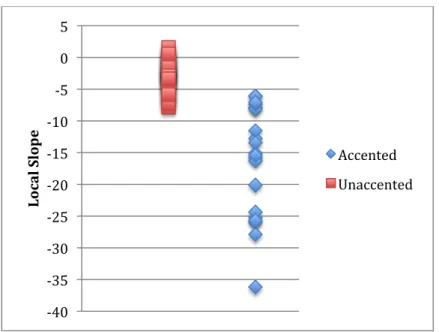
In order to confirm that the local slope metric as detailed above does distinguish between accented and unaccented items, I performed the above procedure on the native speaker's
productions. The local slope values for the native speaker's accented and unaccented productions are displayed below.
Figure 4.3. Native speaker data
In the above chart, unaccented items have local slopes that are consistently closer to zero. This is consistent with the pitch contours of unaccented words. On the other hand, accented items have a more negative local slope, which is again consistent with our expectations. There is some overlap, but the two categories are clearly distinct.
-‐40 -‐35 -‐30 -‐25 -‐20 -‐15 -‐10 -‐5 0 5
Lo
cal Slo
pe
4.4.5 Measurement issues
The pitch measurements (max f0 and mora f0) were obtained with a Praat script,20 then checked by hand for errors due to perturbations caused by consonants or creaky voice.
When there was creaky voice in a word, I did not take an overall minimum pitch
measurement, but I did take a max pitch measurement. (The minimum pitch was not included in the analysis, but rather to calculate each speaker's average minimum, which was then used to convert the data into semitones.) While rare, any tokens that had creaky voice in the middle of the word were discarded entirely (4/270 tokens, or about 1.5% of the data). Local slope was not taken for tokens that contained creaky voice at the timepoint at one mora duration after the pitch max (14/270 tokens, or about 5.2% of the data). If the script was unable to obtain a pitch value at one mora after the max for an item, that item was excluded from the analysis (6/270 tokens, or about 2.2% of the data). The total number of items excluded was 24/270 or about 8.9% of the data.
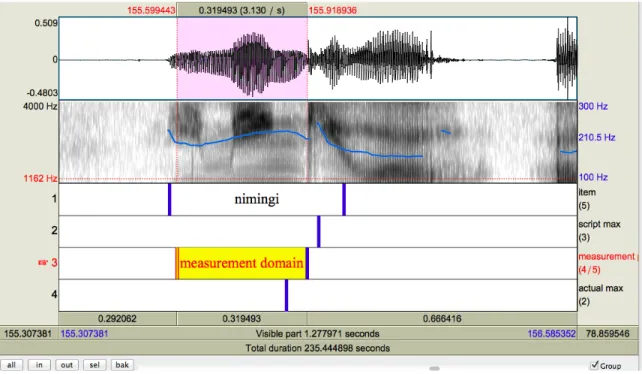
In the case of consonant perturbations, I adjusted the point of measurement by hand to the maximum location in the rest of the word using Praat's pitch tracker tool. I marked the domain of measurement as the area where the pitch slope became less extreme, and the change in pitch slope was visually near-constant. In figure 4.4 below, the first tier shows the item name and the original domain of measurement; the second tier marks the consonant perturbation where the script originally placed the max; the third tier indicates where the domain of measurement was for measurement by hand; and the fourth tier indicates the location of the max that was taken.
20 Again, based on Mietta Lennes' script "collect_pitch_data_from_files.praat," available at
http://www.helsinki.fi/~lennes/praat-scripts/public/collect_pitch_data_from_files.praat; and on Mietta Lennes' "calculate_segment_durations.praat," available at
Figure 4.4. Spectrogram showing consonant perturbation
In cases where the distance between the location of the pitch maximum and the end of the minimal prosodic word was smaller than one mora length, I still included the pitch measurement produced by the script, as long as it did not fall outside of the full prosodic word or during a creaky-voiced segment. In cases where the pitch max fell on a consonant perturbation, I manually found the pitch value at the timepoint one mora after the new measurement for max pitch.
4.5 Summary
CHAPTER 5
ANALYSIS AND RESULTS 5.1 Overview
Overall, the participants varied widely in terms of their word-level prosody. Most speakers showed a gradient range of pitch slopes for each category, resulting in a continuum rather than clear clusters of "accented" and "unaccented." In order to determine if any speakers were inserting pitch accents, I performed two kinds of analysis. The first was a statistical analysis that treated local slope as a gradient measure of accentedness (§5.2). The second was a categorical analysis that looked to get a general idea of whether speakers appeared more likely to insert accents or not by defining boundaries at a certain pitch slope value and counting the number of items with slopes closer to or further from zero than that boundary (§5.3).
In the end, there was one speaker (speaker 14) who appeared to support the hypothesis for RQ1 by showing a tendency to accent Heavy words more than Light words in both analyses. Two additional speakers appeared to show this effect as well, only much weaker in the
5.2 How accented was each speaker for each category?
Accent itself is categorical: a word is either accented or it isn't. However, the
measurements for each speaker appeared to lie along a continuum rather than grouping into clear categories. This may be due to a number of factors, such as speech rate, variation in the size of the pitch drop from utterance to utterance, or variation in the timing of the tones. Regardless, if a speaker prefers inserting accents on members of one of the three prosodic structure categories rather than the other two, the mean local slope should be more negative overall. Thus, a gradient statistical test is appropriate to understanding the effect of a Heavy syllable on the insertion of accent.
5.2.1 Methodology
The following results are based on a fixed-effects linear regression model (with fixed effects for LLL, LLLL, and LHL) for local slope by speaker, with standard error adjusted for multiple observations within speaker. A Wald chi-square test was performed to examine the relation between the prosodic structure of the stimuli and the estimated mean local slope for that category over all speakers. The results were not significant, χ2 (2, N=244) = 0.64, p = 0.73. Then, contrasts between each pair of prosodic structures (LLL vs LHL; LLL vs LLLL; LLL vs LHL) were examined within each speaker, using a series of Wald chi-square tests (the specific values for each test are reported in their respective tables). The null hypothesis was that there is no difference between the means of each category. The ">" symbol indicates the direction of the contrast; the item on the left has a more extreme (=negative) local slope than the item on the right.21
21 Note that this use of the symbol indicates a relationship based on level of accentedness, rather than the strict
Broadly speaking, each stimulus category is set to a particular value for three parameters: presence/absence of a heavy syllable, length in syllable, and length in morae. These three
parameters serve as three potential axes along which the stimulus categories can be divided, and each axis separates one of the stimulus categories from the other two.
(26) Stimulus categories by Prosodic Structure
Light 3σ 4σ
3µ LLL ---
4µ LHL LLLL
As seen here, LLL is the only item in the 3µ row, LLLL is the only category in the 4σ column, and LHL is the only item not in the Light diagonal. Each one of these contrasts captures the uniqueness of each category in terms of a particular kind of prosodic structure. If one of these parameters is affecting the number of accents inserted, we would expect the stimulus category that is unique with respect to that parameter to contrast significantly with both of the other stimulus categories. As a result, we expect significant contrasts between each type of stimulus category to come in pairs.
Parameter Contrasts predicted 3µ vs 4µ (Mora) LLL vs LLLL, LHL 4σ vs 3σ (Syllable) LLLL vs LLL, LHL Heavy vs Light (Weight) LHL vs LLL, LLLL
Table 5.1. Potential contrasts between stimulus categories, sorted by parameter
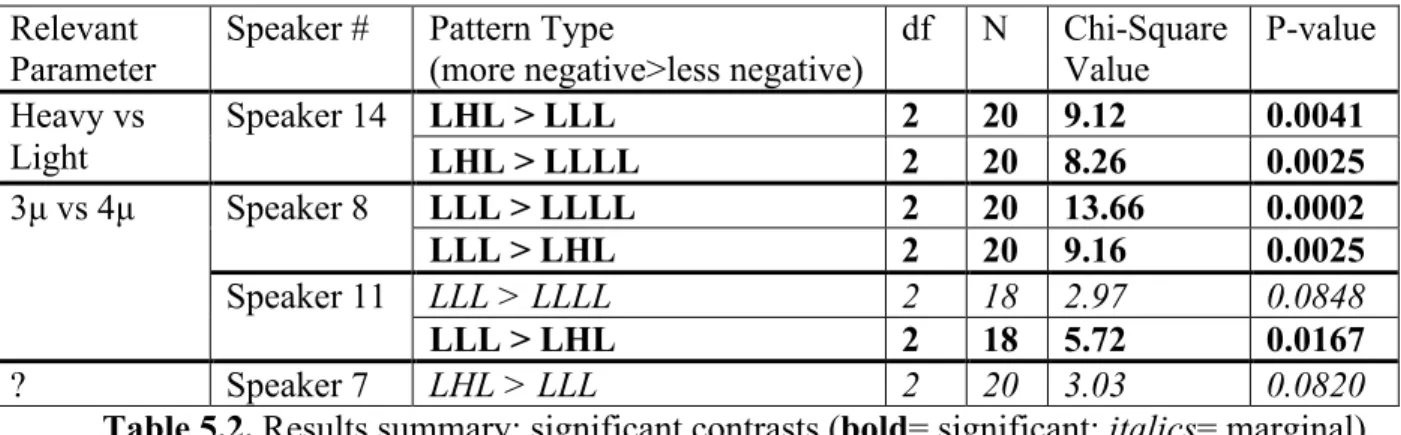
The predictions of the model state that the Heavy vs Light parameter should be the only one for which we find significant contrasts. If a speaker is inserting accents on Heavy words only, they should demonstrate the two significant contrasts based on the Heavy/Light parameter: LHL > LLL and LHL > LLLL. If a speaker is behaving consistently with the predictions of RQ2 (no effect of length on the number of accents inserted), they should show no significant contrasts between items distinguished only by the mora and syllable parameters: LLL > LLLL or LLLL > LLL.
5.2.2 Summary of significant contrasts
Most of the speakers did not show a significant contrast between the different structures. Below is a chart representing the significant and marginal contrasts found.
Relevant
Parameter Speaker # Pattern Type (more negative>less negative) df N Chi-Square Value P-value Heavy vs
Light
Speaker 14 LHL > LLL 2 20 9.12 0.0041
LHL > LLLL 2 20 8.26 0.0025
3µ vs 4µ
Speaker 8 LLL > LLLL LLL > LHL 2 2 20 20 13.66 9.16 0.0002 0.0025
Speaker 11 LLL > LLLL 2 18 2.97 0.0848
LLL > LHL 2 18 5.72 0.0167
? Speaker 7 LHL > LLL 2 20 3.03 0.0820
Table 5.2. Results summary: significant contrasts (bold= significant; italics= marginal)