© The Author 2015. Published by Oxford University Press on behalf of The Gerontological Society of America. All rights reserved.
For permissions, please e-mail: [email protected]. 1348
cite as: J Gerontol A Biol Sci Med Sci,2016, Vol. 71, No. 10, 1348–1355 doi:10.1093/gerona/glv209 Advance Access publication November 17, 2015
Research Article
Vitamin K Status and Lower Extremity Function in Older
Adults: The Health Aging and Body Composition Study
M. Kyla Shea,
1Richard F. Loeser,
2Fang-Chi Hsu,
3Sarah L. Booth,
1Michael Nevitt,
4Eleanor M. Simonsick,
5Elsa S. Strotmeyer,
6Cees Vermeer,
7and Stephen B. Kritchevsky
8for the Health ABC Study
1Tufts University USDA Human Nutrition Research Center on Aging, Boston, Massachusetts. 2Division of Rheumatology, Allergy and
Immunology, University of North Carolina, Chapel Hill. 3Division of Public Health Sciences, Wake Forest School of Medicine, Winston-Salem North Carolina. 4Department of Epidemiology and Biostatistics, University of California San Francisco. 5National Institute on Aging/ NIH Baltimore, Maryland. 6Graduate School of Public Health, University of Pittsburgh, Pennsylvania. 7VitaK, University of Maastricht, Netherlands. 8Sticht Center on Aging, Wake Forest School of Medicine, Winston-Salem, North Carolina.
Address correspondence to Kyla Shea, PhD, USDA Human Nutrition Research Center on Aging at Tufts University, 711 Washington St., Boston MA. E-mail: [email protected]
Received March 24, 2015; Accepted October 22, 2015
Decision Editor: James Goodwin, PhD
Abstract
Background: While low vitamin K status has been associated with several chronic diseases that can lead to lower extremity disability, it is not known if low vitamin K status is associated with worse lower extremity function.
Methods: Vitamin K status was measured according to plasma phylloquinone (vitamin K1) and dephosphorylated-uncarboxylated MGP (dp-ucMGP) in 1,089 community-dwelling older adults (mean ± SD age =74 ± 3 years; 67% female). Lower extremity function was assessed using the short physical performance battery (SPPB), gait speed, and isokinetic leg strength. Linear regression and mixed models were used to determine the cross-sectional and longitudinal associations between vitamin K status and functional outcome measures.
Results: Cross-sectionally, higher plasma phylloquinone was associated with better SPPB scores and 20-m gait speed (p ≤ .05). After 4–5 years, those with ≥1.0 nM plasma phylloquinone (the concentration achieved when recommended intakes are met) had better SPPB scores (p = .03) and 20-m gait speed (p < .05). Lower plasma dp-ucMGP (reflective of better vitamin K status) was associated with better SPPB scores and leg strength cross-sectionally (p ≤ .04), but not longitudinally. Neither measure of vitamin K status was associated with walking endurance or with the rate of decline in function.
Conclusion: Older adults with higher vitamin K status had better physical performance scores at baseline, but data are less consistent longitudinally. Since lower extremity disability is a common consequence of multiple chronic diseases for which a role of vitamin K has been suggested, future studies are needed to determine if vitamin K supplementation could improve function in those with vitamin K insufficiency and clarify underlying mechanism(s).
Keywords: Physical performance—Nutrition—Physical function—Vitamin K
Vitamin K is an essential fat-soluble nutrient found mainly in green leafy vegetables and vegetable oils that functions primarily as an enzy-matic cofactor in the carboxylation of vitamin K-dependent proteins. While the most-known vitamin K-dependent proteins are coagula-tion proteins, several others are present in vascular, skeletal, and other extra-hepatic tissues, suggesting multiple roles for vitamin K in health and disease (1). For example, matrix gla protein (MGP) is a vitamin K-dependent protein in vascular tissue, cartilage, and bone that inhibits
Impaired lower extremity function is a risk factor for disability and mortality (12,13) While the etiology of functional impairment is complex, the presence of age-related comorbidities increases the likelihood of developing or having worse impairment (14). More than 75% of adults over age 65 have more than one chronic disease (15) and older adults with multiple chronic disease are more likely to have impaired physical function than those with one condition (14,16). Mechanisms common to chronic diseases associated with impaired function represent possible targets to reduce functional decline. While weight loss and physical activity are two approaches that reduce functional decline in older age (17,18), vitamin K may represent an alternate novel and readily modifiable approach because vitamin K-dependent mechanisms are implicated in mul-tiple comorbidities associated with functional decline (1). To our knowledge the association between vitamin K status and lower extremity function has not yet been reported. The purpose of this study was test the hypothesis that older community-dwelling adults with better vitamin K status would have better lower extremity function and less functional decline.
Methods
A detailed description of participants, outcome, exposure, and covariate measurements, and statistical analyses is included in the
Supplementary Methods.
Participants were drawn from the Health, Aging and Body Composition Study (Health ABC, n = 3,075), a prospective lon-gitudinal cohort study designed to examine age-related changes in physical function and body composition in older black and white adults. Health ABC recruitment has been well-described (19). When enrolled, all participants were free of disability in activities of daily living and reported no difficulty walking 1/4 mile or up 10 steps. Vitamin K status was measured in 1,133 participants in the knee osteoarthritis substudy, initiated at the year 2 clinic visit (1998–99) to examine the relationship between knee osteoarthritis and functional decline. The Health ABC knee osteoarthritis sub-study included 836 participants with knee pain and 297 randomly selected controls without knee pain. Knee pain was defined as “knee pain, aching, or stiffness on most days for at least 1 month” at some point over the previous year or moderate or worse knee pain during the previous month in association with at least one activity on the WOMAC knee pain scale (8). All participants pro-vided written informed consent and the institutional review boards at both study sites approved all protocols.
Lower Extremity Function
In years 1, 4, and 6 physical performance was assessed using the short physical performance battery (SPPB) (20). To minimize ceiling effects, the Health ABC PPB was also administered (19). Usual gait speed over 20 m and endurance over 400 m was assessed in years 2, 4, and 6 using a 20-m course marked with cones at each end, as described (19). Knee extensor strength was measured at years 2, 4, and 6 using an isokinetic dynamometer (Kin-com, model 125AP, Chattecx Corp., Chattanooga, TN) as described (19). Exclusion cri-teria for lower extremity function tests are described in detail else-where (19).
Vitamin K Status
Vitamin K status was measured according to plasma phylloquinone and desphospho-uncarboxylated MGP (dp-ucMGP) from the same
citrated samples collected at the year 2 clinic visit (1998/99) after an overnight fast. All samples were stored at −70°C until analysis. Plasma phylloquinone was measured using reversed-phase HPLC (Tufts University (21)). Plasma dp-ucMGP was measured using a sandwich ELISA (VitaK, University of Maastricht (22)). This form of circulating MGP is reduced in response to phylloquinone sup-plementation (23).
Covariates
The following covariates were assessed, as described in the
Supplementary Methods: age, sex, race, site, education, triglycerides, total cholesterol, smoking, alcohol use, healthy eating index, energy intake, fat intake, 25(OH)D, creatinine, time spent walking per week, depression, diabetes, lipid lowering medication use, antihypertension medication use, BMI, systolic blood pressure, interleukin-6 (IL-6), cognitive status, and anti-inflammatory medication use.
Statistical Analyses
Linear regression and mixed models were used to determine the cross-sectional and longitudinal associations between vitamin K sta-tus and lower extremity function. Based on previous work, plasma phylloquinone was categorized as <0.2, 0.2–<1.0, or ≥1.0 nM (8). Concentrations <0.2 nM are generally achieved when dietary intakes are ≤20% of current recommendations and 1.0 nmol/L is the con-centration that is generally achieved when adequate intakes are met, based on metabolic feeding studies (24). Given the lack of estab-lished dp-ucMGP normal ranges, categories were based on distribu-tion tertiles. All analyses were carried out in SAS v.9.3 (Cary, NC). Significance was set at two-sided alpha of 0.05.
Results
Our study population was 60% female, 47% black, with a mean ± SD BMI of 28.0 ± 5.0 kg/m2. Over 61% had plasma phylloquinone
<1.0 nM and nearly 8% had concentrations <0.2 nM. Participant characteristics according to plasma phylloquinone category are shown in Table 1. Participants with ≥1.0 nM plasma phylloquinone had higher triglycerides and total cholesterol, were more likely to be female, from Memphis, and less likely to smoke. Participant characteristics according to plasma dp-ucMGP tertile are shown in
Supplementary Table 1. Those with low dp-ucMGP had lower tri-glycerides and circulating IL-6, were more likely to be black and less likely to take anti-inflammatory medication.
Cross-sectionally, higher plasma phylloquinone was associ-ated with higher SPPB scores (p < .01) and faster 20-m gait speed (p = .05) after adjustment (Table 2). Lower dp-ucMGP was associ-ated with higher SPPB scores cross-sectionally (p ≤ .05) and with higher isokinetic leg strength (p = .04). Neither vitamin K status measure was significantly associated with 400-m gait speed (both p
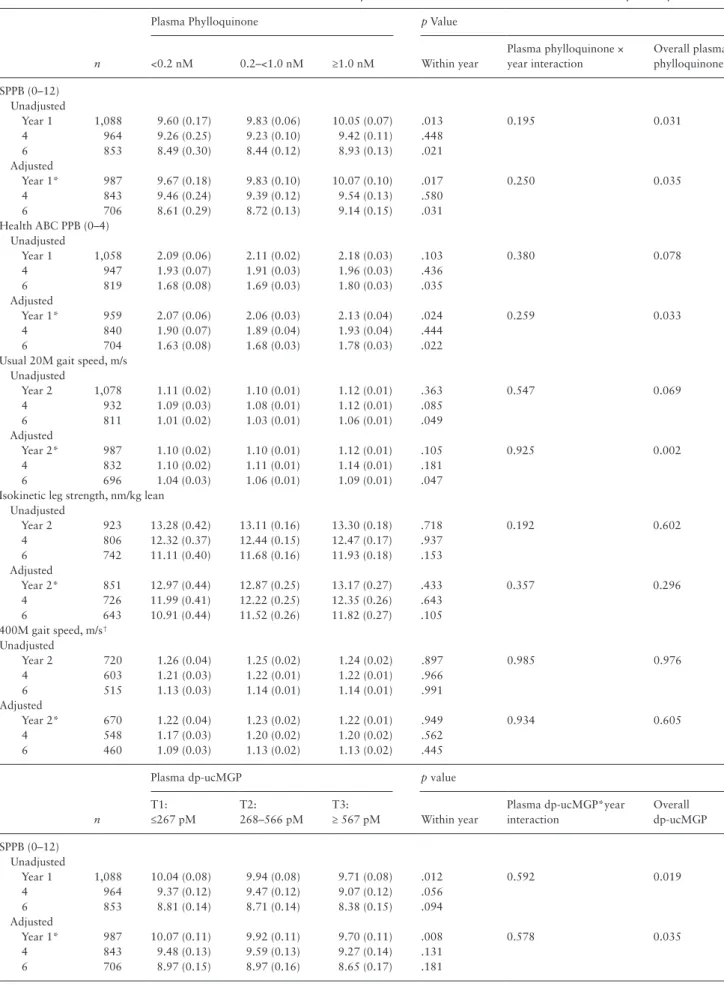
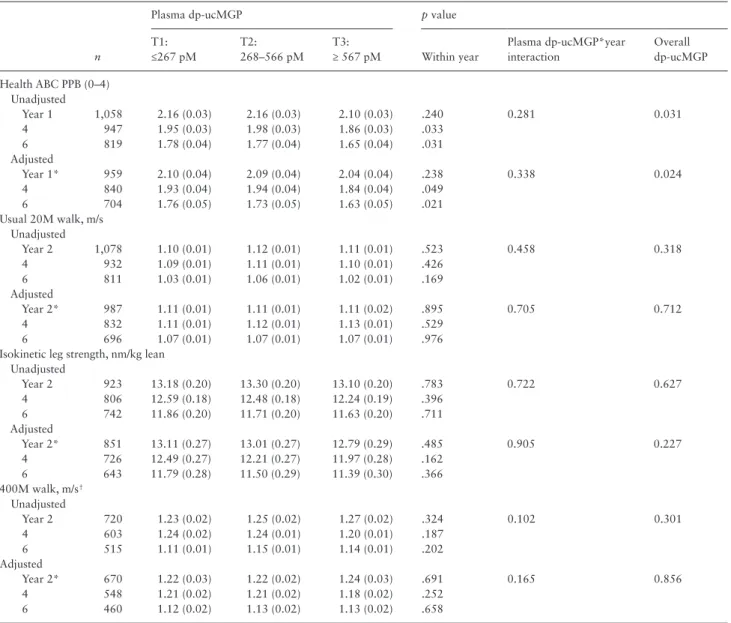
≥ .45) nor with ability to complete the 400-m walk (both p ≥ .45). Longitudinally, participants with plasma phylloquinone ≥1.0 nM had higher physical performance scores and faster usual gait speed at 4–5 years of follow-up, fully-adjusted (Table 3; Figure 1). Plasma phylloquinone was not associated with isokinetic leg strength, 400-m gait speed, or ability to complete 400-m walk longitudinally. Participants in the lower dp-ucMGP tertiles had better Health ABC physical performance scores over time compared to the highest tertile, but plasma dp-ucMGP was not associated with any other performance outcome during follow-up (fully-adjusted) (Table 3;
the rate of decline was similar across the plasma phylloquinone groups (phylloquinone category*time interaction all p > .25) and dp-ucMGP tertiles (dp-ucMGP tertile*time interaction all p > .10). The interaction between sex/race and vitamin K status were not sta-tistically significant (p values for sex interactions >0.32 and for race interactions >0.06).
When unadjusted models were restricted to those with com-plete covariate data, the results were similar. We also stratified by whether participants had qualifying knee pain or not (on account of this Health ABC subgroup’s selection (8)). The results in both groups were generally consistent with the direction of our overall findings, but statistical significance was attenuated because sample sizes were reduced (n = 799 with knee pain, 290 without) (data not shown.)
Discussion
We hypothesized higher vitamin K status would be associated with better lower extremity function because higher vitamin K status has been associated with a lower prevalence and progression of several comorbidities that have been associated with impaired function and disability (5–8). We found generally healthy older adults with ≥1.0 nM plasma phylloquinone had better physical performance scores and better usual gait speed cross-sectionally and at 4–5 fol-low-up years compared to those with <1.0 nM plasma phylloqui-none. The rate of decline did not differ by plasma phylloquinone status. Lower plasma dp-ucMGP (reflective of better vitamin K sta-tus) was associated with better lower extremity performance and isokinetic leg strength cross-sectionally and with better Health ABC physical performance scores (but not SPPB scores) over time. Neither
Table 1. Baseline Characteristics of Health ABC Participants According to Plasma Phylloquinone Category
<0.2 nM
n = 84
0.2–<1.0 nM
n = 585
≥1.0 nM
n = 419 p*
Age, y 74.8 ± 2.6 74.8 ± 3.0 74.4 ± 2.8 .13
Female (n [%]) 47 (56) 334 (57) 270 (64) .05
Black (n [%]) 43 (51) 265 (45) 200 (48) .53
Pittsburgh (n [%]) 56 (67) 331 (57) 190 (45) <.01
BMI, kg/m2 27.9 ± 5.2 27.9 ± 5.0 28.4 ± 5.0 .07
Triglycerides, mg/dL† 111 ± 44 129 ± 39 161 ± 100 <.01
Total cholesterol, mg/dl 200 ± 36 205 ± 39 210 ± 42 .04
IL-6, pg/ml† 4.1 ± 4.1 3.6 ± 3.9 2.5 ± 3.8 .11
Creatinine, mg/dl† 1.0 ± 0.3 1.0 ± 0.2 1.0 ± 0.2 .70
25(OH)D, ng/ml 25.4 ± 9.4 25.2 ± 11.1 25.2 ± 10.0 .99
dp-ucMGP, pM† 477 ± 323 508 ± 409 401 ± 339 <.01
Healthy Eating Index score 68 ± 12 69 ± 12 70 ± 12 .23 Energy intake, kcal/day 1872 ± 827 1882 ± 778 1794 ± 653 .30
Fat intake, g/day 71 ± 41 71 ± 37 69 ± 33 .45
Systolic blood pressure, mmHg 132 ± 18 135 ± 21 135 ± 20 .62
Diabetes (n [%]) 11 (13) 100 (17) 77 (18) .49
Lipid lowering medication (n [%]) 13 (15) 90 (15) 69 (16) .90 Anti-hypertension medication (n [%]) 40 (47) 325 (56) 265 (63) <.01 Anti-inflammatory medication ( n[%]) 41 (49) 336 (58) 247 (59) .23 Cognitive function (3MS score)† 88 ± 8 90 ± 8 90 ± 8 .22
Depression (CESD10 score)† 3.8 ± 4.0 3.2 ± 3.2 3.2 ± 3.5 .96
Walking, min/week
0 35 (42) 266 (46) 172 (41) .11
1–149 34 (40) 166 (28) 139 (33)
≥150 15 (18) 152 (26) 109 (26)
Smokers (n [%])
Current 12 (14) 59 (10) 28 (7) .04
Former 40 (48) 254 (43) 172 (41)
Alcohol intake (n [%])
None 39 (46) 321 (55) 218 (52) .62
≤7 per week 39 (46) 227 (39) 173 (41)
>1 per day 6 (7) 34 (6) 27 (7)
Education
<High school 29 (35) 153 (26) 114 (39) .51
High school graduate 22 (27) 196 (34) 141 (34)
College graduate 32 (39) 235 (40) 164 (39)
Season (n [%])
Dec–Feb 13 (16) 155 (27) 100 (24) <.01
Mar–May 5 (6) 171 (29) 134 (32)
June–Aug 24 (29) 93 (16) 90 (21)
Sep–Nov 42 (50) 166 (28) 96 (23)
Note: Mean ± SD unless indicated otherwise.
*Based on one-way ANOVA or Kruskal–Wallis (continuous outcomes) or Chi-square test (categorical outcomes).
measure of vitamin K status was associated with lower extremity endurance as measured according to 400-m walk gait speed. This may reflect task specificity such that vitamin K status could be more relevant to low-endurance functional tasks (eg, standing from a chair) than to tasks requiring more endurance (eg, walking around the neighborhood).
Our finding that plasma phylloquinone was associated with lower extremity function is novel and suggests plasma phylloquinone ≥1.0 nM is beneficial with respect to maintaining lower extremity physical performance and usual gait speed over 4–5 years. A concen-tration of ≥1.0 nM is generally achieved when recommended vitamin K intakes (90–120 mcg/day) are met (24). There is not an established threshold of circulating phylloquinone that defines sufficient/insuf-ficient and low circulating phylloquinone has not been consistently defined in population-based studies (5,7,8). Identifying the threshold of circulating vitamin K that is sufficient to meet all physiological needs is an area of research that needs attention. Since low circu-lating phylloquinone is easily corrected, substantiating our findings in future studies could have an important public-health impact on physical function in older age.
Dp-ucMGP was associated with SPPB cross-sectionally but not longitudinally. However, lower dp-ucMGP was associated with better Health ABC performance scores over time. The Health ABC perfor-mance battery was designed to reduce potential ceiling effects of the SPPB since Health ABC participants were well-functioning at base-line (25). This may explain why dp-ucMGP was differentially asso-ciated with the two performance batteries. Because the Health ABC performance battery was the only performance measure that was associated with dp-ucMGP longitudinally, chance cannot be ruled out as a possible explanation. In an earlier analysis of this same cohort plasma dp-ucMGP was associated with structural characteristics of knee osteoarthritis cross-sectionally but not over follow-up (8), which may suggest (dp)ucMGP is not causally related to these health out-comes. It is also possible vitamin Ks role in functional decline could be through mechanisms that do not involve MGP. Vitamin K-dependent proteins other than MGP are implicated in physiological processes that lead to functional impairment (26,27). Phylloquinone has been shown to reduce expression of proinflammatory cytokines (4). Low grade inflammation is a characteristic of aging and has been linked to functional impairment (11). This could be an additional mechanism
Table 2. Cross-Sectional Associations Between Vitamin K Status and Lower Extremity Function in Health ABC
Plasma Phylloquinone n <0.2 nM 0.2–<1.0 nM ≥1.0 nM p Trend*
SPPB (0–12)
Unadjusted 1,089 9.61 ± 0.17 9.86 ± 0.06 10.07 ± 0.07 <.01 Adjusted† 982 9.58 ± 0.19 9.74 ± 0.12 9.98 ± 0.13 <.01
Health ABC PPB (0–4)
Unadjusted 1,059 2.09 ± 0.06 2.13 ± 0.02 2.19 ± 0.03 .05 Adjusted† 954 2.06 ± 0.08 2.10 ± 0.04 2.18 ± 0.04 <.01
Usual 20M walk (m/s)
Unadjusted 1,079 1.11 ± 0.03 1.10 ± 0.02 1.12 ± 0.02 .21 Adjusted† 980 1.09 ± 0.03 1.09 ± 0.01 1.12 ± 0.02 .05
Isokinetic leg strength (nm/kg lean)
Unadjusted 924 13.51 ± 0.43 13.17 ± 0.16 13.46 ± 0.19 .53 Adjusted 847 12.94 ± 0.49 12.89 ± 0.30 13.40 ± 0.32 .06 400M walk, m/s‡
Unadjusted 721 1.27 ± 0.04 1.25 ± 0.02 1.25 ± 0.01 .82 Adjusted† 667 1.21 ± 0.03 1.23 ± 0.03 1.23 ± 0.04 .68
Plasma dp-ucMGP n T1: ≤ 267 pM T2: 268–566 pM T3: ≥567 pM p trend†
SPPB (0–12)
Unadjusted 1,089 10.07 ± 0.08 9.96 ± 0.08 9.73 ± 0.08 <.01 Adjusted† 982 9.98 ± 0.13 9.80 ± 0.13 9.57 ± 0.14 <.01
Health ABC PPB (0–4)
Unadjusted 1,059 2.18 ± 0.03 2.16 ± 0.03 2.11 ± 0.03 .09 Adjusted† 954 2.16 ± 0.04 2.13 ± 0.04 2.08 ± 0.05 .05
Usual 20M walk, m/s
Unadjusted 1,079 1.10 ± 0.01 1.12 ± 0.01 1.11 ± 0.01 .57 Adjusted† 980 1.10 ± 0.02 1.10 ± 0.02 1.10 ± 0.02 .76
Isokinetic leg strength, nm/kg lean
Unadjusted 924 13.36 ± 0.20 13.39 ± 0.20 13.18 ± 0.21 .54 Adjusted 847 13.32 ± 0.33 13.10 ± 0.31 12.74 ± 0.34 .04 400M walk, m/s‡
Unadjusted 721 1.23 ± 0.01 1.26 ± 0.01 1.27 ± 0.02 .10 Adjusted† 667 1.22 ± 0.04 1.23 ± 0.03 1.24 ± 0.04 .45
Note: Data are means (or LS means) ± SEM.
*Trend test based on general linear model using category as an ordinal exposure (1–3).
†Adjusted for age, sex, race, site, education, triglycerides, total cholesterol, smoking, alcohol use, healthy eating index, energy intake, fat intake, 25(OH)D,
creatinine, depression, diabetes, lipid-lowering medication use, anti-hypertension medication use, BMI, systolic blood pressure, IL-6, cognitive status, anti-inflam-matory medication use, walking time per week.
Table 3. Associations Between Vitamin K Status and Lower Extremity Function Over Time in Health ABC Knee OA Study Participants
n
Plasma Phylloquinone p Value
<0.2 nM 0.2–<1.0 nM ≥1.0 nM Within year
Plasma phylloquinone × year interaction
Overall plasma phylloquinone
SPPB (0–12) Unadjusted
Year 1 1,088 9.60 (0.17) 9.83 (0.06) 10.05 (0.07) .013 0.195 0.031 4 964 9.26 (0.25) 9.23 (0.10) 9.42 (0.11) .448
6 853 8.49 (0.30) 8.44 (0.12) 8.93 (0.13) .021 Adjusted
Year 1* 987 9.67 (0.18) 9.83 (0.10) 10.07 (0.10) .017 0.250 0.035 4 843 9.46 (0.24) 9.39 (0.12) 9.54 (0.13) .580
6 706 8.61 (0.29) 8.72 (0.13) 9.14 (0.15) .031 Health ABC PPB (0–4)
Unadjusted
Year 1 1,058 2.09 (0.06) 2.11 (0.02) 2.18 (0.03) .103 0.380 0.078 4 947 1.93 (0.07) 1.91 (0.03) 1.96 (0.03) .436
6 819 1.68 (0.08) 1.69 (0.03) 1.80 (0.03) .035 Adjusted
Year 1* 959 2.07 (0.06) 2.06 (0.03) 2.13 (0.04) .024 0.259 0.033 4 840 1.90 (0.07) 1.89 (0.04) 1.93 (0.04) .444
6 704 1.63 (0.08) 1.68 (0.03) 1.78 (0.03) .022 Usual 20M gait speed, m/s
Unadjusted
Year 2 1,078 1.11 (0.02) 1.10 (0.01) 1.12 (0.01) .363 0.547 0.069 4 932 1.09 (0.03) 1.08 (0.01) 1.12 (0.01) .085
6 811 1.01 (0.02) 1.03 (0.01) 1.06 (0.01) .049 Adjusted
Year 2* 987 1.10 (0.02) 1.10 (0.01) 1.12 (0.01) .105 0.925 0.002 4 832 1.10 (0.02) 1.11 (0.01) 1.14 (0.01) .181
6 696 1.04 (0.03) 1.06 (0.01) 1.09 (0.01) .047 Isokinetic leg strength, nm/kg lean
Unadjusted
Year 2 923 13.28 (0.42) 13.11 (0.16) 13.30 (0.18) .718 0.192 0.602 4 806 12.32 (0.37) 12.44 (0.15) 12.47 (0.17) .937
6 742 11.11 (0.40) 11.68 (0.16) 11.93 (0.18) .153 Adjusted
Year 2* 851 12.97 (0.44) 12.87 (0.25) 13.17 (0.27) .433 0.357 0.296 4 726 11.99 (0.41) 12.22 (0.25) 12.35 (0.26) .643
6 643 10.91 (0.44) 11.52 (0.26) 11.82 (0.27) .105 400M gait speed, m/s†
Unadjusted
Year 2 720 1.26 (0.04) 1.25 (0.02) 1.24 (0.02) .897 0.985 0.976 4 603 1.21 (0.03) 1.22 (0.01) 1.22 (0.01) .966
6 515 1.13 (0.03) 1.14 (0.01) 1.14 (0.01) .991 Adjusted
Year 2* 670 1.22 (0.04) 1.23 (0.02) 1.22 (0.01) .949 0.934 0.605 4 548 1.17 (0.03) 1.20 (0.02) 1.20 (0.02) .562
6 460 1.09 (0.03) 1.13 (0.02) 1.13 (0.02) .445
n
Plasma dp-ucMGP p value
T1: ≤267 pM
T2: 268–566 pM
T3:
≥ 567 pM Within year
Plasma dp-ucMGP*year interaction
Overall dp-ucMGP
SPPB (0–12) Unadjusted
Year 1 1,088 10.04 (0.08) 9.94 (0.08) 9.71 (0.08) .012 0.592 0.019 4 964 9.37 (0.12) 9.47 (0.12) 9.07 (0.12) .056
6 853 8.81 (0.14) 8.71 (0.14) 8.38 (0.15) .094 Adjusted
Year 1* 987 10.07 (0.11) 9.92 (0.11) 9.70 (0.11) .008 0.578 0.035 4 843 9.48 (0.13) 9.59 (0.13) 9.27 (0.14) .131
through which vitamin K influences physical function. Additional research is needed to clarify the role of MGP and other vitamin K-dependent mechanisms in physical performance.
Our study is strengthened by including cross-sectional and lon-gitudinal components in a well-characterized cohort with multiple measures of lower extremity function. However, the observational design precludes causal inferences. At the time of enrollment, Health ABC participants reported being well-functioning, which could limit the generalizability to less functional groups. Participants included in this analysis were selected because they had qualifying knee pain or were a randomly selected control without knee pain (8). When partici-pants with and without knee pain were analyzed separately, the strati-fied results were generally consistent to our overall findings (although not statistically significant). Plasma phylloquinone and dp-ucMGP did not differ according to knee pain status (both p > .38), but persons with knee pain had worse function. Given our sample size and that the majority of participants in our study had knee pain, larger studies are
needed to clarify if vitamin K is more relevant to function in persons with knee pain or in older adults overall. The clinical relevance of our findings is also uncertain. In older adults more functionally impaired than Health ABC participants, a 0.3–0.5 unit difference in SPPB was found to be a minimally meaningful change, and for usual gait speed a 0.04–0.05 m/s difference was considered clinically meaningful (28,29). Our results suggest participants with ≥1.0 nM plasma phylloquinone had a 0.3 unit higher SPPB score at baseline and a 0.4 unit higher SPPB score after 5 years compared to participants with <1.0 nM. The difference in usual gait speed between these two groups after 4 years was 0.04 m/s. At the 2–3-year follow-up, we did not detect differences in any outcome across categories of plasma phylloquinone, although significant differences in SPPB were detected at baseline and after 5 years and differences in usual gait speed were detected after 4-year follow-up as well. The explanation for this observation is unclear. Had our follow-up been limited to 2 years, we would have concluded that plasma phylloquinone was not associated with functional impairment
n
Plasma dp-ucMGP p value
T1: ≤267 pM
T2: 268–566 pM
T3:
≥ 567 pM Within year
Plasma dp-ucMGP*year interaction
Overall dp-ucMGP
Health ABC PPB (0–4) Unadjusted
Year 1 1,058 2.16 (0.03) 2.16 (0.03) 2.10 (0.03) .240 0.281 0.031 4 947 1.95 (0.03) 1.98 (0.03) 1.86 (0.03) .033
6 819 1.78 (0.04) 1.77 (0.04) 1.65 (0.04) .031 Adjusted
Year 1* 959 2.10 (0.04) 2.09 (0.04) 2.04 (0.04) .238 0.338 0.024 4 840 1.93 (0.04) 1.94 (0.04) 1.84 (0.04) .049
6 704 1.76 (0.05) 1.73 (0.05) 1.63 (0.05) .021 Usual 20M walk, m/s
Unadjusted
Year 2 1,078 1.10 (0.01) 1.12 (0.01) 1.11 (0.01) .523 0.458 0.318 4 932 1.09 (0.01) 1.11 (0.01) 1.10 (0.01) .426
6 811 1.03 (0.01) 1.06 (0.01) 1.02 (0.01) .169 Adjusted
Year 2* 987 1.11 (0.01) 1.11 (0.01) 1.11 (0.02) .895 0.705 0.712 4 832 1.11 (0.01) 1.12 (0.01) 1.13 (0.01) .529
6 696 1.07 (0.01) 1.07 (0.01) 1.07 (0.01) .976 Isokinetic leg strength, nm/kg lean
Unadjusted
Year 2 923 13.18 (0.20) 13.30 (0.20) 13.10 (0.20) .783 0.722 0.627 4 806 12.59 (0.18) 12.48 (0.18) 12.24 (0.19) .396
6 742 11.86 (0.20) 11.71 (0.20) 11.63 (0.20) .711 Adjusted
Year 2* 851 13.11 (0.27) 13.01 (0.27) 12.79 (0.29) .485 0.905 0.227 4 726 12.49 (0.27) 12.21 (0.27) 11.97 (0.28) .162
6 643 11.79 (0.28) 11.50 (0.29) 11.39 (0.30) .366 400M walk, m/s†
Unadjusted
Year 2 720 1.23 (0.02) 1.25 (0.02) 1.27 (0.02) .324 0.102 0.301 4 603 1.24 (0.02) 1.24 (0.01) 1.20 (0.01) .187
6 515 1.11 (0.01) 1.15 (0.01) 1.14 (0.01) .202 Adjusted
Year 2* 670 1.22 (0.03) 1.22 (0.02) 1.24 (0.03) .691 0.165 0.856 4 548 1.21 (0.02) 1.21 (0.02) 1.18 (0.02) .252
6 460 1.12 (0.02) 1.13 (0.02) 1.13 (0.02) .658
*Adjusted for age, sex, race, site, education, triglycerides, total cholesterol, smoking, alcohol use, healthy eating index, energy intake, fat intake, 25(OH)D, creatinine, physical activity, depression, diabetes, lipid lowering medication use, anti-hypertension medication use, and time-varying BMI, systolic blood pressure, IL-6, cognitive status, anti-inflammatory medication use, time spent walking per week.
†In those who completed the test (66%).
longitudinally. With repeated measures we could account for changes in status over time, but vitamin K status measures were only available at a single time point. The primary dietary sources of phylloquinone are characteristic of healthy diets (30) and higher circulating phyllo-quinone can reflect healthy lifestyles, which could be associated with better function itself. Although we adjusted our models for multiple
co-morbidities, medication use, and multiple characteristics that could reflect general good health (diet and physical activity), residual con-founding may persist.
In conclusion, older community-dwelling adults with ≥1.0 nM plasma phylloquinone had better physical performance battery scores cross-sectionally and over 4–5 follow-up years. Those with
Figure 1. Plasma phylloquinone and (A) SPPB score, (B) Health ABC PPB score, (C) 20-meter gait speed, (D) isokinetic leg strength. Data are fully-adjusted LS means, error bars are SEM.
higher plasma phylloquinone also had better usual gait speed at 4 years of follow-up, but plasma phylloquinone status was not asso-ciated with walking endurance. The findings with an independent functional marker of vitamin K status were less consistent. Low vita-min K status has been associated with multiple co-morbidities that lead to impaired function and disability (5–8), so improving vitamin K status may reduce functional decline in older adults with various age-related conditions. Future studies are needed to confirm our find-ings, establish if vitamin K supplementation reduces lower extrem-ity functional decline in older age and to clarify the mechanism(s) underlying vitamin Ks role in this process.
Supplementary Material
Please visit the article online at http://gerontologist.oxfordjournals. org/ to view supplementary material.
Funding
This study was supported by the NIH Intramural Research Program, the NIA and contracts (N01-AG-6-2101, N01-AG-6-2103, and N01-AG-6-2106; R01-AG028050); the NINR (R01-NR012459); the NIAMS (R21AR062284, K01AR063167); an Arthritis Foundation New Investigator Grant and the USDA, Agricultural Research Service Cooperative Agreement (58-1950-7-707).
References
1. McCann JC, Ames BN. Vitamin K, an example of triage theory: is micronutri-ent inadequacy linked to diseases of aging? Am J Clin Nutr. 2009;90:889–907. 2. Price PA, Faus SA, Williamson MK. Warfarin causes rapid calcification of the elastic lamellae in rat arteries and heart valves. Arterioscler Thromb Vasc Biol. 1998;18:1400–1407.
3. Schurgers LJ, Spronk HM, Skepper JN, et al. Post-translational modifications regulate matrix Gla protein function: importance for inhibition of vascular smooth muscle cell calcification. J Thromb Haemost. 2007;5:2503–2511. 4. Ohsaki Y, Shirakawa H, Hiwatashi K, et al. Vitamin K suppresses
lipopol-ysaccharide-induced inflammation in the rat. Biosci Biotechnol Biochem. 2006;70:926–932.
5. Misra D, Booth SL, Tolstykh I, et al. Vitamin K deficiency is associated with incident knee osteoarthritis. Am J Med. 2013;126:243–248. 6. Dam V, Dalmeijer GW, Vermeer C et al. The association between vitamin
K and the metabolic syndrome: a ten year follow-up study in adults. J Clin Endocrinol Metab. 2015;100:2472–2479.
7. Shea MK, Booth SL, Miller ME, et al. Association between circulating vita-min K1 and coronary calcium progression in community-dwelling adults: the Multi-Ethnic Study of Atherosclerosis. Am J Clin Nutr. 2013;98:197–208. 8. Shea MK, Kritchevsky SB, Hsu FC, et al. The association between vitamin
K status and knee osteoarthritis features in older adults: the Health, Aging and Body Composition Study. Osteoarthritis Cartilage. 2015;23:370–378. 9. Hochberg MC, Kasper J, Williamson J, et al. The contribution of osteoar-thritis to disability: preliminary data from the Women’s Health and Aging Study. J Rheumatol. 1995;43:16–18.
10. Newman AB, Arnold AM, Naydeck BL et al. “Successful aging”: effect of subclinical cardiovascular disease. Arch Intern Med. 2003;163:2315–2322. 11. Cesari M, Kritchevsky SB, Nicklas B, et al. Oxidative damage, platelet acti-vation, and inflammation to predict mobility disability and mortality in older persons: results from the health aging and body composition study. J Gerontol A Biol Sci Med Sci. 2012;67:671–676.
12. Guralnik JM, Ferrucci L, Simonsick EM, et al. Lower-extremity function in persons over the age of 70 years as a predictor of subsequent disability. N Engl J Med. 1995;332:556–561.
13. Hardy SE, Perera S, Roumani YF,et al. Improvement in usual gait speed pre-dicts better survival in older adults. J Am Geriatr Soc. 2007;55:1727–1734. 14. Wang L, van Belle G, Kukull WB, Larson EB. Predictors of functional
change: a longitudinal study of nondemented people aged 65 and older. J Am Geriatr Soc. 2002;50:1525–1534.
15. Rocca WA, Boyd CM, Grossardt BR, et al. Prevalence of multimorbidity in a geographically defined American population: patterns by age, sex, and race/ethnicity. Mayo Clin Proc. 2014;89:1336–1349.
16. Fried LP, Bandeen-Roche K, Kasper JD, Guralnik JM. Association of comorbidity with disability in older women: the Women’s Health and Aging Study. J Clin Epidemiol. 1999;52:27–37.
17. Pahor M, Guralnik JM, Ambrosius WT, et al. Effect of structured physi-cal activity on prevention of major mobility disability in older adults: the LIFE study randomized clinical trial. JAMA. 2014;311:2387–2396. 18. Beavers KM, Miller ME, Rejeski WJ, et al. Fat mass loss predicts gain in
physical function with intentional weight loss in older adults. J Gerontol A Biol Sci Med Sci. 2013;68:80–86.
19. Houston DK, Tooze JA, Neiberg RH et al. 25-Hydroxyvitamin D sta-tus and change in physical performance and strength in older adults: the health, aging, and body composition study. Am J Epidemiol. 2012;176:1025–1034.
20. Guralnik JM, Simonsick EM, Ferrucci L, et al. A short physical perfor-mance battery assessing lower extremity function: association with self-reported disability and prediction of mortality and nursing home admis-sion. J Gerontol. 1994;49:M85–M94.
21. Davidson KW, Sadowski JA. Determination of vitamin K compounds in plasma or serum by high-performance liquid chromatography using post-column chemical reduction and fluorimetric detection. Methods Enzymol. 1997;282:408–421.
22. Cranenburg EC, Koos R, Schurgers LJ, et al. Characterisation and poten-tial diagnostic value of circulating matrix Gla protein (MGP) species. Thromb Haemost. 2010;104:811–822.
23. Shea MK, O’Donnell CJ, Vermeer C, et al. Circulating uncarboxylated matrix gla protein is associated with vitamin K nutritional status, but not coronary artery calcium, in older adults. J Nutr. 2011;141:1529– 1534.
24. Booth SL, Martini L, Peterson JW, et al. Dietary phylloquinone depletion and repletion in older women. J Nutr. 2003;133:2565–2569.
25. Simonsick EM, Newman AB, Nevitt MC, et al. Measuring higher level physical function in well-functioning older adults: expanding familiar approaches in the Health ABC study. J Gerontol A Biol Sci Med Sci. 2001;56:M644–M649.
26. Loeser RF, Varnum BC, Carlson CS, et al. Human chondrocyte expres-sion of growth-arrest-specific gene 6 and the tyrosine kinase receptor axl: potential role in autocrine signaling in cartilage. Arthritis Rheum. 1997;40:1455–1465.
27. Viegas CS, Rafael MS, Enriquez JL, et al. Gla-rich protein acts as a calcifi-cation inhibitor in the human cardiovascular system. Arterioscler Thromb Vasc Biol. 2015;35:399–408.
28. Perera S, Mody SH, Woodman RC, Studenski SA. Meaningful change and responsiveness in common physical performance measures in older adults. J Am Geriatr Soc. 2006;54:743–749.
29. Kwon S, Perera S, Pahor M, et al. What is a meaningful change in physi-cal performance? Findings from a cliniphysi-cal trial in older adults (the LIFE-P study). J Nutr Health Aging. 2009;13:538–544.