Editors’ Suggestion
Phonon interferometry for measuring quantum decoherence
M. J. Weaver,1,*D. Newsom,1F. Luna,1W. Löffler,2and D. Bouwmeester1,2
1Department of Physics, University of California, Santa Barbara, Santa Barbara, California 93106, USA
2Huygens-Kamerlingh Onnes Laboratorium, Universiteit Leiden, 2333 CA Leiden, Netherlands
(Received 15 March 2018; published 14 June 2018)
Experimental observation of the decoherence of macroscopic objects is of fundamental importance to the study of quantum collapse models and the quantum to classical transition. Optomechanics is a promising field for the study of such models because of its fine control and readout of mechanical motion. Nevertheless, it is challenging to monitor a mechanical superposition state for long enough to investigate this transition. We present a scheme for entangling two mechanical resonators in spatial superposition states such that all quantum information is stored in the mechanical resonators. The scheme is general and applies to any optomechanical system with multiple mechanical modes. By analytic and numeric modeling, we show that the scheme is resilient to experimental imperfections such as incomplete precooling, faulty postselection, and inefficient optomechanical coupling. This proposed procedure overcomes limitations of previously proposed schemes that have so far hindered the study of macroscopic quantum dynamics.
DOI:10.1103/PhysRevA.97.063832
I. INTRODUCTION
The transition between quantum and classical regimes, particularly in massive systems, is still largely unexplored. The fields of opto- and electromechanics have emerged as effective tools for controlling and measuring the quantum motion of mechanical resonators [1]. In recent years macroscopic me-chanical resonators have been developed with exceptionally-high-quality factors [2–4]. At the same time devices with a single-photon strong cooperativity [5–7] are enabling ma-nipulation of optomechanical systems at the single quantum level [8–10]. Large mechanical resonators are proposed to undergo a number of unconventional decoherence mechanisms [11–14]. One promising technique for testing decoherence is to produce a spatial superposition state of one of these resonators, but this requires a controlling interaction with some other quantum system. We investigate a method for entangling two mechanical resonances and harnessing the advantageous capabilities of each resonator to study decoherence.
There are many proposed methods of producing a su-perposition state in an opto- or electromechanical system, all of which require the introduction of some nonlinearity. Examples of this include electromechanical systems coupled to a superconducting qubit [8,9,15] and optomechanical sys-tems interacting with a single photon sent through a beam splitter [16]. However, the latter scheme is unfeasible with almost all current optomechanical systems, because it requires single-photon strong coupling [16]. This requirement can be circumvented by postselection [17] or displacement [18], but these experiments are limited by the need for long storage of photons, which is lossy, and the requirement that cavity photons predominantly couple to a single mechanical mode. Here we propose a method to eliminate these constraints by
entangling two mechanical modes optomechanically to avoid the losses and decoherence in optical and electrical systems.
Methods to generate optomechanical entanglement be-tween multiple mechanical devices have been investigated ex-tensively [19–25]. To generate a superposition, an interaction with two mechanical resonators is required [26,27]. So far demonstrations of entanglement in optomechanical systems have used elements with similar structure and frequency [28–30]. Flayac and Savona suggested that single-photon projection measurements could generate an entangled superpo-sition state between two resonators of similar frequency [27]. We propose a scheme which entangles resonators of different frequencies so that it is easy to manipulate one resonator and to use the other (possibly more massive) resonator for tests of quantum mechanics.
II. EXPERIMENTAL SCHEME
We consider an optomechanical system with one optical cavity and two mechanical resonators: an interaction resonator (resonator 1) and a quantum test mass resonator (resonator 2). The Hamiltonian for the system is the standard optomechanics Hamiltonian for multiple resonators [1]
ˆ
H0=hω¯ caˆ†aˆ+
j=1,2 ¯
hωjbˆ†jbˆj +hg¯ jaˆ†aˆ( ˆb†j +bˆj), (1)
whereωcand ˆa, andωjand ˆbj are the frequencies and bosonic
ladder operators of the cavity and resonatorj, respectively, and gj are the single-photon optomechanical coupling rates. The
system is sideband resolved, withωj κ the optical cavity
FIG. 1. Proposed experimental setup. Two mechanical resonators are optomechanically coupled to an optical cavity. Here we show a membrane and a trampoline resonator with a mirror, but the procedure could be used for any two mechanical resonators coupled via an optical cavity field. A continuous-wave laser is sent to an optical pulse generation setup, which produces pulses of varying frequency, duration, and intensity. The light enters the optomechanical cavity and subsequently the reflected light is filtered to remove the control pulses. The filtered signal contains the single photons used for heralding and readout, which are measured with a superconducting single-photon detector (SSPD).
Figure2illustrates the method we propose to study deco-herence. First both mechanical modes must be cooled close to the ground state using standard sideband cooling with two long laser pulses red detuned from the cavity resonance byω1 andω2[31–33]. Next we excite resonator 1 to its first excited state using a weak pulse and projection measurement [34]. We perform a Mach-Zehnder-type interference experiment on this initial state. To generate a beam-splitter interaction between the mechanical resonators, we apply a two-laser pulse, resulting in an entangled state |ψ = √1
2[|11|02+i|01|12]. The system now evolves freely for a timeτ, possibly decohering
FIG. 2. The four control pulses sent into the optomechanical cav-ity to execute the experiment. The pulses are (i) cooling to the ground state, (ii) excitation to a coherent state, followed by postselection of the first excited state, (iii) a mechanical-mechanical interaction withJ t=π/2, and (iv) readout of a resonator. On the bottom, the equivalent optics experiment is shown with the corresponding steps. The grayed out detector is the optional addition of a readout pulse for resonator 2.
during that interval. The frequency difference between the resonators causes the state|ψto pick up a phase difference of (ω2−ω1)τ. A second mechanical-mechanical interaction rotates the system to sin[(ω2−ω1)τ/2]|11|02+cos[(ω2− ω1)τ/2]|01|12if the system did not decohere. Finally, a laser pulse red detuned byω1is used to swap the mechanical state of resonator 1 with that of the cavity and read it out with a photodetector.
We will now examine the steps in more detail, starting with the heralded generation of a single-phonon mechanical Fock state [34], which has already been used to produce single-phonon Fock states with reasonably high fidelity [10,35]. Here we will review the process briefly, including some of the imperfections in the generated state. A weak pulse of light, blue detuned in frequency byω1, is sent into the cavity, creating an effective interaction described by the Hamiltonian H(ii)=h¯√ncavg1( ˆabˆ1+aˆ†bˆ†1), wherencav is the number of
photons in the cavity from the laser pulse. This generates an entangled state between the cavity and resonator 1, |ψ = 1/√2(|0c|01+ √p|1c|11+p|2c|21), wherep 1 is the excitation probability. The light leaks out of the cavity and passes through a filter to isolate the resonant light from the blue-detuned pulse. By detecting a single photon, the mechanical resonator is projected onto|11, a single-phonon Fock state. Because of the limited detection efficiency of cavity photonsη and the dead time of the detector, higher number states will be mistaken as single photons, so the probabilityp must be kept small to avoid inclusion of these states. Control pulse photons which leak through the filter and detector dark counts will incoherently add in |01 to the single-phonon Fock state. Using a good filter and superconducting single-photon detectors avoids the inclusion of the ground state [10]. Taken together these steps produce, with probability ηp, a heralded single-phonon Fock state and we can proceed to the interference experiment.
Exchange of quantum states is the essence of the inter-ference experiment. In recent years there have been many demonstrations of opto- and electromechanically controlled coherent coupling between mechanical resonators [36–42]. All of these could be used to create an effective beam-splitter interaction between two mechanical resonators. We will use the swapping method proposed by Buchmann and Stamper-Kurn [43] (and experimentally demonstrated in [44]) because it is quite general and couples resonators with a large frequency separation, which is important for the individual readout of each resonator. Two pulses of light, red detuned and separated by ω2−ω1, are sent into the cavity. These pulses each exchange excitations between one mechanical resonator and the cavity mode, resulting in a net swapping interaction with rateJ between the two resonators:H(iii)=hJ¯ ( ˆb†1bˆ2+bˆ1bˆ†2). This interaction can be used for both beam-splitter interactions in the proposed experiment.
of η. Because of the difference in frequency of the two resonators, the measured phonon occupation of resonator 1 after the second mechanical-mechanical interaction oscillates as a function of the delay timeτ at the frequency ω2−ω1. However, if decoherence occurs during free evolution, the visibility of the oscillations will decrease. These features in the readout enable a simultaneous comparison of the coherent evolution, decoherence, and thermalization of the system.
III. EXPECTED RESULTS
First we model the experiment analytically. We assume that in step (ii) of Fig.2 a perfect entangled state is generated, but that the off-diagonal elements of the density matrix decay exponentially with a decoherence timeτd. The environment
heats resonator 2, adding incoherently to the mechanical state. As an approximation, we assume that the state thermalizes from its average initial value of 1/2 to the thermal occupation of the environment nenv. The average readout R on the superconducting single-photon detector (SSPD) in step (iv) after many trials is the sum of the two effects
ndec2= 1 2 −
cos[(ω2−ω1)τ]e−τ/τd
2 , (2a)
nth2=
nenv−1 2
(1−e−τ/τt h), (2b)
R=η(ndec2+ nth2), (2c)
where nenv=kBTenv/hω¯ 2 is the thermal occupation of the environment at temperatureTenvandτthis the thermalization
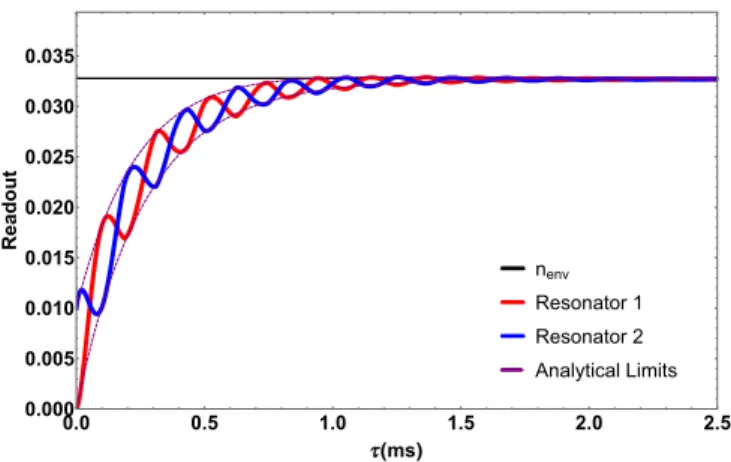
time constant. Three key features are visible in the readout signal: an oscillation atω2-ω1, which is evidence of coherence; an exponential decay of the coherent signal; and an exponential increase in the phonon number as the system thermalizes.
We verify Eq. (2) by performing a numerical simulation of the interaction between a mechanical resonator and its environment in the quantum master equation formalism. We assume that one resonator, the test mass resonator, has a much greater interaction rateγwith the environment, dominating the decoherence effects. Environmentally induced decoherence can be modeled as an interaction with a bath of harmonic oscillators, leading to the master equation [45,46]
˙ ρ= i
¯
h[ρ,Hˆ0]− D
¯
h2[x,ˆ [ ˆx,ρ]]− iγ
¯
h[ ˆx,{p,ρˆ }], (3)
where ˆx and ˆp are the position and momentum operators for resonator 2 andD=2mγ kBTenvis the phonon diffusion constant. The numerical results are shown in Fig.3and are in excellent agreement with Eq. (2).
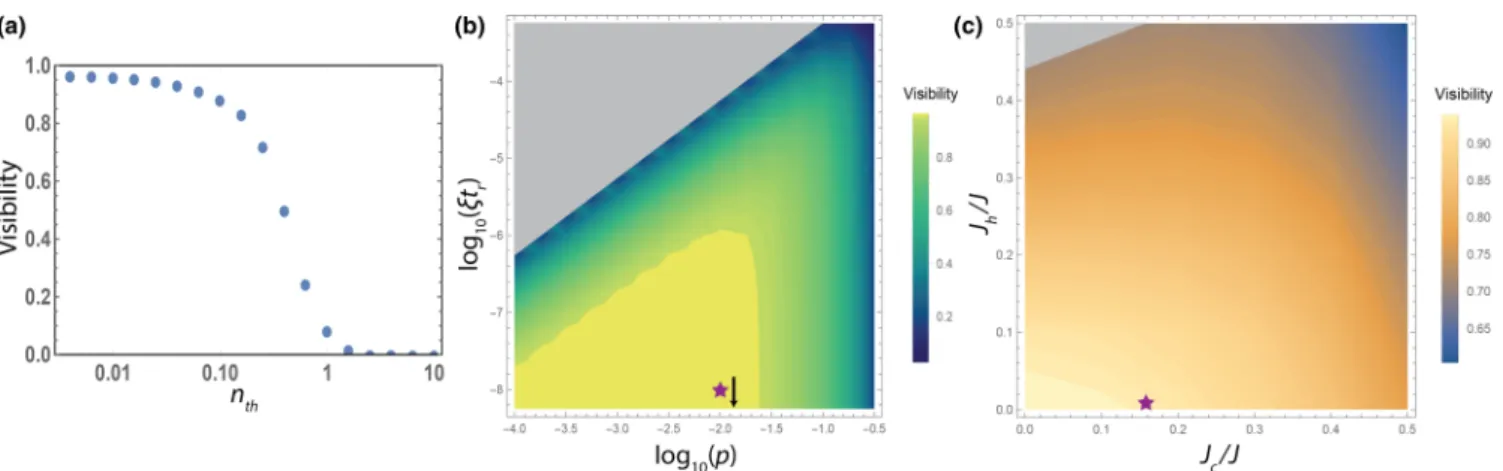
We now discuss the experimental feasibility of this scheme with currently available technologies. We numerically simulate density matrices with the phonon states of each resonator as basis states (details in AppendixA). The initial visibility of the oscillations between the two resonators is a direct measure of the entanglement generation, and the decay of the visibility is the essential result of the experiment. Although the limit would depend on the exact experimental implementation, we estimate that the experiment would likely require an initial visibility greater than 10%. First we consider imperfections in step (i), cooling to the ground state. Figure4(a)shows the
nenv Resonator 1 Resonator 2 Analytical Limits
0.0 0.5 1.0 1.5 2.0 2.5
0.000 0.005 0.010 0.015 0.020 0.025 0.030 0.035
τ(ms)
Readout
FIG. 3. Expected results of a decoherence measurement with two entangled resonators in which one interacts with a thermal environment. The red (blue) indicates the readout of resonator 1 (2). Dotted lines are the limits set by the analytical model. Three effects are visible: coherent oscillations due to the frequency difference between the resonators, a decay of that coherence due to environmentally induced decoherence, and thermalization with the environment. The parameters for this plot areω1=2 GHz,ω=30 kHz,γ =2 kHz, Tenv=0.1 K, andη=0.01.
visibility achieved with a nonzero thermal phonon occupation. This occupation must be below about 0.7 for the experiment to be feasible.
Next we consider step (ii), the postselection of a single-phonon state. By changing the pulse strength, the probability pof an excitation can be adjusted. Dark counts on the single-photon counter during the postselection will skew the produced state. Figure4(b)shows the visibility as a function ofpand dark count rate. There is a large region of parameter space with good visibility, and experiments are already well within this region (purple star) [35].
Finally, in step (iii), the optomechanical beam splitter nominally only causes an interaction between the two me-chanical resonators. However, the beams used to produce the interaction also have heating and cooling effects. In Fig.4(c) the visibility as a function of cooling rateJcand heating rate
Jhis shown. Again, experimental demonstrations of this type
of beam-splitter interaction are already sufficient to produce an interference experiment [44]. In Fig.5we show numerical simulations of decoherence and thermalization that include experimental imperfections and an initial visibility of 30%. All of the qualitative features of Fig.3are still easily discernible, indicating that the experiment should be feasible with these or even slightly worse parameters. There is a large area of experimentally achievable parameter space in all dimensions with visibility greater than 10%.
IV. TIMING CONSIDERATIONS
FIG. 4. Effects of several experimental imperfections on the resulting interference experiment, using the initial visibility as a metric. (a) The two resonators are only cooled to a phonon occupancy ofnt hin step (i). (b) The detector has a dark count probability ofξ trfor different
probabilities of excitation,pin step (ii). (c) Step (iii) also induces an optical cooling rateJcand an optical heating rateJhin addition to the
mechanical-mechanical couplingJ. The grayed out regions indicate regimes in which the dominant behavior is not the desired entangled state. The purple stars indicate parameters already achieved in experiments in (b) Ref. [35] and (c) Ref. [44]. The unvaried parameters for these plot arent h=0.01,p=0.01,ξ tr =10−6,η=0.01, andJc=Jh=0.
would take years to build up enough detection events. However, if there is no heralding of a single photon in step (ii), there is no reason to continue the experiment. If we only continue to step (iii) after a successful postselection the timeT required is
T =nanp
t12(1−ηp)
η2p +
ttotηp
η
≈nanp
t12 η2p, (4)
where t12 andttot are the time required for steps (i) and (ii)
and for the total experiment, respectively, andna andnp are
the number of averages and the number of points. In general, step (iii) andτ should dominate the experiment time, so this would drastically reduce the total experiment time. For a high-frequency resonator with approximately gigahertz high-frequency, reasonable parameters might be na =1000, np=30, η=
nenv Resonator 1 Resonator 2 Analytical Limits
0.0 0.5 1.0 1.5 2.0 2.5
0.000 0.005 0.010 0.015 0.020 0.025 0.030 0.035
τ(ms)
Readout
FIG. 5. Expected results of a decoherence measurement with im-perfections present and an initial visibility of 30%. The parameters for this plot are the same as for Fig.3with additional imperfectionsnt h=
0.4,p=0.1, andJc=Jh=0. Despite the limited initial visibility, all
three effects are still visible: coherent oscillations due to the frequency difference between the resonators, a decay of that coherence due to environmentally induced decoherence, and thermalization with the environment. We estimate that the experimental limit on the initial visibility is around 10%.
0.01,p=0.01, andt12=1μs, leading to an experiment time of about 8 h. For lower-frequency resonators, t12 might be closer to 100μs, leading to an experiment time of about 35 days. The number of averages needed depends inversely onη, soT ∼1/η3, and the experiment can be drastically sped up by increasingη.
Many experiments which are proposed for testing novel decoherence mechanisms are in the lower-frequency range. These experiments have the difficulty that their thermal envi-ronment contains more thermal quanta. In order to measure the full thermalization in addition to the decoherence, we must be able to countηnenvphotons. If an SSPD has a relatively short dead time (∼100 ns) compared to the leakage time from the cavity and filter (∼50μs) it may be possible to observe more than one photon. In general, however, the experiment should be constrained toη1/nenv. For low-frequency resonators η may need to be artificially lowered. If this is the case, we suggest different detectors for step (ii) and step (iv) with different optical paths. If step (ii) has high efficiencyη1 and step (iv) has low efficiencyη2the experiment time only slows down toT ≈nanpt12/η1η2pand it is possible to count higher phonon numbers with a reasonable increase in experiment time.
V. EXPERIMENTAL IMPLEMENTATIONS
enables single-phonon control of the massive DBR device despite its relatively small single-photon cooperativity.
Another possible system would be a membrane in the middle at one end of a Fabry-Pérot cavity and a cloud of atoms trapped in the harmonic potential of the standing wave in the cavity at the other end. The optomechanical coupling enables the direct coupling between the∼zg cloud of atoms and the
∼100-ng membrane. Clouds of atoms and membranes have al-ready been coupled between different cavities [47,48] and this scheme could be modified to use that interaction for step (iii). One could also imagine making a cavity with a bulk acoustic wave resonator coupled to a small high-frequency membrane. These modes can have exceptionally-high-Qfactors and large mode mass [2].
VI. DISCUSSION
There are a number of distinct advantages of the method proposed here. First, the readout of phonon occupation natu-rally lends itself to studying thermalization and decoherence together in the same system and on the same time scale. This has never been observed before in mechanical resonators. A thorough understanding of the mechanics of thermalization and decoherence is necessary in order to verify that unknown faster decoherence processes can be attributed to new physics. Second, this experiment can easily be compartmentalized into the four constituent steps and each one tested individually. This would make it easier to build up to the final experiment with confidence in the results. In particular, one could obtain interference results from two resonators in a classical state, so it is essential to demonstrate that the procedure is performed with a single phonon. Finally, this scheme can use mechanical resonators with different frequencies and masses, so large systems with relatively small optomechanical coupling rates can be studied.
VII. CONCLUSION
We have proposed a scheme to entangle two mechanical res-onators with a shared single phonon. Using interferometry and phonon counting, we could simultaneously measure decoher-ence and thermalization of a macroscopic mechanical mode. The methods proposed are quite general and can be applied to any sideband-resolved two-mode opto- or electromechanical system. Furthermore, the scheme is resilient to experimental imperfections in its constituent steps. This technique could greatly expand our understanding of the quantum to classical transition in mechanical systems.
ACKNOWLEDGMENTS
The authors would like to thank F. Buters, H. Eerkens, S. de Man, V. Fedoseev, and S. Sonar for helpful discussions. This work was part of the research program of the Foundation for Fundamental Research and of the NWO VICI research program, which are both part of The Netherlands Organisation for Scientific Research. This work was also supported by the National Science Foundation Grant No. PHY-1212483.
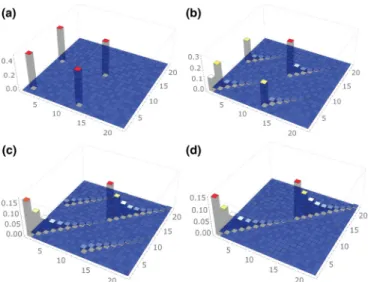
FIG. 6. Density matrix representation of decoherence and ther-malization. Each matrix is plotted during step (iii) after a delay time τ of (a) 0 ms, (b) 190 ms, (c) 950 ms, and (d) 3.8 s. The states labeled 1–22 in the figure correspond to the basis states
{00,01, . . . ,09,010,10,11, . . . ,19,110}. The relevant parameters are
ω2=10 GHz,γ =1 Hz, andTenv=0.2 K.
APPENDIX A: NUMERICAL METHODS
In the main text we investigated two main problems. The first is the interaction of a mechanical entangled state with the bath of one resonator. We use a numerical differential equation solver to solve the master equation (3) with density matrices. After some algebraic manipulation, this can be rewritten as a set of differential equations
ρ= ∞
p,q,r,s=0
apqrs(t)|pr qs|, (A1)
[x,ˆ [ ˆx,|r2s|2]]=
k,l
klrs|k2l|2, (A2)
[ ˆx,{p,ˆ |r2s|2}]=
k,l
klrs|k2l|2, (A3)
˙
apqrs(t)= −i[ω1(p−q)+ω2(r−s)]apqrs(t)
−D
¯ h2
∞
k,l=0
rsklapqkl(t)
−iγ
¯ h
∞
k,l=0
rsklapqkl(t). (A4)
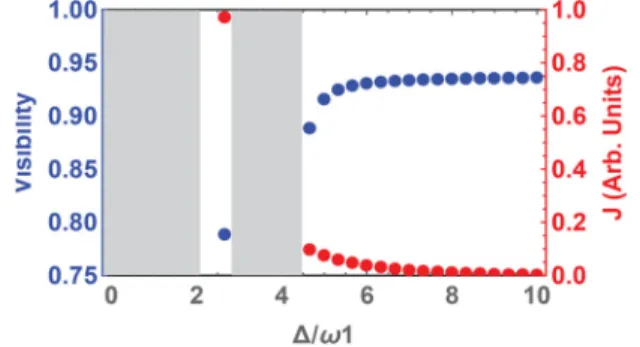
FIG. 7. Visibility as a function of detuning. Grayed out regions have too highJcorJhto run the experiment. The value ofJdepends
on the exact experimental parameters, so it is normalized to the highest value. The parameters areω2/ω1=2,ω1/κ=10,nt h=0.01,p=
0.01,ξ tr =10−6, andη=0.01.
elements decay away. These effects match with the expected behavior for thermalization and decoherence.
We also need to simulate a mechanical-mechanical π/2 pulse. Because it is equivalent to a beam splitter, the ef-fect on the two modes is the same. Here we expand the density matrix to have basis states {00,01, . . . ,0n,10, 11, . . . ,1n,n0,n1, . . . ,nn}. The beam-splitter interaction con-serves energy, so it can be represented as ann2×n2 transfor-mation matrix, which recombines the elements of common phonon number. The transformation matrixSBS for the three
lowest-energy levels with basis states{00,01,10,02,11,20}is
SBS = ⎛ ⎜ ⎜ ⎜ ⎜ ⎜ ⎜ ⎝
1 0 0 0 0 0
0 1/√2 −1/√2 0 0 0
0 1/√2 1/√2 0 0 0
0 0 0 1/2 −1/√2 1/2
0 0 0 −1/2 0 1/2
0 0 0 1/2 1/√2 1/2
⎞ ⎟ ⎟ ⎟ ⎟ ⎟ ⎟ ⎠
.
(A5)
After the beam-splitter interaction the density matrix ρ is ST
BSρSBS. The combination of these two techniques lets us
fully model how the ideal state interacts with its thermal environment.
The other problem we investigate is how various experi-mental imperfections can impact the initial visibility of the experiment. For this we use density matrices with basis states going up ton=3. To model imperfect cooling in step (i) we start with a thermal state of both resonators. The modeling of step (ii) is a little more complex. A successful postselection means that one phonon has been added to resonator 1. However, with probability p, the phonon occupation should be incre-mented by 2, with probabilityp2by 3, and so on. Conversely,
if there is a dark count or leaked pulse photon (probability ξ tr) the phonon occupation should remain the same. Finally,
we implement the beam splitter, step (iii), in the same way as above. We add in an additional cooling pulse with a probability Jc/J of removing a phonon from one of the resonators and a
heating pulse with a probabilityJh/J of adding a phonon to
a resonator. The cooling matrix transformationScwith basis
states{00,01,02,10,11,12,20,21,22}is
Sc=
1−Jc J
I +Jc J
×
⎛ ⎜ ⎜ ⎜ ⎜ ⎜ ⎜ ⎜ ⎜ ⎜ ⎜ ⎜ ⎜ ⎝
0 1 0 1 0 0 0 0 0
0 0 √2 0 1 0 0 0 0
0 0 0 0 0 1 0 0 0
0 0 0 0 1 0 √2 0 0
0 0 0 0 0 √2 0 √2 0
0 0 0 0 0 0 0 0 √2
0 0 0 0 0 0 0 1 0
0 0 0 0 0 0 0 0 √2
0 0 0 0 0 0 0 0 0
⎞ ⎟ ⎟ ⎟ ⎟ ⎟ ⎟ ⎟ ⎟ ⎟ ⎟ ⎟ ⎟ ⎠
.
(A6)
The heating matrix transformation isST
c. All of these
imperfec-tions are combined to determine their impact on the proposed experiment.
APPENDIX B: ADDITIONAL EXPERIMENTAL CONSIDERATIONS
The first additional consideration relates to the pulses used in the experiment. It is possible to perform the experiment with simple square-shaped pulses. However, it is more efficient to use an exponentially shaped pulse, resulting in a more even interaction time [49]. We suggest using pulses of that shape, as is performed in [35]. In particular, it is crucial that the area under the readout pulse0∞ncav(t)g1dtisπ/2 to fully read out the phonon occupation of resonator 1.
We also consider the most effective detuning of the two laser beams for performing aπ/2 pulse. The two-laser tone exchange method relies on exchanging the state of each mechanical resonator with that of the cavity. This is fastest if the two laser beams are red detuned toω1andω2. However, at this detuning quantum information leaks out of the cavity, leading to large values ofJcandJh. In Fig.7we examine the
effects of the average detuningof these two laser beams. Ideally, the two beams should be quite far detuned from the cavity, but there is a tradeoff between efficient exchange and the exchange rateJ, shown in red [44]. The best detuning depends on experimental parameters such as sideband resolution and frequency of the resonators.
[1] M. Aspelmeyer, T. J. Kippenberg, and F. Marquardt,Rev. Mod. Phys.86,1391(2014).
[2] M. Goryachev, D. L. Creedon, E. N. Ivanov, S. Galliou, R. Bourquin, and M. E. Tobar, Appl. Phys. Lett. 100, 243504
(2012).
[3] Y. Tsaturyan, A. Barg, E. S. Polzik, and A. Schliesser, Nat. Nanotechnol. 12, 776
(2017).
[4] M. Yuan, M. A. Cohen, and G. A. Steele,Appl. Phys. Lett.107,
[5] C. Reinhardt, T. Müller, A. Bourassa, and J. C. Sankey,Phys. Rev. X6,021001(2016).
[6] R. A. Norte, J. P. Moura, and S. Gröblacher,Phys. Rev. Lett. 116,147202(2016).
[7] R. Leijssen, G. R. La Gala, L. Freisem, J. T. Muhonen, and E. Verhagen,Nat. Commun.8,16024(2017).
[8] A. D. O’Connell, M. Hofheinz, M. Ansmann, R. C. Bialczak, M. Lenander, E. Lucero, M. Neeley, D. Sank, H. Wang, M. Weides
et al.,Nature (London)464,697(2010).
[9] F. Lecocq, J. D. Teufel, J. Aumentado, and R. W. Simmonds,
Nat. Phys.11,635(2015).
[10] R. Riedinger, S. Hong, R. A. Norte, J. A. Slater, J. Shang, A. G. Krause, V. Anant, M. Aspelmeyer, and S. Gröblacher,
Nature (London)530,313(2016).
[11] A. Bassi, K. Lochan, S. Satin, T. P. Singh, and H. Ulbricht,
Rev. Mod. Phys.85,471(2013).
[12] A. Bassi and G. Ghirardi,Phys. Rep.379,257(2003). [13] L. Diósi,Phys. Rev. A40,1165(1989).
[14] R. Penrose,Gen. Relat. Gravit.28,581(1996).
[15] Y. Chu, P. Kharel, W. H. Renninger, L. D. Burkhart, L. Frunzio, P. T. Rakich, and R. J. Schoelkopf,Science358,199(2017). [16] W. Marshall, C. Simon, R. Penrose, and D. Bouwmeester,Phys.
Rev. Lett.91,130401(2003).
[17] B. Pepper, R. Ghobadi, E. Jeffrey, C. Simon, and D. Bouwmeester,Phys. Rev. Lett.109,023601(2012).
[18] P. Sekatski, M. Aspelmeyer, and N. Sangouard,Phys. Rev. Lett. 112,080502(2014).
[19] D. Vitali, S. Mancini, and P. Tombesi,J. Phys. A40,8055(2007). [20] M. J. Hartmann and M. B. Plenio,Phys. Rev. Lett.101,200503
(2008).
[21] K. Børkje, A. Nunnenkamp, and S. M. Girvin,Phys. Rev. Lett. 107,123601(2011).
[22] M. J. Woolley and A. A. Clerk,Phys. Rev. A89,063805(2014). [23] J. Li, I. M. Haghighi, N. Malossi, S. Zippilli, and D. Vitali,New
J. Phys.17,103037(2015).
[24] J. Li, G. Li, S. Zippilli, D. Vitali, and T. Zhang,Phys. Rev. A95,
043819(2017).
[25] J. Zhang, T. Zhang, and J. Li,Phys. Rev. A95,012141(2017). [26] U. Akram, W. P. Bowen, and G. J. Milburn,New J. Phys.15,
093007(2013).
[27] H. Flayac and V. Savona,Phys. Rev. Lett.113,143603(2014). [28] R. Blatt and D. Wineland,Nature (London)453,1008(2008). [29] K. C. Lee, M. R. Sprague, B. J. Sussman, J. Nunn, N. K.
Langford, X.-M. Jin, T. Champion, P. Michelberger, K. F. Reim, D. Englandet al.,Science334,1253(2011).
[30] R. Riedinger, A. Wallucks, I. Marinkovic, C. Löschnauer, M. Aspelmeyer, S. Hong, and S. Gröblacher, Nature 556, 473
(2018).
[31] F. Marquardt, J. P. Chen, A. A. Clerk, and S. M. Girvin,Phys. Rev. Lett.99,093902(2007).
[32] J. Chan, T. P. M. Alegre, A. H. Safavi-Naeini, J. T. Hill, A. Krause, S. Gröblacher, M. Aspelmeyer, and O. Painter,Nature (London)478,89(2011).
[33] J. D. Teufel, T. Donner, D. Li, J. W. Harlow, M. S. Allman, K. Cicak, A. J. Sirois, J. D. Whittaker, K. W. Lehnert, and R. W. Simmonds,Nature (London)475,359(2011).
[34] C. Galland, N. Sangouard, N. Piro, N. Gisin, and T. J. Kippen-berg,Phys. Rev. Lett.112,143602(2014).
[35] S. Hong, R. Riedinger, I. Marinković, A. Wallucks, S. G. Hofer, R. A. Norte, M. Aspelmeyer, and S. Gröblacher,Science358,
203(2017).
[36] Q. Lin, J. Rosenberg, D. Chang, R. Camacho, M. Eichenfield, K. J. Vahala, and O. Painter,Nat. Photon.4,236(2010). [37] H. Okamoto, A. Gourgout, C.-Y. Chang, K. Onomitsu, I.
Mah-boob, E. Y. Chang, and H. Yamaguchi,Nat. Phys.9,480(2013). [38] A. B. Shkarin, N. E. Flowers-Jacobs, S. W. Hoch, A. D. Kashkanova, C. Deutsch, J. Reichel, and J. G. E. Harris,Phys. Rev. Lett.112,013602(2014).
[39] A. Noguchi, R. Yamazaki, M. Ataka, H. Fujita, Y. Tabuchi, T. Ishikawa, K. Usami, and Y. Nakamura,New J. Phys.18,103036
(2016).
[40] E. Damskägg, J.-M. Pirkkalainen, and M. A. Sillanpää,J. Opt. 18,104003(2016).
[41] K. Fang, M. H. Matheny, X. Luan, and O. Painter,Nat. Photon. 10,489(2016).
[42] M. Pernpeintner, P. Schmidt, D. Schwienbacher, R. Gross, and H. Huebl,arXiv:1612.07511.
[43] L. F. Buchmann and D. M. Stamper-Kurn,Phys. Rev. A92,
013851(2015).
[44] M. J. Weaver, F. Buters, F. Luna, H. Eerkens, K. Heeck, S. de Man, and D. Bouwmeester,Nat. Commun.8,824(2017). [45] A. O. Caldeira and A. J. Leggett,Physica A121,587(1983). [46] W. H. Zurek,Rev. Mod. Phys.75,715(2003).
[47] A. Jöckel, A. Faber, T. Kampschulte, M. Korppi, M. T. Rakher, and P. Treutlein,Nat. Nanotechnol.10,55(2015).
[48] H. Zhong, G. Fläschner, A. Schwarz, R. Wiesendanger, P. Christoph, T. Wagner, A. Bick, C. Staarmann, B. Abeln, K. Sengstock, and C. Becker,Rev. Sci. Instrum.88,023115(2017). [49] S. G. Hofer, W. Wieczorek, M. Aspelmeyer, and K. Hammerer,