PARENTAL DECISION-MAKING PROCESSES:
HISTORICAL AND SOCIO-CULTURAL INFLUENCES ON EVERYDAY PARENTING OCCUPATIONS
Chetna Sethi
A dissertation submitted to the faculty at the University of North Carolina at Chapel Hill in partial fulfillment of the requirements for the degree of Doctor of Philosophy in the Department
of Allied Health Sciences (Occupational Science).
Chapel Hill 2017
ABSTRACT
Chetna Sethi: Parental Decision-Making Processes:
Historical and Socio-Cultural Influences on Everyday Parenting Occupations (Under the direction of Brian Boyd)
ACKNOWLEDGEMENTS
TABLE OF CONTENTS
LIST OF TABLES ... ix
LIST OF FIGURES ... x
LIST OF ABBREVIATIONS ... xi
CHAPTER 1: INTRODUCTION ... 1
Background ... 1
Purpose of Study ... 3
Frames of Reference ... 4
Transactional perspective on occupation. ... 4
Life course sociology. ... 7
Conclusion ... 9
CHAPTER 2: LITERATURE REVIEW ... 11
Family Theories ... 12
Study of Families in Occupational Science ... 14
Family routines and rituals. ... 14
Parenting occupations. ... 15
Gaps in the occupational science literature. ... 17
Study of Parenting Outside of Occupational Science ... 18
Perceptions about child behavior. ... 19
Communication style. ... 19
Parenting style. ... 20
Family situation. ... 23
Socio-demographic factors. ... 23
Gaps in the literature. ... 25
Models of Parenting Children with Behavioral Challenges ... 26
Social information processing. ... 27
Addressing Gaps in the Literature: The Transactional Perspective ... 28
Conclusion ... 30
CHAPTER 3: METHODOLOGY ... 32
Emergence of Grounded Theory ... 32
Schools of Grounded Theory ... 33
Rationale for Employing Constructivist Grounded Theory ... 35
Role of the Literature Review in Grounded Theory ... 36
Sample Characteristics ... 37
Recruitment. ... 38
Data Collection ... 40
Data management. ... 42
Development of interview guide. ... 42
Changes to interview questions. ... 43
Simultaneous Data Collection and Analysis ... 43
Coding... 44
Constant comparison. ... 46
Memo-writing. ... 46
Theoretical sampling. ... 47
Development of Conceptual Framework ... 48
Mothers as study participants. ... 50
Sample size. ... 50
Study of typically developing population. ... 50
Conclusion ... 50
CHAPTER 4: RESULTS ... 52
Mothering as a Relational Role... 53
Caregiver. ... 54
Nurturer. ... 55
Educator. ... 56
Protector. ... 56
Learner. ... 57
Summary. ... 58
Conditions Influencing Mothering Occupations ... 59
Past. ... 59
Present. ... 61
Future. ... 63
Summary. ... 64
The Transactional Framework of Parental Decision-Making ... 65
Is it necessary to intervene? ... 66
How to achieve desired result? ... 69
Embodied action ... 72
Was the intervention successful? ... 74
Contemplation. ... 75
Summary. ... 79
CHAPTER 5: DISCUSSION AND CONCLUSION ... 82
Discussion of Findings ... 83
Mothering as a relational role. ... 85
Conditions influencing occupations. ... 88
The transactional framework of parental decision-making (TFPD). ... 91
Models of Parenting Children with Behavior Challenges ... 97
Social information processing ... 98
Implications for Research and Practice ... 99
Future Research ... 100
Limitations ... 101
Conclusion ... 103
APPENDIX A: CONSENT FORM (APPROVED BY UNC IRB)... 104
APPENDIX B: EXAMPLE INTERVIEW QUESTIONS ... 108
APPENDIX C: RECRUITMENT FLIER ... 110
APPENDIX D: CAREGIVER & CHILD DEMOGRAPHIC FORM ... 111
APPENDIX E: EXAMPLE OF REFLECTIVE MEMO ... 113
APPENDIX F: EXAMPLE OF ANALYTIC MEMO... 114
APPENDIX G: TRANSACTIONAL FRAMEWORK OF PARENTAL DECISION-MAKING ... 115
LIST OF TABLES
Table 3.1: Caregiver demographics ... 40
Table 3.2: Application of sensitizing concepts for data collection ... 43
Table 3.3: Example of initial and focused coding ... 45
LIST OF FIGURES
LIST OF ABBREVIATIONS CAD Cumulative advantage/disadvantage
CHIP Children’s Health Improvement Program OS Occupational science
SES Socio-economic status
CHAPTER 1: INTRODUCTION Background
A mother’s response to her child’s behavior is influenced by many factors. For example, her decisions about parenting will not only be influenced by her cultural understanding of what parenting should look like, but also, her memories of being parented. In addition, the social structure and support the mother has for parenting are likely to inform parental decision-making, from nurturing family members acting as a positive influence to an unsafe neighborhood perhaps negatively influencing parenting decisions. The current research that has focused primarily on descriptions of parenting has largely ignored the processes and decision-making behind
parenting practices. Many of these studies have described the “who” and the “what” of parenting practices, but have paid much less attention to the “how” and the “why”.
defined as “parenting”, most studies related to family routines have focused on the parents’ perspectives of the occupations the family engages in; family routines can thus be used as a proxy for parenting occupations. As stated above, these studies describe what parents do, but do not explore why or how parents decide what they do.
Parenting occupations also have been studied primarily as co-occupations (Pierce, 2003; Esdaile & Olson, 2004). According to Pierce (2003), “co-occupations are the most highly interactive types of occupation, in which the occupational experiences of the individuals
involved simply could not occur without the interactive responses of the other person or persons with whom the occupations are being experienced.... They are a synchronous back and forth between the occupational experiences of the individuals involved, the action of one shaping the action of the other in a close match.” (p. 199). Although the proponents of co-occupation have since conceded that mothering can take place in a situation where no in-person back and forth is taking place, this definition is an incomplete depiction of parenting or mothering in two ways. First, mothering is described here as an occupation rather than a relational role that is fulfilled by many occupations. Second, this definition relies heavily on the bidirectional influences between parent and child, ignoring the transactional experience.
Merrick, 2013; Dixon, Browne, & Hamilton-Giachrists, 2009), breaking the cycle of violence (Dixon et al., 2009), and preventing violence or abuse. Understanding the degree to which parents of young children with behavior problems use intergenerational knowledge (i.e., knowledge transmitted from their own parents / childhood experiences) to manage the “everyday” parenting decisions is missing from the literature. By understanding how parents handle everyday / routine interactions, it will shed light on how these situations do or don’t escalate into aforementioned maladaptive parent-child interactions.
Previous research also has established that intergenerational transmission is not absolute; rather it depends on multiple situational factors. Some of these factors include attitudes towards parenting, socio-economic status (SES), parental mental health, substance abuse, and the presence of a nurturing partner (Conger et al., 2013; Jaffee et al., 2013). Systems theorists also support the notion that individuals can form mutually beneficial relationships with their
environments, which can in turn translate into positive or negative parenting behaviors (Belsky, 1984; Bronfenbrenner, 1989). Thus, determining the parent-identified situational factors that influence this intergenerational transmission can provide a holistic view of the situation and create a place for early intervention.
Purpose of Study
The current research on parenting within occupational science has focused on describing parenting occupations. The contribution of this research is expected to increase the
understanding of the processes involved in everyday interactions between mothers and their typically developing children rather than simply describing parenting occupations. Thus, the broad research question explored in this study is:
a. How are the negotiations of everyday interactions similar to or different from those in the parent’s family of origin?
b. What are the parent-identified situational factors leading to these similarities and/or differences?
The contribution of the current research will be significant because it has led to the development of a conceptual framework of the processes involved in everyday parental decision-making. For example, a parent being spanked as a child (i.e. a past intergenerational knowledge / experience) could contribute to a negative response from that parent following their child’s tantrum; however, current parent-identified situational factors, such as poor sleep contributing to a parent’s irritability, may increase the likelihood of a negative response occurring.
Alternatively, the parent may choose to employ techniques learned at a parent-training seminar (another example of a situational factor); perhaps then leading the parent to rely less on
intergenerational knowledge. Furthermore, extant literature on factors influencing parenting practices has considered parent-child relationships as bidirectional interactions. As such, the exploration of the historical, social and cultural context, or the family situation as a whole has been minimal. The conceptual framework that has emerged from this research is the
Transactional Framework of Parental Decision-Making. Frames of Reference
Guided by the principles of the transactional perspective (Dickie, Cutchin, & Humphry, 2006) and life course sociology (Elder, 1998), this study aims to capture the social, cultural, historical, and temporal influences on everyday parenting practices.
his or her environment or another individual. Dickie et al. (2006) defined self-action as based on the notion of a single, unitary agent whose action originates solely from within. They also
suggested that inter-action implies separate entities coming together in a related action originated by one or the other or both. Inspired by symbolic interactionism and the pragmatist traditions of John Dewey, these authors have critiqued the emphasis on individualism and proposed a
transactional perspective. The philosophical tradition of the transactional perspective, known as pragmatism, dates back to the 1870s. This tradition continued with the teachings of American pragmatists Charles Sanders Peirce and William James at Harvard University in the late 1890s and early 1900s. Building on the work of Peirce and James, George Mead extended pragmatist ideas and served as one of the key originators of symbolic interactionism (Hickman, 1998). As a sociological perspective, symbolic interactionism considers individuals to be co-constructors within society. That is, people interpret their world from others’ responses to their actions and based on those interpretations, they act again (Nayar, 2012). Mead and John Dewey worked together at the Chicago School of Pragmatism, which Dewey founded at the University of Chicago; in 1905, he directed another pragmatism center at Columbia University. Dewey was and continues to be known as the premier American pragmatist philosopher (Hickman, 1998) on the basis of whom Dickie and her colleagues have described the transactional perspective on occupation.
The transactional perspective overcomes the boundaries between person and
environment, and between past, present, and future (Cutchin & Dickie, 2013). The emphasis is on going beyond the individual to encompass social, cultural, physical, spatial and temporal environments.
acquired predispositions or ways to respond to situations (Cutchin & Dickie, 2012). Through the use of habits and habit repertoires, which have been acquired through our oneness with culture, it is believed that we “functionally coordinate” with our environments when “problematic
Life course sociology. In order to understand the social and cultural existence of
families, life course sociology provides an opportunity to study the occupations of parenting in a holistic manner. The life course perspective as a concept describes a sequence of age-graded roles, which are a consequence of opportunities, expectations and limitations. Expectations are typically decided by societal norms and structure the life course. Thus, the life course perspective as a paradigm examines situations holistically, taking into account concepts like social roles, historical contexts, institutions such as education and family, linked lives, timing of events, and human agency, to mention a few (Elder, 1998). For the purpose of this study, two distinct life course concepts were used as guiding points to study the occupations of parenting. First, to illustrate the additive or leveling effects of adverse or favorable situations, cumulative
advantage/disadvantage is discussed. Next, in order to examine parenting roles in the contexts of
other roles, the concept of pathways is described.
Cumulative advantage/disadvantage (CAD). Cumulative advantage refers to the idea
accumulated and/or dissipated over the life course in the satisfaction of human needs and wants. On the other hand, life course risks are defined as the differential likelihoods of exposure to adverse conditions (disadvantages) or structural opportunities (advantages) for the accumulation, protection, or depletion of forms of life course capital (O’Rand, 2006).
In the current study, the concept of CAD is best exemplified by the conditions that influence parenting practices. Mothers rely heavily on their past experiences of being parented, as well as the resources available to them, such as previous education, as capital or risk for their current parenting skills. These conditions are described in detail in Chapter 4 and further
discussed in Chapter 5.
Pathways. In agreement with the concept of CAD, Rutter (1989) suggested that
continuities would occur because children carry with them the results of earlier learning and earlier structural and functional changes. However, Rutter (1989) argued that this does not necessarily mean that a person’s characteristics at one age will predict the degree or type of change over a later time period. These changes are more likely detected by focusing on the
roles, which structure the life course. In fact, according to MacMillan and Copher (2005), life courses are structured to the extent that they are differentially defined by the order and timing of multiple social roles.
MacMillan and Copher (2005) also described family role schemas and discussed the varying meanings that these schemas provide to different family roles. They illustrated, for example, the different social meaning associated with parenthood (a social role) within or outside marriage. This difference in meaning influences the trajectory of such a social role and thus is important to keep in mind when attempting to research families. In essence, family role schemas are the cultural tools that define what family roles are (MacMillan & Copher, 2005). Further, family roles within larger role configurations and pathways involve interdependencies with extra-family roles of school and work. For example, MacMillan and Copher’s (2005) example of teen parenting suggests that parenthood may foster transitions out of schooling and undermines educational attainment over the life course. Thus, social roles and the fulfillment of such roles in light of other roles becomes important to study in order to get a holistic picture of family
dynamics.
In the current study, multiple social roles fulfilled by mothers, such as student, wife, or daughter, are apparent. However, this research goes beyond the social roles, exploring also the multiple relational roles within motherhood. Some of these include a mother’s role as protector, mentor, nurturer, caregiver and learner. The conceptualization of mothering as a relational role is further discussed in Chapter 4.
Conclusion
as a relational role and recognize the importance of social roles and how they interconnect with one another. The concert of mothering roles that encompasses many habits and occupations provides an opportunity to explore these occupations at multiple levels. The current research conceptualizes mothering as a relational role, outlining the conditions that influence mothering occupations spanning over a temporal context, and finally presents a transactional framework of parental decision-making.
In Chapter 2, I present a review of the literature with a particular focus on the study of families, family theories, and existing theories of parenting practices. Chapter 3 will outline the methods used for the study and the rationale for using grounded theory methodology. In Chapter 4, I present the findings from the current study including the Transactional Framework of
CHAPTER 2: LITERATURE REVIEW
There are differing views regarding whether (or how) to conduct a literature review as part of grounded theory studies. Some argue that since grounded theory is an emergent
methodology, the literature review process should be delayed as much as possible. Glaser was a strong believer that conducting a literature review early in the process will bias the researcher and the emergence of categories will then be tainted by the knowledge already gained. On the other hand, some scholars believe that all researchers bring a level of prior knowledge to their research (Mills, Bonner & Francis, 2006) and this must be recognized in order to complete a successful grounded theory study. Charmaz (2014) believes that conducting a literature review is essential, but strongly emphasizes that the existing literature should be used as a source of “sensitizing concepts” which can guide the data collection and analysis process. The purpose of acknowledging sensitizing concepts is to create a reflexive and informed process of data
collection and analysis. Thus, following Charmaz’s perspective, the literature presented here is done so to help situate the data collection and analysis that will be discussed in Chapter 3.
This chapter has been organized into four sections. The first section of this review
highlights existing family theories and how they guide the study of parenting practices. Although there is much debate about reviewing existing theories before a grounded theory project,
highlights research from outside OS regarding known influences on parenting practices to identify sensitizing concepts for the current research. Finally, existing models of parenting children with behavior problems are discussed, and a rationale for the current study is presented. Family Theories
Some researchers within the fields of sociology and psychology appear to approach and study the family as a thing-like entity, that is, an object that can be objectively observed and described. Yet, family theories have progressively moved from a child-centered individualistic approach to a family-centered systems approach. The theories discussed below highlight this progression. The current research aims to provide a more holistic approach than existing theories to understand parental decision-making.
One of the most prominent theories within developmental psychology is
Bronfrenbrenner’s (1994) ecological model of human development. He posited that proximal as well as distal forces influenced a child’s behavior, and thus focused on the interactions between the microsystem (e.g., family and school), mesosystem (e.g., relationship between home and school), exosystem (e.g., relationship between home and parent’s workplace), macrosystem (e.g., society and culture), and chronosystems (changes over the life course) in relation to the
The evolution of family theories also led scholars to develop and apply a transactional model of child development (Sameroff, 2009; Fiese, 2007). Within this transactional model, the experience of an individual would somehow change, adapt or create something new as a result of the transaction with the environment over time. Although a shift in perspective from systems theory towards a more inclusive view of the person and environment, Sameroff (2009) still believed that there are certain experiences that failed to become transactions (and remained interactions) if there was no change taking place over time. For example, if a routine interaction between two people were somehow disrupted, it would be considered a transaction only if they adapted to the new situation over time. Sameroff’s argument was that if a change or adaptation does not take place, then no transaction takes place. However, it can be argued that humans are ever changing social beings and all interactions are in fact transactions; therefore, a false
distinction between the two should not exist. This view is more consistent with the occupational science view of the transactional perspective.
Another developmental model that provided an understanding of the complexities of parenting was the developmental niche described by Harkness et al. (2007). These authors posited that the developmental niche included three domains: settings (physical and social, as well as a child’s daily routine), customs (customs and habits of care), and caretaker psychology (parental ethnotheories or the values and beliefs that guide parent behavior). Culture was at the heart of this developmental niche because it was presumed to be the guiding principle behind all domains. In other words, a person’s cultural embeddedness and history guides their perspectives about parenting strategies, customs of care and values and beliefs.
mutually constitutive in a truly interpenetrating manner. These researchers, in an attempt to describe the navigation between cultural worlds, recognized that individual, family and
community level constructs operate together. Mistry and Wu believe that family-level assets and ethnotheories are situated in community-level constructs representing a mutuality that surpasses simple bidirectional influences. The models of Harkness et al. (2007) and Mistry and Wu (2010) are most consistent with the transactional perspective described within occupational science.
The transactional view on occupation would suggest that the social, cultural and historical influences on parenting practices should guide future research on families within occupational science. The current project acknowledges the shortcomings of existing theories and aims to build upon models that articulate the social, cultural and historical influences on parental decision-making, which are lacking in the existing occupational science literature. Study of Families in Occupational Science
Segal (1999) recognized that individual occupations are different from family
occupations. She urged researchers that to study families, we must move beyond the individual. She described “doing for others”, or a commitment to sacrificing the needs of one for another within a family, and recognized that this could not be studied at an individual level. Following her argument, occupational scientists have attempted to study family occupations through the study of family routines and rituals. Similar to family theories described above, parenting
occupations also have been studied primarily as co-occupations with an individualistic focus, and a more recent emphasis on family occupations as being socially co-constructed. Each of these areas of scholarship is described below.
structure that allow people to develop and maintain healthful lives (Koome, Hocking, & Sutton, 2012). For this reason, family routines and rituals, and disruptions to family routines, have been researched over several decades and in many contexts (Fiese et al., 2002). Routines and rituals have been defined differently by different scholars (Segal, 2004). The most commonly used description is that routines are undertaken for the purpose of accomplishing an instrumental task or goal, whereas rituals are described as acts that carry some symbolic meaning. Some scholars have placed these on a continuum (Evans & Rodger, 2008), while others have described them as hierarchical, nesting within the larger realm of occupations. Regardless of the way these terms have been defined, it has been found that the maintenance of routines and rituals promotes health and well-being (Downs, 2008; Evans & Rodger, 2008; Koome et al., 2012), and helps to create a family identity (Evans & Rodger, 2008; Fiese, 2007; Koome et al., 2012).
Within the literature that has focused on family routines, researchers have attempted to study a variety of contexts. For example, Downs (2008) studied leisure routines of families with children with disabilities and found that these leisure activities led to a sense of normalcy, control and happiness in these families. She also found that maintaining healthy leisure routines resulted in increased levels of self-efficacy for parents. Similarly, Evans and Rodger (2008) while studying mealtime and bedtime routines of typically developing children, found that routines gave them a sense of belonging and social support while at the same time helping develop a sense of family identity. Researchers have thus used family routines as a means to better understand family practices, and in turn, to better describe family occupations.
actions of one influence and shape the actions of another (Pierce, 2009). Although not restricted to the parent-child dyad, co-occupations are typically described as the back and forth interactions that occur between a mother and a child. Further, co-occupations have been described as highly interactive; however, Pierce (2009) has argued that this interaction need not be face to face. For example, if a child spreads out his/her toys in the morning and the mother picks them up and puts them away in the evening, this qualifies as a co-occupation. However, the person-centered
approach of co-occupations is not fully able to capture the complexities that are associated with family beliefs and values, or the influence of other family members on parenting occupations.
In a similar attempt, Larson (2000) used “orchestration” as a metaphor for occupations and applied this to mothering occupations. She recognized the importance of decision-making and thought processes that are involved in occupations associated with mothering. For example, she included the constructs of planning, organizing and forecasting within what she called, “the dance that mothers do”. Larson also recognized the influence of the temporal context with respect to mothering, as she explored mothers’ use of planning for the immediate future as well as forecasting their child’s long term future.
has utilized this concept as well as recognized the importance of social and historical influences on fathering occupations. He further articulated that past events and future goals influence present actions. This life course perspective is also in line with the transactional view on occupation of diminishing the boundaries between past, present and future (Cutchin & Dickie, 2013), and shifting the focus away from an individualistic approach.
Gaps in the occupational science literature. Although an excellent way to describe family occupations, the routines literature has almost exclusively focused on families of children with disabilities with very few exceptions (c.f.e. Evans & Rodger, 2012). Furthermore, the research that has focused on family routines and rituals has utilized parent interviews with few observations of the family “doing” or “being.” This research has had an individualistic,
descriptive perspective and not one that focuses on process. As such, many of these studies have described the “who” and the “what” of family occupations, but have paid much less attention to the “how” and the “why”.
Similarly, the research associated with parenting as a co-occupation has generated descriptive knowledge with little attention to understanding parenting practices as being socially and culturally informed. Lawlor’s (2003; 2012) descriptions of childhood occupations and
decision-making, from nurturing family members acting as a positive influence to an unsafe neighborhood perhaps negatively influencing parenting decisions. The existing research that has focused
primarily on description has ignored the process and decision-making behind parenting practices. Primeau’s (2000) work illustrates this issue. She explored the “traditional” and “non-traditional” gender identities of parents with respect to household and child care tasks, and while an excellent description of mothers’ and fathers’ role identities, the study did not delve into the reasons for such ideologies and the cultural and social embeddedness of these role identities. The current research is process-oriented in that it has a focus on “how” and “why” social, cultural and temporal contexts inform parents’ decisions about everyday parenting occupations.
Moreover, the understanding of parenting within occupational science has conceptualized mothering (or parenting) as an occupation, or rather, co-occupation. The current research strives to apply a life course perspective and transactional perspective, to consider parenting as a relational role encompassing many occupations influenced by social, cultural, physical, spatial and temporal contexts. As with most definitions of occupation, the description of parenting practices in occupational science also has adhered to the false separation between individual and environment; person and culture; and past, present and future experiences. This project aims to eliminate such false separations and understand the parental decision-making situation as a whole.
Study of Parenting Outside of Occupational Science
factors that influence parenting. Before interviewing the mothers for the current research, the known factors that could influence parental decision-making were identified. The purpose of this section is to briefly describe some of the prominent literature about the known factors that influence parenting practices. These factors were used as what Charmaz has described as “sensitizing concepts” to guide the data collection and analysis process. These sensitizing
concepts are: parents’ perceptions about child behavior; parents’ communication style; parenting style; intergenerational transmission; family situation; and socio-demographic factors.
Perceptions about child behavior. One of the factors that influences parental practices is how parents perceive their child’s behavior (Benzies, Harrison, & Magill-Evans, 2004). For example, when a child throws a tantrum, the parent must actively consider how to respond. This decision-making can be based on what the parent believes the child’s intentions are. Parents may indulge in harsh parenting when the child is as young as 2 to 18 months of age, if they believe their child understands that their actions are wrong (Burchinal, Skinner, & Reznick, 2010). Burchinal et al. (2010) found that mothers who believed that their child was “pushing my
buttons” or “testing me” used this intentionality as a justification for harsher parenting strategies (e.g., giving a slap on the child’s hand, threatening to spank with a switch or belt).
By interviewing mothers about their child’s behavior and their response to it, the current research aims to gain a better understanding of the subjective perspectives about how mothers make decisions everyday.
and second, during adolescence when the child begins to physically and psychologically distance himself/herself from the parents (Dixon, Graber, & Brooks-Gunn, 2008). Positive
communication, or a healthy manner of conflict resolution, involves the parents’ use of
justification rather than forced compliance (e.g., a parent says to a child, “you are not allowed to play on the street” versus “you are not allowed to play on the street because there is a lot of traffic at this time”). Further, parents’ recognition of, and sensitivity towards, their child’s emotions during communication exchanges with their child leads to better conflict management (Laible & Thompson, 2002). In fact, parents’ use of positive conflict resolution strategies leads to children’s increased social competence, as children learn to apply these strategies during interactions with their peers or siblings.
The current research explores how mothers communicate with their children when behavioral challenges arise, keeping in mind that communications styles of the parent and child can influence parental responses.
Parenting style. Parenting styles have been extensively studied, and scholars have tried to categorize them, as well as identified the positive and negative child outcomes related to various parenting styles. However, many individual differences exist in parenting behaviors and concrete categories may not always work. Nonetheless, many scholars have identified categories such as authoritative, authoritarian, and permissive, and more recently the focus has been on parental supportiveness (Fulgini et al., 2013).
children that engaged in relational aggression, whereas positive parenting was associated with less relational aggression. Other scholars also have emphasized the relationship between harsh parenting and increased child behavioral problems (c.f.e. Patterson, 1992), and contrasted this with the relationships found between positive child outcomes and parental warmth and nurturing (Benzies et al., 2004; Harvey & Metcalfe, 2012).
In general, parenting styles are labels that can be influenced by other parenting practices. More specifically, a parent’s attitude towards their child, their personal communication style, and their supportiveness towards their child must all be considered in tandem when identifying a person’s parenting style.
Intergenerational transmission. Scientists and non-scientists alike agree that parenting practices are transmitted from one generation to the next (Belsky, Jaffee, Sligo, Woodward, & Silva, 2005; Caspi & Elder, 1988; Conger, Schofield, & Neppl, 2012). Most of this literature has focused on the intergenerational transmission of the specific parenting practices of spanking or corporal punishment and attitudes towards the same (Bower-Russa, 2005; Deater-Deckard, Lansford, Dodge, Pettit, & Bates, 2003). These studies typically explore child maltreatment, previous abuse and/or sexual abuse (Conger, Schofield, Neppl, & Merrick, 2013; Dixon,
Browne, & Hamilton-Giachrists et al., 2009), breaking the cycle of violence (Dixon et al., 2009), and preventing violence or abuse.
& Bright, 2014). One of the reasons this occurs is because there are influences on parenting besides one’s family of origin (Capaldi, Pears, Kerr, & Owen, 2008) that can break the cycle of abuse (Dixon et al., 2009). Some of these include the attitudes towards physical punishment (Deater-Deckard et al., 2003); gender of the parent (Lunkenheimer, Kittler, Olsen, & Kleinberg, 2006); and the presence of a safe, nurturing partner (Jaffee et al., 2013). For example, Deater-Deckard and colleagues found that adolescents who had been spanked by their own mothers were more approving of this discipline method, regardless of the overall frequency, timing, or chronicity of physical discipline they had received. Additionally, Lunkenheimer and colleagues found that for mothers, their own mother’s use of physical punishment significantly predicted their current endorsement of physical punishment; however, for fathers, perceived harshness of childhood discipline predicted current endorsement of physical punishment. Finally, repetition of harsh parenting across generations is less likely to occur if adults have “worked through” their negative childhood experiences, or if they have had corrective experiences in close, supportive relationships such as the marital relationship (Lunkenheimer et al., 2006).
Similarly, protective factors such as financial solvency and social support distinguished the people who successfully broke the cycle of abuse from those that maintained or initiated it (Dixon et al., 2009), and marital satisfaction moderated the intergenerational transmission of physical punishment for fathers, but not mothers (Lunkenheimer et al., 2006). In other words, marital conflict has been shown to be more predictive of fathers’ use of physical punishment
than that of mothers.
decision-making.
Family situation. Many parents have identified that their situation as a whole impacts their decisions regarding parenting. Some of these situational factors include marital conflict, family stress, socio-economic status, and chronic illness (Benzies et al., 2004). In addition, family restructuring or transitions play a role in parenting strategies as well as influence child outcomes (Patterson, Forgatch, Yoerger, & Stoolmiller, 1998). The overall functioning of a family, in particular as related to lower parent education, poorer socio-economic status, and disrupted family routines has been associated with family chaos. Apart from disrupted family routines, chaos is characterized by noise and over-crowding of the home. Chaos within the home has been related to poor language and cognitive outcomes for children (Vernon-Feagons et al., 2012) as well as associated with more behavior problems (Deater-Deckard et al., 2009).
In addition, inconsistent discipline and disrupted family practices can lead to poor effortful control in children, which is associated with higher levels of behavior problems. Further, effortful control is associated with the development of morality, conscience, fewer behavioral challenges and improved social competence in children (Poehlmann, Burson, & Weymouth, 2014). As such, the emergence of effortful control in children has thus been regarded as a protective factor for children experiencing difficult family situations. Therefore, it is
important to recognize parent-identified situational factors that can act as risk or protective factors during disruptive family situations.
exhibit externalizing behavior problems, they are associated with harsher responses from parents across ethnic groups (Polaha, Larzelere, Shapiro, & Pettit, 2004). In regards to parent gender, maternal uninvolvement is associated with increased relational aggression in children, but not paternal (Kawabata et al., 2011). Yet, the same authors found that paternal psychological control was associated with higher levels of relational aggression, especially in girls. Based on parents’ perceptions of traditional gender norms, subtle differences also may exist in parental responses towards child behavior.
It also has been well documented that ethnic differences exist in parenting practices. Researchers have found, for example, that African-American and Hispanic mothers are less likely to read to their children than European-American mothers in the general population as well as in low-income samples (Brooks-Gunn & Markman, 2005), and that European-American mothers are more likely to use child intentionality as an excuse for harsher parenting than African-American or Latino-American mothers (Burchinal et al., 2010). Other examples of ethnic differences also exist in overall parental supportiveness and respect for parental authority. Fulgini et al. (2013) reported that Latino-American and African-American mothers showed decreasing parent supportiveness towards their children over time. In a different study, African-American and Latino-African-American girls showed more respect for authority towards their parents than did European-American girls (Dixon et al., 2008). More respect for parental authority was in turn associated with fewer conflict situations between parents and children.
European-American boys in contrast to African-European-American boys even if both groups were harshly parented. This indicates that harsh parenting could be more detrimental to European-American children than to African-American children (Iruka, 2009). One of the reasons for this difference has been hypothesized as the normativeness of parenting practices as being different for different
ethnicities (Lansford et al., 2012). In other words, what is considered the norm for African-American mothers is different from the norm for European-African-American or Hispanic mothers. This differential scale of what is considered effective parenting in different ethnicities appears to translate into child outcomes. Parents rely on cultural influences to develop their parenting theory (Julian, McKenry, & McKelvey, 1994); thus, it is important to recognize that parenting theory or how one parents their children can be different based on culture and ethnicity.
Gaps in the literature. Most of the literature related to factors that influence parenting practices has considered parent-child relationships as bidirectional interactions. As such, the exploration of the social and cultural context in which the family operates, or the family situation as a whole has not always been considered. In many studies, ethnicity, demographics, or socio-economic status have been identified as “control variables”, or variables that may mediate or moderate the relationship between parenting practices and child outcomes. These correlational studies have enhanced knowledge about parenting practices, and have acknowledged the social and cultural context but have failed to understand the family situation as a whole. Spicer (2010) has argued that culture drives the hopes and dreams that parents have for their children and that culture influences the way parents perceive parenting advice. That said, in too many of our studies of parenting, ethnicity is used as a proxy for culture which creates inaccurate
outcomes. Many of the parenting differences highlighted in the literature could be generalized across ethnicities (Iruka, 2009), but not across cultures. For this reason, although it is beneficial to understand how ethnic differences mediate parenting practices, it may be more beneficial to understand how cultural processes shape parental decision-making practices as they relate to child outcomes.
In addition, most of these studies have used quantitative modes of inquiry, and thus have operationalized and quantified some subjective factors such as maternal warmth and
supportiveness. Although valid and reliable scales have been used to measure such factors and the studies themselves are quite rigorous, qualitative study of these constructs will further existing knowledge through a more in-depth and rich exploration of social and cultural situatedness of family practices. Process-oriented qualitative research such as the current grounded theory inquiry is thus well suited to fill the gaps in existing literature.
Models of Parenting Children with Behavioral Challenges
Some of the ideas that have influenced theory development regarding parenting practices have originated through the extensive study of anti-social (Patterson, 1992) and aggressive behaviors in children (Dodge & Crick, 1990), as well as the intergenerational transmission of violence (Dodge & Crick, 1990; Kim, 2012) in families. Many of these theories have
relationship that existed between child behavior and parenting practices. In fact, he argued that through inconsistent positive or negative reinforcement for deviant or pro-social acts,
respectively, parents “directly train” their children to engage in deviant behavior. According to the model of coercive parenting, disruptive parenting practices acted as a proximal mechanism for children to exhibit behavior problems (Patterson et al., 1998). Coercive parenting and poor parental monitoring have been empirically associated with higher levels of child problem behaviors. Patterson et al. (1998) did include contextual factors, such as socio-economic status, family restructuring or transitions as influencing this process, however the coercive model primarily focuses on the bidirectional influences between parent discipline and child behavior.
Social information processing. In an attempt to study aggressive behavior in children, Dodge and Crick (1990) outlined the social information processing model. They believed that individuals interpret social cues, make decisions about how to respond to those cues, and then act accordingly. For aggressive children, they concluded that more often than not, a violent response was enacted due to the inaccurate interpretation of a social stimulus from another person.
The main components of the social information processing theory include
representativeness (appropriate categorization of the stimulus), availability (cognitive processing of available responses from memory), and accessibility (responses from recent events that are in the short-term memory). For example, if a child is pushed in the lunch line, his response would depend on his perception of the pusher’s intentions, the frequency of the pusher’s previous “attacks”, and the different ways to respond from the child’s memory. In other words, the
proximal mechanism for a response is the active cognitive process of decision-making about how to respond. The distal mechanism is the availability of response choices from latent memory.
model has been applied to parenting as well. For example, Azar, Reitz, and Goslin (2008) believed that parents employ the social information processing model to make active decisions about how to respond to a child’s behavior. These authors believe that cognitive flexibility, planning and thinking are important aspects of the parenting process. They argue that had parenting been simply instinctual or a conditioned response to routines, then parent training and education would not work. We do know that parent education has been successful in the short-term decrease of behavior problems in children (Patterson et al., 1992), and Azar and her colleagues suggest this is due to the active thinking and decision-making involved in the parenting process. It is also noteworthy that stress (or cognitive demands) and life factors associated with stress, such as living in poverty, can affect parents’ ability to make sound judgments in the moment. Azar’s assertion provides a rationale for studying parental decision-making processes, and the goals of the current research are in line with this form of inquiry. Addressing Gaps in the Literature: The Transactional Perspective
Daly (2003) has argued that existing theories about family functioning are very different from the theories that families live by everyday. The disjointed nature of the theories that exist about family and the theories that families actually live by behooves us to explore what Daly (2003) has described as negative spaces. Using an art metaphor, Daly (2003) argued that negative spaces are just as important as positive forms, and he studied the negative spaces of family beliefs and values, material consumption of families, and the coordinates of space and time.
In my opinion, within occupational science, the process of parenting has been a negative space for a long time. Although many descriptive studies exist about the occupations that
to exist within occupational science research. Parenting has been considered as a co-occupation in most studies, ignoring the family situation as a whole. This missing piece in the occupational science parenting literature is similar to what has been observed in other disciplines.
Inspired by symbolic interactionism and the pragmatist traditions of John Dewey, some occupational scientists have critiqued the emphasis on individualism (Dickie et al., 2006) and have proposed a transactional perspective. As a sociological perspective, symbolic interactionism considers individuals to be co-constructors within society. That is, people interpret their world from others’ responses to their actions and based on those interpretations, they act again (Nayar, 2012). Similarly, the transactional perspective overcomes the boundaries between person and environment, and between past, present, and future (Cutchin & Dickie, 2013). The emphasis is on going beyond the individual to encompass social, cultural, physical, spatial and temporal environments.
community-level constructs representing a mutuality that goes beyond bidirectional influences. In other words, social and cultural influences cannot be ignored when considering parental decision-making strategies. Chapter 5 explores this transactional decision-making in detail, in light of the findings from the current research.
Conclusion
The aim of this chapter has been to describe the current research related to parenting in occupational science as well as in other disciplines. The existing family theories have included child-oriented explanations of parent behavior; bidirectional, reciprocal parent-child interactions; and the cultural influences on parenting through the developmental niche. Additionally, I
identified the descriptive nature of parenting occupations through family routines and rituals, as well as the existing view of parenting as a co-occupation. The known factors that influence parenting such as socio-demographic traits, parents’ communication styles, and intergenerational transmission are important sensitizing concepts, which guided the data collection, and analysis for the current research as discussed in Chapters 3 and 5. Finally, established models of
parenting were discussed, highlighting the possible enhancement of such models using the transactional view on occupations.
In light of this literature review, the current research is significant for multiple reasons. First, the findings presented in the subsequent chapters express parenting in a holistic manner. The findings do not focus on individualism but rather on the transaction among parent, child, and family situation, with an emphasis on social, cultural, spatial, and historical contexts. Next, the process-oriented approach of grounded theory methodology explores the “why” and “how” of parental decision-making instead of simply describing the “what” and “who” of parenting
CHAPTER 3: METHODOLOGY
The methodology used for the current research is grounded theory. This chapter provides a history and description of the different schools of grounded theory. Next, the rationale for using constructivist grounded theory methodology as the chosen mode of inquiry for this research study is presented. The manner in which the research was carried out is also
highlighted, including methods of data collection, data management strategies, and data analysis techniques. Finally, ethical considerations are discussed with an emphasis on how rigor was maintained in the research process.
Emergence of Grounded Theory
Two sociologists, Barney Glaser and Anselm Strauss, developed grounded theory in the 1960’s. At that time, within the field of sociology, there was much tension between qualitative and quantitative methodologies (Charmaz, 2014). The methodology Glaser and Strauss
proposed, was considered a radical move because it refocused qualitative inquiry on the methods of analyses.
Glaser, who was trained at Columbia University, was steeped in the quantitative tradition and positivism during his time there; in contrast, Strauss trained under the pragmatist traditions of Dewey and Mead at the University of Chicago. When they jointly developed this
methodology, their aim was to develop a rigorous qualitative mode of inquiry for their studies of death and dying. Many of the original tenets of grounded theory came from Glaser; thus,
and Strauss were trying to establish a purely qualitative methodology in a climate where quantitative methodologies were dominant.
At its core, the procedures of grounded theory are designed to develop a well integrated set of concepts that provide a thorough theoretical explanation of the social phenomena under study (Corbin & Strauss, 1990). To that end, Glaser, in his original statement, emphasized the development of “middle range” theories (Charmaz, 2014) as opposed to “grand” theorizing, which would emerge from the analysis of qualitative data in an iterative process. He believed that theory would be discovered by analyzing the data inductively.
Schools of Grounded Theory
As mentioned before, the philosophical orientations of Glaser and Strauss were rather different. Likely for this reason, Strauss and Glaser have taken the development of grounded theory methodologies in divergent directions. Whereas Glaser continues to stand by his original perspective about discovery of theory from data (Heath & Cowley, 2003), Strauss’ focus has been on process, rather than structure (Charmaz, 2014), or action rather than things, and subjectivity, rather than objectivity. Due to his close ties with pragmatism and symbolic interactionism at the University of Chicago, Strauss truly believes in social situations being understood through symbols and meanings and represented through action.
somewhat rigid criteria for coding data (Corbin & Strauss, 1990). Glaser’s original emphasis on grounded theory being an emergent design led him to criticize the use of such a paradigm, remarking that this would lead to forcing the data into pre-conceived categories, ignore
emergence, and result in “full conceptual description” rather than in grounded theorizing. In fact, it also has been proposed that Strauss and Corbin’s version of grounded theory does not
prioritize theory development as a goal (Cooney, 2010). Corbin and Strauss have since evolved in their thinking and proposed that their axial coding paradigm is simply a guide and not a rigid set of steps that must be followed. In fact, some have also argued that the evolution of Corbin and Strauss’ perspective was motivated by a constructivist intent (Mills, Bonner, & Francis, 2006).
The constructivist tradition of grounded theory, first proposed by Kathy Charmaz, is another school of grounded theory methodology. Although launching from Glaser’s original statement of grounded theory as an iterative, comparative, emergent, and open-ended
Overall, the different schools of grounded theory present only subtle differences in technique. However, the ontological and epistemological assumptions of each are quite different. Charmaz (2014) has argued that grounded theory techniques are rather universal in that they can be applied to many research scenarios. What makes grounded theory different in each of these scenarios is the representation of the findings based on different ontological assumptions. Although Glaser and Strauss’ original statement of grounded theory implied a post-positivist tradition, some have argued that Glaser’s orientation was highly positivist (Cooney, 2010), and that he believed in an objective reality that could be discovered by a neutral observer. In contrast, Corbin and Strauss’ post-positivist approach used a rigid coding system that some argue ignores the emergence of theory and forces data into preconceived categories. The focus for Corbin and Strauss, then, has been on conceptual description, and theory development may not be the ultimate goal. The constructivist school of grounded theory represents a relativist ontology and subjectivist epistemology. The coding procedures are more flexible within this school and the focus is on theory construction.
Rationale for Employing Constructivist Grounded Theory
families (Mistry & Wu, 2010) provides the basis for a constructivist inquiry into parenting practices.
As a novice researcher and doctoral student, my research is dependent on my ontological and epistemological assumptions. Like Charmaz’s (2014) view on social phenomena, I believe that experiences are socially constructed, and social realities are multiple and processual. Additionally, using the life course perspective, and viewing mothering as a relational role in a historical and socio-cultural context, is in line with Charmaz’s representation of a constructivist perspective. For this reason, I employ Charmaz’s constructivist grounded theory methodology in this research project. Using that as a starting point, the following sections highlight the manner in which this study was conducted.
Role of the Literature Review in Grounded Theory
There are differing views regarding conducting a literature review in grounded theory studies. Some argue that since grounded theory is an emergent methodology, the literature review process should be delayed until after data analysis is complete (Charmaz, 2014). Glaser was a strong believer that conducting a literature review early in the process would bias the researcher and the emergence of categories would then be tainted by the knowledge already gained. Alternatively, some scholars believe that all researchers bring a level of prior knowledge to their research (Mills et al., 2006), and that this must be recognized in order to complete a successful grounded theory study. In addition, it is important to know the sort of research that exists about a certain phenomenon in order to avoid wasting time and energy on areas that might already be well theorized. Charmaz (2014) believes that conducting a literature review is
collection and analysis. Thus, the literature presented in the previous chapter has been used as such. Based on the research discussed in the literature review, the sensitizing concepts for this study include socio-demographic factors such as gender and ethnicity; as well as known influences on parenting such as communication styles, perceptions of child behavior, intergenerational transmission, and the family situation as a whole.
Sample Characteristics
The primary inclusion criterion for this study was mothers who were primary caregivers of children between the ages of 2 and 6 years old. Charmaz (2014) has advised that researchers should first gather information from sources that have a possibility of providing the richest data. Mothers of children aged 2 to 6 should yield ample information regarding situations in which conflict management or negotiation between parent and child occurred.
Based on previous research that has involved primary caregivers (Brehaut et al., 2003; Ones, Yilmar, Cetinkaya, & Calgar, 2005), it was noted that the majority of participants (>95%) in studies of primary caregivers, were mothers. Further, Lunkenheimer and colleagues (2006) found that the mechanisms for the endorsement of physical punishment are different for mothers and fathers. Although an in-depth analysis of this distinction would be worthy of study in the future, in order to create a substantive theory truly grounded in the data, I decided to target one group at a time. For these reasons, only mothers were included in this study.
impressionable, and their judgment is not always sound. They also require good behavioral models after which to pattern their own behavior (Canadian Pediatric Society, 2004). For these reasons, mothers of children between the ages of 2 and 6 were interviewed for this study as their children are most likely to show behavioral challenges, which in turn lead parents to enact disciplinary responses.
Previous studies have substantiated that parenting priorities and family routines are different for families of children with disabilities versus typically developing children (Downs, 2008; Koome, Hocking, & Sutton, 2012). For this reason, participants were excluded from the study if there was any known physical or intellectual disability present in the immediate family, including the child. Further, teen mothers were also excluded from the sample, as they may not have been the primary caregivers of their children.
child have any known/diagnosed conditions? There were no exclusion criteria based on parent race/ethnicity; however, for the convenience of data collection and analysis, only English-speaking participants were included (as my primary spoken language is English).
Table 3.1: Caregiver demographics Mothers
Age Range 26 – 35 5
36 – 45 7
Race/Ethnicity African-American/Black 2
Caucasian/White 6
Asian/Pacific Islander 1
Hispanic/Latino 1
Other/Mixed 2
Education Less than high school 1
GED 0
High school diploma 4 Associate’s degree 2
Bachelor’s degree 1
Master’s degree 2
Doctoral degree 0
Other 2 (Career school; Personal
Care Assistant (PCA) and accounting certification) Annual Household Income Less than $15,000 3
$15,000 - $24,999 0
$25,000 - $49,999 4
$50,000 - $99,999 1
More than $100,000 2 Prefer not to answer 2
Data Collection
(Gardner, 2000). Thus, observations of mother child interactions were not utilized since the study was related to the somewhat sensitive topic of parenting practices.
The initial in-depth interview lasted approximately 50-75 minutes. The second interview was conducted approximately 2-4 weeks after the first and lasted anywhere between 35-50 minutes. Since the interview questions encouraged mothers to introspect on their decision-making, the mothers were given some time to reflect on the questions and their responses before the second interview was conducted. The primary purpose for conducting two interviews was related to the extensive amount of information that needed to be gathered to address the research questions. Another purpose for the second interview was for clarification of data as well as member checking to optimize validity. During the first interview, mothers were asked to describe scenarios from recent experiences with their children that led to a disciplining response from the mother, and appropriate probes were used to get rich and in-depth interview responses regarding decision-making. In the second interview, the mothers were provided with an opportunity to reflect on the previous interview, describe other scenarios with their children, or other factors that influenced their decisions about responding to their child’s behavior. Mothers were
compensated with a $25 visa gift card after the completion of each interview. Two mothers were unavailable for the second interview, and thus a total of 22 interviews were conducted.
documents, retained one, and returned the other to me. The participant was also asked to complete a demographic information form (see Appendix D). Then, the digital audio recorder (iPhone) was turned on and the interview began.
Data management. All consent forms and demographic forms were kept separate from each other in lock boxes. Additionally, participant contact information was stored as a password protected file on a password protected personal laptop. The audio recordings of all interviews were kept on a password and fingerprint protected iPhone until they could be transferred to a password protected laptop. After that, the audio files were deleted from the recording device. The audio files were transcribed verbatim before data analysis began.
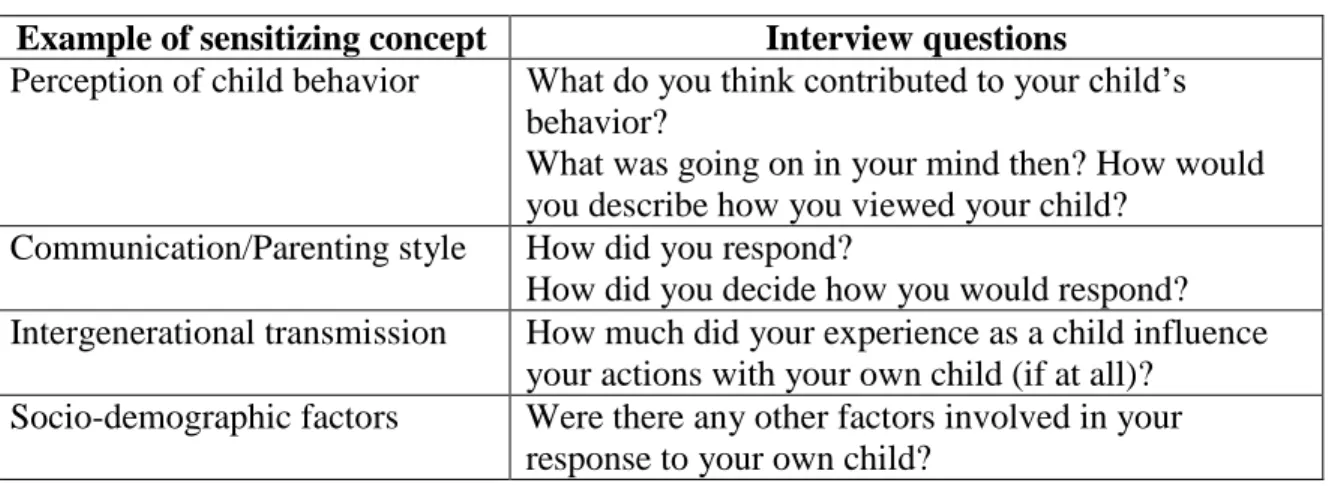
Table 3.2: Application of sensitizing concepts for data collection Example of sensitizing concept Interview questions
Perception of child behavior What do you think contributed to your child’s behavior?
What was going on in your mind then? How would you describe how you viewed your child?
Communication/Parenting style How did you respond?
How did you decide how you would respond? Intergenerational transmission How much did your experience as a child influence
your actions with your own child (if at all)? Socio-demographic factors Were there any other factors involved in your
response to your own child?
Changes to interview questions. Although the reviewed literature suggested that gender of the child could influence parenting practices, this was not evident in the mothers’ responses at first. After the first few interviews had been completed, the following question was added to the interview guide: Do you think your response would be different if your child was a girl/boy? If so, how?
Closely linked to the concept of intergenerational transmission, “personal growth” and “past experiences” were identified by mothers as factors that influenced how they parented their first (older) child versus the younger child who was the focus of these interviews. Thus, a
question was added regarding the mothers’ age: How do you think your chronological age and/or your personal growth have contributed to your parenting?
Simultaneous Data Collection and Analysis
analysis. The manner of data analysis at this early stage was quite preliminary and became more sophisticated as the process continued.
Once the interviews were conducted, I listened to each audio file at least once in order to start familiarizing myself with the data before transcription. Next, the interviews were
transcribed verbatim and the transcripts were read at least once before the coding began. Of the 22 interview audio files, I transcribed 12, and in the interest of time, the remaining 10 were transcribed using a professional transcription service. I read all transcribed files while listening to the audio files to ensure accuracy and maintain familiarity with the data. All transcripts were de-identified and all participants were given pseudonyms before data analysis began. Initial coding for each transcript was carried out, while data collection continued simultaneously.
The data analysis phase of this grounded theory was marked by coding procedures, constant comparative methods, extensive memo-writing, and theoretical sampling.
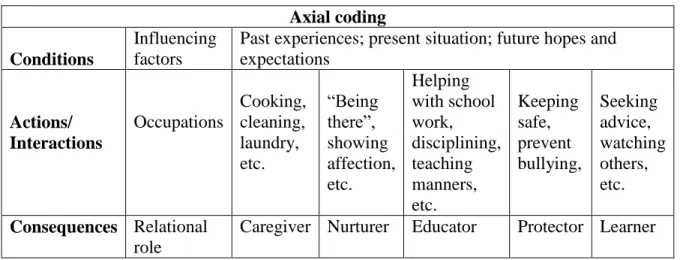
Coding. Coding procedures in grounded theory studies are carried out slightly different in each of the different schools of thought. Glaser’s open-ended approach identified substantive coding and theoretical coding as a means to let the data reveal the theory. On the other hand, Corbin and Strauss (1990) identified open coding as the first step of the analysis process, followed by axial coding, and finally selective coding. The axial coding procedures are more specifically considered to be a “coding paradigm” that include conditions, contexts, strategies (including actions and interactions) and consequences.
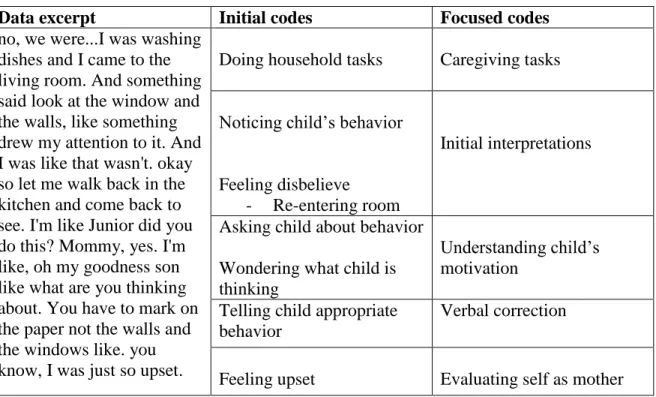
Coding for this study was carried out in a line-by-line manner utilizing initial, focused and theoretical codes. Table 3.3 provides an example of a section of data that was coded for initial and focused coding. This example illustrates that with each round of coding, a higher level of abstraction was achieved.
Table 3.3: Example of initial and focused coding
Data excerpt Initial codes Focused codes
no, we were...I was washing dishes and I came to the living room. And something said look at the window and the walls, like something drew my attention to it. And I was like that wasn't. okay so let me walk back in the kitchen and come back to see. I'm like Junior did you do this? Mommy, yes. I'm like, oh my goodness son like what are you thinking about. You have to mark on the paper not the walls and the windows like. you know, I was just so upset.
Doing household tasks Caregiving tasks
Noticing child’s behavior
Feeling disbelieve - Re-entering room
Initial interpretations
Asking child about behavior Wondering what child is thinking
Understanding child’s motivation
Telling child appropriate behavior
Verbal correction
Feeling upset Evaluating self as mother
Table 3.4: Axial coding scheme
Axial coding
Conditions
Influencing factors
Past experiences; present situation; future hopes and expectations Actions/ Interactions Occupations Cooking, cleaning, laundry, etc. “Being there”, showing affection, etc. Helping with school work, disciplining, teaching manners, etc. Keeping safe, prevent bullying, Seeking advice, watching others, etc. Consequences Relational
role
Caregiver Nurturer Educator Protector Learner
Constant comparison. One of the hallmarks of grounded theory studies, and what makes the process an iterative and inductive one, is the use of constant comparative methods (Charmaz, 2014). The idea behind constant comparison is to continuously achieve a higher level of
abstraction from the data towards theory development. Comparisons were made as part of the analysis process between data and other data, data and codes, codes and other codes, categories and codes, categories and other categories, and core category to all other categories. The
rationale for this constant comparison lies in the importance of highlighting relationships among the different parts of the framework developed. The ultimate goal was to develop a conceptual framework that has related categories and the relationships between them can be well articulated using the constant comparative method.
Memo-writing. During the entire process of data collection and analysis, many
reflective memos make the researcher’s thought process behind research decisions evident and can serve as a source of an audit trail (see Appendix E). A total of 28 reflective memos were written during the entire research process. Analytic memos are used to develop analytic leads emerging from the data. They can be helpful for creating links between emerging theoretical categories as well as theory development (see Appendix F). Twenty-six analytic memos were written during the analysis phase of the project, leading to decisions about adding additional interview questions, as well as theoretical sampling.
Theoretical sampling. Another hallmark of grounded theory studies is the application of theoretical sampling techniques. Theoretical sampling implies that sampling is done based on emergent theoretical categories rather than simply based on the repetition of certain ideas within the data. In other words, sampling is carried out in order to achieve theoretical saturation, rather than data saturation. The purpose of this form of sampling is to develop a theory that has
theoretically saturated categories and provides a detailed conceptualization of the phenomenon under study.