PROJECT PLANNING AND SCHEDULING USING PRONET
D.P.Tripathy
Professor & Head, Department of Mining Engineering, National Institute of Technology, Rourkela-769008, Odisha, India.
Abstract
Project network analysis techniques (CPM & PERT) help in designing, planning, co-ordination, controlling and decision making in order to accomplish the project economically in the minimum available time with the limited available resources. The paper deals with the basic concepts of CPM & PERT techniques and their differences and applications succinctly. Further, an attempt has been made to develop a comprehensive, menu-driven, graphics software package (PRONET) in TURBO „C‟, to solve network problems. For planning and scheduling
of an opencast mining project under Eastern Coalfields Limited (ECL), the utility of the software was verified.
Keywords: Critical path method, PERT, Planning, Scheduling, Float, PRONET
1 Introduction
Project network analysis techniques help designing, planning, co-ordination, controlling and in decision making in order to accomplish the project economically in the minimum available time with the limited available resources. They can be applied to a wide range of engineering and non-engineering applications such as construction projects, manufacturing/production planning, inventory planning, project planning and scheduling, R &D activities etc. Critical Path Method (CPM) and Programme Evaluation Review Technique (PERT) are the most common techniques used for solving network problems. Network analysis involves construction of network/arrow diagrams that presents visually the relationship between all the activities involved. Time, cost and other resources are allocated to different activities. In this paper, an attempt has been made to develop a comprehensive, menu-driven, graphics software package (PRONET), to solve network problems using CPM and PERT concepts.
2 Basic Concept of Project Planning & Scheduling
A Project is a plan or scheme or undertaking to establish or to carry out some work effectively. It is composed of jobs, activities, functions or tasks that are related one to other in some manner, and all of these should be completed in order to complete the project. Every project has one specific purpose: it starts at some specific moment and it is finished when its objectives have been fulfilled. For completion of a project two basic things
are required: (i) material resources and (ii) man power resources. However availability, quality and use of human resources are a single determinant factor in accomplishing
project objectives. Each project, whether big or small has three objectives:
The project should be completed with a minimum of elapsed time.
It should use available manpower and other resources as sparingly as possible, without delay.
Project management involves the following three phases viz. project planning, project scheduling and project controlling. Out of the above three phases of project management, the first two phases are accomplished before the actual project starts. The third phase is operative during the execution of the project, and its aim is to recognize the difficulties during the execution and to apply measures to deal with them (Khanna, 1992).
3 Project Planning & Scheduling Using Network Techniques
A number of techniques have been developed for project network analysis. They are:
PERT: Programme Evaluation and Review Technique, CPM: Critical Path Method,
RAMS: Resource Allocation and Multiproject Scheduling, and PEP : Programme Evaluation Procedure.
The most commonly known and used network techniques are CPM & PERT and are discussed below:
3.1 Critical Path Method
CPM is a technique, used for planning and controlling the most logical and economic sequence of operations for accomplishing a project. It involves determination of earliest starting time, latest finishing time, and float prior to finding critical path and is explained below:
Earliest Starting Time- it is the earliest time at which an event can occur. It is the time by which all the Activities discharging into the event under considerations are completed.It is denoted by TE.
Where,
TE i – earliest occurrence time for the any event i,
TEj - earliest occurrence time for the predecessor event j, t i j - time of completion of activity ij,
i j – activity under consideration.
The value of TE is calculated from starting point up to the end point in a forward direction through different
paths by simple additions. That value is taken which is maximum.
Latest Finishing Time: It is the latest time by which an event must occur to keep the project on schedule. It is denoted by TL. For the last event TE = TL.
Where,
TLi –latest allowable time for any event i, TLj –latest allowable time for the event j, t i j –time of completion of activity ij.
The value of TL is generally calculated starting from the last event up to the first event in a backward direction through different paths by simple subtractions. That value is taken which is minimum. For the starting event both TE & TL are taken as zero and at the last event they are taken to be equal.
Float : it is also termed as slack. It denotes the flexibility range within which an event can occur (it is the difference between the earliest event time and latest occurrence time). So it is the range within which an activity start time or finish time may fluctuate without affecting the completion of the project. They are of following types:
TEj= ( TEi+ t i j) maximum
(1)
Critical Path
:
An activity is said to be critical when there is no “leeway” in determining its start and finish times. So to complete the project without delay, each critical activity must be started and completed in time. A path comprising of these critical activities is called critical path. This path doesn‟t allow any slack or float. A non-critical activity allows some scheduling slack, so that the start time of the activity may be advanced or delayed within limits without affecting the completion date of the entire project.3.2 Steps in CPM
CPM employs the following steps:
Break down the project in to various activities systematically.
Label all activities.
Arrange all the activities in logical sequence.
Construct the arrow diagram (Figure 1).
Number all the nodes (events) and activities.
Find the time for each activity.
Mark the activity times on the arrow diagram.
Calculate early and late, start and finishing times.
Tabulate various times and mark EST and LFT on the arrow diagram.
Calculate the total float for each activity.
Identify the critical activities and mark the critical path on the arrow diagram.
Calculate the total project duration (Khanna, 1992, Taha, 2001).
4 Program Evaluation & Review Technique (PERT)
This method can be applied to any field requiring planned, controlled and integrated work efforts to accomplish established goals. PERT is an event-oriented technique. It assumes non-deterministic or probabilistic approach in which one may only be able to state limits within which it is virtually certain that the activity duration will lie. Therefore time is the most essential and basic variable in PERT system of planning and control. Taking the uncertainties in to account, PERT planners make three kinds of time estimates.
Optimistic time (t0): It represents the time in which the job or the activity could be completed if everything
went perfectly, with no problems or adverse conditions. It is the shortest possible time in which an activity can be completed, under ideal conditions.
Pessimistic time (tp): it represents the time it might take us to complete a particular activity if everything went
wrong and abnormal situations prevailed.
Most likely time (tm): it represents the time the activity would most often require if normal conditions prevail.
This time estimate lies between the optimistic and pessimistic time estimates.
Expected Time (te): Expected time is the average time or single workable time considering the above three time
estimates by approximation.
Variance: It is affected by the relative distance from the most optimistic estimate to the most pessimistic estimate. It does not depend upon the most likely time estimate t m
It is denoted by .
Probability of Completing the Project in Scheduled Date
Step 1: determine the standard deviation (σ) appropriate to the critical path, for the network, using the relation. σ = √(sum of variance along critical path)
t e = (t o + 4 t m + t p) / 6 (3)
2
= ((t p – t 0) / 6) 2
(4)
Where,
σ i j 2 – variance for the activity i-j along the critical path
Step 2: determine the probability factor Z (normal deviate)
Where,
ts - required time for completing the job, and te - expectedtime of completion of the project.
Step 3: determine the % probability with respect to the normal deviate Z from standard normal table (Hu et al., 1995).
4.1 Steps in PERT
The PERT planning technique consists of the following steps:
The project is broken down into different activities simultaneously.
Activities are arranged in logical sequence.
The network diagram is drawn. Events and activities are numbered.
Using three time estimate, the expected time for each activity are calculated.
Standard deviation and variance for each activity are computed.
Earliest starting time and latest finishing times are calculated.
Expected time, earliest starting time and latest finishing times are marked on the network diagram.
Slack is calculated.
Critical path(s) are identified and marked on the network diagram.
Length of critical path or total project duration is found out.
Lastly, the probability that the project will finish at due date is calculated (Khanna, 1991).
5 Development of Software (PRONET) for Project Network Analysis
PRONET is a comprehensive, menu driven, user-friendly, graphics software package. The program is written in Turbo-C (Kanetkar, 2001).It consists of 805 lines and occupies 20 KB. The folder comprises of the pro.exe file of the program along with other 18 basic graphic files to make the software user-friendly. The total software consumes 182 KB. PRONET can be operative in any standard Pentium based IBM compatible system with VGA display unit. The software displays the interactive window (Figure 2) to choose the option of using CPM/ PERT technique. The user need not be an expert in computers but he only has to feed the data about the activities, the time durations and their predecessor activities. The software does all the other tasks such as, designing the paths, determination of critical path and finding the optimum duration for completion of the project. The software is also capable of taking dummy activities in the network automatically so as to help the user. For solving PERT problems, the software also calculates the probability of completing the given project with the help of standard normal distribution table.
6 Applications of CPM & PERT Techniques in Mining
A mining project is defined by the object and process of constructing a new mine or organizing / re-structuring an existing mine for higher production and / or improved economics. Application of network analysis results in finding out the optimum path and time duration of various types of mining projects. In general, the network analysis techniques are used in mine planning and scheduling, production planning, mining construction, and R&D activities.
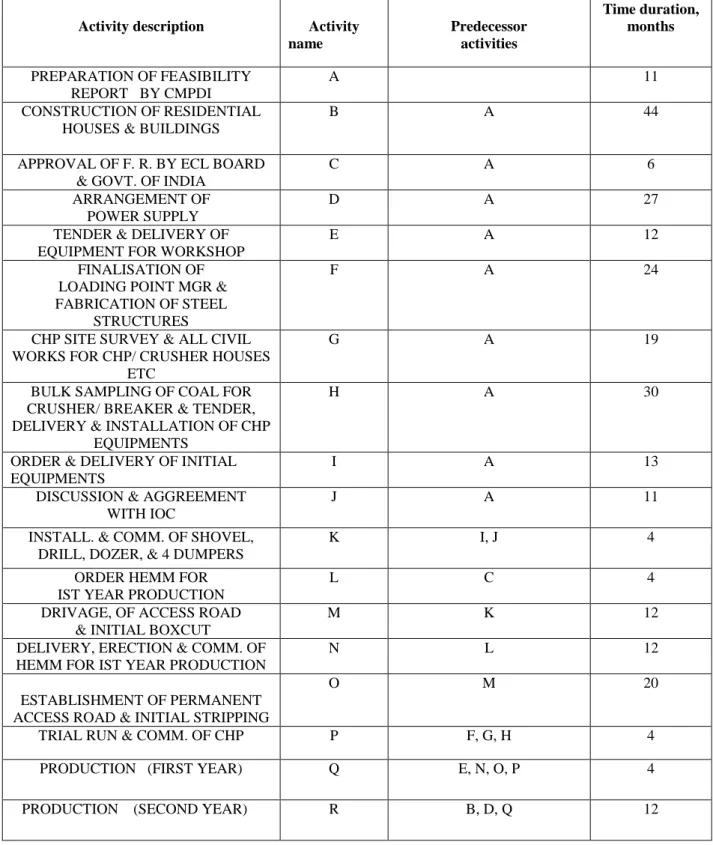
In order to find the applicability of PRONET for planning and scheduling, a case study of opencast mining project under Eastern Coalfields Limited (ECL) was selected (Jha, 1981; Basu, 1981). This begins with the preparation of Feasibility Report by CMPDI and includes all the other mining activities needed for establishing
σ i j 2
= ( ( t p i j – t o i j ) / 6 ) 2
(6)
Z = (t s – t e) / √ (σ i j 2
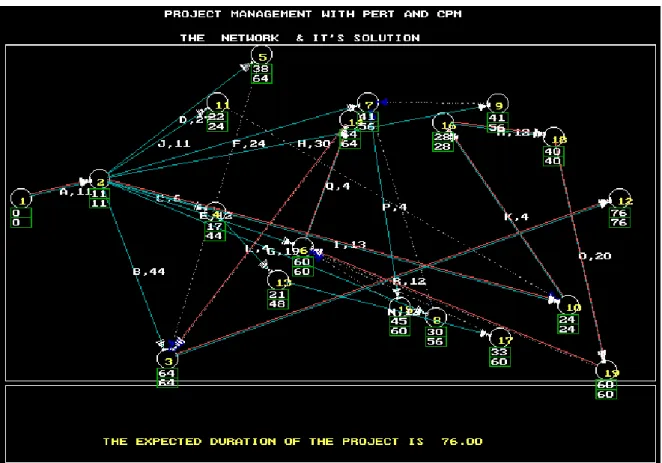
a new mine and ends with the production of coal up to IInd year. However, in the present work the activities like preliminary geological exploration by CMPDI of 11 months duration prior to preparation of Feasibility Report have not been taken into account. The different activities, their durations in months and their predecessor activities of the project are outlined in tabular form in Table 1. The output of the program depicting the arrow diagram, the critical path and the total project duration for completing the project is shown in Figure 3. The critical path for the project was 1-2-10-16-18-19-6-14-3-12 and was of 76 months duration.
7 Conclusion
The network techniques (CPM & PERT) help in designing, planning, coordinating, controlling and in decision making to complete the project economically in the minimum available time with the limited available resources. PRONET- a comprehensive, menu-driven, graphics software package that can be effectively used to design and solve network problems using the concepts of CPM & PERT techniques. The software can determine the critical path, and project duration and probability of completion of project by the scheduled date for any network. However, the software needs to be modified to determine the optimum cost/time of a project and make the networks updated and smoothened automatically after each stage of crashing.
References
Basu, T. P. 1981.An effective management system for a coal mining project. Minetech, 5, 44 –50.
Hu Qinghuai, Wei Wei and Fang Shihong Fang.1995. Short-term production scheduling for openpit mines by PERT network with resource constraints, Proceedings of Mine Planning and Equipment Selection, Ed: Singhal, Raj. K., Balkema Publications, 103-108.
Jha, S.1981. Project implementation- Organization & control. Minetech, 5, 51-55. Kanetkar, Y. 2001. Graphics in „C‟. New Delhi: BPB Publications Pvt. Ltd. Kanetkar, Y. 2001.Let us „C‟. New Delhi: BPB Publications Pvt. Ltd.
Khanna, O. P. 1992. Industrial Engineering and Management. New Delhi: Dhanpat Rai & Sons, 10:1-21. Mani, M. S., Gehring, H. and Vogt, W.1985.Time scheduling of equipping and commissioning of Neyveli II
lignite mine with the aid of network planning techniques, Journal of Mines, Metals and Fuels, Vol. XXXIII, No.4, 195-205.
Punmia, B. C. and Khandelwal, K. K. 1987.Project Planning and Control with PERT & CPM. New Delhi: Laxmi Publications Pvt. Ltd.
Taha, A. Handy.2001.Operation Research-An Introduction. New Delhi: PHI Pvt. Ltd., 263-280.
E
E
E
E
E
A
A
AA
A
E A
EVENT ACTIVITY
Figure 1.Network diagram
Table 2.Description of activities of an opencast project.
Activity description Activity name
Predecessor activities
Time duration, months
PREPARATION OF FEASIBILITY REPORT BY CMPDI
A 11
CONSTRUCTION OF RESIDENTIAL HOUSES & BUILDINGS
B A 44
APPROVAL OF F. R. BY ECL BOARD & GOVT. OF INDIA
C A 6
ARRANGEMENT OF POWER SUPPLY
D A 27
TENDER & DELIVERY OF EQUIPMENT FOR WORKSHOP
E A 12
FINALISATION OF LOADING POINT MGR & FABRICATION OF STEEL
STRUCTURES
F A 24
CHP SITE SURVEY & ALL CIVIL WORKS FOR CHP/ CRUSHER HOUSES
ETC
G A 19
BULK SAMPLING OF COAL FOR CRUSHER/ BREAKER & TENDER, DELIVERY & INSTALLATION OF CHP
EQUIPMENTS
H A 30
ORDER & DELIVERY OF INITIAL EQUIPMENTS
I A 13
DISCUSSION & AGGREEMENT WITH IOC
J A 11
INSTALL. & COMM. OF SHOVEL, DRILL, DOZER, & 4 DUMPERS
K I, J 4
ORDER HEMM FOR IST YEAR PRODUCTION
L C 4
DRIVAGE, OF ACCESS ROAD & INITIAL BOXCUT
M K 12
DELIVERY, ERECTION & COMM. OF HEMM FOR IST YEAR PRODUCTION
N L 12
ESTABLISHMENT OF PERMANENT ACCESS ROAD & INITIAL STRIPPING
O M 20
TRIAL RUN & COMM. OF CHP P F, G, H 4
PRODUCTION (FIRST YEAR) Q E, N, O, P 4
Figure 3. Network diagram of the ECL opencast project