A CP-directed Study of Doctor-patient Oral
Interaction in Outpatient Departments
Fang Guo
North China Electric Power Univesity, China
Hongyan Wei
North China Electric Power Univesity, China
Abstract—Based on the data collected from an A-class hospital in Shanxi Province of China, the paper analyzes the compliance and violation of cooperative principle during the six stages of the doctor-patient oral interaction in outpatient departments and the current doctor-patient relationship revealed in the interaction. The study shows that: (1) When answering the doctor’s question, most patients violate the Maxim of Quantity. (2) Many patients violate the Maxim of Relevance. (3) Many patients often violate the Maxim of Manner. (4) Most doctors often comply with the Maxim of Quality and violate the Maxim of Quantity. (5) Both doctors and patients may violate the Maxim of Attitude, and most patients will violate the Maxim of Attitude.
Index Terms—doctor-patient interaction, cooperative principle, pragmatic analysis
I. INTRODUCTION
Doctor-patient oral interaction in outpatient departments refers to the oral interaction which occurs between doctors and patients (or patients’ relatives), and it is generally about the illness.
In general, in order to help the doctor make an accurate diagnosis for his condition, the patient will actively cooperate with the doctor and seriously follow the cooperative principle in doctor-patient oral interaction in outpatient departments. However, there are also a large number of phenomena of the violations of the cooperative principle in doctor-patient oral interaction in outpatient departments.
In order to examine the compliance and violation of the new type cooperative principle of doctor-patient interaction, the analysis will be carried out at each of the six different stages of the doctor-patient oral interaction in outpatient departments.
Have (1991, 1995, 2001, 2002) points out that there is an ideal sequence in the process of the medical consultation. This ideal sequence contains six stages. The first stage is opening; the second stage is complaint; the third stage is elaboration, examination end/or test; the fourth stage is diagnosis; the fifth stage is treatment and/or advice; the sixth stage is closing. It is well-known that the modern medical science and practice in China were originated in the western countries, so the consultation of outpatient departments in China also contains six stages.
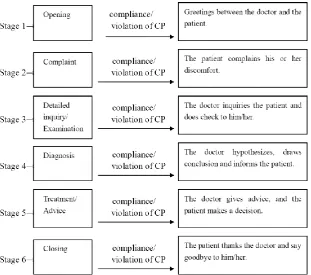
Thus, from the preliminary investigation into the self-collected corpus of doctor-patient interaction, the writer found a doctor-patient oral interaction in outpatient departments is generally composed of six stages, including Stage 1, Opening, Stage 2, Complaint, Stage 3, Detailed inquiry/Examination, Stage 4, Diagnosis, Stage 5, Treatment/Advice and Stage 6 Closing. The six parts work together to reach a common goal between doctors and patients. The writer assumes that in this process, both doctors and patients interact with each other by complying with or violating the cooperative principle to reach the common goal. Based on this assumption, the writer will analyze doctor-patient interactions at six stages as shown in Figure 1.
Doctor-patient interaction is a purposefully joint activity directed towards a common goal: the patient’s illness gets treated. The six different stages have different intentions and features. The writer assumes that at each of the six different stages, both doctors and patients interact with each other by complying with or violating the five conversational maxims of the new type cooperative principle of doctor-patient interaction to reach the common goal.
Figure 1 CP-directed analytical procedure for doctor-patient interaction
II. DATA
The study of this thesis is mainly based on forty-nine doctor-patient oral interactions recorded by a recording pen. The place where the writer recorded the doctor-patient oral interaction is in the outpatient departments of a Grade A hospital in Shanxi province. The consultations of the outpatient departments took place in different consulting rooms. Each consultation room was separate. All the patients had to wait outside the consultation room. There were some benches for the patients in the corridor. Each patient took a numbered voucher from the registration office. The doctor called on the patients to enter the consultation room one by one according to their numbers or names. However, the reality was that when the doctor is treating a patient, usually other patients or the relatives of the patients still stayed in the consultation room. It helped the writer to obtain the natural and real corpus.
The corpus collection work has been done by the writer by means of pretending to be an intern or a patient. The writer put the recording pen on the table with the permission of all the doctors. The writer did not participate in the interaction and communication between doctors and patients during the process of collecting corpus. She just sat aside, observing and taking notes. The information includes the names of the departments, and other nonverbal behavior of the doctors and patients, for example, the facial expressions and the body languages. In the meantime, the patients didn’t notice the recording pen and they didn’t know that the interactions were being recorded, thus the interactions between doctors and patients have carried out naturally and smoothly.
The total length of the recorded corpus (the forty-nine doctor-patient oral interactions) is about 6 hours. Moreover, the shortest one is 161 seconds and the longest one is 460 seconds. The writer selects 15 doctors for this study, and nine of them are females and six of them are males. These doctors include chief physician and attending doctor. The titles of these doctors are chief physician and attending doctor. It covers seven major departments in outpatients, including four departments of internal medicine and three departments of surgery. The four departments of internal medicine are respiratory medicine department, digestion department, vasculocardiology department, and endocrinology department. The three departments of surgery are general surgery department, osteology department and pain treatment department. In addition, the patients in this study are of different ages, different educational backgrounds and different social status.
III. QUESTIONS
IV. METHODOLOGY
This thesis is a corpus-based empirical research. The main object of this study is the oral interaction between doctors and patients in outpatient departments of the Chinese hospitals. The entire corpus used in this study is collected by the writer, from January to February, 2014, from seven major departments in outpatients in a Grade A hospital in Shanxi province. The study of this thesis is mainly based on forty-nine doctor-patient oral interactions recorded in the consulting rooms of one hospital. The thesis aims to study the new cooperative principle in doctor-patient oral interaction by the CP-directed analytical procedures for doctor-patient interaction. At the same time, the writer analyzes the compliance and violation of new type cooperative principle during the six stages of the doctor-patient oral interaction in outpatient departments, and also analyzes the current doctor-patient relationship revealed in the process of doctor-patient oral interaction.
V. CASE ANALYSIS
A. At the Opening Stage
Figure 2 at the opening stage
Example 1:
At the vasculocardiology department: D:Are you Ms. Wang? ( 是王女士吗?) P: Yes, I am. ( 是,我是。)
D:What’s wrong with you? ( 你咋啦?)
P: I always feel chest ache. ( 我老是觉得胸口疼。) D: Oh, chest ache. ( 噢,胸口疼。)
Example 1 is the opening stage from a doctor-patient oral interaction of vasculocardiology department. The doctor starts a conversation by using an opening question, Are you Ms. Wang (是王女士吗). And the patient just answer yes (是).Then the doctor moves quickly to the second stage by asking What’s wrong with you(你咋啦). In Example 1, the doctor and the patient do not greet each other. So they both violate the Maxim of Attitude.
This example shows that: (1) the opening stage is usually very short. At this stage, both doctor and patient have the same intention. Some doctors and patients even skip the opening stage and quickly get into the complaint stage to gather the valuable information they needed as soon as possible. (2) At the opening stage, both doctors and patients usually violate the Maxim of Attitude.
B. At the Complaint Stage
Figure 3 at the complaint stage
Example2:
At the respiratory medicine department D: What’s wrong with you? ( 怎么了?) P: I have a sore throat. ( 感觉嗓子疼。) D: Do you have a cough? ( 咳嗽吗?) P: No, I don’t. ( 不咳嗽。)
D: Just a sore throat? ( 就是嗓子疼?) P: Yes. ( 嗯。)
D: Did you get acid reflux or heartburn? ( 反酸,烧心吗?)
P: I had a sore throat when I was swallowing foods and drinking water. ( 就是吞咽和喝水都疼。)
fourth question , the doctor asks Did you get acid reflux or heartburn(反酸,烧心吗), and the patient should answer yes or no(是或不是), but he doesn’t.
According to the example, it can be concluded that: (1) the complaint stage is often longer than the opening stage. At this stage, both the doctor and the patient have the same intention. The intention of the patient is to complain and state all his or her discomfort and symptoms. And the doctor intends to collect the information about the patient’s discomfort and symptoms. (2) At the complaint stage, doctors often comply with the Maxim of Quality and violate the Maxim of Quantity. Patients often violate the Maxim of Quantity and the Maxim of Relevance.
C. At the Detailed Inquiry/Examination Stage
Figure 4 at the detailed inquiry/examination stage
Example 3:
At the respiratory medicine department:
D: Have you taken any medicine? ( 吃过什么药吗?)
P: I have taken amoxicillin for two days. I feel that medicine is not very effective. ( 吃了两天阿莫西林。感觉不是
很管用。)
D: Do you feel chest tightness and shortness of breath? ( 胸憋气断吗?) P: No, I don’t. ( 没有。)
D: Do you have a headache? ( 头疼吗?)
P: I don’t have a headache, nor fever. ( 头不疼,也不发热。)
D: Let me examine your chest. Open your mouth and let me examine. Open your mouth and say ah. ( 来我听一
下,张开嘴我看一下。来张开嘴,啊~ ) P: Ah~ ( 啊~ )
D: Harder! ( 再使劲!) P: Ah~ ( 啊~ )
Example 3 is the detailed inquiry/examination stage from a doctor-patient oral interaction of respiratory medicine department. At this stage, the intention of the doctor is to collect more information about the patient’s discomfort and symptoms. And the intention of the patient is to continually complain and to state all his or her discomfort and symptoms. In Example 5, when the doctor says Have you taken any medicine (吃过什么药吗), the patient says I have
taken amoxicillin for two days. I feel that medicine is not very effective (吃了两天阿莫西林。感觉不是很管用). So the
patient violates the Maxim of Relevance. When the doctor says Do you have a headache (头疼吗), the patient says I
don’t have a headache, nor fever (头不疼,也不发热). So the patient also violates the Maxim of Relevance.
Based on the above example, it can be concluded that: (1) the detailed inquiry/examination stage is often longer than the opening stage and the complaint stage. At the detailed inquiry/examination stage, both the doctor and the patient have the same intention. At this stage, the intention of the doctor is to collect more information about the patient’s discomfort and symptoms. And the intention of the patient is to continually complain and state all his or her discomfort and symptoms. (2) At the detailed inquiry/examination stage, doctors often comply with the Maxim of Manner. Patients often violate the Maxim of Relevance.
D. At the Diagnosis Stage
Figure 5 at the diagnosis stage Example 4:
At the digestion department:
P: Oh. Doctor, what is wrong with me? ( 噢。大夫, 我这个到底是什么问题?)
D: It should be the problem of the esophagus. Now you may have esophagitis and esophageal erosions. ( 应该就是 食道的问题。你现在可能就是食道炎,食道糜烂。)
P: No other disease? ( 别的病没有吧?)
gastroscopy. Making a gastroscopy would be better, all right? ( 应该是。再观察。你确实是喝酒以后出来这种情况。 你要是吃几天药,过一段时间觉得好了,再没有这些症状,可能就是急性损伤。你还是需要做胃镜看一下,做 一下放心,好吧?)
Example 4 is the diagnosis stage from a doctor-patient oral interaction of digestion department. At this stage, the intention of the doctor is to make his or her diagnosis. And the patient intends to get the diagnosis from the doctor. When the patient asks Doctor, what is wrong with me(大夫,我这个到底是什么问题), the doctor answers It should be
the problem of the esophagus. Now you may have esophagitis and esophageal erosions (应该就是食道的问题。你现在
可能就是食道炎,食道糜烂). So the doctor complies with the Maxim of Quality and the Maxim of Manner. When the patient asks No other disease(别的病没有吧), then the doctor answers I think so. We need to observe. These symptoms really appear after drinking. If you will feel better after you take medicine for a few days, then these symptoms disappear, it may be an acute injury. It is necessary for you to make a gastroscopy. Making a gastroscopy would be
better, all right. So the doctor complies with the Maxim of Quality and the Maxim of Manner, and violates the Maxim
of Relevance.
This example proves that: (1) the diagnosis stage is often not too long. At this stage, both the doctor and the patient have the same intention. At this stage, the intention of the doctor is to make his or her diagnosis. And the patient intends to get the diagnosis from the doctor. (2) At the diagnosis stage, doctors often comply with the Maxim of Quality and the Maxim of Manner, and violate the Maxim of Relevance.
E. At the Treatment/Advice Stage
Figure 6 at the treatment/advice stage
Example 5:
At the endocrinology department:
P: Oh, do you think this is better than before? ( 噢,觉得这个比原来好点儿吗?)
D: It is much better than last July, and it is similar to August. So, you can control like this. You should take half a pill each time, and twice a day. ( 比你去年7月份好多了,和8月份的差不多。所以说,您就这样控制就可以了。还
是按每次半片,每天两次来吃药就可以了。) P: Should I still eat half a pill? ( 还是吃半片?)
D: Yes, you should still eat half a pill. You can do a check again in June or July next year. All right. ( 嗯,还是吃半 片。完了等到6、7月份再查吧。好吧。)
P: What I should pay attention to? ( 平时注意点啥?) D: Nothing. ( 没啥注意的。)
P: Don’t eat kelp, and don’t eat iodized salt. ( 不要吃海带,不要吃碘盐。) D: No, you should keep a normal diet. ( 没有,正常饮食就可以。) P: Eating iodized salt is ok? ( 碘盐没问题吧?)
D: Yes. That’s ok. ( 可以。)
Example 5 is the treatment/advice stage from a doctor-patient oral interaction of endocrinology department. In order to recover as soon as possible, the patient will ask the doctor a few questions. Then the doctor may give the patient some advice on diet and taking medicine. In Example 9, when the patient asks the doctor, do you think this is better than before (觉得这个比原来好点儿吗), then the doctor answers It is much better than last July, and it is similar to
August. So, you can control like this. You should take half a pill each time, and twice a day (比你去年7月份好多了,
和8月份的差不多。所以说,您就这样控制就可以了。还是按每次半片,每天两次来吃药就可以了). So the doctor violates the Maxim of Relevance. When the patient asks the doctor, Should I still eat half a pill (还是吃半片), then the doctor answers Yes, you should still eat half a pill. You can do a check again in June or July next year. All right. (嗯,还
是吃半片。完了等到6、7月份再查吧。好吧). So the doctor violates the Maxim of Relevance.
This example proves that (1) the treatment/advice stage may last longer than the diagnosis stage. At this stage, both the doctor and the patient have the same intention. At this stage, the intention of the doctor is to give the patient some advice. And the intention of the patient is to get clear explanation about the treatment from the doctor. (2) At the treatment/advice stage, doctorsoften comply with the Maxim of Quality, and violate the Maxim of Relevance.
Figure 7 at the closing stage
Example 6:
At the respiratory medicine department:
R: Should I go to pay downstairs? ( 这个是在楼下交费吗?)
D: Yes, you should go to pay on the first floor, and then you should have intravenous drip on the first floor. ( 对,一
楼交费,然后在一楼输液。)
R: Should I bring the medicine there? ( 我把药拿过去?)
D: Yes, you should bring the medicine there. ( 对,把药拿过去就行。) R: Ok, ok. ( 好,好。)
Example 6 is the closing stage from a doctor-patient oral interaction of respiratory medicine department. It is very short. In Example 11, the relative of the patient just follows the doctor’s advice and he is going to pay. When the relative of the patient asks the doctor, Should I go to pay downstairs (这个是在楼下交费吗), then the doctor answers
Yes, you should go to pay on the first floor, and then you should have intravenous drip on the first floor (对,一楼交费,
然后在一楼输液). So the doctor violates the Maxim of Relevance. When the doctor says Yes, you should bring the
medicine there (对,把药拿过去就行),then the patient says Ok, ok (好,好).The patient should say thanks and goodbye
to the doctor, but he doesn’t. So the patient violates the Maxim of Attitude.
It can be concluded from example 6 that: (1) the closing stage is usually very short. At this stage, both the doctor and the patient have the same intention. The intention of the doctor is to finish the consultation and to hope that the patient can comply with his or her advice. The intention of the patient is to decide whether he or she complies withthe doctor’s advice. (2) At the closing stage, patients usually violate the Maxim of Attitude.
VI. CONCLUSION
Through the data analysis, it is found that a complete doctor-patient oral interaction in outpatient departments actually has six stages. The six stages include the opening stage, the complaint stage, the detailed inquiry/examination stage, the diagnosis stage, the treatment/advice stage and the closing stage. Each stage has different characteristics. We also found that there are differences between doctors and patients in compliance and violation of the new type cooperative principle of doctor-patient interaction.
The characteristics of the six stages are: (1) the opening stage is usually omitted and it is usually very short. (2) At the complaint stage, the patient usually will take the initiative to tell the doctor about all his or her discomfort. (3) At the detailed inquiry/examination stage, the doctor usually asks the patient some questions about his or her symptoms. (4) The diagnosis stage is short. The doctor usually makes his or her own judgment and tells the patient what disease he or she may have. (5) The treatment/advice stage is usually long. The patient often asks the doctor a lot of questions about the treatment, and the doctor will answer in detail. (6) The closing stage is the last stage and it is usually very short. In general, the patient will follow the doctor’s advice. At the closing stage, the patient often does not thank the doctor, and left the hospital at once.
The following five kinds of situations often occur in the six stages of doctor-patient oral interaction in outpatient departments: (1) When answering the doctor’s question, most patients violate the Maxim of Quantity. They often provide excess information. (2) Many patients violate the Maxim of Relevance. (3) Many patients often violate the Maxim of Manner; their words are not brief and not orderly. (4) Most doctors often comply with the Maxim of Quality and violate the Maxim of Quantity. We found that doctors always provide insufficient information to comply with the Maxim of Quality; there are a few patients with this kind of situation. (5) Both doctors and patients may violate the Maxim of Attitude, and most patients will violate the Maxim of Attitude.
The writer finds that the CP-directed analytical procedures for doctor-patient interaction combined with the five conversational maxims of the new type cooperative principle of doctor-patient interaction have the following characteristics: (1) The applicability of the new type cooperative principle of doctor-patient interaction in doctor-patient oral interaction in outpatient departments will be better reflected through this analytical framework; (2) It will better regulate and guide the actual doctor-patient oral interaction in outpatient departments through this analytical framework; (3) by this analytical framework, it will promote that the doctor-patient oral interaction in outpatient departments be carried out effectively, and it will improve a more friendly doctor-patient relationship.
No research is perfect and mine is no exception. Improvements for future study are as follows.
basis of the study. The corpus collection work is really very important for the study. Therefore, in the future, the researchers need to pay more attention to have plenty of corpuses and ensure that the collected corpus is more representative in the process of collecting corpus.
Future researchers can be developed around other related issues. Such as the issue that different levels of doctors complies with and violates the new cooperative principle in doctor-patient oral interaction in outpatient departments. The male patients and female patients comply with and violate the new cooperative principle in doctor-patient oral interaction in outpatient departments. Patients of different ages comply with and violate the new cooperative principle in doctor-patient oral interaction in outpatient departments.
REFERENCES
[1] Have, Paul ten. (1991). Talk and institution: a reconsideration of the ‘asymmetry’of doctorpatient interaction. In Deirdre Boden & Don H. Zimmerman, (Eds.), Talk and social structure: studies in ethnomethodology and conversation analysis. Cambridge: Polity Press, 138-63.
[2] Have, Paul ten. (1995). Medical ethnomethodology: An Overview. Human Studies, 18, 245-61. [3] Have, Paul ten. (2001). Lay Diagnosis in Interaction. Text, 21, 251–260.
[4] Have, Paul ten. (2002). Comparing telephone call openings: theoretical and methodological reflections. In Kang Kwong Luke & Theodossia-Soula Pavlidou (Eds.), Telephone Calls: Unity and Diversity in Conversational Structure across Languages and
Cultures. Amsterdam: John Benjamins, 233-249.
[5] Schegloff, E. A., I. Koshik, S. Jacoby & D. Olsher. (2002). Conversation Analysis and applied linguistics. Annual Review of
Applied Linguistics, 22, 3–31.
Fang Guo was born in Liaoning, China in 1974. She received her PH.D. degree in Linguistics from BeijingNormal University, China in 2009.
She is currently an associate professor in the School of Foreign Languages, North China Electric Power University, Beijing, China. Her research interests include Discourse Analysis and Applied Linguistics.
Hongyan Wei was born in Shanxi, China in 1987.