JEEECCS, Volume 3, Issue 8, pages 21-28, 2017
A Fuzzy Logic Expert System for Diagnosing
EHF and Evaluating its Risk Level
Annie Oghenerukevbe Egwali
Email: [email protected]
Francis Aien-Akho Imouokhome
Email: [email protected] Department of Computer Science
University of Benin Benin City, Nigeria
Corresponding author Email: [email protected]
Abstract – The complex nature of Ebola hemorrhagic fever (EHF), particularly at the early stages of its outbreak, makes it difficult to diagnose because it manifests symptoms that are similar to those commonly associated with other diseases. Diagnostic decisions of physicians are therefore subjective, calling for an intelligent system for the diagnosis of EHF. This study proposes a fuzzy logic system that takes account of human limitations of medical professionals in the diagnosis of EHF and evaluation of its Risk Level in patients. To achieve the aim of the study, a fuzzy logic-controlled system was designed and implemented using MATLAB fuzzy logic tool box. Input variables to the fuzzy logic controller are (i) patient’s symptoms (PS), (ii) laboratory test results (TR), (iii) patient’s itinerary history (PH), and (iv) number of days since initial infection (ND). The proposed system, which is able to diagnose EHF and evaluate its risk level in patients, shows varying output values as the input parameters vary; with TR having a dominant effect on the results. Fuzzy Logic is proved here to be a powerful tool to design computer-based health diagnostics systems to deal with vagueness or imprecision in disease diagnosis. The fuzzy logic system designed in this study addresses the limitations that are usually associated with the subjective decisions of physicians in the orthodox procedures of diagnosing EHF and evaluating its risk levels in patients.
Keywords - Ebola, Diagnosis, Risk Level, Fuzzy Logic Controller
I INTRODUCTION
Ebola virus has been identified as a pathogen that causes severe and often deadly illnesses in humans
and non-human primates. The disease it causes, though known generally as ―Ebola hemorrhagic fever‖ (EHF), is referred to as ―Ebola virus disease‖ (EVD) by the World Health Organization (WHO). Ebola virus disease first erupted in 1976 in Yambuku village (near Ebola River) in Mongala district in northern Zaire (now Democratic Republic of Congo, DRC) [1,2]. In the same year, there was an outbreak also in Sudan. Ebola viruses that caused these diseases later became known as Zaire and Sudan virus, respectively. Other species of the virus known today are the Reston virus, Taï Forest virus and Bun-dibugyo virus [3]. Of these five known species, only the Reston virus affects the non-human primates but not humans [4].
Table 1: Chronology of previous Ebola virus disease outbreaks (Source: WHO Factsheet [7]
Year Country Ebola virus
species Cases Deaths
Case fatality
2015 Italy Zaire 1 0 0%
2014 DRC Zaire 66 49 74%
2014 Spain Zaire 1 0 0%
2014 UK Zaire 1 0 0%
2014 USA Zaire 4 1 25%
2014 Senegal Zaire 1 0 0%
2014 Mali Zaire 8 6 75%
2014 Nigeria Zaire 20 8 40%
2014-2016 Sierra Leone Zaire 14124* 3956* 28%
2014-2016 Liberia Zaire 10675* 4809* 45%
2014-2016 Guinea Zaire 3811* 2543* 67%
2012 Democratic Republic of Congo Bundibugyo 57 29 51%
2012 Uganda Sudan 7 4 57%
2012 Uganda Sudan 24 17 71%
2011 Uganda Sudan 1 1 100%
2008 Democratic Republic of Congo Zaire 32 14 44%
2007 Uganda Bundibugyo 149 37 25%
2007 Democratic Republic of Congo Zaire 264 187 71%
2005 Congo Zaire 12 10 83%
2004 Sudan Sudan 17 7 41%
2003 (Nov-Dec) Congo Zaire 35 29 83%
2003 (Jan-Apr) Congo Zaire 143 128 90%
2001-2002 Congo Zaire 59 44 75%
2001-2002 Gabon Zaire 65 53 82%
2000 Uganda Sudan 425 224 53%
1996 South Africa (ex-Gabon) Zaire 1 1 100%
1996 (Jul-Dec) Gabon Zaire 60 45 75%
1996 (Jan-Apr) Gabon Zaire 31 21 68%
1995 Democratic Republic of Congo Zaire 315 254 81%
1994 Côte d'Ivoire Taï Forest 1 0 0%
1994 Gabon Zaire 52 31 60%
1979 Sudan Sudan 34 22 65%
1977 Democratic Republic of Congo Zaire 1 1 100%
1976 Sudan Sudan 284 151 53%
1976 Democratic Republic of Congo Zaire 318 280 88%
* Include Suspect, Probable and Confirmed EVD cases
Ebola virus disease (EVD), being very lethal and contagious [9], can be contracted from physical contact with the body or fluid (such as saliva, urine, stool/faeces, breast milk, semen) from an infected person or animal [2]. After infection, symptoms of the disease can manifest in patients `within four to ten days, though it could manifest as early as two days or as late as twenty-one days after exposure [5,10,11]. To manage and respond to the risks and consequences of the disease, surveillance systems are usually put in place to enable health care workers as well as members of the public to report to relevant authorities, any cases of febrile illness or death that are suspected to be connected with EVD [6].
Movements into and out of the high-risk area are controlled by the health care workers who determine who goes into the area, how frequently, and for what length of time [17,18].
Mutua et al. [19] analyzed the commonly reactive approaches used in the management and containment of past Ebola outbreaks, and suggested that combining pre-emptive strategies with reactive ones will lead to having better knowledge about the disease, and better preparation against and better response to future outbreaks.
To diagnose Ebola virus, physicians subject patients to a number of laboratory tests to isolate the virus by cell culture of clinical specimens [20]. Other considerations include patients‘ symptoms (PS), patient itinerary history (PH), and the number of days since initial infection (ND). A patient may be suspected of EHF infection if his/her itinerary history (PH) reveals that he/she has travelled to a country within 21 days after the World Health Organization (WHO) has reported cases of outbreak of EHF in that country. The number of days since initial infection (ND) also affects the risk level. The subjective, vague and imprecise judgment of the physician in respect of the diagnosis of EHF and its risk level determination is usually based on these four parameters. This paper presents a Fuzzy Logic Control-based system for intelligent diagnosis of EHF and its risk-level evaluation in patients.
II MATERIALS AND METHODS
Fuzzy logic, being a powerful tool for knowledge representation in computational intelligence, and an effective framework for dealing with vagueness, imprecision and subjectivity in human decisions, has been employed successfully in the diagnosis of Malaria and Dengue disease [21], Jaundice [22], Mental illness [23], Breast Cancer [24], Diabetes [25], Brain disease [26], as well as in the prediction of Heart disease [27], etc. Safdari et al. [28] developed a 90% accuracy fuzzy expert system that could be used in hospitals for the prediction of the risk of neonatal death among infants within 0 to 28 days of age. Since Fuzzy logic techniques deal with qualitative and approximate reasoning, they act as the force that enables experts and decision support systems to effectively mimic the human mind [29]. Baheti [30] reviews the use of fuzzy-logic-based expert systems in the diagnosis of various diseases with a view to revealing the importance and the breakthrough in the use of computer in the diagnosis of diseases in human.
Architecture of a fuzzy logic expert system proposed in this study, for diagnosing EHF and evaluation of its risk level, is presented in Fig. 1. It comprises of an interface module that enables the physician to input
patients‘ PS, TR, ND and PH values to the Knowledge-Base Expert System module. The Knowledge-Base Expert System consists of the Fuzzy Logic Controller (FLC) and the Decision Support Engine (DSE).
`
Figure 1: Architecture of Neuro-fuzzy Expert System for the diagnosis of EHF
The structure of the fuzzy logic controller, shown in Fig. 2 comprises a Fuzzifier, Knowledge Base, Inference Engine and a Defuzzifier.
The fuzzifier receives crisp numerical input data in the form of linguistic variables, namely, PS, TR, ND and PH, which it transforms into appropriate values of linguistic labels of the fuzzy sets.
Figure 2: Fuzzy Logic Controller
Suppose f is a fuzzy set of diagnosis categories in F
(Universe of Discourse) and xi represents an element in f, the fuzzy set f is expressed as in equations 1 and 2:
System Output
(Physician Authentication)
Output Decision
Classification of EHF Risk Level Decision Support Engine
Cognitive Filter
Emotional Filter Fuzzy Logic
Controller
Knowledge-Based expert System Crisp input
Test Results Clinical
Symptom s
Duration of Symptoms
( | ) (1)
. . . (2)
where μf(xi) is the membership function(i.e., the degree of belonging) of x in the fuzzy set f.
From equations 3 to 6, = {0, 1} if f is a crisp set; conversely, {0< < 1} if f is a fuzzy set.
µf: x → [0, 1] (3)
µf(x) = 1 if x is totally in f (4)
µf(x) = 0 if x is not in f at all (5)
0 < µf(x) < 1 if x is partially in f (6)
µf(x) maps all elements of F to a membership grade
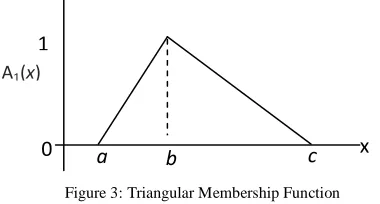
from 0 and 1 in various shapes called Triangular, Trapezoidal, Bell Curve, Gaussian, etc. membership functions. The Triangular membership function shown in Fig. 3 is adopted in this study because of its simplicity and ease of use.
Figure 3: Triangular Membership Function
Membership functions are determined at various points on the triangle by use of equation (7).
Triangle( ;a,b,c) =
{
(7)
where ‗a‘ and ‗c‘ respectively set the left and right ―feet,‖ or base points of the triangle, while b sets the location of the triangle peak.
The Knowledge Base of the fuzzy logic controller comprises a database and a rule base. The membership function of an element in a fuzzy set is defined in the database module. The rule base comprises the set of fuzzy production rules, which represent the control policy and goals of the domain experts by means of control rules expressed in linguistic terms. The control rules are formulated in an "IF–THEN‖ format that makes learning and adaptation easier, and outputs better; consequently resulting in a system that relies less on expert knowledge within the particular domain knowledge [31,32]. Given the diagnosis category, the antecedent (the IF …) part of the rules, and the consequence or ―firing strength‖ (the THEN …) part, determine the EHF Risk Level (EHF-RL). A patient‘s EHF-RL would be classified into ‗No EHF Risk‘, ‗Very Low
EHF Risk‘, ‗Low EHF Risk‘, ‗High EHF Risk‘ or ‗Very High EHF Risk‘ as shown in Table 2.
TABLE 2: OUTPUT FUZZY SET
Diagnosis Categories Fuzzy Values
T-1 (No EHF Risk) 0.0< x < 0.2 T-2 (Low EHF Risk) 0.2 < x < 0.3 T-3 (Moderate EHF Risk) 0.3< x < 0.5 T-4 (High EHF Risk) 0.5< x < 0.7 T-5 (Very High EHF Risk) 0.7< x ≤ 1.0
A rule fires if any of the precedence diagnosis categories evaluates to true (i.e., 1); else, it does not fire if all the diagnosis categories evaluate to false (i.e., 0). Examples of the structure of the rules in the rule base are:
If (PS is Mild) and (TR is V-Mild) and (ND is Short) and (PH is Unsafe) then (EHF-RL is T-2)
If (PS is V-Severe) and (TR is V-Mild) and (ND is Short) and (PH is V-Unsafe) then (EHF-RL is T-3) If (PS is Deadly) and (TR is High) and (ND is V-Short) and (PH is Disastrous) then (EHF-RL is T-5)
Decision-making process takes place in the Inference Engine of the fuzzy logic controller. The engine mimics decision-making process in humans and infers fuzzy control actions by utilising fuzzy implication and linguistic rules. The output of the fuzzy inference engine process is a fuzzy set.
The Defuzzifier converts inferred fuzzy control actions from the fuzzy inference engine into crisp control action that is outputted from the controller in the real life domain.
The decision support engine of Figure 1 is driven by the inference mechanism of the fuzzy logic controller. The output from the inference engine of the fuzzy logic controller is fed into the cognitive filter of the decision support engine and applies the objective rules to determine if a patient is Ebola virus infected or not. This result is inputted into the emotional filter where the subjective rules in the domain of study are applied appropriately to rank the patient‘s EHF_Risk Level.
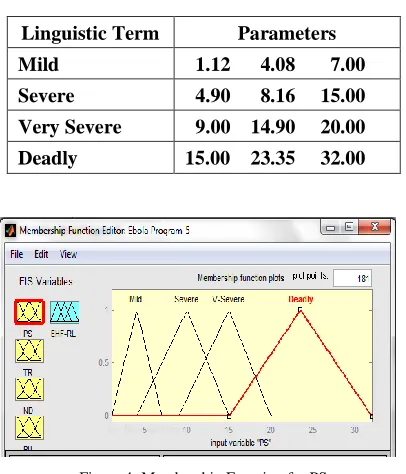
The proposed fuzzy control system, with input linguistic variables PS, TR, ND and PH, was implemented using the Fuzzy logic toolbox in MATLAB 7.10.0.499 (R2010) software. Each linguistic variable was fuzzified into linguistic terms to explain it at different levels within scale 0 – 1. Linguistic variable PS, fuzzified into four linguistic terms: mild‘, ‗severe‘, ‗very severe‘ and ‗deadly‘, has 0
1
A1(x)
x
b c
values ranging from 1 – 32 as shown in the membership function of Fig. 4.
TABLE 3: INPUT VARIABLE PS
Linguistic Term Parameters Mild 1.12 4.08 7.00
Severe 4.90 8.16 15.00 Very Severe 9.00 14.90 20.00
Deadly 15.00 23.35 32.00
Figure 4: Membership Function for PS
Linguistic variable TR with values from 1 – 5, was fuzzified into four linguistic terms: ‗very mild‘, ‗mild‘, ‗high‘ and ‗very high‘ shown in Table 4, and depicted in the membership representation of fig
. 5.
TABLE 4: INPUT LINGUISTIC VARIABLE TR
Linguistic Term Parameters Very Mild 1.00 1.63 2.25
Mild 1.50 2.25 3.00 High 2.25 3.15 4.00
Very High 3.00 4.00 5.00
Figure 5: Membership Function for TR
Values of linguistic variable ND ranges from 1 – 21, fuzzified into four linguistic terms: ‗very short‘, ‗short‘, ‗long‘, ‗very long‘ shown in Table 5, represented by the membership functions of Fig. 6.
TABLE 5: INPUT LINGUISTIC VARIABLE ND
Linguistic Term Parameters
Very Short 1.00 2.50 4.00 Short 3.00 5.50 8.00 Long 6.00 10.00 14.00
Very Long 10.00 15.50 21.00
Fig. 6: Membership Function for ND
Table 6 shows Linguistic variable PH with its linguistic terms (‗mild‘, ‗unsafe‘, ‗very unsafe‘ and ‗disastrous‘) varying from 1 – 5, as pictured in the membership functions of Fig. 7.
TABLE 6: INPUT LINGUISTIC VARIABLE PH
Linguistic Term Parameters
Mild 1.00 1.65 2.30 Unsafe 1.50 2.35 3.20 Very Unsafe 2.30 3.20 4.10
Disastrous 3.20 4.10 5.00
Figure 7: Membership Function for PH
specified weight to a rule is assumed to be unity (1). Given the set of Input values, the rules which satisfied the operational logic were utilised to generate the output for the Inference Engine. The inference engine mechanism searches the membership values in the condition of each rule and processes the crucial decision-making output denoted as EHF-RL (i.e. EHF Risk Level). The output derived from each rule is aggregated and then defuzzified as described.
III RESULTS AND DISCUSSION
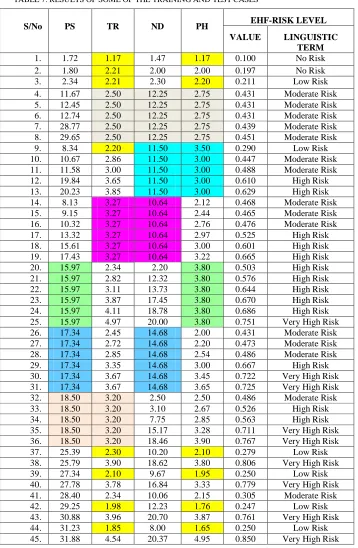
Table 7 shows some EHF Risk Level (EHF_RL) results (on a scale of 0 – 1) generated from the training of the FIS, using test cases of PS, TR, ND and PH input values. Each of the crisp numerical input data of these linguistic variables was
TABLE 7: RESULTS OF SOME OF THE TRAINING AND TEST CASES
S/No PS TR ND PH EHF-RISK LEVEL
VALUE LINGUISTIC TERM
1. 1.72 1.17 1.47 1.17 0.100 No Risk
2. 1.80 2.21 2.00 2.00 0.197 No Risk
3. 2.34 2.21 2.30 2.20 0.211 Low Risk
4. 11.67 2.50 12.25 2.75 0.431 Moderate Risk
5. 12.45 2.50 12.25 2.75 0.431 Moderate Risk
6. 12.74 2.50 12.25 2.75 0.431 Moderate Risk
7. 28.77 2.50 12.25 2.75 0.439 Moderate Risk
8. 29.65 2.50 12.25 2.75 0.451 Moderate Risk
9. 8.34 2.20 11.50 3.50 0.290 Low Risk
10. 10.67 2.86 11.50 3.00 0.447 Moderate Risk
11. 11.58 3.00 11.50 3.00 0.488 Moderate Risk
12. 19.84 3.65 11.50 3.00 0.610 High Risk
13. 20.23 3.85 11.50 3.00 0.629 High Risk
14. 8.13 3.27 10.64 2.12 0.468 Moderate Risk
15. 9.15 3.27 10.64 2.44 0.465 Moderate Risk
16. 10.32 3.27 10.64 2.76 0.476 Moderate Risk
17. 13.32 3.27 10.64 2.97 0.525 High Risk
18. 15.61 3.27 10.64 3.00 0.601 High Risk
19. 17.43 3.27 10.64 3.22 0.665 High Risk
20. 15.97 2.34 2.20 3.80 0.503 High Risk
21. 15.97 2.82 12.32 3.80 0.576 High Risk
22. 15.97 3.11 13.73 3.80 0.644 High Risk
23. 15.97 3.87 17.45 3.80 0.670 High Risk
24. 15.97 4.11 18.78 3.80 0.686 High Risk
25. 15.97 4.97 20.00 3.80 0.751 Very High Risk
26. 17.34 2.45 14.68 2.00 0.431 Moderate Risk
27. 17.34 2.72 14.68 2.20 0.473 Moderate Risk
28. 17.34 2.85 14.68 2.54 0.486 Moderate Risk
29. 17.34 3.35 14.68 3.00 0.667 High Risk
30. 17.34 3.67 14.68 3.45 0.722 Very High Risk
31. 17.34 3.67 14.68 3.65 0.725 Very High Risk
32. 18.50 3.20 2.50 2.50 0.486 Moderate Risk
33. 18.50 3.20 3.10 2.67 0.526 High Risk
34. 18.50 3.20 7.75 2.85 0.563 High Risk
35. 18.50 3.20 15.17 3.28 0.711 Very High Risk
36. 18.50 3.20 18.46 3.90 0.767 Very High Risk
37. 25.39 2.30 10.20 2.10 0.279 Low Risk
38. 25.79 3.90 18.62 3.80 0.806 Very High Risk
39. 27.34 2.10 9.67 1.95 0.250 Low Risk
40. 27.78 3.78 16.84 3.33 0.779 Very High Risk
41. 28.40 2.34 10.06 2.15 0.305 Moderate Risk
42. 29.25 1.98 12.23 1.76 0.247 Low Risk
43. 30.88 3.96 20.70 3.87 0.761 Very High Risk
44. 31.23 1.85 8.00 1.65 0.250 Low Risk
transformed into fuzzy values by the fuzzifier in the Fuzzy Logic Controller (FLC). Each of the fuzzy values represents the degree of membership of the crisp value (i. e., the degree or extent to which the crisp value belongs to a fuzzy set) on a scale of 0 to 1 on the triangular membership function of Figure 3. Then fuzzy ―IF-THEN-RULES‖ are applied by the Inference Engine of the FLC to logically compute the degree to which the input data matches the conditions of a rule. This leads to fuzzy outputs, which represent the actions to be taken by the controller in terms of the given information. The fuzzy outputs have to be transformed back to crisp values by the defuzzifier module of the FLC. MATLAB uses the ―Centre of Gravity‖ also called the ―Centroid‖ approach to carry out the defuzzification of the fuzzified values. Usage of the Centroid technique has a very high success rate because it gives accurate results based on weighted values of several output membership functions; hence it is commonly used. The centroid method is given by equation 8.
∑
∑
.
.
(8)where x* = Fuzzy controller output variable xi = Sampled element
µF(xi) = Membership value of sampled
element
⋃ = Fuzzy set
n = number of sampled values
Table 7 reveals variations in the Ebola Haemorrhagic Fever Risk Level (EHF_RL) with varying values of the input parameters (PS, TR, ND and PH). The output depends on all these parameters. Little variations are observed in the output when TR, ND and PH (Tan coloured in Table 7) are kept constant while varying PS even to a ―Deadly‖ region value of 29.65. The output remains on a ―Moderate Risk Level‖ — an indication that PS does not necessarily determine EHF_RL.
Keeping ND and PH (coloured Aqua in Table 7) constant, while varying PS and TR, EHF_RL increases gradually from ―Moderate‖ to ―High‖ risk level. This same pattern is observed when TR and ND (coloured purple in Table 7) are kept constant and PS and PH are varied.
It is however all ―High‖ risk level, even when ―Very Mild‖ value of TR and ―Very Short‖ duration of ND combine with ―Very High‖ constant values of PS and PH (shown in light green color in Table 7). This is an
indication that TR and ND are very crucial in determining the risk level of EHF virus infection
With constant high values of PS and ND (light turquoise color in Table 7), the system output increases gradually from ―Moderate‖ to ―Very High‖ risk level; implying that TR and PH have significant effect on the risk level of EHF infection. It is also observed (as shown in light orange color in Table 7) that keeping PS and TR at a very high level also results in ―High‖ and ―Very High‖ EHF risk level. The very singular dominant effect of TR is observed in all the results shown. Generally, a ―mild‖ value of TR results in either a ―No‖ or ―Low‖ EHF risk level irrespective of the combinations of the other input parameters. This shows that TR is the fundamental indicator of EHF_RL.
IV CONCLUSION
In this study, a fuzzy expert system to diagnose EHF and evaluate its risk level is proposed. The design is based on four judiciously chosen fuzzy input variables namely: patient‘s symptoms (PS), laboratory test results (TR), the number of days since initial infection (ND) and the patient‘s itinerary history (PH), and one output variable EHF risk level (EHF-RL) in patients. The knowledge representation and fuzzy logic rules of the proposed system are based on the experience and judgment of physicians, and reports and reviews from health associations/organizations. The EHF expert system, which can be used by both the physician and patient alike does not only diagnose for EHF but also determines the disease risk level in patients. Designing the system with fuzzy technology in comparison with classical design techniques improves results due to the fact that human factors like ambiguity, imprecision and fatigue have been addressed.
REFERENCES
[1] S. Shakeel, ―Ebola Virus Disease: an Emerging Threat to Pakistan‖, Journal of Medical Diagnostic Methods, vol. 6, no.1, pp. 1-2, January 2017.
[2] D. Passi, S. Sharma, S. R. Dutta, P. Dudeja, and V. Sharma, ―Ebola Virus Disease (The Killer Virus): Another Threat to Humans and Bioterrorism: Brief Review and Recent Updates‖, Journal of Clinical and Diagnostic Research. Vol. 9. No.6, pp. LE01-LE08, June 2015. DOI: 10.7860/JCDR/2015/13062.6100 [3] J. R. Spengler, E. D. Ervin, J. S. Towner, P. E. Rollin,
and S. T. Nichol, ―Perspectives on West Africa Ebola Virus Disease Outbreak, 2013–2016‖, Emerging Infectious Diseases, Vol. 22, No. 6, pp. 956-963, June
2016. www.cdc.gov/eid. DOI:
http://dx.doi.org/10.32032/eid2206.160021
of Allied Med. Sci. and Clin. Research, Vol-5(2) pp. 517-530, April – June, 2017.
[5] Acute (2015). ―Ebola Virus Disease‖. Acute Communicable Disease Control Manual (B-73).
Available at:
http://www.publichealth.lacounty.gov/acd/procs/b73/Di seaseChapters/B73Ebola.pdf.
[6] InternationalSOS. Fighting Ebola in West Africa. 2014. https://www.internationalsos.com/hotline/fighting-ebola-in-west-africa.
[7] World Health Organisation, 2017, Ebola Situation
Report - 30 March 2016,
http://www.who.int/about/copyright/en/
[8] WHO Factsheet (2017). Available online athttp://www.who.int/mediacentre/factsheets/fs103/en/ Last visited on September 19, 2017. ―Ebola virus disease Fact sheet No. 103‖. World Health Organization. September 2014
[9] S. Kumar, R. Kumari, R. Pandey, And V. A Sharma, ―Ebola Virus Disease: Biology, Diagnosis‖, Treatment and Prevention of Epidemics, Proc Indian Natn Sci Acad 83 No. 1, March 2017 pp. 103-149
[10] Centers for Disease Control and Prevention. Ebola Virus
Disease, 2014. Available at:
http://www.cdc.gov/vhf/ebola/healthcare-us/preparing/clinicians.html
[11] A. A. Ansari, ―Clinical features and pathobiology of Ebolavirus infection‖, J of utoimmunity.vol. 55, pp.1-9. [12] Y. J. Peter, Ebola Virus Disease, IOSR Journal of
Dental and Medical Sciences (IOSR-JDMS), vol. 16, no. 8 Ver. IX , PP 71-74, August 2017.DOI: 10.9790/0853-1608097174 www.iosrjournals.org
[13] A. MacNeil, and P. E. Rollin, ―Ebola and Marburg haemorrhagic fevers‖, PLoS Negl Trop Dis, vol. 6, no. 6, pp. 1-7, 2012. Available from: Academic Search Complete, EBSCOhost.
[14] WHO. Ebola Virus Disease 2014. Available at: http://www.searo.who.int/entity/emerging_diseases/ebol a/keyfacts_ebola_virus_disease.pdf.
[15] Echwalu E. Disease Briefing: Ebola Hemorrhagic Fever, 2014. Tomas Reuters. An Abbreviated Entry 2014.
Available at:
http://www.whiov.cas.cn/xwdt_105286/kydt/201408/W 020140822749968603837.pdf.
[16] WHO. Ebola hemorrhagic fever fact sheet 103 2012.
Available at:
http://www.who.int/mediacentre/factsheets/fs103/en/. [17] A, Wolz, ―Face to Face with Ebola — An Emergency
Care Center in Sierra Leone‖, N Engl, J Med; vol. 371, pp. 1081-1083, September 2014. DOI: 10.1056/NEJMp1410179
[18] T. R. Frieden, I. Damon, B. P. Bell, T. Kenyon, and S. Nichol, ―Ebola 2014 — New Challenges, New Global Response and Responsibility‖, N Engl J Med 2014; vol. 371, pp.1177-1180, September 2014 DOI: 10.1056/NEJMp1409903,
http://www.nejm.org/doi/10.1056/NEJMp1409903 [19] G. A. Matua, D. M. Van der Wal, and Locsin RC,
“Ebola Hemorrhagic Fever Outbreaks: Strategies for Effective Epidemic Management, Containment and Control‖, Braz. J Infect Dis., Vol. 19, No. 3, April 2015, pp. 308-313.
[20] E. M. Leroy, J. P. Gonzalez, and S. Baize, ―Ebola and Marburg haemorrhagic fever viruses: major scientific advances, but a relatively minor public health threat for Africa‖ Clin Microbiol Infect. vol. 17, pp. 964–976, 2011. http://dx.doi. org/10.1111/j.1469-0691.2011.03535.x, PMid:21722250.
[21] P. Sharma, D. B. V. Singh, M. K. Bandil, and N. Mishra, ―Decision Support System for Malaria and Dengue Disease Diagnosis (DSSMD)‖ International Journal of Information and Computation Technology, vol. 3, no. 7, pp. 633-640, 2013.
[22] N. Sahai, D. Shrivastava, and P. Srivastava P. ―Diagnosis of the Jaundice Using Fuzzy Expert System‖ International journal of Biomedical Engineering and Science, vol. 1, no. 3, pp. 15-19, October 2014. [23] E. S. Singh, ―A Fuzzy Rule Based Expert System to
Diagnostic the Mental Illness (MIDExS)‖. International Journal of Innovative Research in Computer and Communication Engineering, vol. 3, no. 9, pp. 8759-8764, September 2015.
[24] P. B. Tintu, and R. Paulin, ―Detect Breast Cancer using Fuzzy C means Techniques in Wisconsin Prognostic Breast Cancer (WPBC) Data Sets‖. International Journal of Computer Applications Technology and Research, vol. 2, no. 5, pp. 614 – 617, 2013.
[25] V. Jain, and S. Raheja. ―Improving the Prediction Rate of Diabetes Using Fuzzy Expert System‖, International Journal of Information Technology and Computer Science, vol. 10, pp. 84-91, September 2015.
[26] O. J. Ayangbekun, and I. A. Jimoh ―Fuzzy Logic Application to Brain Diseases Diagnosis‖ Journal of Emerging Trends in Computing and Information Sciences, vol. 6, no. 3, pp. 144-148, March 2015. [27] N. Ziasabounchi and I. Askerzade, ―ANFIS Based
Classification Model for Heart Disease Prediction‖. International Journal of Electrical & Computer Sciences IJECS-IJENS, Vol. 14, No. 2, pp. 146402-7373, April 2014.
[28] R. Safdari, M. Kadivar, M. Langarizadeh, A. F. Nejad, and F. Kermai, ―Developing a Fuzzy Expert System to Predict the Risk of Neonatal Death‖, Acta Inform Med., vol. 24, no. 1, pp. 34-37, February 2016.
[29] K. Rahul, S. Anupam, and T. Ritu, ―Fuzzy Neuro Systems for Machine Learning for Large Data Sets‖. Proceedings of the IEEE International Advance Computing Conference 6-7, Patiala, India 2009; 541-545.
[30] M. Baheti, ―Study of need and Framework of Expert Systems for Medical Diagnosis‖. IOSR J Comput Eng. (IOSR-JCE) e-ISSN: 2278-0661, p-ISSN: 2278-8727, 2016; 45-48.
[31] E. Al-Daoud, ―Identifying DNA splice sites using patterns statistical properties and fuzzy neural networks‖, EXCLI J., vol. 8, pp. 195-202, 2009. [32] M. T. Adewunmi, and Y. A. Adekunle, ―Clinical
![Table 1: Chronology of previous Ebola virus disease outbreaks (Source: WHO Factsheet [7]](https://thumb-us.123doks.com/thumbv2/123dok_us/7806505.2085191/2.612.79.506.86.536/table-chronology-previous-ebola-disease-outbreaks-source-factsheet.webp)