Available online throug
ISSN 2229 – 5046
International Journal of Mathematical Archive- 8(11), Nov. – 2017 162
APPLICATION OF HOMOTOPY ANALYSIS METHOD AND APPROXIMATE
ANALYTICAL SOLUTION OF NON-LINEAR EQUATION IN CHEMICAL SCIENCE
R. KARTHIKEYAN*¹, A. P. DHANABALAN²
¹Department Of Mathematics,
NMS SVN College, Madurai – 625019, Tamil Nadu, India.
²PG & Research Department of Mathematics,
Alagappa Govt. Arts College, Karaikudi - 630003. Tamil Nadu, India.
(Received On: 05-09-17; Revised & Accepted On: 01-11-17)
ABSTRACT
T
he analytical solution of the steady state concentrations of carbon dioxide, hydrogen carbonate and carbonate at the gas-liquid phase is discussed. The analytical expression is based on system of reaction diffusion equations containing a non-linear term of the chemical reaction. A simple and closed approximate analytical expression of the steady-state concentrations and effectiveness factor derived for all values of the reaction diffusion parameters. In this paper, Homotopy analysis method is used to solve the system of non-linear differential equations.Keywords: Absorption, Mass transfer, chemical reactions, interferometry, parametric estimation, Mathematical modelling, Homotopy analysis method.
1. INTRODUCTION
A lot of chemical engineering process is based on chemical reaction between a gas and a component in a liquid phase. It is commonly admitted that the global gas-liquid mass transfer rate is controlled by phenomena occuring in layers close to the gas-liquid interface, especially the coupling between the diffusive transport and the chemical reaction in the liquid phase [1].
Mass transfer is the net movement of mass from one location, usually meaning a stream, phase, fraction or component, to another. Mass transfer occurs in many processes, such as absorption, evaporation, adsorption, drying, precipitation, membrane filtration, and distillation [2-4].
A new experimental tool and an original procedure to study phenomena occuring during the gas-liquid absorption coupled with chemical reactions in the liquid phase. The concentration variation due to the mass absorption and the chemical reaction can modify the refractive index of the liquid. Therefore, digital holographic interferometry can be used to visualize the formation and the development of the diffusion layer during the mass transport in this liquid close to the gas-liquid interface [5]. Overall external mass transfer and pressure drop performance are addressed for a square 2 mm width channel filled with metal foams as catalyst supports for gas–liquid–solid reactions under an applied pulsing regime [6].
Several approaches, such as the two-film theory [6], the penetration theory [7] are presented in the literature to model the global mass transfer rate in a gas-liquid contactor. All these approaches based on mass balance equations in the thin layer of liquid close to the liquid interface. The modelling of the phenomena taking place in the vicinity of the gas-liquid interface when the absorbtion occurs. As mentioned in Komiya et al. [6], one of the key steps in improving the understanding of this phenomenon would be to develop a tool enabling a direct visualization of the absorption at the interface and the reaction diffusion processes in the liquid phase.
Corresponding Author: R. Karthikeyan*¹,
¹Department Of Mathematics, NMS SVN College, Madurai – 625019, Tamil Nadu, India.
Recently Wylock et al. [1] developed a mathematical model for gas-liquid absorption process coupled with chemical reaction in the liquid phase. To the best of our knowledge, till date, no exact analytical solutions of the model have been reported. The purpose of this chapter is to present an analytical expression for the concentrations of carbon dioxide
CO
2, hydrogen carbonateHCO
3− and carbonateCO
32−for all possible values of parameters and for short time using Homotopy analysis method.2. MATHEMATICAL FORMULATION OF THE BOUNDARY VALUE PROBLEM
The reaction scheme for gas-liquid absorption with chemical reactions in the liquid phase can be written as follows:
−
−
+
→
+
2 2 33
2
CO
H
O
2
HCO
CO
(1) The diffusion reaction equation in this model can be written in the following form [1]:
]
[
]
[
]
[
]
[
]
[
3 2 3 2 0 2 2 2 2 2 − −−
∂
∂
=
∂
∂
HCO
CO
CO
k
x
CO
D
t
CO
CO (2)
]
[
]
[
]
[
2
]
[
]
[
3 2 3 2 0 2 3 2 3 3 − − − −+
∂
∂
=
∂
∂
−HCO
CO
CO
k
x
HCO
D
t
HCO
HCO (3)
]
[
]
[
]
[
]
[
]
[
3 2 3 2 0 2 2 3 2 2 3 2 3 − − − −−
∂
∂
=
∂
∂
−HCO
CO
CO
k
x
CO
D
t
CO
CO (4)
where
CO
2 ,− 3
HCO
,andCO
32−are the concentration of carbon dioxide, hydrogen carbonate and carbonate and 2CO
D
, −3
HCO
D
and 2−3
CO
D
are the corresponding diffusion coefficient. 0k
is the kinetic constant. The boundary conditions are, 0 2 3 2 3 0 3 3 0 22
]
[
]
,
[
]
[
]
,
[
]
[
]
[
,
0
=
−=
− −=
−=
CO
CO
HCO
HCO
CO
CO
t
(5)0
]
[
,
0
]
[
,
]
[
,
0
2 3 32 2
∂
=
∂
=
∂
∂
=
=
− −x
CO
x
HCO
RT
p
n
CO
x
co (6)0
]
[
,
0
]
[
,
0
]
[
,
2 3 3 2=
∂
∂
=
∂
∂
=
∂
∂
∞
→
− −x
CO
x
HCO
x
CO
x
(7)where 0
2
]
[
CO
,[
HCO
3−]
0 and[
CO
32−]
0be the initial concentrations, n is theCO
2 solubility, 2 COp
is theCO
2 partial pressure in the gaseous phase, R is the perfect gas constant and T is the absolute temperature. Now, using the following dimensionless parameters]
[
]
[
],
][
[
1
,
,
,
]
[
]
[
,
]
[
]
[
,
]
[
]
[
2 3 3 0 1 2 3 2 0 2 3 2 3 0 3 3 0 2 2 − − − − − − −=
=
=
=
=
=
=
CO
HCO
k
k
CO
CO
s
t
T
D
x
X
CO
CO
c
HCO
HCO
b
CO
CO
a
α
α
α
α
, (8)
We get the dimensionless non-linear reaction diffusion equations for the concentration as follows:
© 2017, IJMA. All Rights Reserved 164
0
,
0
,
,
0
=
∂
∂
=
∂
∂
=
=
X
c
X
b
l
a
X
(13)0
,
0
,
0
,
=
∂
∂
=
∂
∂
=
∂
∂
∞
→
X
c
X
b
X
a
X
(14)3. ANALYTICAL SOLUTIONS OF THE PROBLEM USING HOMOTOPY ANALYSIS METHOD
Liao [9-11] proposed a powerful analytical method for solving the nonlinear problems, namely the Homotopy analysis method. Different from all perturbation and non-perturbation techniques, the Homotopy analysis method [12-14] itself provides us with a convenient way to control and adjust the convergence region and rate of approximation series, when necessary. Briefly speaking, the Homotopy analysis method has the following advantages: It is valid even if a given nonlinear problem does not contain any small/large parameters at all; it can be employed to efficiently approximate a nonlinear problem by choosing different sets of base functions.
Now, more and more researchers have been successfully applying this method to various nonlinear problems in science and engineering. In this paper we apply HAM to solve the nonlinear differential equations (Eqns. (9) - (11)). The basic concept of Homotopy analysis method is given in Appendix A. By solving the equations (9) - (11), using Homotopy analysis method (see Appendix B) we can obtain the following new approximate expression for the concentrations as follows: 2 2 2 / 4 1
1 1 4
1
( , ) 1 (
1)
2
2
2
(
1)
2
2
2
X t X tX
x
X
t
a X s
l
erfc
hk
t erfc
X
e
t
t
hk l
t
X
hk t
e
Xerfc
X
t
π
π
− −
= + −
−
+
−
−
+
+
−
(15) 2 2 2 / 4 1 1 / 4 1( , )
1 2
(
1)
2
2
(
1)
2
2
X t
X t
X
X
t
b X s
hk t
hk l
t
erfc
X
e
t
t
X
hk l
X
e
Xerfc
t
π
π
− −
= −
−
−
+
−
−
−
−
(16)
−
+
−
+
+
−
+
−
−
=
− − − T X T X T Xe
T
X
T
X
erfc
T
X
lX
hk
T
hk
T
X
erfc
X
TX
X
T
e
T
l
hk
T
X
Xerfc
e
T
l
s
X
c
4 / 2 1 1 3 2 4 / 1 4 / 2 2 22
2
2
2
)
6
(
6
1
)
4
(
3
1
2
2
2
)
,
(
π
π
π
(17) The analytical expression represented by Eqns. (9) - (11) contains the auxiliary parameters h, which gives the convergence region and the rate of approximation for HAM. The auxiliary parameter h controls the convergence and accuracy of the solution series [15]. The parameterh
∈ −
[ ]
1,1
, throughout this chapter we chooseh
= −
1
, to show the accuracy of solution and it gives better results.4. RESULTS AND DISCUSSION
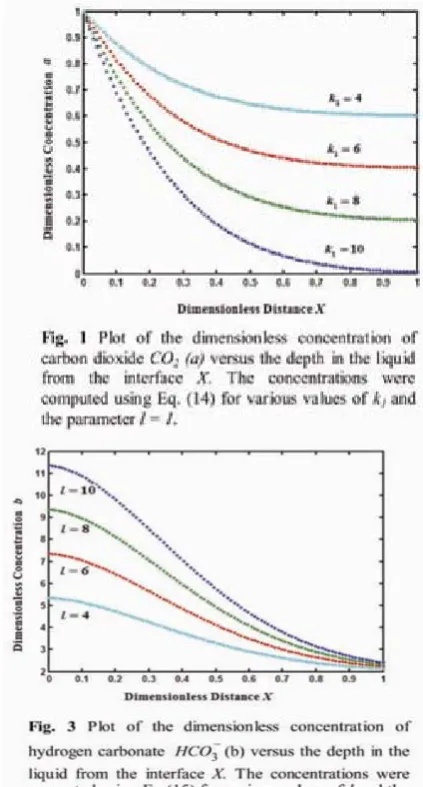
Equations (9)-(11) are the new approximate analytical expression of dimensionless concentration of carbon dioxide 2
Fig. (1-2) represents the dimensionless concentration of
CO
2 versus depth in the liquid from the interfaceX
for all values of dimensionless rate constantsk
1,
l
andπ
. From Fig. 1, it is inferred that the concentration ofCO
2decreases whenk
1 increases. Fig. 2 shows that concentration ofCO
2 increases when interfacial concentration of carbon dioxide in the liquid facel
is increases.Fig. (3-4) shows that the dimensionless concentration of
HCO
3−versus depth in the liquid from the interfaceX
for various values of parameters. From this figures we can see that the concentration ofHCO
3− gradually increases when interfacial concentration of carbon dioxidel
and 1k
increases.Fig. (5-6) shows that the dimensionless concentration of
CO
32−versus depth in the liquid from the interfaceX
for various values of parameters. From this figures we can see that the concentration ofCO
32− gradually decreases whenl
and 1k
increases. 5. CONCLUSIONS© 2017, IJMA. All Rights Reserved 166 6. REFERENCES
1. Bird, R., Stewart, W., Lightfoot, E., Transport Phenomena. John Wiley and sons, New York. 2002. 2. Treybal, R. E., Mass-Transfer Operations, 3rd Edition, McGraw-Hill, 1981.
3. Geankoplis, C.J., Transport Processes and Separation Process Principles. 4th Edition, Prentice-Hall of India, New Delhi, 2005.
4. Dutta, B.K., Principles of Mass transfer and Separation Processes. Prentice-Hall of India, New Delhi, 2007. 5. Komiya, A., Maruta, K., Nakano, Y., Hashida, T., Visualization of transient concentration field in process of
carbon dioxide absorption at gas-liquid surface, France.2008
6. Whitman, W., The two-film theory of absorption. Chemistry and Metal Engineering 1923, 29, 147.
7. Higbie, R., The rate of absorption of pure gas into a still liquid during short periods of exposure. Transactions on American institute of Chemical Engineers 1935, 31,365.
8. Coulson, J., Richardson, J., Fluid Flow, Heat transfer, and Mass transfer. Chemical Engineering, 1999, 1. 9. Cattrall, R. W. In Chemical Sensors; Oxford University Press: Oxford, 1997.
10. Liao, S.J.; Ph. D., thesis, Shanghai Jiao Tong University, 1992.
11. G.Domairry.; M. Fazeli, Comm. Nonlinear Sci. Numer. Sim. 2009,14,489-499
12. Liao, S.J.; Tan, Y., A general approach to obtain series solution of nonlinear differential equations, Studies in Applied Mathematics, 2007, 119, 297-354.
13. Liao, S. J.; Commun. Nonlinear Sci. Numer. Simul. 2010, 15, 2003-2016.
14. Sohouli, A. R.; Famouri, M.; Kimiaeifar, A.; Domairry, G., Comm. Nonlinear. Sci. Numer. Simulat. 2010, 15, 1691-1699.
15. Loghambal, S.; Rajendran, L., J. Membr. Sci. 2011, 373, 20–28.
16. S.J. Liao Homotopy Analysis Method in Nonlinear Differential Equation. Springer: Berlin, Germany (2012). 17. Liao, S. J. Beyond Perturbation: Introduction to the Homotopy analysis method. 1stEdn. Chapman and Hall,
CRC Press, Boca Raton, 2003.
Source of support: Nil, Conflict of interest: None Declared.