Available online throug
ISSN 2229 – 5046
PERISTALTIC TRANSPORT OF A COUPLE STRESS FLUID
THROUGH A POROUS MEDIUM IN AN INCLINED CHANNEL
DR. N. G. SRIDHAR
Govt. First Grade College & P. G. Centre, Sedam-585 222, Karnataka, India.
(Received On: 30-11-18; Revised & Accepted On: 04-01-19)
ABSTRACT
T
he present paper investigates the peristaltic transport of a couple stress fluid in a two dimensional inclined channel through a porous medium. The effects of various physical parameters on velocity, pressure gradient and friction force have been discussed & computed numerically. The effects of various key parameters are discussed with the help of graphs.Keywords: Peristaltic transport, Couple stress fluid, Porous media and inclined channel.
1. INTRODUCTION
The aim of this paper is to study a physiological situation with the presence of an endoscope placed concentrically. Srivastava et al. [9] investigated peristaltic transport of a physiological fluid: part I flow in non- uniform geometry. Latham [18] investigated the fluid mechanics of peristaltic pump and science. Ramchandra and Usha [16] studied the influence of an eccentrically inserted catheter on the peristaltic pumping in a tube under long wavelength and low Reynolds numbers approximations. Gupta and Sheshadri [4] studied peristaltic transport of a Newtonian fluid in non-uniform geometries. Cotton and Williams [15] investigated practical gastrointestinal endoscopy. Mekhemier [7] studied non linear peristaltic transport a porous medium in an inclined planar channel. Srivastava and Srivastava [10] have investigated peristaltic transport of a non-newtonian fluid: applications to the vas deferens and small intestine. Rathod and Asha [30] have investigated peristaltic transport of a couple stress fluid In a uniform and non-uniform annulus. Raptis and Peridikis [17] are investigated flow of a viscous fluid through a porous medium bounded by a vertical surface. El-dabe and El-Mohandis [5] have studied magneto hydrodynamic flow of second order fluid through a porous medium on an inclined porous plane. Ayman and Sobh [2] investigated peristaltic transport of a magneto-newtonian fluid through a porous medium. Habtu and Radhakrishnamacharya (6) studied dispersion of a solute in peristaltic motion of a couple stress fluid through a porous medium with slip condition. Rathod and Mahadev [31] investigated effect of thickness of the porous material on the peristaltic pumping of a Jeffry fluid with non - erodible porous lining wall. Rathod, et al. [22] have investigated peristaltic pumping of couple stress fluid through non - erodible porous lining tube wall with thickness of porous material. Mekhemier and Abd elmaboud [8] studied peristaltic flow of a couple stress fluid in an annulus: application of an endoscope. Alsaedi et al. [1] studied peristaltic flow of couple stress fluid through uniform porous medium. Rathod and Sridhar [19] investigated peristaltic transport of couple stress fluid in uniform and non-uniform annulus through porous medium. Rathod and Asha [30] studied effect of couple stress fluid and an endoscope in peristaltic motion. Abd elmaboud and Mekheimer [40] study non-linear peristaltic transport of a second-order fluid through a porous medium. Rathod and Asha [21] studied effects of magnetic field and an endoscope on peristaltic motion. Rathod and Mahadev [29] studied effect of magnetic field on ureteral peristalsis in cylindrical tube. Rathod and Mahadev [26] Studied of ureteral peristalsis in cylindrical tube through porous medium. Rathod and Pallavi [36] studed the influence of wall properties on MHD Peristaltic transport of dusty fluid. Rathod and Pallavi [37] investigated the influence of wall properties on Peristaltic transport of dusty fluid through porous medium. Rathod and Mahadev [27] studied of ureteral peristalsis with Jeffrey fluid flow. Rathod and Mahadev [28] studied Slip effects and heat transfer on MHD peristaltic flow of Jeffrey fluid in an inclined channel. Rathod and Laxmi [25] investigated slip effect on peristaltic transport of a conducting fluid through a porous medium in an asymmetric vertical channel by Adomian decomposition method. Rathod and Laxmi [24] studied peristaltic transport of a conducting fluid in an asymmetric vertical channel with heat and mass transfer. Rathod and Laxmi [23] studied effects of heat transfer on the peristaltic MHD flow of a Bingham fluid through a porous medium in a channel. Rathod and Sridhar [35] studied effects of couple stress fluid and an endoscope on peristaltic transport through a porous medium, Jayarami Reddy et al., [3] have studied the peristaltic flow of a Williamson fluid in an inclined planar channel under the effect of a magnetic field. Rathod and Sridhar [33] studied peristaltic flow of a couple stress fluid in an inclined channel. Rathod et al., [38] studied peristaltic flow of a couple stress fluid in an inclined channel under the effect of magnetic field.
Corresponding Author: Dr. N. G. Sridhar
© 2019, IJMA. All Rights Reserved 14 Rathod et al., [39] studied peristaltic transport of a conducting couple stress fluid through a porous medium in a channel. Rathod et al., [32] studied effect of magnetic field on peristaltic transport of a couple stress fluid in a channel. Sridhar [11] studied effect of thickness of the porous material using porous media on the peristaltic pumping of couple stress fluid through non - erodible porous lining tube. Sridhar [12] studied effects of magnetic field with variable viscosity and an endoscope on peristaltic transport of couple stress fluids through a porous medium. Sridhar [13] studied peristaltic pumping of couple stress fluid through non - erodible porous lining tube wall with thickness of porous material using magnetic field. Rathod and Sridhar [34] studied peristaltic flow of a couple stress fluids through a porous medium in an inclined channel. Sridhar [14] studied peristaltic flow of a couple stress fluid in an inclined channel under the effect of magnetic field with slip condition
The present research aim is to investigate the peristalsis for the flow of a couple stress fluid in a two dimensional inclined channel through a porous medium. The computational analysis has been carried out for drawing velocity profiles, pressure gradient and frictional force.
2. FORMULATION OF THE PROBLEM
We consider a peristaltic flow of a Couple stress fluids through two-dimensional channel of width 2a and inclined at an
angle α to the horizontal symmetric with respect to its axis. The walls of the channel are assumed to be flexible.
The wall deformation is
2
( , )
(
)
H x t
a bCos
π
X
ct
λ
= +
−
(1)
Where ‘b’ is the amplitude of the peristaltic wave, ‘c’ is the wave velocity, ‘
λ
’ is the wave length, t is the time and X is the direction of wave propagation.Neglecting the body force and the body couples, the continuity equation and equations of motion (Mekheimer 2002) through a porous medium are
0
u
v
x
y
∂
+
∂
=
∂
∂
(2) Navier Stokes equations are:2 * 4
sin
u
u
p
u
v
u
u
g
u
x
y
x
K
µ
ρ
∂
+
∂
= −
∂
+ ∇ − ∇ +
µ
η
ρ
α
−
∂
∂
∂
(3)2 * 4
cos
v
v
p
u
v
v
v
g
v
x
y
y
K
µ
ρ
∂
+
∂
= −
∂
+ ∇ − ∇ −
µ
η
ρ
α
−
∂
∂
∂
(4)Where,
2 2
2 4 2 2
2 2
,
x
y
∂
∂
∇ =
+
∇ = ∇ ∇
∂
∂
u and v are velocity components, ‘p’ is the fluid pressure, ‘
ρ
’ is the density of the fluid, ‘µ
’ is the coefficient ofviscosity, ‘
η
*’ is the coefficient of couple stress, ‘g’ is the gravity due to acceleration, ‘α
’ angle of inclination and ‘K’ is porous media.Introducing a wave frame (x, y) moving with velocity c away from the fixed frame (X, Y) by the transformation
, , , , ( , )
x=X −ct y=Y u=U v=V p=P X t
(5)
We introduce the non-dimensional variables:
* 2 * 2 2 * * * * * * * * * * , , , , , ( ( ),
)
,
,
,
,
,
x y u v tc pa ga
x y u v t p
a c c a c c
a K
p p z K c
G
b
H
h
a
a
ρ ηλ δ λ µ λ µ
λµ λ
η
φ
= = = = = = = ==
=
=
=
(6)Equation of motion and boundary conditions in dimensionless form becomes
0
u
v
x
y
∂
+
∂
=
2 2 2 2 2 2
2 2 2
2 2 2 2 2 2 2
1
Re
u
u
v
u
p
u
u
(
)(
u
u
)
x
y
x
x
y
x
y
x
y
δ
δ
δ
δ
γ
∂
+
∂
= −
∂
+
∂
+
∂
−
∂
+
∂
∂
+
∂
∂
∂
∂
∂
∂
∂
∂
∂
∂
2sin
G
α
k u
−
−
(8)2 2 2 2 2 2
3 2 2 2 2 2
2 2 2 2 2 2 2
1
Re
u
v
v
v
p
v
v
v
v
x
y
y
x
y
x
y
x
y
δ
δ δ
δ δ
δ
γ
∂
+
∂
= −
∂
+
∂
+
∂
−
∂
+
∂
∂
+
∂
∂
∂
∂
∂
∂
∂
∂
∂
∂
−
ρ δ
g
cos
α δ
−
2k v
2 (9)Where, * 2 2
a
η
γ
µ
=
couple-stress parameter andk
2a
K
=
porous media.The dimensionless boundary conditions are: 2
2
2
2
0;
0
0
1;
1
[2
]
u
u
at
y
y
y
u
u
finite at
y
h
Cos
x
y
φ
π
∂
∂
=
=
=
∂
∂
∂
= −
= ± = +
∂
(10) Using long wavelength approximation and neglecting the wave numberδ
, one can reduceNavier Stokes equations:
0
p
y
∂
=
∂
(11)2 4
2
2 2 4
1
sin
p
u
u
G
k u
x
y
γ
y
α
∂
=
∂
−
∂
−
−
∂
∂
∂
(12)Solving the Eq. (12) with the boundary conditions (10), we get
2 2 2 4 4 2 2
2 2
2 2 2 2 2
1
1
sin
(
)
1
1
(
)
1
2
2
4
4
2
2
p
h
y
h
y
h
G
y
h
u
h
y
x
k
α
γ
γ
γ
γ
∂
−
=
+
−
−
+
−
+
−
+
+
−
∂
(13)The volumetric flow rate in the wave frame is defined by
3 3 5
2 2 2 2
0
1
1
2
sin
1
3
3
15
h
h
p h
h
h
q
udy
G
h
x
k
α
γ
γ
γ
∂
=
=
−
+
− −
∂
+
+
∫
(14)The expression for pressure gradient from Eq.(14) is given by 3 2 2 3 5 2 2
1
1
sin
1
3
2
3
15
h
G
h
q
p
x
h
h
h
k
α
γ
γ
γ
−
+
− −
∂
=
∂
+
+
(15)The instantaneous flux Q (x, t) in the laboratory frame is
0
( , )
(
1)
h
Q x t
=
∫
u
+
dy
= +
q
h
(16)The average flux over one period of peristaltic wane is
Q
0
1
1
T
Q
Qdt
q
T
© 2019, IJMA. All Rights Reserved 16 From equations (15) and (17), the pressure gradient is obtained as
3
2 2
3 5
2 2
1
1
sin
1
(
1)
3
2
3
15
h
G
h
Q
p
x
h
h
h
k
α
γ
γ
γ
−
+
− −
−
∂
=
∂
+
+
(18)
The pressure rise (drop) over one cycle of the wave can be obtained as 1
0
dp
P
dx
dx
∆ =
∫
(19)The dimensionless frictional force F at the wall across one wavelength is given by 1
0
dp
F
h
dx
dx
=
−
∫
(20)3. RESULTS AND DISCUSSIONS
In this section we have presented the graphical results of the solutions axial velocity u, pressure rise
∆
P
, friction force F for the different values of couple stress (γ
), porous medium (K), angle of inclination (α
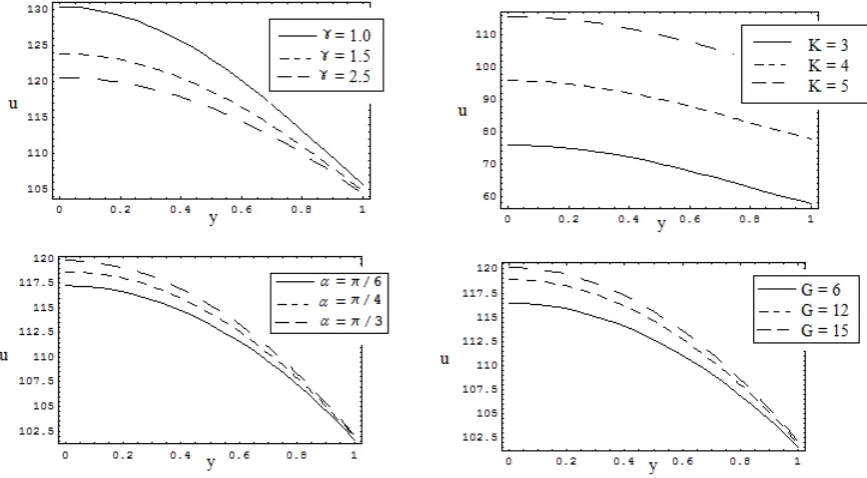
) and gravitational parameter (G). The axial velocity is shown in Figs. (1 to 4).The Variation of u with
γ
, we find that u depreciates with increase inγ
(Fig. 1). The Variation of u with porous medium K shows that for u increases with increasing in K (fig. 2). The Variation of u with angle of inclinationα
shows that for u increases with increasing inα
(Fig 3). The Variation of u with gravitational parameter G shows that for u increases with increasing in G (Fig 4).Fig. 1: Effect of
γ
on u, whenφ
= 0.2,x= 0.1, p=-25, a=1.25, G= 6, K=5 & α = π/4.Fig. 2: Effect of K on u,when
γ
=1,φ
=0.3, x=0.3, p=-25, a=1.25, G=6 & α = π/4.Fig. 3: Effect of
α
on u,whenγ
=8,φ
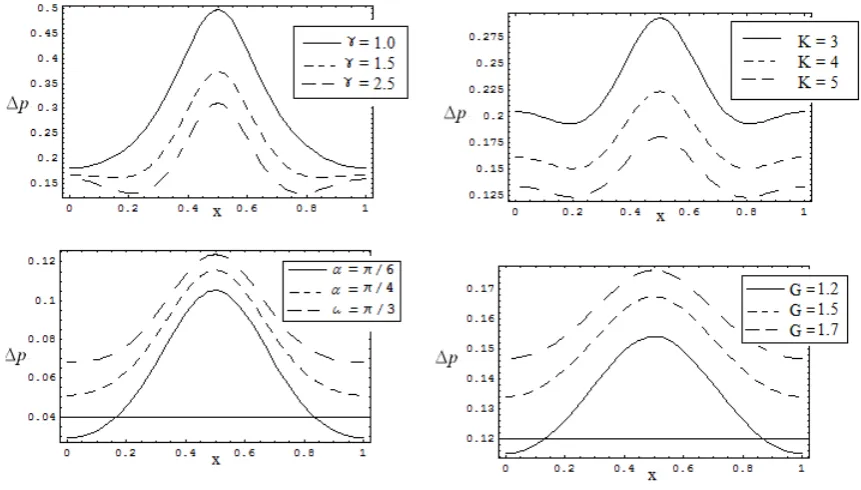
=0.1,x= 0.1,p =-25, a=1.25, K = 5&G = 12.The variation of pressure rise
∆
P
is shown in Figs (5 to 8) for a different values ofγ
, K,α
& G. We find that∆
P
depreciates with increase inγ
(Fig. 5). The Variation of∆
P
with porous medium K shows that for∆
P
decreases with increasing in K (Fig 6).The Variation of∆
P
with angle of inclinationα
shows that for∆
P
increases with increasing inα
(Fig 7). The Variation of∆
P
with gravitational parameter G shows that for∆
P
increases with increasing in G (Fig 8).Fig. 5: Effect of
γ
on∆
p
,whenφ
=0.5, G = 2, α = π/4, Q = 0 & a=1.25, K = 5.Fig. 6: Effect of K on
∆
p
,whenγ
=3,φ
=0.3, G=2, a=1.25, α = π/4 & Q = 0.Fig. 7: Effect of
α
on∆
p
,whenγ
=3,φ
=0.2, a=1.25, K = 5, Q=0 & G = 1.Fig. 8: Effect of G on
∆
p
,whenγ
=1.5,φ
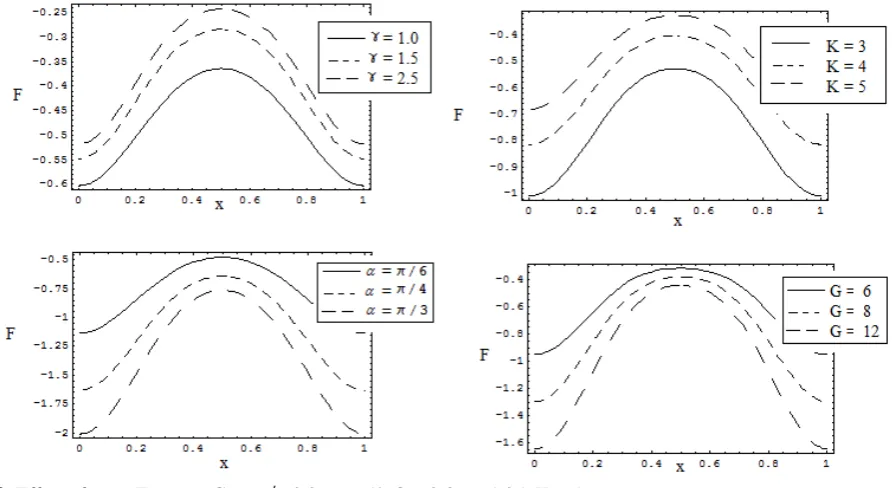
=0.1,a=1.25, K = 5, Q=0 & α =π/4.The variation of friction force F is shown in Figs.(9 to 12) for a different values of
γ
, K,α
& G. Here, it isobserved that the effect of all the parameters on friction force are opposite behavior as to the effects on pressure with
© 2019, IJMA. All Rights Reserved 18 Fig. 9: Effect of
γ
on F,when G = 6,φ
=0.2,α = π/4, Q = 0 & a=1.25, K = 5.Fig. 10: Effect of K on F, when
γ
=1,φ
=0.3,α = π/4, Q = 0, a=1.25 & G=6.Fig. 11: Effect of
α
on F, whenγ
=5,φ
=0.2, G = 12, Q=0,a=1.25 & K = 3.Fig. 12: Effect of G on F, when
γ
=5,φ=.2, α = π/4, Q=0, a=1.25 & K = 3.4. CONCLUSION
In this paper we presented a theoretical approach to study the peristaltic flow of a couple stress fluid in an inclined channel through a porous medium. The effect of various values of parameters on Velocity, Pressure rise and Friction force have been computed numerically and explained graphically.
We conclude the following observations:
1. The velocity u increases with increasing in gravitational parameter G, angle of inclination
α
& porous medium K but, decreases with increasing in couple stress parameterγ
.2. The pressure
∆
P
increases with increasing in gravitational parameter G & angle of inclinationα
but, decreases with increasing in couple stress parameterγ
& porous medium K.3. The friction force F increases with decreasing in gravitational parameter G & angle of inclination
α
but, increases with increasing in couple stress parameterγ
& porous medium K.REFERENCES
1. A.Alsaedi,N.Ali,D.Tripathi,T.Hayat, Peristaltic flow of couple stress fluid through uniform porous medium, Applied Mathematics and Mechanics, 2014(4), Vol. 35, pp 469-480. 2. Ayman and M.F.Sobh (2004) Peristaltic Transport of a Magneto-Newtonian Fluid Through a porous medium,
J. Islamic University of Gaza, Vol. 12, No.1, PP. 37-49.
3. B. Jayarami Reddy , M. V. Subba Reddy, C. Nadhamuni Reddy and P. Yogeswar Reddy, Peristaltic flow of a Williamson fluid in an inclined planar channel under the effect of a magnetic field , Adv. Appl. Sci. Res., 2012, 3 (1):452-461.
4. B.B.Gupta and V.Sheshadri, “Peristaltic Pumping in Non-Uniform Tubes”, J.Biomech.9 (1976), pp. 105-109. 5. El-dabe, N.T. and El-Mohandis, S. (1995) Magneto hydrodynamic flow of second order fluid through a porous
medium on an inclined porous plane, The Arabian J.for Sci. and Eng., 20, No. 3, 571-580.
6. Habtu alemaychu and G.Radhakrishnamacharya (2011) Dispersion of a Solute in Peristaltic Motion of a couple stress fluid through a porous medium with slip condition, World Aca. Of Sci., Eng. And Tech., 75, PP. 804-809.
8. Kh.S.Mekhemier,Y.Abd elmaboud, Peristaltic flow of a couple stress fluid in an annulus : Application of an endoscope,Science Direct, Physica A, 387, 2008, 2403-2415.
9. L. M. Srivastava and V. P. Srivastava, “Peristaltic transport of a non-newtonian fluid: applications to the vas deferens and small intestine,” Annals of Biomedical Engineering, vol. 13, pp. 137–153, 1985.
10. L.M.Srivastava and V.P.Srivastava , and S.K.Sinha, “Peristaltic Transport of a Physiological Fluid: Part I Flow in Non- Uniform Geometry” Biorheol. 20 (1983), pp. 428-433.
11. N.G.Sridhar,Effect of thickness of the porous material using porous media on the peristaltic pumping of couple stress fluid through non - erodible porous lining tube., Transactions on Mathematics, Vol.3, No.2,April 2017, PP. 1-13.
12. N.G.Sridhar, Effects of magnetic field with variable viscosity and an endoscope on peristaltic transport of couple stress fluids through a porous medium, International Journal of Mathematical Archive-8(7), 2017, 6-15. 13. N.G.Sridhar,Peristaltic pumping of couple stress fluid through non - erodible porous lining tube wall with thickness of porous material using magnetic field, International Journal of Advance Research, Vol. 3, Issue 7, July 2015, pp.1 -14.
14. N.G.Sridhar,Peristaltic flow of a couple stress fluid in an inclined channel under the effect of magnetic field with slip condition, Int. Jourl. of Statistics and Applied Mathematics, 2017, 2(4), 01-06.
15. P.B. Cotton and C.B. Williams, Practical Gastrointestinal Endoscopy, London: Oxford University Press Third Edition, (1990).Paper Received 18 March 2003,Revised 12 October 2003; Accepted 13 January 2004.
16. R.A.Ramachandra and S.Usha, “Peristaltic Transport of Two Immiscible Viscous Fluids in a Circular Tube”, J.Fluid Mech., 298 (1995), p.271.
17. Raptis. A., Peridikis.C. (1983) Flow of a viscous fluid through a porous medium bounded by a vertical surface, Int. J. Engng. Sci., 21, No 11, 1327-1336.
18. T.W.Latham, “Fluid Motion in a Peristaltic Pump”, M.Sc.Thesis, MIT, Cambridge MA (1966).
19. V. P. Rathod and N. G. Sridhar, Peristaltic transport of couple stress fluid in uniform and non-uniform annulus through porous medium, international journal of mathematical archive, 3(4), 2012, page: 1561-1574.
20. V. P. Rathod and S.K.Asha, Effect of couple stress fluid and an endoscope in peristaltic motion, Ultra Science, vol.21, no.1, pp.83-90, 2009.
21. V. P. Rathod and S.K.Asha, Effects of Magnetic Field and an Endoscope on Peristaltic Motion, Journal of Applied Mathematics,2(4),2011,pp.102-109.
22. V. P. Rathod, N. G. Sridhar and Mahadev. M. Peristaltic pumping of couple stress fluid through non - erodible porous lining tube wall with thickness of porous material, Advances in Applied Science Research, 2012, 3 (4): 2326-2336.
23. V.P. Rathod And Laxmi Devindrappa: Effects of heat transfer on the peristaltic mhd flow of a bingham fluid through a porous medium in a channel, International Journal of Biomathematics, Vol. 7, No. 6 (2014) 1450060-1450080.
24. V.P. Rathod And Laxmi Devindrappa: peristaltic transport of a conducting fluid in an asymmetric vertical channel with heat and mass transfer, j.Chem.Biol.& Physical Sci.,4(2), 2015, 1452-1470.
25. V.P. Rathod And Laxmi Devindrappa: Slip effect on peristaltic transport of a conducting fluid through a porous medium in an asymmetric vertical channel by Adomian decomposition method, Int.J Mathematical Archive,4(3), 133-141, 2013.
26. V.P. Rathod and Mahadev. A Study of Ureteral Peristalsis in Cylindrical Tube Through Porous Medium, Advance in Applied Science Research,2(3), 134-144,2011.
27. V.P. Rathod And Mahadev :A study of ureteral peristalsis with Jeffrey fluid flow. I.J.Mathematical Modeling, Simulation and Application, 5 , 11-22 ,2012.
28. V.P. Rathod And Mahadev :Slip effects and heat transfer on MHD peristaltic flow of Jeffrey fluid in an inclined channel.J.Chemical, Biological & Physical Sci. 2 , 1987-97, 2012.
29. V.P. Rathod And Mahadev: Effect of magnetic field on ureteral peristalsis in cylindrical tube, Ultra Scientist of Physical Sciences, 23, 135-142, 2011.
30. V.P.Rathod and Asha.S.K,” Peristaltic Transport of a Couple Stress fluid In a Uniform and Non-Uniform Annulus through a Porous Medium”, International journal Of Mathematical Modeling, Simulation and Applications, ISSN: 0973-8355, Vol 2, No4, 2009, pp 414-426.
31. V.P.Rathod and Mahadev. M., Effect of thickness of the porous material on the peristaltic pumping of a Jeffry fluid with non - erodible porous lining wall, Int. j. of Mathematical Archive, 2(10), Oct.-2011.
32. V.P.Rathod and N.G.Sridhar, Effect of magnetic field on peristaltic transport of a couple stress fluid in a channel, Advances in Applied Science Research, 2016, 7(1), pp 134-144.
33. V.P.Rathod and N.G.Sridhar, peristaltic flow of a couple stress fluid in an inclined channel, International Journal of Allied Practice Research and Review, Vol. II, Issue VII, (2015) p.n. 25-36.
34. V.P.Rathod and N.G.Sridhar, Peristaltic flow of a couple stress fluids through a porous medium in an inclined channel, Journal of Chemical, Biological and Physical Sciences, Apr. 2015, 5(2),1760-1770.
35. V.P.Rathod and N.G.Sridhar, Effects of couple stress fluid and an endoscope on peristaltic transport through a porous medium, Int. J. of Math. Sci. & Engg. Appls., Vol. 9 No. I (March, 2015), pp.79-92.
© 2019, IJMA. All Rights Reserved 20 37. V.P.Rathod and Pallavi Kulkarni: The influence of wall properties on Peristaltic transport of dusty fluid
through porous medium.Int. J. of Mathematical Archive, 2 (12), 1-13, 2011.
38. V.P.Rathod, Navrang Manikrao and N.G.Sridhar, peristaltic flow of a couple stress fluid in an inclined channel under the effect of magnetic field, Advances in Applied Science Research, 6(9) (2015), 101-109. 39. V.P.Rathod, Navrang Manikrao and N.G.Sridhar, peristaltic transport of a conducting couple stress fluid
through a porous medium in a channel, International Journal of Mathematical Archive-6(9), (2015), 106-113. 40. Y. abd elmaboud, kh.s. mekheimer, non-linear peristaltic transport of a second-order fluid through a porous
medium, Applied mathematical modeling, 35 (2011), 2695–2710.
Source of support: Nil, Conflict of interest: None Declared.