DFT CALCULATIONS ON MOLECULAR STRUCTURES OF
“SELF-ASSEMBLED” METALMACROCYCLES IN M(II)-
DITHIOOXAMIDE-PROPANE-1,3-DIOL(M=3D METAL)
SYSTEMS
Oleg V. Mikhailov
[a]*and Denis V. Chachkov
[b]Keywords: self-assembly; metalmacrocyclic chelate; 3d-element; dithiooxamide; propandiol-1,3; DFT OPBE/TZVP method; molecular structure.
Using density functional theory (DFT) at the OPBE/TZP level, the calculation of the geometric parameters of the molecular structures of M(II) (5656)macrotetracyclic complexes with a tetradentate macrocyclic ligand with (NNNN)-coordination of donor centers, resulting from “self-assembly” process in M(II)– dithiooxamide– propandiol-1,3 ternary systems, where M= Mn, Fe, Co, Ni, Cu, Zn was performed. The calculation of the molecular structure of this ligand itself was also carried out. The values of the bond lengths, bond and torsion angles in the resulting complexes and macrocyclic ligand indicated above, are presented. The values of the standard enthalpy, entropy and Gibbs free energy of formation of these compounds were also calculated.
Corresponding Authors*
E-Mail: [email protected]
[a] Analytical Chemistry Department, Kazan National Research Technological University, K. Marx Street 68, 420015 Kazan, Russia
[b] Kazan Branch of Joint Super-Computer Center of RAS, Lobachevsky Street 2, 420008 Kazan, Russia
Introduction
Previously a quantum-chemical calculations of the selected (5656) M(II) macrotetracyclic metalchelates of types I and II (where M= Mn, Fe, Co, Ni, Cu, Zn), each with two five-membered and two six-membered metal chelate cycles arranged symmetrically to each other, namely those that are formed in “self-assembly” processes (1).1
and (2)2,3
were carried out. Macrocycles of chelants (ligands resulting from "self-assembly") consisted of 14 atoms, and coordination of chelants to M(II) was carried out through four nitrogen atoms. When in the replacing formaldehyde in the reaction (1) or acetone in the reaction (2) with propandiol-1,3 H2C(OH)–CH2–CH2(OH), (5656) macro-tetracyclic metalchelates of type III can arise according to the “self-assembly” process (3) where chelant also contains a 14-membered macrocycle and, also, is coordinated to M(II) through four nitrogen atoms:
H2N-C-C-NH2 +
S S
OH
N
S
S S
S N
+ [Fe(CN)6] H2 O
HCH
HN NH
O M2[Fe(CN)6] +
O
M O
2
+
-4 8 4
4-+ 8 (1)
I
H2N-C-C-NH2 +
S S
N S
S S
S N
+ [Fe(CN)6] H2 O
M2[Fe(CN)6] +
M
OH H3C-C-CH3
CH3 H3C
N
CH3 H3C
H3C
N
CH3
(2) 2
4
4-+ 12
+4
-8
O
II
M2[Fe(CN)6] + H2N-C-C-NH2 +
S S OH
OH
+ [Fe(CN)6] H2 O
H2C-CH2-CH2
OH
N S
S S
S N
HN NH
M 2
-4 4 4
4-+
+
III
The principal possibility to form such complexes was mentioned in review.4 In this connection it is very interesting to get and analyze the objective data on structural and geometric parameters of these metal chelates using non-empirical quantum-chemical calculation. This is just the subject of this article.
Method
As in previous our article5 to carry out quantum-chemical calculations, the density functional theory (DFT) was applied. It combined the standard extended TZVP split-valence basis sets, described in papers6,7 and non-hybrid OPBE functional described in Refs.8,9 According to publications,9-13 in the case of 3d-element complexes, this method gives more accurate ratio of the high-spin state energy stability to the low-spin one as compared to the most popular B3LYP method. At the same time, DFT method accurately characterizes the basic geometric parameters of the molecular structures of the indicated compounds. The calculations were performed using the Gaussian09 program.14 As in previous article,5 the correspondence of the obtained stationary points to the energy minima in all cases was proved by the calculation of the second energy derivatives in coordinates of atoms. Thus, all the equilibrium structures, corresponding to the minimum points on the potential energy surfaces, only had real positive values of frequency.
Results and Discussion
According to our calculations, the ground state of the Mn(II) complex is a spin sextet and it is high-spin complex. For the Fe(II) complex, a ground state is spin triplet and it occupies an intermediate position between the low-spin and high-spin complexes. The ground states for the Co(II) and Ni(II) complexes are a spin doublet and a spin singlet, respectively, so both of them are low-spin. As for the Cu(II) and Zn(II) complexes, spin doublet and singlet, respectively, are their ground states in full agreement with theoretical expectations. In this case, the energy difference of structures with spin multiplicity (which is different from the ground state multiplicity) [quartet in the Mn(II), quintet in the Fe(II), quartet in the Co(II), triplet in the Ni(II), quartet in the Cu(II) and triplet in the Zn(II)] is 20.2, 24.2, 51.4, 68.8, 71.9 and 62.3 kJ mol-1 respectively. There is also a very negligible (more than 30 kJ mol-1) energy difference between the ground and the nearest different from it in spin multiplicity excited states; it is only less than this value in the case of the Mn(II) and Fe(II) complexes.
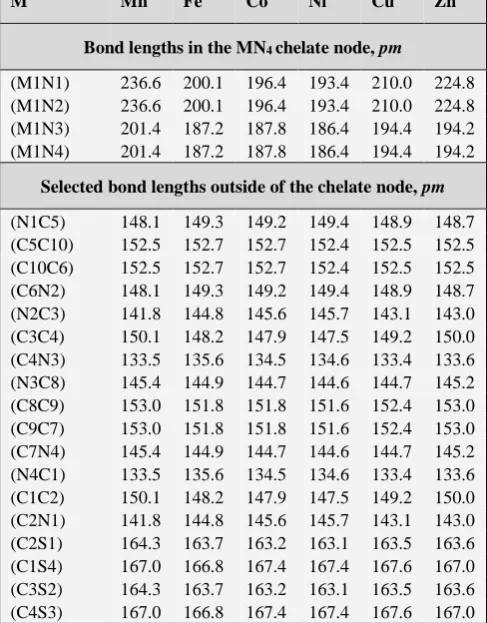
Calculated bond lengths, bond (valence) angles and torsion (dihedral) angles for Mn(II), Fe(II), Co(II), Ni(II), Cu(II) and Zn(II) complexes of type III are listed in Tables 1-3. Their molecular structures are outwardly very similar to each other. Metal–nitrogen d(M-N) bond lengths in these macrotetracyclic coordination compounds do not coincide between each other; besides, the shortest M-N lengths can be observed in the Ni(II) complex, the longest – in the Mn(II) one. In average, in the Mn – Zn series they decrease in the proceeding from Mn to Ni, and increase in the proceeding from Ni to Zn (Table 1).However, it should be noted in this connection that d(M1N3) and d(M1N4) values in the same
series decrease in the proceeding from Mn to Fe, increase in the proceeding from Fe to Co, decrease in the proceeding from Co to Ni, increase in the proceeding from Ni to Cu, and, finally, decrease in the proceeding from Cu to Zn. Besides, in the each of these complexes a pairwise equality of d(M–N) values, namely, (M1N1) and (M1N2), (M1N3) and (M1N4), is observed; similar situation takes place for series of pair C– N, C–C and C=S bond lengths, for example (N1C5) and (C6N2), (C8C9) and (C9C7), (C1S4) and (C4S3) (Table 1). M(II) chelates under study have either a pyramidal [in the case of Mn(II) and Zn(II)] or quasi-planar [in the case of Fe(II), Co(II), Ni(II) and Cu(II)] coordination of the ligand donor centers relative to M [the sum of the four (N1M1N2), (N2M1N3), (N3M1N4) and (N5M1N2) bond angles, formed by donor atoms and M(II) ion (VAS) is equal to 340.6o (Mn), 356.3o (Fe), 358.6o (Co), 358.7o (Ni), 356.2o (Cu), 352.2o (Zn)].
It should be noted that only two of the above mentioned bond angles, namely, (N2M1N3) and (N4M1N1), have equal values (Table 2). However, the sum of the internal (non-bond) (N1N2N3), (N2N3N4), (N3N4N1) and (N4N1N2) (NVAS) angles in any of these complexes is exactly 360.0o; consequently, the group of N4 donor atoms can be considered as strong planar. It is noteworthy that in the five of six complexes a pairwise equality of these non-bond angles, namely, (N1N2N3) and (N4N1N2), (N2N3N4) and (N3N4N1) occurs, and in the Cu(II) complex all these non-bond angles even are quite equally (each in 90o) (Table 2). The degree of deviation from co-planarity of each of the five-membered metal chelate rings in all these complexes is rather considerable (the sums of bond angles VAS51 and
Table 1. Bond lengths in the M(II) complexes of type III.
M Mn Fe Co Ni Cu Zn
Bond lengths in the MN4 chelate node, pm
(M1N1) 236.6 200.1 196.4 193.4 210.0 224.8 (M1N2) 236.6 200.1 196.4 193.4 210.0 224.8 (M1N3) 201.4 187.2 187.8 186.4 194.4 194.2 (M1N4) 201.4 187.2 187.8 186.4 194.4 194.2
Selected bond lengths outside of the chelate node, pm
Table 2. Bond angles in the M(II) complexes of type III.
M Mn Fe Co Ni Cu Zn
Bond angles in the MN4 chelate node, deg
(N1M1N2) 83.2 89.3 90.4 90.3 90.7 85.7 (N2M1N3) 79.0 84.3 84.5 84.5 82.6 81.1 (N3M1N4) 99.4 98.4 99.0 99.4 100.3 104.3 (N4M1N1) 79.0 84.3 84.5 84.5 82.6 81.1 VAS 340.6 356.3 358.4 358.7 356.2 352.2
Non-bond angles in the N4 group, deg
(N2N3N6) 89.3 90.2 90.8 91.1 90.0 90.1 (N3N6N5) 90.7 89.8 89.2 88.9 90.0 89.9 (N6N5N2) 90.7 89.8 89.2 88.9 90.0 89.9 (N5N2N3) 89.3 90.2 90.8 91.1 90.0 90.1 VAS 360.0 360.0 360.0 360.0 360.0 360.0
Bond angles in the 5-membered chelate ring 1, deg
(M1N2C2) 92.4 103.3 105.6 107.4 103.0 98.0 (N1C2C1) 112.7 111.3 111.0 110.6 112.3 112.6 (C2C1N4) 110.4 110.8 110.5 110.7 111.5 110.7 (C1N4M1) 115.7 116.0 116.6 117.1 116.0 117.2 (N4M1N1) 79.0 84.3 84.5 84.5 82.6 81.1 VAS51 510.2 525.7 528.2 530.3 525.3 519.6
Bond angles in the 5-membered chelate ring 2, deg
(M1N2C3) 92.4 103.3 105.6 107.4 103.0 98.0 (N2C3C4) 112.7 111.3 111.0 110.6 112.3 112.6 (C3C4N3) 110.4 110.8 110.5 110.7 111.5 110.7 (C4N3M1) 115.7 116.0 116.6 117.1 116.0 117.2 (N3M1N2) 79.0 84.3 84.5 84.5 82.6 81.1 VAS52 510.2 525.7 528.2 530.3 525.3 519.6
Bond angles in the 6-membered chelate ring 1, deg
(M1N1C5) 104.0 102.0 102.5 104.1 100.2 101.2 (N1C5C10) 112.9 110.9 110.9 110.8 112.1 112.5 (C5C10C6) 117.7 116.8 117.0 116.5 117.7 117.7 (C10C6N2) 112.9 110.9 110.9 110.8 112.1 112.5 (C6N2M1) 104.0 102.0 102.5 104.1 100.2 101.2 (N2M1N1) 83.2 89.3 90.4 90.3 90.7 85.7 VAS61 634.7 631.9 634.2 636.6 633.0 630.8
Bond angles in the 6-membered chelate ring 2, deg
(M1N4C7) 121.0 125.4 124.5 124.5 122.0 119.1 (N4C7C9) 112.6 112.1 112.3 112.4 112.4 112.6 (C7C9C8) 117.8 115.1 114.8 114.5 116.7 118.0 (C9C8N3) 112.6 112.1 112.3 112.4 112.4 112.6 (C8N3M1) 121.0 125.4 124.5 124.5 122.0 119.1 (N3M1N4) 99.4 98.4 99.0 99.4 100.3 104.3 VAS62 684.4 688.5 687.4 687.7 685.8 685.7
Bond angles outside of the chelate rings, deg
(C5N1C2) 120.1 118.0 116.9 115.3 117.4 118.3 (N1C2S1) 120.6 119.5 119.3 119.4 120.2 120.3 (S1C2C1) 126.1 129.0 129.5 129.9 127.3 126.7 (C2C1S4) 118.8 121.4 121.1 121.5 120.6 119.6 (S4C1N4) 130.7 127.8 128.4 127.9 127.9 129.7 (C1N4C7) 120.6 118.5 118.5 118.3 120.6 121.0 (C4N3C8) 120.6 118.5 118.5 118.3 120.6 121.0 (C6N2C3) 120.1 118.0 116.9 115.3 117.4 118.3 (N2C3S2) 120.6 119.5 119.3 119.4 120.2 120.3 (S2C3C4) 126.1 129.0 129.5 129.9 127.3 126.7 (C3C4S3) 118.8 121.4 121.1 121.5 120.6 119.6 (S3C4N3) 130.7 127.8 128.4 127.9 127.9 129.7 VAS=valence angle sum
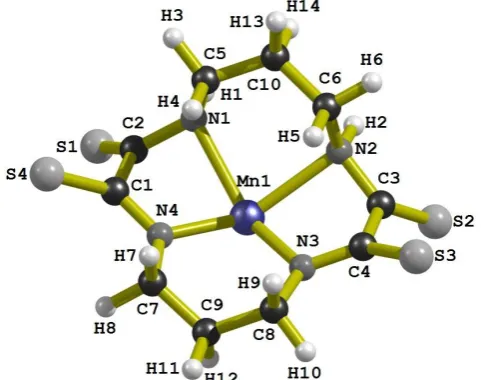
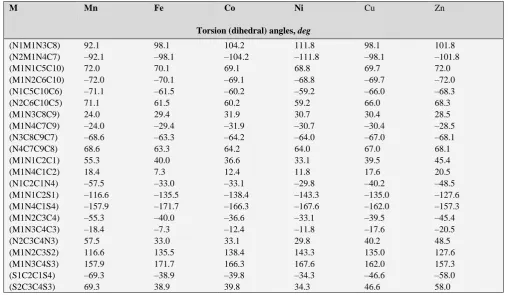
VAS52 differ from the sum of the interior angles in a plane pentagon (540o) at least by 9.7o). Nevertheless, VAS51 and VAS52 in each of the metal chelates under study are equal each other (Table 2). The distortion is even more in the six-membered cycles, where the sums of the bond angles VAS61 and VAS62differ from the sum of the interior angles in a flat hexagon (720o) by not less than 30o. It is significant that similar bond angles both within the chelate cycles and outside of them, in all of these complexes are pairwise equal to each other. The same equality between bond lengths, forming sides of these angles, is also observed. So the bond angle values both within the chelate cycles and outside of them only slightly depend on the nature of the M(II) ion. The values of torsion angles, which are often strongly different both from 0° and 180°, confirm the general non -co-planarity of molecular structures of complexes having general formula I (Table 3). As an example the structures of the Mn(II), Co(II) and Zn(II) chelates are shown in Fig. 1-3.
As you can see from them, all coordination compounds under examination are non-coplanar, have only one element of symmetry, namely symmetry flatness.
Figure 1. The molecular structure of the Mn(II) complex of type III.
Table 3. Torsion (dihedral) angles in the M(II) complexes of type III.
M Mn Fe Co Ni Cu Zn
Torsion (dihedral) angles, deg
(N1M1N3C8) 92.1 98.1 104.2 111.8 98.1 101.8
(N2M1N4C7) –92.1 –98.1 –104.2 –111.8 –98.1 –101.8
(M1N1C5C10) 72.0 70.1 69.1 68.8 69.7 72.0
(M1N2C6C10) –72.0 –70.1 –69.1 –68.8 –69.7 –72.0
(N1C5C10C6) –71.1 –61.5 –60.2 –59.2 –66.0 –68.3
(N2C6C10C5) 71.1 61.5 60.2 59.2 66.0 68.3
(M1N3C8C9) 24.0 29.4 31.9 30.7 30.4 28.5
(M1N4C7C9) –24.0 –29.4 –31.9 –30.7 –30.4 –28.5
(N3C8C9C7) –68.6 –63.3 –64.2 –64.0 –67.0 –68.1
(N4C7C9C8) 68.6 63.3 64.2 64.0 67.0 68.1
(M1N1C2C1) 55.3 40.0 36.6 33.1 39.5 45.4
(M1N4C1C2) 18.4 7.3 12.4 11.8 17.6 20.5
(N1C2C1N4) –57.5 –33.0 –33.1 –29.8 –40.2 –48.5
(M1N1C2S1) –116.6 –135.5 –138.4 –143.3 –135.0 –127.6 (M1N4C1S4) –157.9 –171.7 –166.3 –167.6 –162.0 –157.3
(M1N2C3C4) –55.3 –40.0 –36.6 –33.1 –39.5 –45.4
(M1N3C4C3) –18.4 –7.3 –12.4 –11.8 –17.6 –20.5
(N2C3C4N3) 57.5 33.0 33.1 29.8 40.2 48.5
(M1N2C3S2) 116.6 135.5 138.4 143.3 135.0 127.6
(M1N3C4S3) 157.9 171.7 166.3 167.6 162.0 157.3
(S1C2C1S4) –69.3 –38.9 –39.8 –34.3 –46.6 –58.0
(S2C3C4S3) 69.3 38.9 39.8 34.3 46.6 58.0
Figure 3. The molecular structure of the Zn(II) complex of type III.
In this connection, for all these complexes, rather high values of the electric dipole moment () can be expected. And the OPBE/TZVP calculation method fully confirms these expectations, as calculated values of are very high and are 4.15, 5.80, 5.94, 5.73, 5.34 and 4.80 Debye units for the Mn(II), Fe(II), Co(II), Ni(II), Cu(II) and Zn(II) complexes respectively.
The values of the key thermodynamic parameters of the examined metalchelates (standard enthalpy, entropy and Gibbs energy of formation) are given in Table 4. As can be seen, all of them are positive, which shows that they can not be formed from individual elements and suggests that the above-mentioned template synthesis process (3) is likely to
be thermodynamically forbidden for its implementation in a solution or a solid phase. However, it seems to be quite possible under the specific conditions of complex formation in the organizing systems, based on the metal-complex gelatin-immobilized matrices.4
Table 4. Standard enthalpy H0
f,298, entropy S0f, 298 and Gibbs energy G0
f, 298 for the formation of the various M(II) chelates of type III.
M H0
f, 298,
kJ mol-1
S0 f, 298,
J mol-1 K-1
G0 f, 298,
kJ mol-1
Mn 490.8 740.1 487.5
Fe 243.9 762.5 235.5
Co 394.4 735.6 392.7
Ni 431.9 732.4 432.0
Cu 424.8 727.6 426.2
Zn 552.0 739.0 551.0
Table 5. Bond angles of fourteen-membered macrocycle in chelant IV and type III complexes formed by it
Bond angle Chelant Mn Fe Co Ni Cu Zn
(C10C6N2) 115.0 112.9 110.9 110.9 110.8 112.1 112.5
(C6N2C3) 228.0 239.9 242.0 243.1 244.7 242.6 241.7
(N2C3C4) 120.3 112.7 111.3 111.0 110.6 112.3 112.6
(C3C4N3) 111.6 110.4 110.8 110.5 110.7 111.5 110.7
(C4N3C8) 233.7 239.4 241.5 241.5 241.7 239.4 239.0
(N3C8C9) 112.8 112.6 112.1 112.3 112.4 112.4 112.6
(C8C9C7) 116.6 117.8 115.1 114.8 114.5 116.7 118.0
(C9C7N4) 112.8 112.6 112.1 112.3 112.4 112.4 112.6
(C7N4C1) 233.7 239.4 241.5 241.5 241.7 239.4 239.0
(N4C1C2) 111.6 110.4 110.8 110.5 110.7 111.5 110.7
(C1C2N1) 120.3 112.7 111.3 111.0 110.6 112.3 112.6
(C2N1C5) 228.0 239.9 242.0 243.1 244.7 242.6 241.7
(N1C5C10) 115.0 112.9 110.9 110.9 110.8 112.1 112.5
(C5C10C6) 117.8 117.7 116.8 117.0 116.5 117.7 117.7
Angles sum (VAS14) 2077.4 2091.3 2089.1 2090.4 2092.8 2095.0 2093.9
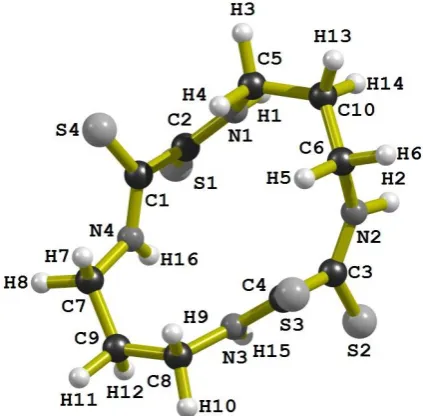
Figure 4. The molecular structure of the chelant IV.
In this regard, it can be stated that the complex formation of the above mentioned M(II) ions with chelant IV is accompanied by decrease of its structure distortion degree.
Acknowledgements
This article was prepared with the financial support of RFBR (№ 09-03-97001). Quantum chemical calculations were carried out in the Kazan Branch of Joint Supercomputer Center of RAS (http://kbjscc.knc.ru), which the authors express their sincere appreciation for its technical support.
References
1Mikhailov, O. V.; Chachkov, D. V.; Macroheterocycles 2009, 2, 271.
2Mikhailov, O. V.; Chachkov, D. V.; J. Coord. Chem. 2010, 63, 4309.
3Chachkov, D. V.; Mikhailov, O. V.; Russ. J. Inorg. Chem. 2013, 58, 1073.
4Mikhailov, O. V.; Inorg. Chim. Acta 2013, 394, 664.
5Mikhailov, O. V.; Chachkov, D. V.; Grigorieva, O. N.; Central
Eur. J. Chem. 2013, 11, 1822.
6Schaefer, A.; Horn, H.; Ahlrichs, R.; J. Chem. Phys. 1992, 97, 2571.
7Schaefer, A.; Huber, C.; Ahlrichs, R.; J. Chem. Phys. 1994, 100, 5829.
8Hoe, W.-M.; Cohen, A.; Handy, N.C.; Chem. Phys. Lett. 2001,
341, 319.
9Perdew, J.P.; Burke, K.; Ernzerhof, M.; Phys. Rev. Lett. 1997, 78, 1396.
10Paulsen, H.; Duelund, L.; Winkler, H.; Toftlund, H.; Trautwein, A.X.; Inorg. Chem. 2001, 40, 2201.
11Swart, M.; Groenhof, A. R.; Ehlers, A. W.; Lammertsma, K. J.
Phys. Chem. A. 2004, 108, 5479.
12Swart, M.; Ehlers, A. W.; Lammertsma, K.; Mol. Phys. 2004, 102, 2467.
13Swart, M.; Inorg. Chim. Acta 2007, 360, 179.
14Frisch, M. J.; Trucks, G. W.; Schlegel, H. B.; Scuseria, G. E.; Robb, M. A.; Cheeseman, J. R.; Scalmani, G.; Barone, V.; Mennucci, B.; Petersson, G. A.; Nakatsuji, H.; Caricato, M.; Li, H.; Hratchian, H. P.; Izmaylov, A. F.; Bloino, J.; Zheng, G.; Sonnenberg, J. L.; Hada, M.; Ehara, M.; Toyota, K.; Fukuda, R.; Hasegawa, J.; Ishida, M.; Nakajima, T.; Honda, Y.; Kitao, O.; Nakai, H.; Vreven, T.; Montgomery, J. A., Jr.; Peralta, J. E.; Ogliaro, F.; Bearpark, M.; Heyd, J. J.; Brothers, E.; Kudin, K. N.; Staroverov, V. N.; Kobayashi, R.; Normand, J.; Raghavachari, K.; Rendell, A.; Burant, J. C.; Iyengar, S.S.; Tomasi, J.; Cossi, M.; Rega, N.; Millam, J. M.; Klene, M.; Knox, J. E.; Cross, J. B.; Bakken, V.; Adamo, C.; Jaramillo, J.; Gomperts, R.; Stratmann, R. E.; Yazyev, O.; Austin, A. J.; Cammi, R.; Pomelli, C.; Ochterski, J. W.; Martin, R. L.; Morokuma, K.; Zakrzewski, V. G.; Voth, G. A.; Salvador, P.; Dannenberg, J. J.; Dapprich, S., Daniels, A. D.; Farkas, O.; Foresman, J. B.; Ortiz, J. V.; Cioslowski, J.; Fox, D. J.; Gaussian 09, Revision A.01, Gaussian, Inc., Wallingford CT, 2009.