International Journal of Advances in Management and Economics
Available online at:
www.managementjournal.info
RESEARCH ARTICLE
Barriers for High-Growth Female Entrepreneurs in Brazil
Charlotte Burrier
1,Gilberto Sarfati
2*1Msc. SciencesPo, France
2FGV EAESP, São Paulo, Brazil.
*Corresponding Author: Email: [email protected]
Abstract
: The aim of this study was to identify the challenges that women face to become high-growth entrepreneur. This exploratory research was done with a survey with 21 high-growth entrepreneurs and trough in-depth interviews with seven of the survey respondents. The study identifies three key challenges to Brazilian women entrepreneurs: they are discriminated by a high barrier to entry into the entrepreneur world, through lack of support, discriminations and lack of knowledge and networks.Keywords: Female Entrepreneurship; High-growth startups, Entrepreneurial barriers.
Article Received: 30 July 2018 Revised:10 Aug. 2018 Accepted: 20 August 2018
Introduction
Brazil has one of the statistically most entrepreneurial woman populations in the world [1], despite its rampant machoistic culture [2]. However, entrepreneurship incentive remains targeted at SMMEs (Small, Medium and Micro-Enterprise). In this study, we strive to shift the focus from women entrepreneurs who lead SMMEs with traditional business models to entrepreneurs who lead innovative startups with a value-adding business plan, which we will call high-growth entrepreneurs. In recent years Brazil has witnessed the high increasing rate of women-led new entrepreneurial ventures.
In GEM 2014, out of the 23 million new SMMEs who entered the Brazilian market, 51% of them were women-owned enterprises [3]. Just two years later in the 2015/2016 GEM Global Report, Brazilian women ranked ninth in the world in terms of Total Entrepreneurial Activity [1].
Women create businesses at a rate 1.5 higher than men; this high rate is due to entrepreneurship by necessity rather than by opportunity, meaning that the motivation for launching a new business is the need for additional personal income rather than the basis of a real analyzed market demand. Consequently, women are less prepared, less structured and less ambitious in their endeavor [4].
This study seeks to answer the following research question: what challenges does women face to become a high-growth entrepreneur in Brazil? We start by covering the current relevant literature to understand the depth of research on traditional women entrepreneurs in Brazil. We then investigate the profile of the high-growth entrepreneurs whom we surveyed.
This study is an exploratory research based on a survey and further in-depth interviews with female entrepreneurs. Our study uncovers that everything plays out before women turn into entrepreneurs: the main obstacle is indeed an obstacle to entry into the entrepreneur lifestyle, mindset and career choice.
Another major obstacle is knowledge in several fields, being mainly technology, communication and finance. The key to unlock these challenges thus seems to be both socio-cultural and educative. Barriers to entry into entrepreneurship are linked to discriminations and lack of support rooted in socio-cultural habits and stereotypes of the female role in the Brazilian society.
Literature Review
The existing literature on high-growth women entrepreneurs in Brazil is scarce This
is, however, specific to high-growth
research is available which focuses on women entrepreneurs in general or rather on business women and women owners of SMEs at the national level in Brazil, as the first studies on women entrepreneurship in Brazil were published as early as in the late 1990s.
Prado Gimenez et al [4] count 56 academic
articles on Brazilian women entrepreneurs in the period extending from 2000 to 2015. The bulk of that research is qualitative with only eight quantitative articles, which use descriptive methods rather than more sophisticated statistical methods.
The genesis of the studies on woman entrepreneurship in Brazil is associated with studies focused mainly on the understanding
of the motivations, difficulties and
perceptions of women with regards to the exercise of the entrepreneurial role in society and its results, whether from a personal, organizational or social perspective.
These various studies thus started
investigating the entrepreneurs’ motives, personality characteristics and personal profile of the entrepreneurs, as well as the difficulties faced by them while in the creation process of their companies. Over time, the focus switched to other aspects, namely: the skills and behaviors of the entrepreneurial woman; the process of creating the companies and the factors intervening in their development and performance; and the peculiarities in access to credit and venture capital faced by entrepreneurs [5, 6].
Global Entrepreneurship Monitor (GEM) classifies entrepreneurs according to two main motives: opportunity entrepreneurship
and necessity entrepreneurship. An
opportunity entrepreneur is one who starts and grows their business by taking advantage of a unique market opportunity- in other words, one who seeks to start and grow a value-adding activity. Among opportunity entrepreneurship, GEM identifies a portion of entrepreneurs who seek to improve their current situation, either through increased income or through increased independence, which are defined as improvement-driven opportunity (IDO) entrepreneurs [1].
A necessity entrepreneur is one who starts and grows their business because it is the best option available-in other words, one who lacks another option to generate personal
income. Despite the consensus on the conceptual distinction between the two factors which drive entrepreneurship within the literature, there is in parallel a paradoxical finding which is that startup creation increases in times of recessions. As discussed by Fairlie and Fossen [7], this phenomenon can be explained by the fact that opportunity entrepreneurs operate in a
pro-cyclical attitude while necessity
entrepreneurs operate in a countercyclical manner.
In other words, opportunity entrepreneurs, as opposed to necessity entrepreneurs, are associated with the creation of growth-oriented businesses. In 2016, according to GEM over half of women business-owners across the world started their business out of necessity, while this proportion is lower for men. Brazil is ranked 57 out of 64 countries on the motivational index, which means that the most common motive for starting a business is necessity or IDO, for women and men alike.
According to GEM, Brazilian women rank second out of 64 countries in Female/Male Total Entrepreneurial Activity (TEA) ratio and ninth in overall TEA, as 20.3% of them are entrepreneurs (Brazilian men rank thirteenth with 21.6%), with 54.2% of them being entrepreneurs by necessity and 45.3% by opportunity [1].
The survival of women-run businesses reaches a time-span beyond the standards found as average survival times of small businesses. In a survey conducted in the Brazilian state of Bahia in the mid-2000s [8] this assumption has been proved to be based on facts, since the companies surveyed had, on average, nine years of age. For a country where the corporate mortality rate is high, particularly in the early years, the average age of these women-run businesses is extremely satisfactory.
Silveira and Gouvêa [10] investigate the characteristics of understanding of success strategies and thereby seek to determine the main factors of success and failure for Brazilian women entrepreneurs; by doing so, they uncover a number of characteristics distinct to women and their entrepreneur style.
They describe main business characteristics of Brazilian women entrepreneurs such as participative and collaborative management, delegation and dissemination of the company vision amongst collaborators, both strategies meant to lead to company growth without leading to more personal work but rather to spread the work among collaborators. They find that a high priority is placed on the training and development of collaborators and a high value is associated to them, characteristics also corroborated by Jonathan [11] and Cramer et al. [12].
Lack of access to financial resources is by far the top challenge faced by women entrepreneurs in Brazil [13]. Nascimento et al. [14] collected data from a total of 141 accounting firms, it led to results which indicated that failure in business occurred because of various reasons, of which come in first place the entrepreneur's insufficient working capital and inaccessibility to credit. Data obtained through a questionnaire answered by 102 women entrepreneurs from the Brazilian cities of Maringá and Cianorte point to the fact that, on a scale from one to ten, one of the most salient difficulties upon market entry was access to initial capital [15].
Research on women entrepreneurs’ motives for starting a business, as mentioned previously, shows mitigated results. Some research leads to conclusions which point toward a lack of ambition of women entrepreneurs while others point to the contrary position, whereby women’s
ambitions for their businesses cannot be viewed as or restricted to a limitation but on the contrary, should be seen as a launchpad.
However, one fact sticks out: women’s ambitions for their business, and the associated vision of success, are of a different nature than the dominant one in society- the sole purpose of earning money or earning more money. It can be explained by the
finding that they tend to consider that business growth requires a purpose; growth for the sole purpose of growth does not interest them [11].
Prado Gimenez et al. [4] have concluded from
their research that entrepreneurs with shorter experience present lower levels of optimism than the average of women entrepreneurs due to lack of confidence. Another research dwelling on women entrepreneurs’ motives indicates that women create their business due to perception of a market opportunity, to a desire to grow to higher levels of management (when their company is preventing them to reach those levels) or to a desire of self-fulfillment [16].
Other mentioned obstacles to success among the literature are as follows: slow decision-making process, cautious and conservative acts, age discrimination, difficulty to find qualified labor, lack of experience, lack of a specialized training and lack of access to initial capital, lack of time and need to conciliate work and family roles, stereotype of women’s position in relation to men and socio-cultural prejudice against women in high-level management position, affective and emotional personal factors overlapping with professional factors namely in the areas of finance, clients’ relations and human resource management [5, 10, 15, 17, 18, 19, 20].
Methodology
This research is an exploratory study of high-growth women entrepreneurs in Brazil. The first stage of the study consisted in building
up a high-growth business woman
entrepreneur profile through a questionnaire sent out to women leaders of startups and businesses. This study complements the already existing discussion on traditional women entrepreneurs by adding the high-growth dimension, through the research
survey focused on high-growth
entrepreneurs, in the form of a questionnaire directly responded by 21 startup founders, owners and CEOs.
This stage also aims to complement the data already present in current research while compiling it in one single data presentation analysis. In a second stage, this research consists in in-depth interviews with startup founders, owners and/or CEOs, whose final aim was to understand what key obstacles those entrepreneurs faced and if gender constitutes a major challenge or factor. The survey questionnaires were sent out and collected from 21 high-growth entrepreneurs between August 2017 and October 2017.
In-depth interviews were led between
September and November 2017 via Skype
call with seven high-growth female
entrepreneurs.
The target population of the second and third stages of this study was Brazilian high-growth women entrepreneurs currently in the process of being accelerated in Brazil or having been accelerated in the past, whose current financial results present high-growth characteristics or whose business plan
presents high-growth potential-hence
excluding traditional business models
offering traditional services or products.
The purposefully selected respondents represent as many states of Brazil as possible, various education levels and their business activities encompass a diversity of sectors. The sample size of the second stage of this research, namely the survey questionnaire to high-growth entrepreneurs, amounts to 21 respondents to build the personal high-growth entrepreneur profile and to 15 businesses to build the high-growth business profile -as some entrepreneurs were partners in launching the same business.
The last stage consisting of in-depth interviews was led with seven high-growth entrepreneurs selected from the sample of respondents to the survey questionnaire.
The first stage of the study consists of the survey questionnaire, which is the primary instrument in data collection; it considers such issues as personal profile, business profile, motivation for starting or having intention to start a business, obstacles encountered, previous business history, needs and aspirations, definition of success and its. An initial approach was made via e-mail to all Brazilian accelerators and
incubators as listed on the publicly available largest entrepreneurial database in Brazil which maps all accelerators in the country: http://mappedinbrasil.com.br.
A first e-mail was sent inviting the accelerators to share the contacts of all women entrepreneurs in their database. Of all 49 accelerators contacted, 24 responded; six of them had never accelerated women and sixteen eventually accepted and proceeded to share a total of 57 contacts of women entrepreneurs they accelerated or were still in the process of accelerating. The corresponding women were sent via e-mail a descriptive explanation of the procedure and objectives of the study and were invited to participate.
Those who acknowledged their consent, in the majority of cases extremely eager to do so, were then sent the questionnaire in Word format between June and August 2017. The final sample consists in 21 questionnaires fully filled and sent back. The choice of accelerators was made to control for the high-growth potential or current achievement of the entrepreneurs who would participate in the research.
The questionnaire distributed contains closed questions organized around three topics: the respondent’s personal profile, her business profile and her business characteristics.
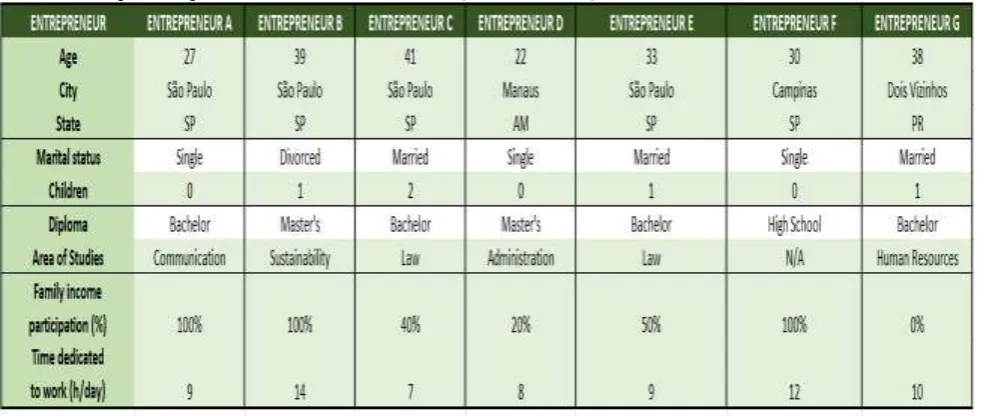
The interview stage was led via distance Skype. Six interviews were led with seven Brazilian women entrepreneurs, for duration between thirty-five minutes to an hour. The interviewees were selected so that the data would cover profiles as varied as possible on the personal as well as on the business characteristics. In personal characteristics, the criteria were representativeness of the sample according to age, location and diploma.
Table 1- Entrepreneur profile of research interviewees (November 2017)
Source: Research survey
The interview revolved around a set of eleven open-ended questions organized according to three themes: entrepreneurial culture, funding and skills. Those prepared questions served as main guidelines to the interviews, but the discussion was in no way restricted to them, as the main inputs came directly from
the entrepreneurs’ experience and
spontaneity. The interviews explored various possible or potential challenges, focused on (but not restricted to) the challenges identified by previous literature: lack of financing or funding, lack of specific knowledge or skills and differentiated vision of success which may lead to poorer returns on investment.
Were also raised topics such as education, suggestions for entrepreneurial courses, and essential fields of improvement where specialized courses could have helped. As for the first stage and second stage of the research, the data was grouped by theme and presented within tables which will sum up quantitative and qualitative information in an organized manner using a variety of relevant indicators, to be able to perform a comparison analysis between the two resulting tables.
The data collected was described and analyzed through basic data analysis procedures to compare and assess the differences between traditional and high-growth entrepreneurs and businesses.
The qualitative data gathered during the interviews was described and analyzed following Moustakas' [21] updated seven
steps analysis by Adrian van Kaam.
The Van Kaam's procedure consists of (1) transcribing all interviews and relating interview materials, (2) coding them, (3) grouping themes and (4) verifying with participants for consistency purposes. It also entails (1) describing experiences, (2) identifying common patterns in the coded data and (3) drawing a synthesis of the signification of participants’ experiences.
The questionnaire participants were
benchmarked using a set of simple variables such as age, location, marital status, diploma with regards to personal profile; such as duration of existence, sector, technology use, genesis, growth, gross income and number of employees to determine a possible response bias in the case that non-participants have similar traits with regards to such measures, as compared with participants. The research records no significant bias.
Results
The general profile of high-growth Brazilian women entrepreneurs (in our sample) can be
highlighted with the following
characteristics: they are young married adults with at least an academic degree of Bachelor or Master’s and a couple of years of working experience, settled in an urban environment, who are generally fully dedicated to their venture. A feature seldom controlled and/or noted in previous research
with regards to Brazilian women
entrepreneurs’ profile is the predominance of
urbanity, unsurprisingly. All the
entrepreneurs who responded to this survey launched their business in an urban environment, which, in this specific case, is due to the fact that accelerators and incubators in Brazil are located in cities and not in rural environments.
Amongst these results, it is to be noted that some urban settlements are more significant in terms of presence of high-growth women entrepreneurs, namely, the state of São Paulo and, less expected but however consistent with the fact that Southern states are wealthier and more developed than northern states in Brazil, the state of Rio Grande do Sul. They represent, respectively, 29% and 19% of the total of respondents of our study. The city of São Paulo on its own represents 24% of the respondents of this study, thereby underlining the obvious role of demographics, this city representing over 20 million inhabitants, but also economic dynamism in the opportunities for (women) entrepreneurs to start and grow their business within a vibrant and cosmopolitan community.
The participants of this study are on average 33.2 years old, which is consistent with previous studies. Close to half of the participants to this study (43%) are concentrated around 30 to 36 years of age, which can be associated to an age-span at which women feel confident enough to launch their own startup due to previous working experience combined with a possible dissatisfaction or frustration in their current working position or lack of growth perspectives in their current company. This follows the trend noted in the analysis of the
average age of traditional women
entrepreneurs` profile.
The largest proportion of participants’ marital status is married (48%), with a
significant proportion of single entrepreneurs (33%) and a less significant although still
noteworthy proportion of divorced
entrepreneurs (14%). Only one participant has two children, as opposed to all others having either one child or no children at all. These tendencies are aligned with a global trend pointing to the founding of a family at a later stage in life, mainly due to longer life expectancy and to higher literacy. Higher global literacy means more educated women who focus first on their education, second on their career and third on founding a family with the sound foundation of the two first elements.
Higher level of education is confirmed in our study with 86% of participants having studied at university and obtained a degree, with the highest proportion having reached Master’s degree level (43%), followed by Bachelor degree level (33%) and counting a few MBAs (5%) as well as Doctorates (5%).
High-growth women entrepreneurs
participate, on average, to 49% of the family income. Generally, however, the income participation is rather high or rather low (high variance), with few cases of actual equal participation.
Depending on the stage of the startup, it seems to vary between low percentages of participation to family income (0% to 20%) to a high percentage (80% to 100%), with few cases of equal or close-to-equal participation to family income (40% to 50%). The average time dedicated to work is of nine hours; however, similarly to family income participation, it can also be highlighted that time dedicated to work is either part-time (four to six hours per day) or full time (nine hours or above, reaching fourteen hours per day).
flexibility to spend time with their family (10 %). Out of the 21 Brazilian high-growth women entrepreneurs who responded to our questionnaire, we collected data for fifteen businesses, as some of the respondents were partners or co-founders of the same startup.
Our objective is to draw an exclusive and exhaustive picture of the characteristics of the business launched by a high-growth woman entrepreneur in Brazil, as opposed to the characteristics of the business launched by a traditional entrepreneur in Brazil. As opposed to the results we presented
regarding traditional businesses, our
research focuses only on businesses with less than five years of existence, which has an influence on average gross revenue and number of employees.
Our results still confirm that high-growth entrepreneurs are opportunity entrepreneurs (100%), with comparable average of employees and with one major distinction: the inclusion and importance of technology in the business plan, which is absent from the businesses of traditional entrepreneurs and explains in great part its high-growth potential.
On average, their companies have been in existence for a bit over two years and thus are indeed still at the startup stage. They are directed toward the service industry (93%) with only one startup directed toward the manufacturing industry (representing 7% of the total), thereby indicating an even stronger trend toward the service industry than traditional businesses do. The areas of business are as vast as consulting,
agriculture, e-commerce, marketing
biotechnology, fashion, transport, art, beauty, law, entertainment, architecture and interior design, social business – consulting being the most represented area with three businesses in total (20%).
All startups were launched by entrepreneurs by opportunity, with a majority having identified an opportunity within a specific market, often the one of the sectors where they previously worked (67%) and over a quarter launching the startup as a result of their own idea (27%). A major trait emerges which is the one of technology inclusion within the business plan of the product or service: whether the service is online, consists of an app, has digital applications, or
consists in the introduction of a new technology. Seven of the entrepreneurs who filled in the questionnaire were selected to participate to a further in-depth interview to explore and determine the obstacles high growth women entrepreneurs face.
The semi-structured interviews lasted 45 minutes on average and were led around three key themes identified by the researcher as key challenge clusters: the entrepreneurial culture, the skills and the general challenges. The main findings of our research are that first, high-growth women entrepreneurs do not feel that their gender entails specific obstacles due to gender bias or gender discrimination, with the noticeable exception of women who act in a segment socially stigmatized as a feminine sector-such as beauty, cosmetics, clothing, etc, where their credibility is questioned, and their skills challenged by a man-dominated investor environment.
The issue also appears to have a generational aspect, thus the situation of women entrepreneurs is improving as the current generation does not repeat the gender bias
which characterized the previous
generations, Secondly, women are socially encouraged by a pre-set society environment to seek for financial security and stability rather than risk and initiative taking, which leads them to embrace entrepreneurship at a later stage in life, only due to push factors linked to a lack of perspectives in their current professional career, rather than embrace entrepreneurship by pure aspiration as a first choice career.
intrinsic to startups that it needs capital, in the form of investment: this will be the catalysator which will allow to test the product and validate its model in the market.
The main challenge, then, for a woman, when she has to deliver her pitch, is simple: her interlocutor… is a man. And when it relates to a feminine sector, which has the stigma of being superficial, it is different than, say, the digital finance sector – there is no credibility. My investor, for instance, is a woman.
This investment is based on the wish for return on investment but also partly based on a wish to help a woman-led business, in the objective to bring more equity in the business world.” This statement is further partially validated by Entrepreneurs B and C, co-founders of Startup 2, who have only one investment from their business partners, but are facing difficulties in finding an angel investor for their online consulting platform. From their perspective, gender bias applies to older generations, as some investors prioritize men over women in their investing decisions when they are from a previous generation.
This, as they have experienced it, is due to the low presence of women in such investment opportunities and events, which leads the older generation of investors to be reinforced in their judgment that men are more likely to increase their return on investment or reinforced in their bias in taking initiatives taken by men seriously while dismissing initiatives taken by women. Entrepreneur D, leader of Startup 3,
platform connecting deliverers with
restaurants in Manaus, considers that there is a lack of an entrepreneurship culture in the system of Manaus due to a low number of universities, which leads to few startups being launched in the region. She believes developing a stronger entrepreneurship culture in the ecosystem, with more information-sharing, would improve her startup’s financial position. Similarly, the lack of exposure of women to entrepreneurial culture represents an obstacle to their access to entrepreneurship. Our study shows signs that the general environment to which women are exposed in society can be understood as an anti-entrepreneurial culture, which makes entry to the startup world the key challenge; whilst once the woman has entered the entrepreneurial
ecosystem, the feeling of belonging follows systematically and the gender bias fades away.
For instance, only two of the women
entrepreneurs have role models of
entrepreneurs in their environment, who are non-females: their father or their husband. The lack of role models is not explicitly mentioned as an obstacle by the respondents; however, it contributes to a general environment where a woman entrepreneur is the exception and not the rule. The respondents furthermore underline explicitly the importance of the support of father or husband entrepreneur to their confidence and success: it is thus a differential that impacts the entrepreneurial culture in which women evolve.
The lack of women entrepreneurs in general also contributes to the negative perception of the choice of a woman to embrace entrepreneurship: our respondents were socially marginalized by their friends and sometimes family by being labeled as ‘crazy’ to have made the decision to launch their startup. It is not seen as initiative or as a bold move but as an unreasonable move which is deprived of sense – entailing that it shall be bound to failure. Over 50% of our respondents were dismissed or explicitly disapproved by their friends or colleagues, sometimes by their family, for turning into an entrepreneur. The disapprobation is higher when the entrepreneur was in a good economic situation with a respectable position in a renowned company and earning a good salary.
first place, and thus from launching a startup which could potentially be a high-growth success.
Indeed, on the one hand, our respondents turned into entrepreneurs as a result of a frustration in their current career, even if it had always been their dream to launch their own startup. Turning into an entrepreneur-
in other words, entering the startup world- is
the challenge, not being a high-growth entrepreneur. Entrepreneur A, CEO of the beauty salon discounted group appointment scheduling app, felt that she was performing under her capacities in her corporate position and was firstly going to launch a traditional business, until she read about scalable business models and decided to take the risk.
Entrepreneur E, founder of the legaltech company Startup 4, felt unfulfilled although she was working in a renowned São Paulo law firm; she was only following the traditional path leading her to a career and a good salary as she was expected to, however she was seeking another path which entrepreneurship was corresponding to: when she realized she was not adding any particular value to the corporate world she belonged to is when she made the decision to change paths.
Entrepreneur F, founder of Startup 5, an online tool designed to enhance internal and external communication for architects and interior designers owned a traditional architecture company for four years before taking the leap to innovative, digital and high-growth entrepreneurship. On the other hand, for women who do enter the startup world, confidence in their own success is not an issue, contrary to general belief.
The confidence of our respondents in them and the success of their business is in 100% of the cases extremely high from the beginning. For instance, Entrepreneur G, at the forefront of Startup 6, software developed to manage dairy farms, takes a lot of pride in her success: “I was always confident. After just seventeen months in the market, we are present in twelve Brazilian states and we have a hundred clients with some international companies approaching us to offer our service to them as well, such as one in Panama. I would say I am reaching 110 % of trust in our success today since I was already 100% confident on the first day!”.
Can also be quoted the two co-founders of Startup 2, the online consulting platform, who also “knew [they] were capable” and thus never doubted their own success.
According to our respondents, the fields where women would need improvement in order to be able to scale faster would be the technology and finance areas. Out of our seven respondents, five mentioned technology as a major challenge (71%), four mentioned communication (57%) and four mentioned finance (57%). In the technology field, the challenge is mostly linked to lack of familiarity with or general practical knowledge of tech; as pointed out by Entrepreneur G, it is extremely difficult to find a woman programmer.
This lack of knowledge is underlined by the co-founders of Startup 2, who admit to the fact that having done tech studies would have been of great help to them while building up their prototype. The Startup 4 legal tech manager, Entrepreneur E, is specific in pointing out that programming is the skill which is missing from her skillset to fully dedicate herself to her product and she considered it a lack to be able to support or have input on the development of the tool. Startup 2`s co-founders Entrepreneurs B and C highlight the challenge of the constant search for investment to be able to internalize the programmers instead of outsourcing them.
It is thus not in a theoretical course but in a practical, technical way that women need to be introduced to technology, so as to optimize the use of technology in their venture and its centrality in their value proposition. Regarding the communication field, the challenge is linked to the innovative business model of the entrepreneurs’ product: they face difficulties in developing the right communication that would serve the double purpose of delivering the right and the most attractive message to their target market and thereby convincing them of their legitimacy and trustworthiness despite their unusual and new attitude toward the market.
business model; the aggrotech tool Startup 6’s leader considers that the main challenge to scaling is to communicate in an efficient way that leads to word of mouth and peer recommendation. Last but not least, finance is also appointed as a main challenge for two reasons: lack of knowledge and thus shaky financial management, or lack of network and thus difficult access to funding.
Startup 3`s director Entrepreneur D explains that financial education is fundamental and having not been exposed to finance during her studies, she had no other choice than to independently acquire this knowledge while starting her venture, Less important but still note worthy are a few other challenges mentioned by the interviewees. First, when asked if they participated to a mentorship program, they all responded negatively, nevertheless 43% of them explained that they mentored themselves by reading extensively about entrepreneurship, about innovation or about startups in their own sector.
This has two main downfalls: one, neither incubators nor accelerators nor universities offer the opportunity to women to be mentored as a tailored solution for them to grow and scale their businesses; two, a possible way to resolve the lack of high-growth women mentorship is to read extensively. In spite of this, two participants did mention the learning and specific workshop opportunities offered by the state-funded institution of SEBRAE, which is a potential other window of opportunity for mentoring.
The CEO of Startup 3, Entrepreneur D mentions time, logistics and team capacity as some of the main challenges her food delivery startup faced. The latter obstacle is in line with previous research which points out to human capital skills being one of the major obstacles to startup successes in Brazil, all other things being equal. Startup 4 CEO Entrepreneur E names as main challenge to her legal tech the difficulty to choose a business model in a context of limited resources-which we found to be irrelevant to the research as it appears as a challenge any startup faces. Lastly, 29% of participants mentioned the importance of their business administration studies as a fuel and necessary step towards their dealing with challenges in their new venture. We therefore draw the lesson that this statement is
consistent with our previous finding that having studied business administration increases Brazilian women’s potential to launch a successful startup.
Conclusion
This study explored the challenges faced by high-growth entrepreneurs. We find that the main challenge that they face is prior to
becoming entrepreneurs: they are
discriminated by a high barrier to entry into the entrepreneur world, through lack of support, discriminations and lack of knowledge and networks. This implies that they need to be equipped with high confidence, a strong resilience system and extreme dedication to their purpose – in a larger extent than their men counterpart.
Paradoxically and contradictorily with previous research, although they face lack of support and discriminations before becoming entrepreneurs, women do not perceive gender-biased discriminations to become entrepreneurs. Nevertheless, discrimination still exists in particular cases, for instance: in industry segments stigmatized as dominated by women, such as clothing, cosmetics, beauty, etc.; when there is a generation gap, such as when investors are born in the previous generation, where they still prioritize men over women as a safer investment.
Rather, women are challenged before
becoming entrepreneurs; many obstacles prevent them from aspiring to create their own businesses and to aspire to scale with high-growth and high income. Once they turn into high-growth entrepreneurs, their main challenge is knowledge and networks. Knowledge-wise, they lack knowledge in three key areas: technology, finance and communication.
to higher sales but also to investment. Finally, knowledge of finance is paramount to be able to sustain and manage the funds and budget of the startup until it reaches capacity to hire a financial head.
Women also lack networks in the financial area: be it angel investors, business networks, bank networks or investor networks, women lack access to those, which ultimately has an impact on their performance as it impacts negatively their potential for fundraising and thus for growth. Several limitations to our research can be pointed out.
First, the geographical spread of the research on traditional entrepreneurs is limited to three states, Santa Catarina and Rio Grande
do Norte and Paraná, with only one study
which is non-restricted to a specific state:
Smith-Hunter & Leone (2010), 33
respondents – however, no location analysis. It may impact the representativeness of the sample on the national scale. On the opposite, our own study`s spread is much larger with fourteen cities and eight states represented, although it comprehends a much lower number of participants, being 21 vs 168. Secondly, the traditional women-led business profile is limited by the presence of high-earning outliers in the sample – which
we however noted and considered as having a negligible impact overall. Thirdly, the comparison between the traditional business profile and the high-growth startup business is limited by the fact that the sample selection was random. For instance, there is a difference in the respective numbers of years in existence which could have been avoided if the sample had been a convenience sample.
With the purpose of going beyond these limitations, we encourage further research to replicate our framework in a systematic way at the state level and national level until a more exhaustive picture can be drawn, preferably using quantitative methods as most previous research focuses on qualitative methods. Further research topics to explore, following our conclusions, include: why are Brazilian women not pursuing degrees in areas such as technology or finance?
What are the discriminations faced by Brazilian women which prevent them to become entrepreneurs? Which strategies can they use to build, maintain and benefit from strong networks? We also encourage research on how to best promote women high-growth entrepreneurship, as this could effectively combat the challenge to entry into the entrepreneurship world.
References
1. Kelley D, Singer S, Herrington M (2016) GEM 2015/2016 Global Report. Global Entrepreneurship Research Association (GERA).
2. Venturi G, Godinho T (2013) Mulheres
brasileiras e gênero nos espaços público e privado: uma década de mudanças na opinião pública. São Paulo: Fundação Perseu Abramo; Edições Sesc SP.
3. Singer S, Amoros JE, Arreola DM (2015) Global entrepreneurship monitor 2014 global report. Global Entrepreneurship Research Association (GERA).
4. Prado Gimenez FA, Ferreira, JM, Ramos, SC (2017) Empreendedorismo feminino no Brasil: Gênese e formação de um campo de pesquisa. REGEPE - Revista de Empreendedorismo e Gestão e Pequenas Empresas, 6(1): 40-74.
5. Gomes FA, Araújo PU, Martins FCM, Santana
PWG (2014). Empreendedorismo feminino como sujeito de pesquisa. Revista Brasileira de Gestão de Negócios, 16: 51.
6. De Vita, L, Mari, M, Poggesi, S (2014) Women
entrepreneurs in and from developing
countries: Evidences from the
literature. European Management Journal, 32 (3): 451-460.
7. Fairlie, RW, Fossen, FM (2017) Opportunity
versus necessity entrepreneurship: Two
components of business creation. Stanford Institute for Economic Policy Research Discussion Paper, 17-014.
8. Gomes FA, Santana PGW, Silva MJ (2005) Mulheres empreendedoras: Desafios e competências. Técnica Administrativa, Buenos Aires, 4: 24.
9. SEBRAE (2014) Mulher de Negocios. Empreendedorismo Femenino em Pauta. Pesquisa Mulher Empreendedora em MS.SEBRAE. Retrieved December 20, 2017, from
10. Silveira A, Gouvêa AB (2008)
Empreendedorismo feminino: mulheres
gerentes de empresas. Revista de
Administração FACES Journal, 7 (3): 124-138.
11. Jonathan EG (2011) Mulheres
empreendedoras: o desafio da escolha do
empreendedorismo e o exercício do
poder. Psicologia Clínica, 23 (1): 65-85.
12. Cramer L, Cappelle MCA, Andrade ÁLS,
Brito MJ (2012) Representações femininas da ação empreendedora: uma análise da trajetória das mulheres no mundo dos
negócios. REGEPE-Revista de
Empreendedorismo e Gestão de Pequenas Empresas, 1 (1): 53-71.
13. Bomfim, LCS, Teixeira, MR (2015) Empreendedorismo feminino: desafios enfrentados por empreendedoras na gestão de pequenos negócios no setor de turismo. Revista Pensamento Contemporâneo em Administração, 9: 2.
14. Nascimento, M, Montenegro, CR, Lima, MA,
Ensslin, ER. (2013). Factors causing the demise of micro and small business in the metropolitan region of Florianópolis, through the lens of the accountant. Revista Eletrônica de Estratégia e Negócios, 6: 244-283.
15. Fabrício, JS, Machado HV (2013) Dificuldades
para criação de negócios: um estudo com
mulheres empreendedoras no setor do vestuário. Gestão & Planejamento-G&P, 13: 3. 16. Machado HPV, Gazola S, Anez MEM (2013)
Criação de empresas por mulheres: um estudo com empreendedoras em Natal, Rio Grande do Norte. RAM. Revista de Administração Mackenzie, 14(5): 177-200.
17. Jonathan, EG (2003) Empreendedorismo
feminino no setor tecnológico brasileiro: dificuldades e tendências. Encontro de Gestão Estratégica de Pequenas Empresas, 3 : 41-53.
18. Gouvêa ABCT, Silveira A, Machado HPV
(2013) Mulheres empreendedoras:
compreensões do empreendedorismo e do exercício do papel desempenhado por homens e mulheres em organizações. REGEPE-Revista de Empreendedorismo e Gestão de Pequenas Empresas, 2(2): 32-54.
19. Alperstedt DG, Borges Ferreira, J Custódio, Serafim M (2014) Empreendedorismo feminino: dificuldades relatadas em histórias de vida. Revista de Ciências da Administração, 16: 40.
20. Nassif, VMJ, Andreassi, T, Tonelli, MJ (2016)
Critical incidents among women
entrepreneurs: Personal and professional issues. Revista de Administração, 51 (2): 212-224.
21. Moustakas C (1994) Phenomenological