Eur. Chem. Bull. 2013, 2(6), 304-310 DOI: 10.17628/ECB.2013.2.304
304
EFFECT OF NOVEL SUPERPLASTICIZER ON WORKABILITY
AND STRENGTH OF READY MIXED CONCRETE
Anuradha Varshney
[a], Pratibha Singh
[b]and Kiran Prajapati
[c]Keywords: p-Acetylbenzylidenetriphenylarsonium ylide (p-ABTAY), ready-mixed concrete (RMC), fly ash, water cement ratio, styrene, acrylonitrile, copolymer.
With the advent of superplasticizers, dream to discover method of making ready mixed concrete at the lowest possible water cement ratio while maintaining a high workability has achieved. In addition, these concrete material are also suitable for use with other cementations materials like fly ash. Poly(styrene-co-acrylonitrile) prepared with the help of p-acetyl benzylidene triphenyl arsonium ylide had made it possible, the production of concrete at low water cement ratio. Many waste materials of today become the useful by products of tomorrow water cement ratio was maintained between 0.38-0.47. Use of fly ash in concrete improves the penetration rate of CO2 or chloride ions. The result have shown substantial improvement in the properties of concrete after use of copolymer of styrene and acrylonitrile as superplasticizer.
* Corresponding Authors E-Mail: [email protected]
[a] Department of Chemistry, D.G. (P.G.) College, Kanpur, India
[b] Research Scholar Singhania University, Rajasthan, India [c] Department of Chemistry, G.G.I.C., Singhpur, Kanpur, India
Introduction
Polymer chemistry is emerging as one of the fastest growing field in science and technology. Polymerization dates back to the beginning of DNA based life, as both DNA and proteins are polymers. However, it was not until the industrial revolution that the modern polymer chemistry began to flowish. The advent of new technique has created a boom in the growth of polymer science. Modern methods of
polymerization like atom transfer radical polymerisation,1
group transfer polymerisation,2 liquid crystal polymerisation,3
star polymerisation,4 polymerization by ylide5 have proven to
be effective in controlling the properties of the polymers.
The ylides6 are 1,2 dipolar compounds in which a carbon
atom is attached directly to a heteroatom X+ carrying a
positive formal charge.
RX(+)–C(-)R’ R
mX = CR’
(I) (II)
X+ = (nitrogen, phosphorus, sulphur, arsenic, antimony,
bismuth, selenium or tellurium)
The ylides give mostly alternating copolymers as well as
syndiotactic homopolymers unlike the conventional
initiators like azobisisobutyronitrile (AIBN) and benzoyl peroxide (BPO) otherwise Lewis acids are used to obtain
stereo regular polymers. Ylides5,7-9 are found to be more
economical than conventional initiators.
Concrete, a composite material made with cement, aggregates, admixtures and water comprises in quantity the
largest of all man-made materials. Superplasticizers10-12 in
concrete confer some beneficial effects such as acceleration, retardation, air entertainment, water reduction, plasticity etc. and these effect are due to their action on cement. In this
chapter as attempt has been made to synthesis13 copolymer
of styrene and acrylonitrile with p-acetylbenzylidene triphenyl arsonium ylide and study the effect of the copolymer as novel superplasticizer on workability and strength of ready mix concrete.
Experimental
Purification of monomers and solvents14-15 were carried
out by standard methods. P-acetylbenzylidene triphenyl
arsonium ylide (p-ABTAY) was prepared16 using triphenyl
arsine (Merck) and dioxane. They were used without purification.
Polymerization procedure
Styrene acrylontrile copolymer was prepared in dioxane
flushed with nitrogen gas at 60 ± 0.1o
C for 1 hour using p-ABTAY as radical initiator. The copolymer were precipitated with acidified methanol and dried under vacuum. The copolymers were refluxed with cyclohexane and DMF to remove homopolymers of styrene and acrylonitrile respectively. The structure of the copolymer
was confirmed by (FTIR, 1H-NMR and 13C-NMR (Fig. 1, 2,
3).
Materials used
Cement (OPC -43 grade) and its properties
Specific gravity (Gc) 3.16
Normal consistency 30%
Initial setting time 120 minutes
Final setting time 370 minutes
Compressive strength 54.46 N mm-2
Fineness 97.80
Fly ash from Thermal Power Station, Kanpur
Specific gravity (Gf) 2.1
Eur. Chem. Bull. 2013, 2(6), 304-310 DOI: 10.17628/ECB.2013.2.304
305
Lime reactivity 5.4 N mm-2
Loss on ignition 3.4 %
Fine Aggregate river sand
Specific gravity (Gfa) : 2.53
Unit mass (Wfa) 1420 kg m-3
Fineness modulus
by sieve analysis (Table 1) 2.78
Water absorption 0.32 %
Coarse aggregate–
Grit 10 - 20 mm
Specific gravity(Gca) 2.64-2.73
Unit mass (Wca) 1360-1375 kg m-3
Fineness modulus 6.91
Water
Tap water
Polymer Admixture
Copolymer of styrene and acrylonitrile prepared by (p-ABTAY)
Result and Discussion
The copolymer of styrene and acrylonitrile prepared initiated by p-ABTAY. The properties of copolymer are studied which are as follows:
Properties of polymer admixture
Polymer styrene-co-acrylonitrile
Colour yellowish
Activation energy
by Arrhenius equation 55 KJ mol–1
Polydispersity index
by GPC Mw/Mn 12
Characterization of copolymer(s)
Fourier Transform Infrared Spectroscopy
The FTIR spectrum17 of the copolymers (Fig. 1) shows
bands at 3053 cm–1 and 2237 cm–1 due to aromatic C–H
stretching of phenyl protons of styrene and –CN group of acrylonitrile respectively.
1H-Nuclear Magnetic Resonance Spectroscopy
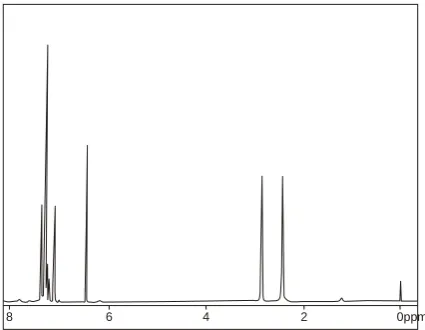
The 1H-NMR spectra18 of the copolymers (Fig.2) shows
peak at 6.1-7.4 ppm due to phenyl group of styrene.
13C-Nuclear Magnetic Resonance Spectroscopy
The 13C-NMR spectrum of the copolymers (Fig.3) shows
peaks at 122-124 ppm and at 128-133 ppm due to –CN
group of AN and –C6H5 carbon of styrene respectively.
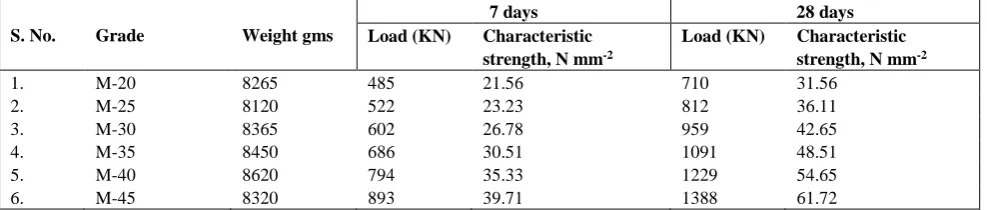
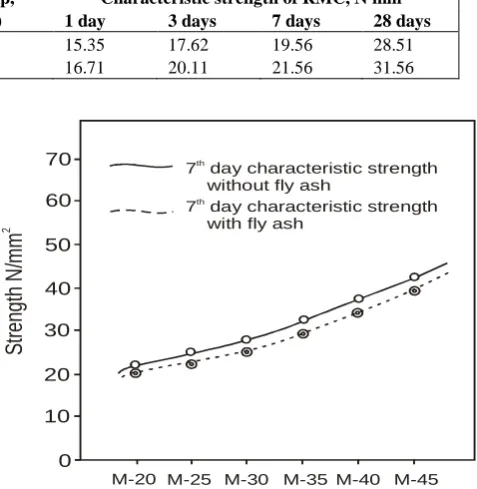
Different grades of concrete, 20, 25, 30, M-35, M-40 and M-45 (Table 2 and 3) were used to study the effect of ready mixed concrete in presence of absence of polymer admixture and fly ash to get low cost environment friendly concrete. Bulk density was maintained between 2350 to 2441 as per specification (Fig. 4). The water cement ratio was maintained between 0.38 - 0.47 with slump 120-130. Low
strength19 on 7th day is due to the pozzolanic reaction
between fly ash and cement it lags behind cement hydration.
3500 3000 2500 2000 1500 1000 500
Wavenumber cm-1
0
.0
0
.2
0
.4
0
.6
0
.8
1
.0
T
ra
n
s
m
it
ta
n
c
e
(
%
)
Figure 1. FTIR spectrum of the prepared (Sty-co-AN).
200 150 100 50 0 ppm
Figure 2. 1H-NMR spectrum of the prepared (Sty-co-AN).
8 6 4 2 0ppm
Eur. Chem. Bull. 2013, 2(6), 304-310 DOI: 10.17628/ECB.2013.2.304
306
Table 1. Sieve Analysis of sandS. No. Bis sieve size Weight retained g (I)
% ge retained (1)/10 (II)
Cumulative of retained (III)
Cumulative of passing (100) (IV)
Silt content
1. 4.75 mm 102 10.2 10.2 89.8 7.50%
2. 2.36 mm 110 11 21.2 78.8
3. 1.18 mm 107 10.7 31.9 68.1
4. 600 184 18.4 50.3 49.7
5. 800 200 20 40.3 29.7
6. 150 244 24.4 94.7 5.3
7. Passing 150 - 0 94.7 5.3
Wt. of sample cumulative
1000 278.8
Table 2. Effect of RMC without fly ash.
Material M-20 M-25 M-30 M-35 M-40 M-45
Cement, kg m-3 345 390 420 470 530 565
Sand, kg m-3 771 770 764 738 683 679
20 mm grit, kg m-3 720 700 695 685 684 660
10 mm grit, kg m-3 350 340 320 310 305 300
Admixture, kg 2 2.5 3 4 5 6
Water, kg 162 177 185 198 215 220
w/c ratio 0.47 0.45 0.44 0.42 0.40 0.38
Density 2350 2379 2387 2405 2422 2430
Slump 130 120 125 120 120 120
Table 3. Effect of RMC with fly ash.
Material M-20 M-25 M-30 M-35 M-40 M-45
Cement, kg m-3 250 290 310 350 400 425
Fly ash, kg m-3 95 100 110 120 130 140
Sand, kg m-3 800 790 785 753 693 690
20 mm grit, kg m-3 720 700 695 685 684 660
10 mm grit, kg m-3 350 340 320 310 305 300
Admixture, kg 2 2.5 3.0 4 5 6
Water, kg 162 177 185 198 215 220
w/c Ratio 0.47 0.45 0.44 0.42 0.40 0.38
Density 2387 2400 2408 2420 2432 2441
Slump 130 120 120 120 130 125
Table 4. Cube test results showing strength of RMC without fly ash.
S. No. Grade Weight gms
7 days 28 days
Load (KN) Characteristic strength, N mm-2
Load (KN) Characteristic strength, N mm-2
1. M-20 8180 519 23.11 55 28.44
2. M-25 8135 580 25.78 639 31.52
3. M-30 8125 644 28.65 866 38.51
4. M-35 8165 730 32.45 933 41.50
5. M-40 8225 862 38.32 975 43.35
6. M-45 8390 935 41.56 1072 47.65
Table 5. Cube test results showing strength of RMC with fly ash.
S. No. Grade Weight gms
7 days 28 days
Load (KN) Characteristic strength, N mm-2
Load (KN) Characteristic strength, N mm-2
1. M-20 8265 485 21.56 710 31.56
2. M-25 8120 522 23.23 812 36.11
3. M-30 8365 602 26.78 959 42.65
4. M-35 8450 686 30.51 1091 48.51
5. M-40 8620 794 35.33 1229 54.65
Table 6. Study of strength of ready mixed concrete M-20 in presence and absence of polymer admixture.
Table 7. TG studies showing rate of hydration with different percentage of polymer admixture.
Memon20 studied the effect of superplasticiser and extra
water on workability and comprehensive strength of self compacting geopolymer concrete by incorporating fly ash in the design mix. They varied the superplasticisor from 3 to 7 % and extra water ranging from 10-20 % of the mass of fly ash. The test results indicated that extra water and superplasticizer are key parameters and play an important role in the development of self compacting geopolymer concrete with the increase in amount of water and superplasticizer the workability was improved.
Figure 4. Effect of the density of ready mix concrete in absence and presence of fly ash.
Niral Desai21, have developed a new age superplasticizer
Fairflo S. It is high range water reducer, excellent slump retainer and it is very much cost effective. The slump obtained by them using w/c ratio 0.45 and 0.8% superplasticizer was between 105-135 mm.
It was observed that the effect of 20-30% substitution of cement by fly ash using different quantities of polymer admixture gives better density of concrete (Fig. 5 and 6),
more pumpability and less strength on 7th day but higher on
28th day as analysed cube testing reports (Table 4 and 5).
Krishnamoorthy22 has pointed out that fly ash should
regarded more as a durability enhancer and void blocker than as a cement economizer.
The role of polymer admixture on compressive strength of ready mixed concrete on 1, 3, 7 and 28 days keeping cement, water cement ratio constant was studied.
Figure 5. Comparative study of 7th day characteristic strength of the specimen of RMC with and without fly ash.
It was observed that it is higher than the blank at early stages of hydration (1-3 days) but at later stage it is slightly
higher (Fig. 7 and Table 6). Cube testing results on 28th day
of R.M.C. with fly ash sows greater strength of design mix concrete. Hence we can conclude that strength of design mix concrete with fly ash increases drastically and there by reducing the cost of ready mix concrete and making it
economical. Similar results were obtained by Ahmad et al.23
they studied the effect of superplasticizer on workability and strength of concrete, superplasticizer used was Rheobuild 561 and 1100.
Mechanism
The principal role in the mechanism of water reduction and set retardation of the admixtures can be explained as follows. These substances are usually composed of long chain organic molecules that are hydrophobic (non wetting) at one end and hydrophilic at the other.
Such molecules tend to become concentrated and form a film at the interface between two immiscible phases such as water and cement and alter the physio-chemical forces acting at this interface. The poly(Sty-co-AN) get absorbed on the cement particles giving them a negative charge that
Admixture 3 h 8 h 12 h 24 h 7 day 28 day
0% 2.8 5.8 9.1 13.2 17.2 21.2
1% 2.7 5.1 8.9 12.7 16.5 21.0
2% 1.9 4.7 7.8 11.7 15.1 20.9
3% 1.7 3.8 6.5 10.9 14.7 20.7
4% 1.6 3.0 6.1 9.2 14.6 20.0
5% 1.4 2.7 6.2 8.6 14.2 19.9
Polymer Admixture Cement w/c Slump, (mm)
Characteristic strength of RMC, N mm-2
1 day 3 days 7 days 28 days
Without polymer admixture 345 0.47 60 15.35 17.62 19.56 28.51
With polymer admixture 345 0.47 130 16.71 20.11 21.56 31.56
2250 2300 2350 2400
2450
M-20 M-25 M-30 M-35 M-40 M-45 Without Fly ash
D
en
si
ty
k
g/
m
3
SP 0.09% W/c = 0.47
SP 0.10% W/c = 0.45
SP 0.13% W/c = 0.44
SP 0.17% W/c = 0.42
SP 0.20% W/c = 0.40
SP 0.24% W/c = 0.38
0 2500
With Fly ash
20 40 60
M-20
S
tr
en
gt
h
N
/m
m
2
0
M-25 M-30 M-35 M-40 M-45
10 30 50
70 7 day characteristic strength
without fly ash
th
7 day characteristic strength with fly ash
Eur. Chem. Bull. 2013, 2(6), 304-310 DOI: 10.17628/ECB.2013.2.304
308
then orients the water dipoles around each particle24 hence it
results in (a) Reduction of the interfacial tension. (b) An increase in electro kinetic potential (c) A protective sheet of oriented water dipoles around each particle.
Figure 6: Comparative study of 28th day characteristic strength of the specimen of RMC with and without fly ash.
Hence we can conclude that the mobility of the fresh mix becomes greater partly because of a reduction in the inter particle forces and partly because water is freed from the restraining influence of the highly flocculated system which is now available to lubricate the mixture. Less water is therefore, required to achieve given consistency.
Figure 7. Comparative study of M-20 sample of RMC with and without polymer admixture
Mechanism as retarding admixture
The mechanism of set retardation25,26 is based on
adsorption. The large admixture anions and molecules are absorbed on the surface of the cement particles, which hinders further reactions between cement and water i.e. it retards the setting. Experiments performed showed the setting time of superplasticizer increased by 3-5 hours. In one formulation, an alkalized sulfite liquor was mixed with ethylene oxide-propylene oxide copolymer to extend the setting time of
cements by 2½ to 5 hrs.27
Organic group for poly(styrene-co-acrylonitrile) as retarding admixture.
Kinetics of hydration
The hydration is a process in which Portland cement mixed with sand gravel and water and produces the synthetic rock, called concrete. As the reaction proceed, the products of the hydration process gradually bond together the individual sand and gravel particles, and other compounds of the concrete to form a solid mass.
In the anhydrous state, four main types of minerals are
normally present, alite, belite, aluminate (C3A) and a ferrite
phase (C4AF) when water is added the reaction is
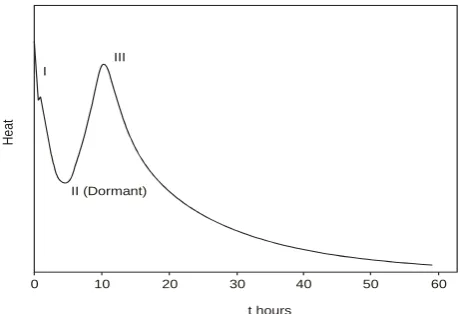
exothermic and generate heat. The conduction calorimetry shows the rate at which the minerals are reacting by monitoring the rate at which the heat is evolved (Fig. 8). The
principal reaction28,29 that occur are as follows:
Stage I: On adding water some of the clinker sulphates and gypsum dissolve producing an alkaline, sulfate-rich,
solution after mixing the C3A phase react with water to
forman aluminate rich gel. The gel reacts with sulfate in solution to form small rod-like crystals of ettringite.
Stage-II: Stage II is called dormant or induction period.
In this stage C3A reaction with water is strongly exothermic
but does not last long typically only a few minutes, and is followed by a period of a few hours of relatively low heat
evolution.
Stage-III: Stage III corresponds to main period of hydration during which time concrete strength increases. As the dominant period progresses, the paste becomes too stiff to be workable. At the end of dormant period, the alite and belite in the cement start to react, with the formation of calcium salicate and calcium hydroxide. The individual grains reacts from the surface inwards and the anhydrous
particles become smaller, C3A hydration continues as fresh
crystals become accessible to water. The period of maximum heat evolution occurs typically between 10 and 20 hours after mixing and then gradually tails off. T.G. studies shows the reduction in hydration by superplasticizer upto 24 hours (Table 7 and Fig. 9). After 24 hours the rate of hydration shows only marginal difference.
Figure 8. Conduction calorimetry showing different stages of hydration.
Mechanism of action of superplasticizers
Superplasticizers cause dispersion into smaller agglomerates of cement particles which predominate in the cement paste of the concrete mixture. Due to this dispersion effect, there 20 40 60 M-20
St
re
ng
th
N
/m
m
2 0M-25 M-30 M-35 M-40 M-45
10 30 50 70
28 day characteristic strength without fly ash
th
28 day characteristic strength with fly ash
th 20 30 1 day S tr e n g th k g /m m 2 5 15 25 10
3 day 7 day 28 day Increased strength
with polymer admixture 35 W it h o u t P .A . W it h P .A . W it h o u t P .A . W it h P .A . W it h o u t P .A . W it h P .A . W it h o u t P .A . W it h P .A . H e a t
0 10 20 30 40 50 60
Figure 9. Studies showing rate of hydration with different percentage of polymer admixture.
is a fluidity increase in the cement mixture.30 The dispersion
mechanism performed by (Sty-co-AN) superplasticizers are related more to a steric hindrance effect (product by the presence of graft chain) rather than to the presence of
negatively charged anionic groups.31 In other words we can
say that, the graft chains of the polymer molecules on the cement would hinder by themselves from flocculating into large and granular agglomerates of cement particles (Fig.10).
Figure 10. Schematic picture of (Sty-co-AN) copolymer and its steric hindrance effect on dispersion of cement particles.
This mechanism would be in the cement with the relating
smaller number of negative anionic groups (COO–) in the
acrylic polymers products in comparison with those present
as SO3– in the SEF and SNF polymers.32
Conclusion
Superplasticizers are able to enhance the placement characteristics of concrete mixtures by increasing the workability level at a given w/c. concrete with higher characteristic strength and better durability was obtained with fly ash and admixture. Thereby replacing cement and reducing the cost of concrete and making it environment depends the time setting as the RMC is to be transported from the plant to the site so it is very useful.
Acknowledgement
The authors are grateful to Dr. Meeta Jamal, Principal, D.G. (P.G.) College, Kanpur and the Director Mr. Vikas Agrawal VAIM Consulting Engg. and Architects, Kanpur for providing necessary facilities. A. Varshney is thankful to UGC, New Delhi for sanctioning the project "Effect of polymer admixture on physicochemical and mechanical property of ready mixed concrete". The authors are also thankful to Mr. Santosh Kumar Retd. Superintendent Civil Engg. (DOT) for guidance.
References
1Matyjaszewski, K., Tsarevsky, N. V., Chem. Rev., 2007, 107(6),
2270.
2Bugnon, L., Mortan, C. J., Novak, P., Velter, J., Nesvadba, P.,
Chem. Mater., 2007, 19(11), 2910.
3Mishra, G., Srivastava, A. K., Polym. Bull., 2007, 58(2), 351.
4Matyjaszweski, K., Gao, H., Macromolecules, 2006, 39(15), 4960.
5Prajapati, K., Varshney, A. J. Polym. Res., 2006, 13(2), 97..
6Wittig, G., Felletschin, C. Ann.1944, 555, 133.
7Vasishtha, R., Srivastava, A. K., J. Polym. Sci. Part-A: Polym.
Chem., 1990, 28, 1297.
8Tiwari, R. S., Awasthi, A., Kumar, M., Srivastava, A. K., J. Polym.
Chem. Ed. 1984, 22, 1875
9Saini, S. Srivastava, A. K., J. Macromol. Sci. Chem. Part-A:1985,
22(1), 43
10Phatak, T. C., Agarwal, S. K., Masood, I., 1992, 25, 355.
11Kantro, D. L., Cem. Concr. Aggregates, 1980, 2, 95.
12Ramachandran, V.S. Am. Concr. Inst., 1981, SP-68, 393
13Srivastava, S. Varshney, A., Design. Monomers Polym., 2005,
8(1), 49 (2005).
14Overberger C. G. and Yamamoto, N. J., J. Polym. Sci., 1966, 4,
3101.
15Vogel, A. I., A Text Book of Practical Organic Chemistry, 5th
Edn., Longman, London, 1994.
16Tewari, R. S. Chaturvedi, S. C. Synthesis, 1979, 616.
17Sylverstein M. R. and Webser, X. F. Spectromertic Identification
of Organic Compounds, 6th edn. Wiley, New York, NY,
1965.
18Dyer, J. R. Application of Absorption of Organic Compounds,
10th edn. Prenctice-Hall, Englewood, New York, NY, 1998.
19Hinislioglu, S. Bayrak, O. U., Civil Eng. Environ. System, 2004,
21(2), 79.
20Memon, F. A. Nuruddin, M. F. Demie S. and Shafiq, N., Res. J.
Appl. Sci. Eng. Techn., 2012, 45(2), 407.
21Desai, N., Civil Eng. C. R., 2001, 6, 55.
22Krishnamoorthy, S., ICI Journal, 2002(1-3), 10
23Ahmad, S. Nawaz, M. Elahi, A., 30th Conf. World Concrete
Struct., 23-24 August, Singapore, 2005.
24Ramachandran, V. S. Mater. Struct. Res. Testing, 1971, 4, No. 19.
25Diamond, S., J. Am. Ceram. Soc., 1971, 54(6), 273.
26Diamond, S., J Am. Ceram. Soc., 1972, 55(4), 177.
27Stanik, V., Oltus, E., Vajner, J., Danis, L., CS 254161 B1, 1988
28Ramachandran, V. S., Seeley, R. C., Polomark, G. M., Mater.
Struct., 1984, 17, 285.
8 12 16 20
R
a
te
o
f
h
yd
ra
tio
n
2 6 10
4 14 18 22 24
3 hrs 8 hrs 12 hrs 24 hrs 168 hrs 672 hrs
Time in hours = 0% Polymer admixture
= 1% Polymer admixture = 2% Polymer admixture = 3% Polymer admixture = 4% Polymer admixture = 5% Polymer admixture
Side chain (negatively charged) Main polymer chain
Side long graft chain (neutral)
Steric hindarence effect
Eur. Chem. Bull. 2013, 2(6), 304-310 DOI: 10.17628/ECB.2013.2.304
310
29Singh, N. B., Ohja, P., J. Mater. Sci., 1981, 16, 2675.30Collepardi, M. and Ramachandran, V. S., "Effect of Admixtures"
Proc. 9th Int. Congr. Chem. Cement, New Delhi, India, 1992,
1, Theme IIID, 529-570.
31Collepardi, M., Coppola, T., Cerulli, T., Ferrari, G., Pistolesi, C.,
Zafforoni, P., "Zero slump loss superplasticized concrete",
Proc. Congr. "Our World in Concrete and Structures",
Singapore, 1993, 73-80.
32Basete, F. Biagini, S. Ferrari, G. Collepardi, M., Cement
Concrete Res., 1987, 805.