Reference & User Services Quarterly, vol. 55, no. 2, pp. 132–43
© 2015 American Library Association. All rights reserved.
Permission granted to reproduce for nonprofit, educational use.
Public libraries have implemented Readers’ Advisory (RA) services and outreach efforts online in a variety of formats, ranging from one-way communications such as book club announcements and reading lists to interac-tions with individual patrons about their reading preferences. While the literature contains numerous case studies describing online RA activities and extensive recom-mendations for practice, what is lacking is a broad, generalizable picture of what per-centage of libraries are offering online RA, what types of public libraries are most likely to do so, and what types of online RA efforts have been implemented. Using a random sample of 369 public libraries, this study examined library websites for evidence of RA and analyzed library characteristics that were associated with a higher likelihood of offering these services.
T
hroughout America’s public libraries, recreational reading is booming, with fiction ac-counting for an average of 66 percent of the print circulation and 80 percent of the e-book usage in public libraries in 2013.1 Naturally enough, many librarians have sought to improve services to their adult recreational read-ers by emphasizing readread-ers’ advisory services, which “connect readers with the stories that enrich their lives and our world.”2 “Because leisure pursuitsare still the most common rationale for public library visits in this information-centric age,” writes May, “it makes sense for libraries to court their most impor-tant constituency—recreational readers. One way to fulfill this mission would be to renew the emphasis on providing readers’ advisory services.”3
Readers’ advisory services have en-joyed a renaissance in public libraries since the 1980s.4 But has that renais-sance translated to public library web-sites?
Library websites serve as “the pub-lic face of the institution” and provide extensive information and library ser-vices to patrons who never set foot into a physical branch.5 Public library websites also serve as a resource for us-ers who do patronize their community libraries in person, alerting them to the services, events, and resources that will be available to them when they visit. Librarians recognize the importance of delivering services through the digital channels to which users are accus-tomed—including, potentially, readers’ advisory services.6 This study explores the confluence of those ideas: If readers’ advisory is important in public libraries, and a well-designed online presence is important for public libraries, what is the current state of practice in bringing adult readers’ advisory online?
Susan K. Burke and Molly
Strothmann
Susan K. Burke ([email protected]), PhD, Associate Professor, School of Library and Information Studies, University of Oklahoma. Molly Strothmann
([email protected]), MLIS, Associate Professor and Social and Behavioral Sciences Librarian, University of Oklahoma Libraries
Dr. Connie Van Fleet contributed to developing the research questions and research instrument that led to this article. Although Dr. Van Fleet died before the work could be completed, it is nevertheless part of her considerable intellectual legacy, and the authors gratefully acknowledge her as a respected scholar and cherished friend.
LITERATURE REVIEW
Providing readers’ advisory (RA) information and services online offers many advantages to library patrons. Much like virtual reference, online RA is likely to appeal to patrons because of the privacy and convenience it affords. Some patrons who are reticent about approaching in person may be particularly drawn to this option.7 “Noninvasive” online forms allow librarians to provide reading guidance to patrons in an “efficient, low-pressure” way.8 Online RA can also offer librarians an opportunity to provide better service. While the in-person readers’ advisory conversation sometimes feels rushed, causing librarians to recommend the books they can find or recall most quickly instead of the ones that are best matches, online RA can be more deliber-ate, allowing advisors to consult with their colleagues and peruse appropriate tools without stress.9 In addition, cre-ating an online presence for RA services inherently serves to promote them: Patrons in the stacks may be unaware that any reading guidance is available, but could learn of it if they visit a library website that highlights it.10 Online RA, therefore, can be used as both a service itself and also a form of outreach to website visitors about the library’s suite of RA services. Finally, in addition to promoting the readers’ advisory service, online RA can be used to promote the contents of a library’s collections, bringing attention to books that might otherwise go overlooked.11
Although a standard vocabulary is not universally em-ployed, most recommendations for online readers’ advisory services distinguish between various forms of “one-way” communication and “interactive” approaches to RA (and consequently to website design). Newman divides online readers’ advisory techniques into two categories, static and dynamic, with static techniques including book lists and reviews and dynamic including interactive forms.12 Trott draws a similar distinction between “passive” and “active” RA techniques, applying those categories to both in-person and online services.13
Static, passive, or one-way techniques include any mech-anisms by which libraries can share information or recom-mendations about books with their website users as a group (as opposed to techniques for providing recommendations to an individual). Book lists, reviews, annotations, and read-alike ideas all fall into this category.14 Some of these techniques can be online translations of book promotion activities previously undertaken in the physical library—for example, reading lists that had been distributed as handouts or bookmarks might be converted to online lists or blog posts, or book talks made into podcasts. Visually pleasing book displays on endcaps in the library can move online as annotated reading lists or reading maps.15 Other suggested approaches are unique to online RA—Ellis, for example, advises librarians to create video “trailers” to pitch selected books on their websites.16
Interactive or dynamic approaches are those that en-able readers’ advisory librarians to provide online service to
factors—can make their catalogs into “remote community space for readers.”32 These social tools somewhat blur the distinction between one-way and interactive online readers’ advisory, but librarians can still differentiate between ser-vices intended for groups of patrons, such as blogs, podcasts, or enriched catalog content; and individual recommenda-tions, such as can be provided via social networking tools.
Many non-library sites and tools serve functions related to online readers’ advisory. Dedicated social networking sites such as Goodreads, LibraryThing, and Shelfari connect users to one another based on common interests and create communities of readers online. Users discuss books in what Stover calls the “vocabulary of appeal” and in what Naik calls the equally important language of “repel terms,” factors that might make a book unappealing.33 While some have framed these sites as competitors to RA in libraries, other readers’ advisory librarians have found them valuable as RA tools or suggested them as models from which ideas can be drawn.34 Wright and Bass advise librarians to participate actively in these online communities to meet and assist patrons where they are already discussing books.35 Finally, an additional feature of LibraryThing, LibraryThing for Libraries, can be used to enhance the usefulness of library websites as sources of reading recommendations. The system of OPAC enhance-ments enables users to add ratings, reviews, and tags, while the BookPsychic service tailors recommendations to the holdings of an individual library.36 (N.B. Amazon has owned Shelfari since 2008 and acquired Goodreads in 2013. The company is also a minority shareholder in LibraryThing.)37
In addition to social sites that appeal to communities of readers, a variety of online tools have been developed spe-cifically to generate reading guidance. For example, Which-book generates recommendations based on a series of sliding scales for appeal factors; users can indicate where they would like their books to fall on continua like “easy to demanding” or “optimistic to bleak.”38 NPR organized its critics’ 2014 book recommendations into a “Book Concierge” app that readers can use by selecting combinations of descriptive tags.39 Penguin Books offers the Penguin Hotline, through which readers can fill out a form and receive personalized recommendations from staffers.40 Even the streaming music site Pandora provides an example of an online service that helps users (in this case listeners, rather than readers) iden-tify new entertainment based on the systematic analysis of appeal factors—Wyatt cites Pandora as a model for some of the features of the ideal RA database.41 The popularity of these and similar sites speaks to the viability of online com-munities and conversations about books and reading, and so implicitly argues for online readers’ advisory.
Ten years ago, Trott noted that it had “become common for library Web sites to include a readers’ advisory presence”; however, it is still difficult to quantify that “common.”42 While the practitioner literature contains numerous case studies and extensive advice on developing online read-ers’ advisory, little research has been conducted describ-ing the state of online RA or the factors associated with its
development. In 2001, a group of readers’ advisory librarians in the Chicago area examined a sample of RA websites and developed recommendations. However, that study focused on guidelines for site design (visibility, clear purpose, logical organization, clean layout, etc.), not the content of the read-ers’ advisory tools contained therein.43 Anwyll and Chawner, in a small-scale review of the social media readers’ advisory practices at New Zealand public libraries, found that respon-dents were generally well-disposed toward offering online RA, but that limited staff time and technical barriers created impediments, and that smaller libraries were generally later to adopt social media.44 A recent evaluation of academic and public library websites measured some related features, such as descriptions of library services, information on library news and events, and online reference; however, it did not address readers’ advisory per se.45
The most similar study to the present article that could be located was Kelly’s master’s degree thesis, in which he analyzed several hundred public library websites for readers’ advisory content. He found that approximately 10 percent offered “original” RA on their websites in some fashion, either submitted by patrons or created by staff. The most frequently noted elements were genre book lists, some kind of interactivity (site searches being the most common type), and links to external websites. Kelly also analyzed a small sample of libraries with robust readers’ advisory websites, selecting eighteen sites that either “contained most of the variables studied; namely, numerous and varied genre book lists, a degree of interactivity, and a substantial number of links” or offered “overall innovative features.” He found that “no stereotypical library . . . produced high-quality readers’ advisory web pages,” noting that smaller libraries were well-represented among his sample. However, he cautioned that the available sample was too small for significant conclusions to be drawn.46 One of the goals of the present study is to de-termine whether more meaningful trends can be observed with a larger sample now that online readers’ advisory has had an additional fifteen years to mature.
RESEARCH PROBLEMS
This study examined whether public libraries are using their websites to engage in readers’ advisory outreach and services to users and what factors are correlated with online readers’ advisory, where it exists. Both one-way means of information transfer (e.g., announcements) and interactive approaches (such as web forms for contacting librarians) were examined. The research questions were:
1. What types of readers’ advisory information and ser-vices do public libraries include on their websites? 2. What characteristics of libraries—such as size, location,
3. Is the quality or complexity of the website overall related to the likelihood of readers’ advisory being included on the website?
METHOD
A simple random sample of 369 public libraries was chosen using the 2010 Public Libraries in the United States Sur-vey (PLS) by the Institute of Museum and Library Services (IMLS) as a sampling frame.47 The sample size was deter-mined using a sample size calculator and based on the total number of libraries in the 2010 PLS (9,308). There were 323 libraries in the sample that had websites (87.5 percent). A content analysis check sheet was used to examine the web-sites for the presence of many readers’ advisory items. Web-sites were analyzed for both elements of readers’ advisory service that took place entirely online (e.g., a form for per-sonal reading guidance) and outreach elements for in-person activities (e.g., announcements of book clubs). A dataset was created that paired the information from the content analy-sis sheets with the PLS data for each of the libraries in the sample. This pairing made it possible to analyze the content analysis data with many variables from the PLS dataset, such as population of the service area, funding variables, and location variables. A variety of analyses were conducted including univariate analyses (frequencies, percentages, and range), bivariate analyses (cross-tabulations and chi-square), correlations (Spearman’s rho), and regression analyses.
A limitation of the study was its exclusion of RA ser-vices aimed at children and teenagers—only adult readers’ advisory was examined. Also, many public libraries have Facebook or other social media pages either as their only online presence or in addition to their websites. These so-cial media library sites were not examined. Websites were only viewed with a desktop computer and not with mobile devices. Library sites designed for mobile users might have different content than more traditional websites. Finally, it was not possible to examine what RA services the libraries in this study offer in their physical branches, so the relation-ship between the online and in-person RA services within a given library cannot be analyzed.
DESCRIPTION OF THE VARIABLES
The dependent variables in this study were the readers’ ad-visory items from the content analysis check sheet and are listed individually in table 1. These individual items were also combined into the following scores that were computed from how many possible items in a particular category that each website contained. These scored items were: the total Readers’ Advisory Score with a theoretical range of 0–13, and an actual range of 0–9; Announcements Score with a theoretical and actual range of 0–3; Internet Score with a theoretical and actual range of 0–3; Patron Input Score with
a theoretical and actual range of 0–2; and Staff Content Score with a theoretical range of 0–3 and an actual range of 0–2.
To determine whether the availability of RA services was merely a function of an overall better website, an indepen-dent variable labeled Website Score was created from the variables “subpage of city website,” “website has subpages,” “ease of use,” “complexity,” and “broken” (broken links, empty pages, etc.). This score had a theoretical range of 0 to 8, and an actual range of 2–8. Because of the nature of some of the variables that created this score, for analysis purposes this was considered an ordinal level variable.
Several items from the IMLS Public Library Survey were used as independent variables. These items were selected be-cause they describe several key characteristics by which pub-lic libraries substantively differ—size, geographical location, funding levels and sources, employment of degreed librarians, and administrative structure. Analyses were conducted on these variable to determine whether particular characteristics of libraries were associated with online readers’ advisory. The variables are listed below with their PLS codes:
z Population of the Legal Service Area (POPU_LSA) z Full-Time Equivalent (FTE) ALA-MLS Librarians
(MAS-TER)
z Operating revenue from local government (LOCGVT) z Operating revenue from state government (STGVT) z Operating revenue from federal government (FEDGVT) z Total expenditures on the library collection (TOTEXPCO) z Legal Basis Code (C_LEGBAS)—this is the type of
gov-erning agency of the library
z Bureau of Economic Analysis Code (OBEREG)—this is
the region of the country
z Urban-Centric Locale Code (LOCALE)—this refers to
the size of the community the library serves and was recoded as City, Suburb, Town, and Rural
z Administrative Structure Code (C_ADMIN)—this states
whether or not the library has branches
DATA ANALYSIS
readers’ advisory contact capability on their sites such as a web form for personal reading guidance (2, 0.6 percent) or contact information for personal reading guidance (zero libraries had this). Overall, while 62.5 percent of libraries had some of the items defined as readers’ advisory in this study, the majority of the individual items were represented by fewer than 20 percent of libraries, with only book club announcements as an individual item appearing on more than 20 percent of websites. The two items listed as ways for patrons to request assistance were found on so few websites (only 2) that this variable was not used for any of the further data analysis in the study. See table 1.
BIVARIATE AND REGRESSION ANALYSES
Bivariate and regression analyses were used to examine the second research question: What characteristics of libraries are related to a higher likelihood of having readers’ advisory on the websites? For the cross-tabulation tables, dependent variables were created for the overall “Any Readers’ Advisory Items” on the websites, and for each of the categories from table 1: Announcements, Internet items, Patron input, and Staff content. These items were coded 1 if the website had any item from that category, and 0 for no items.
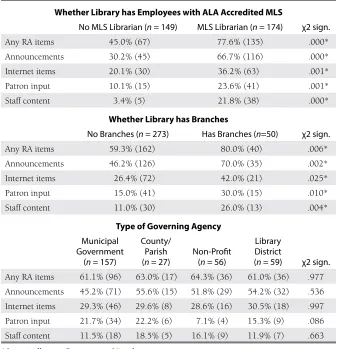
Table 2 examines whether the following library variables are related to the likelihood of having readers’ advisory
items: the employment of ALA-MLS librarians, the library having branches, and the type of governing body. The data show that libraries with ALA-MLS librarians were much more likely to have all categories of readers’ advisory items on their websites than libraries without degreed librar-ians, and for several categories they were more than twice as likely. The biggest contrast was that almost no libraries without degreed librarians provided their own readers’ advi-sory content such as reviews or reading lists (5, 3.4 percent) compared to libraries with librarians (38, 21.8 percent). All of these differences were statistically significant.
Libraries that had branches were more likely to provide readers’ advisory content on their webpages, and in the cases of providing staff content and seeking patron input, they were twice as likely to do so. All of the differences between libraries with branches and those without were statistically significant. The last comparison in this table was whether content varied for libraries governed by different types of agencies. There were no meaningful differences for libraries on this variable, and none of the readers’ advisory categories showed differences across library types that were statistically significant. See table 2.
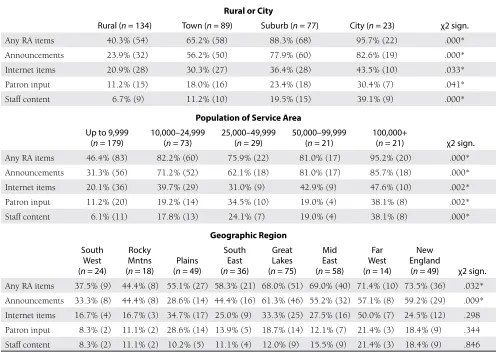
Library location made a great deal of difference in wheth-er libraries had readwheth-ers’ advisory items on their websites. For all content areas, city libraries were more than twice as likely as rural libraries to have items, with nearly all city libraries having some readers’ advisory (22, 95.7 percent) compared Table 1. Adult Readers’ Advisory on Public Library Websites
Types of Items Libraries (N = 323) %
Any Readers’ Advisory Items 202 62.5
Announcements 161 49.8
Book club announcements 148 45.8
Announcements for book/author programs 26 8.0
New book alerts 27 8.4
Internet Items 93 28.8
Specific Readers’ Advisory page 57 17.6
Links to Readers’ Advisory websites: Annotated 51 15.8
Links to Readers’ Advisory websites: Classified 39 12.1
Request Input from Patrons 56 17.3
Requests for purchases 46 14.2
Requests for patron reviews/annotations 21 6.5
Intellectual Content by Librarians/Staff 43 13.3
Annotations/reviews/recommendations by staff 35 10.8
Readers’ Advisory blog 11 3.4
Reading lists by staff 10 3.1
Ways for Patrons to Request Assistance 2 0.6
Form for personal reading guidance 2 0.6
to less than half of rural libraries (54, 40.3 percent). Once again, the largest difference was in staff-generated content, with only 6.7 percent of rural libraries compared to 39.1 percent of city libraries having this feature on their websites. The differences across library locations were statistically sig-nificant for all readers’ advisory categories.
The population of the service area (recoded into 5 groups) was also significantly related to differences in the availabil-ity of readers’ advisory items. More than half of the libraries in the study had fewer than 10,000 people in their service area, and in most categories these libraries were less than half as likely to offer readers’ advisory on their websites than even the next largest population category of 10,000 to 24,999 people. While the differences between the small-est population areas and the next size up were large, the differences between that second-smallest category and the largest population areas were less than 15 percentage points for Announcements, Internet items, and the overall readers’ advisory category. However, the presence of staff content and requests for patron input doubled between libraries in this category and libraries in the largest population areas.
When examining readers’ advisory by geographic region of the country, the only real differences were in Announce-ments, and the effect that the announcements category had
on the overall readers’ advisory item. These categories showed a statisti-cally significant difference across re-gions. Libraries in states on the coasts and in the upper Midwest were more likely to have readers’ advisory an-nouncements on their websites than libraries in the southern and central states. Note that the n for the Far West and Rocky Mountain regions was small, fewer than 20 libraries, so results for those regions should be viewed with caution. See table 3.
Research question 3 was “is the quality or complexity of the website overall related to the likelihood of readers’ advisory being included on the website?” During the data collec-tion, websites were classed on three subjective factors: complexity of the site, ease of use, and the incidence of broken links, empty pages, and other problems. Complex and mid-level websites were enormously more likely to have readers’ advisory items of all categories than basic websites, and these differences were statisti-cally significant. Middle ease of use websites were more likely than low or high ease of use sites to have readers’ advisory items, and this was statisti-cally significant for all categories ex-cept patron input. These results were not what was expected, so a cross-tabulation of complexity and ease of use was done to understand the variables better. This showed that basic websites had a higher ease of use and complex websites were more likely to have a middle ease of use. In other words, the relationship between middle ease of use and presence of RA items is a function of the fact that complex websites generally had both RA items and middle ease of use. The majority of sites had few or no broken links and other errors, and the presence of readers’ advisory items on the websites were not statistically significant across this variable, except for staff content, which did show statistical significance. See table 4.
CORRELATION AND REGRESSION
The cross-tabulations in the previous section showed that library size variables are related to different levels of read-ers’ advisory availability on websites, but how strong is the relationship between these variables? A Spearman’s rho (a statistic measuring correlation of ordinal-level variables) was conducted using the readers’ advisory category scores and sev-eral library size variables. The correlation analysis indicated that the overall score for readers’ advisory items on the website Table 2. Readers’ Advisory Items on Websites by Library Variables
Whether Library has Employees with ALA Accredited MLS
No MLS Librarian (n = 149) MLS Librarian (n = 174) χ2 sign.
Any RA items 45.0% (67) 77.6% (135) .000*
Announcements 30.2% (45) 66.7% (116) .000*
Internet items 20.1% (30) 36.2% (63) .001*
Patron input 10.1% (15) 23.6% (41) .001*
Staff content 3.4% (5) 21.8% (38) .000*
Whether Library has Branches
No Branches (n = 273) Has Branches (n=50) χ2 sign.
Any RA items 59.3% (162) 80.0% (40) .006*
Announcements 46.2% (126) 70.0% (35) .002*
Internet items 26.4% (72) 42.0% (21) .025*
Patron input 15.0% (41) 30.0% (15) .010*
Staff content 11.0% (30) 26.0% (13) .004*
Type of Governing Agency
Municipal Government
(n = 157)
County/ Parish
(n = 27) Non-Profit (n = 56)
Library District
(n = 59) χ2 sign.
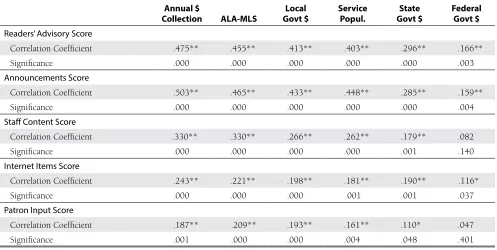
was correlated at a moderate to near-substantial level with the library’s total expenditure on the collection, the number of ALA-MLS librarians, the amount of annual funding by lo-cal government sources, and the size of the population of the library’s service area. The score was correlated at a low-mod-erate level to state government funding. The correlation with the level of federal government funding was negligible. The presence on the websites of readers’ advisory announcements was substantially correlated with the total expenditure on the collection, and near-substantial for population size, presence of ALA-MLS librarians, and level of local government funding. State funding was correlated at a low-moderate, and federal funding at a negligible level. The number of ALA-MLS librar-ians and the level of local government funding showed a low level of correlation with the presence on the website of readers’ advisory Internet items such as a readers’ advisory page and links, and also with requests for patron input such as reviews and purchase requests. Total expenditure on the collection was also correlated at a low level with the presence of Inter-net items. Typical interpretations of correlation coefficients range from those near zero which are negligible, through low, substantial, strong, to those that are very strong near 1.00.48 In this table the statistically significant correlations ranged
from .110, a negligible correlation, to .503, a substantial cor-relation. See table 5.
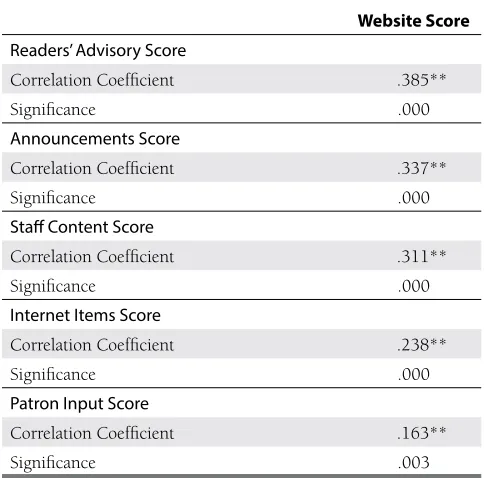
A Spearman’s rho correlation analysis was also run with the readers’ advisory category scores and the created variable Website Score. The correlation coefficients for the overall readers’ advisory score, the announcements score, and the staff content score ranged from .311 to .385, indicating a moderate level of correlation. The Internet item score coef-ficient (.238) and the patron input score coefcoef-ficient (.163) showed a low correlation of these variables with Website Score. See table 6.
The cross-tabulations and the bivariate correlations de-scribe the interaction of two variables. Multiple regression analysis combines several independent variables and tests their ability to predict change in the dependent variable. A variety of multiple regression analysis combinations were conducted to evaluate how well the library size variables predicted the presence of readers’ advisory items on the li-braries’ websites. The predictor variables were the following measures of aspects of library size: population of the service area, FTE ALA-MLS librarians, total expenditures on the collection, and levels of local, state, and federal funding; and the dependent variables were readers’ advisory score, Table 3. Readers’ Advisory Items on Websites by Location Variables
Rural or City
Rural (n = 134) Town (n = 89) Suburb (n = 77) City (n = 23) χ2 sign.
Any RA items 40.3% (54) 65.2% (58) 88.3% (68) 95.7% (22) .000*
Announcements 23.9% (32) 56.2% (50) 77.9% (60) 82.6% (19) .000*
Internet items 20.9% (28) 30.3% (27) 36.4% (28) 43.5% (10) .033*
Patron input 11.2% (15) 18.0% (16) 23.4% (18) 30.4% (7) .041*
Staff content 6.7% (9) 11.2% (10) 19.5% (15) 39.1% (9) .000*
Population of Service Area
Up to 9,999
(n = 179) 10,000–24,999(n = 73) 25,000–49,999(n = 29) 50,000–99,999(n = 21) 100,000+ (n = 21) χ2 sign.
Any RA items 46.4% (83) 82.2% (60) 75.9% (22) 81.0% (17) 95.2% (20) .000* Announcements 31.3% (56) 71.2% (52) 62.1% (18) 81.0% (17) 85.7% (18) .000* Internet items 20.1% (36) 39.7% (29) 31.0% (9) 42.9% (9) 47.6% (10) .002* Patron input 11.2% (20) 19.2% (14) 34.5% (10) 19.0% (4) 38.1% (8) .002* Staff content 6.1% (11) 17.8% (13) 24.1% (7) 19.0% (4) 38.1% (8) .000*
Geographic Region
South West (n = 24)
Rocky Mntns
(n = 18) (nPlains = 49)
South East (n = 36)
Great Lakes (n = 75)
Mid East (n = 58)
Far West (n = 14)
New England
(n = 49) χ2 sign.
announcements score, Internet items score, staff content score, and patron input score.
First, a regression was conducted with each individu-al predictor variable and each dependent variable. Locindividu-al Table 4. Readers’ Advisory on Websites by Quality of Website Variables
Complex
(n = 57) Midlevel(n = 165) (n Basic= 101) sign.χ2
Any RA items 86.0% (49) 69.7% (115) 37.6% (38) .000*
Announcements 73.7% (42) 53.9% (89) 29.7% (30) .000*
Internet items 42.1% (24) 35.8% (59) 9.9% (10) .000*
Patron input 38.6% (22) 16.4% (27) 6.9% (7) .000*
Staff content 33.3% (19) 13.3% (22) 2.0% (2) .000*
Ease of Use High
(n = 139) Ease of Use Middle(n = 140) Ease of Use Low(n = 44) sign.χ2
Any RA items 48.9% (68) 77.1% (108) 59.1% (26) .000*
Announcements 42.4% (59) 58.6% (82) 45.5% (20) .022*
Internet items 20.9% (29) 40.0% (56) 18.2% (8) .000*
Patron input 12.2% (17) 22.9% (32) 15.9% (7) .062
Staff content 8.6% (12) 20.7% (29) 4.5% (2) .002*
Few/No Broken Links
(n = 269) Some Broken Links(n = 36) Many Broken Links(n = 18) sign.χ2
Any RA items 63.6% (171) 61.1% (22) 50.0% (9) .506
Announcements 52.0% (140) 41.7% (15) 33.3% (6) .178
Internet items 29.0% (78) 30.6% (11) 22.2% (4) .803
Patron input 16.7% (45) 27.8% (10) 5.6% (1) .103
Staff content 15.6% (42) 2.8% (1) 0.0% (0) .024*
*Statistically significant at α =.05 or better
Table 5. Correlation of Library Size Variables and Readers’ Advisory Items on Library Websites (N = 323)
Annual $
Collection ALA-MLS Govt $Local ServicePopul. Govt $State FederalGovt $
Readers’ Advisory Score
Correlation Coefficient .475** .455** .413** .403** .296** .166**
Significance .000 .000 .000 .000 .000 .003
Announcements Score
Correlation Coefficient .503** .465** .433** .448** .285** .159**
Significance .000 .000 .000 .000 .000 .004
Staff Content Score
Correlation Coefficient .330** .330** .266** .262** .179** .082
Significance .000 .000 .000 .000 .001 .140
Internet Items Score
Correlation Coefficient .243** .221** .198** .181** .190** .116*
Significance .000 .000 .000 .001 .001 .037
Patron Input Score
Correlation Coefficient .187** .209** .193** .161** .110* .047
Significance .001 .000 .000 .004 .048 .401
government funding was the best single predictor variable for the overall readers’ advisory score (predicted 9.8 percent of the variance) and for the announcements score (predicted 15.1 percent of the variance). FTE ALA-MLS librarians was the best single predictor for the staff content score (9.2 per-cent) and the patron input score (1.8 percent, quite negli-gible). The Internet score variable showed very little ability to be predicted by any of the individual independent variables, with less than 1 percent of its variance being predicted.
The multiple regression model that was considered most appropriate used the predictor variables total expenditures on the collection, FTE ALA-MLS librarians, local funding, and state funding. Federal funding was eliminated for its low correlation with the dependent variables. Population of the service area had a higher correlation, but appeared to offer little additional predictive input beyond the variables already in the model, probably due to multicollinearity. Therefore, it was eliminated from the final model.
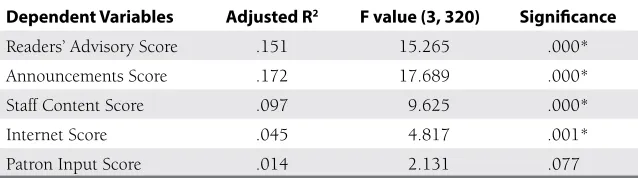
The results of the regression are shown in table 7. The best prediction model was for Announcements Score, but even so, the model predicted less than 20 percent of the variation in whether a library’s website contained readers’ advisory announcements (17.2 percent prediction). Readers’ Advisory Score could be predicted at 15.1 percent, and Staff Content Score at 9.7 percent. The model predicted less than 5 percent of Internet Score (4.5 percent), and Patron Input Score was so low as to not reach statistical significance.
It can be concluded that these variables that are repre-sentative of library size predicted very little of the likelihood that readers’ advisory items would be found on the library’s website. This suggests that there are other, unidentified fac-tors affecting libraries’ decisions to include readers’ advisory items on their websites; possibilities are discussed in the conclusion.
DISCUSSION
Of the 369 libraries in the sample, 323 had websites (87.5 percent). These library sites were searched for thirteen types of readers’ advisory items, grouped into five cat-egories. Nearly two-thirds of libraries (62.5 percent) had at least one item, and the most common by far was book club announcements (45.8 percent of sites). All other items were found on fewer than 20 percent of websites. Within the groupings of readers’ advisory items by type, half of sites had announcements (49.8 percent), over one-quarter had Internet items (28.8 percent), 17.3 percent requested input from patrons, and 13.3 percent of sites contained content created by library staff. Items in the fifth category, ways for library patrons to contact staff to request read-ers’ advisory assistance, were found on only two websites. This number was too few to reasonably use this category in further analysis.
Cross-tabulations showed that a variety of variables re-lated to library size were significantly rere-lated to the presence
of readers’ advisory items. These included the presence of ALA-MLS librarians, whether the library had branches, city compared to rural location, and population of the service area. Region of the country was significant for the overall readers’ advisory score and for announcements, but not for the other categories. Type of governing agency was not a significant factor. Website complexity and ease of use were also significantly related.
Correlation analysis found that the library size factors most highly correlated with the presence of readers’ advisory items were, in order, total expenditure on the collection, FTE ALA-MLS librarians, amount of local government funding, and population of the service area. State government fund-ing was less strongly correlated, and federal fundfund-ing was negligible. Website quality was moderately correlated. In the correlation analysis, the Internet score and the patron input scores were much less likely to show correlation with the independent variables than staff content, announcements, and the overall readers’ advisory score. Even the best cor-relations in this analysis were merely mid-level and did not reach the level of a strong correlation.
Regression analysis also showed merely a weak to moder-ate relationship between the predictor and dependent vari-ables with the best models predicting less than 20 percent of the variation in the readers’ advisory category scores. This suggests that while some larger libraries are more likely to have these items on their websites than some smaller li-braries, there are other, unexamined factors that are more influential.
Table 6. Correlation of Readers’ Advisory Scores and Website Score Using Spearman’s rho (N = 323)
Website Score
Readers’ Advisory Score
Correlation Coefficient .385**
Significance .000
Announcements Score
Correlation Coefficient .337**
Significance .000
Staff Content Score
Correlation Coefficient .311**
Significance .000
Internet Items Score
Correlation Coefficient .238**
Significance .000
Patron Input Score
Correlation Coefficient .163**
Significance .003
CONCLUSION
The literature on readers’ advisory describes a wide variety of approaches to online RA, and numerous case studies out-line exemplary outreach efforts on public library websites. Librarians who have reported on their online RA endeavors have generally described an enthusiastic response from their patrons as well as averring that the online environ-ment improves the quality of service, as it allows advisors to respond more deliberately. However, this study’s findings indicate that libraries that offer robust online RA services remain a minority. Contrary to the advice in the practitio-ner literature, public libraries appear to be much more likely to use their websites only for outreach about in-person RA activities (such as book club announcements), not for actual provision of readers’ advisory online. In 2000, Kelly found that approximately 10 percent of the libraries in his sample included original RA content such as book lists.49 The most similar item in the present study was intellectual content by librarians, found on the websites of 13.3 percent of the stud-ied libraries. Although Kelly’s variables do not align perfectly with those of the present study, which limits the potential for comparison, that finding suggests that the intervening years have seen little change in the prevalence of that aspect of online RA.
It is distinctly possible that readers’ advisory is taking place online in some public libraries, but that it is invisible as a standalone service or is occurring in another venue besides the library website. Trott has argued that RA is often under-measured because it is subsumed under general reference services.50 General online reference is widespread, provided by 65 percent of public libraries in 2010.51 Some libraries that do not highlight readers’ advisory on their websites as a distinct service might very well be providing RA among other types of reference questions answered online. It is also possible that public libraries are providing readers’ advisory services via social media. The present study only examined library websites; however, its website is not necessarily the entirety of a public library’s online presence. Some libraries may very well be recommending books to their patrons on Facebook, promoting book clubs and author talks on Twitter, and engaging a large community of readers on Goodreads, without any of this activity being apparent on their main
websites. Readers’ advisory, and con-versations about books, may also be oc-curring within next-generation library catalogs.52 Further research is needed to examine the state of practice in these additional online venues.
However, the assumption that RA questions and requests will arrive through the general reference or social media channels, and so no promotion is needed on the website, is risky. Many library patrons have no idea that recre-ational reading guidance is available or fear that such questions would not be welcome.53 Likewise, patrons who look on a library’s website for help will not nec-essarily be motivated to check the library’s Facebook page as well. Readers’ advisory services receive an appreciative response from patrons when they learn that they are avail-able, but they tend to be under-marketed.54 Were greater online outreach for RA services emphasized, many patrons would likely be pleasantly surprised to learn that such help is available.
This study suggests that larger libraries are more likely to have RA items on their websites, but the predictive value is only nominal. Both some large and some small libraries have some RA items, and practically none of any size included op-tions for direct personal assistance. If the presence of online RA items is not a function of library size, then what affects the provision of online RA? This study does not provide ap-propriate data to draw conclusions, and future research is necessary to identify the barriers to robust online RA.
However, it is probably reasonable to assume that the in-dividual interests and priorities of the librarians play a signifi-cant role. In addition, librarians might be less likely to develop online RA services if they anticipate that it would be too dif-ficult or resource-intensive to maintain them. Some librarians may want to provide, say, annotated online book lists, but lack the time to refresh them with appropriate frequency. The correlation between website complexity and presence of RA items might imply that libraries are more likely to commit to online RA if they have adequate resources, including technical staff, to support a more sophisticated online presence. (Con-versely, the absence of RA items may sometimes be an artifact of minimal online services or outreach overall.) Finally, some librarians may simply view RA as uniquely unsuited to online provision. Readers’ advisory “is all about how well we talk to patrons.”55 Some librarians may find it difficult to conceive of effectively translating the personal conversation about books and reading that is at the heart of a readers’ advisory inter-view to a faceless online environment. If librarians perceive this service as inherently demanding a personal conversation that cannot be easily replicated online, they may be especially reluctant to offer it digitally.
However, the popularity of commercial sites such as Goodreads for connecting readers with books, as well as the experience of the relatively small number of libraries whose Table 7. Multiple Regression Results Using Independent Variables: Total expenditure
on collection, FTE ALA-MLS Librarians, Local Funding, State Funding
Dependent Variables Adjusted R2 F value (3, 320) Significance Readers’ Advisory Score .151 15.265 .000*
Announcements Score .172 17.689 .000*
Staff Content Score .097 9.625 .000*
Internet Score .045 4.817 .001*
Patron Input Score .014 2.131 .077
online RA experiences have been described in the practi-tioner literature, belies the assumption that RA cannot take place online. Using public library websites as outreach tools for readers’ advisory can help keep this library service conve-nient and relevant in the lives of digitally immersed users. It might be a useful tool for reaching Millennials in particular. The recent Pew study on the use of public libraries by people under 30 found that these younger adults were as likely to have used a public library in the last year as older adults, and more likely to have ever used a library website (although older adults were more likely to have used a library website in the past week). However, younger adults were less likely to know about the services and programs offered by their pub-lic library.56 An earlier Pew study from October 2012 found that younger adults and older adults were equally likely to get book recommendations from “a librarian/library website.”57 These findings suggest that an audience exists for online RA from public libraries, if libraries choose to provide it.
This study was unable to examine the relationship be-tween online RA items and the readers’ advisory services, if any, that were available in person to patrons of the libraries whose websites were examined. Future research might study whether minimal or nonexistent online RA accurately mir-rors the service’s overall availability. Future research is also suggested to identify the barriers to online RA, perhaps es-pecially to the direct provision of reading recommendations. Meanwhile, this study indicates that online RA of any type would be a new area for many public libraries. Librar-ians who are interested in expanding into this domain might find that the simplest first step is online promotion of ex-isting services. Only 17.6 percent of public libraries in this study’s sample had specific RA pages on their websites. Pre-suming such a service is available, libraries could easily add static pages to their existing sites describing this in-person service and encouraging patrons to take advantage of it. A commitment to ensuring that websites accurately reflect any upcoming events (book clubs, book talks, author programs, etc.) and announcements about the readers’ advisory services would also be a relatively simple and low-investment step into promoting services digitally. Similarly, libraries that pro-vide read-alike lists or other original content should make an effort to ensure that that content is reproduced online for the benefit of their virtual patrons. For librarians who are interested in stepping into online RA but who may be con-cerned about the time and resources required, it may be most useful to think in terms of promotion of in-person services and translation of existing materials to the web, rather than viewing online RA as an entirely new and separate service.
However, case studies from the apparently small number of libraries that do provide readers’ advisory to individual pa-trons online indicate that the service is feasible and need not be overwhelming. Recreational readers want to talk about books, and many of them want to have those conversations online. Shouldn’t public libraries join them?
REFERENCES
1. Barbara Hoffert, “Materials Shift,” Library Journal 139, no. 3 (February 15, 2014): 34–36.
2. Connie Van Fleet, “Education for Readers’ Advisory Service in Library and Information Science Programs: Challenges and Opportunities,” Reference & User Services Quarterly 47, no. 3 (Spring 2008): 229.
3. Anne K. May, “Readers’ Advisory Service: Explorations of the Transaction,” in The Readers’ Advisor’s Companion, edited by Ken-neth D. Shearer and Robert Burgin (Englewood, CO: Libraries Unlimited, 2001), 123.
4. Barry Trott, “Building on a Firm Foundation: Readers’ Advisory over the Next Twenty-Five Years,” Reference & User Services Quarterly 48, no. 2 (Winter 2008): 132–35.
5. Anthony S. Chow, Michelle Bridges, and Patricia Commander, “The Website Design and Usability of US Academic and Public Libraries,” Reference & User Services Quarterly 53, no. 3 (Spring 2014): 253.
6. Rebecca Anwyll and Brenda Chawner, “Social Media and Read-ers’ Advisory: A Win-Win Combination?,” Reference & User Services Quarterly 53, no. 1 (Fall 2013): 18–22.
7. Bobbi Newman, “Taking Readers’ Advisory Online,” in The Readers’ Advisory Handbook, edited by Jessica E. Moyer and Kaite Mediatore Stover (Chicago: American Library Association, 2010), 113–20.
8. Neil Hollands, “Improving the Model for Interactive Readers’ Advisory Service,” Reference & User Services Quarterly 45, no. 3 (Spring 2006): 211.
9. Neal Wyatt, “Take the RA Talk Online,” Library Journal 133, no. 3 (February 15, 2008): 32–34.
10. Ibid.; Barry Trott, “Advising Readers Online: A Look at Internet-Based Reading Recommendation Services,” Reference & User Services Quarterly 44, no. 3 (Spring 2005): 210–15.
11. Raya Kuzyk, “A Reader At Every Shelf,” Library Journal 131, no. 3 (February 15, 2006): 32–35.
12. Newman, “Taking Readers’ Advisory Online.” 13. Trott, “Advising Readers Online.”
14. Newman, “Taking Readers’ Advisory Online”; Kuzyk, “A Reader At Every Shelf.”
15. Stephanie L. Maatta, A Few Good Books: Using Contemporary Readers’ Advisory Strategies to Connect Readers with Books (New York: Neal-Schuman, 2010), 112–14; Newman, “Taking Readers’ Advisory Online”; Trott, “Advising Readers Online.”
16. Emily Ellis, “Book Trailers: Available at a Library Near You,”
Indiana Libraries 29, no. 2 (July 2010): 24–26.
17. Trott, “Advising Readers Online”; Newman, “Taking Readers’ Advisory Online.”
18. Barbara Hoffert, “Taking Back Readers’ Advisory,” Library Jour-nal 128, no. 14 (September 1, 2003): 44–46; Trott, “Building on a Firm Foundation.”
19. Trott, “Advising Readers Online.”
20. “Your Next 5 Books,” Seattle Public Library, accessed August 25, 2014, https://www.spl.org/using-the-library/get-help/your -next-5-books; David Wright, “Your Next Five Books: What Form-Based Readers’ Advisory Can Do for You,” Alki 27, no. 3 (December 2011): 9–10.
21. Hollands, “Improving the Model for Interactive Readers’ Advi-sory Service.”
22. “Personalized Booklist,” Jacksonville Public Library, accessed August 25, 2014, http://jpl.coj.net/lib/readers.html; “Personal-ized Playlist,” Jacksonville Public Library, accessed August 25, 2014, http://jpl.coj.net/lib/music-advisory.html.
24. Trott, “Advising Readers Online”; Michael Porter and David Lee King, “Readers’ Advisory in a 2.0 World,” Public Libraries 49, no. 1 (January/February 2010): 20–22.
25. Maatta, A Few Good Books, 39–59.
26. Anwyll and Chawner, “Social Media and Readers’ Advisory.” 27. Jessica Zellers, “In Blog Heaven: A Painless New Approach to
Readers’ Advisory,” Virginia Libraries 53, no. 3 (July/August/ September 2007): 23–24.
28. Alison Kastner, “Facebook RA,” Library Journal 136, no. 8 (May 1, 2011): 24–26; Robert J. Rua, “Mission: Connect,” Library Jour-nal 136, no. 8 (May 1, 2011): 26.
29. Joyce Saricks, “Technology in an RA World,” Booklist 109, no. 11 (February 1, 2013): 23.
30. Neal Wyatt, “2.0 For Readers,” Library Journal 132, no. 1 (November 1, 2007): 30–33.
31. Jen Pecoskie, Louise F. Spiteri, and Laurel Tarulli, “OPACs, Users, and Readers’ Advisory: Exploring the Implications of User-Generated Content for Readers’ Advisory in Canadian Public Libraries,” Cataloging & Classification Quarterly 52, no. 4 (May 2014): 431–53.
32. Laurel Tarulli, “Readers’ Services and the Library Catalog: Com-ing of Age Fiction? Or Non-Fiction?,” Reference & User Services Quarterly 51, no. 2 (Winter 2011): 116.
33. Kaite Mediatore Stover, “Stalking the Wild Appeal Factor: Read-ers’ Advisory and Social Networking Sites,” Reference & User Services Quarterly 48, no. 3 (Spring 2009): 243–46; Yesha Naik, “Finding Good Reads on Goodreads,” Reference & User Services Quarterly 51, no. 4 (Summer 2012): 319–23.
34. Maatta, A Few Good Books, 311; Steven M. Cohen, “The Next Big ‘Library Thing,’” Public Libraries 45, no. 2 (March/April 2006): 33–35; David Rapp, “Crowdsourcing RA,” Library Journal 136, no. 10 (June 1, 2011): 56–57.
35. David Wright and Abby Bass, “No Reader Is an Island: New Strategies for Readers’ Advisory,” Alki 26, no. 3 (December 2010): 9–10.
36. LibraryThing for Libraries homepage, accessed March 7, 2015, https://www.librarything.com/forlibraries; “LibraryThing Debuts BookPsychic,” Advanced Technology Libraries 41, no. 10 (October 2012): 6.
37. “Goodreads Acquisition Presents Opportunity,” Library Journal
138, no. 8 (May 1, 2013): 17.
38. Kuzyk, “A Reader At Every Shelf”; “Whichbook,” Opening the Book, accessed March 7, 2015, www.openingthebook.com/ whichbook.
39. Nicole Cohen et al., “NPR’s Book Concierge,” December 3, 2014, http://apps.npr.org/best-books-2014.
40. “The Penguin Hotline,” Penguin Books, accessed March 7, 2015, www.penguin.com/penguinhotline.
41. Pandora Internet Radio homepage, accessed March 7, 2015, www.pandora.com; Neal Wyatt, “The Ideal Tool,” Library Journal
134, no. 17 (October 15, 2009): 39–43. 42. Trott, “Advising Readers Online.”
43. Ricki Nordmeyer, “Readers’ Advisory Web Sites,” Reference & User Services Quarterly 41, no. 2 (Winter 2001): 139–43. 44. Rebecca Anwyll and Brenda Chawner, “Social Media and
Read-ers’ Advisory: New Zealand Experiences,” Reference & User Ser-vices Quarterly 53, no. 2 (Winter 2013): 113–18.
45. Chow, Bridges, and Commander, “The Website Design and Usability of US Academic and Public Libraries.”
46. James M. Kelly, “Promoting Fiction: Readers’ Advisory and the Use of Public Library Web Sites” (master’s thesis, University of North Carolina at Chapel Hill, 2000).
47. Institute of Museum and Library Services, “Public Libraries in the United States Survey,” 2010, www.imls.gov/research/ pls_data_files.aspx.
48. David de Vaus, Analyzing Social Science Data (Thousand Oaks, CA: Sage, 2002).
49. Kelly, “Promoting Fiction,” 17. 50. Trott, “Advising Readers Online.”
51. Virgil E. Varvel, “Characteristics and Trends in the Public Library Data Service 2010 Statistical Report,” Public Libraries 49, no. 6 (December 11, 2010): 34–42.
52. Laurel Tarulli and Louise F. Spiteri, “Library Catalogues of the Future: A Social Space and Collaborative Tool?,” Library Trends
61, no. 1 (Summer 2012): 107–31.
53. May, “Readers’ Advisory Service”; Hollands, “Improving the Model for Interactive Readers’ Advisory Service.”
54. Trott, “Building on a Firm Foundation.” 55. Wyatt, “Take the RA Talk Online,” 32.
56. Kathryn Zickuhr and Lee Rainie, “Younger Americans and Pub-lic Libraries: How Those Under 30 Engage with Libraries and Think About Libraries’ Role in Their Lives and Communities,” Pew Research Center, Setpember 10, 2014, www.pewinternet .org/2014/09/10/younger-americans-and-public-libraries. 57. Kathryn Zickuhr et al., “Younger Americans’ Reading and