Eur. Chem. Bull., 2017, 6(5), 201-205 DOI: 10.17628/ecb.2017.6.201-205
201
SYNTHESIS AND CHARACTERIZATION OF SOME
4-SUBSTITUTED THIAZOLIDINONE DERIVATIVES
Assala Salam Jebur
[a]and Mahmood Shakir Magtoof
[a]*Keywords: Thiazolidinones; imines; synthesis; NMR spectroscopy
This study is concerned with the synthesis and characterization of 4-thiazolidinone derivatives )3a-3h(. These compounds were prepared by
reacting mercaptoacetic acid with the appropriate Schiff bases (imines) by heating at 50-60 °C in chloroform with moderate yields (51-75 %). The structures of these 4-thiazolidinone derivatives were established on the basis of the spectral studies using IR, 1H-NMR, 13
C-NMR, 13C-NMR DEPT and MS.
* Corresponding Authors Tel: 009647813199256
E-Mail: [email protected]
[a] Department of Chemistry, Science, College,Thiqar University, Thiqar, Nasyria, Iraq
Introduction
Thiazolidinones are ketone derivatives of the saturated form of thiazole (called thiazolidine). 1,3-Thiazolidin-4-ones are five-membered heterocycles with one sulfur and one nitrogen atom (Figure 1(.
Figure 1. Thiazolidinone ring
1,3-Thiazolidin-4-ones belong to the most intensively investigated classes of five-membered heterocyclic compounds, the biological significance of this class of compounds attracted us to work on the synthesis of new derivatives because numerous 4-Thiazolidinonesknown for their versatile pharmacological activities1,2 such as hypnotic,3 anti-cancer,4 cardiovascular5 and antioxidant6 effect.
Experimental part
The 1H-NMR spectra were recorded using VARIAN spectrophotometer (500 MHz), the 13C-NMR spectra were recorded using VARIAN spectrophotometer (75 MHz).The chemical shift values are expressed in δ(ppm), using tetramethylsilane (TMS) as internal standard and d6-DMSO as the solvent. The mass spectra were recorded at 70eV using HPLC-LCQ Fleet/Thermo Scientific mass spectrophotometer
General procedure for the preparation of imines (2a-2h)7-9 Preparation of mono-imines (2a-2d).
In general, the mono-imines (2a-2d) were prepared by the reaction of the mixture of 0.01 mol amine with 0.01 mol aldehyde in 20 ml of methanol or ethanol and 4-6 drops of glacial acetic acid. The reaction mixture was refluxed for 0.5-9 h, and the progress of the reaction was followed by TLC using hexane:ethyl acetate 6:4 as eluent. After completion the reaction, the solvent was evaporated, and the residue was recrystallized from a suitable solvent.
3-(4-Bromophenylimino)indolin-2-one (2a)
The compound was prepared by reacting 1.169 g (0.01 mol) of 4-bromoaniline and 1 g (0.01 mol) of indoline-2,3-dione (isatin). Yield=75 %, M.p.=273-275 ºC, colour orange, IR (KBr disk) 1608 cm-1 (C=N).
2-Chloro-N-(4-chlorobenzylidene)aniline (2b)
The compound was prepared by reacting 1.72 g (0.01 mol) of 2-chloroaniline and 1.4 g (0.01 mol) of 4-chlorobenzaldehyde. Yield = 71.7 %, m.p. = 225-228 ºC,
colour white, IR (KBr disk) 1614 cm-1 (C=N).
2-(3-Ethoxy-2-hydroxybenzylideneamino)benzoic acid (2c)
The compound was prepared by reacting 0.825 g (0.01 mol) of 2-aminobenzoic acid and 1 g (0.01 mol) of 3-ethoxy-2-hydroxybenzaldehyde. Yield = 87.5 %, m.p. = 208-209 ºC, colour orange, IR (KBr disk) 1625 cm-1 (C=N).
4-Bromo-2-(4-bromophenyliminomethyl)phenol (2d)
The compound was prepared by reacting 0.85 g (0.01 mol) of 4-bromoaniline and 1 g (0.01 mol) of 5-bromo-2-hydroxybenzaldehyde. Yield = 87.5 %, m.p. = 108-110 ºC,
colour yellow, IR (KBr disk) 1618 cm-1 (C=N).
O
S
Preparation of bis-imines (2e-2h)
In general, the bis-imines (2e-2h) were prepared by the reaction of 0.01 mol diamine with 0.02 mol of aldehyde (20 ml) of methanol or ethanol and 4-6 drops of glacial acetic acid. The reaction mixture was refluxed for 1-9 h, with monitoring the progress of the reaction by TLC using hexane:ethyl acetate 6:4 as eluent. After completion the reaction, the solvent was evaporated and the product was recrystallized from a suitable solvent .
2,2'-{Benzene-1,4-diylbis[nitrilomethylylidene]}bis(6-ethoxy-phenol) (2e)
The compound was prepared by reacting 0.324 g (0.01 mol) of benzene-1,4-diamine with 1 g (0.02 mol) of 3-ethoxy-2-hydroxybenzaldehyde. Yield = 85 %, m.p = 187-190 ºC, colour orange, IR (KBr disk) 1624 cm-1 (C=N).
2,2'-{Naphthalene-1,5-diylbis[nitrilo(E)methylylidene]}bis(6-ethoxyphenol) (2f)
The compound was prepared by reacting 0.452 g (0.01 mol) of naphthalene-1,5-diamine with 0.95g (0.02 mol) of 3-ethoxy-2-hydroxybenzaldehyde. Yield = 96 %, m.p = 133-136ºC, colour chartreuse, IR (KBr disk) 1618 cm-1 (C=N).
2-Ethoxy-6-[({4-[(E)-(3-ethoxy-2-hydroxybenzylidene)amino]-benzyl}imino)methyl]phenol (2g)
The compound was prepared by reacting 0.595 g (0.01 mol) of 4-(4-aminobenzyl)benzenamine with 1 g (0.02 mol) of 3-ethoxy-2-hydroxybenzaldehyde. Yield = 87.6 %, m.p = 157-158ºC, colour yellow, IR (KBr disk) 1615 cm-1 (C=N).
4-bromo-2-[({4-[(E)-(5-bromo-2-hydroxybenzylidene)amino]-benzyl}imino)methyl]phenol (2h)
The compound was prepared by reacting 0.595 g (0.01 mol) of 4-(4-aminobenzyl)benzenamine with 1 g (0.02 mol) of 5-bromo-2-hydroxybenzaldehyde. Yield = 84.2 %, m.p = 142-143 ºC, colour yellow, IR (KBr disk) 1623 cm-1 (C=N).
General procedures of mono and bis thiazolidinones (3a-3h)10 Preparation of mono thiazolidinones (3a-3d)
A mixture of appropriate Schiff bases (0.01 mol) (2a-2d)
and thioglycolic acid (0.01 mol, 0.20 ml) in a suitable solvent (50) ml was refluxed for 10-30 h. Water formed during the reaction was removed azeotropically by a Dean-Stark apparatus. The progress of the reaction was monitored by TLC using hexane:ethyl acetate 6:4 as eluent. This mixture of reaction are treated with sodium bicarbonate solution to remove unreacted acid. The obtained solids were filtered, washed and purified by recrystallization from dichloromethane to give color powders.
3'-(4-Bromophenyl)spiro[indoline-3,2'-thiazolidine]-2,4'-dione (3a)
The compound was prepared by reaction of 0.5 g (0.01 mol) of 3-((4-bromophenyl)imino)indolin-2-one (2a) and 0.153 g (0.115 ml, 0.01 mol) of thioglycolic acid. Yield=55 %, m.p.=180-182ºC, colour: yellow. IR (KBr) 1654 (C=O of thiazolidinone ring ); 3024cm-1 (Ar-H), 2909 cm-1 (C-H aliphatic), 1393 cm-1 (C-N), 665 cm-1 (C-S).1 H-NMR (500 MHz, DMSO-d6) δ=4.4 (s, 2H, C5H); 7.3-8.01 (m, 8H, ArH); 9.27(s, 1H, N-H). 13C NMR (75 MHz, DMSO-d6) δ=36(s, -CH2-), 49(s, -C-), 107-139(m, Ar-C); 177(s, CH2-C=O); 179(s, N-H-C=O).
3-(2-Chlorophenyl)-2-(4-chlorophenyl)thiazolidin-4-one (3b)
The compound was prepared by reaction of 0.8 g (0.01 mol) of 2-chloro-N-(4-chlorobenzylidene)aniline (2b) and 0.29 g (0.22 ml, 0.01 mol) of thioglycolic acid. Yield=61 %, m.p.=248-251 ºC, colour: orange. IR (KBr) 1681 (C=O of thiazolidinone ring), 3018 cm-1 (Ar-H), 2930 cm-1 (C-H aliphatic), 1396 cm-1 (C-N), 667 cm-1 (C-S). 1H-NMR (500 MHz, DMSO-d6) δ=4.3(s, 2H,C5H), 7.2(s, 1H, C2H), 7.4-8.01(m, 8H, ArH). 13C NMR (75 MHz, DMSO-d
6) δ =36.9(s, -CH2-), 43(s, -CH-), 111-142(m, Ar-C), 175(s, CH2-C=O).
2-(2-(3-Ethoxy-2-hydroxyphenyl)-4-oxothiazolidin-3-yl)benzoic acid (3c)
The compound was prepared by reaction of 2-((3-ethoxy-2-hydroxybenzylidene)amino)benzoic acid (2c) (0.5 g, 0.01 mol) and thioglycolic acid (0.16 g, 0.12 ml, 0.01 mol). Yield=70 %, m.p.=178-180 ºC, colour: orange. IR (KBr) 1691 cm-1 (C=O of thiazolidinone ring ); 3010 cm-1 (Ar-H), 2945 cm-1 (C-H aliphatic); 1399 cm-1 (C-N); 637 cm-1 (C-S). 1H-NMR (500 MHz, DMSO-d
6) δ=1.9(s, 3H, -CH3); 4.2 (s, 2H, C5H); 4.4(s, 2H, -CH2); 7.20(s, 1H, C2H); 7.22-8.7 (m, 8H, ArH); 9.59(s, 1H, O=C-OH). 13C NMR (75 MHz, DMSO-d6), δ=28(s, CH3); 35(s, -CH2-); 40(CH2O); 44(s, -CH-); 116-153 (m, Ar-C); 172(s, CH2-C=O); 182(COOH).
2-(5-Bromo-2-hydroxyphenyl)-3-(4-bromophenyl)thiazolidin-4-one (3d)
The compound was prepared by reaction of 0.7 g (0.01 mol) of 4-bromo-2-(((4-bromophenyl)imino)methyl)phenol
(2d) and 0.18 g (0.137 ml, 0.01 mol) of thioglycolic acid. Yield=78 %, m.p.=171-172 ºC, colour: yellow. IR (KBr) 1685 cm-1 (C=O of thiazolidinone ring ); 3052 cm-1 (Ar-H) , 2913 cm-1 (C-H aliphatic) ; 1385 cm-1 (C-N) ; 681 cm-1 (C-S). 1H-NMR (500 MHz, DMSO-d
6) δ =4.48 (s, 2H, C5H);7.3(s, 1H, C2H); 7.5-8.01(m, 8H, ArH); 9.62 (s, 1H, Ar-OH). 13C NMR (75 MHz, DMSO-d
6) δ=37(s, -CH2-); 45(s, -CH-); 120-157(Ar-C); 172(s, CH2-C=O).
Preparation of bis thiazolidinones (3e-3h)
Eur. Chem. Bull., 2017, 6(5), 201-205 DOI: 10.17628/ecb.2017.6.201-205
203
The progress of the reaction was checked by TLC using hexane : ethyl acetate 6:4 as eluent . This mixture of reaction was treated with sodium bicarbonate solution to remove unreacted acid. The obtained solid was filtered, washed and purified by recrystallization from dichloromethane to give color powder.
3,3'-(1,4-Phenylene)bis(2-(3-ethoxy-2-hydroxyphenyl)thiazo-lidin-4-one) (3e)
The compound was prepared by reaction of 0.4 g (0.01 mol) of 2e and 0.18 g (0.139 ml, 0.02 mol) of thioglycolic acid. Yield=71 %, m.p.=155-157 ºC, colour: orange. IR (KBr) 1654 cm-1 (C=O of thiazolidinone ring ); 3014 cm-1 (Ar-H), 2920 cm-1 (C-H aliphatic); 1380 cm-1 (C-N) ; 671 cm-1 (C-S). 1H-NMR (500 MHz, DMSO-d
6) δ = 1.8(s, 6H,-CH3); 4.0(s, 4H, -CH2); 4.6 (s, 4H, C5H); 7.2-8.04(m, 12H, Ar-H); 9.5(s, 2H, Ar-OH). 13C NMR (75 MHz, DMSO-d
6) δ =29(d, -CH3); 38(d, -CH2); 42(d, CH2O); 53 (d, -CH-); 113-153(m, Ar-C); 178(d, CH2-C=O).
3,3'-(Naphthalene-1,5-diyl)bis(2-(3-ethoxy-2-hydroxyphenyl)-thiazolidin-4-one) (3f)
The compound was prepared by reaction of 0.5 g (0.01 mol) of 2f and 0.1 g (0.153 ml, 0.02 mol) of thioglycolic acid. Yield=59 %, m.p.=154-157 ºC, colour: brown. IR (KBr) 1650 cm-1 (C=O of thiazolidinone ring ); 3030 cm-1 (Ar-H), 2911 cm-1 (C-H aliphatic); 1387 cm-1 (C-N); 668 cm-1 (C-S). 1H NMR (500 MHz, DMSO-d
6), δ=1.9(s, 6H, -CH3); 4.11(s, 4H, -OCH2); 4.7 (s, 4H, C5H); 7.4(s, 2H, -C2H-); 7.58-8.1(m, 14H, Ar-H); 9.6 (s, 2H, Ar-OH).
2-(3-Ethoxy-2-hydroxyphenyl)-3-(4-(4-(2-(3-ethoxy-2-hydroxy-phenyl)-4-oxothiazolidin-3-yl)benzyl)phenyl)thiazo-lidin-4-one (3g)
The compound was prepared by reaction of 0.5 g (0.01 mol) of 2g and 0.093 g (0.141 ml, 0.02 mol) of thioglycolic acid. Yield=76 %, m.p.=105-107 ºC, colour: orange. IR (KBr) 1654 cm-1 (C=O of thiazolidinone ring ); 3027 cm-1 (Ar-H), 2915 cm-1 (C-H aliphatic); 1390 cm-1 (C-N); 672 cm-1 (C-S). 1H-NMR (500 MHz, DMSO-d
6), δ=1.87(s, 6H, -CH3); 2.9(s, 2H, -CH2-); 4.2(s, 4H, -OCH2); 4.4 (s, 4H, C5H); 7.39(s, 2H, -C2H-); 7.59-8.16(m, 14H, Ar-H); 9.58 (s, 2H, Ar-OH).
2-(5-Bromo-2-hydroxyphenyl)-3-(4-(4-((R)-2-(5-bromo-2-hydr-oxyphenyl)-4-oxothiazolidin-3-yl)benzyl)phenyl) thiazolidin-4-one (3h)
The compound was prepared by reaction of 0.4 g (0.01 mol) of 2h and 0.18 g (0.139 ml, 0.02 mol) of thioglycolic acid. Yield=73 %, m.p.=246-247 ºC, colour orange. IR (KBr) 1660 cm-1 (C=O of thiazolidinone ring ); 3032 cm-1. (Ar-H), 2918 cm-1 (C-H aliphatic); 1395 cm-1 (C-N); 677 cm-1 (C-S). 1H-NMR (500 MHz, DMSO-d
6), δ=2.8(s, 2H, -CH2-); 4.2(s, 4H, C5H); 7.1(s, 2H, -C2H-); 7.59-8.16(m, 14H, Ar-H); 9.4 (s, 2H, Ar-OH).
RESULTS AND DISCUSSION
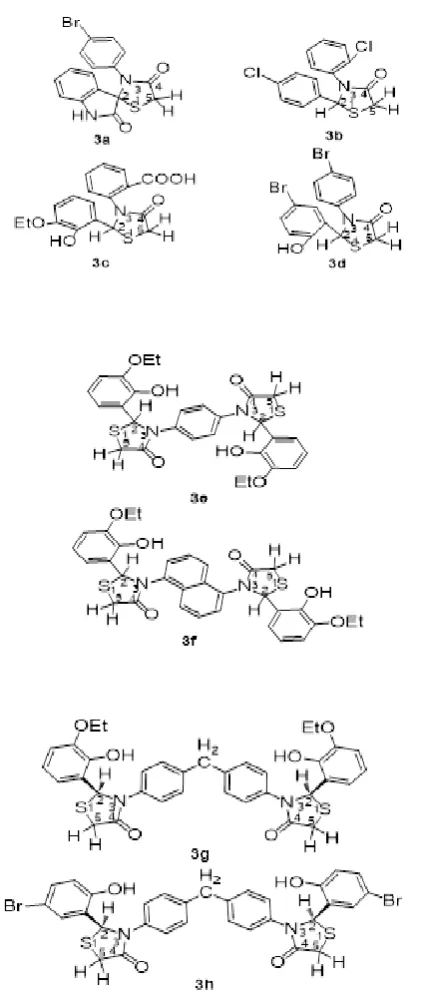
Thiazolidinones 3a-3h have been preparedby reaction of the appropriate Schiff bases (2a-2h) with thioglycolic acid in a suitable solvent ( benzene or chloroform).
Scheme 1. Mechanism of formation of mono thiazolidinone.
Scheme 2. Synthesis of bis thiazolidinone.
Scheme 3. Probable mechanism of the formation of bis-thiazolidinone
Analysis of infrared spectra
The absorption frequencies are affected by substitution of the phenyl ring, and the substitution by electron-donating groups (methyl group decreases) while substitution by electron-withdrawing groups (bromo) increase the vibrational frequencies.
Figure 2. Structures of the compounds 3a-3h.
1H-NMR spectral analysis
The1H-NMR spectrum of 3a shows a singlet signal at δ 4.4ppm for methylene group of thiazolidin-4-one ring, a multiplet signal at δ 7.3-8.01 ppm for aromatic protons (m, 8H, Ar-H), finally a singlet signal at δ 9.2 ppm for amide proton (1H, N-H).
Analysis of 13C-NMR spectra
The 13C NMR spectrum of 3a showed thiazolidin-4-one ring signals at δ 36 ppm for C5 carbon 5) at δ 49.94 ppm for C2 atom. A multiplet for aromatic carbons at δ 107-139 ppm, a singlet of carbonyl group at δ 177.06 ppm and a signal for C4 carbon of the ring were observed at δ 179.78 ppm.
Analysis of mass spectra
The mass spectrum of 3a showed the molecular ion peak corresponding to the particular compound at 375 m/z. The fragmentation of 3a gave the peaks at 301, 283, 273, 205, 156, 117, 76 and 64 m/z which attributed to the fragments of C14H9BrN2O+, C15H11N2O2S+, C13H9BrN2+, C10H7NO2S+, C6H4Br+, C7H5N2+, C6H4+, and C5H4+, respectively.
The mass spectrum of 3b showed the molecular ion peak corresponding to the particular compound at 359 m/z, and the fragmentation of 3b gave the peaks at 342, 314, 238, 210, 181 and 154 m/z which attributed to the fragments of C18H16NO4S+, C17H16NO3S+, C11H12NO3S+, C10H12NO2S+, C8H7NO2S+, C7H8NOS+, respectively.
The mass spectrum of 3c showed the molecular ion peak corresponding to the particular compound at 429 m/z, and the fragmentation of 3c gave the peaks at 355, 183, 172, 156, 76, 64 m/z which attributed to the fragments of C13H9Br2NO+, C7H5BrN+, C6H4BrO+, C6H4Br+, C6H4+, C5H4+, respectively.
Analysis of 13C-NMR DEPT spectra
13C-NMR DEPT spectra of 3a showed thiazolidin-4-one ring signals at δ 36(negative) 49.94(positive) ppm for C5 carbon C2 carbons, respectively. Multiplet signals for aromatic carbons were observed at δ 107-139 (positive) ppm, while at δ 177.06(positive) and δ 179.78(positive) ppm the carbonyl γ-lactam C4 signals could be observed, respectively.
13C-NMR DEPT spectrum of 3b showed the following signals: δ 28.67 (positive) ppm for -CH3, δ 35.67(negative) ppm for C5, δ 40.82(positive) ppm for -OCH2, and δ 44.94 ppm C2, multiplet signals for aromatic carbons at δ 106-153 (positive) ppm, δ 172.90 (positive) ppm for C4 and δ 183.02(positive) ppm for carbonyl of carboxylic group.
Acknowledgements
This work is sponsored by the University of Thi-Qar as a part of research development and higher studies projects.
References
1Kato T., Ozaki T., Tamura K., Suzuki Y., Akima M., Ohi N., J.
Med. Chem. 1999,42, 3134-3146.
Eur. Chem. Bull., 2017, 6(5), 201-205 DOI: 10.17628/ecb.2017.6.201-205
205
2Solankee, A., Solankee, P., Patel, H., Int. J. Chem. Sci., 2008, 6(2),
1017.
3Chaudhary S. K., Verma M., Chaturvedi A. K. and Parmar S. S., J.
Pharm. Sci., 1975, 64, 614.
https://doi.org/10.1002/jps.2600640408
4Shah B. R., Desai N. C., Undavia N. K. and Trivedi P. B., Indian
J. Heterocycl. Chem., 1993, 2, 249.
5Nagar S., Singh H. H., Sinha J. N. and Parmar S. S., J. Med.
Chem., 1973, 16, 178. https://doi.org/10.1021/jm00260a027
6Kato T., Ozaki T., Tamura K., Suzuki Y., Akima M., Ohi N., J.
Med. Chem., 1998, 41(22), 4309.
https://doi.org/10.1021/jm980335f
7Hello K .M ., Iraqi J. Chem., 2000, 24, 266.
8Krishnaswamy D., Tetrahedron, 2002, 34, 4567.
https://doi.org/10.1016/s0040-4020(02)00363-0
9Abdulrhman Y. K., Mahmood, S. M., Best Journal., 2014, 2(5),
37-48.
10Divyesh, P., Premlata, K. and Navin, P., Arch. Appl. Sci. Res., 2010, 2(6), 68-75.