CATION EXCHANGE MECHANISM OF DIVALENT METALS
IONS IN SYNTHETIC NaX AND LTA ZEOLITES: EFFICIENCY
AND SELECTIVITY
Zeinab Ezzeddine
[a,b]*, Isabelle Batonneau-Gener
[a]and Yannick Pouilloux
[a]Keywords: : NaX zeolite; LTA zeolite; exchange mechanism; heavy metals; selectivity.
In this investigation, the removal of divalent heavy metals by two types of zeolites has been studied. The mechanism of cation exchange for Cu2+, Ni2+, Cd2+ and Pb2+ on NaX Faujasite and Linde type A (LTA) zeolites was studied. Both zeolites are very efficient in divalent heavy
metals removal from water. Ion exchange isotherms were performed and the thermodynamic parameters were calculated as well. Kielland plots showed that the order of selectivity is not the same for both the zeolites. For NaX it followed the following order Pb2+ > Cu2+ > Cd2+ >
Ni2+ while for LTA the order is Pb2+ > Cd2+ > Cu2+ > Ni2+. Exchange velocity (k
w) and the radii of the hydrated metals ions are involved in
determining this order of selectivity.
* Corresponding Authors Fax:
E-Mail: [email protected]
[a] Institut de chimie des milieux et matériaux de Poitiers (IC2MP) - UMR 7285, Poitiers University, Poitiers, France [b] Platform for research and analysis in environmental sciences,
Lebanese University, Lebanon
Introduction
Zeolites are cation exchangers that occur naturally, the Swedish mineralogist Axel Fredrick Crønstedt first discovered them in 1756.1 The framework of zeolites is a
three-dimensional arrangement of tetrahedral SiO4 and
AlO4- units. The aluminate units in the framework are
responsible for its net negative charge which is balanced by the presence of extra framework cations located on defined crystallographic positions. These cations are responsible for zeolite exchange properties and the rich ion-exchange chemistry of these materials. The elevated cation exchange capacity made zeolite attractive for wastewater treatment especially for removing heavy metals.
Nowadays, many water resources are contaminated due to the direct release of industrial influents. Heavy metals are one of the most serious environmental pollutants since they accumulate in living organisms even at low concentration causing dangerous diseases.2 Natural zeolites have been
used to remove heavy metal from aqueous solutions because they are inexpensive and highly abundant. Several researches showed that zeolites have good cation-exchange capacities under different experimental conditions.3-5 One of
The most frequently studied natural zeolites is Clinoptilolite.6,7 The cation exchange capacity is usually
between 0.6 and 2.3 meq g-1.8 Recently, a great deal of
attention has been paid to synthetic zeolites due to their enhanced properties including higher cation exchange capacity compared to natural ones. Synthetic Faujasite zeolite, NaX (Na88Al88Si104O384 and Si/Al ratio = 1.18) and
Zeolite A, LTA (Na96Al96Si96O384 and Si/Al ratio=1) are
more favourable for heavy metals adsorption since they contain more exchangeable Na+ ions in their framework.
There are several studies dealing with divalent heavy metals adsorption onto synthetic zeolites,9,10 but no detailed
analysis for the cation exchange mechanism is available. The current study highlights the theory of ion exchange in synthetic NaX and LTA zeolites. The efficiency and selectivity of divalent heavy metals binding (Cu2+, Ni2+,
Cd2+ and Pb2+) were analyzed in detail based on the cation
exchange theory including calculation of thermodynamic parameters which allows better understanding the selectivity of these zeolites toward metal ions.
Experimental
Materials
The French Institute of Petroleum (IFP Energie Nouvelle) provided the synthetic NaX Faujasite and LTA zeolite samples. These samples were used as received without any further chemical modification. Copper nitrate trihydrate (Cu(NO3)2.3H2O), cadmium nitrate tetrahydrate
(Cd(NO3)2.4H2O), nickel nitrate hexahydrate
(Ni(NO3)2.6H2O) and anhydrous lead nitrate (Pb(NO3)2)
were purchased from Sigma Aldrich, and used as received. Ultrapure water was used throughout.
Batch adsorption experiments
Metal ions solutions (Cu2+, Ni2+, Pb2+and Cd2+) were
prepared from their corresponding nitrate salts in ultrapure water to obtain solutions of different concentrations. In batch studies, 20 mg of the solid zeolite powder was placed in 100 mL of a metal solution of desired concentration. For obtaining the isotherms, the initial metal ions concentrations were varied between 0.17 mmol L-1 and 5 mmol L-1. The
solutions were stirred for 120 min at 25 °C then filtered by a 0.45 μm syringe filter and the remaining metal ions were measured by AAS (Perkin Elmer AA200). The adsorption capacity (mmol g-1) of the adsorbent at equilibrium was
𝑞e=
(𝐶0 –𝐶e)𝑉
𝑚 (1)
where
C0 is the initial concentration
Ce is the concentration at equilibrium, V is the volume of metal solution in litre and
m is the mass of the adsorbent in g.
Theory of cation exchange in zeolites
The sodium–divalent metal ion exchange process in zeolite can be expressed by eqn. (2)
2 Na̅̅̅̅++ M2+ 2Na++ M̅2+ (2)
The bar above the symbols represents the ion exchanger phase. The thermodynamic equilibrium constant, K, of the reversible ion-exchange reaction is defined by eqn. (3).11
𝐾 =〖[Na〗+]
2
𝑋̅M𝛾Na2𝑓M [M2+]𝑋̅
Na2𝛾M𝑓Na2 (3)
[Na+] and [M2+] are the molarities of the ions in solution, γ i
and fi are the activity coefficients in the aqueous phase and
in the ion-exchanger phase, respectively. The standard states for the ion-exchanger phase are taken as the exchanger in its pure Na+ and M2+ forms, and the activity coefficients, f
Na
and fM, are chosen as unity when the exchanger is at the
standard state of the Na+ form and the M2+ form,
respectively. 𝑋̅i is an equivalent fraction of ion i in the ion-exchanger phase, defined by Eqns. (4) and (5).
𝑋̅Na=
[Na̅̅̅̅+]
2[M̅2+]+[Na̅̅̅̅+] (4)
𝑋̅M=
2[M̅2+]
2[M̅2+]+[Na̅̅̅̅+] (5)
The equivalent fractions of the ions in the solution (Xi) can
replace the molarities [Na+] and [M2+] leading to eqns. (6 –
8).
𝑋Na=
2[Na+]
2[M2+]+[Na+] (6)
𝑋M=
2[M2+]
2[M2+]+[Na+] (7)
[Na+] + 2[M2+] = 𝑇𝑁 (8)
where TN represents the total normality of the solution. By using a corrected selectivity coefficient, 𝐾NaM, the
thermo-dynamic equilibrium constant can be rewritten eqn. (9).12
𝐾NaM =
𝑋Na2𝑋̅MγNa2
𝑋M 𝑋̅Na2γM [2(𝑇𝑁)] (9)
where,
𝐾 = 𝐾NaM 𝑓𝑓M2 (10)
When the total normality, TN= [Na+] + 2[M2+], is lower
than 0.01 N, γ2
Na/γM will be close to unity. 𝐾NaM depends on the total normality. When the corrected selectivity coefficient is larger than unity (ln 𝐾NaM>0), the zeolite is selective for the ion M2+. If 𝐾
NaM is smaller than unity (ln
𝐾NaM<0), Na+ ions are more preferred. When 𝐾NaM is equal to unity (ln 𝐾NaM=0), there will be no preference between these ions. 𝐾NaM is also related to the Kielland coefficient as given below. Kielland plots show the details of the ion exchange selectivity as a function of the equivalent fraction 𝑋̅𝑀.
M m M
m
Na m 1 M Na XM 0
log ( 1) log( )
→ =
= + +
K m C X K (11)
The coefficient, Cm, is called generalized Kielland
coefficient. These plots often give linear relationships with a slope 2C1.
log 𝐾NaM = 2𝐶1𝑋̅M+ log(𝐾Na𝑀)X̅m→0 (12)
If the Gibbs–Duhem equation is applied to the ion-exchange reaction, the thermodynamic equilibrium constant,
K, is given by the integration of Kielland plot from 𝑋̅M=0 to
𝑋̅M=1.
ln 𝐾 = (𝑍Na− 𝑍M) + ∫ ln 𝐾NaM𝑑𝑋̅M+ ∆ 1
0 (13)
Thus, the thermodynamic equilibrium constant is determined by the valences of the exchanged and exchanging cations, the generalized Kielland coefficient C1
and the intercept of Kielland plot, (𝐾NaM)X̅M→0.
The Gibbs standard free energy change ΔG° can be
calculated by eqn. (14).
∆𝐺0= −𝑅𝑇 ln 𝐾 (14)
Results and Discussion
Exchange equilibrium curves for NaX Zeolite
The exchange isotherms are shown in Figure 1 and are represented as the equivalent fraction of the divalent metal ions fraction (𝑋̅M) inside the NaX zeolite as a function of the equivalent ion fraction in the solution (𝑋M).
The obtained exchange isotherms almost have the same shape, they showed a steeper increase in the initial stage of
XM2+<0.2 and then the isotherms increased more gently. This
shape is characteristic of a favourable exchange process.
For 2Na+→Pb2+ exchange reaction, the isotherm proceeds
more steeply up to 𝑋̅𝑃𝑏 ~0.6 which indicates higher selectivity for Pb2+ than for the other three heavy metals
(Figure 1). The theoretical exchange capacity was calculated from the Na+ ions contained in NaX (Na
88Al88Si104O384). 1 g
of NaX zeolite contains 6.54 mmol Na+, so theoretically, it
one divalent metal cation so this value was supposed to be the theoretical exchange capacity of NaX. The ion exchange capacities for all metal ions were determined from their corresponding isotherms and were found to be 93, 87, 95, and 96% of the theoretical exchange capacity for Cu2+, Ni2+,
Cd2+ and Pb2+ respectively. These values were calculated
from the equivalent fraction of cations in zeolite when the maximum exchange capacity was reached.
Figure 1. Cation exchange isotherm for 2Na+→M2+ (M= Cu, Ni,
Cd and Pb) exchange on the NaX zeolite.
Figure 2. Cation exchange isotherm for 2Na+→M2+ (M= Cu, Ni,
Cd and Pb) exchange on the LTA zeolite.
Exchange Equilibrium Curves for LTA Zeolite
The exchange reactions of the four heavy metals ions Cu2+, Ni2+, Cd2+ and Pb2+ were done for LTA zeolite as well
under the same conditions. The corresponding isotherms are shown in Figure 2. As in the case of NaX zeolite, the exchange isotherms for LTA showed a favourable exchange process with a steep increase in the initial stage of XM2+ <
0.2 that proceeds more gently afterwards. Similarly, for 2Na+ → Pb2+ exchange reaction, the isotherm proceeded
more steeply up to 𝑋̅𝑃𝑏 ~0.6 which indicates higher selectivity for Pb2+ than for the other three heavy metals.
The theoretical exchange capacity was calculated from the Na+ ions contained in LTA (Na
96Al96Si96O384). 1 g of LTA
zeolite contains 7 mmol Na+. So theoretically, it has a
maximum adsorption capacity for divalent ions equals to 3.5
mmol g-1 since every two Na+ ions are exchanged for 1
metal divalent cation so this value was supposed to be the theoretical exchange capacity of LTA. The ion exchange capacities for all were determined from their corresponding isotherms and were found to be 88, 82, 96, and 95% of the theoretical exchange capacity for Cu2+, Ni2+, Cd2+ and Pb2+
respectively. These values were calculated from the equivalent fraction of cations in zeolite when the maximum exchange capacity was reached.
Cation exchange selectivities: 2Na+→M2+
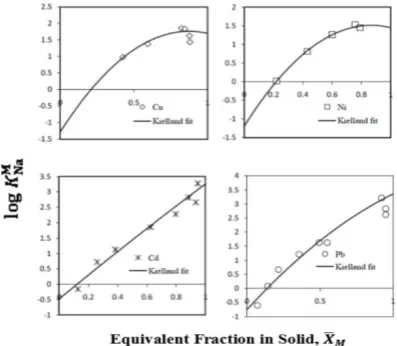
The selectivity of both NaX and LTA zeolites is further analyzed through Kielland plots where the logarithm of the selectivity coefficient is plotted as a function of the equivalent fraction of cations in zeolites (XM).
Table 1.Thermodynamic data for 2Na+→M2+ exchange on NaX at
25 °C.
M2+ 𝐥𝐧(𝑲
𝐍𝐚 𝐌)
𝑿̅𝑴→𝟎 C1 ΔG0
(kJ mol-1)
Cu2+ 2.32 1.10 -5.80
Ni2+ 1.69 1.50 -4.20
Cd2+ 1.77 1.70 -4.40
Pb2+ 2.65 1.60 -6.40
Figure 3. Kielland plots for 2Na+→M2+ (M= Cu, Ni, Cd and Pb)
exchange on the NaX zeolite.
Figure 4. Kielland plots for 2Na+→M2+ (M= Cu, Ni, Cd and Pb)
The Kielland plots are represented in figure 3 and 4 for NaX and LTA respectively. The plots gave a linear relation for all metals except for Cu2+. The line at 0 indicates that the
corrected selectivity coefficient is equal to unity (𝐾NaM = 1) where there is no preference between Na+ and M2+ ions. If
the plots fall below this line this means that the zeolite is more selective for Na+ while if they fall above it this
indicates that the zeolite is more selective for M2+. From
these Kielland plots, it can be deduced that for Cd2+ and
Pb2+ ions the zeolite becomes more selective for the metal
ions at 𝑋̅𝑀> 0.2 since all Kielland plots fall above the 0 line above this value. For Cu2+ and Ni2+, M2+ ions are more
preferred almost throughout the 2Na+→M2+ exchange
reaction. From the Kielland plots, the Kielland coefficient
C1, and ΔG0 values were estimated. The obtained values are
listed in Table 1.
For NaX, ΔG0 value for Pb2+ was the smallest while that
of Ni2+ was the highest. Based on this results, the order of
selectivity will be Pb2+ > Cu2+ > Cd2+ > Ni2+ which is in
accordance with what was found before using the distribution coefficient Kd. The Kielland coefficient, C1, is
related to the energy of the steric limitation or jumping barrier for the exchanging ions in the sodalite cages. In general, the energy term for the steric limitation is larger as the |C1| value is larger. For NaX zeolite, the energy of the steric limitation increases in the order of Cd2+ > Pb2+ > Ni2+
> Cu2+ but the order of selectivity didn’t follow the same
order. These findings are related to the nature of the metal ions and mainly to the exchange velocities between the ligands and the aqueous metal ions which is generally expressed as eqn. (15).13
(Me(H2O)m)n+ + L (Me(H2O)m-1L)n+ +H2O (15)
where L represents H2O or other ligands and Me the metal
ion. The exchange velocity constant (k_w) of water
molecules with metallic ions (Table 2) is the fundamental step controlling the rate of ions removal from water.
Table 2. The exchange velocity constant (k_w) and Hydrated ionic
radius (R) for the four studied metal ions.
Cation k_w(s-1) R (nm)
Ni2+ 3.104 0.302
Cd2+ 3.108 0.275
Cu2+ 1.109 0.297
Pb2+ 7.109 0.261
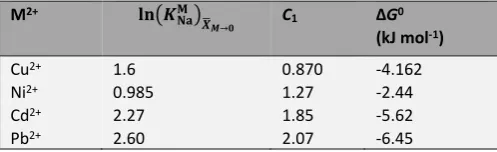
Table 3.Thermodynamic data for 2Na+→M2+ exchange on LTA at
25 °C.
M2+ 𝐥𝐧(𝑲
𝐍𝐚 𝐌)
𝑿̅𝑴→𝟎 C1 ΔG0
(kJ mol-1)
Cu2+ 1.6 0.870 -4.162
Ni2+ 0.985 1.27 -2.44
Cd2+ 2.27 1.85 -5.62
Pb2+ 2.60 2.07 -6.45
The obtained selectivity results vary with the order of the exchange velocity (k_w) values which seem to be the main
parameter that controls their adsorption. Pb2+ has the
greatest exchange velocity (k_ ) so it is the first to be
adsorbed while Ni2+ has the lowest k_
w value so its
adsorption is less favorable compared to Pb2+, Cu2+ and Cd2+.
For LTA zeolite, the energy of the steric limitation increases in the order of Pb2+ > Cd2+ >Ni2+ > Cu2+ (Table 3)
but the order of selectivity didn’t also follow the same order. The order of selectivity according to ΔG0 values will be Pb2+
> Cd2+ > Cu2+ > Ni2+. LTA is more selective for Pb2+ and
less selective for Ni2+ like in the case of NaX zeolite but the
selectivity of Cu2+ and Cd2+ is reversed. So in the case LTA
zeolite, the selectivity might be affected by the radii of the hydrated metal ions (Table 2) in addition to exchange velocity (k_w) since the pore size of LTA are smaller than
that of NaX zeolite.
Conclusions
NaX and LTA zeolites were found to be very efficient in the removal of heavy metals from water. The theory of cation exchange was applied in order to understand the mechanism of heavy metals adsorption. For both zeolites, Kielland plots showed that Cd2+ and Pb2+ have higher
selectivity over Ni2+ at 𝑋̅
𝑀> 0.2 while for Cu2+ and Ni2+, M2+ ions are more preferred almost throughout the 2Na+→M2+
exchange reaction.
For NaX, the order of selectivity is Pb2+ > Cu2+ > Cd2+ >
Ni2+ while for LTA the selectivity order is Pb2+ > Cd2+ >
Cu2+ > Ni2+. This order was directly controlled by exchange
velocity (k_w) for NaX and the radii of the hydrated metal
ions for LTA.
References
1Bekkum, V. H., Flanigen, E. M., Jacobs, P. A., Jansen. J. C.,
Introduction to Zeolite Science and Practice, 2nd Revised
Edn, Elsevier, Amsterdam, 1991; Crønstedt, A. F., Kongl Svenska Vetenskaps Acadademiens Handlingar. 1756, 17, 120.
2Fu, F., Wang, Q., J. Environ. Manage., 2011, 92, 407-418.
https://doi.org/10.1016/j.jenvman.2010.11.011
3Motsi, T., Rowson, N. A., Simmons. M. H., Int. J. Miner. Process,
2009, 92, 42-48.
https://doi.org/10.1016/j.minpro.2009.02.005
4Ostroski, I., Barros, M., Silva, E., Dantas, J., Arroyo, P., Lima, O.,
J. Hazard. Mater., 2009, 161, 1404-1412. https://doi.org/10.1016/j.jhazmat.2008.04.111
5Taffarel, S. R., Rubio. J., Miner. Eng., 2009, 22, 336-343.
https://doi.org/10.1016/j.mineng.2008.09.007
6Inglezakis, V. J., Styliano, M. A., Gkantzou, D., Loizidou. M. D.,
Desalination, 2007, 210, 248-256. https://doi.org/10.1016/j.desal.2006.05.049
7Athanasiadis, K., Helmreich. B., Water Res., 2005, 39, 1527-1532.
https://doi.org/10.1016/j.watres.2005.01.024
8Wang, S. Peng. Y., Chem. Eng. J., 2010, 156, 11–24.
https://doi.org/10.1016/j.cej.2009.10.029
9Nibou, D., Mekatel, H., Amokrane, S., Barkat, M., Trari, M., J.
Hazard. Mater., 2010, 173, 637–646. https://doi.org/10.1016/j.jhazmat.2009.08.132
10Hui, K.S., Chao, C.Y.H., Kot, S.C., J. Hazard. Mater., 2005, 127,
11Kodama, T., Komarneni, S., J. Mater. Chem., 1999, 9, 533–539.
http://dx.doi.org/10.1039/A806758I
12Barrer, R. M., Klinowski, J., J. Chem. Soc., Faraday Trans. 1.,
1974, 70, 2080. http://dx.doi.org/10.1039/F19747002080
13Sigg, L., Behra, P., Stumm, W., Chimie des milieu aquatiques, 5th
Edition, Dunod, Paris, 2014.