International Journal Advances in Social Science and Humanities
Available Online at:
www.ijassh.com
RESEARCH ARTICLE
Research on Investigation of Students Attitudes and Participation
in Prison Second Chance Schools of Sterea Ellada Region-Greece
Vasiliki Iliopoulou
Secondary Education Teacher Ministry of Education Greece.
Abstract: The concept, organization and implementation of educational programs, integrated into various educational structures – typical or non-typical - in detention facilities, have been processed by the State for several years and is one of its main aims at educational and penitentiary level. The inclusion and application of the penal code of articles and provisions concerning the establishment and operation of schools in prisons demonstrates the necessity of any educational process being offered and addressed to incarcerated persons during their sentence. Therefore, researches into the course of prison educational structures help and support the work of the State and achieve the goals it has set for the proper and unobstructed development of the framework within which prison will operate the system, with the ultimate goal of achieving successful results. In the past, studies and research have been conducted in Greece on the educational structure of SCSs, which operate outside prisons, on issues related to students-trainees, their motivations, perceptions and attitudes towards SCSs [1-2-3]. In addition, surveys in our country and abroad have been conducted regarding the functioning of prison educational institutions, students-trainees, their motivation for participation and their perceptions of the school [4-5-6-7-8-9]. The present study, which was conducted at the newly established Prisons of Central Greece Prisons, is expected to help investigate the motives, perceptions and attitudes of prisoners-students who are voluntarily involved in second-chance school education. In this way, it is possible to take into account, evaluate and exploit, by all stakeholders, elements and parameters that can support and potentially improve the work of prison education, especially nowadays as the State establishes and operating both new SCSs in more detention centers and new educational organizations, such as IEKs, in prisons.
Keywords: Second chance schools, Attitudes, Motivation, Participation in prison education.
Article Received: 01 July 2019 Revised: 13 July 2019 Accepted: 20 July 2019
Introduction
Purpose, Research Questions and Research Sample
The purpose of this study is to investigate the motivations for prisoners’ involvement in prison SCSs, as well as the views and attitudes of prisoners-students (trainees) regarding the functioning and work of SCSs. In addition, the following research questions arise:
How do prisoners experience their role as students and what objective difficulties do they face in this role?
Is there a need to create a curriculum within prisons as a continuation of SCSs?
Is there any interest among
prisoners-students (trainees) to continue their studies after their release?
What are the additional benefits that
detainees / trainees receive while studying at a SCS, in addition to the lower secondary school diploma?
What are the observations of
prisoners-students (trainees) about the impact that their involvement in a SCS has on a psychological and emotional level?
Are there changes in the life-style of prisoners-students, in general, as they attend SCS lessons?
Regarding the sample of the study, the
interviewees are prisoners-students
Male prisoners- students attend the 1st SCS of Domokos and women prisoners students (trainees) belong to the 1st SCS of Eleona Thebes.
Sample Description
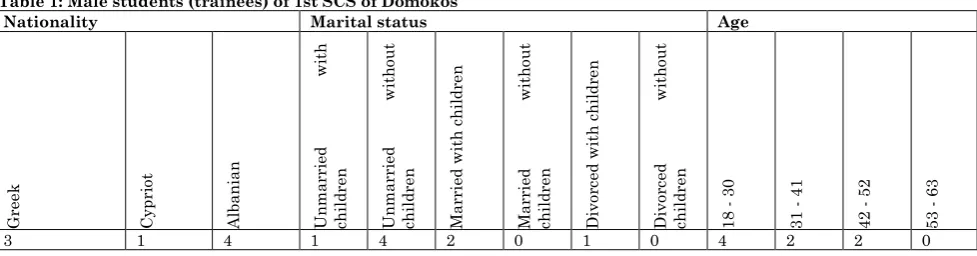
Male prisoners-students (trainees) present the following characteristics regarding their age, nationality and marital status, as illustrated in Table1.
Table 1: Male students (trainees) of 1st SCS of Domokos
Nationality Marital status Age
Gre ek C yp ri ot A lb ania n U n m ar ri ed wi th child re n U n m ar ri ed wi th out ch il dr en M ar rie d wi th c hil dr en M ar rie d wi th out child re n Di vo rc ed wi th c hil dr en Di vo rc ed wi th out child re n 18 - 30 31 - 41 42 - 52 53 - 63
3 1 4 1 4 2 0 1 0 4 2 2 0
Regarding their age, four out of eight, i.e. 50%, are in the 18-30 age range, two in eight are between 31 and 41 years old, 25%, and one 25%, two out of eight are aged 42-52 years.
In terms of nationality, three out of eight, 37.5%, are Greeks, a percentage of 50%, ie four out of eight, are Albanians and finally one trainee comes from Cyprus, 12.5%.
Regarding their marital status, 50%, four out of eight, are single children, two in eight, 25% of the sample, are married with children, one in eight, 12.5% of the sample , is unmarried with children and finally, 12.5%, i.e. one in eight, is divorced with children.
The female prisoners-students (trainees) present the following characteristics regarding their age, nationality and marital status as illustrated in Table 2.
Table 2: Women students (trainees) of the 1st SCS of Eleona Thebes
Nationality Marital status Age
Gre ek R om ania n A lb ania n U n m ar ri ed wi th chil dr en U n m ar ri ed wi tho ut chil dr en M ar rie d wi th c hil dr en M ar rie d wi th out c hil dr en Di vo rc ed wi th c hil dr en Di vo rc ed wi th out c hil dr en 18 - 30 31 - 41 42 - 52 53 - 63
4 1 3 1 1 1 0 4 1 3 4 1 0
Looking at their age, three in eight range between 18 and 30 years, 37.5%, four out of eight, ie 50%, are in the 31-41 age range, and one trainee is between 42-52 years old. , 12.5%.
In terms of ethnicity, four out of eight, 50%, are Greeks, a percentage of 37.5%, ie three in eight, are Albanians and finally one trainee comes from Romania, 12.5% of the sample .
Regarding their marital status, 50%, four out of eight, are divorced, one in eight, 12.5%, are married, 12.5% of the eight respondents in the sample. is divorced without ever having children, one in eight, 12.5%, is unmarried with children, and
finally, only one in eight is unmarried, 12.5%.
Selection of Research Methodology The main purpose of a scientific research is to provide answers to important questions using scientific methods [10]. A research in the social sciences is based on three key questions: the 'what' (subject of the research), the 'why' (feasibility of conducting research), and the 'how' (research methodology) [11-10].
That is to say, there is a specific framework within which the researcher is invited to move. An important part of the research is the foundation of the feasibility of the research effort, as well as the validity of the research process. The latter is ensured when research is carried out with techniques and tools (research methodology) that are accepted by the scientific community. In the social sciences, methodological approaches are usually of a quantitative or qualitative nature, depending on the type of research data.
Most of the time, the combination of these two methodological approaches is used, since the results of quantitative methods need to be compared with the pre-existing theoretical framework, while qualitative methods, due to
their flexible structure, favor the
development of new theoretical assumptions. Depending on the specifics and the specific objectives of the research, the appropriate tools are also identified by the researcher. In order to do an original work, one must first research what has been written so far on the subject to be presented.
In the present work, empirical research, with qualitative data to follow, is intended to confirm, challenge or enrich the findings from the literature review [11], which has already been carried out. In addition, the bibliographic review also helps in the
formulation and implementation of
qualitative research.
Individual Interview
Interviewing is one of the most flexible methods of collecting research data in the social sciences, since in some types of interviews (structured type) the main means of communication between the researcher and the subject are specific questions that the researcher has predetermined [12]. The present research will use the semi-structured interview, which is an intermediate situation between a perfectly structured interview and a completely open and free discussion.
In this type of interview, the researcher has pre-formed the question box (Interview Guide), but when conducting the interview he / she is able to formulate it in the order he / she wants at the moment and / or make extra questions and answers, in order to gather the information required by the research objectives.
The selection of the semi-structured interview in the present research is aimed at creating a personal and open communication on the research questions, which will give the prisoners - SCS students the opportunity to freely express their personal perceptions and motivations. In addition, it is possible to obtain other interesting data that the researcher may not have anticipated [13].
The advantages of interviewing the
questionnaire for this research and the given researcher are presented below.
Advantages of the Method
Initially, perhaps the most important reason contributing to the choice of this method is the level of oral and written language of the learners, which is often quite low, since they have left school too early. In addition, interviews are indicated for 'monitoring unexpected results' [3], while being a two-way method resulting in more data being collected [14]. Specifically, the person who does the interview, the researcher comes into direct contact with the interviewee, has the ability to recast the question, if the latter does not understand it [15].
He/she can add questions that may arise during the interview and finally keep this
information necessary and can give
measurable results. The interview, therefore, as an oral procedure facilitates both the interviewee and the researcher and at the same time demonstrates the positive attitude of the participants towards the process [13]. The semi-structured interview methodology, however, also has some disadvantages, which should be taken into consideration by the researcher in order to avoid problems that may arise.
Disadvantages of the Method
aware of the purpose of the questions in order to gather the information he or she wants. Regarding the fact that the interviewee is very likely to be influenced by the interviewer, we would say that the research subjects do not try to mislead the researcher, but depending on how they perceive the question, they try to give the answer which they consider to be the most appropriate. Whether or not this happens, it depends on how the researcher perceives the research, the way they perceive the questions and what image they want to present [14]. In summary, researchers should consider both the advantages and disadvantages of the method when designing the research and the selection of questions.
Interview Planning
A very important factor to be taken into account is the situation that prevails in these institutions, in order to avoid a rigorous and rigid methodology that will affect the outcome. That is, the methodology should be flexible in terms of the age, sentence and "treatment" of the prisoners at the institution [16]. In addition, the process of planning the interview, that is to find, formulate and form
the questions, contributes to the
bibliographic review, in order to use the previous experience in similar surveys in the formulation of the questionnaire.
Thus, the questions are not arbitrarily selected, but they are also the product of scientific research (literature review) and contribute to the reliability of the result. The researcher then notes, in detail or in a list, all the information that he or she would like to gather during the interview. This 'messy' list of desired information then needs to be organized and the questions put in a logical order. At this point, it is important to mention that the interviewer should seek to feel comfortable during the process, so that a great deal of attention should be paid to the series of questions.
In particular, it is advisable to begin with questions that facilitate and encourage the respondent and gradually the more difficult questions should follow. It is very important, when designing questions, not to "guide" the respondent and, moreover, to use language understandable to him / her [14]. On the one hand, in the first case, there is a possibility that invalid information may emerge, while
on the other hand, the interviewee is not facilitated, which may require clarification and this can be time consuming. In addition, in some cases the respondent may feel at a disadvantage and not feel comfortable following the interview, a situation that is not desired by the researcher, who tries to maintain a "comfortable" and mild climate during the interview. Additional information that the researcher needs to take into account in order to maintain an appropriate climate for the interview is to have a prologue prepared before the interview begins.
This foreword will explain where the resulting data will be used and in any case that confidentiality will be used during the process. However, a pleasant climate should be sought by closing the interview, where the researcher should always thank the interviewee for his / her participation and ask him / her if there is anything he / she would like to add [14].
Organization of the Interview
The organization of the interview is mainly about how the researcher will manage the way he collects his results, his time and the means he will use. So, for his convenience, he can use a tape recorder and notes to make sure he will gather all the information he will need [14]. In addition, during transcription, he may be able to listen to the interviewee's responses more than once and to include in his conclusions evidence that may not have been understood during the interview.
Of course, one should ask for the authorization of the interviewee as well, when he/she uses the tape recorder and this task requires both the disclosure of the research-investigation and the notification of the IDEKE research license to the prison managers. Finally, checking for proper functioning of the tape recorder should be performed from time to time. In addition, it is important to determine the length of the interview and the timing of the interview.
as valid as possible ([17]. These parameters are presented below:
Open and case closed questions will be used, ie questions answered in a specific way and a finite amount of information.
Respondents will be given instructions and
clarifications.
The questions will be formulated with
vocabulary and expressions accessible to the respondents, taking into account their educational level.
Also, during the pilot phase [17], a
questionnaire could be completed to help feedback on its design:
How long did it take you to complete the questionnaire?
Were the instructions clear?
Were there questions vague or ambiguous?
If so, which ones and why?
Did you object to answering some of the questions?
The Interview Guide is based on The review of international literature
The review of Greek literature on issues similar to our own issue
The results of the pilot implementation using a questionnaire to be distributed in the pilot phase.
Quality Analysis of Content
The present study has selected qualitative content analysis because it helps to access the text messages that were formed from the
interviewing of prisoners-students,
systematically and qualitatively. Qualitative content analysis studies the answers given carefully and socially, given that the frequency of certain features, which appear within the answers, is unrelated to their significance.
Each repetition of a report does not have the same significance. Also, omissions or silences in the text can be significant [18]. Thus, the qualitative analysis seeks to take into account what the respondent is able to silence, that is, to discover the 'underlying' or 'creepy' content that he or she perceives through 'hesitations', silences, repetitions, etc. p.[19]. Although content analysis can be applied in a variety of different ways, some basic steps and stages are usually followed.
It is first necessary to elaborate theoretically and clarify the research subject and research questions. Usually, this stage goes through the whole research process as it is reshaped during its progress.
Then, precise identification of quality
material is required.
Next, the logging and analysis unit is identified, that is, the parts of the answers that are of research interest.
Then, the conceptual categories in which the qualitative data are classified and on which the content analysis is essentially based should be systematized.
Finally, in order to give results, the material must be coded within each category.
According to Samanidis [20], “qualitative content analysis helps to understand that the texts, which are the material to be analyzed, have a specific purpose and operate within a specific socio-political and ideological context. Texts are also viewed as a social practice with its predispositions, orientations and directions, on the assumption that it promotes specific analyzes of the world and at the same time reinforces certain aspects of reality that are most often related to the interests of particular social groups”.
Expected Results
The conclusions of the research, which will be made after a qualitative analysis of the content of the data, should be compared with the results of previous surveys, to determine whether the motivations, perceptions and attitudes of prisoners-students (trainees) are common or similar to other SCS students’ characteristics. It is also possible to compare the findings with those of previous investigations that may have been carried out in other prison SCSs.
exclusion, raise awareness of environmental
issues, develop entrepreneurship and
promote of gender equality, the importance of the above is great. Recognizing, therefore, the real needs of learners helps to take measures and actions targeted at these groups, as well as measures to improve the conditions of inclusion in the educational system of pupils threatened by inequality in order to prevent marginalization. In summary, we would say that the results of this work can contribute to early diagnosis and problem solving and at the same time enhance the capacity building of learners based on their needs, cognitive level and social skills.
Conclusions
The concept of social reintegration emerged at the end of the 19th century to replace penalty as punishment, by "improving" the person who has exhibited abusive behavior and committed an offense. The penitentiary system has turned towards this end, implementing a number of programs that would help to rebuild their personality. Along the way, there have been efforts that have been successful and others that have failed.
Thus, it is now considered that social reintegration should be pursued with respect for human rights, while the state should support ex-prisoners in their quest for a smooth return to social life. Efforts to create educational opportunities in prisons have begun since 1989, as the factors imposing it have been visible and clear, given that by the time statistics mentioned above had shown a high proportion of prisoners with very low levels of education. To this day, these rates appear to be at the same level, revealing the high and serious need for prison education. In addition, these rates indicate one of the main causes of prisoners’ abusive behavior, the cause of unemployment.
Therefore, it is necessary to encourage prisoners to participate in educational programs aimed at acquiring inmates in such a way as to minimize their chances of recidivism when returning to society, mainly due to unemployment. The main incentives for prisoners to start attending a SCS program, as found in the present study, are to reduce their sentences, obtain a high school diploma, which increases the
likelihood of post-release vocational
rehabilitation and eventually their personal
evolution and development through the improvement of various skills. These results are consistent with the findings of previous studies, as presented in the literature review [4-5-6-7-8-9]. These incentives are met by almost all prisoners- trainees, especially as motivators to make the decision to start school. But along the way, as other studies have shown, as well as the present work, the incentives to continue to participate in the educational process vary and focus on the benefits they derive from their personal
development, as individuals and
personalities, given the great gravity in the ability they employ through their journey to SCS to redefine and reshape attitudes and behaviors. During the course of study, prisoners-students recognize even more benefits from the above, such as:
Fight routine during their detention, as they have something to do throughout the day with tasks and reading.
Creating and providing daily contact with the "outside world" through their teachers, which makes them feel that they are not completely cut off from society.
Improve their psychological state. Most prisoners-students do not fail to emphasize how beneficial their school employment is to their psychology by talking about "psychotherapy".
Positive, rewarding employment as well as
deterring extreme, abusive behavior or as one prisoner-trainee typically puts it, "prevents you from doing many bad things".
Developing and embodying a sense of
opportunity/s to change, redesign their life course.
Many of the above have been mentioned in previous research, such as "fighting routine"[6-8] or "contact with the outside world" [6], but also additional benefits such as " working with something positive rather than something negative in prison "or" creating the mood to redesign their lives ".
possible, to improve their lives both in prison during their incarceration and after serving their sentences and being released. They call the SCS an "oasis", in relation to the reality of living in prison, honestly stating that it greatly and substantially improves their daily lives. All of the above are a point of reference and answer to the research questions that were initially sought and processed.
Therefore, responses are given to the way inmates (prisoners) are experiencing the new role they have adopted as students, and there is a great need to establish a curriculum within prisons as a continuation and extension of SCS and in some cases expectation and, in part, the need to pursue post-release studies are evident.
The interviews also show the additional benefits those inmates - in addition to obtaining a high school diploma - have as a catalytic effect on their psychological
well-being, on their healthy emotional
development and on a new, more rational and more civil society-based approach, on a new, more logically redefined basis. The benefits, therefore, of SCS prisoners - trainees are undeniable, both in terms of the research they have done and the testimonies of the prisoners themselves. However, there are factors that can often be an obstacle to achieving the goals of prison SCSs, both in terms of living in Greek prisons and the lack of institutional frameworks for operating educational facilities in detention facilities.
Factors such as overcrowding, lack of
prisoners’ segregation, or, sometimes,
inability to control drug trafficking, a serious shortage of social services and health services, or weaknesses in the more complete and meaningful professional training of prison officers etc., are often able to disintegrate, "tear down", or at worst level, all that which with the support and
assistance of the State, are "built" within the school. Therefore, it is clear that the functioning of prison SCSs alone does not guarantee their achievement, that is to say, the social reintegration of the individual, if no general efforts are made to upgrade the penitentiary system, since a smooth and the highest likelihood of successful reintegration treatment of those who were given a certain incarceration sentence.
Moreover, no matter how successful an in-prison training program is, it makes no sense if it is abruptly interrupted by release, without the possibility of continuing any
other complementary or expanding
educational structure because such
conditions unduly confirm the indifference of the "unprepared" society to ensure decisive, effective and responsible reintegration of the individual. Finally, it should be noted that the present work, which relied largely on qualitative research and analysis, drawing on elements and data from a relatively small sample of research, could be the reason for further research, mainly quantitative, which they may be broader, cover a larger sample, and be carried out with more specific and more detailed reports, approaches and metrics.
As a result, it is possible to orientate and focus on future research and studies that will concern and focus, more specifically, on parameters and areas related to the gender of prisoners - trainees, their age, occupational and marital status, their former course of study up to and including the commencement of their studies at SCS, the smooth and proper functioning of the educational organization within the prison, within the framework of the current penitentiary system, the possibility of restructuring or voltage existing educational programs and structures and more elements of relevant content and interest [21-58].
References
1. Alexopoulou E (2006) Investigating
perceptions of trainees at Pyrgos Second Opportunity School about the effectiveness of Counseling Careers for their smooth integration into the labor market.
Bachelor's thesis. Hellenic Open
University - School of Humanities, Studies in Education.
2. Ananiadis II (2007) Second Opportunity Students' Perceptions of Self Image (Self Esteem). Bachelor's thesis. Greek Open University-School of Humanities, Studies in Education.
Bachelor's thesis. Hellenic Open University - School of Humanities, Studies in Education.
4. Vergidis D (2003) Evaluation of the SBS program for the school years 2001 / 02-2002. University of Patras - School of
Humanities and Social Sciences,
Continuing Education and Training Laboratory.
5. Landritsis I (2007) Second Chance School
Trainees: Research on their
Characteristics and Cultural Capital at the SSSs of Patras, Pyrgos and Agrinio, University of Patras - School of Social and Human Sciences Postgraduate Education - Primary Education Department.
6. Vergidis D, Assimaki A, Tzitzidis A (2007) Education of Prisoners - The Second Chance School in Korydallos Prison. University of Patras - School of
Humanities and Social Sciences
Education, Scientific Yearbook, Arethas, IV.
7.
Irwin T (2008) the inside story:“Practitioner Perspectives on Teaching in Prison”. The Howard Journal, 47(5): 512-528.
8.
Bhatti G (2010) Learning behind bars:Education in prisons. Teaching and Teacher Education, 26:31-36.
9. Manger T, Eikeland OJ, Diseth A, Hetland
H, Asborjornsen A (2010) Prison Inmates’ Educational MotivesQ Are They Pushed or
Pulled?. Scandinavian Journal of
Educational Research, 54 (6): 535-547. 10.Filias B (1998) Introduction to Social
Research Methodology and Techniques. Athens: Gutenberg Publications,
11.
Tsoukatos EK (2007) Short Instructions for Writing Tests and Tasks. E / C Regulation, TEI of Crete, Department of Finance and Insurance.12.Komil A (1989) Basic principles and
methods of scientific research in
Psychology. Athens: Ulysses.
13.Kaztaridou A (2007) the motivation for adult learners learning in Second Chance School: the example of SBS Kastoria.
Bachelor's thesis. Hellenic Open
University-School of Humanities, Studies in Education.
14.Faulkner D, Swann J, Baker S, Bird M, Carty J (1999) Child's Evolution in the
Social Environment. Methodology
Handbook (Translated by: Alexandra Rautopoulou). Patras: Hellenic Open University, EKP 50.
15.
Papadaki B (2006) Study on education, training and employment of prisoners in the context of social reintegration.Bachelor's thesis. Hellenic Open
University - School of Humanities, Studies in Education.
16.
Svensson I (2011) Reading and writing disabilities among inmates in correctional settings. Swedish perspective. Learning and individual differences, 2: 19- 29.17.
Javeau C (1996) Questionnaire research - the good researcher's handbook. Athens: Print.18.Bonidis K, Chondolidou E (1997) Textbook
Survey: From Quantitative Content Analysis to Qualitative Methods of Analysis -The Greek Example. In: Vamvoukas, M., Hourdakis, A. (Ed.), Pedagogical Science in Greece and Europe. Trends and perspectives. Athens: Greek Letters.
19.
Palla M (1992) Content analysis.Philologist, 67.
20.
Samanidis N (2006) the education ofimmigrant children of three in the journal of educational magazines. Postgraduate thesis, Department of Primary Education, AUTH, Thessaloniki.
21.
Albrecht HJ (2002) Developments inModern Prison: Prison and Imprisonment in Modern Societies. Edited by A. Haidou. The penitentiary system. Issues in theory and practice. Athens: Law Library.
22.
Boekaerts M (2002) Motivation to learn.(Translation: Mavroskoufis DK),
International Bureau of Education
International Bureau of Education - Ibe Unesco, Educational Practicies Series, 10.
23.
Commission of the European Communities(1995) White Paper on Education and Training: Teaching and learning towards the learning society. Brussels.
24.
European Commission (2000) “Second25.
European Commission (2005) Eurybase The Information Dtabase on Education Systems in Europe. Greece.26.
Foulin J, Mouchon, S (2001) Educational Psychology Athens: Ephemeral.27.Rogers A (1999) Adult education, (ed. M. Papadopoulou & M. Tombrou). Athens: Metachimo Publications.
28.Rogers A (2001) Adult Learners:
Characteristics, Needs, Ways of Learning,
in A. Kokkos (ed.), International
Conference on Adult Education. Athens: Ephemeral.
29.Wright R (2005) Going to Teach in Prisons:
Culture Shock. The Journal of
Correctional Education, 56 (1):19- 37. 30.Aloskofis O (2005) Social and criminal
status of prisoners in the Korydallou
Prison: Domestic-aliens differences.
Unpublished work submitted to the Central Scientific Council of the Ministry of Justice as a service report. Athens: Korydallos Judicial Prison.
31.
Andritsou A, Daskalaki K, PapadopoulouP, Sinopoulos PA, Tsambarli, D.,
Fronimou, E, Katsoujiani K (1988) (Research Team of the National Center for
Social Research).Hellas. Preliminary
Report. Social Research Inspection.
Special issue, dedicated to Elias
Daskalakis 68A. 3. Kingdom.
32.Cotton M (1988) Introduction to Psycho Educational Research and Methodology. Athens: Grigoris Publications.
33.Vergidis D (2004) Second Chance Schools:
Students' School Routes and Expectations, in Vekris L., Chondolidou E. (curator), Proceedings of the 1st Pan-Hellenic Second Chance Schools Conference, Athens June 28-29, 2003, Ministry of Education, Athens, Greece-399.
34.Vergidis D, Abrahamsson K, Davis M, Fay
R (1999) Adult Education - Social and Economic Functioning. Hellenic Open University, B, EPS 64 / N.
35.Yovanovlou S (2006) Institutional
problems of social reintegration of detainees. Athens-Thessaloniki: Sakkoula
Publications, Social Assistance and
Criminal Justice, 2.
36.Gasuka M (c.c.). Educational Techniques for Prisoners and Prisoners. Trainer
Training Program - Training Program for Theoretical Training Trainers, II, NC. 37.Recommendation no. R (89) 12 from the
committee of ministers to the state - members for education in prison (Adopted by the Committee of Ministers on 13 October 1989 at the 429th meeting of the Ministers.
38.Iosifidis TH (2003) Analysis of qualitative data in the social sciences. Athens: Review.
39.Kavadias K, Kioulanis SP, Metis S, Orlis ST (2007) In-school training as a key factor in the effectiveness of the educational process in SBS: an alternative proposal for in-service teacher training. Proceedings of Second Phase Secondary School Reporting Conference Athens 23-24 June 2006, Ministry of Education.
40.Kautatzoglou I (2006) Social Exclusion: outside, inside and under. Athens: Savvala Publications.
41.Kokkos A, Lionarakis A (1998) Open and Distance Education - Teacher-Student
Relations. Patras: Hellenic Open
University.
42.Kokkos A (2005) Adult education.
Detecting the field. Athens: Ephemeral.
43.Koutrouba K (2007) Mapping and
evaluating the training process as a means of supporting the pedagogical role of
Second Chance School teachers.
Proceedings of Second Phase Secondary School Reporting Conference Athens 23-24 June 2006, Ministry of Education.
44.Kyriazis N (1999) Sociological research. Athens: Greek Letters.
45.Costaridou-Euclid A (1999) Incentive
Psychology. Athens: Greek Letters, Ed. 46.Mitrosil M, Fronimou E (2006) Family,
social & occupational reintegration of special population groups - The case of female prisoners. National Center for Social Research - Institute of Social Policy.
47.Bakirtzis K (2000) Experience and
motivation for learning. Pedagogical Review, 30.
48.Nikolopoulos G (2005) the issue of
49.Organizing & Operating Second Chance
Schools (2004) Available at:
http://www.ideke.edu.gr/uploads/news_355 .pdf.
50.
Tsibkouli A (1999) Adult Education-Teaching Methods- Group of Learners. Hellenic Open University, D, EKP 64 / D.
51.
http://www.gslll.gr/index.php/nomoi/doc_download/2----2525---18823091997FEK A
188 / 23.09.1997, "Second Chance Schools" - (Article 5).
52.
http://www.gslll.gr/index.php/kya/doc_download/12---107029072005- FEK B 1070 / 29.07.2005, "Establishment of Second Chance Schools"
53.
http://www.gslll.gr/index.php/kya/doc_download/16---66516042008- FEK B 665 /
16.04.2008, "Establishment of Second Chance Schools"
54.
http://www.gslll.gr/index.php/kya/doc_download/11---79427052004-FEK B 794 / 27.05.2004, "Establishment of Second Chance Schools"
55.
Government Gazette B 1169 / 04.08.2010, "Renaming Second Chance Schools".56.Hatzisavvidis S (2003) the Institution of Second Chance Schools, Communications 77 (Janvier), 19-21.
57.Chondolidou E (2003) the Second Chance
Schools Curriculum. Curriculum
Specifications for Second Chance Schools, SGEI, IDEKE.
58.Foulin J, Mouchon, S (2001) Educational Psychology Athens: Ephemeral.