Peer Feedback in Chinese College English
Writing Class: Using Action Research to Promote
Students’ English Writing
Wei Wang
School of English Education, Beijing International Studies University, China
Abstract—Peer feedback is an effective method to promote students’ English writing competence and skill according to the literature and my personal experience. But it is not welcomed in my class at first. So I employ action research to motivate them to do peer assessment. My action research undergoes four stages: Ruin of Expectation and Emergence of Research Question, Cycle One, Cycle Two, Reinforcement and Back-proof, including both students’ change and my change in both action and thought. Imperfect as it is, my action research turns out to be a success and students do gain many benefits from the practice of peer feedback.
Index Terms—peer feedback, action research, English writing, Chinese college students
I. INTRODUCTION
To make it simple, action research, abbreviated as AR, is the combination and interaction of two modes of activity—action and research. The action is located within the ongoing social processes of particular societal context, and typically involves developments and interventions into those processes to bring about improvement and change. The research is located within the systematic observation and analysis of the developments and changes that eventuate in order to identify the underlying rationale for the action and to make further changes as required based on findings and outcomes. The driving purpose for the AR process is to bridge the gap between the ideal and the real in the social situation (Burns & Richards, 2009). The characteristic of AR (1) is carried out by classroom practitioners; (2) is collaborative in nature; and (3) is aimed at bringing about change (Nunan & Bailey, 2008).
Briefly, AR goes through 4 essential steps: plan, act, observe and reflect. There is a general model for AR (Wang & Zhang, 2014). See below.
TABLE 1. CYCLE OF AR
Peer feedback, also called peer assessment, peer evaluation or peer review, commonly used in higher education and professional development, is generally defined as the application of standards to evaluate and provide feedback on the work of peers or colleagues. Objective peer feedback is an important skill for students to learn during their formal education (Theising, 2013). Peer feedback is attached greater importance in recent years since student-centered pedagogical concept is accepted gradually and student-centered teaching is practiced in more language classes.
with teachers who are rather busy, students have more sufficient time to do writing evaluation, making the process of receiving feedback and completing writing. Besides, students improve the evaluation capacity by shifting their role from readers to criticizers and correctors. Students’ writing skills are improved gradually when experiencing the process (Rollinson, 2005). In short, as a method to sharpen up students’ writing competence and skill, peer feedback is highly suggested in pedagogical practices.
Based on my personal experience, peer assessment is of great assistance in writing. During my undergraduate period, I experienced peer assessment for some time. In the English writing class, the teacher exposed us to peer feedback. We tried it all the semester and got familiar with it gradually. After the course ended, we found this method did work and we made great progress. Since then, I have been impressed deeply by it and as a pre-service teacher, I have been looking for opportunities to try peer assessment on my students. I have not been able to fulfill this dream until finally I enroll in Beijing International Studies University (BISU).
I am lucky enough to be appointed to teach undergraduate students in BISU. It is worth mentioning something about BISU before having an in-depth description of my students. BISU is a high-level national university specialized in foreign languages. Students from around the nation and the world spend their three or four years in this renowned university. The course I teach is second language for non-English majors. The students I teach major in Russian and French, and their second language is English. They come from different provinces of China and their language proficiency is relatively high though individual difference does exist. I was so excited when I first heard this news. I felt it was the right time for me to let my students try peer feedback.
II. ACTION RESEARCH CYCLE
A. Ruin of Expectation and Emergence of Research Question
Just as mentioned in the Introduction Part, I couldn’t wait to introduce peer feedback to my students because I believed firmly that it was a decent pedagogical method. Therefore, in the fourth week of the semester, I assigned a writing task called “An Unforgettable Event I Have Experienced Before” to my students. After they all finished the composition, I gave a very brief introduction to peer feedback and asked them to do it by exchanging their papers with deskmates. Then the students handed in the compositions with peer feedback and I took students’ paper back to correct them, expecting that my students would benefit a lot from what I asked them to do.
To my surprise and disappointment, however, things got the opposite of what I wanted, and my expectation was ruined totally. After I corrected all the composition and checked the assessment by students themselves, I found that the “decent method” wasn’t welcomed and didn’t work on my students. See Table 2 below for details.
TABLE 2.
PEER FEEDBACK OF COMPOSITION 1
Number Feedback Type Word Number Perspective(s) Language
1 Critique 5 Content Chinese
2 Critique 4 Emotion Chinese
3 Both 12 Content Chinese
4 Affirmation 12 Sentence Pattern, Content, Emotion Chinese
5 Both 10 Sentence Pattern, Content Chinese
6 Affirmation 29 Content, Grammar, Vocabulary Chinese
7 Affirmation 16 None Chinese
8 Affirmation 4 None Chinese
9 Affirmation 11 Emotion, Grammar Chinese
10 Affirmation 12 Content, Cohesion Chinese
11 Both 27 Emotion, Sentence Pattern, Content Chinese
12 Affirmation 1 None Chinese
Here feedback type was explained in detail. See Table 3 below.
TABLE 3.
FEEDBACK TYPE (WENG &LI,2009)
Feedback Type Description Sample Statements
Affirmation Supportive, appreciative statement without concrete information of future revision
Excellent! Perfect!
Good handwriting! Clear structure! Critique Constructive criticism that is related to what
students have written and leads to following revision
You didn’t catch the gist of the writing task. Some spelling mistakes exist.
Handwriting is unrecognizable. You didn’t get yourself across.
although it did not mean affirmation was not significant. It was obvious, however, that students couldn’t make huge progress without criticism from others. Besides, the average word number of peer feedback was 11.91, which was comparatively low and indicated students’ reluctance to get participated. In addition, averagely, students chose only one perspective to do peer assessment, showing students’ uncertainty about the criteria for peer evaluation. Last, all the students wrote their peer feedback in Chinese, displaying the low production of target language.
Looking at the data, I was at first astonished, and then disillusioned. I even started to doubt that if what I had believed deeply from the bottom of my heart before was wrong. But after a few minutes for calming down and regaining a cool head, I wondered about the reason why students were unwilling to get involved in peer assessment. I began to turn to action research for help to solve the head aching problem of students’ low participation.
B. Cycle One
1. Planning
Pondering over the problem for several days, I had a clearer thinking slowly. I sent out questionnaires and held interviews with my students, and then gradually had a clearer picture of the problem. I summarized the reasons why students were reluctant to do peer feedback, and the reasons could be put into 2 categories: internal factors and external factors. The external factors (the internal factors are discussed in Cycle Two Part) included: 1. time for peer assessment was not sufficient; 2. deskmate evaluation was inappropriate; 3. handwriting of some students was unrecognizable, making peer review impossible; 4. peer feedback was not a criterion for composition correction and had no impact on the score students got. Thus, I planned to do my action research within two cycles. Cycle One was to motivate students to do peer feedback by removing external obstacles. Cycle Two was to motivate students to do peer assessment by removing internal obstacles. The rationale for my plan was based on the order from something easy from something hard. Generally speaking, internal factors determined external factors and were much harder than external factors.
2. Action
As planned, in the eighth week of the semester, I gave my students another writing task called “A book I have read in college”, and invited them to do peer evaluation. Different from previous one, this time I gave enough time for the purpose of achieving better results. Moreover, I distributed students’ compositions in the whole class randomly instead of within deskmates. Furthermore, I told my students to write their paper neatly. Last, I told them I would read every word they wrote for peer assessment. They handed in the paper after finishing peer feedback.
3. Findings
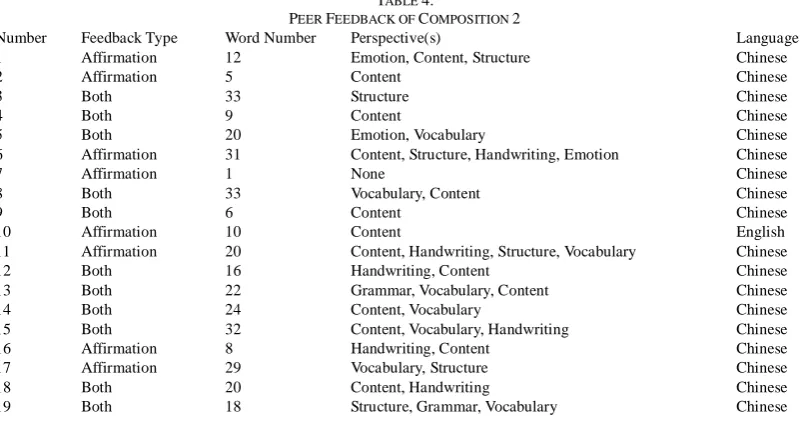
I then marked the composition and summarized the peer assessment students gave. The details were displayed in Table 4.
TABLE 4.
PEER FEEDBACK OF COMPOSITION 2
Number Feedback Type Word Number Perspective(s) Language
1 Affirmation 12 Emotion, Content, Structure Chinese
2 Affirmation 5 Content Chinese
3 Both 33 Structure Chinese
4 Both 9 Content Chinese
5 Both 20 Emotion, Vocabulary Chinese
6 Affirmation 31 Content, Structure, Handwriting, Emotion Chinese
7 Affirmation 1 None Chinese
8 Both 33 Vocabulary, Content Chinese
9 Both 6 Content Chinese
10 Affirmation 10 Content English
11 Affirmation 20 Content, Handwriting, Structure, Vocabulary Chinese
12 Both 16 Handwriting, Content Chinese
13 Both 22 Grammar, Vocabulary, Content Chinese
14 Both 24 Content, Vocabulary Chinese
15 Both 32 Content, Vocabulary, Handwriting Chinese
16 Affirmation 8 Handwriting, Content Chinese
17 Affirmation 29 Vocabulary, Structure Chinese
18 Both 20 Content, Handwriting Chinese
19 Both 18 Structure, Grammar, Vocabulary Chinese
Specifically, more students showed interest in peer evaluation. 30 of them turned in their writing paper, and 19 of the 30 compositions were with peer assessment, which increased a lot compared with the previous time. 8 of the feedbacks were affirmative ones and 0 of them were critical one. The rest 11 feedbacks embraced both affirmation and critique. Although critique decreased in comparison with the previous one, affirmation decreased at the same time. That was to say, critique actually increased because the rest 11 feedbacks mentioned above included the critical one. The word number increased by 6.47, reaching 18.38. The perspectives that students chose were 2, which served as a sign of progress. The dominant language they adopted was Chinese while one student selected English.
4. Reflection
was determined to continue my action research in order to carry on improving their English writing competence though peer assessment.
C. Cycle Two
1. Planning
As discussed in Cycle One, I would not stop my action research with only one round. So in Cycle Two, I intended to encourage my students to do peer feedback by removing some internal obstacles. Here internal obstacles included: 1. Students thought they were not capable of doing peer feedback; 2. They consider it to be useless; 3. They lacked relevant experience because they hadn’t done it before; 4. They believed teacher feedback was much more valuable than peer one; 5. They didn’t want to criticize their classmates and let them lose face because face almost meant everything in China; 6. They were not very clear about the criteria for it.
2. Action
In the 14th week of the semester, I provided my students the third writing task titled “What can college students do to fight against smog?” and of course let them do peer feedback. This time, I gave them much encouragement by saying that everyone was differently qualified and had his or her own special opinion. And I told them peer evaluation was highly helpful by talking about the literature and my personal experience. Besides, I made it clear that teacher feedback and peer one complemented each other. Furthermore, I set out that they would make progress very slowly if without critique. Last, I offered them some general criteria. See Table 4 below.
TABLE 5. CRITERIA FOR PEER FEEDBACK
Criterion Description
Emotion Real, full
Content Complete, rich
Handwriting Recognizable, neat, beautiful Structure Appropriate, clear
Grammar Consistent with grammatical rule Phrase, idiom Included, proper in usage
Vocabulary Correct in spelling, proper in usage, varied
3. Findings
The peer feedback for the third composition was processed by Microsoft Excel and was shown one by one in Table 6 below.
TABLE 6.
PEER FEEDBACK OF COMPOSITION 3
Number Feedback Type Word Number Perspective(s) Language
1 Both 30 Content, Sentence Pattern, Vocabulary Chinese
2 Both 23 Content, Structure, Handwriting, Vocabulary Chinese
3 Both 27 Grammar, Handwriting Chinese
4 Both 33 Handwriting, Emotion, Vocabulary English
5 Both 28 Content, Handwriting Chinese
6 Both 29 Handwriting, Content, Sentence Pattern Chinese
7 Affirmation 29 Structure, Content, Handwriting, Phrase Chinese
8 Affirmation 6 None Chinese
9 Affirmation 5 None English
10 Affirmation 1 None Chinese
11 Affirmation 41 Sentence Pattern, Vocabulary Chinese
12 Both 21 Vocabulary, Content Chinese
13 Both 19 Handwriting, Structure Chinese
14 Affirmation 8 Content, Structure English
15 Critique 5 Structure Chinese
16 Affirmation 12 Handwriting, Sentence Pattern, Structure Chinese
17 Affirmation 15 Content, Structure, Grammar Chinese
18 Both 38 Structure, Content, Handwriting, Sentence Pattern Chinese
19 Affirmation 8 Content, Vocabulary English
20 Affirmation 12 Structure Chinese
21 Both 22 Handwriting, Grammar, Vocabulary Chinese
22 Both 44 Content, Handwriting, Grammar, Phrase, Vocabulary Chinese
23 Both 51 Content, Handwriting, Structure, Vocabulary Chinese
24 Both 31 Vocabulary, Structure Chinese
25 Both 50 Content Chinese
26 Both 24 Handwriting, Content, Word Number Chinese
27 Affirmation 2 None Chinese
28 Affirmation 5 Structure Chinese
critical one. The dominant rest 15 of them included both affirmation and critique, indicating that students were able to both appreciate and criticize. The average word number of peer feedback was 22.1, increasing significantly compared with the previous two. Students finished their peer evaluation from about 3 different perspectives, making their opinions multidimensional. Although Chinese was still dominant, 4 of them wrote in English (the previous time was only 1). One thing that hadn’t been touched upon in Table 5 was that emoticons like a smiling face or a thumb-up sign appeared in peer review, indicating that most students were on longer reluctant to communicate with their classmates.
4. Reflection
Ecstasy occupied me when looking at the statistics. Through class observation, I could feel that my dear students gradually adapted to peer feedback and attached value to it. They stepped forward in their writing capacity by the practice.
D. Reinforcement and Back-proof
After Cycle One and Cycle Two, I wanted to test whether my students really benefited from peer feedback and figured out their real and in-depth opinion on the pedagogical method. Therefore, I designed and sent out a questionnaire, and held interviews with 6 students.
1. Questionnaire
I issued 40 questionnaires (the questionnaire was attached to appendixes) and 32 of them were recalled. All the 32 questionnaires were valid. Then I processed them and got the data. The analysis was as follows.
TABLE 7. QUESTION 1
Over half of the students chose Option C. More students were no longer reluctant to do peer review.
TABLE 8. QUESTION 2
Most students selected Option A and C. About half of them felt both fresh and stressful while the other half thought they didn’t care.
The overwhelming majority of students preferred Option B. They believed that only some of them possessed the ability to do peer evaluation.
TABLE 10. QUESTION 4
More than half of students agreed with Option A. They thought that to some extent peer evaluation could arouse their interest in English writing.
TABLE 11. QUESTION 5
The majority of students preferred Option A. Most of them were pleased to accept the comments from their classmates.
TABLE 12. QUESTION 6
Half students selected Option B. They held that basically speaking, they could give serious and objective comments for their classmates.
Every option was chosen evenly by students. Some believed peer feedback was helpful for enhancing students’ writing skills while some didn’t believe so.
TABLE 14. QUESTION 8
Most of the students agreed with Option A. Compared with peer assessment, they trusted teacher assessment much more.
TABLE 15. QUESTION 9
The majority of the students selected Option B. They preferred the mode of teacher assessment along with peer one.
TABLE 16. QUESTION 10
The four options were chosen almost evenly by students. They believed that peer review could arouse their awareness of cooperation, enhance mutual understanding, improve writing appreciation skill, and broaden horizon.
2. Interview
Except for the questionnaire, I also held interviews (the interview questions were attached to appendixes) with some students in order to get their true opinion on peer feedback. The 6 interviewees were chosen randomly from my class.
In regard to Question 1, most of them had done peer assessment before. However, their experience occurred during their primary school time when viewing their Chinese compositions. Their first impression and the latest one on peer evaluation were different. They held a more serious attitude towards it.
As for Question 2, generally, most of the 6 interviewee thought that they were not capable enough to do peer review and it was beyond their ability.
As to Question 4, beside the improvement in writing skills, they had a deeper understanding of their classmates and enhanced their learning autonomy.
As regards Question 5, all of my students loved the mode of teacher assessment accompanied with peer one. They believed that this mode could mobilize them to learn actively and enthusiastically.
Concerning Question 6, some said that peer review ought to be only regarded as a supplement of teacher review. One student mentioned that some were against peer review because they didn’t want their paper to be read by others except their teacher.
III. CONCLUSION,LIMITATION AND FUTURE STUDY
By adopting to action research, peer feedback in college English writing class can promote students’ English writing competence and skill. In my action research, I first identify the research question (students are reluctant to do peer assessment), and plan the intervention. Then I take some actions and motivate my students to do peer evaluation by removing external obstacles and internal ones respectively. Last, I conduct a questionnaire and interview to reinforce and back-prove that the students do gain a lot through the practice of peer research. It is found that the students make recognizable progress not only in English writing capability, but also in cooperation awareness, mutual understanding, reciprocal appreciation and mind-stretching.
For limitation and future study, there are some points worth considering. While most students accept peer feedback gradually, some believe that it is totally useless and a waste of time and energy. In addition, gender difference in peer evaluation is a valuable direction for future study. Besides, the comparison of teacher review and peer one is another further research perspective.
ACKNOWLEDGEMENT
I would like to extend my sincere thank to School of English Education and Department of Graduate Student of Beijing International Studies University. I am grateful to all the leaders and faculties in School of English Education, especially to Dean Xiangmin Li and Doctor Zhencong Liu. I also own my earnest gratitude to Department of Graduate Student for its kind support. This paper is sponsored by the Innovation Foundation of Scientific Research for Graduate Students of Beijing International Studies University.
APPENDIXES. SURVEY OF PEER FEEDBACK IN CHINESE COLLEGE ENGLISH WRITING CLASS FOR NON-ENGLISH MAJORS
I. Closed questions
1. What kind of assessments do you expect in English writing class? A. teacher review B. peer review C. both
2. Are you willing to engage in peer feedback in English writing class? A. yes but with high pressure B. yes C. indifferent
3. Do you think you and your partners are capable of reviewing English compositions? A. yes B. only some are capable C. no
4. Does peer feedback in English writing class interest and motivate you? A. a little B. greatly C. not really
5. Are you willing to accept the comments given by your partners? A. yes B. no C. sometimes
6. Can you offer serious and objective assessments for your partners? A. yes B. basically yes C. not really
7. Do you think peer feedback is an effective way to improve English writing level? A. yes B. no C. not sure
8. Which one do you prefer, teacher review or peer review? A. teacher review B. peer review C. both
9. Which option do you think is more useful for enhancing English writing level?
A. teacher review accompanied by peer review B. teacher review C peer review accompanied by teacher review
10. What have you learnt from peer feedback?
A. greater sense of cooperation B. better communication with classmates C. greater appreciation of writing work D. broader horizon
II. Open questions
11. What difficulties have you encountered when giving peer feedback? 12. What have you gained though the practice of peer review?
13. What is your opinion on peer assessment? Do you have any suggestions? 14. What else do you want to add concerning peer feedback?
Russian and French majors from Beijing International Studies University
Number:
6 students
Questions:
1. Have you ever done peer assessment before? If yes, do you feel any differences between your previous experience and the present one?
2. What difficulties have you encountered when doing peer review?
3. Do you think that you improve a lot in English writing through the practice of peer feedback? If yes, can you talk about your gains specifically?
4. Do you learn something else except the training of English writing through the practice of peer feedback? If yes, talk about it specifically.
5. Do you like the mode of teacher review accompanied by peer review? Why or why not? 6. What else do you want to share concerning peer feedback?
REFERENCES
[1] Burns, A. & Richards, J. (2009). The Cambridge Guide to Second Language Teacher Education. New York: Cambridge University Press.
[2] Nunan, D. & Bailey, K. (2008). Exploring Second Language Classroom Research: A Comprehensive Guide. Boston: Heinle ELT.
[3] Rollinson, P. (2005). Using Peer Feedback in the ESL Writing Class. ELT Journal 59: 23-30.
[4] Theising, K. (2013). Impact of peer assessment on student pharmacists’ behaviors and self-confidence. Currents in Pharmacy Teaching and Learning, 6: 10-14.
[5] Wang, Q. & Zhang, H. (2014). Action Research of English Teacher. Beijing: Foreign Language Teaching and Research Press. [6] Weng, K. & Li, Q. (2009). Synchronous Learning Network: How College Students Use Peer Assessment Techniques in
Evaluation of Their Writing. Teaching English in China, 32:52-64.
[7] Williams, J. (2007). Teaching Writing in Second and Foreign Language Classrooms. The Modern Language Journal, 91: 136-137.
Wei Wang was born in Tongling, China in 1989. He received his bachelor degree in English from Anhui University, China in 2012.