The Writing Performance of Iranian EFL
Learners in the Light of Metadiscourse
Awareness
Sima Farhadi
Islamic Azad University, Ahar Branch, Iran
Nader Asadi Aidinloo
Islamic Azad University, Ahar Branch, Iran
Zahra Talebi
Islamic Azad University, Ahar Branch, Iran
Abstract—In the framework of language teaching, the writing skill requires to be encouraged during the language learners’ course of study. Since metadiscourse markers help transform a tortuous piece of text into a coherent and reader-friendly one, knowledge about the metadiscourse, amongst other things, is used to improve writing skill. The current study aimed to investigate the influence of instruction of metadiscourse markers on intermediate EFL learners’ writing performance by using metadiscoursal taxonomies proposed by Hyland (2005). For this purpose, a pet test was administrated to 60 intermediate students in Iran Language Institute in Urmia. Having being homogenized by Preliminary English Test (PET), they were assigned randomly into two groups. Both the control and the experimental group sat for a pretest of writing test in the form of a cloze test which aimed to measure the learners’ initial knowledge of writing performance. The experimental group was exposed to explicit instruction of metadiscourse markers for seven successive sessions. On the other hand, the control group didn’t receive any instruction. Eventually, a post test designed to evaluate their writing ability with the focus of metadiscourse markers was administered to both groups. The findings implied generally that the implementation of metadiscourse markers (via instruction) significantly improves EFL learners’ writing ability.
Index Terms—metadiscourse awareness, interactive resources, interactional resources, writing performance
I. INTRODUCTION
the following one, MD is a priority applied in connecting the sentences and paragraphs effectively which results in facilitating readers' interpretation of the whole discourse effectively.(Ali et al, 2012)
According to Williams (1981) Zelling S. Harriss in 1959 was the first researcher who coined the word “metadiscourse" and his aim was to elaborate on text elements playing some role in conveying the information of the text. Knowledge about the metadiscourse, amongst other things, is used to improve writing skill. The term “Metadiscourse” (MD) has been defined in a number of ways by various researchers. In some definitions, it is remembered as the language that writers use to refer to themselves, their readers, or their writings. Metadiscourse is discourse about discourse, intended to direct rather than inform readers (Williams 1981). In the process of writing, an interaction takes place between the writer and the reader which is called metadiscourse and is defined by Crismore, Markkanen and Steffensen (1993, p.40) as “linguistic material in texts, written or spoken, which does not expand the propositional content, but that is intended to help the listener or reader to organize, interpret, and evaluate the information given”. Crismore (1993) and Vande Kopple (1985) emphasizes that MD has a special feature that signals the presence of the writer. Crismore et al (1993) further added that metadiscourse helps both readers and listeners to “organize, interpret and evaluate the information given” (p.40). Vande Kopple (1985) categorized MD into two main domains–textual and interpersonal. The interpersonal, helping writers express their personalities, their evaluations of and attitudes toward ideational material function, is the use of language to put interaction into codes, allowing us to engage with others, to take on roles and to express and understand evaluations and feelings. The textual function is the use of language to organize the text itself, coherently relating what is said to the words and to others. Interpersonal domain shows what role in the communication situation they are choosing, and indicates how they hope readers will respond to the ideational material (Vande Kopple 2002, p: 2-3). The textual domain equips writers with propositions to be used in a cohesive manner and the interpersonal helps writers in such a way to convey their feelings toward the given propositions. The textual MD is exemplified through the use of text connectives and code glosses while the interpersonal MD is realized through the use of illocutionary markers, validity markers, narrators, attitude markers and commentary. Regarding other proposed classifications of metadiscourse, Crismores(1984) classifies metadiscourse into two broad common types with subtypes for each one: informational and attitudinal. Informational metadiscourse makes it possible for readers to understand the primary message by referring to its content and structure or to the author's goals. On the other hand, attitudinal metadiscourse directs readers to an understanding of the author's perspective toward the content or structure of the primary discourse. The subtypes of them are mentioned below as,
a. Informative (a. Goals b. Pre-plans c. Post-plans d. Topicalizers) b. Attitudinal (a. Saliency b. Emphatics c. Hedges d. Evaluative)
Williams (1981) has classified metadiscourse into three general types: Advanced organizers (including the preliminary and final statements or summaries), Connectives (specification of structure of relations in the content structure), and Inter personal discourse (pointer words).
The advantages of metadiscourse lie in the fact that it allows authors to make some announcements to the readers. These announcements can change the subject (Let us now turn to, ...) imply a conclusion(as a result), stating something with or without certainty(surely, possibly), indicating an important idea(it is important to note...), defining a term(by x I mean...), introducing a difficult line of thought (This is a difficult notion...), pointing out the existence of a reader (You will remember that...), showing cause or other relationships between ideas such as contrast (therefore, but).
However, Hyland(2005) classifies metadiscourse into two broad types including subtypes; the interactive(instead of textual) one which helps the reader through the text and the interactional one(instead of interpersonal) which gets the reader involved in the argument. Attended to Hyland's (2005) definition, Hyland's types of metadiscourse is interesting to be used in the present study.
investigated the effect of explicit teaching of metadiscourse markers on EFL learners' writing ability at three levels of advanced, intermediate, and elementary. They found that explicit instruction of metadiscourse makers significantly increased EFL learners' writing ability at three levels (as cited in Hashemi, khodabakhzade, and Shirvan, 2012). Asadi (2012) investigated the effect of discourse markers on the essay writing of EFL learners to determine whether the use of DMs instruction results in a better writing performance of the Iranian L2 learners. The results of the study revealed that there was a significant difference in the participant’s posttests of writing scores.
Despite the fact that, within the past years, there has been an increasing interest in the theoretical status of MD (metadiscourse markers) on their function, meaning and actually what they are, fewer studies have been contributed to language pedagogy and the impact of metadiscourse on skills of writing. Judging from the reviewed works thus far, it can be concluded that MD plays an important role in creating cohesion and coherence. Therefore, the objective of this study is to inquire the effects of instruction of metadiscourse on the writing performance of EFL learners.
II. RESEARCH QUESTION AND HYPOTHESIS
The study poses the following research question and null hypothesis:
Q: Does instruction of MD have any significant influence on the learners’ writing performance? HO: Instruction of MD doesn’t have any impact on the learners’ writing performance.
III. PARTICIPANTS
The population from which the participants were selected for this study included female Iranian intermediate EFL learners in Iran Language Institute famous for I.L.I. in Urmia. Two intact classes were chosen and in a random way assigned into experimental and control groups. The participants were in the age range between 15 and 21. Meanwhile, in order to meet the homogeneity of the participants, a Preliminary English Test (PET) was applied. An independent samples t-test was run in order to get a meaningful guarantee for the homogeneity of the participants’ proficiency level (t (18) = 1.16 ρ=.28> .05).
IV. DESIGN
The study applied a quasi-experimental design to investigate the effect of instruction of metadiscourse markers on the writing performance of Iranian intermediate EFL learners. Instruction of metadiscorse markers was considered as the independent variable and the participants writing was as the dependable one.
V. INSTRUMENTATIONS
Regarding instrumentation, it must be stated that the study employed the following instruments: (1) The Preliminary English Test (PET):
It was administered to ensure the homogeneity of the subjects in terms of their level of language proficiency.
Moreover, before conducting the treatment, in order to check the performance of both the experimental and control groups in writing performance,
(2) a pretest of writing:
Before conducting the treatment, in order to check the performance of both the experimental and control groups in writing performance, a test in the form of a cloze test was administered. After the treatment stage, (3) a posttest of writing performance:
Following the treatment stage, a test which was actually the equivalent version of pretest was administered to both groups to check whether there was any significant difference between the performances of the two groups.
VI. PROCEDURE
Having being homogenized by Pet test, the participants in both experimental and control groups were given a pretest of writing performance in the form of a cloze test before treatment in order to check their initial performance. The experimental group (EG) received explicit instruction of metadiscourse markers for seven sessions. In each session, definitions and examples of some types of MD markers proposed by Hyland (2005) were taught and introduced. Regarding the aim of the study (investigating the effects of MD markers instruction on the learner’s performance), the control group (CG) was not instructed in MD markers. The treatment procedure was followed by a posttest of writing which was applied in order to see the effect of MD awareness on the learners’ writing performance. (Learners in both groups were given a posttest of writing). Fifty minutes was the allocated time for this test. The participants’ scores on the pre-test and posttest were then compared to spot the level of improvement of each group.
VII. DATA ANALYSIS
analyze the pre- and post-test scores of the experimental and control groups.
VIII. RESULTS
Through gathering and analyzing the result of posttest statically, providing the answer to the proposed research questions was possible. The present study was an effort to find evidence for the effects of explicit instruction of MD markers on Iranian intermediate EFL learners’ writing performance.
Table 1 shows the descriptive statistics for the participants’ pre- and post-test of writing performance.
TABLE 1.
DESCRIPTIVE STATISTICS FOR PRE- AND POST-TEST OF WRITING PERFORMANCE BY GROUPS
Group N Mean std Std. Error Mean
Pre-test
Experimental group 30 17.45 1.63 .35
Control group 30 17 1.56 .31
Post-test
Experimental group 30 19.37 2.24 .68
Control group 30 17.21 1.96 .50
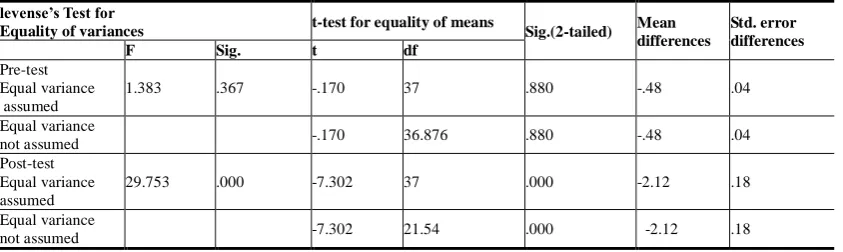
An independent samples t-test was conducted to compare the cloze test scores for experimental and control groups in pretest. As Table 2 demonstrates there was no significant difference for experimental group (M = 17.45, SD = 1.63) and control group (M = 17.00, SD = 1.56; t (37) = -.170, P>.05). This indicates that the performance of the experimental and control groups on the writing performance test was not different in the pretest.
The reason for which an independent sample t-test was run lay in the purpose of finding whether the treatment procedure implemented to the experimental group had any significant impact on this group. In other words, an independent samples t- test was applied to detect any statistically significant difference between the performances of the two groups. As it is shown in Table 1, the mean score for the experimental group (M = 19.37) is higher than that of the control group (M= 17.21). The results of the independent t-test (t (37) = -7.30, P = .000 < .05) indicate that there is a significant difference between experimental and control groups’ mean scores on the posttest of writing test (Table 1). Therefore, the null-hypothesis (the instruction of MD markers does not influence the writing performance of Iranian EFL learners) is rejected.
TABLE 2.
INDEPENDENT SAMPLES T-TEST FOR PRE- AND POST-TEST OF WRITING PERFORMANCE
levense’s Test for
Equality of variances t-test for equality of means Sig.(2-tailed) Mean differences
Std. error differences
F Sig. t df
Pre-test Equal variance assumed
1.383 .367 -.170 37 .880 -.48 .04
Equal variance
not assumed -.170 36.876 .880 -.48 .04
Post-test Equal variance assumed
29.753 .000 -7.302 37 .000 -2.12 .18
Equal variance
not assumed -7.302 21.54 .000 -2.12 .18
IX. DISCUSSION AND CONCLUSION
metadiscourse which is correspondent to the result of the present study. The other corresponding result is the study conducted by Dastjerdi and Shirzad (2010) who investigated the effectiveness of teaching of metadiscourse markers on EFL learners' writing ability including three levels of advanced, intermediate, and elementary which led to significantly increased writing ability at all three levels through the implementation of explicit instruction of metadiscourse makers. Another study conducted by Asadi (2012) investigating the impact of discourse markers in the essay writing of EFL learners represented a better writing performance of the Iranian L2 learners.
The purpose of the present study was to shed light on the positive impact of explicit instruction of MD markers on Iranian intermediate EFL learners’ writing performance. The findings implied that learners in experimental group performed better than control group. The results of this study provide some implications for second language teachers. In order to motivate the learners to produce more suitable and coherent texts, teachers are required to raise the learners’ awareness toward MD markers and consequently become perceptive writers. The findings of the study can be employed by syllabus designers and material development. In other words, providing appropriate texts containing MD markers for learners of different language proficiency levels is of great importance.
However, there are certain delimitations in this study. First, this study is limited to intermediate level. Investigations for elementary and advanced levels of proficiency to infer some generalizations can be more investigated. It must not be ignored that the participants were chosen from I.L.I (Iran Language Institute, Urmia branch), so the findings cannot be generalized.
REFERENCES
[1] Ali, S., Kalajahi, R., & Abdullah, N. (2012). Discourse Connectors: An Overview of the History, Definition and Classification of the Term. World Applied Sciences Journal, 19(11), 1659-1673.
[2] Amiri, Masoud. (2007). Effects of Teaching Practical Metadiscourse Use on Persian EFT University Students’ Writing. Unpublished Master‘s thesis, Iran University of Science and Technology.
[3] Assadi, N. (2012). The Effect of Discourse Markers Instruction on EFL Learners’ Writing. World Journal of Education, 2(2), April 2012.
[4] Behnam, B. & Babapour, M. (2015). EFL Learners’ Reading Comprehension Ability in the Light of Metadiscourse Awareness,
Modern Journal of Language Teaching Methods 9(5), 1851-1853
[5] Canagarajah, A. S. (2002). Critical academic writing and multilingual students. Ann Arbor, MI: University of Michigan Press. [6] Cheng, X and Stefensen, M. (1996). Metadiscourse: A techniquein improving students writing. Research in the Teaching of
English, 30, 149-181
[7] Crismore, A. (1984). The rhetoric of social studies textbooks: Metadiscourse. Journal of Curriculum Studies, 16(3), 279-296 [8] Crismore, A. (1985). Metadiscourse in social studies texts. Technical Report, No. 366.
[9] Crismore, Avon, Raija Markkanen & Margret Steffensen. (1993). “Metadiscourse In Persuasive Writing: A Study of Texts Written by American and Finnish University Students.”Written Communication10(1): 39–71.
[10] Dastjerdi, H. V., & Shirzad, M. (2010). The impact of explicit instruction of metadiscourse markers on EFL learners writing performance. The Journal of Teaching Language Skills, 2 (2), 155-174
[11] Dergisi, U. (2010). Discourse Markers in English Writing. The Journal of International Social Research, 3 & 11, spring 2010. [12] Grice, H. P. (1975). Logic and conversation, In Cole and Morgan (Eds.), Speech acts. New York: Academic Press, 45-58 [13] Halliday, M.A. and R. Hasan. (1976). Cohesion in English. London: Longman.
[14] Hashemi, khodabakhshzade & Shirvani. (2012). The effect of metadiscourse on learners’ listening comprehension. Journal of Language Teachin and Research, 3(3), 452-457
[15] Hyland, K. (1998). Persuasion and context: The pragmatics of academic metadiscourse. Journal of Pragmatics, 30 (4), 437-455. [16] Hyland, K. (1999). Talking to students: Metadiscourse in introductory course books. English for Specific Purposes, 18(1), 3-26 [17] Hyland, K., and Tse, P. (2004). Metadiscourse in academic writing: A reappraisal. Applied Linguistics, 25(2), 156-177 [18] Hyland, K. (2005). Metadiscourse: Exploring interaction in writing. Continuum: London.
[19] Jalilifar, A. and Alipour, M. (2007). How explicit instruction makes a difference: Metadiscourse markers and EFL learners’ reading comprehension skill. Journal of College Readingand Learning, 38(1), 35-52
[20] Jalilifar, A.R. (2008). Discourse Markers in Composition Writings: The Case Of Iranian Learners Of English as a Foreign Language. Journal of CCSE, English Language Teaching, Vol.1, No.2, December 2008. [Online] Available: http://ccsenet.org/journal/index.php/elt/article/view/460.
[21] Intraprawat, P. & Stefensen, M. S. (1995). The use of metadiscourse in good and poor ESL essays. Journal of Second Language Writing, 4(3), 253-272
[22] Khorvash, Zohreh. (2008). The Effect of Metadiscourse Awareness on EFL Learners’ Reading Comprehension. Unpublished Master‘s thesis, University of Isfahan.
[23] Nemati, Majid & Vahid Parvaresh. (2008). Metadiscourse and Reading Comprehension: The Effect of Language and Proficiency. Electronic. Journal of Foreign Language Teaching 5(2): 220-239.
[24] Simin, Shahla. (2004). Metadiscourse Knowledge and Use in Iranian EFL Writing. Unpublished Master‘s thesis, Isfahan University, Isfahan.
[25] Simin, S. and Tavangar, M. (2009). Metadiscourse Knowledge and Use in Iranian EFL writing. Asian EFL Journal, 11, 230-255
[26] Vande Kopple, W.J. (1985). Some exploratory discourse on metadiscourse. College Composition and Communication, 36, 82– 93.
[28] Williams, Joseph, M. (1981). Style: Ten Lessons in Clarity and Grace. Chicago: University of Chicago Press. [29] Williams, J. (2007). Style: Ten Lessons in Clarity and Grace, (9th ed). New York: Pearson-Longman.
Sima Farhadi is currently a PhD candidate in applied linguistics from Islamic Azad University, Ahar Branch, Iran. Her MA is in TEFL from Islamic Azad University, Tabriz Branch and BA in English literature from Urmia State University. She has been teach ing English for over12 years. She is an instructor in I.L.I and in Azad University and Payam-e- Noor. She has published and presented papers in different international journals and conferences. Her main areas of interest include psycholinguistics, philosophy of language, discourse analysis and differentiated instruction.
Nader Asadi Aidinloo holds a PhD in Applied Linguistics from University Sains Malaysia and his MA. and BA. in Teaching English as a Foreign Language from Islamic Azad University, Tabriz Branch. As an academic member at the Department of E nglish Language and Literature, Islamic Azad University, he is the Research Vice-chancellor and Head of the Graduate Department of English Language and Literature at Islamic Azad University, Ahar Branch. He has widely published and presented papers in different international journals and conferences and published the book "The ABC's of Functional Grammar" by Oxford Fajar. He is also an authorized translator for the Islamic Republic of Iran's Administration of Justice.