Made Hery Santosa; I Putu Surya Pratama; I Nyoman Adi Jaya Putra
Universitas Pendidikan Ganesha, Indonesia [email protected]; [email protected];
Abstract: This study intended to develop an android-based application for English vocabulary learning for primary school students. By implementing Design and Development design model, the researcher underwent three main stages namely; 1) Design, 2) Development, and 3) Evaluation. Through the use of questionnaires and interview guide, the needs were assessed. The results showed that the primary school students need more time to learn English and emphasize more on vocabulary learning. The primary school students need a smartphone application which provides vocabulary practice, test and entertainment about the topics learnt in the class. The smartphone application was developed in Android Package Kit (APK) format designed by using Microsoft Power Point. Contrasted to others, this smartphone application provides vocabulary practices, quizzes, and games for all topics that 4, 5, and 6 graders need to learn. The smartphone application was tested and evaluated by 5 English teachers and 2 technology experts to find out the quality. The results showed that the application has a very good quality and ready to be installed and used in Android smartphone. An effective use of the application with meaningful learning activities for vocabulary learning for young learners are strongly suggested.
Keywords: APK; Primary School Students; Smartphone Application; Vocabulary English Learning.
INTRODUCTION
teaching English to young learners especially primary school students might come with many problems or constrains encountered by teachers. The problems lay on numerous teaching components, among others curriculum, learning environment, students, and teaching or content delivery. In addition, it is important to understand the student diversity in the classroom. In line to this, Santosa (2017) states that a complex mixture of factors including the centralized mechanism, teaching practices, learning behaviours and social contexts, currently shapes the English teaching and learning context.
Regarding the problems above, many researchers have conducted some studies and revealed some ways to overcome those problems. One of them that many researchers have indicated to be successful is the use of technology. Ahmadi (2018) states that with technology being part of our everyday lives, it is time to rethink the idea of integrating technology into the curriculum and aim to embed technology into teaching to support the learning process.
One of the technologies that is suitable to be used for learning English is smartphone, since smartphone provides some interactive applications that let the user learn English in there. Wang (2017) asserts that using mobile phone applications in teaching and learning provides positive ideas and benefits that motivate students to learn and understand better.
integrated into the process of teaching and learning English outside and inside the classroom. The results showed that mobile applications can be used inside and outside the classroom. From all studies above, it can be concluded that smartphone applications bring positive outcomes for the students in learning English. They encourage the students to have active and independent learning. Therefore, the teacher can facilitate the students with mobile phone application to encourage the independent and active learning.
Nowadays, children spend most of their time by playing with their smartphone. Because of the numerous presences of smartphone applications, it changes the children learning style and learning environment these days. In order to have these children learn, teachers need to understand how to cultivate their learning motivation more instead of forbidding them for using smartphones. Teachers can consider this phenomenon as an advantage by providing their students a learning environment that incorporates the use of smartphone to the learning process. The students can also get entertained during their English learning process.
The extensive usage of mobile devices has fetched loads of mobile application in English language teaching (Gangaiamaran, 2017). It means that a large number of smartphone applications for English learners have emerged by the presence of smartphones. Although smartphones can provide inexpensive and portable access to learning and practice opportunities for ESL students, the challenge is to find tools that are compelling, engaging, effective, and complementary to classroom learning (Zilber, 2013). Therefore, it is important for educators to choose or create effective and interesting smartphone applications, in this case, android application, for the children in learning English.
large file for the distribution purpose, which is the file format that supports Android OS only (Benson, 2018). Thus, to have the application installed successfully on smartphone, the file format should be in the form of APK. Then, by the presence of the application, it is expected that the English learning can be successful and interesting.
LITERATURE REVIEW Vocabulary Learning
In most elementary schools in Indonesia, teachers begin the English class by learning English vocabulary first, as it is believed that the children will find it easy to learn other language, skills such as listening, reading, writing, and speaking because they are rich of basic thing of language that is vocabulary. Richards (2002) defines vocabulary as the core component of language proficiency and provides much of the basis for how well learners speak, listen, read, and write. According to Linse (2005), vocabulary entails a collection of words in language which is known, learnt, and used by the speakers. Thus, vocabulary provides basic supports to all language skills.
According to Cameron in Alqahtani (2015), vocabulary is one of the knowledge areas in language, plays significant role for learners in acquiring a language. Learners need vocabulary as the basic knowledge to be mastered, such as learning about words, before they learn more complex knowledge, such as forming phrases, creating clauses and sentences. Harmon, et.al in Alqahtani (2015) further adds that learners’ vocabulary development is an important aspect of their language development. This means that when someone’s language develops, his/her vocabulary also develops which eventually develops the possibility to improve language capacity.
main role in the successful particular subject learning, since it gives the basis terms and concepts of particular subjects in the learning process. Therefore, teacher should give more attention towards vocabulary instruction in the classroom in the very beginning of the school, which means young learners should get vocabulary instructions to make good basic concept about the words. However, some authors state that vocabulary instruction was traditionally undervalued and teachers gave little attention to the techniques to help students learn vocabulary as well (Helena, 2007). Regarding to the issues, the teachers nowadays are suggested to give vocabulary instructions for the students in early age to maintain their interest to learn.
Teaching English to Young Learners (TEYL)
English for young learners has been the best way to learn the basic knowledge of English. The primary level are cognitively primed to acquire language skills in ways that lend themselves to an integrated skills and content-based experiential approach (Imaniah & Nargis, 2017). Bay, Husain, and Mamu (2018) further state that because the developmental period mostly happens throughout the primary level, primary school teachers are urged to cooperate with the learners in understanding the shift in the cognitive development of these learners. Thus, English teachers should be prepared with learning resources, strategies, and methods to support the development of the learners.
language when they are involved with concrete objects. Cameron (2001) adds that when introduced into the L2 classroom, they (young learners) need very concrete vocabulary that connects with objects they can handle or see. When learners can have the real representations of objects in their learning, it is easier for them to process the information in English.
Mobile Assisted Language Learning (MALL)
In this 21st century, the emerging of technology one learning trend. Utilised with the use of mobile device, mobile learning is then considered as the acquisition of knowledge or skill through using mobile technology, anywhere and anytime (Geddes, 2004 in Hashemi, Azizinezhad, Najafi, & Nesari, 2011). El-Hussein and Cronje (2010) explains that the features of mobile technology like the portability and information accessibility play a major role in the enhancement of English language teaching and learning. Mobile devices are designed for all kinds of learners, even for users with disabilities (García and Fombona, 2015) and therefore may assist learning more effectively.
The widespread use of mobile devices led the use of mobile tools for learning, normally called as Mobile-Assisted Language Learning (MALL). According to Kukulska-Hulme & Shield (2008), MALL use of personal, portable devices enable new ways of learning, emphasizing continuity or spontaneity of access across different contexts of use. Its practice can improve idiomatic skills and support a foreign language class, and there is a positive sense in the learners’ perceptions towards mobile-based learning (Kim, 2013).
that Mobile Assisted Language Learning has positive outcomes on students’ learning.
Empirical Review
Several studies have highlighted the use of applications in learning English, including vocabulary. Farrah and Abu-Dawood (2018) investigated the use of mobile phone applications in teaching and learning processes within the Business English course context. By using questionnaire and interviews, it was found that most students responded positively to using mobile applications in teaching and learning processes. Students also understood and learned better when learning using the applications. In the English learning context, Asnadi, Ratminingsih, and Myartawan (2018) explored the teachers’ and 6th grade students’ perception of the of ICT-based English interactive game toward their learning motivation and English achievement. The results showed that both teachers and students showed a positive perception with regard to the use of ICT-based English interactive game toward their learning motivation and English achievement.
A study to check the effectiveness of mobile learning using application has been conducted by Elfeky and Masadeh (2016) on the development of the academic achievement and conversational skills of English language specialty students. The results showed that mobile learning had quite significant effect on both students’ academic achievement and conversational skills. Relating to the present study, the results of the previous study are helpful to the development of the smartphone applications since it showed positive effect on students’ achievement. However, it is necessary to find out the result of using the smartphone application to the children.
The previous studies have utilised mobile phone applications in their learning applications, especially in the field of English, including vocabulary context. The positive effect, perception, and development obtained from the earlier existing studies support the present study and provide additional information for the product development aimed in this research. However, specific subjects and settings employed in this study may address different results and potentials. Therefore, it is necessary to conduct the present study to develop an android-based application for English vocabulary learning for primary school students.
METHOD
developing the product. In this process, some sub-processes were done by using computer applications to develop the product. Finally, Evaluation is the process of judging the quality of the product where two kinds of evaluation, namely qualitative and quantitative evaluation were used to assess the strengths and weaknesses of the product. Some revisions were also done due to the evaluation results.
The subjects of this research were 75 primary school students of grade 4, 5, and 6 in one school in Denpasar, 5 English teachers in elementary schools in Denpasar, and 2 technology experts. The students were selected with purposive sampling technique.
In collecting the data, there were several instruments used, namely questionnaire, interview guide, and product evaluation sheet. The questionnaire was distributed to 75 grade 4, 5, 6 students in one primary school in Denpasar to find out the needs regarding to the problems they usually face in learning English, the learning process they expect, and their attitudes towards mobile phone applications. An interview guide was used to support the questionnaire data on the students’ needs, the teachers’ opinion about the learning problems and difficulties, and the smartphone application. The interview was done to an English teacher in elementary schools in Denpasar. To find out the quality of the product, two kinds of evaluation sheet, namely quantitative and qualitative product evaluation sheet were given to the English teachers and the experts.
A questionnaire was given to the students and an interview was conducted to the teacher. The result of the questionnaire and interview were analysed descriptively based on the emerging themes. The data of needs, current learning situations, and problems from the students and teacher were gathered from the survey and interview and used as the reference for developing the Android Package Kit (APK) product. In developing the product, several software were utilised, namely Microsoft PowerPoint, iSpring 6.0, and Andaired. In a simple note, the material contents of the APK were created using Microsoft PowerPoint, published into HTML using iSpring, and converted into APK using Andaired. The evaluation sheet was given to the teachers and the experts to examine the product’s quality. The quantitative evaluation sheet was calculated by using Microsoft Excel to find the mean score, while qualitative evaluation sheet was analysed by using descriptive qualitative analysis.
FINDINGS
From the data collection, several interesting findings can be reported in this section. Data include needs of students and teachers obtained from the survey and interview, findings on design and development process, and the quality of the product assessed by the English teachers and experts by using product evaluation sheet. The findings follow the design model proposed by Richey and Klein (2014).
Primary School Students’ Needs in Learning English
From the data, it was found that the needs of the primary school students in learning English are the need to have more time to study English, the need of more vocabulary learning, and the need to be involved in MALL activities.
(58.7%) students seldom spend their time to study English at home. It means that more than a half of the students have insufficient time to study English at home. The questions on the interview asked the teacher’s opinion about students’ understanding of the material from the teacher and course book. The teacher said that that the material that the students learn at school should be learnt again at home.
From the interview result, teachers found that some students still do not understand the material and pay attention while not being motivated at the same time. Thus, that results to their English learning process to be left behind from others. Moreover, it was said that the problem leads to students lacking skills in English, especially vocabulary, because the students might not be paying attention when the teacher teaches new vocabulary/words.
Regarding to the third need, the questionnaire results showed that 75 (100%) students are able to operate smartphone, and 50 (66.7%) students often use their smartphone at home. 75 (100%) students think that smartphone is beneficial for learning English, and 70 (93.3%) students agree to use MALL for learning English. Thus, it means that the smartphone application is really needed to be developed and soon be used by the students for learning English.
Android Package Kit (APK)-based Application Development
There were three main processes that were conducted to develop the product, namely; 1) Design, 2) Development, and 3) Evaluation. The ‘design process’ was conducted to design the content and the appearance of the application regarding to the needs of the students. The ‘development process’ was conducted to develop the application based on the ‘design process’. The ‘evaluation process’ was conducted after the product was done to find out its quality.
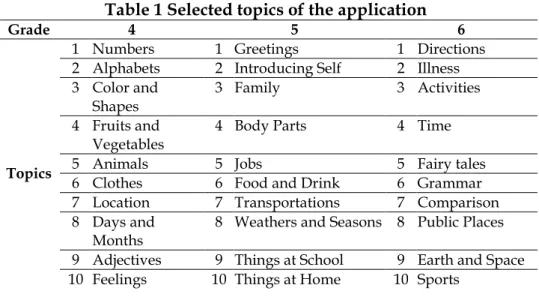
discussing with the teacher. The selected topics were shown in Table 1.
Table 1 Selected topics of the application
Grade 4 5 6
Topics
1 Numbers 1 Greetings 1 Directions
2 Alphabets 2 Introducing Self 2 Illness 3 Color and
Shapes
3 Family 3 Activities
4 Fruits and Vegetables
4 Body Parts 4 Time
5 Animals 5 Jobs 5 Fairy tales
6 Clothes 6 Food and Drink 6 Grammar
7 Location 7 Transportations 7 Comparison 8 Days and
Months 8 Weathers and Seasons 8 Public Places 9 Adjectives 9 Things at School 9 Earth and Space 10 Feelings 10 Things at Home 10 Sports
In ‘development’ process, there were some main processes, namely; 1) main characters making process, 2) interactive slideshows making process, and 3) PowerPoint to APK converting process. The main characters making process was done by using Adobe Photoshop Cs5, by modifying the original picture taken from the Internet, and making the animated characters by using AVS Video Editor 7.0 and a website named ezgif.com. The result is shown in Picture 1.
The ‘design’ and ‘development’ process were summarized to a table that shows the profile of the product. The profile of the product was seen by the English teacher of one of the schools in Denpasar to be asked for the agreement before producing the product. The profile of the product is shown in Table 2.
Table 2 Profile of the product
No Item Details
1 Title Ori English Learning 2 Format Android Package Kit (*.apk) 3 Modes Vocabulary, Practice, Quiz, Games 4 Picture
Type Cartoon (semi authentic) created in Adobe Photoshop Cs5, and downloaded in free picture sites namely; clker.com, vecteezy.com, and clipart.com
5 Icons Shapes in Microsoft PowerPoint 2013 and iSlide 6 Sounds Self-recording
7 Languages English and Bahasa Indonesia
8 Topics Grade 4 Numbers, alphabets, color and shapes, fruits and vegetables, animals, clothes, location, days and months, adjectives, feelings Grade 5 Greetings, introducing self, family, body
parts, jobs, food and drink, transportations, weathers and seasons, things at school, things at home
Grade 6 Directions, illness, activities, time, fairy tales, grammar, comparison, public places, earth and space, sports
9 Contents 624 vocabularies, 4 grammar rules, and 3 comparison rules
Picture 2 Sample slideshow of the application
Finally, the last process in developing the application was converting the PowerPoint slideshows to APK by using iSpring 6.0 and Andaired. The final product was in Android Package Kit (APK) format and ready to be evaluated by the judges.
Picture 3 Story mode of the application
Picture 4 Game mode of the application
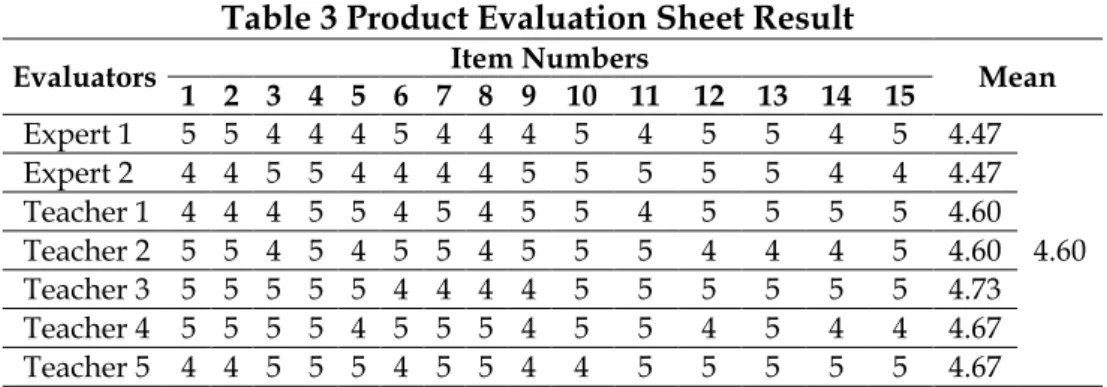
In the ‘evaluation’ process, the developed smartphone application was evaluated by 5 English teachers of elementary school and 2 experts in technology. The APK-based application was first installed on an Android smartphone. Then, the smartphone was given to the English teachers and the experts to test the application. Based on the results of the qualitative product evaluation sheet above, it can be concluded that the Android Package Kit (APK)-based application can be used on smartphones and it is suitable to be used by the students of grade 4, 5, and 6 to learn English, especially enriching their vocabulary.
Developed Android Package Kit (APK)-based Application Quality
Table 3 Product Evaluation Sheet Result
Evaluators 1 2 3 4 5 6 7 8 9 10 11 12 13 14 15 Item Numbers Mean
Expert 1 5 5 4 4 4 5 4 4 4 5 4 5 5 4 5 4.47
4.60 Expert 2 4 4 5 5 4 4 4 4 5 5 5 5 5 4 4 4.47 Teacher 1 4 4 4 5 5 4 5 4 5 5 4 5 5 5 5 4.60 Teacher 2 5 5 4 5 4 5 5 4 5 5 5 4 4 4 5 4.60 Teacher 3 5 5 5 5 5 4 4 4 4 5 5 5 5 5 5 4.73 Teacher 4 5 5 5 5 4 5 5 5 4 5 5 4 5 4 4 4.67 Teacher 5 4 4 5 5 5 4 5 5 4 4 5 5 5 5 5 4.67
The product evaluation sheet result shows that the mean score for the product evaluation sheet about the smartphone application was 4.60. As the criteria, 4.60 was categorized as very good. Thus, the quality of the smartphone application was very good.
DISCUSSION
The primary school students need to manage their time to learn English in order to have complete understanding about the topics taught in the class. In line with this study, Lynch (2008) states that one of the most crucial problems of English language teaching and learning classroom is the insufficient time. Therefore, to be able to adjust the learning time, the students can use the smartphone application as the additional time for them to learn English.
The primary school students need to have more vocabulary learning in order to understand the material when the teacher is teaching and be active in the learning process. In line to this, Hussein & Elttayef (2018) state that students are unable to understand and use English because they lack of necessary vocabulary items. Therefore, the smartphone application designed to enrich students’ vocabulary items should be applied in the students’ English learning.
Language Learning (MALL) enables new ways of learning, emphasizing continuity or spontaneity of access across different contexts of use. Therefore, the smartphone application enables the students in effective way to get involved in MALL and help the teacher in such a way in the teaching process.
The primary school students need to be well-guided in having MALL in teaching and learning process in the classroom. In line to this, Khaddage et al. (2011) state that instructors can adapt activities, practice teaching, and reinforce assessment and feedback. Therefore, providing good teaching strategies, including the instructions and follow-up activities in the process of MALL should be done by the teachers.
In conclusion, the primary school students’ need in learning English vocabulary was the smartphone application which provides the vocabulary, practice, test, and entertainment about the topics learnt in the class. Supported by Wang (2017), using smartphone applications in teaching and learning provides positive ideas and benefits that motivate students to learn and understand better. In addition, Elfeky and Masadeh (2016), state that learning through smartphone application has important effects on the students’ achievement and skills.
There were three main processes conducted during the development of the product. The processes are namely; 1) Design, 2) Development, and 3) Evaluation. The content of the application consisted of the gameplay and the English topics in syllabus. In line to this, Imaniah and Nargis (2017), state that English for young learners at the primary level are cognitively primed to acquire language skills in ways that lend themselves to an integrated skills and content-based experiential approach. Therefore, the purpose of providing English topics as the content of the application is to let the students acquire the integrated skills in English.
topics. The English topics in the application were analysed from the syllabus of primary school students of grade 4, 5, and 6. From the analysis result, it was found that there were 30 topics that were going to be used in the application.
The process of selecting the vocabulary for each topic was done. It was found that there were 624 vocabularies, including 4 grammar rules, and 3 comparison rules. In line to this, Cameron (2001), adds that when introduced into the L2 classroom, young learners need very concrete vocabulary that connects with objects they can handle or see. Therefore, the application provides the vocabularies with the pictures as the concrete objects to ease the students to process the information in English. Furthermore, the vocabulary selection was contextual by considering the students’ background and prior knowledge.
In Practice mode, the users are provided with several practices to enhance their understanding about the topic. In line to his, Kim (2013) states that MALL practice can improve idiomatic and support a foreign language class, and developing listening abilities for instance. Therefore, the practice mode was made to improve the students’ understanding and skills.
In Quiz mode, the users are given several questions related to the topic to test the users’ understanding. In line to this, Khaddage et al. (2011) state that smartphone application helps instructors determine students’ difficulties and misunderstanding. In addition, instructors can adapt activities, practice teaching, and reinforce assessment and feedback. Thus, the Quiz mode in the application can provide the assessment for the students.
In Games mode, the users are provided with interesting game related to the topic. In line to this, Zilber (2013) states that games and game-like activities are the most obvious examples of engaging applications. Therefore, the Games mode in the application should engage and entertain the students’ interest towards the topics.
used Microsoft PowerPoint 2013 to design the layout. Microsoft PowerPoint 2013 was also used in the development process of the application. In line to this, Rieber et al. (2009), states that although there are certainly much better design tools for designing application, some believe that harnessing PowerPoint for designing the application is a practical way to bring the design into the classroom.
In development process, it was not only Microsoft PowerPoint 2013, but the researcher also used some additional applications to develop the smartphone application. In other words, technology was effectively used in improving the learning and teaching process. In line to this, Ahmadi (2018) states that with technology being part in our everyday lives, it is time to rethink the idea of integrating technology into the curriculum and aim to embed technology into teaching to support the learning process. The additional applications were namely; Adobe Photoshop Cs5, AVS Video Editor 7.1, and a website named ezgif.com.
The additional applications above were used to create the main characters in the application. The main characters and other objects in the application were made in cartoon, while some of them were made in cartoon animation. The purpose of this was to get the students’ interest to using the smartphone application. In line to this, Hussein and Elttayef (2018) states that curriculum designers should take into their account the importance of technology use, and cartoon pictures and linked pictures which play the vital role in students’ motivation.
The converting process from PowerPoint Presentation to APK-based application was done by using iSpring 6.0 and Andaired. The final result of this process was an Android Package Kit (APK) file. In line to this, Benson (2018) defines APK as the collection of various small files, source codes, icons, audios, videos, etc. into one large file for the distribution purpose, which is the file format that supports Android OS only. However, it does not mean that the smartphone application can be used only on Android. The researcher uploaded the developed smartphone application on Google Play and App Store. Thus, the students who have Apple smartphone can also use the application.
The evaluation process was done to the developed APK-based application to find out the agreement of the English teachers and the experts of technology to the appropriateness of the smartphone application to learn English for primary school students, and the suggestions and comments to the smartphone application. The strengths and weaknesses of the smartphone application were also analysed. Based on the results, it was found that the smartphone application has interesting appearance, and it is appropriate to the students for learning English as it is entertaining and engaging the learning. In line to this, Gangaiamaran (2017) mentions the benefits of mobile application in education that include; 1) more social, 2) entertainment, 3) round the clock availability, 4) effective utilization of leisure hours, 4) alternate modes of learning, and 5) fun and informal. In addition, Zilber (2013) suggests teachers look for apps with the following considerations, namely; 1) designed in small segments, 2) engaging, entertaining, and addictive, 3) highly focused and complementary to classroom learning, 4) specifically designed for smartphones. The developed smartphone application has fulfilled the considerations and included the benefits as stated above.
was 4.60. From the criteria of the product quality, the smartphone application was categorized ‘very good’. Thus, it can be concluded that the developed APK-based application to learn English for primary school students has a very good quality. In line to the result above, Hashemi et al. (2011) defines mobile learning as the acquisition of any knowledge or skill through using mobile technology, anywhere and anytime.
The smartphone application supports the mobile learning as the students can acquire the knowledge or skill, in this case the vocabulary mastery. In addition, Wang (2017) asserts that using mobile phone applications in teaching and learning provides positive ideas and benefits that motivate students to learn and understand better. The smartphone application motivates the students to learn, and it is supported by the judges’ evaluation that agreed to the statement ‘The application can motivate the students to study English’. El-Hussein and Cronje (2010) adds that the features of mobile technology such as the portability and information accessibility play a major role in the enhancement of English language teaching and learning. The developed smartphone application also has portability and information accessibility features, and it is supported by the judges’ evaluation that strongly agreed to the statement ‘The application can be used anywhere (at home or at school), and ‘The application can be used at any time, and the duration in using the application can be adjusted’.
CONCLUSION
REFERENCES
Abrar, M. (2016). Teaching English Problems : an Analysis of Efl Primary School Teachers in Kuala. The Proceedings of ISIC 2016 Academic Conference, (October 2016). Retrieved from https://www.researchgate.net/publication/314280291%0ATEA CHING
Ahmadi, M. R. (2018). The Use of Technology in English Language Learning: A Literature Review*. International Journal of Research in English Education (IJREE), 3(2).
Alqahtani M. (2015). The Importance of Vocabulary in Language Learning and How to be Taught. International Journal of Teaching and Education, 3(3). King Khaled Academy, Saudi Arabia.
Asnadi, I. W. S. W., Ratminingsih, N. M., & Myartawan, I. P. N. W. (2018). Primary Teachers ’ and Students ’ Perception on the Use of ICT-Based Interactive Game in English Language Teaching. Jurnal Pendidikan Indonesia, 7(1), 10–20. https://doi.org/10.23887/jpi-undiksha.v7i1.10963
Bay, I. W., Husain, N., & Mamu, R. (2018). Developing Local Content Syllabus for Elementary School Based on the English for Young Learners Learning Strategy to Maintain Gorontalo Cultures. Asian EFL Journal, 20(1), 1–101.
Benson, M. (2018). Know the Differences Between an App and APK. Retrieved from www.friendfactor.org/differences-between-an-app-and-apk/
Cameron, L. (2001). Teaching Languages to Young Learners. Teaching by Principles An Interactive Approach to Language Pedagogy, 2. https://doi.org/10.1016/S0346-251X(03)00040-X
Elfeky, A. I. M., & Masadeh, T. S. Y. (2016). The Effect of Mobile Learning on Students’ Achievement and Conversational Skills. International Journal of Higher Education, 5(3), 20–31. https://doi.org/10.5430/ijhe.v5n3p20
AN=55428819&site=ehost-live;%5Cnhttp://search.ebscohost.com/login.aspx?direct=true& db=awn&AN=NX047120&site=ehost-live
Farrah, M. A.-H., & Abu-Dawood, A. K. (2018). Using Mobile Phone Applications in Teaching and Learning Process. International Journal of Research in English Education (IJREE), 3(2).
Gangaiamaran, R. (2017). Review on Use of Mobile Apps for Language Learning. 12(21), 11242–11251.
García, S., & Fombona, J. (2015). Approach to the phenomenon of m-learning in English teaching. Digital Education Review, (28), 19–36. Habibi, A., & Sofwan, M. (2015). Teachers of English for Young Learners :
An Analysis on Their English Proficiency and Profile. (April).
Hashemi, M., Azizinezhad, M., Najafi, V., & Nesari, A. J. (2011). What is Mobile Learning? Challenges and Capabilities. Procedia - Social and Behavioral Sciences, 15(May), 2947–2951. https://doi.org/10.1016/j.sbspro.2011.04.220
Helena, L. (2007). How to Teach Vocabulary Effectively. An analysis of the course book Eyes and Spies: Praia.
Hussein, N. O., & Elttayef, A. I. (2018). Arab Learners ’ Problems in Learning English Language : A Teacher Perspective. 40(August 2017), 1–6.
Imaniah, I., & Nargis. (2017). Teaaching English for Young Learners. Tangerang: Cikokol-Kota: FKIP UMT Press.
Khaddage, F., Lattemann, C., & Bray, E. (2011). Mobile Apps Integration for Teaching and Learning.(Are Teachers Ready to Re-blend?). for Information Technology & Teacher, 2545–2552. Retrieved from http://www.editlib.org/p/36694
Kim, H.-S. (2013). Emeriging mobile apps to improve English listening skills. Multimedia-Assisted Language Learning, 16(2), 11– 30. https://doi.org/10.15702/MALL.2013.16.2.11
Kukulska-Hulme, A., & Shield, L. (2008). An overview of mobile assisted language learning: From content delivery to supported collaboration and interaction. ReCALL, 20(03). https://doi.org/10.1017/S0958344008000335
McGraw Hill: NY.
Liu, M., Navarrete, C. C., & Wivagg, J. (2014). Potentials of mobile technology for k-12 education: An investigation of ipod touch use for english language learners in the United States. Educational
Technology and Society, 17(2), 115–126.
https://doi.org/10.2307/jeductechsoci.17.2.115
Lynch, L. M. (2008). Three Critical Problems in English Language Teaching and Learning and What to Do About Them. 14–16.
Nushi, M., & Eqbali, M. H. (2017). Duolingo : A mobile application to assist second language learning (App Review). Teaching English with Technology, 17(1), 89–98.
Ratminingsih, N. M. (2012). Teaching techniques, types of Personality, and English listening skill. Jurnal Ilmu Pendidikan, 18(1), 23–29. https://doi.org/http://dx.doi.org/10.17977/jip.v18i1.3379 Richards, C., and Schmidt, R. (2002). Longman Dictionary of Language
Teaching and Applied Linguistics. London: Pearson Education Limited.
Richey, R., & Klein, J. (2014). Design and Development Research. In M. Spector, D. Merrill, J. Elen & M. Bishop, Handbook of Research on Educational Communications and Technology (4th ed., pp. 141-150). London: Springer.
Rieber, L., Barbour, M., Thomas, G., & Rauscher, D. (2009). Learning by Designing Homemade PowerPoint Games. (January). https://doi.org/10.1007/978-0-387-09775-6
Santosa, M. H. (2017). Learning approaches of Indonesian EFL Gen Z students in a Flipped Learning context. Journal on English as Foreign Language, 7(2), 183-208.
Suwantarathip, O., & Orawiwatnakul, W. (2015). Using Mobile-Assisted Exercises To Support Students’. The Turkish Online Journal of Educational Technology, 14(1), 163–171. https://doi.org/10.1017/CBO9781107415324.004