PLANAR SECTIONS THROUGH THREE-DIMENSIONAL LINE-SEGMENT
PROCESSES
S
ASCHAD
JAMALM
ATTHESB,1 ANDD
IETRICHS
TOYAN21Institut f¨ur Keramik, Glas- und Baustofftechnik, Technische Universit¨at Bergakademie Freiberg, D-09596
Freiberg, Germany;2Institut f¨ur Stochastik, Technische Universit¨at Bergakademie Freiberg, D-09596 Freiberg, Germany
e-mail: [email protected]
(Received September 25, 2013; revised January 14, 2014; accepted January 14, 2014)
ABSTRACT
This paper studies three–dimensional segment processes in the framework of stochastic geometry. The main objective is to find relations between the characteristics of segment processes such as orientation- and length-distribution, and characteristics of their sections with planes. Formulae are derived for the distribution of segment lengths on both sides of the section plane and corresponding orientations, where it is permitted that there are correlations between the angles and lengths of the line-segments.
Keywords: fibre process, fibre-reinforced materials, line-segment process, stereology, stochastic geometry.
INTRODUCTION
Segment processes are stochastic models for random systems of line-segments randomly scattered in space. They belong to the more general class of fibre processes, the mathematical theory of which was developed by Joseph Mecke and coworkers (Mecke and Nagel, 1980; Mecke and Stoyan, 1980b; Chiuet al., 2013).
These processes find important applications in the context of fibre-reinforced materials, where fibres, which can be often modelled as line-segments of negligible thickness, are embedded in a matrix of more or less homogeneous material.
In the now classical papers mentioned above planar sections played an important role. Such sections produce systems of fibre–plane intersection points, which can be statistically analysed with the aim to get information on the spatial fibre system. This setting belongs to the field of stereology, and a classical formula there is
LV =2NA, (1)
whereLV is the mean total fibre length per unit volume
and NA the number of intersection points per unit
area. (The formula holds true under the assumptions of statistical homogeneity or stationarity and isotropy, see also Chiuet al., 2013.)
Planar sections through segment processes appear in the context of fibre-reinforced materials, when axial tension is studied. Following Li et al. (1991) the intersections of fibres with a plane orthogonal to the tension axis are investigated. Additionally to the characteristics studied when stereology is of interest,
also the residual lengths of the line-segments on both sides of the section plane are of importance in the mechanical calculations. (They have never been considered in the stereological context, since these lengths cannot be measured in the section plane.)
The present paper first explains a natural segment process model, following the pattern of Mecke and Stoyan (1980a). Then it derives formulae for the section process characteristics. Some of them have counterparts in the classical theory, while those related to the residual lengths are new, generalising results in Li et al. (1991), who considered the case of segments of constant length. Furthermore, formulae for the maximum and minimum residual segment length are derived since these characteristics play a role in calculations of the contribution of fibres to the mechanical strength in a composite material.
MODEL DESCRIPTION
This paper considers three–dimensional line-segment processes. A realisation of such a process is a set of randomly distributed line-segments in space. To characterise such a line-segment we use its top point (in the sense of the z-axis) (x,y,z) ∈ R3, the
Figure 1.Computer-tomography-based measurements on fibre-reinforced autoclaved aerated concrete. The upper figure shows the three-dimensional distribution of fibres. The lower figure presents a planar section of reinforced material. The section points of the fibres (black points) form a random point pattern.
x y
z
λ β
l
Figure 2.Geometrical representation of a line-segment which is shifted so that its endpoint meets the origin of the coordinate system.
A line-segment process is here represented as a
marked point process ΨV (for more on marked point
processes see Chiu et al., 2013). Realisations of ΨV
can be written as sequences of marked points:
ψV ={[(xi,yi,zi),lVi ,λiV,βiV]}, (2)
with (xi,yi,zi) ∈ R3,lVi > 0,λiV ∈ [0,2π] and βiV ∈
0,π
2
. Moreover we introduce the stochastic variables of the polar angle, BV, the azimuthal angle, ΛV, and the fibre length,LV, of a typical line-segment ofΨV.
Here and in the following we assume ΨV to be
stationary, i.e., the distribution of ΨV is translation
invariant. It is not assumed that the marked point process ΨV has some specific distribution, e.g., a
marked Poisson process. The results presented in this paper hold for every distribution of a stationary ΨV,
where BV and ΛV are stochastically dependent (see page 57) or independent (see page 60) ofLV.
ESSENTIAL PROPERTIES
The distribution of the marked point processΨV is
described by the following characteristics:
Table 1. Characteristics of the spatial marked point processΨV
NV mean number of top points of
line-segments per unit volume
FV,L,B,Λ(l,β,λ) joint distribution function of fibre length LV and angles
BV and ΛV of a typical line segment
FV,B(β),FV,Λ(λ), FV,L(l)
marginal distribution functions of the stochastic variables BV, ΛV andLV.
The stochastic variables of the polar angle,BV, and the azimuthal angle,ΛV may depend on the stochastic variable of the spatial fibre length,LV.
In order to study the mechanical behavior of fibre-reinforced materials under axial tensions the intersection of a plane with a line-segment system is of peculiar interest. The mechanical effect of a fibre in a homogeneous material depends on the intersection angle and the length of the fibre under and over the plane respectively. Thus these quantities have to be studied. This approach appears in the classical papers by Liet al. (1991), Brandt (1985) and in subsequent work. However, in these papers the segment lengths are assumed to be constant.
Due to our homogeneity assumption we choose the intersecting plane to be the(x,y)-planeS={(x,y,z)∈
S yields the marked point process ΨA of intersection
points with the realizations
ψA={[(ξi,ηi),r1,Ai,r A
2,i,λ A i ,β
A
i ]}, (3)
where (ξi,ηi) are the intersection points,rA1,i and rA2,i
the lengths of the upper and lower part of the segments respectively andλiA andβiA the corresponding section angles. Due to stationarity ofΨV also the marked point
processΨAis stationary.
We introduce the stochastic variables of the polar section angle, BA, the azimuthal section angle ΛA and the upper and lower part of the segment which belongs to the typical intersection point, RA1 and
RA2 respectively. The basic constants and distribution functions of the marked point processΨAare shown in
the following table:
Table 2. Characteristics of the planar marked point processΨA
NA mean number of section
points ofΨAper unit area
FA,R1,R2,Λ,B(r1,r2,λ,β) joint distribution function
of upper and lower segment lengths and intersection anglesBA,ΛA at a typical section point
FA,R1,R2(r1,r2), FA,Λ(λ),FA,B(β)
marginal distribution functions of the upper and lower segment lengths and the intersection anglesBAandΛA.
BASIC CHARACTERISTICS OF
Ψ
AAND RELATIONS TO
Ψ
VMAIN RESULTS
The main objective at this point is to establish relations between the basic constants and distribution functions ofΨV and those of ΨA. Due to the choice
of the intersection plane S and the definition of the azimuthal angleλ, the latter can be ignored.
We concentrate on relations between NA, NV and
the marginal distribution functionsFA,R1,R2,B(r1,r2,β)
andFV,L,B(l,β). The following general basic equation
holds forNA,NV >0,r1,r2>0 andβ ∈
0,π
2
:
NAFA,R1,R2,B(r1,r2,β) =
=NV
β Z
0
sinβ0
min{r1,r2}
Z
0
FV,L,B(l+max{r1,r2},β0)
−FV,L,B(l,β0)
dldβ0
+NVcosβ
min{r1,r2}
Z
0
FV,L,B(l+max{r1,r2},β)
−FV,L,B(l,β)
dl. (4)
The relation of the corresponding probability density functions fV,L,B(l,β) and fA,R1,R2,B(r1,r2,β) is
therefore
NAfA,R1,R2,B(r1,r2,β) =NVcosβfV,L,B(r1+r2,β).
(5)
Eq. 4 is the starting point for some important formulae. Letβ = π2 andr1,r2→∞. Then we obtain
the intensity ofΨAas
NA=NVE(LVcosBV), (6)
where
E(LVcosBV) =
π 2
Z
0 ∞ Z
0
lcosβfV,L,B(l,β)dldβ.
This expression simplifies for the isotropic case and if
LV andBV are stochastic independent, see Eq. 26.
With the latter relation we are able to determine
FA,R1,R2,B ifNV andFV,L,B are given. Furthermore, we
obtain with Eq. 4, Eq. 6 andβ=π2 the joint distribution function
FA,R1,R2(r1,r2) =FA,R1,R2,B
r1,r2,π
2
of the upper and lower segment lengths. These distributions exist if EcosBV 6=0, i.e., if the case of all fibres parallel to the section plane is excluded.
NAFA,R1,R2(r1,r2) =
=NV
min{r1,r2}
Z
0 π 2
Z
0
sinβ0 FV,L,B(l+max{r1,r2},β0)
−FV,L,B(l,β0)
dβ0dl, FA,R1,R2(r1,r2) =
= 1
E(LVcosBV)
min{r1,r2}
Z
0 π 2
Z
0
sinβ0·
FV,L,B(l+max{r1,r2},β0)−FV,L,B(l,β0)
dβ0dl,
with 0≤r1,r2 <∞. We can determine the marginal distribution functions for the upper and lower segment lengths
FA,R1(r1) = lim
r2→∞
FA,R1,R2(r1,r2)
and
FA,R2(r2) = lim
r1→∞
FA,R1,R2(r1,r2).
The stochastic variables RA1 and RA2 are identically distributed with the distribution function
FA,R(r) =FA,R1(r) =FA,R2(r) =
1 E(LVcosBV)
r
Z
0 π 2
Z
0
sinβ0 FV,B(β0)
−FV,L,B(l,β0)dβ0dl, (8)
forr>0 andFV,B(β) =lim l→∞
FV,L,B(l,β).
With Eqs. 6 and 4 andr1,r2→∞we analogously get the distribution function of the section angleBA
FA,B(β) =
1 E(LVcosBV)
∞ Z
0
β Z
0
sinβ0 FV,B(β0)−FV,L,B(l,β0)
dβ0
+cosβ FV,B(β)−FV,L,B(l,β)
!
dl.
(9)
With Eqs. 6–9 we have explicit relations for the basic characteristics ofΨA. We can add also the probability
density functions using Eqs. 6–9:
fA,R1,R2(r1,r2) =
1 E(LVcosBV)
π 2
Z
0
cosβfV,L,B(r1+r2,β)dβ, (10)
and
fA,B(β) =
1 E(LVcosBV)
∞ Z
0 ∞ Z
0
cosβfV,L,B(r1+r2,β)dr1dr2.
(11)
The length of the line-segments were assumed to be stochastically dependent on the angle BV
throughout the above investigations. Eq. 4 shows that, consequently, the line-segment lengthsRA1 andRA2 are stochastically dependent of the intersection angleBA.
SKETCH OF THE PROOF OF EQ. 4
The proof follows the pattern of Mecke and Stoyan (1980a), which is also used in Mecke and Stoyan (1980c).
Let SD(t1,t2,b,c) be the expected number of
segments pi = [(xi,yi,zi),lVi ,λiV,βiV] of the marked point processΨV fulfilling the following conditions:
1. the line-segment pi intersects a given compact
subsetDof the planeS,
2. the line-segment has intersection anglesβiA∈[0,b] withb∈
0,π
2
andλiA∈[0,c]withc∈[0,2π],
3. the lengths of the segment above and belowSfulfil
rA1,i≤t1andrA2,i≤t2witht1,t2>0.
The quantitySD(t1,t2,b,c) can be calculated in terms
ofΨA andΨV, and equating the corresponding terms
yields Eq. 4.
The Campbell theorem (see,e.g., Chiuet al., 2013) applied toΨA yields simply
SD(t1,t2,b,c) =NAFA,R1,R2,B,Λ(t1,t2,b,c) (12)
fort1,t2>0,b∈
0,π
2
andc∈[0,2π].
In terms ofΨV,SD(t1,t2,b,c)can be expressed as
SD(t1,t2,b,c) =E
∑
pi∈ψV
f(pi,t1,t2,b,c) !
(13)
for t1,t2 > 0, b ∈
0,π
2
and c ∈ [0,2π], pi =
[(xi,yi,zi),lVi ,λiV,βiV]denotes a single segment and f is the indicator function with f(pi,t1,t2,b,c) =1 for
segments that fulfil the conditions 1–3 of the definition ofSD, otherwise f =0. In the following we describe
the function f.
With r1,Ai+rA2,i =liV it follows 0≤lVi ≤t1+t2 as
a first constraint. Furthermore we haveβiV ∈[0,b]and λiV ∈[0,c], therefore we choose
f(pi,t1,t2,b,c) =
1[0,t1+t2](lVi )1[0,b](βiV)1[0,c](λiV)1Z0(xi,yi,zi)
for some setZ0=Z0(λiV,βiV,lVi ,t1,t2)with(xi,yi,zi)∈
Z0if and only if pifulfils the conditions 1 and 3. Let
Z1=D⊕ n
s·eλV
i ,βiV,s∈[0,min{l
V i ,t1}]
o
and
Z2=D⊕ n
s·eλV
i ,βiV,s∈[l
V
i −min{l V
i ,t2},lVi ]
with eλ,β = (cosλsinβ,sinλsinβ,cosβ), where ⊕ denotes the Minkowski addition. Thenpiintersects the
set D with an upper segment length rA1,i ≤t1 if and only if(xi,yi,zi)∈Z1and pi intersectsDwith a lower
segment lengthrA2,i≤t2if and only if(xi,yi.zi)∈Z2. In
both casespi intersectsDwith the intersection angles
βiV ∈[0,b]andλiV ∈[0,c]. It follows thatpifulfils the
conditions 1 to 3 if and only if(xi,yi,zi)∈Z0=Z1∩Z2.
Due to the structure ofZ1andZ2we can writeZ0as the
Minkowski sum ofDand a line-segment:
Z0=
D⊕ns·eλV
i ,βiV,s∈[l
V
i −min{t2,lVi },min{t1,lVi }]
o .
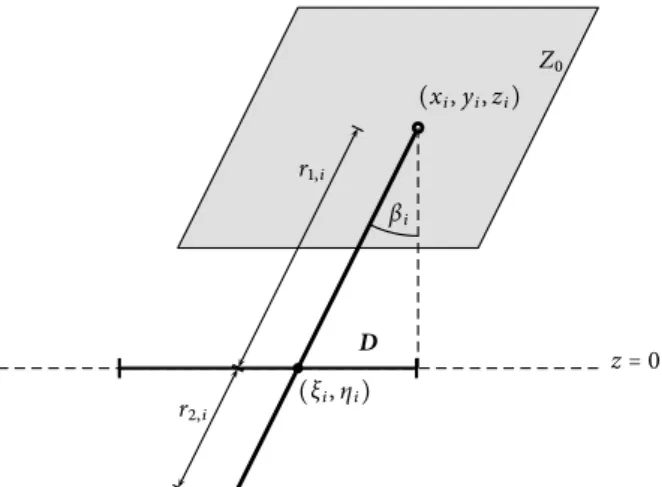
Fig. 3 explains the underlying geometry.
βi
b
(xi,yi,zi)
z=0
D
Z0
(ξi,ηi)
r1,i
r2,i
Figure 3.Underlying geometry in the(x,z)-plane of the intersection of a segment of azimuthal angleλiV =0 with the plane S.
The right hand side of Eq. 13 can be calculated by means of the Campbell theorem. We obtain
SD(t1,t2,b,c) =
=NV
Z
R3
Z
[0,t1+t2]×[0,b]×[0,c]
1Z0(x,y,z)·
dFV,L,B,Λ(l,β,λ)d(x,y,z)
=NV
Z
R3 t1+t2
Z
0
b
Z
0
c
Z
0
1Z0(x,y,z)
fV,L,B,Λ(l,β,λ)dλdβdld(x,y,z). (14)
By applying Fubini’s theorem we can rearrange the order of integration, and we evaluate
R
R3
1Z0(x,y,z)d(x,y,z) using Cavalieri’s principle. Due
to the representation ofZ0as a Minkowski sum we can
express this integral by the product of the area of D, ν2(D), and the height ofZ0. We get
Z
R3
1Z0(x,y,z)d(x,y,z) =
ν2(D)cosβ min{l,t1}+min{l,t2} −l
.
At this point the integrand is independent of λ. With Eq. 12 it follows the equivalence of the marginal distributions
FA,Λ(λ)≡FV,Λ(λ). (15)
Hence follows, we concentrate on the relation of the marginal distribution functions FA,R1,R2,B and FV,L,B
andSD(t1,t2,b,2π). We obtain
SD(t1,t2,b,2π) =
NV
Z
[0,t1+t2]×[0,b]
cosβ·
min{l,t1}+min{l,t2} −l
dFV,L,B(l,β).
(16)
Equating Eq. 16 with Eq. 12 and applying integration by parts gives the desired relation Eq. 4.
APPLICATIONS AND DISCUSSION
The stereological formulas Eqs. 6–9 can now be used to verify earlier results and to examine application-related cases.
SUPERPOSITION OF LINE-SEGMENT PROCESSES
In the following example the line-segments follow a special relation between length and direction: long fibres (l∈[l0,lmax], 0<l0 <lmax) all have the same
polar angle β0 ∈
0,π
2
while short fibres (l∈[0,l0])
are isotropic. The proportion of segments of length
l∈[0,l0]isp∈[0,1]and for segments withl∈[l0,lmax]
is 1−p. The joint probability density function ofLV
andBV is therefore
fV,L,B(l,β) =
p
l0sinβ , l≤l0
1−p
lmax−l0δβ0(β), l0≤l≤lmax
0, l>lmax.
(17) Thus, this example represents a superposition of two different line-segment processes. With Eq. 6 the mean number of section points per unit area is
NA=NV
1 4pl0+
1
2cosβ0(1−p)(lmax+l0)
Moreover using Eq. 7 and Eq. 8 the conditional distribution function
FA,R1|R2≤r2(r1) = min{r1,r2}
Z
0 π 2
Z
0
sinβ0 FV,L,B(l+max{r1,r2},β0)
−FV,L,B(l,β0)dβ0dl !,
r2
Z
0 π 2
Z
0
sinβ0 FV,B(β0)−FV,L,B(l,β0)
dβ0dl !
as well as the conditional density function
fA,R1|R2≤r2(r1) = π
2
R
0
sinβ0 FV,L,B(r1+r2,β0)−FV,L,B(r1,β)dβ0
r2
R
0 π 2
R
0
sinβ0 FV,B(β0)−FV,L,B(l,β0)dβ0dl
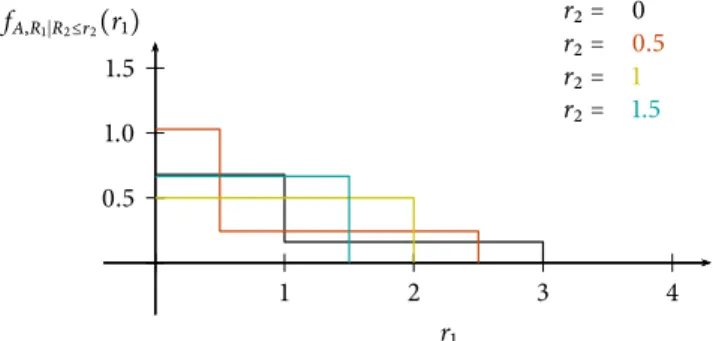
can be calculated. The conditional probability density function fA,R1|R2≤r2(r1) is shown in Fig. 4 forl0=1, lmax=3,β0=34andp=34and by means of Eq. 18 the
ratio NA
NV is 0.553. Thus,NAcan be determined onceNV
is known.
0.5 1.0 1.5
1 2 3 4
r2= 0
r2= 0.5
r2= 1
r2= 1.5
fA,R1∣R2≤r2(r1)
r1
Figure 4.The conditional probability density function fA,R1|R2≤r2(r1) of the upper segment length RA1 under the condition the lower segment length RA2 is bounded from above.
INDEPENDENT FIBRE ANGLES AND LENGTHS
Assume the line-segment length LV is stochastically independent of the anglesΛV andBV for the line-segment process ΨV. Under this assumption
this line-segment process can be characterized using the following parameters and functions:
Table 3. Characteristics of the spatial marked point processΨV under the assumption that LV and BV are
stochastically independent.
NV mean number of top points of
line segments per unit volume
FV,L(l) distribution function of length
of a typical segment ofΨV
FV,Λ(λ),FV,B(β) distribution function of azimuth
and polar angle of a typical segment ofΨV
Eq. 4 simplifies in the following way:
NAFA,R1,R2,B(r1,r2,β) =
=NV
min{r1,r2}
Z
0
β Z
0
FV,L(l+max{r1,r2})−FV,L(l)
·cosβ0dFV,B(β0)dl
=NV
min{r1,r2}
Z
0
FV,L(l+max{r1,r2})−FV,L(l)
dl
·
β Z
0
sinβ0FV,B(β0)dβ0
for r1,r2 >0, β ∈0,π2 and NA,NV >0. It follows
that the segment lengths RA1, RA2 and the polar angle
BA of the segment process ΨA are stochastically
independent.
We therefore concentrate on the marginal distribution functionsFA,R1,R2(r1,r2)andFA,B(β). We
have
NAFA,R1,R2(r1,r2)FA,B(β) =
NV
min{r1,r2}
Z
0
FV,L(l+max{r1,r2})−FV,L(l)
dl·
β Z
0
sinβ0FV,B(β0)dβ0. (19)
Using this simplified relation we obtain
NA=NVELVEcosBV, (20)
FA,R1,R2(r1,r2) =
1 ELV
min{r1,r2}
Z
0
FV,L(l+max{r1,r2})−FV,L(l)
dl
and
FA,B(β) =
1 EcosBV
β Z
0
sinβ0FV,B(β0)dβ0. (22)
The segment lengths RA1 and RA2 are identically distributed, i.e., the marginal distributions FA,R1 and
FA,R2 are equivalent:
FA,R(r) =FA,R1(r) =FA,R2(r) =
1 ELV
r
Z
0
1−FV,L(l)
dl, r>0. (23)
Concerning the corresponding probability density functions ofΨV andΨAit holds
fA,R1,R2(r1,r2) =
1
ELV fV,L(r1+r2), (24)
and
fA,B(β) =
1
EcosBV fV,B(β)cosβ . (25)
THE ISOTROPIC CASE
We assume that the line-segment length LV is stochastically independent of the angles ΛV and BV
for the line-segment processΨV. Furthermore the
line-segment process ΨV is assumed to be isotropic, i.e.,
the directional vector of the typical line-segment is uniformly distributed on the unit sphere. We have
fV,B(β) =sinβ ,
and the distribution function
FV,B(β) =1−cosβ
for this case. Eq. 9 yields
fA,B(β) =sin 2β ,
and
FA,B(β) =sin2β ,
which is a result true for general fibre processes, see Mecke and Nagel (1980).
With Eq. 6 we obtain NA, the mean number of
section points per unit area as
NA=
1 2NVEL
V
. (26)
This result is a special case of another well-known stereological formula, namely (11.3.3) in Chiu et al.
(2013), where characteristics of germ-grain models are studied. Here the ”grain” is an isotropic line-segment.
SEGMENTS OF CONSTANT LENGTH
In papers such as Liet al.(1991) and Brandt (1985) line-segment processes and their sections with planes are studied. They derived formulas for the strength of fibre-reinforced materials using calculations for segments of constant length. If in this context the constant length is chosen to bel0>0, we obtain with
Eq. 8 the marginal distribution function FA,R(r). It
holdsFV,L(l) =Θ(l−l0)with the Heaviside function
Θ(x) =
0, x<0 1, x≥0
and
FA,R(r) =
1
l0
r
Z
0
1−Θ(l−l0)
dl
=
r
l0, r≤l0
1, r≥l0
for the distribution function of the upper and lower segment length at a typical section point. This distribution is the uniform distribution on [0,l0]. We therefore obtain the mean values of the residual segment lengths ERA1 = ERA2 = 12l0. This result
coincides with results of Liet al.(1991).
Moreover the line-segments in (Li et al., 1991) are considered to be isotropic. Using Eq. 26 we have
NA=12NVl0.
A PARAMETRIC MODEL
In Chin et al. (1988), Hegler (1985) and other papers line-segment length and angle distribution functions for segment processes ΨV with LV
independent ofBV appear such as
FV,L(l) =1−e−(ml)
k
, m,k,l>0,
the Weibull distribution function, and
FV,B(β) =
1−exp(−η β) 1−exp −π
2η
, β ∈ h
0,π
2
i
,η>0.
isotropic case. The Figs. 5 and 6 give an impression of the influence of the parameters m,k andη on the probability density functions fV,Land fV,B.
0.5 1.0
0.5 1.0 1.5 2.0
fV,L(l)
l
k=2 m=0.5
k=2 m=1
k=2 m=1.5
Figure 5.Influence of the parameters k and m on the Weibull probability densitiy function of LV.
1 2 3
1 8π
1 4π
3 8π
1 2π
β fV,B(β)
η=0 η=1 η=2 η=3
Figure 6. Influence of the shape parameter η on the probability density function of polar angle BV.
0.5 1.0
2 4 6 8 10
η
NA
NV
Figure 7. The ratio NA
NV in dependence on shape
parameterη.
0.5 1.0 1.5
0.5 1.0 1.5 2.0
fA,R1∣R2≤r2(r1)
r1
r2=0.2
r2=1.2
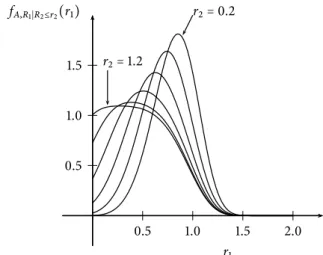
Figure 8.The conditional probability density function fA,R1|R2≤r2(r1) in dependence on r2 for Weibull-distributed fibre lengths. This is the probability density function of the length RA1 of the segment above the plane S, if the segment length RA2 below S is bounded from above. Here r2 ranges from 0.2 to 1.2 with a step size of 0.2.
The distribution of the residual segment lengths can be easily computed using the Eqs. 6–9. For the parametersm=1 and k=5 the results are shown in Figs. 7–9.
Fig. 7 show that NA
NV goes to a limit value asηtends
to infinity. This limit is ELV, the mean length of the line-segments (in the case m=1 and k=5 we have the limit valueELV ≈0.918). This is plausible since for largeη the segments have a preferred orientation inz-direction. Therefore withη→∞all line-segments have the polar angle BV =0 and therefore BA = 0. Applying this case to Eq. 6 we findNA=NVELV.
Furthermore, Fig. 8 shows that the conditional distribution of the upper segment length
fA,R1|R2≤r2(r1) =
FV,L(r1+r2)−FV,L(r1)
r2
R
0
1−FV,L(l)
dl
(27)
is more concentrated if the lower segment length is fixed at small values. Moreover it can be shown that
fA,R1|R2≤r2(r1) coincides with fV,L(l) ifr2→0. Thus
with decreasing upper bound of RA2 the conditional probability density function in Fig. 8 tends to the probability density function of the Weibull distribution with m = 1 and k =5 in Fig. 8. With increasing
r2 the conditional probability fA,R1|R2≤r2(r1) tends to 1
ELV 1−FV,L(r1)
. Since the segment lengthsRA1 and
RA2 are independent of the intersection angle BA in this case the conditional probability density function
0.5 1.0 1.5 2.0 2.5
1 8π
1 4π
3 8π
1 2π β
fA,B(β)
η=0
η=1 η=2
η=3
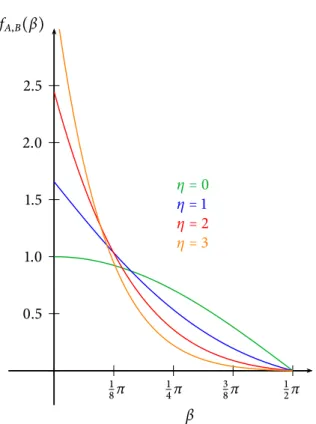
Figure 9. The probability density function fA,B(β)
of intersection angles in dependence on orientation distribution parameterη which varies from 0 to 3.
In Fig. 9 we see that with increasing η the segments at the typical section point show a preferred direction in thez-axis. Since the segment lines tend to have a small polar angleBV for largeη, the segments intersecting S have a small polar angle BA too. For η→0 the probability density function fA,B(β) tends
to cosβ. Note that this is not the isotropic case since for isotropic line-segments it holds fA,B(β) =sin 2β.
MAXIMUM AND MINIMUM RESIDUAL SEGMENT LENGTH
We investigate the stochastic variables M =
max{RA1,RA2} and m = min{RA1,RA2}, which are only in special cases stochastic independent. We therefore consider first the joint distribution function
FA,m,M(rm,rM) with rm,rM > 0. Furthermore we
consider the marginal distribution functions
FA,M(r) =P(M≤r) =P(RA1 ≤r,R
A
2 ≤r) and
FA,m(r) =P(m≤r) =1−P(RA1 >r,RA2 >r)
forr>0. Using simple ideas of probability we obtain
FA,m,M(rm,rM) =
FA,R1,R2(rm,rM)
+FA,R1,R2(rM,rm) rm≤rM
−FA,R1,R2(rm,rm)
FA,R1,R2(rM,rM) rM≤rm
FA,M(r) =FA,R1,R2(r,r)
and
FA,m(r) =2FA,R(r)−FA,R1,R2(r,r).
With Eqs. 7 and 8 we can relate these distribution functions with the distribution functions ofΨV:
FA,m,M(rm,rM) =
1 ELV
rm Z
0
2FV,L(l+rM)−FV,L(l+rm)−FV,L(l)
dl,
(28)
FA,M(r) =
1 ELV
r
Z
0
FV,L(l+r)−FV,L(l)
dl, (29)
FA,m(r) =
1 ELV
r
Z
0
2−FV,L(l)−FV,L(l+r)
dl. (30)
The marginal distributions simplify withFV,L(l) =1−
FV,L(l):
FA,M(r) =
1 ELV
r
Z
0
FV,L(l)−FV,L(l+r)dl
and
FA,m(r) =
1 ELV
r
Z
0
FV,L(l) +FV,L(l+r)dl.
In case of Weibull-distributed lengths it holdsFV,L(l) =
1−e−(ml)k and FV,L(l) =e−(ml)k. The corresponding results are sketched in Fig. 10.
0.5 1.0
0.5 1.0
l F
FA,m(l)
FA,M(l)
FV,L(l)
Figure 10. Distribution functions of minimum and maximum residual length, FA,m(l) and FA,M(l), for
ACKNOWLEDGEMENTS
The authors thank K.G. van den Boogaart for inspiring discussion during a seminar at the Institute of Stochastics of the TU Freiberg and U. Hampel, M. Bieberle and S. Boden for providing CT data of fibre-reinforced autoclaved aerated concrete. They are also grateful to the reviewers for series of valuable comments.
REFERENCES
Brandt AM (1985). On the optimal direction of short metal fibres in brittle matrix composites. J Mater Sci 20:3831– 41.
Carling MJ, Williams JG (1990). Fiber length distribution effects on the fracture of short-fiber composites. Polymer Composites 11:307–13.
Chin WK (1988). Effects of fiber length and orientation distribution on the elastic modulus of short fiber reinforced thermoplastics. Polymer Composites 9:27– 35.
Chiu SN, Stoyan D, Kendall WS, Mecke J (2013). Stochastic geometry and its applications. 3rd Ed. Chichester: Wiley.
Fu SY, Lauke B (1996). Effects of fiber length and fiber orientation distributions on the tensile strength of short-fiber-reinforced polymers. Comp Sci Tech 56:1179–90. Hegler RP (1985). Phase separation effects in processing of glass-bead- and glass-fiber-filled thermoplastics by injection molding. Poly Eng Sci 25:395–405.
Kacir L, Narkis N, Ishai O (1975). Oriented short
glass-fiber composites. I. preparation and statistical analysis of aligned fiber mats. Poly Eng Sci 15:525–31.
Li VC, Wang Y, Backer S (1991). A micromechanical model of tension softening and bridging toughening of short random fiber reinforced brittle matrix composites. J Mech Phys Solids 39:607–25.
Maalej M, Li VC, Hashida T (1995). Effect of fibre rupture on tensile properties of short fibre composites. J Eng Mech 121:903–13.
Mecke J, Nagel W (1980). Station¨are r¨aumliche Faserprozesse und ihre Schnittzahlrosen. Elektron Informationsverarb Kyb 16:475–83.
Mecke J, Stoyan D (1980a). A general approach to Buffon’s needle and Wicksell’s corpuscle problem. In: Combinatorial principles in stochastic geometry, Work Collect. Erevan. 164–71.
Mecke J, Stoyan D (1980b). Formulas for stationary planar fibre processes I – general theory. Math Operationsforsch Statist Ser Statist 11:267–79.
Mecke J, Stoyan D (1980c). Stereological problems for spherical particles. Math Nach 96:311–7.
Naaman AE, Reinhardt HW (1996). High performance fiber reinforced cement composites 2 (HPFRCC2). In: Proc 2nd Int RILEM Worksh.
Vaxman A, Narkis M, Siegmann A (1989). Short-fiber-reinforced thermoplastics. Part III: Effect of fiber length on rheological properties and fiber orientation. Polymer Composites 10:454–62.