NEW CONCEPTS AND TEST METHODS OF CURVE PROFILE AREA
DENSITY IN SURFACE: ESTIMATION OF AREAL DENSITY ON
CURVED SPATIAL SURFACE
H
ONGS
HENDepartment of Pathology, The First Military Medical University, Guangzhou, 510515, P. R. China e-mail: [email protected]
(Accepted February 21, 2001)
ABSTRACT
The concepts of curve profile, curve intercept, curve intercept density, curve profile area density, intersection density in containing intersection (or intersection density relied on intersection reference), curve profile intersection density in surface (or curve intercept intersection density relied on intersection of containing curve), and curve profile area density in surface (AS) were defined. AS expressed the amount of curve profile area of Y phase in the unit containing surface area, S(X). The test methods and formulas were deduced, e.g.: AS=ICI /IC=LCI /BC. In the formula, ICI and IC indicated the intersection numbers of test line with curve intercepts (or profiles in 2D) and with the containing curve respectively. BC denoted the length of containing curve, LCI being the length of curve intercepts. The formula means that AS are equal to the curve intercept density and equal to the curve profile intersection density in surface. Issues about AS application and its correction for shrinking tissues were discussed. Example for testing AS was given.
Keywords: curve profile area density in surface, curve intercept density, stereology, intersection density relied on intersection reference.
INTRODUCTION
As we know that area is a basic parameter important to describe quantitatively a structure. The morphometrical parameters for describing area-related feature include area, area density, surface area, surface density and the ratio of surface to volume. Area (A) is used to describe the absolute size of plane structure. Area density (AA) denotes the amount of area of
interested phase in unit reference area. Surface area (S) is a three dimensional index to describe the absolute surface size of interested phase. Surface density (SV)
means the amount of surface area of interested phase in unit containing space volume. The ratio of surface to volume, S(X)/V(X), denote the ratio of surface area of X phase (or particles) to the volume of the same X phase (or particles) itself (Weibel, 1979; 1980; Collan, 1984; Shen and Shen, 1991; Howard and Reed, 1998). In practice, some biostructures often distribute and take up certain area on or in its containing surface structure, such as desmosomes in cells membrane, nuclear pores in nuclear membrane etc. It is clear that aforesaid area-related parameters can not describe the amount of
membrane like structure in unit surface area of correspondent membrane or membrane like structure, for example, the amount of basement membrane surface area occupied by some kind of glandular epithelium cells in unit basement membrane surface area of the gland, the amount of cell membrane surface area occupied by desmosomes in unit surface area of cell membrane, the amount of reticulum surface area occupied by ribosomes in unit surface area of rough endoplasmic reticulum. This kind of problems as aforesaid are generalized in this paper as the problem of seeking curve profile area density in surface, i.e.:
S(Y)/S(X). Then, how to solve this kind of problem?
DEFINITION AND FORMULA
DEDUCTION
Let A for planar area, S for spatial surface area, AA
for areal density, S(X)/V(X) for the ratio of surface to volume of a set of particles, SV for surface density,
S(Y)/S(X) for the surface density of a spatial curved
surface (Y) embedded in a spatial curved surface (X),
Definition 1: A spatial curved surface X containing
interesting structures in its surface is defined in the paper as containing spatial curved surface or containing surface (or containing curve when in 2D). Let X be a curved spatial surface 3D set containing or intersecting a subset Y of interesting spatial curved structures, the boundary of X (or δX) will be called a containing
surface (or a containing curve in case X being a 2D set).
Definition 2: The curved intersection formed by a
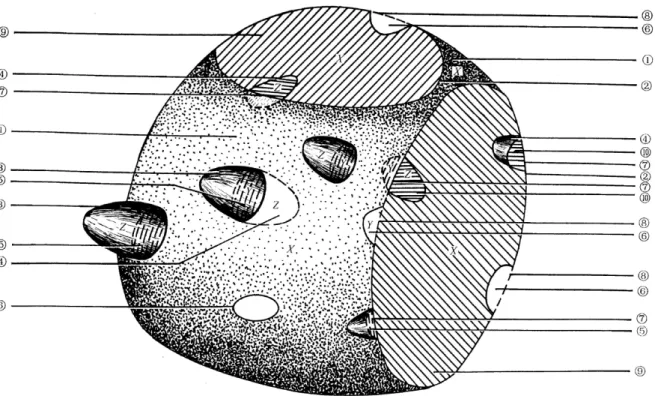
containing surface intersecting with 3D structure (Fig. 1e,f) is defined in the paper as curve profile (Fig.1g,h). Let Z be a 3D structure and X a containing surface, then the curved intersection:
Y
=
Z
Iδ
X
(1)is called a curve profile. Based on the features of Z, volumic or unvolumic (or shell), which intersect with the containing surface, the curve profiles can be divided into two kinds: the solid curve profile (Fig1g) and the empty curve profile (Fig. 1h) whether Z is a volumic or unvolumic (or shell) structures. The curve profiles formed by desmosomes or hemidesmosomes intersecting with cell membrane are just a solid curve profiles. And the nucleopores are empty curve profiles.
Fig. 1. Show containing surface of X c, containing curve lines (d formed by containing surface intersecting with
Definition 3: The intercept formed by a curve
profile intersecting with a 2D plane was defined as curve intercept (Fig. 1i,j). Check the distribution of section as IUR, and let T2 be a planar probe (DeHoff
RT, 2000), then the intersection
[
]
2 2
Y
IT
=
Z
Iδ
X
IT
(2)will be called a curve intercept (empty or solid). If a solid curve profile intersecting with a 2D plane, the corresponding curve intercept is named as solid curve intercept (Fig. 1i), and if an empty curve profile intersecting with a 2D plane, the corresponding curve intercept, which is invisible in fact, is named as empty curve intercept (Fig. 1j).
Definition 4: The length of curve intercepts in unit
length of containing curve, when X being a 2D set, is defined as the curve intercept density (CID), i.e.:
[
]
{
}
[
]
{
22}
L Y
T
CID
L
δ
X
T
=
∑
∑
II (3)In Eq. 3, L denotes the length of curves. The formula can rewrite as:
CI C
L
CID
B
=
∑
∑
(4)In the formula, LCI is the length of curve intercepts,
BC is the boundary length of containing curve, which
can be membrane like structure, in 2D section. It is clear that CID is a parameter with no physical unit.
Definition 5: Let V(X) be the volume of the
containing space bounded by a curved spatial surface, then the amount of curve profiles surface area of Y, S (Y) or CPA, in unit volume of containing space is defined as the curve profile area density (CPAV), that is:
( )
( )
V
S V
CPA
V X
=
(5)The unit of CPAV may be cm
2
/cm3, mm2/mm3,
µm2/µm3, etc..
Definition 6: The amount of intersections of
intercepts from subset Y in containing curve intersecting with test line in unit intersections of containing curve intersecting with test line is defined as intersection density in containing intersection, or intersection density relied on intersection reference, represented by II. Check the distribution of test lines in
3D IUR distribution and let T1 be an IUR probe line and
I denotes the number of intersections. Then:
[
]
{
}
[
]
{
11}
I
I Y
T
I
I X
T
=
∑
∑
I
I (6)
is intersection density in containing intersection, or intersection density relied on intersection reference. The formula can be rewritten as:
Y I
C
I
I
I
=
∑
∑
(7)In the formula, IY is the amount of intersections of
intercepts from subset Y in containing curve intersecting with test line; IC is the amount of
intersections of containing curve intersecting with test line.
According to the definition of II, the amount of
intersections of curve intercepts (or curve profiles) in containing curve (or surface) intersecting with test line in unit intersections of containing curve (Fig. 1d, or containing surface of Fig. 1c) intersecting with test line, is named as curve intercept intersection density relied on intersection of containing curve (containing intersection), or curve profile intersection density in surface, represented by IIS in the paper. That is:
(
)
{
}
[
]
{
2 1}
1IS
I
Y
T
T
I
I X
T
=
∑
∑
I I
I (8)
So, IIS can be calculated by:
CI IS
C
I
I
I
=
∑
∑
(9)In the formula, ICI is the intersections of curve
intercepts (or curve profiles in 2D section) intersecting with test line, IC is the intersections of containing curve
intersecting with test line.
Definition 9: The amount of curve profile area
(S(Y) or CPA) in unit surface area of containing surface, S(X) or SC, is defined as curve profile area
density in surface, represented by AS. The definition
formula is that:
( )
( )
S
S Y
A
S X
=
(10)S C
CPA
A
S
=
(11)It is clear by above formula that AS is a parameter
with no physical unit. Because CPA and SC are hardly
to measure or get directly from 3D under microscope, the key question is how to test AS based on 2D section?
The following deduction is to solve this problem.
Dividing separately numerator and denominator of Eq. 11 by VC, containing space volume, then we can get
that:
/
/
C V S
C C V
CPA V
CPA
A
S
V
S
=
=
(12)In the formula, SV is the surface density for the
containing curve (or containing surface) itself, or
S(X)/V(X) for the ratio of surface to volume of a set of X, i.e.: the amount of containing surface area in unit
containing space volume, or the ratio of surface area of containing curve to the volume of containing
space. Based on the principle and methods of stereology (Weibel, 1979, 1980; Collan, 1984; Shen and Shen, 1991; Howard and Reed, 1998):
( )
( )
{
{
(
(
11)
)
}
}
{
{
(
(
22)
)
}
}
42
V
I X T B X T
S X
S
V X L X T A X T
δ δ
π
= =
∑
=∑
∑
II∑
II (13)or:
2
C4
CV
C C
I
B
S
L
π
A
=
∑
=
∑
∑
∑
(14)In the formula, X is the containing space and δX its
boundary; LC is the length of test line in containing
space; IC is the numbers of intersections of containing
curve (including the part of curve intercepts) intersecting with test line; AC is the area of containing
space in 2D plane; BC is the length of boundary or curve
line of the containing surface in 2D slices. Because
CPA, the curve profile area, is a part of surface area in
containing surface, SC, therefore the curve profile area
density can be calculated similar as surface density, that is:
( )
( )
{
{
(
(
11)
)
}
}
{
{
(
(
22)
)
}
}
4
2
V
I Y
T
B Y
T
S Y
CPA
V X
L X
T
π
A X
T
=
=
∑
=
∑
∑
II∑
II (15)or:
2
CI4
CI VC C
I
L
CPA
L
π
A
=
∑
=
∑
∑
∑
(16)In the formula, LCI is the length of curve intercepts of Y phase. By taking formula (13), (15) and (16) into
formula (12), we can get that:
( )
( )
( )
( )
(
)
{
}
(
)
{
}
(
)
{
}
(
)
{
}
(
)
{
}
(
)
{
}
(
)
{
}
(
)
{
}
(
)
{
}
(
)
{
}
(
)
{
}
(
)
{
}
1 21 1 2 2
1 1 2 2
1 2 4 2 4 2 V s V
I Y T B Y T
S Y
L X T I Y T A X T B Y T
V X CPA
A
S X
S I X T I X T B X T B X T
V X L X T A X T
π
δ δ δ
π = = = = = =
∑
∑
∑
∑
∑
∑
∑
∑
∑
∑
∑
∑
I II I I I
I I I I
I I
(17)
The above formula can be rewritten as:
2
/
2
/
CI C CI S
C C C
I
L
L
A
I
L
L
=
∑ ∑
=
∑
∑ ∑
∑
(18)(
)
(
)
4
/
4
/
CI C CI S
C C C
L
A
L
A
B
B
A
π
π
=
∑
∑
=
∑
∑
∑
∑
(19)It is clear that curve profile area density in surface is equal to the value that the intersections of curve
by the intersections of containing curve intersecting with test line, and also equal to the value that the length of curve intercepts of subset Y divided by the length of containing boundary (or containing curve line) in 2D plane. So the key formula for AS is that:
S IS
A
=
I
=
CID
(20)intersection density in surface), and equal to the curve intercept density.
EXAMPLE FOR TESTING
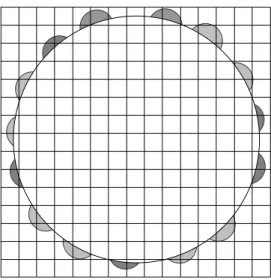
Fig. 2 is an example for calculating curve profile area density in surface. Now let us use the square lattice test system to test AS of the particles in the sphere
surface on 2D plane. First, counting IC, the intersections
of sphere surface (or the boundary of circle in 2D) intersecting with test line in horizontal and longitudinal directions. It is 56; Secondary, counting ICI, the
intersections of curve profiles (which show as curve intercepts in 2D, and are formed by the shadow particles intersecting with sphere surface), intersecting with test line in horizontal and longitudinal directions, it is 34; Finally calculating AS by formula (18), i.e.:
AS = 34/56 = 60.7%. If we want to use formula (19) to
calculating AS of the shadow particles in the sphere
surface, the entire length of containing curve (or the perimeter of the circle in 2D plane) should be measured or calculated by the diameter of the circle (or by image analysis system) first, it is 18.21 cm. Then, measure the lengths of curve intercepts of the shadow particles intersecting with the circle boundary one by one and sum the lengths, it is 11.28 cm in total. Finally
calculating AS by formula (19), i.e.:
AS = 11.28/18.21 = 61.8%. The results are close each
other by aforesaid two methods. If we increase the sample size, the practical testing results will tend to be same by these two kinds of methods.
Fig. 2. An example for test of curve profiles area
DISCUSSION
1. About the correction for tissue shrinkage. Let the shrinkage coefficient of the curve spatial surface 3D tissue (X) be fS,S, the shrinkage coefficient of
subset Y, which are formed by a 3D structure Z intersecting with X, be fS,CPA, AS’ and AS be the
curve profile area density in surface before and after tissue shrinkage correction. By the general correcting method for tissue shrinkage (Shen 1997, Shen and Shen 1991), we can get that:
( )
( )
2 2 2
, , ,
'
2 2 2
, , ,
S CPA S CPA S S
S S
S S C S S S CPA
S Y f CPA f f
A A
S X f S f f
− −
− −
= g = g = g
g g (21)
If the coefficients of the two intersecting tissues are equal to each other, i.e.: fS,S = fS,CPA, then:
'
S S
A
=
A
(22)This means that it is not necessary to make correction to the parameter of AS for the tissue
shrinkage if the shrinkage degree is same for these two intersecting tissues. In fact, as we know that curve profiles area is a part of containing surface, so we can reasonably suppose that: fS,S = fS,CPA , or fS,S ≈ fS,CPA.
Then we can get AS directly by formulas (18) or (19).
The test method for the coefficient of tissue shrinkage is as same as that in Weibel's book (1979).
2. About the application for the parameter of AS. AS
pulmonary alveoli, or by synaptic vesicle in unit surface area of presynaptic membrane, etc. All above can be quantitatively described with the parameter of AS.
3. About empty curve profile. By the definition of empty curve profile, any holes in membrane or membrane like structures could be considered as empty curve profiles. Glandular duct mouthes of all kinds of exocrine glands in surface of mucosa or skin, nuclear pores, alveolar pores and capillary pores etc. are just the examples of empty curve profiles. Empty curve profiles in 2D plane express as a structureless (hole or pore like structures). So we can’t see any empty curve intersections actually, but an empty area, holes or pores or mouth, maybe with a boundary. The empty curve intercepts in 2D show as an interrupted or divided intercepts. In fact, it is also invisible. Therefore when a test line passing through this kind of empty area, interrupted or divided intercepts, it should be counted as an intersection with curve intercepts.
4. It is necessary to emphasize that the reference systems of curve profile area density in surface, curve intercept density, curve profile intersection density in surface (or curve intercept intersection density relied on intersections of containing curve), are separately the correspondent surface area of containing surface, the length of containing curve line, and the intersections of containing curve (or curve line) with test lines. The essential difference between the curve profile area density in surface and the curve profile area density depend just on the references system or containing space. The reference for the former is the containing surface, but that for the latter is the volume of containing space. The general used intersection density is different from the intersections density in containing intersection (or intersection density
relied on intersection reference) just in containing system (or reference system) and physical unit. The intersection density, IL , employ the length of test
line in containing space in 2D for its reference system and its physical unit is numbers per mm or
µm (Weibel, 1979, 1980; Collan, 1984; Shen and Shen, 1991; Howard and Reed, 1998). But the intersection density in containing intersection, II,
employ the intersections in containing curve intersecting with test lines for its reference system with no physical unit.
ACKNOWLEDGEMENT
The study was partly supported by National Natural Science Foundation of China.
REFERENCES
Collan Y et al (1984). Stereology and morphometry in pathology. Kuopio: Kuopio University Press, 21-4. Howard CV, Reed MG (1998). Unbiased stereology:
three-dimensional measurement in microscopy. New York: Springer-Verlag New York Inc., BIOS Scientific Publishers, 107-18.
DeHoff RT (2000). Populations, samples, measurements and relations in stereology. Image Anal Stereol 19:1-8. Shen H, Shen ZY (1991). Practical technique for
biostereology. Guangzhou: Zhongshan University Publishing House, 80-86 (in Chinese).
Shen H (1997). Correcting methods of error for surface density, surface area and the ratio of surface area to volume due to tissue shrinkage: discussion with Weibel’s approach. E J Pathol 3.4:974-06.
Weibel ER (1979). Stereological methods. Vol.1, Practical methods for biological morphometry. London: Academic Press, 31-122, 152-153