Finno-Ugric Languages and Linguistics Vol. 8. No. 1. (2019), 2–35. http://full.btk.ppke.hu ISSN: 2063-8825
Rose Thomas
1 Comparison in Finnish
In Finnish, there are two structures for comparatives. One uses the complementiser kuin, followed by the standard of comparison in the Nominative case.1 The other has the
standard of comparison in the Partitive case (one of two object cases in Finnish – the other is the Accusative), places it before the adjective, rather than after, and there is no complementiser present.2
1 The following abbreviations are used in this paper: 1 = first person, 2 = second person, 3 = third person, ABE = Abessive, ABL = Ablative, ACC = Accusative, ADE = Adessive, COMP = Comparative, ELA= Elative, ESS = Essive, GEN = Genitive, ILL = Illative, INE = Inessive, INF2 = second infinitive, INF3 = third infinitive, LOC = Locative, NEG= Negative, NOM = Nominative, PART = Partitive, PAST = Past Tense, PASTpcle = Past Participle, PERF = Perfective Aspect, pl = Plural (nominal), PL = Plural (verbal), SG = singular (verbal), TRANS = Translative.
2 The word kuin is generally translated as English than in comparatives, which is treated as a preposition in Pancheva (2006). It is also suggested that than is a preposition in Chomsky (1977), and Hankamer(1973) at least in phrasal comparatives. This is understandable in English as it can be followed by pronouns marked with Objective case, e.g than me. Many languages do in fact use prepositions as markers of comparison, for example Polish and Bulgarian (Pancheva 2006) and Greek (Merchant 2009, 2012). There are, however, no overwhelming reasons for regarding kuin as a preposition in Finnish (for example it is never followed by DPs in one of the object cases). If it is correctly analysed as a complementiser, its likely location is ForceP, the highest level of Rizzi’s (1997) split CP. The degree operator is presumably moved to a lower level of a split CP, most likely the specifier of FocP, the likely landing site for a wh-operator.
Kuin can also be used in equative constructions in Finnish (so than is not an exact translation of the word), where it is also followed by a Nominative, which again indicates that its complement is an IP.
(i) Pekka on yhtä vanha kuin Mikko. Pekka is as old as Mikko
The following paper will investigate a type of Finnish comparative construction in which the standard of comparison is marked with Partitive case, and is placed before the comparative adjective, without any comparative complementiser present. This structure is identical to the well-known Ablative of Comparison, familiar from Latin and many other languages. As the Finnish Partitive is known to derive historically from an Ablative case, an account of the Comparative Partitive requires both a synchronic and diachronic perspective. The modern uses of the Partitive as a case of quantification will be considered, as well as its historical development. Then the question will be approached diachronically, dealing with how the Partitive developed from the earlier Ablative case, and how in consequence, Finnish Comparative Partitives developed from Ablatives of Comparison. It will be shown that the use of the Partitive in such structures accords with other uses of the Partitive.
The two structures are illustrated below:
(1) a. Mikko on vanhe-mpi kuin sinä.
Mikko.NOM is old-COMP than you.NOM ‘Mikko is older than you.’
b. Helsinki on suure-mpi kuin Turku. Helsinki.NOM is large-COMP than Turku.NOM ‘Helsinki is larger than Turku.’
c. Pekka on pite-mpi kuin minä.
Pekka.NOM is tall-COMP than I.NOM ‘Pekka is taller than me.’
d. Mikko on sinua vanhe-mpi.
Mikko.NOM is you.PART old-COMP ‘Mikko is older than you.’
e. Helsinki on Turku-a suure-mpi.
Helsinki.NOM is Turku-PART large-COMP ‘Helsinki is larger than Turku.’
f. Pekka on minua pite-mpi.
Pekka.NOM is I.PART tall-COMP ‘Pekka is taller than me.’
The sentences in (1a–c) pose no particular problem. Comparatives can be of two types, conventionally called clausal and phrasal, as illustrated by the English pair below (we will return to the Finnish examples later):
(2) a. John is taller than I am. (clausal)
b. John is taller than me. (phrasal)
Clausal comparatives contain the elements of a clause (e.g the tensed verb in (2a)), as the complement of the marker of the standard of comparison, with a gap where the adjective tall has been elided (i.e. John is taller than I am tall). Phrasal comparatives consist of a single DP (on the surface). It may be asked how we make the distinction between clausal and phrasal comparatives in Finnish, as in all the examples (1a–f) there is only a DP present. However, the Nominative case on the standard of comparison in (1a–c) makes it clear that the remnant is in the specifier of an IP (which I will treat for convenience as a single projection, without splitting it into components such as NegP, TP, etc, in the manner of Holmberg et al. 1993). Unlike in English, the DP is not followed by a verb. This indicates that in Finnish, the entire projection containing the finite verb is elided (Bacskai-Atkari & Kantor 2012) while in English only the AP is.3 Kuin- comparatives thus make
sense in terms of the reduced clause analysis (e.g. Heim 1985, Hackl 2000 Lechner 2001,
2004), which considers that when only a single phrase is present, the complement of the marker of the standard is indeed a clause with all except one item deleted.
So it is reasonable to regard examples (1a–c) as reduced clausal comparatives. The structure of clausal comparatives is fairly well-understood. A wh-operator binding a degree variable (Heim 2000, Pancheva 2006) is moved to (spec, CP), and the adjective is elided. Of course, if the standard marker is itself a complementiser, then we must use some form
of split CP. I will use Rizzi’s (1997) split CP, make the standard marker the head of Force P, and move the operator to (spec, Foc). Thus, a sentence like (2a) has the following LF (leaving out unnecessary projections):
(3) John is taller [ForceP than [FocP whi [IP I am [AP di-tall]]]]
In PF, the AP is deleted under identity with the matrix predicate, a process referred to by Bresnan (1973) as Comparative Deletion.4 In Standard English the wh-operator is of
course non-overt.5 A movement-based approach to Comparative Deletion has developed
since the 1970s. Chomsky (1977) suggested that it was a special case of wh-movement, and this is further developed in Kennedy (2002), where it is overt movement of the degree operator along with the full AP to the specifier of the CP which is the complement of than. The entire constituent is then deleted under identity. In any case, there is deletion under identity, so for the kind of adjectival comparatives we are dealing with, the final PF is the same.
The suffix -er is the PF of a degree quantifier, which (using (2a) as an example) relates the set of degrees to which John is tall to the set of degrees to which I am tall. The LF of this degree quantifier will henceforth be represented as [–ER]. Other LFs will also be represented as capitals in square brackets.
Examples (1d–f) are clearly phrasal comparatives. Phrasal comparatives are less well-understood than clausal comparatives (Pancheva 2006). The reduced clause analysis has already been mentioned, and regards all phrasal comparatives as simply DP remnants of full, tensed clauses. However, this analysis cannot be correct for examples (1d–f). They cannot be subject remnants of a tensed clause as they are not Nominative, no complementiser is present, and they are marked with an object case, although they are not objects. Similar arguments apply to (2b) – “me” cannot be the subject remnant of a tensed clause in Standard English.
One possibility is the direct analysis (e.g. Hankamer 1973, White 1998, Merchant 2009), which considers that the standard of comparison is simply a DP. In the analysis which follows, it would make no difference to the case on the standard of comparison if it was a DP. Nonetheless this is semantically problematic as it makes one of the arguments of [–ER] a set of individuals, instead of a set of degrees. It is therefore preferable that the complement of [–ER] is a clause of some sort, though it must be one that is transparent
4 It is not necessarily always the case that an AP is deleted under identity. For example, if the adjective in the standard of comparison is contrastive, it will not be deleted:
(i) This door is wider than that one is high, and what’s more it’s wider than that one is WIDE.
Contrastive APs will not be considered here.
5 There are languages in which it may be overt, e.g. Bulgarian:
(i) Marija e po-visoka ot (kolkoto e) Ivan.
Maria is COMP-tall from (how much is) Ivan
‘Maria is taller than Ivan is.’ (example taken from Pancheva 2006)
to case-marking from outside. Pancheva (2006) argues that this is a small clause, and this will be assumed without further justification here.6 That is, the structure of (2b) is:
(4) John is taller [ForceP than [SC me [AP di-tall]]]
On this analysis, a phrasal comparative is still a reduced clause, but not a tensed one, and one where only a subject can be a remnant. It is quite possible for Partitive case, as well as Accusative case, to occur on the subjects of small clauses in Finnish, with a predicate generally bearing the Essive (‘as’) or Translative (‘change of state’) case, as the following examples show (the small clause is in square brackets):
(5) a. Hän piti [itse-ä-än tärkeä-nä].
S/he.NOM regarded [self-PART-3SG important-ESS] ‘S/he regarded [her/himself as important].’
b. Hän kutsui [minua ystävä-ksi].
S/he.NOM called [I.PART friend-TRANS] ‘S/he called [me a friend].’
So there is no particular problem in making the standard a small clause. But there are still two questions to be asked about (1d–f). Firstly, no complementiser, adposition, or verb is present so how does the DP get its case? Secondly, how is the word order to be accounted for?
To understand this, it will be necessary to consider the historical development of the Partitive, seeing how it acquired its use in modern Finnish. The phenomenon of the Comparative Partitive will be seen to be a special case of the general development of the Partitive, explicable in terms of the diachronic development of this case. Thus, it is an example of the importance of introducing diachronic considerations into the study of certain synchronic syntactic phenomena (Madariaga 2017).
The paper will be structured as follows. First an account will be given in Section 2 of the modern functions of the Partitive case, and then an account of its historical development from a Finno-Ugric Ablative case. Comparative Partitives such as (1d–f) will be shown to be structurally identical to the well-known Ablative of Comparison, and it will be argued that the structure is in fact a survival from the time when the Partitive suffix was still an Ablative case, and when head-final word order was still the norm for all the
6 Aarts (1992) argues that it is possible for complete small clauses to occur after than (which he also treats as a preposition)in English, as in the following example:
(i) The oven off is less dangerous than [the oven on]. (Aarts 1992: 78)
It could be argued that this actually means ‘the oven off is less dangerous than [the oven on is dangerous]’, that is, the oven on is the small clause subject remnant of a reduced clause. How does it work with a pronoun that can be marked with Objective case? The following seems acceptable to me:
(ii) John’s depressed again, but that’s better than him in a temper.
Ugric languages. There will be a brief consideration of the syntactic structure of comparatives, showing that the comparative clause is a sister of the degree quantifier. Section 3 will then consider the concept of Partitive adpositions (and cases which have the same function as adpositions), and their role in comparatives, while Section 4 will take a diachronic perspective and consider how the modern Finnish Comparative Partitive has derived historically from the Ablative of Comparison. Section 5 will be a conclusion.
2 Function and development of the Partitive case
2.1 Modern functions of the Partitive
In modern Finnish, the Partitive on the object of a verb indicates atelicity (sometimes called irresultativity), while the Accusative indicates telicity (Denison 1957, Heinämäki 1984, Kiparsky 1998, Thomas 2003). The Accusative on a direct object often translates the English definite article the, while the Partitive translates some or a bare plural/mass noun.
(6) a. Kissa joi maido-n. cat.NOM drank milk-ACC ‘The cat drank the milk.’ b. Kissa joi maito-a. cat.NOM drank milk-PART ‘The cat drank (some) milk.’ c. Poika söi omena-t. boy.NOM ate apple-ACCpl ‘The boy ate the apples.’ d. Poika söi omen-i-a. boy.NOM ate apple-pl-PART ‘The boy ate (some) apples.’
(7) a. paljon / vähän maito-a much / a.little milk-PART ‘much/a little milk’
b. paljon / vähän / useita / kaksi / kolme omen-i-a many / a.few / several / two / three apple-pl-PART ‘many/a few/several/two/three apples’
Partitive case on a direct object also indicates the aspectual distinction between Perfective and Imperfective aspect.
(8) a. Poika luki kirja-n.
boy.NOM read book-ACC ‘The boy read the book.’
b. Poika luki kirja-a.
boy.NOM read book-PART ‘The boy was reading the book.’
Finally, the objects of negative sentences are Partitive.
(9) Poika ei luke-nut kirja-a.
boy.NOM NEG.3SG read-PASTpcle book-PART
‘The boy didn’t read the book.’
The data above indicate that Partitive case is licensed by the weak quantifiers (Thomas 2003), either an overt quantifier as in (7a–b), or a covert existential quantifier in the case of bare Partitives, which dominates the VP and which is identified with Heim’s (1982) operator of existential closure by Thomas (2003). The aspectual use of the Partitive can be accounted for on this hypothesis as existential quantification in the temporal domain. Partitive Genitives in the Slavic languages also provide evidence that quantifiers license case – some examples of them will be seen below in Sections 2.3 and 3.1.
2.2 Historical development of the Partitive
It is well-known that the Partitive suffix -(t)A is derived from the proto-Finno-Ugric Ablative (sometimes called Separative) suffix -tA,7 and originally meant ‘’from’ (Collinder
1957, Hajdu 1975, Larjavaara 1991, Abondolo 1998, Campbell 2013, Lees 2015). This fact is now well-established. An outline of its historical development is given below.
At some point, apparently in the Finno-Permian period,8 two cases began to develop
from the old Ablative (Baker 1985, Ylikoski 2011, Aikio & Ylikoski 2016). One was formed by placing the morpheme -s before -tA, the other by placing -l before -tA, with ‘internal’
7 The Finno-Ugric languages have vowel harmony, which goes back to the parent language (proto-Finno-Ugric), so suffixes change their vowel depending on the vowels in the stem they are attached to. The use of A indicates a vowel that can be realized as either the low front vowel /æ/ or the low back vowel /a/.
and ‘external’ meaning respectively – that is, the ‘internal’ case is used for movement ‘out of’ an enclosed space, and the ‘external’ case for movement ‘from’ a surface or vicinity.9
In modern Finnish these are called the Elative and Ablative cases. They are illustrated below.
(10) a. Aino otti sormukse-n rasia-sta. Aino.NOM took ring-ACC box-ELA ‘Aino took the ring out of the box.’ b. Lintu lensi kato-lta.
bird.NOM flew roof-ABL ‘The bird flew from the roof.’
The development of the internal and external cases left the original suffix without its directional meaning. However, it had started to be used with a quantificational meaning as early as the Volgaic Finnic period with certain verbs (Larjavaara 1991, Kiparsky 1998). This stage of development can be seen in the Mordvinian languages. Here the suffix can still be used with Ablative meaning but also occurs on the objects of certain verbs, such as those of eating and drinking. In this usage, it must have originally indicated ‘a part from’. It also occurs after quantifiers such as ‘a lot of’.
(11) a. Jarsa-n kal-do, sima-n vet-te. (Mordvin) eat-1SG fish-ABL drink-1SG water-ABL
‘I’m eating fish, I’m drinking water.’ b. Tasa lama penga-da.
here a lot of firewood-ABL
‘There’s a lot of firewood here.’ (examples taken from Kiparsky 1998)
In Baltic Finnic and Saamic the suffix came to be used with a quantificational meaning alone, although in the Saamic languages it is now used only in Inari Saami (Nelson & Toivonen 2003) and Skolt Saami (Feist 2015), and even in these languages it is becoming moribund.10 Eventually its use was extended in Baltic Finnic to indicate imperfective
aspect, giving us the state of affairs that exists in modern Finnish. The suffix is sometimes still found with its original meaning in such fossilized expressions as kotoa, ‘from home’ and ulkoa, ‘from outside’.
9 The ‘external’ and ‘internal’ markers -l and -s are also found in cases which indicate location and movement towards. These need not concern us here. The -l cases may not have had a wholly directional/locational meaning until the Baltic Finnic period (Baker 1985, Aikio & Ylikoski 2016).
10 It is used after numerals larger than six in Skolt Saami, and after other weak quantifiers, for example:
(i) Toʹb mij mäŋgg eeʹǩǩed leeiʹm.
there we many year.PART be.PAST.1PL
‘We were there for many years.’ (example taken from Feist 2015)
2.3 The Ablative of Comparison
Now let us return to Comparative Partitives. Structurally, (1d–f) recall the well-known ‘Ablative of Comparison’, familiar from Latin and many other Indo-European, Uralic and Altaic languages. Some examples are shown below:
(12) a. Caesar est longior illo viro. (Latin) Caesar is tall.COMP that.ABL man.ABL
‘Caesar is taller than that man.’
b. Caesar est Cicerone eloquentior. Caesar is Cicero.ABL eloquent.COMP ‘Caesar is more eloquent than Cicero.’
c. Manas-o yo jav-i:ya:n. (Sanskrit)
mind-ABL which swift-COMP
‘That which is swifter than the mind.’
d. Pa:p-i:ya:n aśva:d gardabhah.
bad-COMP horse.ABL ass
‘The ass is worse than the horse.’
e. Ankara Istanbul-dan daha küçük . (Turkish)
Ankara Istanbul-ABL more small ‘Ankara is smaller than Istanbul.’ f. Ahmet Beril-den daha uzun. Ahmet Beril-ABL more tall ‘Ahmet is taller than Beril.’
g. Zarńi azveś-leś duno-ges. (Udmurt)
gold silver-ABL valuable-COMP ‘Gold is more valuable than silver.’
h. Ta-leś badźym u-d luy.
that-ABL big NEG-2SG become
‘You will not become bigger than that.’
The Latin examples are the author’s own. Examples (12c–d) are from the Rig Veda (1.183) and the Taittiriya Samhita respectively. The Turkish examples are from a native speaker informant. Examples (12g–h) are from Stolz (2013: 112–113). A comparative marker is optional in Udmurt.
The Ablative of Comparison illustrates the ‘source’ schema, a common strategy for forming comparatives across languages (Stolz 2013). Here, the relationship between the two compared entities is modeled on the spatial relationship of moving away from a source, as though the standard is a point of origin from which the compared entity moves away. That is, in a sentence like John is taller than me, the maximum degree to which I am tall is treated as a point of origin, and the degree of tallness by which John exceeds this is treated as though it has moved away from that point of origin.
The standard of comparison may be before or after the adjective, depending on the normal word order for the language. Latin historically showed a preference for SOV word order, but otherwise had many of the features of a head-initial language, such as prepositions and adjectives which follow nouns (Bauer 2009). The Latin Ablative of Comparison can occur both before and after the adjective, as seen in structures such as (12a–b), which is compatible with the ‘mixed’ word order of Classical Latin. Similar considerations apply to Sanskrit, believed to be underlyingly head-final (MacDonell 1916, Hock 2015), but which like Latin frequently showed a ‘free’ word order. We see the Ablative of Comparison before the adjective in (12c) and after it in (12d). Turkish is strongly head-final (Lewis 2001), therefore we find the Ablative of Comparison before the adjective. Historically, the Finno-Ugric languages were head-final and this remains the norm in the eastern branches of the group, so we find the standard before the adjective in Udmurt. The Baltic Finnic and Saamic branches now show a preference for SVO word order, but they still maintain many head-final structures (Campbell & Harris 1995). The same is true of the Mordvinian languages. Vilkuna (1998) points out that a recent decrease in SOV order can be seen in 19th century folklore texts, so the move to SVO is fairly recent
in these languages. They still use the Ablative case to mark comparison, and the standard is placed before the adjective, as in the following example:
(13) Son kelazden-d’a xitraj. s/he fox-ABL clever
‘S/he is cleverer than a fox.’ (Stolz 2013: 104)
An interesting parallel with Finnish, except for the word order, is found in Russian, where, as well as clausal comparatives like (14a), it is possible for a Genitive-marked expression to occur as the standard of comparison after a comparative adjective, as in (14b). The Genitive case in Russian and many other Slavic languages parallels the use of the Partitive in Finnish, as it can be used to indicate a partially affected object.11
(14) a. Anna vyše čem Ivan. Anna tall.COMP than Ivan.NOM ‘Anna is taller than Ivan.’
b. Anna vyše Ivan-a.
Anna tall.COMP Ivan-GEN
‘Anna is taller than Ivan.’12 (examples from Pancheva 2006)
11 For example:
(i) Ivan vy-pil moloko/ moloka.
Ivan PERF-drink milk.ACC/milk.GEN ‘Ivan drank the milk/some milk.’
However, the Genitive case is not used to indicate Imperfective aspect, as this is shown by verbal morphology in Russian.
The standard of comparison is after the adjective, as Russian is a head-initial language.
Now, if we recall that the Partitive was originally an Ablative case, it is clear that the structure in (1d–f) has developed from the Ablative of Comparison and dates back to the time when the suffix -(t)A was an Ablative case. The word order can also be understood on this hypothesis. Placing a standard of comparison before the comparative adjective is characteristic of head-final languages (Campbell & Harris 1995), and it is uncontroversial that the proto-Finno-Ugric language was such a language (Campbell & Harris 1995, Vilkuna 1998, Campbell 2013). Many modern Finno-Ugric languages are moving towards SVO word order (Vilkuna 1998, E. Kiss 2013, Asztalos 2016), but as already mentioned, SOV word order remains common in the eastern branches of the family. Today, Finnish shows a ‘mixed’ word-order, with a preference for SVO, although structures that are characteristic of SOV languages are still common. For example, approximately 80% of adpositions are postpositions (Vainikka 1993, Campbell & Harris 1995, Vilkuna 1998), and adjectives and genitives are routinely placed before nouns. It is also possible for relative clauses to be positioned before the nouns they modify, though this is not common in the modern language. When they occur before the noun, they have the structure shown in (15b). The structure with the relative pronoun in (15a) does not occur before the noun. So the following structures are both possible for relative clauses:
(15) a. Tämä on auto joka on pudonnut joke-en. this is car which is fallen river-ILL ‘This is a car which has fallen into the river.’
b. Tämä on joke-en pudonnut auto.
this is river-ILL fallen car
‘This is a car which has fallen into the river (literally: this is an into-the-river- fallen car).’
It is also possible for Comparative Partitives to appear before nouns as modifiers. This is also compatible with head-final structure.
(16) Mikko on minua vanhempi poika.
Mikko is I.PART older boy
‘Mikko is a boy older than me.’ (literally: ‘a than-me-older boy’)
Such considerations might indicate that Comparative Partitives are a mere fossilisation from an earlier stage of the language. However, the structure is still productive in modern Finnish (unlike genuine fossilisations such as kotoa, ‘from home’ and ulkoa, ‘from outside’, where the suffix still has Ablative meaning even though it does not occur with that meaning in any other circumstances). This indicates that the occurrence of Partitive case in Comparative Partitives should be understood in the same way as the other occurrences of the Partitive, that is, as a case licensed by a weak quantifier.
a small clause.13 From a diachronic perspective, it is possible to see how the development
of the Partitive case itself enabled the Comparative Partitive to develop from the Ablative of Comparison. This necessarily involves historical reconstruction, as there are no extensive written works in Finnish prior to the 16th century (Lees 2015). But first, some
consideration should be given to the syntactic structure of comparatives.
2.4 The structure of comparatives
First, let us consider what the structure of a sentence like the following is:
(17) Mikko on minua vanhempi.
Mikko is I.PART older ‘Mikko is older than me.’
A comparative adjective remains an adjective, so I will assume that it plays the role of a predicate in a Predicate Phrase (PredP). This phrase is the complement of I, the head of IP (here treated as a single projection). Let us illustrate this structure with an example with a bare adjective:
(18) Mikko on vanha. Mikko is old ‘Mikko is old.’
IP
spec I
I PredP
spec Pred
Pred XP
Mikko on vanha
Figure 1: The structure proposed for example (18)
The subject Mikko will raise to (spec, IP) from the specifier of PredP, and the copula ole-, ‘be’ (on is its third person singular) will raise to I. The adjective is the complement of the predicator head of PredP, and is here shown as an XP. Naturally, when we are dealing with a bare adjective, XP is an AP. The question is, what is it when a comparative adjective and a standard of comparison is present?
There is considerable debate regarding the structure of comparatives (Bresnan 1973, White 1998, Kennedy 2002, Lechner 2004, Schwarzschild 2008, Bacskai-Atkari 2014, Moryzcki 2015). However, it is widely considered that the comparative clause and the degree quantifier [–ER] form a constituent, a Degree Phrase (DegP). There are considerable arguments for this; some account of them will be given below, and of the different approaches to the structure of comparatives more generally. In Section 4, it will be seen that the solution to the problem of the Comparative Partitive depends on the existence of a Degree Phrase.
The degree quantifier relates two sets of degrees, those to which the subject of the matrix clause has a certain property, and those to which the subject of the comparative clause has the property. Therefore the comparative clause must be an argument of [–ER] (Heim 2000, Bhatt & Pancheva 2004, 2007). Furthermore, in both clausal and phrasal comparatives, selectional restrictions hold between the degree head and the marker of the comparative clause or the case which occurs on its subject (similar arguments apply to equatives).14 For example in English, the degree head, -er/more selects than to introduce a
comparative clause. In Finnish, as we have seen, the comparative suffix -mpi selects either kuin or a Partitive. Selectional restrictions hold between heads and complements (Chomsky 1965), so we can conclude that the comparative clause forms a constituent with the degree quantifier. Finally, in Ablatives of Comparison, the fact that a semantic case occurs on the standard of comparison shows that this standard must be a sister of the case-licensing adposition. Furthermore, the degree head and comparative clause together can take scope independently of the matrix adjective. Many examples can be found in Heim (2000). Although the degree head and the standard form a constituent, morphologically the degree head is usually found attached to the adjective or adjacent to it. This indicates that the standard usually extraposes in comparatives – this can clearly be seen in English analytic comparatives such as (19), as opposed to (20).
(19) This book is more interesting than that one. (20) *This book is more than that one interesting.
It is usually considered that extraposition takes place for scope-related reasons (Bhatt & Pancheva 2004, 2007, Alrenga, Kennedy & Merchant 2012), and the position of the extraposed item corresponds exactly to the scope of the degree quantifier. With regard to the problem under consideration here, we need not worry about extraposition. In a head-initial language it is most likely to be rightwards, and in a head-final language (which the Volgaic Finnic languages were when the structure we are concerned with originated), it is most likely to be to the left. Therefore, it will not lead to any difference between ‘surface’ structure and underlying structure.
The position of the comparative adjective with respect to the degree clause is not certain. Bresnan (1973) assumes that the degree phrase is an argument of the adjective (this
14 In equatives, the degree head as selects another as to introduce the subclause. For example:
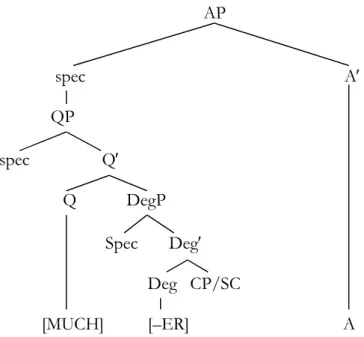
is also argued by Heim 2000, Hackl 2000, Bhatt & Pancheva 2004, Pancheva 2006, Bhatt & Pancheva 2007). Her paper was written in a different theoretical framework than that which exists now, and adapted to a modern formulation, the DegP is in the specifier of AP, and is dominated by a quantifier phrase (QP). Bresnan (1973) considers this quantifier phrase necessary to account for more (= much – er) in English analytic comparatives, and similar structures in languages which have them (Bacskai-Atkari 2014). She assumes that the degree head -er raises to much, giving us more when this is used, and that a process of much-deletion occurs in synthetic comparatives. This is called the ‘small DegP’ by Moryzcki (2015). Its structure is shown below (only the LFs of the heads of DegP and QP are shown) for a head-initial language. I use CP and SC for the complement of the degree head, to allow for both clausal and phrasal comparatives:
AP
spec A
QP
spec Q
Q DegP
Spec Deg
Deg CP/SC
[MUCH] [–ER] A
Figure 2: The ‘small DegP’ view of the structure of comparatives
A similar structure is used by Vainikka (1993) to explain the Comparative Partitive. Vainikka suggests that the Partitive is a default case for obligatory complements and thus occurs as a default case on the complement of the degree head. Taking minua vanhempi, ‘older than me’ as an example, and leaving out the QP for simplicity, this gives the following structure:
AP
spec A
DegP A
Deg DP
-mpi minua vanha-
The main problem here is the location of the degree head in the specifier of AP. Consider an expression like vanhempi. The comparative suffix -mpi is attached to the adjective vanha- by suffixation (the final vowel is changed to -e- before the suffix), and if the expression was seen in isolation, we would probably imagine that a straightforward case of head-to-head movement on the PF level had occurred. However, it is not clear how the adjective could move to adjoin to a head in its own specifier (and PF movement of the adjective would give us the wrong word order anyway). There is no more reason to suppose that the degree head could lower and attach to the adjective.15
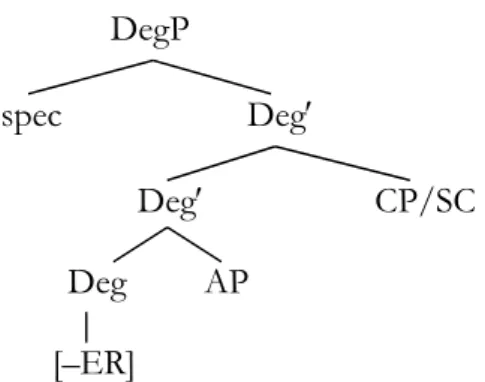
The ‘big DegP’ view (Moryzcki 2015) makes the AP the complement of the degree head, based on the argument that nouns and verbs are dominated by functional projections, and there is no reason why adjectives should be an exception (Grimshaw 2005).16 Its structure is shown below (again leaving out QP).
DegP
spec Deg
Deg CP/SC
Deg AP
[–ER]
Figure 4: The ‘Big DegP’ view of comparatives
A similar structure is used in Kennedy & Merchant (2000) (where the adjunct is described as ‘base-generated’) and in Schwarzschild (2008), although these treat than as a preposition and make the adjunct a PP. Such a structure allows the PF of the adjective to raise and acquire its inflexion by head movement. However, it raises the serious problem that the comparative clause becomes an adjunct not an argument. Given the strong arguments that the degree head and the standard form a constituent, the ‘Big DegP’ analysis seems unlikely.
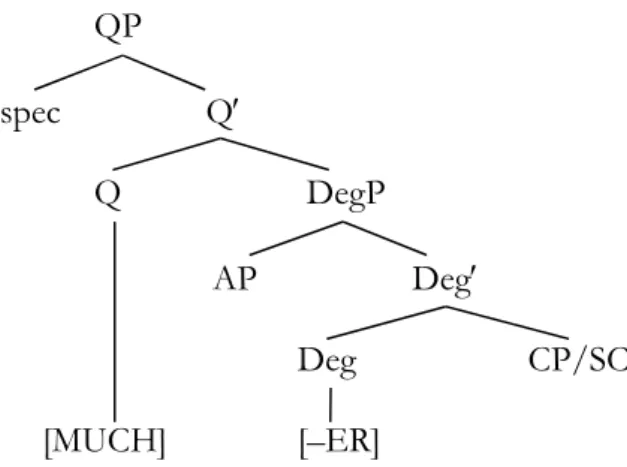
The ‘small DegP’ places the DegP in the specifier of AP. Another view places the AP in the specifier of DegP. This is the view favoured by Lechner (2004), Bacskai-Atkari & Kantor (2012) and Bacskai-Atkari (2014) who suggest the following structure for comparatives in a head-initial language. The complement of Deg is a CP in Bacskai-Atkari (2014), though there is no reason why it could not be a small clause (the author discusses the possibility that the complement may be of diverse categories, though only deals with
15 It could be possible in a Distributed Morphology framework (Halle & Marantz 1993). Here, in Morphological Merger a syntactic complement structure [XYP] could be realized in morphology as [[Y] X] or [[X] Y]. A variety of Merger, called Local Dislocation requires linear precedence and adjacency. Embick & Noyer (2001) give evidence that the formation of comparatives in English requires adjacency. The adjective and the degree head are not adjacent in Figure 2. Lowering is allowed in this framework and does not require adjacency, but it happens in morphology before Vocabulary Insertion – Local Dislocation occurs after Vocabulary Insertion. There is Vocabulary Insertion in the above structure, so there seems to be no way vanhempi can be formed in such a structure.
CP). Its status is unclear in Lechner (2004), who remains agnostic on the status of than, but makes its complement a CP).
QP
spec Q
Q DegP
AP Deg
Deg CP/SC
[MUCH] [–ER]
Figure 5: A comparative structure with AP in the specifier of DegP
This structure puts the comparative adjective in a spec-head relationship with the degree head. The specifier of QP, in this view, is the location of expressions such as far and much. The degree head and the standard still form a constituent.
If we adapt this structure to head-final languages, the type of language in which the Comparative Partitive originated, the adjective is still likely to be to the left of the comparative clause, as even in head-final languages, specifiers tend to be merged to the left (Ernst 2004). The Degree head will be assumed to be head–final in the Comparative Partitive for consistency (the other type of comparative, illustrated in (1a–c), will not have a final Deg head). Its complement (the SC) precedes it – as has already been mentioned above, this is characteristic of head-final languages. The PF of the degree head, -mpi, appears on the adjective.
Let us use the expression minua vanhempi as an example, and put in the PF forms of all the items. We would then have the following (leaving out the QP for simplicity):
DegP
AP Deg
SC Deg
vanhempi minua d-vanha [–ER]
Figure 6: Figure 5 adapted to the Finnish Comparative Partitive
that it undergoes covert adjunction, its LF moved, but its PF pronounced in the base position. This seems unmotivated, so extraposition to PredP is the more likely option. For the problem under discussion here, it is not necessary to take a stance on whether AP is in the specifier of DegP or DegP is in the specifier of AP, as in both cases the degree head and the standard form a constituent. So I will remain neutral on this matter.
3 Partitive adpositions in the domain of degrees
3.1 Partitive adpositions
If comparative clauses are complements of degree quantifiers, how do their subjects acquire case in Comparative Partitives and Ablatives of Comparison? Let us start off by considering the role of than in English. Pancheva suggests (2005, 2006) that than is a partitive preposition in the domain of degrees, as of is a partitive preposition in the domain of entities in English. The preposition of is used in two types of structure in English, called by Pancheva referential partitives and predicative partitives. In a referential partitive the complement of of is a definite description:
(21) a. some of the chocolate b. three of the children
Such structures as the above are translated by means of the Elative (‘out of’) case in Finnish:
(22) a. osa suklaa-sta part chocolate-ELA
‘some (a part) of the chocolate’
b. kolme laps-i-sta
three children-pl-ELA ‘three of the children’
In predicative partitives the complement of the preposition has a predicate or ‘kind’ interpretation (that is, it does not refer to a specific set, but merely to the kind of thing the noun denotes). In English, only a bare mass noun or plural count noun occurs after of in predicative partitives.
(23) a. a bar of chocolate b. a crowd of people
Such expressions in Finnish require the Partitive on the noun:
b. joukko ihmis-i-ä
crowd person-pl-PART
‘a crowd of people’17
What does a partitive preposition (more generally, a partitive adposition) actually do? Referential partitives are quantifier phrases with an adpositional phrase as the complement of the quantifier. The complement of the adposition is a contextually specified set and the adposition returns one of its subsets as an argument of the quantifier, the cardinality of which is given by the quantifier. In predicative partitives the complement of of is a bare mass or plural count noun and the PP itself is the complement of an ‘individuating’ noun such as a container or measure noun, which enables the substance, or plurality of countables, to be put into a form in which it can be counted. The adposition returns a subset which is simply some part of the kind of entity that the bare mass or plural count noun denotes, and which is then individuated by the individuating noun. The adposition thus functions rather like the quantifier some, in that it gives an unspecified amount which can then be individuated by the ‘upper’ noun.
To return to comparatives, clausal comparatives can be regarded as referential partitives in the domain of degrees. Clausal comparatives contain a definite description of degrees, and are analogous to the complement of of in (21a–b). (The wh-clause is a free relative of degrees, and free relatives are interpreted as definite descriptions.) Kuin, which introduces a tensed clause, as shown in Section 1, can be regarded as introducing referential partitives in the domain of degrees in Finnish.
For Finnish Comparative Partitives, the standard of comparison is a case-marked DP (see examples 1d–f), treated here as the subject of a small clause. There is no overt preposition, complementiser or verb which licenses object case (the copula ole-, ‘be’ is always followed by Nominatives), and since the standard is the complement of the weak quantifier [–ER], this must be the source of the case on the expression, exactly as in all other occurrences of Partitive case. As the Partitive case is derived from an Ablative case, we are now in a position to consider exactly how the Comparative Partitive is derived from the Ablative of Comparison.
The preposition ‘from’ is used as a partitive preposition in many Slavic languages (recall the ‘source’ schema (Stoltz 2013), mentioned in Section 2.3), and interestingly, is frequently used for predicative partitive comparatives. The following Polish examples are from Pancheva (2006).
(25) a. Anna jest wyzsza niz Agnieska. (referential)
Anna is taller.COMP than Agnieska.NOM ‘Anna is taller than Agnieska.’
b. Anna jest wyzsza od Agnieski. (predicative)
Anna is taller.COMP fro m Agnieska.GEN ‘Anna is taller than Agnieska.’
In (25b) the complement of od, ‘from’ is in the Genitive case. This preposition routinely takes a Genitive complement in Polish (Sadowska 2012), but the Genitive is also
used in Polish, as in Russian, to indicate a partially affected object. Thus it parallels the Finnish Partitive.
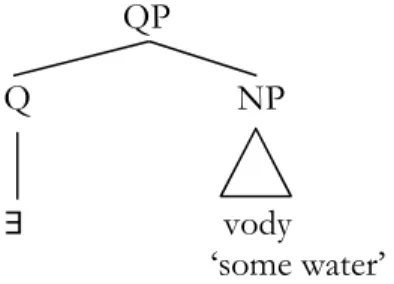
It is generally agreed that the Slavic bare Partitive Genitive is licensed by an existential quantifier, as is the Finnish Partitive. This quantifier may be an operator of existential closure, which heads a QP above the VP (Thomas 2003), or the head of a QP which has the genitive object as its complement (Pesetsky 1982, Franks 1986, Neidle 1988, Franks & Dziwirek 1993, Franks 1995, Bailyn 2004). The NP has a case feature to be checked, which for convenience we will call [+PART], and it can check this feature against the quantifier, which is itself a case-licenser, being a relational term. This structure is shown below, using the Russian expression vody ‘some water’ as an example:
QP
Q NP
∃ vody
‘some water’
Figure 7: Possible structure for bare partitive genitives in Russian
However, a structure headed by the preposition ‘from’ should be a prepositional phrase. So the Polish predicative comparative in (25b) should have the structure:
PP
P DP
od Agnieski
Figure 8: A Polish Prepositional Phrase18
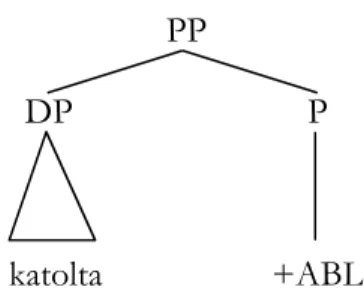
When ‘from’ is expressed by the Ablative case, the phrase should also be an adpositional phrase. It has been suggested (Nikanne 1993), that in languages with semantic cases, such cases are adpositional phrases headed by a null adposition. The case is licensed by the adposition.19 So, considering the Finnish Ablative case, a phrase such as katolta,
‘from the roof’ may have the following structure (it is shown as a postpositional phrase in accordance with the Finnish preference for postpositions):
18 It has been claimed that there is no DP layer in Polish (e.g Willim 2000) on the basis of its absence of articles, but this has been challenged by Migdalski (2001). Bošković (2005, 2009) also claims that article-less languages do not have a DP layer, and argues that possessives and demonstratives are adjectives.
PP
DP P
katolta +ABL
Figure 9: The likely structure for Ablative-marked DPs in Finnish
Now let us consider how we apply this to Ablatives of Comparison.
3.2 Adpositions with small clause complements
Can we extend this to the Ablative of Comparison? That is, does a phrase such as illo viro, ‘than that man’ in (12a) have the same structure as Figure 8, except with a small clause as the complement of P? If so, then it must be possible for null adpositions to have small clause complements. Is there any evidence that this is so?
It is certainly possible for overt adpositions to have small clause complements. It is a well-known fact that English with and without can be followed by a small clause, as shown below (small clause in square brackets):
(26) a. With [me out of the game], they’ll be sorry. b. With [him behind the wheel], we’re all in danger. c. Without [Pete in the team], we’ll lose.
Small clauses are less common after other prepositions in English, but Aarts (1992) gives the following examples:
(27) a. She was distressed at the thought of [him alone]. b. I would have given half the world for [him back again].
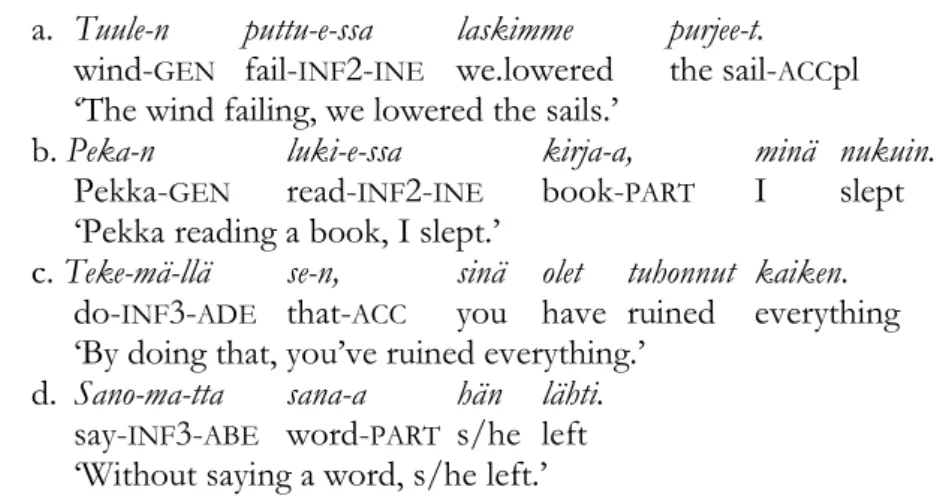
Some people might regard (27b) as unacceptable. It seems acceptable to me. Can small clauses occur as the complements of null adpositions? In Finnish, certain non-finite constructions can occur as modifiers of other clauses. They use what are conventionally called the second and third infinitive, although these words are actually verbal nouns. These ‘infinitives’ can be marked with various cases, as shown below:20
20 Such structures often translate what are called absolute constructions in English. The English translations of (28a–b) are examples of such constructions. Absolute constructions are non-finite structures that modify other clauses. They frequently have a gerund as their subject and/or a participle as a predicate, and can often be preceded by with without any change in meaning. The English translations of (28a–b) could be preceded by with, for example. They can often be replaced by when- or
while-clauses, as can their counterparts in Finnish.
(28) a. Tuule-n puttu-e-ssa laskimme purjee-t. wind-GEN fail-INF2-INE we.lowered the sail-ACCpl ‘The wind failing, we lowered the sails.’
b. Peka-n luki-e-ssa kirja-a, minä nukuin. Pekka-GEN read-INF2-INE book-PART I slept ‘Pekka reading a book, I slept.’
c. Teke-mä-llä se-n, sinä olet tuhonnut kaiken. do-INF3-ADE that-ACC you have ruined everything ‘By doing that, you’ve ruined everything.’
d. Sano-ma-tta sana-a hän lähti.
say-INF3-ABE word-PART s/he left ‘Without saying a word, s/he left.’
The object is Partitive in (28b), because of the unfinished nature of the action. It is Partitive in (28d) because the Abessive suffix means ‘without’, and gives the clause a negative meaning.
What is the status of such non-finite clauses? The item marked with the semantic case is certainly a verbal noun, and must acquire its case from a null adposition. The Genitive expression in (28a–b) is almost certainly in the specifier of the noun, as Genitive case appears to be a default case for items in specifiers (Vainikka 1993, 2003). Leaving aside the specifics of the process of nominalization, the object (e.g kirjaa in (28b)) remains the complement of a predicator. So it is reasonable to regard them as small clauses. That is, their structure is:
PP
SC P
+CASE
Figure 10: Possible structure for certain Finnish non-finite constructions
Thus there is evidence that null adpositions can license case on the subjects of clauses in Finnish.
Turning to languages which use Ablatives of Comparison, there is evidence that null adpositions may take small clause complements too. The structures known as the Ablative Absolute in Latin, and the Locative Absolute in Sanskrit may also be small clauses which are the complements of null adpositions, with the features [+ABL] and [+LOC] respectively. Examples of them are shown below:
(29) a. Caesar-e duc-e vincemus. (Latin)
Caesar-ABL leader-ABL we.will.conquer ‘With Caesar as leader, we will conquer.’
b. Candragupte ra:jan-y a-parigrahaś chala:na:m. (Sanskrit)
Candragupta.LOC king-LOC NEG-welcome error.GENpl
‘With Candragupta king, there is no welcome for errors.’
Thus it appears that small clauses can be the complements of null adpositions. With this in mind, Ablatives of Comparison can be treated as remnants of small clauses which are complements of a null adposition marked [+ABL].
3.3 Partitive adpositions and the Ablative of Comparison
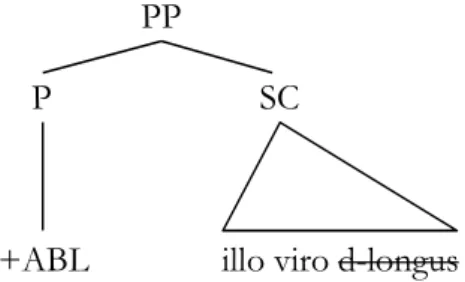
If this is the case, then the Ablative of Comparison should have the following structure. Example (12a), from Latin, is used to illustrate it, so a preposition is used.
PP
P SC
+ABL illo viro d-longus
Figure 11: Possible structure for the Ablative of Comparison
The subject of the small clause gets its case from the nearest case assigner, in this case the preposition. However, the small clause still contains a degree variable. This variable must be bound. Thus, a quantifier should be present. This could be the head of the QP which dominates DegP, mentioned in Section 2.4, but for Ablatives of Comparison there is another possible position, i.e. the QP dominates a PP.
Let us return to the difference between referential and predicative partitives. Partitive prepositions can be used in both types of partitive, as we have already seen with English of. In a referential partitive, the prepositional phrase must be dominated by a quantifier phrase. For example:
QP
Q PP
Three of the children
Figure 12: An English referential partitive
In such an expression, the quantifier three has what Milsark (1977) calls ‘strong’ interpretation. It is not simply the cardinality of the intersection of the set of children with some other set – it has as an argument a specific subset of a larger contextually specified set of children which has been picked out by the partitive preposition. The preposition itself has no intrinsic quantificational meaning.
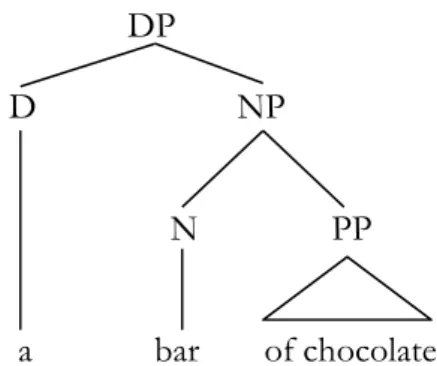
In the case of English predicative partitives, it is not so obvious that a quantifier phrase is present. The obvious structure for an expression such as (23a) is:
DP
D NP
N PP
a bar of chocolate
Figure 13: An English predicative partitive
The determiner a(n) is included among the weak quantifiers, although the same position can also be occupied by a definite determiner like the. However, if such a definite determiner is present, it makes the individuating noun specific, not the complement of the preposition, which does not here refer to any specific quantity of chocolate, but merely to the substance in general. If any quantifier phrase is present in structures such as Figure 13, it must be covert, headed by the existential quantifier and above NP. Is there any reason to suppose this is so?
Prepositions do not occur with the weak quantifiers in English when they have weak interpretation. However, there are languages where this is possible. An example is French, where de is used after the weak quantifiers apart from the numerals:
(30) a. Il y a beaucoup de fleurs dans le jardin. it there has a lot of flowers in the garden. ‘There are a lot of flowers in the garden.’
b. Peu de gens ont vraiment compris le problème. few of people have really understood the problem ‘Few people really understood the problem.’
In these sentences, the quantifiers beaucoup and peu express the relation between the set of flowers and the set of things in the garden, and the set of people and those who understood the problem, respectively. It is reasonable to suppose that these expressions have the same structure as Figure 12 (although the preposition will be followed by an NP, not a DP):
QP
Q PP
beaucoup de fleurs peu de gens
Figure 14: French weakly quantified expressions
the argument. The preposition is therefore redundant from a semantic point of view (and thus liable to being lost). But again we can see that when a partitive preposition is present a quantifier is also present, heading a QP which dominates the PP. The preposition, however, has a different meaning in a predicative partitive than in a referential partitive. Its meaning is effectively indistinguishable from some, that is, it picks out a subset of indeterminate amount. In French, of course, the expressions du/de la/des can be used with the meaning of some – they are called partitive articles in traditional grammars. It is interesting that these expressions consist only of the preposition de and the definite article. They were originally referential partitives (see below), but have been reanalysed as weak quantifiers.
Where does the quantificational meaning come from? De itself has no intrinsic
quantificational meaning. Its basic meaning is of, and the expressions are of course still used with the meaning ‘of the’, with no implication of quantificational meaning, in such sentences as:
(31) Il a vu la porte de la maison. he has seen the door of the house ‘He saw the door of the house.’
As du/de la/des have no intrinsic quantificational meaning, when they are used as partitive articles, that meaning comes from something else. Given that a de- phrase is dominated by a QP in the case of the other weak quantifiers like beaucoup and peu, by analogy the partitive articles acquire their meaning of some from the presence of a covert QP, headed by the existential quantifier, dominating the PP. This gives them their quantificational meaning
4 Deriving the Comparative Partitive from the Ablative of Comparison
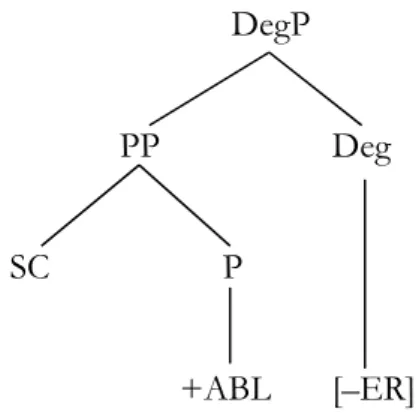
So now let us apply this to the Ablative of Comparison, and consider how it developed into the Comparative Partitive. We start off by assuming that Ablatives of Comparison involve a PP with an Ablative-marked adposition. The complement of the adposition is a small clause. Like any other predicative partitive a quantifier phrase must be present to dominate the PP, which in the case of comparatives is DegP. Thus the following structure can be proposed for Ablatives of Comparison. For convenience, we will use head-final order as in most of the examples mentioned above the languages involved use head-final order, or have a preference for it.
DegP
PP Deg
SC P
+ABL [–ER]
Figure 15: The structure of the Ablative of Comparison
To see how the Finnish Comparative Partitive derives from such a structure, we should consider the historical development of the Partitive in general. Historical records of Volgaic-Finnic languages do not exist until the 13th century (the Birchbark Letter No.
292, which is a brief inscription in an archaic Finnic dialect on a piece of birch bark), and there is no extensive written literature until the 16th century (Lees 2015). So it is not possible
to trace the development of Partitives from written evidence, as it is in French, for example. Doubt has been cast on the validity of syntactic reconstruction in the case of language groups where there is limited written evidence (e.g. Lightfoot 2002). However, Walkden (2013) provides strong arguments that this is possible, just as the reconstruction of ancestral phonological forms is possible. Phonemes can be represented as feature matrices, and ancestral forms can be reconstructed from consistent changes in features across cognate forms. Lexical and functional items can also be represented as feature matrices, and although sentences cannot be cognate across languages (that is, have diachronic identity), it is possible to reconstruct earlier forms from consistent feature changes of such items, which occur with consistent distribution patterns in the daughter languages. Similarity in meaning, as in phonological reconstruction, can also be evidence.
The development of the -(t)A suffix can be traced via its use in the Mordvinian,
meaning some from (a part) from. Thus, we can infer that in Volgaic Finnic, the state of affairs which exists in modern Mordvinian languages was the norm, but in the Saamic-Finnic languages, the suffix had lost its Ablative feature and become quantificational (more on this later), and finally its use was extended in the Baltic-Finnic period.
Now, historically, predicative and weakly quantified partitives have derived from referential partitives (Koptjevskaja-Tamm 2001, Carlier 2007, Rutkowski 2007, Carlier & Lamiroy 2014). An example of this is found in French. As already mentioned, the French partitive articles du/de la/des ‘some’, originate from Old French referential partitives. Carlier (2007) and Carlier & Lamiroy (2014), suggest the following development from Old French to Modern French. Consider an Old French sentence such as that below:
(32) Il boit de-l vin. he drinks of/from-the wine ‘He drinks some wine.’
This could only be interpreted as meaning ‘he drinks (a part) from a specified
quantity of wine’. However, gradually the preposition de, which means ‘from’ as well as
‘of’, lost its separative meaning in such structures, and came to be reanalysed as a marker of an indefinite amount. The definite article le, la, les became incorporated with de, losing its definite meaning. De became a predicative partitive preposition, and du/de la/des acquired weak interpretation. The complement came to be reanalyzed as an NP with ‘kind’ interpretation, giving us the modern French:
(33) Il boit du vin. he drinks of-the wine
‘He drinks some wine (or: he drinks wine in general).’
This accords with the ideas of Koptjevskaja-Tamm (2001), who shows that cross-linguistically, predicative partitives develop from referential partitives, and suggests the following grammaticalisation path from PPs to Partitives of the Finnish type:
(34) ‘From/Of’ PPs referential partitives predicative partitives QPs (phrases headed by a covert or overt quantifier)21
Let us now apply this to the development of Partitive case. The transition we are especially concerned with here is that from Volgaic Finnic (where both Ablative and Partitive use of the old Ablative suffix was possible) to Saamic and Baltic Finnic (where the use is only quantificational, apart from a few fossilisations). During the Finno-Ugric period, the Ablative case was a directional case (and hence was a PP), but by the Volgaic Finnic period was starting to be used with quantificational meaning in certain circumstances, as shown in examples (11a–b) above. Let us consider a sentence in proto- Volgaic Finnic which was the equivalent of (11a), repeated below.
(35) Jarsa-n kal-do, sima-n vet-te. (Mordvin) eat-1SG fish-ABL drink-1SG water-ABL
‘I’m eating fish, I’m drinking water.’
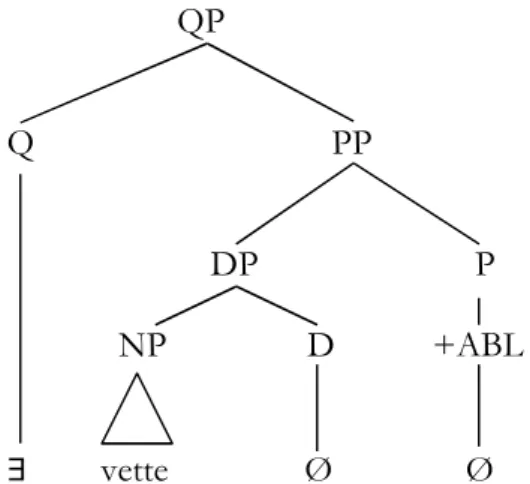
We will use vette, ‘some water, water in general’ for illustrative purposes. Following the path of grammaticalisation shown in (34), which can be traced historically in French, the original meaning was probably ‘I’m drinking from the water’. ‘From the water’ would be a PP of the type shown in Figure 8. But if we drink, we must drink an amount, and the Ablative case by itself does not tell us anything about that. Thus in the next stage a covert quantifier appeared and headed a QP dominating PP. This gives the structure shown below for vette (leaving aside considerations of headedness).
QP
Q PP
DP P
NP D +ABL
∃ vette Ø Ø
Figure 16: The probable structure of referential Partitives in Volgaic Finnic languages
The meaning at this stage was that of a referential partitive – ‘I’m drinking (some amount) from the water’, and the structure was still a PP dominated by a covert QP. The presence of a Determiner requires explanation. In the modern Mordvinian languages, suffixes which correspond to the definite article can be attached to nouns. They derive from demonstrative pronouns (Zaicz 1998). There is no clear evidence that they existed at the time we are considering (the time the Baltic Finnic and Saamic languages diverged from the Mordivinian languages), although Zaicz (1998) claims the development of the definite declension was well underway in proto-Mordvinian. Nonetheless, a Determiner head is present as it is possible for such heads to be phonologically null (Migdalski 2001).22
Furthermore, the presence of such a head would be expected in a referential partitive.
But the suffix was already losing its purely directional meaning due to the development of two other cases. Language acquisition plays an important role in diachronic change (Longobardi 2001, Roberts 2007), and it is suggested that while learners can parse the relevant input coming to them, called Primary Linguistic Data (PLD), their own internal grammar will come to converge with that of the input – a process called inertia (Longobardi 2001). However, the presence of innovative pieces of data in the PLD can cause the grammar of learners to stop converging with the one that provides the input and lead to the reanalysis of certain items (Madariaga 2017). In the situation we are considering, the innovative pieces of data were almost certainly the two new cases which had taken over Ablative function in the grammar. They had rendered the original use of the suffix -tA irrelevant, except for its use on the objects of certain verbs. Learners would reanalyse it under these circumstances as having a purely quantificational meaning. The adposition lost its feature [+ABL], became a predicative partitive adposition, and became indistinguishable from some (this is the third stage of Koptjevskaja-Tamm’s process of grammaticalisation). Thus, it became redundant.23 It is may be that during this process, the marker of
definiteness was lost too. It is impossible to know if this happened before the adposition became redundant. In principle, this could have happened during the time period that the adposition was losing its Ablative meaning, but if the path of grammaticalisation proposed in (34) is correct – that predicative partitives precede pure QPs – the definiteness marker should have been lost first. That is, an expression like siman vette may have had the interpretation ‘I’m drinking (some amount) from/of water (in general)’ before the adposition was lost completely. At this point, the following structure is likely:
the object is a mass noun or a plural number of count nouns. If the object is a singular count noun, it is still Accusative even if it is interpreted as indefinite (Sadowska 2012). It appears that the property of partitivity (Carlson 1981), i.e. being able to refer to part of an entity by the same term as we can use for the entity as a whole, is more important than definiteness/indefiniteness in deciding the Accusative/Genitive alternation. (It is also relevant in this regard that when the Finnish Partitive is used aspectually, the object can be definite – the important thing is that the situation as a whole is not complete). Nonetheless, the strong correlation which exists between Accusative/Genitive case and definiteness/indefiniteness in Slavic languages inclines me to the view that a covert determiner is present in languages which do not have articles. I take no stance on where Accusative case is checked.
23 In fact, because of this redundancy, many languages do not use adpositions at all in predicative partitives, but simply juxtapose the ‘kind’ NP to the individuating noun, for example Swedish:
(i) en kopp te
a cup tea
QP
Q PP
NP P
∃ vette Ø
Figure 17: The probable structure of predicative Partitives in Volgaic Finnic languages
Finally, the redundant adposition was lost, and the NP came to be the complement of the quantifier. Thus the expression vette became a pure QP, like that shown in Figure 6, giving the meaning ‘some water, water (in general)’.
Reanalysis often involves loss of structure (Rutkowski 2007), and so, following the suggestions of Carlier (2007) Carlier & Lamiroy (2014), Koptjevskaja-Tamm (2001) and Rutkowski (2007) the loss of structure from the referential Partitive stage to the QP stage, was likely as follows:
QP
Q PP
DP P
NP D
∃ vette Ø Ø
Figure 18: Loss of structure in the development of the Partitive case
The material in the polygon was lost. However, the NP was still marked with a case suffix. This could no longer be interpreted as Ablative and if there was nothing to license it, it would probably have disappeared. However, due to the quantifier’s own ability to licence case, the ending on its complement was reanalyzed as a pure marker of quantification. The case on the object came to be interpreted as having the feature [+ PART], and so the suffix -(t)A became the marker of the case we now know as Partitive, licensed by the quantifier itself.
With this process in mind, it can easily be seen how the Ablative of Comparison became the Comparative Partitive. The same process as that described above would have
affected the old Ablative of Comparison, once the earlier Ablative suffix had lost its original meaning and become a marker of quantification in the Saamic and Baltic Finnic languages. The structure Figure 15, proposed for the Ablative of Comparison is repeated below:
DegP
PP Deg
SC P
+ABL [–ER]
Figure 19: The structure of the Ablative of Comparison
Once the adposition lost its feature [+ABL], it became redundant and disappeared. Its small clause complement became the direct complement of the degree quantifier [– ER]. The degree quantifier belongs to the weak group of quantifiers, themselves case-licensers. The subject still had a case feature to be checked and this was now interpreted as Partitive case, just as it was in all other circumstances where it had once had Ablative meaning. This exactly parallels all the other circumstances where the old Ablative case became the Partitive – the suffix was used in precisely the same circumstances as it was in all other uses. Therefore the structure could survive into the modern language.
Russian Genitive comparatives such as (14b) are also compatible with this analysis, although with a change of headedness. The Partitive Genitive case is licensed, as is generally agreed, by a weak quantifier, and thus in a comparative structure, the case can occur on a standard of comparison which is the subject of a small clause.
5 Conclusions