75
RESEARCH ON THE EFFICACY AND SELECTIVITY OF SOME
HERBICIDES APPLIED TO GRAIN SORGHUM
DRĂGHICI IULIAN, DRĂGHICI RETA, CROITORU MIHAELA, DIACONU AURELIA, BĂJENARU MARIA FLORENTINA, CIUCIUC ELENA, DIMA MILICA
Keywords: the degree of weed, selectivity, efficiency, production, leaf index
ABSTRACT
The research carried out during the period 2018-2019 at Dabuleni Research Development Station for Plant Culture on Sands (Dabuleni RDSPCS) underlines the importance of the herbicide work on the sorghum crop for grains, placed under the conditions of sandy soils. The products were tested: Trek P34 SE (pendimethalin 64 g / l + terbuthylazine 270 g / l), in doses of 2.5 l / ha and 3.5 l / ha, Gardoprim Plus Gold 500 SC (S-metolachlor 312, 5 g / l + terbuthylazine 197.5 g / l), in a dose of 1 l / ha, Universal Buctril (bromoxynil 280 g / l + 2,4-D acid (ester) 280 g / l), in a dose of 1 l / ha, Dicopur Top 464 SL (344 g / l 2.4 D acid from DMA salt and 120 g / l dicamba), in a dose of 1 l / ha and
Dual Gold 960 EC (960 g/l S-metolaclor), in a dose of 1,5 l/ha. The spectrum of weeds recorded in the untreated variant is highlighted by the abundant presence of the species
Ambrosia artemisiifolia, in 48.9%, followed by Digitaria sanguinalis (29.6%), Portulacca oleraceaea (12.2%) and Chenopodium album (9.3 %). The EWRS ratings, regarding the weed degree in the untreated variant, underline high values throughout the vegetation period, the grades being in the range 6-9, with an average of 7.88. Compared to this variant, the application of herbicides ensures a weed control, for the period 15-60 days after application, in a percentage of 50.8-71.4%. The obtained results show that the best control over the weed degree in the sorghum culture was achieved by the post-emergent application of the product Trek P34 SE, at a dose of 3, 5 l / ha, the production of grains obtained at harvesting being 7333.5 kg / ha, compared with the non-herbicide control, in which 3070.5 kg / ha were registered.
INTRODUCTION
Under the current conditions of climate drying, the identification of agricultural practices with the potential to mitigate the impact of climate change on the security of agricultural production is raising more and more interest. In this context, the orientation towards drought-resistant crops is emerging as an alternative solution. Sorghum is one of the crops with high adaptability to slightly favorable ecological conditions (poor soils, arid climate), due to its high capacity to efficiently harness natural resources and increased tolerance to drought. As the degree of weed to sorghum in the USA it is controlled with herbicides including clethodim (group 1),
fluazifop (group 1), imazethapyr (group
2), primisulfuron (group 2), dicamba
76
necessary if herbicide tolerant sorghum hybrids are sown, which limits the chemical control options or increases the germination and seedling rate. Studies by W. James Grichar et al. (2009) highlight the optimal timing of herbicides applied
atrazine, pendimethalin, and trifluralin, applied alone or in combination, by testing in different stages of weed and sorghum development. The best results were obtained by applying the herbicides be based on atrazine and trifluralin in the early stage of plant development of 7 cm, the weeds being controlled in a percentage of 76-100 % depending on the climatic conditions of the year. The same results were obtained in the state of Gujarat on the west coast of India (B. R. Verma et al., 2018). Research by John S. Russin et al. 1995, by applying herbicides based on atrazine, alachlor and
metolachlor, underlines their influence on the colonization of sorghum roots with the fungus Macrophomina phaseolina, which produces the disease "charcoal", similar to rust, but does not have the color orange but black. The best effect was atrazine, regardless of the application phase.
MATERIAL AND METHOD
The research aimed at testing some phytosanitary products, with pre-emergent or post-pre-emergent application, to control weeds from sorghum culture for grains located on sandy soils. The products were tested: Trek P34 SE
(pendimethalin 64 g / l + terbuthylazine
270 g / l), in doses of 2.5 l / ha and 3.5 l / ha, Gardoprim Plus Gold 500 SC ( S-metolachlor 312, 5 g / l + terbuthylazine
197.5 g / l), at a dose of 1 l / ha, Universal Buctril (bromoxynil 280 g / l + 2,4-D acid (ester) 280 g / l), at a dose of 1 l / ha,
Dicopur Top 464 SL (344 g / l 2.4 D acid from DMA salt and 120 g / l dicamba), in a dose of 1 l / ha and Dual Gold 960 EC
(960 g / l S-metolachlor), in a dose of 1.5 l / ha, compared to an untreated and untreated control variant. The experience was placed during the period 2018-2019
at Dabuleni RDSPCS, under field
conditions, following the randomized blocks method in 3 repetitions. The study was conducted on irrigated soil, on a poor sandy soil supplied with nitrogen (0.04% and 0.12%), with a phosphorus content between 54 ppm and 110 ppm, values that characterize the soil as being well supplied and a content in exchangeable potassium in the range of 26 ppm to 64 ppm, indicating a reduced supply status towards the middle. Organic carbon showed values in the range of 0.20% - 0.63%, the state of soil supply in organic matter being reduced by portions to the middle, a fact characteristic of sandy soils, and the soil pH ranged from 4.64 to 5.63 values showing a moderately acid to weak acid reaction. It sowed ALIZE ES
hybrid sorghum, treated with CONCEPT, in April 24 (2019) - 3 May (2018), ensuring a density of 25 b.g./m2. The
nutrition of the sorghum plant was ensured by fertilization with N150P80K80, this being done at the preparation of the germinal bed with the dose of N80P80K80, by applying complex fertilizers of the type N16P16K16 and in vegetation with the dose of N70, by applying ammonium nitrate. During the vegetation period of the sorghum plants were made determinations regarding: the degree of soil tillage, the efficiency of the application of herbicides and their selectivity for the sorghum plants, the size of the plant, the diameter of the stem, the leaf surface. At harvest the grain production, the one thousand weight grains (TWG) and the hectolitric weight (HW) were determined. The results were calculated and analyzed, statistically, by the method of analysis of variance and using mathematical correlations.
RESULTS AND DISCUSSIONS
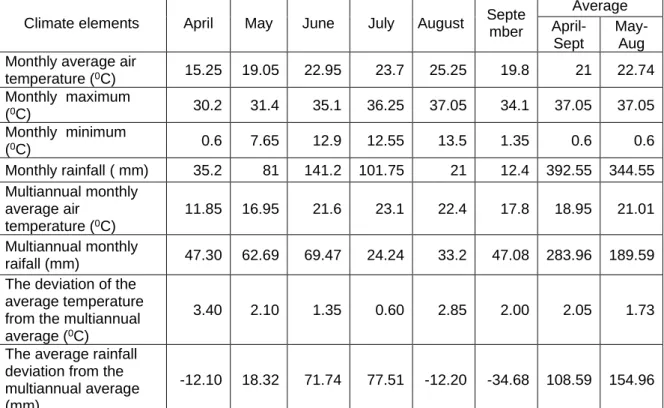
Analyzing the climatic conditions of the period 2018-2019, compared to the multiannual average, we note the increase of the atmospheric drought by increasing by about 2 0C the average air
April-77
September. Sorghum is a thermophilic species, with very high demands on temperature. The climatic conditions recorded in the period 2018-2019 (table 1), were favorable for the growth and development of sorghum plants. The average temperature of 19.05 0C,
recorded in May, favored a uniform rise of sorghum culture. Due to the high drought tolerance, sorghum is called "vegetable camel", using approx. 2500-3500 0C for
the entire vegetation period. Compared to the thermal requirements of sorghum, in the area of sandy soils were recorded between May 10 and September 10 (the period of development of the vegetation phenophases) about 3028,45 0C.
Although the amount of precipitation recorded (344.55 mm) exceeded by
108.59 mm the multiannual average, it was unevenly distributed and insufficient to the water consumption requirement of the sorghum plant, being required to apply 3 waterings, with a watering norm. 300 m3 water / ha. The plant grows well
in regions with temperatures between 25 - 31 °C. It is drought tolerant, having a well-developed root system, a waxy layer on the leaves that reduces water loss through foliar perspiration and the ability to stop growth in drought periods and to resume it under appropriate environmental conditions. It grows well in areas where 500 to 800 mm of rainfall is recorded over the entire vegetation period and can withstand heavy rainfall (Balole and Legwaila 2006).
Table 1 The climatic conditions recorded at the weather station of Dabuleni RDSPCS
(2018-2019)
Climate elements April May June July August Septe mber
Average
April-Sept
May- Aug Monthly average air
temperature (0C) 15.25 19.05 22.95 23.7 25.25 19.8 21 22.74
Monthly maximum
(0C) 30.2 31.4 35.1 36.25 37.05 34.1 37.05 37.05
Monthly minimum
(0C) 0.6 7.65 12.9 12.55 13.5 1.35 0.6 0.6
Monthly rainfall ( mm) 35.2 81 141.2 101.75 21 12.4 392.55 344.55 Multiannual monthly
average air temperature (0C)
11.85 16.95 21.6 23.1 22.4 17.8 18.95 21.01
Multiannual monthly
raifall (mm) 47.30 62.69 69.47 24.24 33.2 47.08 283.96 189.59 The deviation of the
average temperature from the multiannual average (0C)
3.40 2.10 1.35 0.60 2.85 2.00 2.05 1.73
The average rainfall deviation from the multiannual average (mm)
-12.10 18.32 71.74 77.51 -12.20 -34.68 108.59 154.96
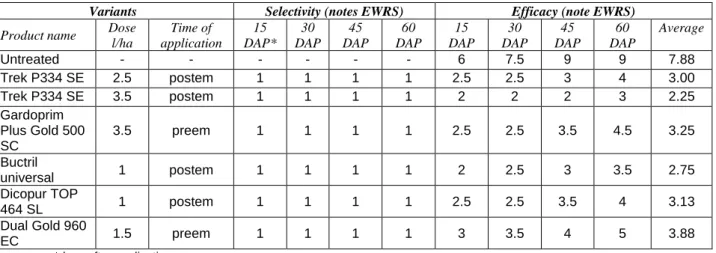
The results show that all products tested for weed control in sorghum culture showed good selectivity compared to sorghum plants (Table 2). The applied herbicides had a good efficacy in combating weeds from sorghum culture in the early stages of vegetation. The efficacy of herbicides, evaluated by
EWRS notes on scale 1-9, performed dynamically, at 15, 30, 45 and 60 days after application, highlights with best results the use of the product Trek P334 SE, applied post-emergently, in a dose of 3.5 l / ha (note 2.25), followed by the
78
Very good results in combating weed sorghum weed were also obtained in Texas by the combined application of
pyrasulfotole and bromoxynil products, which controlled over 94% of the species
Amaranthus ssp, Cucumis melo, and
Proboscidea louisianica (Dan D. Fromme
et al., 2012). The degree of cloudiness, recorded on sandy soils, is generally much higher, compared to other soils, because the sands warm up easier and
early spring it creates the optimal environment for weed seed germination. Ratings EWRS, the degree of weed in the untreated variant, emphasizes a high degree of weed growth throughout the growing season, the notes in the range of 6-9 and an average of 7.88. Compared to this variant, the application of herbicides ensures a weed control, for the period 15-60 days after application, in a percentage of 50.8-71.4%.
Table 2 Selectivity and efficacy of tested products for weed control
at sorghum culture for grains
Variants Selectivity (notes EWRS) Efficacy (note EWRS)
Product name Dose l/ha
Time of application
15 DAP*
30 DAP
45 DAP
60 DAP
15 DAP
30 DAP
45 DAP
60 DAP
Average
Untreated - - - 6 7.5 9 9 7.88
Trek P334 SE 2.5 postem 1 1 1 1 2.5 2.5 3 4 3.00
Trek P334 SE 3.5 postem 1 1 1 1 2 2 2 3 2.25
Gardoprim Plus Gold 500 SC
3.5 preem 1 1 1 1 2.5 2.5 3.5 4.5 3.25
Buctril
universal 1 postem 1 1 1 1 2 2.5 3 3.5 2.75
Dicopur TOP
464 SL 1 postem 1 1 1 1 2.5 2.5 3.5 4 3.13
Dual Gold 960
EC 1.5 preem 1 1 1 1 3 3.5 4 5 3.88
*days after application
The weed spectrum recorded in the untreated variant (Figure 1) is highlighted by the abundant presence of the species
Ambrosia artemisiifolia, in 48.9%,
followed by Digitaria sanguinalis (29.6%),
Portulacca oleraceaea (12.2% and
Chenopodium album (9.3%).
Figure 1. The percentage of weeds in sorghum plants recorded in the
untreated variant
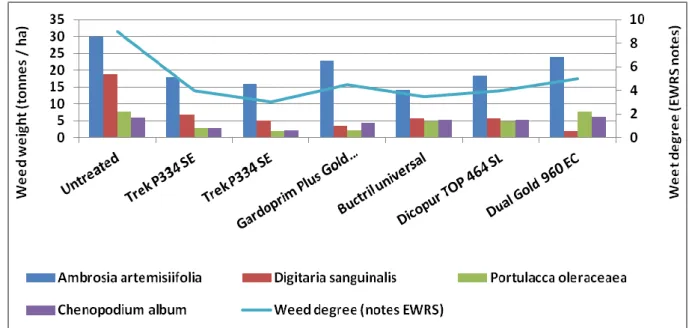
From the analysis of the degree of weeding and the biomass of weeds 60 days after application, Notes are very good herbicidal efficacy TREK P 334,
applied post-emergence at a dose of 3.5 l / ha. (Figure 2).
The product TREK P 334 SE contains the active substance pendimethalin, which acts on the grasses, starting from the germination phase to the first stages of emergence and the active substance and
terbuthylazine, which acts by inhibiting post-emergence photosynthesis to control dicotyledonous weeds, the total effect being within 7 to 10 days, when the total destruction of the weeds takes place. The degree of weed after noting EWRS was in the range of 3-9.
79
plant's waist, stem diameter, leaf surface index, weight of one thousand grains (TWG) and hectolitric weight (HW). Compared with the untreated control, the application of weed control treatments increased 39.6-46.7% at the plant's waist, 26.8-56.1% at the stem diameter, 38.6-47.7% at the leaf area index (LAI), 2-12% in TWG and 5.2-7.5% in HW.
The results obtained during the harvest, showed distinct and very significant increases of the grain production
obtained in sorghum, between 2555.5 - 4263 kg / ha, by applying the chemical treatments for weed control, compared with the untreated control in which 3070.5 kg / ha was registered, (Table 4). The maximum production of 7333.5 kg / ha was registered at the herbicide with the product Trek P334 SE, applied post-emergently at a dose of 3.5 l / ha.
Figure 2. Weed weight at 60 days after the application of herbicides to sorghum
Table 3 Variability of some morphology and productivity parameters in grain sorghum
depending on the herbicide variant
Variants Weed
degree (notes EWRS)
Plant height
(cm)
Stem diameter
(cm)
LAI* TWG g
HW kg Product name
Dose l/ha
Time of application
Untreated - - 7.88 91 2.05 4.4 25 67
Trek P334 SE 2.5 postem 3.00 131 3.1 6.15 27.5 72
Trek P334 SE 3.5 postem 2.25 133.5 3.2 6.5 28 72
Gardoprim Plus
Gold 500 SC 3.5 preem 3.25 133 3 6.3 27.5 71
Buctril universal 1 postem 2.75 129.5 2.9 6.45 25.5 70.5
Dicopur TOP
464 SL 1 postem 3.13 127 2.85 6.1 27.5 71.5
Dual Gold 960
EC 1.5 preem 3.88 127 2.6 6.2 27 71
80
Table 4 The influence of the application of herbicides on the grain production obtained in
grain sorghum
Variants
Grain yield Diference
kg/ha Significance
Product name Dose l/ha application Time of
Kg/ha %
Untreated - - 3070.5 100 0 Mt.
Trek P334 SE 2.5 postem 7098 231.2 4027.5 xxx
Trek P334 SE 3.5 postem 7333.5 238.8 4263 xxx
Gardoprim Plus Gold
500 SC 3.5 preem 6631 216 3560.5 xxx
Buctril universal 1 postem 6612 215.3 3541.5 xxx
Dicopur TOP 464 SL 1 postem 6570 214 3499.5 xxx
Dual Gold 960 EC 1.5 preem 5626 183.2 2555.5 xx
LSD 5% - 1809 kg/ha LSD 1% - 2167.5 kg/ha LSD 0.1 – 2720.5 kg/ha
Having a good capacity to efficiently capitalize on natural resources, sorghum can produce high yields under ecological conditions slightly favorable to other cereals (Antohe I. et al., 1981, Draghici Iulian, 1999). Research has shown that the technology elements significantly influence the production potential of sorghum for berries (Matei Gh., 2011, Narges Zand et al., 2013). The grain
production obtained in sorghum, depending on the herbicide variant (Figure 3), correlated distinctly significantly, negatively, with the average degree of weed recorded in the period -15-60 days after the application of herbicides (r = - 0.99200) and distinctly
positive with the value of the leaf area index (r = 0.978 **).
81 CONCLUSIONS
1. The spectrum of weeds recorded on sandy soils, in the untreated variant, is highlighted by the abundant presence of the species
Ambrosia artemisiifolia, in 48.9%, followed by Digitaria sanguinalis
(29.6%), Portulacca oleraceaea
(12.2% and Chenopodium album
(9.3%).
2. The EWRS notations regarding the degree of weed in the untreated variant, underline high values throughout the vegetation period, the grades being in the range 6-9, with an average of 7.88.
3. Application of the herbicides to grain sorghum ensures weed control in the percentage of 50.8- 71.4%., for the period 15-60 days after application
4. The degree of weed sorghum culture is negatively correlated with biometrics and productivity of the plant.
5. The best control, on the embellishment of sorghum culture, was achieved by post-emergent application of the product trek p34 se, at a dose of 3.5 l / ha, the production of grains obtained at harvest was 7333.5 kg / ha, compared with the non-weed control, in which 3070.5 kg / ha.
6. The grain production obtained in sorghum, depending on the herbicide variant correlated distinctly significantly, negatively, with the average degree of weed recorded in the period -15-60 days after the application of herbicides (r = - 0.99200)
and distinctly positive with the value of the leaf area index (r = 0.978 **).
ACKNOWLEDGEMENT
This work was supported by a grant of the Romanian Ministery of Research and Innovation CCDI - UEFISCDI, “COMPLEX SYSTEM OF INTEGRAL CAPITALIZATION OF AGRICULTURAL SPECIES WITH ENERGY AND FOOD POTENTIAL”, project number PN-III-P1-1.2-PCCDI-2017-0566, Contract no. 9PCCDI / 2018, within PNCDI III.
BIBLIOGRAPHY
1. Balole, T. V. and Legwaila, G. M. 2006. Sorghum bicolor (L.) Moench.
Record from PROTABASE. PROTA (Plant Resources of Tropical Africa), Wageningen, Netherlands. [Online] Available:
http://www.prota4u.org/protav8.asp?h=M 5&t=sorghum&p=Sorghum+bicolor#Vern acularNamesOthers [15 Oct. 2015]. [Online].
2. B. R. Verma, H. M. Virdia, Dinesh
Kumar, 2018. Integrated Weed
Managemnt in Sorghum. The Bioscan. SpeciaL ISSUE, Vol. 10, pp. 167-173, ISSN 0973-7049
3. Dan D. Fromme, Peter A.
Dotray, W. James Grichar, and Carlos J. Fernandez, 2012. Weed Control and
Grain Sorghum (Sorghum bicolor)
Tolerance to Pyrasulfotole plus
Bromoxynil. International Journal of
82
pp. 2277, 2285, 30 June, 2016, Article Number: E45415159222, ISSN 1991, 637X.
6. James Grichar, Brent A. Besler, Kevin D. Brewer, 2009. Weed Control and Grain Sorghum (Sorghum bicolor) Response to Postemergence Applications of Atrazine, Pendimethalin, and Trifluralin. Weed Technology 19(Oct 2005):999-1003, DOI: 10.1614/WT-04-180R2.1. 7. John S. Russin, Carol H. Carter and James L. Griffin, 1995. Effects of
Grain Sorghum (Sorghum bicolor)
Herbicides on Charcoal Rot Fungus.
Weed Technology Vol. 9, No. 2 (Apr. - Jun., 1995), pp. 343-351.
8. Matei Gh., 2011. Research on
some technological measures for
increasing the yields on grain sorghum
cultivated on sandy soils from
Tâmbureşti, Annales Of The University Of Craiova, Agriculture, Montanology, Cadastre Series (ISSN 1841-8317; ISSN
CD-ROM 2066- 950X) - Congres ESNA 2011, vol. XLI/1 2011.
9. Narges Zand, Mohammad Reza Shakiba, 2013. Effect of plant density and nitrogen fertilizer on some attribute of grain sorghum (sorghum bicolor (l.)
moench), International journal of
Advanced Biological and Biomedical Research. 1(12):1577-1582.
10. Werle, R., Tenhumberg, B. and Lindquist, J. L. 2017. Modeling
shattercane dynamics in
herbicide-tolerant grain sorghum cropping
systems. Ecological Modelling 343:131-141.