THE EFFECTS OF SHORT-TERM EXPOSURE TO ORGANOPHOSPHATE
INSECTICIDES ON SOME BIOCHEMICAL PARAMETERS IN COMMON
CARP (
Cyprinus carpio L.
)
DIMITRINKA ZAPRYANOVA1),FERHAT ÇAĞILTAY2),FAIK SERTEL SEÇER3),
TEODORA MIRCHEVA1),VESELIN IVANOV1)
1)Trakia University, Bulgaria;2)Istanbul University, Turkey;3)Ankara University, Turkey
Keywords: organophosphate insecticides, biochemical parameters, carp
ABSTRACT
The aim of the study was to assess the effects of short-term exposure to organophosphate insecticides on some blood biochemical parameters on common carp (Cyprinus carpio L.) harvested from the Tundzha River, Bulgaria. In treated group there were significant (P<0,05) alterations found in the activities of aspartate aminotransferase (AST), creatine phosphokinase (CPK), lactatdehydrogenase (LDH) and urea (P<0,001) as well as in the serum concentrations of alanine aminotransferase (ALT) and amylase. The creatinine concentrations in the exposed fish were statistically (P<0,05) lower than the controls. The differences between investigated serum biochemical parameters of the treated and control groups were not great (except LDH) and we assume that they could return to normal after a short time.
INTRODUCTION
Pesticide is a substance, or mixture of substance, that are used to control pests such as plant parasitic viruses, bacteria, nematodes, fungi, insects, weeds, rodents, and birds. Pesticides include all materials that are used to prevent, destroy, repel, attract, or reduce pest organism. They find application in different area forestry, landscaping, agriculture and domestic use (Sivaperumal, 2008). Fish are appropriate aquatic vertebrates to be used as environmental bioindicator organisms (Mitev et al., 2013). The pollutants such as organophosphate insecticides (OPs) may damage certain physiological and biochemical processes when they enter into the organs of fishes (Nagaraju and Rathnamma, 2013). Fish are sensitive to water contamination, and pollutants may impair many physiological and biochemical processes when assimilated by fish tissue (Mitev et al., 2014). Organophosphates are esters of phosphoric acid, are classified according to the radicals bound to phosphor particles. Toxicity may vary according to the molecule, pharmaceutical form and the affected animal species. (Sivaperumal, 2008). Contamination of water by insecticides is mainly due to intensive agriculture combined with surface runoff and subsurface drainage, usually within a few weeks after application. In fish, different insecticides can be absorbed through gills, skin or alimentary ducts (Banaee, 2013). It was proposed that temporal variations in biochemical parameters of blood must be considered when these parameters are used to evaluate fish health status (Bani and Vayghan, 2011).
The aim of this work was to study the effects of short-term exposure to organophosphate insecticides on some biochemical indices (AST, ALT, LDH, CPK, amylase, urea, and creatinine) in blood of common carps (Cyprinus carpio L.).
MATERIALS AND METHODS
obtained serum was immediately separated and it was stored at -20°C until analysis. The concentrations of were determined by a kit ”Chema Diagnostica” on a biochemical analyzer Mindray BS-200.
Statistical analysis was performed using SPSS statistical software (version 19.0; SPSS Inc., Chicago, IL, USA). All results are presented as mean and standard deviation of the mean (Mean ± SD).
RESULTS AND DISCUSSIONS
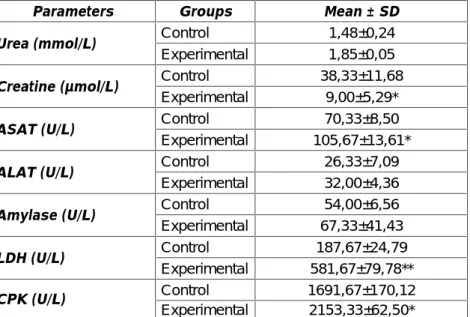
Studies of biochemical changes in the fishes exposed to insecticides can help to supplied information on the impact of insecticides on fish health. The obtained results are shown in table 1.
Table 1
Blood serum biochemical parameters in common carp before and after short-term exposure to organophosphate insecticides
Parameters Groups Mean ± SD
Urea (mmol/L) Control 1,48±0,24
Experimental 1,85±0,05
Creatine (μmol/L) Control 38,33±11,68 Experimental 9,00±5,29*
ASAT (U/L) Control 70,33±8,50
Experimental 105,67±13,61*
ALAT (U/L) Control 26,33±7,09
Experimental 32,00±4,36
Amylase (U/L) Control 54,00±6,56
Experimental 67,33±41,43
LDH (U/L) Control 187,67±24,79
Experimental 581,67±79,78**
CPK (U/L) Control 1691,67±170,12
Experimental 2153,33±62,50*
For a given biochemical parameter: *(P<0,05) and **(P<0,01) indicate significant differences between control and experimental groups.
As with mammals, it has been shown that after functional damage to tissues and organs of fish, some specific cellular enzymes leak into blood plasma where they have been detected (Krajnovic-Ozretic and Ozretic, 1987).
the blood stream. Raised levels of blood fishes ALT and AST activities from polluted water was also observed by Yousafzai et al., (2008).
Elevated lactate dehydrogenase (LDH) activities are a marker for tissue damage in fish and serve as a good diagnostic tool in toxicology (Sivaperumal, 2008). LDH mediates the inter-conversion of lactate and pyruvate and present in numerous tissues, cytoplasm, enzymes and it is a marker of tissue damage. Injured organs and tissues release LDH into the haemolymph, which raises the level of this enzyme, and greater the degree of tissue damage greater is the release of LDH. (Sivaperumal, 2008). In our study LDH activity was significantly (P<0,001) higher (581,67±79,78 U/L) when compared to control (187,67±24,79 U/L) which indicate cellular damages. The increase of liver specific enzymes (AST, ALT, and LDH) indicate a possible liver damages in fishes.
Creatine phosphikinase (CPK) catalyses the reversible exchange of high-energy phosphate bonds between phosphocreatine (PCr) and ADP (adenosine diphosphate), regenerating ATP (adenosine triphosphate) from ADP produced during muscle contractions. CPK are important for supporting cellular energy homeostasis. The levels of CPK are often found to be elevated in organophosphorus poisoning. I was examined by Vanneste and Lison, (1993) that several studies on rat liver and fresh-water snails show that there is a connection between OP poisoning and CPK levels. Hassan and Madboly (2013) have confirmed high degree of correlation between CPK value and severity of OP poisoning. Other authors like Bhattacharyya et al., (2011) recommends CPK can use as an alternative marker of cholinesterase levels in blood to assess the severity of organophosphorus poisoning. The referent ranges for CPK activity are between 191-1312 U/L (Stojkovski, 2001). In our investigation in both controls and treatment carps the CPK values are higher than normal. The measurement show that experimental fishes indicated statistically higher (P<0,05) levels 2153,33±62,50 U/l compared to baselines-1691,67±170,12 U/l. This enhancement could be attributed to the muscle fiber necrosis and needs to be confirmed by muscle biopsy.
The dynamics in the concentration of any biochemical parameters (AST, ALT, CPK) in our study were in agreement with data reported by Velisek et al., (2011) who writes about effect of the toxicity of pyrethroid pesticides on different types of fish.
Sumathi et al., (2014) offers serum amylase and CPK can be used as an additional prognostic indicators with plasma cholinesterase levels in cases with OP poisoning. Serum amylase could be considered as a better predictor of severity followed by CPK. According to Sumathi et al., (2014) hyperamylasemia in cases of OP poisoning, may be due to the fact that acute pancreatitis is caused by excessive cholinergic stimulation of pancreas by OP compounds. Ahmed et al., (2009) found that elevation of serum amylase is common in patients with pesticide poisoning. The result of our study confirm those reports. Mean values of amylase in treated carps was higher (67,33±41,43 U/L) compared to controls 54,00±6,56 U/L. However, the values remained within the normal range for this species according to Stojkovski, (2001) up to 70 U/L.
concentration of urea in cyprinids are 2,02 mmol/L which is very close to the levels found by us. It was reported that exist data about more large limits for blood urea on different species of fish: from 0,06 mmol/L to 2,6 mmol/L. Our results indicated than the urea concentration remained in both of groups in reference ranges for this species.
CONCLUSION
The biochemical profiles determined in the present study suggest that homeostasis of common carps were slightly changed after short-term exposure to organophosphate insecticides. However, the differences are not great, and we presume that they were reversible.
BIBLIOGRAPHY
1. Ahmed A., Begum I., Aquil N., Atif S., Hussain T., Vohra E. A., 2009 -Hyperamylasemia and acute pancreatitis following organophosphate poisoning. Pakistan Journal of Medical Sciences,25(6):957-961.
2. Asztalos, B., Nemcsók, J., Benedeczky, I., Gabriel, R., Szabó, A., and Refaie, O. J.,
1990 - The Effects of Pesticides on Some Biochemical Parameters ofCarp (Cyprinus carpio L.). Archives of Environmental Contamination and Toxicology, 19, 275-282.
3. Banaee, M., 2013 - Physiological dysfunction in fish after insecticides exposure: Insecticides often undesired but still so important. Trdan, S., (Ed.) In: Published by InTech, Chapter 4, 103-142.
4.Bani, A, Vayghan, A.H., 2011 -Temporal variations in haematological and biochemical indices of the Caspian kutum, Rutilus frisii kutum. Ichthyological Research,58:126–133. 5. Bhattacharyya, K., Phaujdar, S., Sarkar, R., Mullick, O. S., 2011 - Serum Creatine Phosphokinase: A Probable Marker of Severity in Organophosphorus Poisoning. Toxicology International, 18(2): 117–123.
6. Hassan, N.A, Madboly, A.G., 2013 - Correlation between serum creatine phosphokinase and severity of acute organophosphorus poisoning: A prospective clinical study. Journal of Environmental Science, Toxicology and Food Technology, 4:18-29. 7. Krajnovic-Ozretic, M., Ozretic, B., 1987 - Estimation of the enzymes LDH, GOT and GPT in plasma of grey mullet Mugil auratus and their significance in liver intoxication. Diseases of Aquatic Organisms,3: 187-193.
8. Mitev, J., Penev, T., Staykov, Y., Atanasov, A., Nikolov, G., Sirakov, I., Rusenov, A., Zhelyazkov, G., 2013 - Practice book: Preventive healthcare of hydrobionts. Publ. house "Academic" - Stara Zagora,ISBN: 978-954-338-052-7.
9. Mitev, J., Penev, T., Binev, R., Atanasov, A., Özden, Ö., Özden, N., Çağıltay, F.,
2014 - Practice book: Aquatic toxicology. Publ. house "Academic" - Stara Zagora, ISBN: 978-954-338-066-4.
10. Nagaraju, B., Rathnamma, V., 2013 - Effect of profenofos an organophosphate on protein levels in some tissues of fresh water fish Labeo rohita (Hamilton). International Journal of Pharmacy and Pharmaceutical Sciences., 5(1): 276-279.
11. Nicula, M., Bura, M., Simiz, E., Banatean-Dunea, I., Patruica, S., Marcu, A., Lunca, M., Szelei, Z., 2010 - Researches Concerning Reference Values Assessment of Serum Biochemical Parameters in some Fish Species from Acipenseridae, Cyprinidae, Esocidae and Salmonidae Family. Animal Science and Biotechnologies,43 (1):498-505.
12. Sivaperumal, P., 2008 - Thesis: “The influence of organophosphorus pesticidemethylparathion on protein, lipid metabolism and detoxifying enzymes in rohu (labeo rohita)”; pp. 1-2; Cochin University of Science and Technology India.
14. Sumathi, M.E., Kumar, S.H., Shashidhar, K. N., Takkalaki, N., 2014 - Prognostic significance of various biochemical parameters in acute organophosphorus poisoning. Toxicology International; 21(2):167-71.
15.Thrall, M. A., Weiser, G., Allison, R., Campbell, T. W.,2012 - Veterinary Hematology and Clinical Chemistry, second edition, John Wiley & Sons.
16. Yousafzai, A. M., Khan, A. R., Shakoori, A.R., 2008 - Hematological and Biochemical Responses of Blood of an Endangered South Asian Fresh Water Fish,Tor putitora Against Aquatic Pollution. Pakistan Journal of Zoology, vol. 40(2), pp.123-134. 17. Vanneste, Y., Lison, D., 1993 - Biochemical changes associated with muscle fibre necrosis after experimental organophosphate poisoning. Human&Experimental Toxicology,12:365–70.