50
CONSIDERATIONS REGARDING THE PROCESS OF COMPACTION AND
SOIL LOOSENING
CROITORU ŞT.1), BĂDESCU M.1), BORUZ S.1), IVANCU B.2), MARIN E.2),
VLĂDUŢ V.2), MANEA D.2), CUJBESCU D.2), CABA I.3) 1)University of Craiova; 2)INMA Bucharest; 3)MUNAX SRL Timişoara / Romania
Keywords: soil loosening, compaction, soil, properties
ABSTRACT
The soil works are a series of agrotechnical operations that modify the physical condition of the soil using mechanical means. The purpose of the soil work is to create optimal conditions for the crop in order to obtain harvests as large as possible,through soil works being able influencing both the content of air, water and soil temperature and nutrient content adjustment. This paper presents some considerations concerning the characteristics and the properties of soil, respectively the measures to be taken to reduce compactness.
INTRODUCTION
Soil compaction is the process of reducing the volume of soil under the influence of environmental conditions (natural compaction) and of some influencing factors (artificial compaction). Artificial compaction (anthropogenic) is due to the traffic carried out on field by the units that carry out various works imposed by technologies of mechanization and some transport works of technological or agricultural products.
Deep soil loosening is a work performed by mechanical means for modifying characteristics of the soil performed in the compacted and impermeable layer, thus increasing the water storage capacity, creating the conditions for normal ventilation and heating of soil and activation of the biological soil processes.
Considerations regarding soil condition in our country that require deep loosening works
Table 1
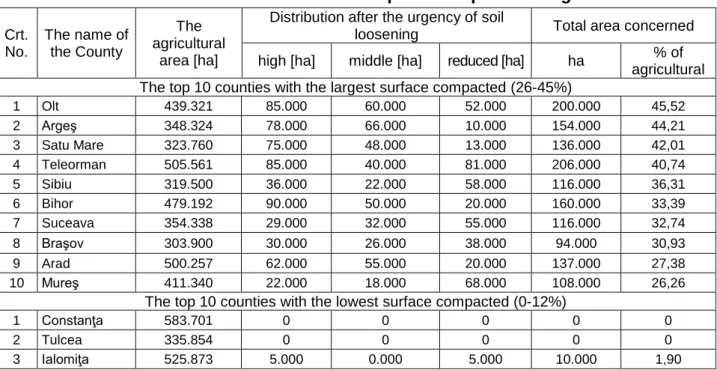
Distribution of areas of land that requires deep loosening works
Crt. No.
The name of the County
The agricultural
area [ha]
Distribution after the urgency of soil
loosening Total area concerned
high [ha] middle [ha] reduced [ha] ha % of
agricultural The top 10 counties with the largest surface compacted (26-45%)
1 Olt 439.321 85.000 60.000 52.000 200.000 45,52 2 Argeş 348.324 78.000 66.000 10.000 154.000 44,21 3 Satu Mare 323.760 75.000 48.000 13.000 136.000 42,01 4 Teleorman 505.561 85.000 40.000 81.000 206.000 40,74 5 Sibiu 319.500 36.000 22.000 58.000 116.000 36,31 6 Bihor 479.192 90.000 50.000 20.000 160.000 33,39 7 Suceava 354.338 29.000 32.000 55.000 116.000 32,74
8 Braşov 303.900 30.000 26.000 38.000 94.000 30,93 9 Arad 500.257 62.000 55.000 20.000 137.000 27,38 10 Mureş 411.340 22.000 18.000 68.000 108.000 26,26
The top 10 counties with the lowest surface compacted (0-12%)
1 Constanţa 583.701 0 0 0 0 0
2 Tulcea 335.854 0 0 0 0 0
51 Crt.
No.
The name of the County
The agricultural
area [ha]
Distribution after the urgency of soil
loosening Total area concerned
high [ha] middle [ha] reduced [ha] ha % of
agricultural The top 10 counties with the largest surface compacted (26-45%)
4 Vaslui 410.903 6.000 4.000 0.000 10.000 2,43 5 Galaţi 359.210 7.000 4.000 0.000 11.000 3,06 6 Brăila 398.805 15.000 5.000 5.000 25.000 6,27 7 Iaşi 408.278 10.000 12.000 10.000 32.000 7,84 8 Harghita 402.048 10.000 10.000 17.000 37.000 9,20 9 Buzău 404.109 24.000 10.000 14.000 48.000 11,88 10 Sălaj 243.918 10.000 3.000 17.000 30.000 12,30
TOTAL 15.067.362 1.269.000 741.000 960.000 2.970.000 19,80
The data in table 1 show that only two of the country's counties (Constanţa and Tulcea) don’t currently have agricultural lands which require being deep loose. On first places are counties Argeş, Olt, Teleorman and Satu Mare in wich the land that requires deep loosening works represents over 40% of all agricultural areas of the respective counties. Large areas of land that requires same work are the counties of Timiş, Arad, and Ilfov.
Studies conducted by experts show that outside of these areas that, at present, due to their natural properties, demands deep loosening work, in the future this work will become necessary at any other cultivated land, as a result of rising soils compactness in terms of modern agriculture, which will become more intensive, more mechanized and irrigated.
The way, in which they are observed from satellite, the soil types on Romanian territory (Figure 2) can be viewed on the map in Figure 1.
52
Figure 2 - Soil Map of Romania, seen from satellite [10]
MATERIAL AND METHOD
Identification of soil types in Romania that require deep soil loosening works
Soils that need to be loose are generally colder; the snow melts harder, being characterized by washing of the calcium, sometimes with total extinction of C layer of calcium accumulation. Also on podzolite soils are found a decrease of humus by washing, which reduces soil fertility.
The processes of washing humus, clays and calcium at the top of the profile lead to damage the glomerular soil structure, to separation of silica that gives a whitish-gray color to A2 soil layer and to the accumulation of clays in B layer starting at 40 … 50 cm, creating one or more layers, compact, compacted and impermeable.
Destruction of soil structure and compaction of arable layer in depthm, through clay accumulation, reduces the water storage capacity, prevent soil aeration, damage aerohidric balance and replace the aerobe microbiological processes with anaerobe processes that are harmful to plant life.
This is because soil compaction, lack of air and the release of anaerobic processes are leading to asphyxiation of plants. The soil compaction, in depth, due to pedogenesis causes, shown above, plus mechanical compaction of the soil in the upper layers due to repeated passage of working units which on land with excessive humidity have an maximum adverse effect.
Vertisol soil type
Vertisol soils type are clay soils, heavy and black throughout the depth profile. They meet on the lower foothills, high fields, old terraces and on smooth surfaces without external drainage.
In profile, to these soil the A layer is 20 ... 50 cm thick and has a slight tint dark gray color. Follows a transition A / B of 20 ... 30 cm, the same color as the layer A. Layer B exceeds 100 cm and is usually dark, dark brown, often with yellow or rust spots.
Clay accumulation begins at a depth of 50 cm, where the percentage of clay is over 50% and reaches its maximum value at 80 cm.
53
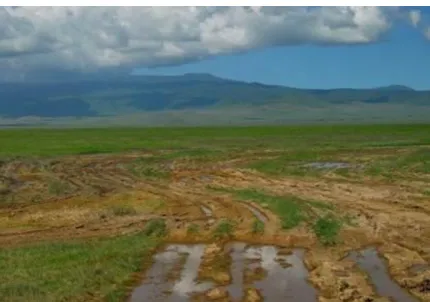
Figure 3 - The appearance of a compact soil in wet periods
Figure 4 - The appearance of a compact soil in drought periods
Clayey podzolic soils
These soils are found in the same area of soils shown before, occupying large areas, being found on horizontal relief units, practically free from external drainage, on older units consist of deposits rich in sand and having an acid character. They are in the most humid portions of joint area. The process of formation of these soils is oriented in the podzolic direction.
A0 layer of 2 ... 4 cm thickness, consists of decomposing organic debris. A1 layer of 10...20 cm thickness, has a light gray color. A2 layer of 10...30 cm thickness, is lighter than the A1 layer.
The B layer, with thickness varying from 40 to 120 cm, is yellowish-brown color, the C layer is missing and the calcium carbonate is being completely washed away. At level of B layer is a huge plus of clay, the textural differentiation index exceeding sometimes the value 3. The maximum accumulation of clay begins at depth of 50…60 cm.
Brown soils (low podzolit)
54
Brown podzolit soil
Podzolite brown soils have A1 layer with a thickness of 10 … 20 cm and are usually have a grey-brown colour. After, follows a podzolic layer of 10 … 20 cm thikness, lighter in color.
Layer B, well defined, has a thickness of 60 ÷ 160 cm, with a color brown to yellowish brown with reddish spots. The B layer, starting at 50 cm, has a considerable addition of clay; the textural differentiation index is sometimes at the value of 2. Due to the presence of clay, of compaction and sealing of layer B, the aerohidric regime of these soils is faulty.
RESULTS AND DISCUSSIONS
Deep soil loosening aims to increase lacunar space of soil layers lying beneath arable layer, without mixing, overturning or reversing soil layers. This is a specific work of hard and compacted soil, alternatively affected by the excess and shortage of humidity, as well as other types of soils which posing limitations on production capacity caused by salinization, alkalinization, pollution, etc.Excess moisture frequently occurs in wetter and low through evapotranspiration periods, on soils that have a clay layer, compact and waterproof under arable layer. Because of the low permeability of this layer, rainwater can not seep towards and accumulate in the upper portion or surface.
Deep soil loosening, without turning the furrow is made for puncturing the impermeable layer of soil and cause water infiltration in the upper layers. In dry areas, water accumulated in depth of the soil set aside for periods without precipitation, and in wet areas this water must be removed by drainage systems.
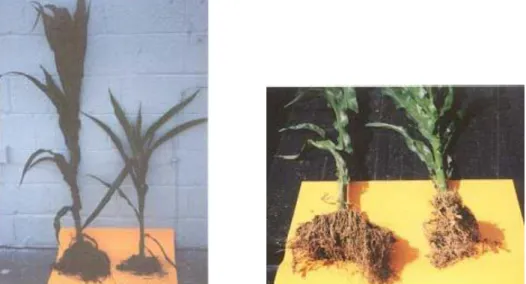
At the same time, by deep soil loosening are obtained positive effects on improving the conditions of aeration, water permeability, storage capacity of rainfall, as well as favoring the development of a deeper root system (Figure 5) and an intensification of biological activity in the soil.
Figure 5 - The development of the root system of the plants on the ground with deep soil loosening
(left) and without deep soil loosening (right)
The main rules to be considered in the execution of this work in optimal conditions with minimal energy consumption are:
55
landscaped drainage system, soil loosening depth uniformity is very important in the sense of favoring drain excess water to drain network.
- Working width depends on the soil loosening depth and on the type of machine. A good soil loosening intensity is obtained when the width is equal to the two soil loosening depths
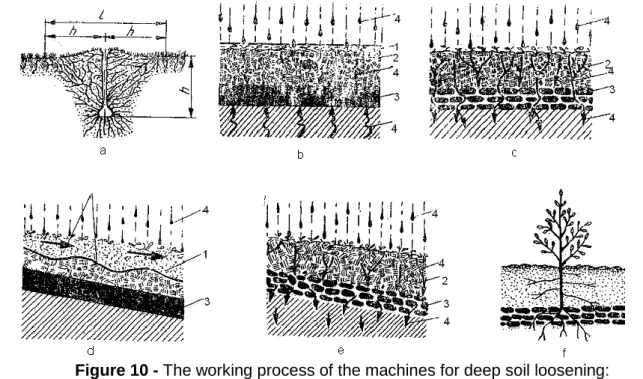
h: l = 2 h. The distance between two active pieces is about 0, 5…0, 7 l, which can ensure an appropriate soil loosening depth h. Distances can be considered only on landscaped lands with drainage works.
- The moment executing the work. Deep loosening may have a more prolonged effect only when are performed under optimal conditions of humidity. Optimal humidity conditions are met when humidity is between 60 ... 90% of the active humidity range. At humidity lower than 60% the soil being too dry, result large lumps of soil that are processed hard and with high energy consumption. In the process of soil loosening the soil must break forming irregular fissures and cracks, structural elements must be misplaced from each other, pushed to the side and towards the surface so that it can no longer be able to recover the original placement. To humidity higher than 90%, the soil loosening reduced to a simple cut of the soil by the working organ.
- Execution time. The work is performed in summer, during july-august or autumn after harvesting crops, before the plowing. Deep loosening may continue in october, if not intervening the wet periods, especially if the land is not intended for other autumn crops.
Also, deep soil loosening must be preceded by application of organic fertilizers and, where appropriate, by application of phosphate fertilizers and amendments to remove excess water.
Choosing land that requires deep soil loosening work is based on a number of criteria such as pedological, climatic, geomorphological, lithological, hydrogeological etc. If one of these criteria is not satisfied, it becomes restrictive to perform deep soil loosening on the respective surface.
From the pedological point of view, have priority the soils which are affected by excess humidity of pluvial nature and those with a degree of compaction above 10% and low air and water permeability. For example, the first category includes compact clay soils, the podzolic, brown-reddish etc., and from the second groups those with clay-containing more than 30%.
- In terms of climate, deep soil loosening is necessary and possible in areas with normal hidric balance surplus for the period from october to march and normally substantively flawed from july to september.
- In terms of geomorphology, the land must have a slope less than 15% to allow the activity of soil loosening of technical equipments.
- In terms of lithology, the land must have a substrate and a slope that does not favor landslides.
- In terms of hydrogeology, it is necessary that the soil is not affected by the groundwater influences on soil loosening depth in periods of excess humidity.
- From the point of view of combating excess humidity, the scheme of a soil profile before and after the deep soil loosening can be presented in two situations, namely:
56
a b
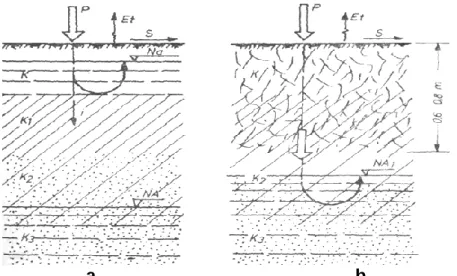
Figure 6 – The effect of deep soil loosening on land with hard permeabil clay layer located at small
depth
a – before soil loosening; b – after soil loosening
- Case 2: When low permeability clay layer thickness is greater than 0.6 to 0.8 m and can not be fully penetrated with existing deep soil loosening equipments, because it exceeds thereof maximum working depth (Figure 7).
a b
Figure 7 – The effect of deep soil loosening on land with hard permeabil clay layer located at small
depth
a – before soil loosening; b – after soil loosening
57
Figure 8 - The effect of deep soil loosening on land with hard permeabil clay layer of large
thickness
(after soil loosening and drainage)
The meanings of the notations in Figures 6, 7 and 8 are as follows: P - the amount of rainfall;
Et - evapotranspiration;
s - drained water from the surface of the land; i - infiltrated water into the depth;
Na - seasonal groundwater level, accumulated over the low permeability layer, which can reach even the land surface;
NA - permanent groundwater level located in permeable layers consisting of sandy and gravel formations;
dc - mole drain;
Dc - drain tube collector.
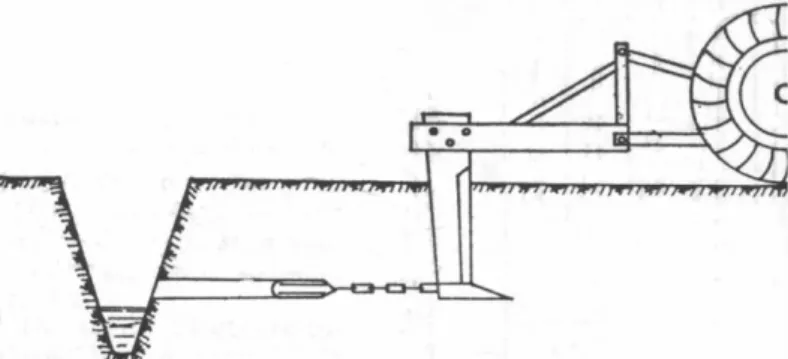
Figure 9 - Execution of mole drainage simultaneously with deep soil loosening,
on a landscaped land with drainage channel
When the volume of rainfall exceeds the water consumption through evapotranspiration, the possibilities of drainage on the surface of the land and of infiltration into deeper arable layers, is formed on the soil profile, above the clayey podzolic layer poorly permeable, an accumulation of water that saturates plant roots area, staying on the surface.
Because soil loosening, the impermeable soil layer is destroyed and the water is no longer staying on the surface of the land and it may drain in depth, and the soil is aerating (Figure 10, b and c). Therefore on the sloping land, through soil depth loosening, is achieved the possibility to avoid water infiltration into the soil and soil erosion, due to water flow downhill (Figure 10, d and e).
58
At soil loosening organs that have vibratory movements, the running resistance force through soil is reduced up to 40%, compared to the rigid force, and at organs with elastic support is up to 20%, which makes that, for great depths, to prefer these kinds of working organs.
Figure 10 - The working process of the machines for deep soil loosening:
a-loose soil section: h- working depth; l- working width (2h); b- not worked soil section on flat land; c- worked
soil section on flat land; 1-standing water; 2- arable soil layer; 3- impermeable soil layer; 4- water and its
circuit; d- not worked soil section on sloping land; e- worked soil section on sloping land: 1- water and soil from the surface; 2- arable soil layer; 3- impermeable soil layer; 4- water and its circuit; f- favorable
conditions for plant development.
Changing the negative characteristics of these soils can be made through a complex of measures and structures contained within the generic agropedoameliorative measures, such as leveling, shaping, drainage, deep soil loosening, subsoiling, irrigation, fertilization, crop system etc.
Of these, through deep soil loosening or subsoiling, aims to achieve a radical change in the characteristics of the soil in compact layer, compacted and inpermeabil, thus increasing the water storage capacity, creating the conditions for normal aeration and heating of the soil and the activation of biological processes in the soil [14, 15, 16 and 17].
Through the work of deep soil loosening increases the pore volume from the soil, increases lacunar space that allows rapid water drainage and surface water flow is accelerating. Beneath arable layer, by reducing compactness and cohesion, it creates favorable conditions for the penetration of plant roots, increasing their feeding area and increasing their ability for resistance to drought.
So, a proper definition of the work of deep soil loosening would be that of agropedoameliorative operation, carried out with mechanical means, through which alter the physical state of the soil, including under arable layer, for the purpose of reducing the degree of natural or gained compaction.
When deep soil loosening works are performed at a level of quality corresponding to the agropedology requirements, at a cost price as low as possible and with low power consumption, it requires ensuring the equipment with superior structural and functional parameters.
59
Topographic and lithologic, deep soil loosening is generally desirable on sloping land or on lands without alternating layers favoring landslides.
Hydrological, deep soil loosening is necessary in territories subjects to alternations of excess and deficit humidity, with or without water or groundwater contributions, drainage, floods etc.
Agrophytotechnical, deep soil loosening is required in the practice of intensive agriculture and ensuring economic harvest gains.
Based on studies conducted, experts from the profile institute (ICPA Bucharest) developed the agronomic and pedological requirements for deep soil loosening works [3, 4, 6, and 7].
According to them, for works deep soil loosening are interested primarily the podzolic, reddish brown, vertisols, marshy grounds and heavy alluvial soils. Subsoiling work can be carried out on the chernozem, medium brown soils and alluvial soils.
No deep soil loosening works are performed on sandy soils, soils with gravel and superficially hard rock, on wetlands and lands with groundwater at a depth of less than 1
m, land with slopes over 15% and on lands with landslides or springs coast.
It is recommended that optimal humidity for deep soil loosening works to be 80 ÷ 90% of water capacity in field soil.
This amount represents about 60 ÷ 90% of active humidity range (I.U.A.), which is the interval between the wilting coefficient and water capacity in field soil.
Soil work at low humidities below 60% of I.U.A. is achieved with high fuel consumption due to higher resistance that opposes the soil to the advancement of active organs, and the work is of poor quality, resulting in large boulders.
To high humidity appear the phenomenon of simple cutting and lateral compression of the soil, which increases the soil volumetric weight and thus reduce its total porosity.
So, agropedology requirements prohibit the execution of works on soil with humidity greater than the upper limit set.
Another requirement for the working direction of the equipmets in the plot: it must be perpendicular to the slope in climatic conditions with hydric balance deficient and parallel or oblique compared to slope in terms of hydric balance surplus and on depressionary land.
CONCLUSIONS
The large number of works that are executed by applying conventional technologies that result in soil compaction, damage to its structure, loss of fertility, etc. and which is carried out with a great energy consumption, as the classification need for agricultural works in the optimal periods, led to the extension of the low working technologies (minimum) within which it belongs the system with deep loosening equipment, which implies that the soil work to be done without turning the furrow and crop residues to be incorporated only partially, being one of the most used equipment.
The complex process of soil loosening equipments which carries out soil loosening through mechanical disintegration and shredding, in contrast to the classical plows which cuts the soil after imposed area, allows that the separation area to coincide with the natural split surface of minimum resistance, which has beneficial effects on soil structure and leads to perform the work with less energy consumption
BIBLIOGRAPHY
60
2. Colibaş, I., Stângă, N., Dumitru, E., Canarache, A., 1989 – Integrated technology of execution of scarifying works (deep loosening) and subsoiling (scratching),
Vegetal production, Grain and technical plants Journal, no. 5, Bucharest;
3. Dumitru, E., Vig Dinescu, I., Motelică, D., Vâlceanu, S., 1988 - Determination of the pedoameliorative effects of the machine of soil loosening, MAS-60D, equipped with two active vibrators organs compared to the standard equipment in conditions of main soils from S.A.I., I.C.P.A. Report;
4. Dumitru, R., Canarache, A. 1970 - Method for determining soil humidity between pF 1 and 2 and its relationship to the volumetric weight and the content of clay in the soil, The Annals of ISCP, no. 38;
5. Sandu, Gh. ş.a., 1981 - Control of soil development from land improvement systems. Ceres Publishing, Bucharest;
6. Sin, Gh. ş.a., 1996 - Improving soils with excess humidity from south of the country, Vegetal production, Grain and technical plants Journal, no. 12, Bucharest;
7. Vâjâială, M., 1991 - Agro biological bases of mechanization and processing of agricultural products. IANB, Bucharest;
8. Vineş, Gh., 1985 - Soil works: Requirements and guidelines. Vegetal production, Grain and technical plants Journal, no. 10, Bucharest;
9. http://www.recolta.eu/arhiva/harta-diferitelor-tipuri-de-soluri-din-romania-9508.html; 10.
![Figure 1 - Soil Map of Romania [9]](https://thumb-us.123doks.com/thumbv2/123dok_us/8072715.2138534/2.892.86.809.94.364/figure-soil-map-of-romania.webp)
![Figure 2 - Soil Map of Romania, seen from satellite [10] MATERIAL AND METHOD](https://thumb-us.123doks.com/thumbv2/123dok_us/8072715.2138534/3.892.209.684.98.440/figure-soil-map-romania-seen-satellite-material-method.webp)