Managing and Measuring for Value:
The Case of Call Centre Performance
By Bernard Marr
and
Andy Neely
Centre for Business Performance
Cranfield School of Management
Cranfield, Bedfordshire MK43 0AL
The Fujitsu Case Study
DESIGNING FOR VALUE ...20
SUMMARY ...21
SENSE AND RESPOND AT FUJITSU ...23
Leadership at all levels ...24
Implementation Phases...24
Phase 1) Learning to Sense ...25
Phase 2) Learning to Respond ...25
Phase 3) Leading Change ...25
Phase 4) Mobilising ...25
RESULTS AT FUJITSU ...26
Results beyond the confines of the call centre...27
Industry recognition ...27
SENSE AND RESPOND – AN OVERVIEW ...28
Understanding why customers call ...28
Restoring Value ...28
Creating Value ...28
Analysing root-cost ...28
Measuring end-to-end response capability...28
Sense and Respond operating principles...29
Changing the corporate culture...29
CONCLUSIONS : CAUTIONARY TALE ...30
REFERENCES ...30
BIOGRAPHIES...18...31
TABLE OF CONTENT ...2
EXECUTIVE SUMMARY ...3
INTRODUCTION ...4
PERFORMANCE MANAGEMENT IN CALL AND CONTACT CENTRES ...5
MEASURING PERFORMANCE IN CALL AND CONTACT CENTRES – THE EFFICIENCY TRAP ...6
MEASURING CUSTOMER VALUE AND SERVICE QUALITY IN CALL AND CONTACT CENTRES ...7
CUSTOMER SATISFACTION ...7 SERVICE QUALITY ...8 EMPLOYEE SATISFACTION...9 SUMMARY: ...9 RESEARCH METHODOLOGY ...10 RESEARCH RESULTS ...10
OPERATIONAL EFFICIENCY MEASURES ...10
CUSTOMER SATISFACTION ...11 SERVICE QUALITY ...11 EMPLOYEE SATISFACTION...11 MEASUREMENT APPROACHES ...12 DISCUSSION ...13 MANAGERIAL IMPLICATIONS ...14 CONCLUSION ...15
Table of Contents
By Professor Daniel T Jones Chairman, Lean Enterprise Academy
Co-author of the books The Machine that Changed the
World and Lean Thinking.
Defining value correctly from the customer’s perspective is the first principle of Lean Thinking. The second principle is designing and managing the whole process for delivering this value backwards from the customer, rather than forwards from the assets the provider is seeking to keep busy. Most people have a hard time moving beyond eliminating waste from existing processes. However, this pioneering research and case study demonstrates just what can be achieved from being truly customer focused. The real significance of this research and case study is that companies start by understanding what the customer is trying to achieve – customer purpose – rather than customer satisfaction or even customer delight. Through an informed dialogue with customers, it is possible not only to enhance value but also to eliminate the need and cost of unnecessary interactions due to failures of the delivery process or in the system or product design. This sets in motion a virtuous circle from which both the customer and the provider continue to gain all the time.
It also shows the way forward in creating more rewarding work in call centres – modern-day information
factories. With the different approaches outlined in this report, work becomes much more purposeful, creative and meaningful – so people stay and grow, rather than quit as soon as they can - a win-win also for employees. A deep understanding of customer purpose also comes from sharing a context with the customer. This in turn is the foundation for innovative service redesign.
As an integral part of most organisations today call centres play a key role in the service delivery chain. Value creation is in the eye of the beholder, if organisations fail to deliver value to their customers, there will inevitably be a loss for stakeholders over the longer term.
Presently in many industries, call centres are the primary source of contact for customers. This important role implies that the performance management of call centres is of critical importance to organisations, especially the delivery of customer satisfaction.
In this research the ways organisations measure and manage customer satisfaction in call centres is explored. Clear evidence that current measures of performance in call centres are often counter-productive to achieving customer satisfaction is revealed. Many call centres seem to have fallen into the trap of believing that operational measures such as call duration are indicators of customer satisfaction. Evidence indicates that they are not; they are only measures of efficiency, which in turn is seen as
determinant of financial performance. Most call centres seem to miss the important link between employee satisfaction, service quality, customer satisfaction, and profitability. In 12 case studies of world-leading call centres, the research identifies various managerial implications to avoid the "efficiency trap" in measuring and managing call centre performance. The managerial implications of this research are as follows:
● Call centre performance is increasingly important for
delivering customer service. Call centre performance should not be measured in isolation from the performance of the whole organisation. In most cases they are not detached operations with a solitary goal of driving down costs. Call centres are an integral part of an organisations value chain delivering its services and products. Therefore, the performance measures of call centres need to reflect the strategic direction of the entire organisation.
● A more balanced approach to measuring performance based on strategic objectives is valuable, especially if visual representations of service delivery and value creation are used. This enables easy communication of overall performance and puts efficiency targets in perspective. Best practice seems to be to track the following areas of performance as well as their
interactions: employee satisfaction, service quality, customer satisfaction, and satisfaction of other stakeholders (e.g. financial performance) with particular emphasis on the intangible performance drivers.
● Customer dialogue is important and call centres are in
fact listening to and speaking with customers all the time. Measuring customer satisfaction should start with understanding customers. Communication is often very task orientated, whereas call centres need to recognise the importance of listening to the customers in order to:
- understand their needs and requirements from their perspective
- detect failures, bottle necks, or improvement potential
- deliver service that satisfies the customer.
● It is critical to understand and classify the nature of demand. Often calls are unwanted or even unwittingly generated by other parts of the organisation. By analysing and classifying demand, it becomes more manageable and more predictable. Unwanted calls could then be reduced or even eliminated.
Overall, a strategy-driven and integrated approach towards performance measurement in call centres will, therefore, improve operational efficiency and contribute to continuous innovation of the organisation as a whole.
Acknowledgements:
The research report summarises the work conducted by the Centre for Business Performance at Cranfield School of Management. I would like to thank DHL who, as a partner of the Cranfield Performance Measurement Best Practice Roundtable, have sponsored the work into call centre performance measurement. Furthermore, I would like to acknowledge the valuable input of my colleagues at Cranfield School of Management, especially Mike Bourne, Bruce Clark, Monica Franco, Mike Kennerley, Andy Neely, Mark Wilcox, and Alan Meekings. Finally, I would like to thank all call centre managers who participated in this research and Fujitsu for their efforts in printing and marketing this report. A Special thank you to Stephen Parry from Fujitsu.
Call centres are an integral part of most industries today. They play an essential role in today’s business worldand are often the primary source of contact for customers[31]. The call centre industry has experienced incredible growth on both sides of the Atlantic, which is set to continue[14]. According to Reuters the Western European call centre market as a whole is expected to grow by 12% annually [37]. In European countries such as the UK more employees work in call centres than in many traditional fields and recent figures estimated that in 2001 2.2 percent of the UK population were working in call centres. One study states [31, p351]:
"Call centres are changing the way companies
communicate with customers and are a strategic asset in delivering exceptional service quality. Companies that focus on customer loyalty are increasingly using their centres to differentiate their product or service offering and drive customer satisfaction".
The management of performance and customer satisfaction in call centres is therefore a critical part of most organisations. Based on an extensive literature search, what call centres are and how they manage performance will be explored. Thenthe way call centres measure their performance addressing the dominant
efficiency measures as well as measures for customer satisfaction, service quality and employee satisfaction
will be discussed.
The way in which the case studies with the twelve leading
call centres were conducted will be described.
Subsequent sections will report the findings of how these
organisations measure their performance.
The operational efficiency measures, customer satisfaction measures, service quality measures and employee satisifaction
measures are seperated. The general measurement systems of the case study firms will be examined leading to a discussion
on the findings and drawing up the managerial implications.
Introduction
According to the Call Centre Association a call centre is a physical or virtual operation within an organisation in which a managed group of people spend most of their time doing business by telephone, usually working in a computer-automated environment. However, it seems that the nature of call centres is rapidly changing, with Customer
Relationship Management (CRM) being the hot topic in call centres today, entailing strong investments in technology for loyalty and growth [38]. According to other researchers, call centres allow a company to build, maintain, and manage customer relationships by solving problems and resolving complaints quickly, having information, answering questions, and being available usually 24-hours a day, 7 days a week, 365 days of the year [32]. It is argued that call centres can form the heart of successful customer-relationship management strategies [32].
There is increasing evidence that call centres are gradually migrating into customer contact centres [2]. Customer contact centres handle all relationships with the customer and utilise multiple channels integrating traditional channels of telephone and fax, with newer technologies such as e-mail, SMS, and Internet. According to Reuters, a contact centre is an operational group within a business which is concerned with the development of customer relationships, using integrated technology solutions and business processes [37]. It is argued that today’s call centres are complex operations that require a combination of technology, process, and human talent in order to succeed [31]. However, it seems that the human aspect is often ignored in today’s call centres. Evidence in the literature suggests that performance management in call centre environments missed the evolution seen in the field of general business performance management since the beginning of the 20th century right through until today. This evolution can be described as one from the machine age to the information age, or from scientific management to the management of today’s complex and global knowledge economy [14]. This evolution started with Frederick Winslow Taylor, who
was later much criticised for his view that there was one
single best way to fulfill a particular task. According to
Taylor, it was only a matter of matching people to a task
and then supervising, rewarding and punishing them in
accordance with thier performance. In Taylor’s view, there
was no such thing as skill and all work could be analysed
step-by-step as a series of unskilled operations that could
then be combined into any kind of job [14].
Performance systems used at that time reflected this view
with a focus on operational efficiency. The stopwatch was the
critical tool of that time. This management approach was later criticised as inhumane, and it was not long until people like the French management thinker Henri Fayol recognised that the esprit de corps is a vital factor for the success of organisations, contrasting Taylor’s view that any
identification with fellow workers was a distraction rather than a motivation. The evolution of business performance management continued with the recognition that aspects other than efficiency and financial output contribute to the overall performance of organisations.
The financial bias needed to be balanced against performance criteria such as stakeholder satisfaction, including customers and employees, quality, know-how, and intellectual property. This resulted in the development of various performance management and measurement tools including the Balanced Scorecard [28], the Skandia Navigator [18], the Knowledge Asset Map [30], and the Performance Prism [33]to name just a few.
When looking at the way many call centres measure and manage their performance today, it is easy to forget that the world has moved on from Taylorism and scientific management of mass production organisations.
Sometimes referred to as the "sweatshops of the Western world"or "new dark satanic mills," call centre performance
measures are dominated by stopwatches and measures, such as time to answer a call and call duration. Some scholars maintain that call centres are very competent in capturing information about efficiency, but they pay little attention to the qualitative employee characteristics that create value for the organisations and its customers [42]. The authors continue to argue that call centre agents would normally be assessed in terms of ‘number of calls taken’, ‘ability to answer the customer query’, or ‘number of productive hours against the number of hours worked', in other words in terms of their productive value and
efficiency. The problem with these measures of productivity and efficiency is that they are of little worth when it comes to measuring value [42]. Researchers from Maastricht University state that, in order to manage well, managers in call centres, "need to ensure that the measurements accurately portray what management wants to be measured. The effective management of high quality voice-to-voice service delivery could be adversely affected
According to Professor Neely and his colleagues,
performance measurement can be defined ‘as the process of quantifying the efficiency and effectiveness of past
action.’[33]. Call centres typically produce many
measures of performance, sometimes numbering in hundreds [31]. Alan Miciak of Calgary University and Mike Desmarais of the Service Quality Measurement Group maintain that the majority of measures are operational efficiency measures and have to do with telephone technology (e.g. average talk time, abandon rates, etc.) in use and adherence of employee standards of practice (e.g. occupancy rates, calls per hour, etc.) [31]. Audrey Gilmore and Lesley Moreland identify the following measures which were all reported on wall displays in various call centres [22].
● Number of calls answered within past ten minutes ● Calls waiting to be answered, that is ‘in the queue’ ● Number of agents currently taking calls
● Number of agents waiting to take calls (free agents) ● Number of ‘not ready’ agents
● Number of agents on outgoing calls or on a call to
another agent.
It was identified that agents paid close attention to the display and that they would only go for a break if the displayed call situation would allow it.
There is little evidence in the literature about performance measures in call centre environments. However, research indicates that call centre manuals provide some guidance about common measures of call centre excellence [43]. Jon Anton of the Prudence University in Indiana claims that the following measures help to track quality of call centre service [19]:
● ASA (average speed of answer)
● Queue time (amount of time caller is in the line for answer)
● Percentage of callers who have satisfactory resolution
on the first call
● Abandonment rate (the percentage of callers who hang up or disconnect prior to answer)
● Average talk time (total time caller was connected to
telephone service representative)
● Adherence (are agents in their seats as scheduled?)
● Average work time after call (time needed to finish paper work, do research after the call itself has been completed)
● Percentage of calls blocked (percentage of callers who receive a busy signal and could not even get in to the queue)
● Time before abandoning (average time caller held on before giving up in queue)
● Inbound calls per TSR eight-hour shift
● TSR turnover (the number of telephone service
representatives who left in a period of time usually annually)
● Total calls
● Service levels (calls answered in less than x seconds
divided by number of total calls).
Richard Feinberg and his colleagues claim that the importance of these measures is confirmed in other leading publications on call centre management [41][19]. From the experience of Miciak and Desmarais, organisations rarely measure customer satisfaction with call centre experience measures, such as the ones stated above [31]. Researchers empirically tested the 13 ‘critical operational
determinants’ of call centre excellence by using data from 514 call centres [19]. Their data shows that only two of the 13 operational determinants, namely ‘percentage of calls closed in first contact’ and ‘average abandonment’, have any statistically
significant, albeit weak, influence on caller satisfaction. One explanation for this is that technology in call centres enables them to easily track operational measures and that "we make important what we can
measure"[19]. This assumption is supported by
additional research which shows that ease of measurement leads to automatic reporting, which in turn, can lead to the deceptive belief that the reported measures are important and motivating [40].
Measuring Performance in Call and Contact Cent
re
s –
Call centre performance is critical to the image of an organisation[7]. A study conducted byPurdue University found that 92% of US customers form their image of a company based on their experience using the company’s call centre. Furthermore, the study reports that based on a negative call centre experience, 63% of consumers even discontinue using a company’s products. This number even rises to 100% for consumers between the ages of 18 and 25 [16]. Gilmore and Moreland state that in most service situations both customers and service employees’ expectations are rising; therefore, all participants have higher expectations of levels of service delivery [22]. There is an obvious link between efficiency and
performance, which is addressed by measuring the operational efficiency measures. Besides operational performance measures, the literature provides clear evidence of other aspects that impact performance but are rarely addressed in call centre performance measurement systems. These are primarily links between the following concepts:
● Customer satisfaction and both profitability and loyalty [47]
● Service quality and customer satisfaction[25]
● Employee satisfaction and service quality[39]
This chain of cause and effect has been described as the
Service Profit Chain [25], or later, as the Value Profit
Chain [26], while others call it the Employee-Customer
Profit Chain[39]. In the subsequent part of this section
each of the concepts and their relationship in the call centre context will be defined and discussed.
Customer satisfaction
Today’s call centre customers want better service. They want to be treated better, have easier ways of accessing services, with timely responses [11]. Some scholars define customer satisfaction as an evaluation of product or service in terms of whether that product or service has met their needs and expectations [47]. Others confirm this view by defining satisfaction as the result of a customer’s assessment of a service based on a comparison of their perception of service delivery with their prior expectations. In this context it is important to understand customer
needs and expectations in call centre environments. Jon Anton of Purdue University in Indiana has identified four basic reasons why customers desire to contact an organisation [3]:
● The customer has a question and needs an answer in
order to proceed, i.e. "Where do I buy your product?", "What is the price?", etc.
● The customer wants the company to do something, i.e.
"Change my address", "Send me a manual", "Take my order for a new product", etc.
● The customer has a problem with the product and
needs assistance and guidance in resolving the issue, i.e. technical support, help desk etc.
● The customer is emotionally upset with the product, and
wants to know that the company will set the situation straight, i.e. complaint resolution and anger diffusion. Researchers from the Netherlands identified the following 13 call centre customer expectations of staff [10]using the work
of research previously published by scholars in this field [4] [6] [8] [23] [34] [46]:
● Self-efficacy– employees’ belief that he/she is
competent to execute the required activities related to the job
● Adaptability – ability to adjust behavior and handle
interpersonal situations
● Empathy– ability to show individualised attention and
personal involvement
● Time– speed with which the customer requests are solved
● Communication style– ability to address customers’
service needs and adjust the language for different customers
● Reliability– ability to deliver on promises in a
dependable and accurate way
● Perception of commitment to service quality and
customer satisfaction– commitment of the
employee as perceived by the customer to provide maximum service quality
Measuring customer value and service quality
● Empowerment– desire, skills, tools, and authority as a
frontline employee to service customers
● Staff attitude– characteristic that involves friendly and
considerate service
● Explanation– Clarity, truth and honesty when
providing content and explanations to the customer
● Competence– skills and knowledge necessary to
perform the service delivery
● Security– confidentiality when dealing with any service
request and customer information, so the customer can be free of any danger, risk or doubts
● Knowing the customer– making an effort to understand
the specific customer needs
Empirical tests allowed the design of a model of
customer expectation dimensions for voice-to-voice
service encounters [10]. The model includes the
following sub-scales:
● Adaptiveness– the customer clearly expects call
centre employees to adjust their behavior to the customer, handle interpersonal situations, and adapt to various situations
● Assurance– call centre employees are expected to
provide security and explanation, treat information discreetly and assure customers of confidentiality
● Empathy – customers expect call centre employees to
empathasise with their emotions and/or situation,they do not want to be treated as a ‘number’
● Authority– customers expect that call centre
employees have the authority to deal with their various problems or questions
The researchers suggest that call centres can use the four-scale model as the basis for performance
measurement, to identify training needs for employees, and as a recruitment and selection template for call centre employees. Other scholars make the link between service quality and satisfaction.They state that high levels of service are important since the number of "completely satisfied" customers is one of the few predictors of long-term profitability [27].
Service quality
Service quality is different to satisfaction; in fact service quality is a determinant of customer satisfaction.
Satisfaction is driven by the customer’s assessment of the difference between perception of service delivery and their prior expectation of that service. Service quality is more often used as a more enduring construct, whereas satisfaction is specific to any situation or experience. Service quality creates an overall impression of the relative perception of an organisation and its service. In fact, the findings of Purdue University show that one bad experience with call centres might cause customers to stop using a company’s product or service [16]. This means that call centres need to deliver on their service promise all the time if they want to avoid the risk of losing customers.
Some scholars note also that some customers actually rate service quality of call centre contact higher than they rate in-person contacts [17]. Quality, in this context, is the net aggregated value of benefits perceived in the service encounter over what the customer had been expecting [29]. Therefore, firms have to pay particular attention to consumers' perceptions of the service process. According to Bearden and his colleagues, [30 p. 794]the benefits of increased quality of the service process will be two-fold:
● firms will improve the ability to attract new customers ● retention rates among current customers will increase
The experience of Miciak and Desmarais suggests that very few call centres actually measure service quality that would deliver customer satisfaction [31]. They note that "in the absence of listening to the customer about how they
perceive service quality at the call centre, management
makes assumptions about satisfaction using operational measures such as service levels, abandon rates, call monitoring (which may not actually be a good indicator of
overall satisfaction with call centre service quality)".
Wallace and his colleagues find that in call centres excellent service is often delivered through the personal efforts of the front-line employees [44]. Consumer perceptions are strongly influenced by the attitudes and behaviors of contact employees when evaluating the
quality of the service delivered [9]. The Australian researchers Bennington and Cummane establish the link between service quality and employee satisfaction [5]. Their research on total service experience (call centre and in-person) has identified that nearly 40 percent of the variance in customers' satisfaction with service was found to be related to expectations of service quality, helpfulness of staff, accuracy, results obtained, age of recipient and whether recipients perceived that the staff were satisfied in their jobs.
Employee satisfaction
Jeffrey Pfeffer notes in his Harvard Business School Press book that since it is becoming increasingly difficult to establish a competitive advantage from the range of services offered, in many service firms, it is the contact employees, and not the services themselves, which are the source of differentiation and create a competitive advantage [35]. It seems to be the general perception that employee satisfaction of front line call centre employees is not a measure that is seen to be critical. Call centres are often associated with high stress levels, high staff turnover, and emotional burnout[44]. Research by the ACA reported that call centre employees have a higher stress profile than coal miners and found that the median stay of agents in call centres to be only 15 months [1].
Frenkel and his colleagues find that the often heavily task-focused control systems require call centres to pursue supportive supervision in order to avoid employee burnout [20]. Also, research from Ireland suggests that call centres would gain significant benefits by using a proactive and supportive managerial approach that incorporates empowerment [21] [22]. In order to tackle the trade-off between service orientation and cost focus, management need to play two different but complementary roles. Besides placing an emphasis on operational performance, they are also required to provide emotional support for the staff [23]. However, the reality is that the management approach in call centres is predominately concerned with operational measures; one could say it is a production-line approach targeted towards efficiency [21]. This is supported by research that reveals that although call centres monitor customer satisfaction and quality to varying degrees, they all rely heavily on task-focused management and measurement systems, which include performance
objectives weighted towards numerical quotas and targets for efficiency and speed [44].
Wallace and his colleagues report that in fact the majority of employees are motivated by being effective service providers and by a desire to serve the customer [44]. Audrey Gilmore confirms this intrinsic drive to deliver service that, when delivered, satisfies call centre employees [21]. However, she shows that call centre employees are frustrated and restrained by the standard efficiency measures as they work against satisfying customers. Overall, a strong focus on efficiency measures prevents call centre employees from delivering good service quality to the customers, which in turn frustrates employees and therefore significantly decreases their job satisfaction.
The above evidence seems to suggest that managing front-line employees is at the core of managing call centre performance. However, other authors suggest addressing the trade off between efficiency and service by allowing service-orientated call centre employees to burn out and then replace them quickly. The authors call this concept ‘sacrificial HR strategy’[43]. According to the authors it will
"deliver efficiency and service together by requiring the
front-line to absorb the emotional costs".Instead of relying
on more expensive relations-orientated management and development programs, service effectiveness can be ensured by employing people who are intrinsically motivated to serve the customer. However, this inhumane approach seems to match the exploitation of employees in the coal mines during the beginning of the Industrial Revolution rather than an approach that would promote sustainable performance in today’s business world.
Summary:
The literature provides clear evidence that the current focus on efficiency measures in call centres can in fact be counter-productive to achieving customer satisfaction. Many call centres seem to have fallen into the trap of believing that operational measures such as call durationor average time
to answerare indicators of customer satisfaction. The fact is
that they are not; they are only measures of efficiency, which in turn is often seen as a determinant of financial
performance. Most call centres seem to miss the important link between employee satisfaction, service quality, customer satisfaction, and profitability.
Using an empirical multiple case study approach [45], the aim of this research was to identify how leading call centres measure and manage their business performance. The way call centres track customer
satisfaction and customer value were at the centre of this research.
In order to identify leading call centres, a series of
telephone and face-to-face interviews with industry thought-leaders, academics, call centre associations
and groups, as well as senior members of consulting firms operating in the field of call centres.
Our attention was focused on call centres in Europe
and the United States of America. Overall 18 call centre managers - 10 from Europe and 8 from the US contributed to the research.
From these interviews, a list of call centres that were perceived to be leading in their field was made. Then 20 call centres were short-listed and contacted either by phone or e-mail to arrange interviews. Senior managers with responsibility for performance management were targeted. Twelve of them
agreed to be interviewed. The interviews lasted between 1.5 and 2 hours. The call centres came from a range of different industries: 2 IT
outsourcers, 2 transport industry (airline and train), 2 telecom operators, 5 call service outsource centres, and 1 retailer.
Based on the literature findings, a semi-structured interview which included open questions on the way call centres measure their business performance, especially testing the areas of operational efficiency, customer satisfaction, service quality, and employee satisfaction was constructed. The questionnaire was piloted using two senior consultants in the call centre industry, and consequently refined. The data collection was supplemented by observation studies when interviews took place in the call centres.
The following section summarises the findings of how the case study call centres measured their performance in each of these four areas: operational efficiency, customer satisfaction, service quality, employee satisfaction, as well as the overall approach they used.
Operational efficiency measures
All case study call centres tracked the classical operational efficiency measures. The most commonly measured efficiency indicators included:
● Number of calls
● Average talk time
● Average speed of answer
● Queuing time
● Abandonment rate
All of these measures were tracked automatically by the IT system and reported almost constantly. In four of the case study firms, the efficiency measures were still the
dominant criteria of success. However, the remaining eight measured operational efficiency measures but
supplemented those with additional measures of performance. Managers of all 8 call centres with a more balanced approach towards performance measurement agreed: "Efficiency goals drive the wrong
behavior". Two of the call centres completely stopped
measuring front-line employees' performance in terms of average talk time as they believed it reduced service quality. Only managers and supervisors would be measured against efficiency targets. The performance director of one of the call centres stated: "Average handling time is for resourcing – not as a measure for our front-line staff"
There was consensus among most managers that driving efficiency was important. However, it was made clear that it is important to separate value calls from non-value calls. These call centres did not accept that all the demand they get is demand they want. One manager made it very clear: "We only optimise value calls,we don’t want to waste our energy looking for ways to knock a
couple of seconds off calls we don’t want". Another
manager of an airline call centre mentioned: "You have to be careful with unwanted calls and queries. We used to promote the best deals on our web page without enough information. Agents then had to spend a lot of time with frustrated customers explaining the pricing structure. Changing the information on the web drove down demand
significantly." This illustrates that reducing the number of
unwanted calls can increase efficiency.
"Unwanted calls" directly link to the next finding that demand is often generated by failures in other parts of the organisation. Two call centres in this research explicitly stated that they use performance measures to identify ineffective processes within the firm as a whole. One director of innovation and development stated: "We have trained our people to detect failure and log calls that might have been avoided by putting in place better processes or reducing
hurdles for the customer". Another manager adds "Our
people listen to customers all day long and they tell us what
we can improve, we just need to listen". In one case front
line employees are measured on the number of reduced calls and the number of suggestions that improve overall service delivery, not just the service related to the call.
Customer satisfaction
All 12 case study firms measured customer satisfaction to various degrees and agreed that customer satisfaction is the key objective of their work. Most firms would use customer satisfaction surveys, which were sent out to a sample of customers. The frequency varied between quarterly and annually for larger customer surveys. Over half of the sample firms measured customer satisfaction more frequently using customer interviews and small sample surveys.
Two firms in the sample used automated survey
technology. After the call between the call centre employee and the customer is finished, an automated message questions the customer about the level of satisfaction with the call, which the customer answers by pressing buttons on his/her phone. This allows continuous and direct feedback for the call centres and can be
communicated to other parts of the organisation such as marketing or sales.
Service Quality
All case study firms claimed to track service quality; however, the interpretation of service quality varied among the call centre managers. Often, service quality was understood as compliance to standards of service-level agreements (SLA). Half of the firms in the sample
understood service quality as operational performance; the others measured it as a combination of operational measures and customer measures.
Service quality was usually measured as part of the customer survey or through call monitoring. All firms among the case study call centres reported that they use call monitoring for service quality. Different aspects of the call were measured depending on the interpretation of service quality. Besides classic operational measures such as queuing time and talk time, the following aspects were also frequently measured:
● Greeting
● Communication style
● Tone of voice
● Knowledge of employee
● Competence in performing the task
● Close
One manager said: "We try to understand the customer expectation from their view. It is so easy to fall into the trap of measuring service quality from our own viewpoint, just
looking at our core business". Another manager made it
clear that service quality does not necessarily mean customer satisfaction: "Sometimes we meet all our SLA’s but customers are still unhappy. It can be a matter of
providing a great service which no-one wants".
Employee satisfaction
All case study firms measured employee satisfaction, although the reasons for doing so were different. Three firms stated that the reason for measuring employee satisfaction was to control staff turnover, as this is a major issue in many call centres. The other 9 correlated
including service quality, customer satisfaction, and operational efficiency.
Employee satisfaction was usually measured with anonymous staff surveys, which were collected at various intervals. Two firms measured it annually, nine measured it every six months, and one firm measured it quarterly. These staff surveys were supplemented with other means of measuring employee satisfaction. Eleven of the twelve case study firms reported that they discuss customer satisfaction in their performance review
meetings, which took place at intervals between three and twelve months. Three firms used a 360 degree feedback process to track employee satisfaction.
In addition to surveys and personal reviews many firms also used surrogate measures for employee satisfaction of which the most frequently used are:
● Staff turnover ● Absenteeism ● Timeliness ● Compliance ● Friendliness ● Attitude
Compliance, friendliness, and attitude are usually collected by supervisors or managers when listening to calls. They are typically measured on a 5 to 7 point Lickert-type scale.
Measurement approaches
Even though there was a general bias towards
operational measures, nine of the twelve case study firms had a corporate performance measurement system in place that could be described as a performance scorecard. Seven of them also referred to it as a scorecard. The other organisations measured their performance using tools such as Statistical Process Control (SPC) and Six Sigma, without a clear definition of separate perspectives of performance.
In each scorecard there was a strong tendency towards operational efficiency measures and financial metrics. In fact, five of the firms used some form of visual representation of how aspects of their
performance are related. On a simple basis, this was a visual diagram of which operational measures might be important for different customers. In the most sophisticated example, call centre departments created a map of how their individual capabilities add value to customers. This map was specifically customised to each group of customers, and in fact the maps varied significantly for each customer group. The following perspectives were measured by all organisations using a scorecard approach:
● Financial performance ● Operational efficiency
● Customer satisfaction ● Employee satisfaction
However, the boundaries of these perspectives seem to be blurred as different organisations have similar or the same measures in different perspectives of their performance scorecards. Some call centres place measures such as call duration or time to answer in the customer satisfaction perspective, whereas others place it in the operational efficiency perspective.
One of the case study call centres recently changed its entire measurement system. This involved a massive change program including re-training of employees. They admitted that the previous efficiency-orientated measurement system did not work: "With the old measurement system people
confused targets with purpose". Today they aim to
measure end-to-end service that adds value to the customer. The company felt that functional
performance measures prohibited the company from delivering the best service. Now, they measure service processes as a whole – in which the call centre is an integral part, rather than just the separate performance of the call centre itself. The key in this
approach is to understand the added value from a customer perspective. In an ongoing dialogue the performance requirements of the customer emerge which then become performance targets for the call centre. The performance manager adds: "Our frontline employees now listen to the customer and understand the issues; by also understanding the whole service delivery process, and not just their own functional
space, they are our source of innovation." In this way
employees are more engaged, analyse and interpret customer needs, and help continuously to innovate and improve the service the company delivers as a whole. Even though the implementation of the new
measurement system was not easy: "Some managers were against our new measurement system because they felt they would lose control. Before they could more directly impact and deliver their targets, now they
have to work as a company". The implementation was
a big success and all performance aspects were positively affected: operating costs decreased, customer satisfaction rose, and employee satisfaction rose, which resulted in a reduction of staff turnover from 40% to just 8% today.
The leading call centres in the case study sample are still heavily biased towards operational efficiency measures, as suggested in the literature (e.g. [5] [21] [31]). Nevertheless, the fact that most of the firms used a scorecard approach in order to balance the efficiency bias seems to suggest that they recognise the link between employee satisfaction, operational performance, customer satisfaction, and financial performance, as suggested in the literature (e.g. [25] [26] [39]). This is also supported by the fact that five firms used visual maps to demonstrate cause-and-effect relationships between various aspects of performance.
This research confirms the proposition that call centres need a stronger focus on measuring their intangible value drivers, as suggested by various researchers (e.g. [5] [21] [42]). The case study firms demonstrated that they believe employee satisfaction and customer satisfaction drive call centre
performance. Measures which Gilmore and Moreland classify as ‘intangible dimensions of call centre performance’, such as responsiveness or empathy, were used by the case study firms as measures of customer service [22].
Concerning efficiency measures, this research identified the focus of call centres on reducing unwanted calls or calls which do not add value. There was agreement among call centre managers that it would be a waste of energy trying to increase the efficiency of call handling for calls that could be avoided. Linking into this is the fact that two call centres in the sample of industry leaders seem to recognise the potential of using call centre front line staff to detect inefficiencies in the overall ‘end-to-end’ process. This view is supported by Bennington and his colleagues who suggest that at times the demand for call services is actually created by other parts of the organisation, especially for example when complex information is forwarded to customers or when correspondence sent to customers contains instructions to contact the call centre for assistance [5].
The literature review suggests four separate but interrelated areas of performance for call centres, namely: operational efficiency, customer satisfaction, service quality, and employee satisfaction. The case studies support three of these areas as separate performance perspectives; however, service quality is not seen as a separate perspective. There seems to be confusion about what service quality is. Some organisations equate it to customer satisfaction, whereas others equate it to operational performance. Only one of the case study firms measured service quality as an end-to-end service provision. In all other cases it was measured as part of operational
efficiency or customer satisfaction. This implies that call centres are often seen as disconnected
operational units with its own performance
measurement system detached from other strategic goals of the organisation. Rowley and his colleagues support this by stating that any customer value proposition should be based on the business vision or business model of the enterprise as a whole [38].
The managerial implications of this research are as follows:
● Call centre performance is an increasingly important
factor for delivering customer service. Call centre performance should not be measured in isolation from the performance of the organisation as a whole. In most cases they are not detached operations with a solitary goal of driving down costs. Call centres are an integral part of an organisation and its services or products. Therefore, the performance measures of call centres need to reflect the strategic direction of the entire organisation.
● A more balanced approach to measuring performance based on strategic objectives is valuable, especially if visual representations of service delivery and value creation are used. This enables easy communication of overall performance and puts efficiency targets in perspective. Best practice seems to be to track the following areas of performance as well as their interactions: employee satisfaction, service quality, customer satisfaction, and satisfaction of other
stakeholders (e.g. financial performance) with particular emphasis on the intangible performance drivers.
● Customer dialogue is important and call centres are in
fact listening to and speaking with customers all the time. Measuring customer satisfaction should start with understanding customers. Communication is often very task orientated, whereas call centres need to recognise the importance of listening to the customers in order to: - understand their needs and requirements from
their perspective
- detect failures, bottle necks, or improvement potential
- deliver service that satisfies the customer.
● It is critical to understand and classify the nature of demand. Often calls are unwanted or even unwillingly generated by other parts of the organisation. By analysing and classifying demand, it becomes more manageable and more predictable. Unwanted calls could then be reduced or even eliminated.
Call centres are critical parts of the service delivery chain of organisations and as such need to be seen as an integral part of overall business performance. The literature suggested a strong bias towards operational efficiency focus in call centre performance management systems. However, there was no single piece in the literature that attempted to bring together existing research in order to provide guidance of how to measure and manage call centre performance. This project brought together current research on call centre performance measurements with a focus on measuring customer value. We then empirically tested the concepts
with 12 leading call centres in order to extract managerial implications of how to manage and measure customer value in call centre environments. Implications for improving a performance measurement system that measures performance more comprehensively and avoids the operational efficiency trap were derived. This will help organisations to move away from a Tayloristicview of managing call centres, in which employees are mainly seen as hands to perform pre-defined tasks. By recognising and managing the chain between employee satisfaction, service quaility, customer satisfaction, and stakeholder satisfaction, organisations start valuing not just hands but also the heads and hearts of employees. Integrated management of call centre performance with a focus on intagible performance drivers will improve service delivery and, therefore, customer value. Satisfied employees who are encouraged to use their heads and hearts can then be applied to detecting inefficiencies in the service delivery process of the whole organisation. Instead of a functional view of call centre performance, an integrated approach towards performance measurement will therefore improve operational efficiency and contribute to continuous innovation within the organisation as a whole.
Literature
and
Further Reading
1. ACA (1998) Call Centre Hang-ups: The Call Centre Agent Report – The Impact on Profit and
Productivity, July.
2. Acey, John (2002) Is your call centre predictive?, Management Services, Feb, pp 20-21
3. Anton, J. (2000) The past, present and future of customer access centres, International Journal of Service Industry Management, Vol 11 No 2, pp 120-130.
4. Bearden, W.O., Malhotra, M.K., Uscategui, K.H. (1998) Customer contact and the evaluation of service experiences: Propositions and implications for the design of services, Psychology and
Marketing, Vol 15 No 8
5. Bennington, L. and Cummane, J. (1998) Customer satisfaction, loyalty and public services, in proceedings: EIASM 8th Workshop on Quality Management in Services, Ingolstadt, Germany, pp.429-452
6. Bittner, M.J. (1990) Evaluating service encounters: the effects of physical surroundings and employee responses, Journal of Marketing, Vol 54 April, pp 64-82 7. Black, G. (1998) Survey-FT Telecoms 98, The Financial
Times, 17 March, p.10.
8. Bosshoff, C. (1999) RECOVSAT: an instrument to measure satisfaction with transaction-specific service recovery, Journal of Service Research, Vol 1 No 3, pp31-39
9. Bowen, D.E. and Lawler, E.E. (1992) The
empowerment of service workers: what, why, how, and when, Sloan Management Review, Vol 33, pp. 31-39 10.Burgers, A., de Ruyter, K., Keen, C. and Streukens, S.
(2000) Customer expectation dimensions of voice-to-voice service encounters: a scale-development study, Internation
11.Calk, J.T. (1998) Cyberservice giving customers what they want – only better, Call Centre Association (1999) Website, http://www.cca.org.uk
12.Telemarketing & Call Centre Solutions, Vol 16 No 7, pp 86-91
13.Cleveland, B. and Mayben, J. (1997) Call Centre Management on Fast Forward, Call Centre Press, Annapolis, MD.
14.Crainer, S. (1998) Key Management Ideas, 3rd Edition, FT Prentice Hall, London
15.Datamonitor (2002) Call Centres, Datamonitor, London 16.Delorey, E. (2003) Correlating ICR Performance and
Customer Satisfaction, Call Centre Magazine, Feb, pp 13 17.Driver, C. and Johnston, R. (1998) The influence of
customer contact on perceived service quality and productivity, in Coughlan, P., Drangoole, T., Peppard, J. (Eds), Operations Management: Future Issues and Competitive Responses, University of Dublin, Dublin. 18.Edvinsson, L. and Malone, M.S. (1997), Intellectual
Capital: The Proven Way to Establish Your Company's Real Value By Measuring Its Hidden Values,
Piatkus, London.
19.Feinberg, R.A., Kim, I-S, Hokama, L. (2000)
International Journal of Service Industry Management, Vol 11 No 2, pp 131-141.
20.Frenkel, S.J., Tam, M., Korczynski, M. and Shire, K. (1998) Beyond bureaucracy? Work organisation in call centres, International Journal of Human Resource Management, Vol 30 No 9, pp57-60
21.Gilmore, A. (2001) Call centre management: is service quality a priority?, Managing Service Quality, Vol 11 No 3, pp153-159
22.Gilmore, A. and Moreland, L. (2000) Call Centres: How can service quality be managed?, Irish Marketing Review, Vol 13 No 1, pp. 3-11
23.Halpin, A.W. and Winer, B.J. (1957) A factorial study of the leader behaviour descriptions, in Stogdill, R.M. and Coons, A.E. (Eds), Leader Behavious: Its Description and Measurement, Research Monograph No. 88, Bureau of Business Research, Ohio State University, Columbus, OH.
24.Hartline, M.D. and Ferrell, O.C. (1996)The management of customer-contact service employees: an empirical investigation, Journal of Marketing, Vol 60, pp 52-70.
25.Heskett, J.L., Sasser, W.E. and Schlesinger, L.A. (1997), The Service Profit Chain: How Leading Companies Link Profit and Growth to Loyalty,
Satisfaction, and Value, Simon & Schuster Inc,
New York.
26.Heskett, J.L., Sasser, W.E. and Schlesinger, L.A. (2003), The Value Profit Chain: Treat Employees
Like Customers and Customers Like Employees,
Free Press, New York.
27.Jones, T.O. and Sasser, E. (1995) Why satisfied customers defect, Harvard Business Review, November/December, pp.88-99
28.Kaplan, R.S. and Norton, D.P. (1992), 'The Balanced Scorecard - Measures That Drive Performance', Harvard Business Review, Vol. 70, No. 1, pp. 71-79.
29.Klaus, P.G. (1985) Quality epiphenomenon: the conceptual understanding of quality in face-to-face service encounters, in Czepiel, J.A., Solomon, M.R. and Surprenant, C.F. (Eds) The Service Encounter, Lexington Books, Lexington, MA. 30.Marr, B. and Schiuma, G. (2001), 'Measuring and
Managing Intellectual Capital and Knowledge Assets in New Economy Organisations', in Bourne, M. (ed.), Handbook of Performance Measurement, Gee, London
31.Miciak, Alan and Desmanais, Mike (2001) Benchmarking service quality performance at business-to-consumer call centres, Journal of Business & Industry Marketing, Vol 16 No 5, pp340-453
32.Michell, P.J. (1998) Alighning customer call centres for 2001, Telemarketing & Call Centre Solutions, Vol 16 No 10, pp 64-69
33.Neely, A., Adams, C. and Kennerley, M. (2002),
The Performance Prism: The Scorecard for
Measuring and Managing Business Success,
Financial Times Prentice Hall, London.
34.Parasuraman, A., Zeithaml, V.A. and Berry, L.L. (1985) A conceptual model of service quality and its implications for future research, Journal of Marketing, Vol 49, Fall, pp. 41-50.
35.Pfeffer, J. (1994) Competitive Anvantage Through Unleashing the Power of the Work Force, Harvard Business School Press, Boston, MA.
36.Prabhanker, P.R., Sheehan, M.J. and Coppett, J.I. (1997) The power of technology in business selling: call centres, Journal of Business and Industrial Marketing, Vol 12 No _, pp 222-235. 37.Reuters 2001: THE FUTURE OF EUROPEAN
CALL CENTRES: From Telephony to Multimedia 38.Rowley, I., Mostowfi, R. and Lees, R., Contact
Centres: Strategies for success, Reuters, May 2002 39.Rucci, A.J., Kirn, S.P. and Quinn, R.T. (1998), 'The
Employee-Customer Profit Chain at Sears', Harvard
Business Review, Vol. 76, No. 1, pp. 82-98.
40.Silverman, M.K. and Smith, C.S. (1995) The effects of human versus computer monitoring of performance on physiological reactions and perceptions of stress, in Sauter, S. and Murphy, L.R. (Eds), Organisational Risk Factors for Job Stress, Americal Psychological Association, Washington DC, pp. 167-173
41.Sparrow, L.B. (1991) Managing the telephone enquiry bureau at British Gas West Midlands, in Littlechild, S.C. and Shutler, M.F. (Eds),
Operations Research in Management, Prentice Hall International, London.
42.Tayles, M., Bramley, A. and Farr, J. (2002) Dealing with the management of intellectual capital: the potential role of strategic management accounting, Vol 15 No 2, pp. 251-267
43.Tom, G., Burns, M. and Zeng, Y. (1997) Your life on hold; the effect of telephone waiting time on customer perception, Journal of Direct Marketing, Vol 11 No 3, pp. 25-31
44.Wallace, C.M., Eagleson, G. and Waldersee, R. (2000) The sacrificial HR strategy in call centres, International Journal of Service Industry
Management, Vol 11 No 2, pp. 174-184 45.Yin, R.K. and Campbell, D.T. (1994), Case Study
Research: Design and Methods, Sage, Thousand Oaks.
46.Zeithaml, V.A. Berry, L.L. and Parasuraman, A. (1990) Delivering Quality Service: Balancing Customer Perceptions and Expectations, Collier-Macmillan, New York, NY.
47.Zeithaml, V.A. and Bitner, M.J. (2000) Services Marketing, McGraw-Hill, Boston, MA.
Bernard Marr M.Sc. (Econ) M.Eng. (Dipl. Wirt.-Ing.) Ing. Ass. Bernard Marr is a Research Fellow in the Centre for Business Performance at Cranfield School of
Management and a Visiting Professor at the University of Basilicata, Italy. Prior to joining Cranfield in 1999 he held a research position at the Judge Institute of Management Studies at Cambridge University. Bernard’s major research interests revolve around managing and measuring business performance. His research focuses on balanced scorecards, strategy maps, intellectual capital, intangible assets, and performance management software applications.
Bernard is a leading thinker in the field of intangible value driver management and is recognised as one of the world’s authorities on performance management and its software applications. He has published widely in this area and is the co-author of the books "Weighing the Options: BSC Software" and "Automating your Scorecard", both jointly published with Gartner. Bernard works with leading organisations and thought leaders in the field to develop approaches and frameworks to measure and manage their intellectual capital and intangible assets, and identifies how those intangibles contribute to the overall value creation of the organisation. Bernard is chairman of the international PMA Intellectual Capital Group, Intangible Assets Editor of the journal Measuring Business Excellence, and member of the editorial board of the Journal of Intellectual Capital and the International Journal of
Learning and Intellectual Capital.
Bernard has worked with international Organisations such as Accenture, Astra Zeneca, DHL, Gartner, and Shell International and has teaching and consultancy experience across Europe, the United States, South Africa, the Middle East and China. He is a regular keynote speaker at international conferences, holds various visiting lecturer positions across Europe, and has produced thought-leadership white papers on current subjects such as Balanced Scorecard, Strategy Maps, Performance Measurement, Measuring Intangible Assets,
Software Evaluation, Intellectual Capital, measuring e-business performance, and Knowledge Assets.
For more information please mail: [email protected] http://www.som.cranfield.ac.uk/som/cbp/bwm.htm
Professor Andy NeelyPhD, MA, Ba
Professor Andy Neely is the Associate Director of AIM, the Advanced Institute for Management, and Chairman of the Centre for Business Performance at Cranfield School of Management. Previously he has held appointments at Cambridge University, where he was a Fellow of Churchill College, Nottingham University, where he completed his PhD and British Aerospace.
Andy has been researching, teaching and consulting in the field of business performance measurement and management since the late 1980s and chairs the PMA, an international network for those interested in the performance measurement and management. He has authored over 100 books and articles, including "Measuring Business Performance", published by the Economist and "The Performance Prism", published by the Financial Times.
He sits on the UK Government's Performance Information Panel and is widely recognised as one of the world's leading authorities on performance measurement. He brings a wealth of practical
experience to his teaching and research, derived from his experiences as a consultant to numerous global organisations, including 3M, Accenture, Aventis, British Aerospace, British Airways, British Telecom, DHL, Diageo, Hogg Robinson, KPMG, Morgan Stanley, NatWest, Pilkington, Posten, Reckitt and Colman, Rolls Royce Aerospace, Schering, T&N and Wolseley Centres.
He specialises particularly in the design and
implementation of performance measurement systems -including balanced scorecards - designed to bring about real and lasting change in organisations.
By Stephen Parry and Bernard Marr
In this case study, the introduction of ‘Sense and Respond’ into Fujitsu Services is outlined. The case study focuses on the work carried out in Fujitsu’s contact centre environment. The philosophy, concept, approach, and the deployment of measurement systems that played a major role in the implementation are also summarised. Furthermore, the implementation process will be described and examples of gains for Fujitsu and its clients will be provided.
The main purpose of this case study is to demonstrate an alternative performance measurement and management approach to that deployed in traditional environments. The following propositions will be considered: 1. Conventionally managed organisations are
increasingly failing both customers and employees, because they are designed, built and operated upon the theories of mass production.
2. Designing operations against customer-knowledge is more effective than constructing them around marketing intelligence.
3. Operational performance must be measured against how well value is created for customers; other issues are secondary.
4. The organisational shape should be driven by the ever-changing needs of the customer; therefore, it cannot be a static design.
Distinctions will also be made between:
● Value-Creation and Value-Restoration.
● Resource Measures and Performance Measures.
● ‘Customer-Pull’ and ‘Customer-Push’ organisations. For clarity, the term ‘Client(s)’ will refer to corporations who contract with Fujitsu for its services. Fujitsu Services contracts with over four-hundred clients, many of which are household names. Furthermore, the service user will be referred to as the ‘Customer(s)’, be they corporate employees or members of the general public.
Contact centre / call centre /
help-desk
Please note that 'call centre', 'contact centre' and ' Help-desk' are synonymous within this case study.
'A contact centre will be said to exist where ten or more people work exclusively or for the majority of their time in a structured telephony environment (which may also involve electronic means of customer management), including either inbound and outbound operations. The operation will usually use an ACD (automatic call distributor)'.
Definition from the DTI report on the UK Contact Centre Industry, May 2004.
Case Study – Fujitsu Services
Designing for Value
Fujitsu Services is one of the leading IT services companies in Europe, Middle East and Africa. It has an annual turnover of £2.4 billion (€3.9 billion), employs 15,400 people and operates in over 30 countries. It designs, builds and operates IT systems and services for customers in the financial services, telecommunications, retail, utilities and government markets. Its core strength is the delivery of IT infrastructure management and outsourcing across desktop, networking and data centre environments, together with a full range of related services, from infrastructure consulting through integration and deployment.
Summary
Sense and Respond is a new customer-centric performance management approach that has been implemented at Fujitsu. It places responsibility for customer demand at the centre of the operation. This pivotal practice identifies the causes of cost within a business and then eliminates them. By applying this new performance management system, service levels are greatly improved as are customer and employee satisfaction.
At Fujitsu, Sense and Respond combines elements of ‘Systems Thinking’, ‘Lean Service’, and ‘Transformational Leadership’ to produce an approach that engages front-line staff and delivers excellent results for customers. It is interesting to note that no new technologies are required, rather existing ones have been used to greater effect. Traditional businesses designed on mass-production doctrines are content when targets are being met and, therefore, may not be aware of the poor service being delivered and the resulting customer attrition rates. The dwindling customer base and lack of contract renewals is often attributed to natural wastage, and as long as this does not exceed a prescribed level, it is generally acceptable. As a result, businesses need to generate new customers, which is more costly than maintaining the existing, loyal customer base.
Fujitsu discovered that a large proportion of calls into the organisation were preventable, often accounting for as
much as 40% to 90% of service demand. This level of
demand waste is unnecessary, yet unavoidable under existing mass production system constraints. Research and experience indicates that customer requests are generally generated from:
1. Inquiries about products or services. 2. Purchases of products or services. 3. Defects in products or services.
4. Failure to deliver products or services correctly. 5. Performance of products or services is to specification
but is unsatisfactory to the customer.
Sense and Respond facilitates determining what ‘value’ means to the customer. It achieves this by understanding ‘customer-purpose’ -- why customers use a company’s goods and services. In the book Lean Thinking, Womack and Jones (1996) ask why organisations have such difficulty defining value. Their response to this is, ‘Partly because most producers want to make [and service] what they are already making and partly because many customers only know how to ask for some variant of what
they are already getting’(31). It is important to
emphasise that without understanding customer purpose, any discussion about customer value is futile.
Fujitsu, like many conventional organisations today, measured customer satisfaction only against its own measures and benchmarks. In effect, organisations often measure against services that they are confident they can perform well against. Therefore, it is commonplace for the true opinion of customers to be absent, with resultant
loss of innovation, improvement and customer loyalty. With the new approach, Fujitsu places the customer as the most important part of the service process. It also recognises that true customer-knowledge (understanding what customers want and need) resides with front-line staff, as it is they who have the most contact with customers.
By accessing this intelligence, Fujitsu is capable of measuring service failures as deemed by the customer,
About Fujitsu Services
as opposed to the organisation. This means that Fujitsu can become proactive and raise service to a much higher level. By understanding and only delivering what customers need, and nothing else, repeat business and extended contracts can be secured; while at the same time the levels of innovation and performance are improved.
In Fujitsu, Sense and Respond encourages front-line advisors to identify the problem, fix it, and take the necessary measures to prevent it from recurring. This investigative process often results in an increase in average handle time for individual calls, which is viewed positively, as long as the number of overall calls decreases. Permanently removing unnecessary demand should not be confused with call avoidance tactics that simply replace people with technology. To many traditional contact centre managers, it will be counter-intuitive to spend more time on calls or see the first -time fix rate reducing.
Quite simply, acting on customer-knowledge leads to operational alignment with customer needs. Starting at the front-line, employees are able to create new performance measures based on purpose as defined by customers and the organisation. Then they redesign their own work to meet both needs. Knowledge generated from this new perspective and driven by the front-line
staff allows the rest of the organisation to redesign itself to meet the needs of its front-line staff and customers. Importantly, with its new Sense and Respond
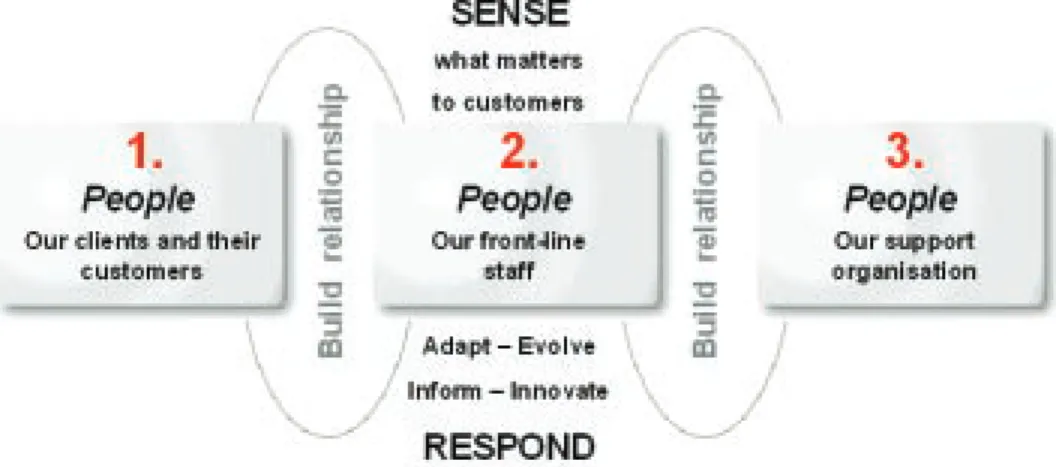
performance management system, Fujitsu defines its businesses in terms of the value it creates, not the products or services it produces. This shift in thinking necessitates a change of culture, where fears to discuss service failures are broken-down as are traditional management practices. As a result, Sense and Respond organisations can become highly responsive to the needs of their customers, where innovation and creativity become common practice, allowing customers to continually pull new value from the organisation. In order to gain a deeper insight into the customer, Fujitsu fosters a new relationship between front-line staff and customers. However, while understanding customers is important, having the ability to act on this understanding is crucial. Therefore, Fujitsu also promotes a different relationship between the front-line staff and the rest of the organisation (see figure 1). As a result, company-wide transformation has occurred from the bottom up and cut across all departments with customer-knowledge ascending the command chain, which has changed the whole culture of the customer service organisation.