Principles of energy optimization underlying human
walking gait adaptations
by
Surabhi N. Simha
B.E., VTU, 2012
Thesis Submitted in Partial Fulfillment of the
Requirements for the Degree of
Doctor of Philosophy
in the
Department of Biomedical Physiology and Kinesiology
Faculty of Science
© Surabhi N. Simha 2020
SIMON FRASER UNIVERSITY
Fall 2020
Copyright in this work rests with the author. Please ensure that any reproduction or re-use is done in accordance with the relevant national copyright legislation.
Declaration of Committee
Name: Surabhi N. Simha
Degree: Doctor of Philosophy
Thesis title: Principles of energy optimization underlying human walking gait adaptations
Committee: Chair: Sam Doesburg
Associate Professor, Biomedical Physiology and Kinesiology
Max Donelan
Supervisor
Professor, Biomedical Physiology and Kinesiology
Dawn Mackey
Committee Member
Associate Professor, Biomedical Physiology and Kinesiology
Daniel Marigold
Committee Member
Associate Professor, Biomedical Physiology and Kinesiology
Dylan Cooke
Examiner
Assistant Professor, Biomedical Physiology and Kinesiology
Young-Hui Chang
External Examiner
Professor, Biological Sciences Georgia Tech
Abstract
Learning to move in novel situations is a complex process. We need to continually learn the changing situations and determine the best way to move. Optimization is a widely accepted framework for this process. However, little is known about algorithms used by the nervous system to perform this optimization. Our lab recently found evidence that people can continuously optimize energy during walking. My goal in this thesis is to identify principles of optimization, particularly energy optimization in walking, that govern our choice of movement in novel situations. I used two novel walking tasks for this purpose. For the first task, I designed, built, and tested a mechatronic system that can quickly, accurately, and precisely apply forces to a user’s torso. It changes the relationship between a walking gait and its associated energetic cost—cost landscape—to shift the energy optimal walking gait. Participants shift their gait towards the new optimum in these landscapes. In my second project, I aimed to understand how the nervous system identifies when to initiate optimization. I used my system to create cost landscapes of three different cost gradients. I found that experiencing a steeper cost gradient through natural variability is not sufficient to cue the nervous system to initiate optimization. For my third and fourth projects, I used the task of split-belt walking. I collaborated with another research group to analyse the mechanics and energetics of walking with different step lengths on a split-belt treadmill. I found that people can harness energy from a split-belt treadmill by placing their leading leg further forward on the fast belt, and that there may be an energy optimal gait. In my fourth project, I used computer modelling to identify that there may exist an energy optimal gait due to the trade-off between the cost of swinging the leg and the cost of redirecting the body center of mass when transitioning from step to step. Together, these projects develop a new system and a new approach to understand energy optimization in walking. They uncover principles governing the initiation of this process and our ability to benefit from it.
Keywords: energy optimization; motor learning; mechatronic system; cost gradient; split-belt treadmill; dynamic walking
Acknowledgements
I am extremely grateful to my senior supervisor Dr. Max Donelan for his guidance and encouragement through these years. Max, your contribution towards making me the scientist I am today is unmeasurable. Thank you for giving me the opportunity to work in your lab, believing in me to when I was discouraged, patiently guiding me as I learnt a wide range of new skills, and putting in the effort to provide me with outside opportunities. Your passion for perpetual learning and clear communication will always inspire me. It has been a pleasure and an honour to work with you all these years.
I thank the members of my supervisory committee, Dr. Dan Marigold and Dr. Dawn Mackey for their support and guidance during key stages of my Ph.D. Dan, thank you for pushing me to develop a well-rounded understanding of the concepts in my thesis. Dawn, thank you for encouraging me to broaden the perspective of my thesis topics while keeping them grounded, and for your support particularly during times of stress.
To all my lab mates over the years, you have been a wonderful source of joy, laughter, and intellectual as well as aimless conversations. This Ph.D. would not have been possible without your moral, emotional, and sometimes physical support. Thank you.
A special thank you to all the participants for volunteering their time and energy. I owe a huge thank you to a number of my friends who are now spread across the globe. You have been the keepers of my sanity through this wild adventure.
Most importantly, none of this would have been possible without the support of my family. Amma and Appa, thank you for your unconditional love in this journey that has taken me so far away from you and no doubt made you anxious. Aṇṇa, thank you for always pushing me to be the best I can be. Raghav, thank you for your unwavering support and always being there when I needed you.
Table of Contents
Declaration of Committee ... ii
Ethics Statement ... iii
Abstract ... iv
Acknowledgements ... v
Table of Contents ... vi
List of Tables ... viii
List of Figures ... ix
Glossary ... xi
Published Studies ... xiii
Chapter 1. Introduction ... 1
1.1. Motor control in novel situations ... 3
1.2. Computational methods for motor control in novel situations ... 6
1.3. Neural implementation of computational methods ... 8
1.4. Cost functions for motor control in novel situations ... 10
1.5. Implementation of energy minimization ... 13
1.6. Energy minimization in human walking ... 14
1.7. Two walking tasks ... 15
1.8. Aims ... 17
Chapter 2. A mechatronic system for studying energy optimization during walking ... 20
2.1. Abstract ... 20
2.2. Introduction ... 21
2.3. System Design ... 23
2.4. System Performance ... 26
2.4.1. Open-loop force control ... 26
2.4.2. Closed-loop force control ... 29
2.4.3. Effect on energetic cost ... 30
2.4.4. Adaptation to new cost landscapes ... 31
2.5. Discussion ... 37
Chapter 3. Increasing the gradient of energetic cost does not initiate adaptation in human walking ... 41 3.1. Abstract ... 41 3.2. Introduction ... 42 3.3. Methods ... 46 3.3.1. Experimental Design ... 46 3.3.2. Experimental Protocol ... 48 3.3.3. Data Analysis ... 51 3.4. Results ... 53 3.5. Discussion ... 56
Chapter 4. Taking advantage of external mechanical work to reduce metabolic
cost: the mechanics and energetics of split-belt treadmill walking ... 60
4.1. Abstract ... 60
4.2. Introduction ... 61
4.2.1. Theory and Predictions ... 63
4.3. Materials and Methods ... 68
4.3.1. Experimental Protocol ... 68
4.3.2. Analysis ... 72
4.3.3. Statistical Analyses ... 74
4.4. Results ... 75
4.4.1. Modulation of Foot Position to Achieve Target Step Length Asymmetry ... 75
4.4.2. Mechanical Work Performed by the Legs and the Treadmill Varies with Step Length Asymmetry ... 76
4.4.3. Assistance Provided by the Treadmill Led to a Reduction in Metabolic Cost 80 4.4.4. The Ability to Use Step Length Asymmetry to Exploit Assistance Provided by the Treadmill is Bounded ... 81
4.4.5. Participants Chose Positive Step Length Asymmetries When Allowed to Freely Adapt ... 82
4.5. Discussion ... 83
Chapter 5. Energetic trade-off between step-to-step transition and limb swing costs explain preferred split belt walking gaits ... 88
5.1. Abstract ... 88
5.2. Introduction ... 89
5.3. Dynamic walking model ... 92
5.4. Tied-belt walking ... 98 5.5. Split-belt walking ... 100 5.6. Discussion ... 104 Chapter 6. Discussion ... 106 6.1. Summary ... 106 6.2. General implications ... 107 6.3. Future Directions ... 109 6.4. Conclusion ... 112 References ... 113
List of Tables
Table 5.1: Fixed parameter values for the split belt walker ... 93 Table 5.2: Properties of the optimizer used with the split-belt treadmill walker ... 96
List of Figures
Figure 1.1: Simple schematic representation of motor control ... 3
Figure 1.2: Schematic representation of motor control in novel situations ... 4
Figure 1.3: Schematic representation of optimization in motor control in novel situations ... 8
Figure 2.1: Mechatronic system ... 24
Figure 2.2: Open loop force control - responsiveness ... 27
Figure 2.3: Open loop force control - accuracy and precision ... 28
Figure 2.4: Closed loop force control ... 30
Figure 2.5: Simulated vs measured energetic costs ... 31
Figure 2.6: Experimental protocol ... 33
Figure 2.7: New cost landscape ... 37
Figure 3.1: Conceptual representation of how the nervous system might detect cost savings from a cost landscape ... 44
Figure 3.2: Mechatronic system and cost landscapes used in the experiment ... 46
Figure 3.3: Experimental protocol ... 49
Figure 3.4: Cost landscapes measured from participants ... 54
Figure 3.5: Average adaptation in each cost landscape ... 55
Figure 4.1: Conceptual representation of calculating mechanical work done during split-belt walking ... 65
Figure 4.2: Experimental protocol and setup ... 69
Figure 4.3: Distance from the leading and trailing foot to the center of mass at heel strike ... 76
Figure 4.4: Mechanical power generated by the legs ... 77
Figure 4.5: Average rate of work performed by the legs and the treadmill belts as a function of step length asymmetry ... 78
Figure 4.6: Average rate of work performed by the individual legs across levels of step length asymmetry ... 79
Figure 4.7: Relationship between the average rate of positive work performed by the legs and the average rate of work performed by the treadmill on the body ... 80
Figure 4.8: Metabolic power, mechanical work, and asymmetry ... 81
Figure 4.9: Adaptation of step length asymmetry during the adaptation trial in the absence of visual feedback ... 82
Figure 5.1: Anthropomorphic split-belt walker ... 93
Figure 5.2: Speed - step length relationship for over ground walking ... 97
Figure 5.3: Gait parameters of symmetry-enforced energy optimal gait during over ground and tied-belt walking ... 99
Figure 5.4: Gait parameters of energy optimal tied-belt walking when asymmetry is allowed ... 100
Figure 5.5: Effect of belt speed difference on step length and Step Length Asymmetry ... 101 Figure 5.6: Effect of belt speed difference on push-off impulse and spring stiffness
... 102 Figure 5.7: Effect of belt speed difference on walking cost ... 103
Glossary
Assistive device A device that can provide assistance to its user in the form of adding mechanical energy, reducing mechanical energy required to perform a task or reducing metabolic energy required to perform a task.
Control policy A rule or mapping that specifies what motor command to execute for a given state of the body
Cost function/ objective function
A weighted sum of the various costs associated with a movement. The two terms are used interchangeably throughout the thesis.
Cost landscape Throughout the thesis, this is used to refer to the relationship between walking with different step frequencies and the costs associated with them. In
Chapter 3, it is sometimes used to refer to a more general relationship between different control policies and the costs associated with them.
de novo or skill learning The process where the nervous system has to learn a new mapping between its actions and the task goal. Energetic cost Primarily used to mean the metabolic energetic cost
measured as metabolic power in Chapters 2-4. In Chapter 5, it is used to refer to an estimate of metabolic power. It is used interchangeably with metabolic power and metabolic energy.
Error-based learning The process of learning the appropriate motor commands in a novel situation that involves updating the forward model.
Fast belt The treadmill belt that is moving faster of the two in a split-belt treadmill.
Fast leg/ limb The leg that is contacting the fast belt during split-belt treadmill walking.
Forward model A model used by the nervous system to depict the mapping between motor commands and actions. Motor adaptation In the Introduction (Chapter 1), I present the
neuroscience definition—a process where the nervous system has to recalibrate its forward model in a novel situation. In the remainder of the thesis, I use it to mean the general process of learning to move in a novel situation and use it interchangeably with “optimization”. Motor control The process of planning a movement by the nervous
Novel situation A situation where there is a change to the body, the environment, or the task objective necessitating the nervous system to learn whether a change is required to its movement.
Optimization The computational process of selecting a movement in a novel situation by minimizing a cost function.
Prediction Recall of a previously learned control policy for a
situation. It is quick but requires prior experience with the situation.
Reinforcement learning A set of optimization algorithms that are adaptive to changing situations whose properties are incompletely known.
Reward-based learning The process of learning how to move in novel situations by maximizing a reward function or minimizing a cost function.
Reward-prediction error The error between the nervous system’s prediction of the reward associated with an action and the measured reward received from that action.
Sensorimotor prediction error
The error between the nervous system’s prediction of the mapping between motor commands and actions, and the measured actions produced by the motor commands. Slow belt The treadmill belt that is moving slower of the two in a
split-belt treadmill.
Slow leg/ limb The leg that is contacting the slow belt during split-belt treadmill walking.
Step-to-step transition cost
The energetic cost involved in the transition from step-to-step due to contacting the ground, in steady-state walking at a constant speed.
Swing cost The energetic cost involved in swinging the leg during walking.
Use-dependant learning The process of learning a movement along the task-redundant dimension. This term is only used in the Introduction (Chapter 1).
Published Studies
Research contained in this thesis has been published in the following peer-reviewed journals:
Chapter 2 Simha SN, Wong JD, Selinger JC, Donelan JM. A mechatronic system for studying energy optimization during walking. IEEE Transactions on Neural Systems and Rehabilitation Engineering. 2019 May 17;27(7):1416-25.
Chapter 3 Simha SN, Wong JD, Selinger JC, Abram, SJ, Donelan JM. Increasing the gradient of energetic cost does not initiate adaptation in human walking. (in revision). Journal of Neurophysiology.
Chapter 4 Sánchez N*, Simha SN*, Donelan JM, Finley JM. Taking
advantage of external mechanical work to reduce metabolic cost: The mechanics and energetics of split-belt treadmill walking. The Journal of physiology. 2019 Aug;597(15):4053-68. (1st two authors
Chapter 1.
Introduction
Humans are adept at successfully performing movements in a variety of situations. This is quite impressive considering the complexity involved in performing even everyday movements. Let us consider one such task of walking down a partially flooded street. In most cases, we can walk through without even getting our shoes wet. To achieve this, our nervous system needs to integrate the physics of the road and the potholes, the dynamics of the water in the potholes, dynamics of our body, our clothes and shoes, our sensory systems and the noise in their measurements, the algorithms that govern our movement, and the objectives or motivations that govern our behaviour. Given this breadth and complexity, the question of how humans control movement is a research topic spanning multiple scientific disciplines. In this introduction, I will provide a brief consolidated summary of the topic as it applies to this thesis. I will gradually increase focus on the concepts related to the algorithms governing our movement, which is the primary focus of this thesis.
Our current understanding of motor control is derived from the combination of many theories. Our primary machinery for movement is the skeletal muscle (1). It consists of bundles of fascicles which themselves are made up of bundles of muscle fibres (1). A single skeletal muscle fibre consists of many myofibrils, each of which is made up of repeating cylindrical units called sarcomeres (1,2). A sarcomere is the smallest functional unit of a muscle (1,2). It is made of thick and thin filaments that extend from the z-disc. Each of these filaments are made of proteins that are the fundamental contractile machinery of the skeletal muscle (1,2). Huxley’s sliding filament theory about how they function from the 1950s is still widely used though further advances have been made to the theory (3). Briefly, the thick filament is made up of myosin molecules while the thin filament consists of proteins called actin, tropomyosin and troponin. The myosins have a globular head that can sit in a cocked position by using energy from ATP and converting it to ADP. The actins have a binding site that is covered by the troponin-tropomyosin complex. However, an action potential delivered by a motor neuron along the surface of the muscle fibre can allow Ca2+ ions to enter and bind to the troponin, leading to a
conformational change to the troponin-tropomyosin complex, exposing the binding site on the actin. The cocked myosin head can then bind to this site, releasing the ADP. It can then form a crossbridge that pulls on the thin filaments, causing an overlap between the filaments, shortening the length of the muscle and producing force. The myosin head will have to bind with ATP again to detach and go back to the cocked position. This is the process of active force production by the muscle (1). The motor neuron that delivers the action potential to the muscle fibre has its nucleus in the spinal cord or brain stem (1). A single motor neuron can innervate multiple muscle fibres (1). The motor neuron together with all its muscle fibres is called a motor unit and represents the simplest pathway of the nervous system’s control of muscles.
The total force produced by the muscle depends on more than just active force. It depends on the number of cross-bridges which are responsible for the active force production, force produced by a single cross-bridge which in part depends on the length of the muscle, the velocity of the muscle, and the force from the non-contractile elements in the muscle such as the connective filaments, connective tissue and collagen surrounding the muscle fibres (1). It is possible for the nervous system to control certain movements, without continuous control of active force production. For example, walking downhill can be largely explained using the passive dynamics of our body (4). Our muscles can also reject some perturbations from the environment using preflexes—immediate responses from a muscle due to its intrinsic force-length and force-velocity properties (5). Such passive dynamics-based control can be modulated by the nervous system but only by changing the muscle activation for the nominal task being performed, rather than in response to a stimulus (5). Such largely passive control can only sustain a limited set of movements.
The simplest stimulus-based active control is a reflex. Sherrington proposed that a reflex is a stereotyped, involuntary response to a stimulus that activates receptors in the skin or muscles (6). However, for such a reflex, the neural control is contained within the spinal cord (1). More recent understanding of reflexes is that movements are performed through feedforward reflex pathways—a mechanism defined as our nervous systems’ use of voluntary control to combine and adapt multiple reflexes to perform a movement (1). This means that the activation of the muscle is still set according to the task being performed. However, a sensory input can elicit responses away from the site of the stimulus suggesting that supraspinal control is involved. For example, the reflex response
of one elbow extensor is affected by the task being performed by the other arm. Such reflexes can also be adapted to (7). While this provides useful insight into motor control, it does not sufficiently explain the specificity of control, particularly in response to a changing body and environment.
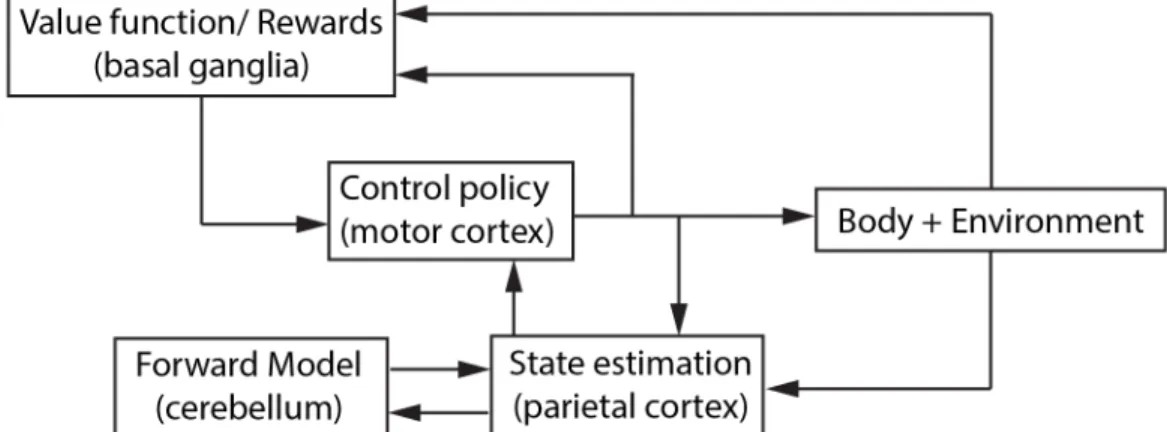
Current theory of motor control combines feedforward and feedback mechanisms. This means that the nervous system uses a forward model of the environment and the body to predict motor commands that will perform the required movement. It simultaneously senses the environment and its body, comparing its prediction to its measurements and makes corrections to the required motor commands (8). Rather than solve for a set of independent motor commands, the nervous system solves for a control policy for a given task. Here, control policy is a rule or mapping that specifies what motor command to execute for a given state of the body (8–10). The nervous system then executes the motor commands to implement that policy. Figure 1.1 presents a simple schematic of this process. In this thesis, I aim to understand how the nervous system chooses a preferred control policy.
Figure 1.1: Simple schematic representation of motor control
1.1. Motor control in novel situations
As we experience different situations, our nervous system uses different processes to select its preferred control policy. In a familiar situation, our nervous system has learnt its preferred control policy. This allows it to quickly implement the policy through prediction (11). In an unfamiliar situation, the nervous system must learn about the new situation and
select its preferred control policy for that situation. In some unfamiliar situations, the nervous system has to learn a new mapping between its actions and task goal and then identify the control policy it wants to use, known as de novo learning (9). An example is a situation where the keys on our keyboard are switched such that pressing “y” now types “n”. Some other unfamiliar situations may only change the relationship between motor commands and the expected actions, and thus require the nervous system to recalibrate its forward model—a process referred to as motor adaptation (9). For example, pressing “y” still types “y” but its location on the keyboard has changed. In other unfamiliar situations, there is no change to the control policy or the forward model and the nervous system needs to learn that its original control policy is still appropriate for the new situation. This might be the case if the keyboard is now replaced with a mechanical keyboard where we just need to press harder. These examples were chosen to provide a clear distinction between the tasks. However, in many tasks such a distinction may not be immediately apparent. An example is if the nervous system suddenly encounters a system that applies unpredictable forces to the torso. The classification mentioned here arises from neuroscience. In the next section, I discuss computational methods where these tasks are described through a single framework. Neither of these sections are meant to be an exhaustive review of the fields, but only meant to provide a foundation to understand the interdisciplinary projects in this thesis. The focus of the thesis is on how the nervous system solves for a control policy in unfamiliar situations.
Figure 1.2: Schematic representation of motor control in novel situations
Three processes broadly explain how the nervous system selects its movement in novel situations: error-based learning, use-dependant learning, and reward-based
learning (12). According to error-based learning, the nervous system learns the appropriate motor commands to a novel situation by updating its forward model to reflect the changes due to the novel situation. The sensorimotor system senses the motor command and outcome, and compares that to its prediction to evaluate a sensorimotor prediction error (Figure 1.2). This way it knows when a target is missed and by how much and can adapt its forward model accordingly. This form of learning states that the nervous system has already developed a control policy that it finds appropriate for the task. This is the form of learning that has traditionally been studied in laboratory settings. Such experiments typically include making reaching movements to a target while wearing prism goggles that shift the visual field, while receiving visually rotated feedback on a screen, or while force-fields are applied to perturb the arm dynamics (13–16). Importantly, for this form a learning, participants receive some form of sensory feedback about the movement of limb that is being adapted.
A second form of learning is called use-dependent learning. A general use of this term refers to the changes in movement learnt simply through repetition irrespective of the goal of the task (12). Diedrichsen et al. developed a more specific usage (17). They refer to a process where a movement is biased by a previous movement but not along the task-relevant dimension. They suggest that when a perturbation does not hinder the performance of a task, it may be beneficial to learn to move along the direction of the perturbation. This form of learning has typically been studied by modifying tasks that require the minimization of a sensorimotor error, such as reaching to a target and thus also states that the nervous system already has a preferred control policy for the task. In such tasks, error-based and use-based learning can occur in parallel. For example, when participants’ reach was constrained towards the right, they applied a force against that constraint. However, when the constraint was removed, after the effect of the error-based learning, participants showed a preference to move towards the right which was task-redundant direction during the constrained task.
Reward-based learning is based on the concept that the nervous system tries to maximize some reward without a prediction about how to move. In such tasks, the nervous system either does not know how to move in order to develop a sensorimotor prediction error, or does not receive or does not use the sensorimotor prediction error. Instead, the nervous system uses a signal about whether a certain movement was successful or not. Therefore, it does not know how exactly to alter its movement to obtain more reward and
may have to explore multiple options before arriving at one that maximizes its reward. This is useful for improving movements beyond achieving a specific goal. This process is typically used to understand learning a new skill where the nervous system has not even solved for a control policy, and hence cannot simply minimize a sensorimotor prediction error to achieve the goal of the task. Recent experiments have modified the original arm reaching paradigms such that the participants only receive feedback of the final results— success or failure—rather than feedback of their limb movements. Some such studies pitted error-based learning and reward-based learning within the same task and found that both processes can occur independently in the same task and when they conflict, error-based learning may take preference (16,18,19). In this thesis, I probe reward-error-based learning in novel situations.
1.2. Computational methods for motor control in novel
situations
Computational methods serve as detailed and cohesive formulations of the processes of motor control in novel situations. A widely accepted framework for such computational methods is optimization—the nervous system selects a preferred movement that optimizes a certain cost function (20–22). Optimal control, derived from the field of control theory, has been quantitatively used in motor control at least since the early 1960s (23). The computational methods of optimal control have steadily improved to capture more aspects of observed motor behaviour. These improvements have been in the form of algorithmic changes to incorporate more realistic aspects of the body and the environment, and in the identification of appropriate cost functions. Section 1.3 provides a brief overview of the cost functions. A landmark improvement for optimal control methods was the development of the Optimal Feedback Control algorithm in early 2000. It has proved to be a unifying theory for how the nervous system optimally combines sensory inputs with forward models in the presence of noise and changing dynamics to determine an optimal control policy (20,24). This framework can combine the various forms of learning described earlier into a single cohesive optimization process.
Motor adaptation is described as a minimization of sensorimotor prediction error through error-based learning of the new forward model. This presupposes that the original
control policy is still relevant in the new situation. The optimal control framework proposes that in the process of learning a new control policy in any new situation, the nervous system learns a new forward model and uses that to determine the control policy that minimizes a cost, or maximizes a reward as proposed by reward-based learning. However, the computational complexity of such an algorithm is extremely huge, causing it to be more generally accepted for motor control in a stationary situation than in novel situations (20,25,26). This complexity primarily arises from the need to develop an accurate forward model and use that to solve for an optimal policy—the algorithms are model-based (Figure 1.3). More recently, simpler optimal control algorithms that don’t require a comprehensive forward model, and whose cost functions can capture some of the dynamics related properties of the system, such as effort, stability and metabolic cost, have been able to accurately predict motor behaviour observed during learning (15,27). Incorporating optimal control methods into a framework that is adaptive to changing situations is an ongoing research problem.
Reinforcement learning has provided a framework of computational methods that can describe behaviour when situations are continuously changing. Reinforcement learning is an optimal control method that is applied to a situation and task whose properties are incompletely known and may be changing. The distinguishing feature of reinforcement learning algorithms that allows this is that the algorithms solve for the optimal control policy by exploring the costs associated with different control policies (28). These algorithms are model-free (Figure 1.3). Through trial-and-error, they learn a value function—the total reward that can be obtained if a given control policy is implemented from the current state—and find the control policy with the optimal value. Reward-based learning is often used interchangeably with this computational method of learning since learning from only a success or failure feedback is model-free. However, there is also a class of reinforcement learning algorithms that are model based. Here, the value function is computed by developing a model of the system and the environment (29). Through these algorithms, the optimal control models described in the previous paragraph also naturally fit into the reinforcement learning framework. The results from the projects in this thesis do not necessitate a reinforcement learning algorithm. However, the development of hypotheses and design of projects have been based on the framework of model-free reinforcement learning.
Figure 1.3: Schematic representation of optimization in motor control in novel situations
1.3. Neural implementation of computational methods
Mechanisms in the human body are essential to validate computational methods as representations of human motor control. But understanding how the nervous system determines how to move in a novel situation through computational methods and through neural mechanisms requires contrasting knowledge and skillset. The projects in this thesis were not developed to probe the neural mechanisms, and do not directly depend on the pathways of a particular neural mechanism. Therefore, I only present a brief overview of relevant mechanisms that informed the relevance of the computational framework chosen for the projects in this thesis. Knowledge about neural mechanisms has developed through invasive recordings from animals, the study of motor behaviour in patients and more recently, with the development of brain imaging techniques, the study of motor behaviours in healthy humans. Such findings suggest that the control policy may reside in the motor cortex (10). I will use the neuroscience-developed classification of learning processes here since they better delineate the roles of different neural structures.
It is widely accepted that the cerebellum is responsible for the sensory prediction error that is essential for model-based learning. The evidence for this has been gathered through studies on monkeys with cerebellar lesions, patients with cerebellar degeneration, and healthy participants (9). The evidence also spans multiple tasks including arm
reaching in with visuomotor rotation, arm reaching with force fields, and locomotion (30– 32). In patients with cerebellar degeneration it has been observed that they are unable to accurately predict the required motor commands when the dynamics of a task are altered—the patient could not adjust their grip force to account for a ball being dropped in a basket they were holding. More recently, brain imagining studies with healthy adults found a correlation between cerebellar activation and experiencing a sensory prediction error (33). Specifically, it is thought that the cerebellum is involved in the formation of a forward model as well as in learning through performance feedback in a task. This has been evidenced through the spiking of cerebellar Purkinje cells of monkeys both at the beginning of a reaching task, as well as at the end of the movement (34). It is thought that the cerebellum is more sensitive to large and abrupt perturbations and is involved in an implicit process (12,34,35). While evidence for the relationship between the cerebellum and forward model in robust, there isn’t a clear theory for the neural circuitry used for implementing the computations, particularly for using the forward model to solve for an optimal control policy.
The basal ganglia is the brain region primarily implicated in reward-based learning. Reward-based learning had its early roots in psychology. Thus, much of the neurophysiology is from the study of decision making in the presence of rewards. A particular algorithm of interest to psychology and neuroscience is temporal-difference reinforcement learning where learning occurs by comparing temporally successive estimates of reward. In psychology, it is used to explain the process of learning through reward-prediction. Pavlov’s conditioning and Law of Effect tell us that any action or stimulus accompanied with a pleasant consequence is likely to be repeated (36). This forms a prediction between action and reward. In the subsequent execution of the action, rewards that are better than predicted lead to a positive reward-prediction error and to improvement of action, while rewards that are worse lead to a negative reward-prediction error and thus stopping of the action. Rewards that lead to zero reward-prediction error continue the action but put an end to learning (37). Therefore, even though this form of learning does not necessitate a goal-directed sensorimotor prediction error similar to error-based learning, it is driven by on an error. The reward-prediction error may be coded in the phasic activity of dopamine-producing neurons in mammals, delivering this signal throughout the brain (38). This was observed by recording the dopamine neurons from the brain of monkeys as they learnt to perform different actions to obtain rewards (37). The
axons of most dopamine neurons contact the axons in the basal ganglia. The primary input to the basal ganglia is the striatum and the output from the striatum connects with the cortex and other motor areas (37,38). It is proposed that this network allows the basal ganglia to influence movement and motor control in novel situations.
Direct evidence of the role of basal ganglia in the control of movement in novel situations is expanding. Early studies of the basal ganglia were only related to learning a new skill. In a task of throwing when the visual field was reversed, a task thought to be primarily driven by reward-based learning, patients with damage to the basal ganglia were unable to learn the task (39). More recent measurements from the caudate nucleus, which is located in the striatum, suggest that it may be active during the early stages of error-based learning tasks (34). Some functional MRI studies also implicate the basal ganglia in regulating kinematic properties such as movement velocity, amplitude and force duration (34). However, it is observed that patients with damage to the striatum can still learn to reduce the error in an error-based learning task (9). A unifying view is based on the observations that the output from the basal ganglia is inhibitory. This means that the basal ganglia primarily controls movement by choosing which movements are to be allowed. During tasks that require correcting of sensorimotor prediction error, regions of the striatum have been found to be deactivated. This is consistent with the hypothesis that error-based learning and reward-based learning work together, and with the findings that in the presence of errors, error-based learning may take preference.
1.4. Cost functions for motor control in novel situations
The cost function plays a major role in optimization but is not universally predetermined. The cost function can theoretically include an infinite number of terms. These may be energy, stability, time, accuracy, pain and many more. Some of these terms, particularly explicit costs such as pain and time can also be modelled as constraints, limiting the cost function to few terms. Importantly, we cannot directly observe the cost function used by our nervous systems. This uncertainty about the nervous system’s cost function, combined with the generality of optimization allows us to explain most motor actions by selecting the appropriate cost function. However, such an endeavour provides minimal insight into the nervous system’s motor control processes.
Therefore, it is important to form a hypothesis of the nervous system’s cost function a priori (10). Such hypotheses of cost functions are inherently influenced by the task being studied. Traditionally, motor adaptation has been studied in tasks of reaching to a target in the presence of visuomotor rotation or force fields. In such tasks, it’s been hypothesized that the cost function is a weighted sum of error and effort (15). Here, error is associated with kinematics where moving away from the baseline trajectory is perceived as a sensorimotor prediction error. Effort is a term representing the system dynamics and can be quantified in multiple ways such as mechanical energy, muscle activity, or metabolic energetic cost. The effort term is generalizable to different learning algorithms, while a kinematic error necessitates error-based learning. I will focus my review to terms in the cost function that can serve as rewards.
Rewards can be broadly classified into primary and non-primary (37). Primary rewards relate to evolutionary fitness and reproduction. These are food or activities necessary to produce an offspring. All other rewards are non-primary rewards. In animal studies, food is often used as a reward and the learning can be framed as maximizing the cost function of food. Primary rewards work less well in human studies. Here, typical rewards include money or points for successfully completing a task. A cost function may be a combination of both these reward terms. In computational methods used to model these human studies, rewards refer to a broader set of terms that may be intrinsic to the task. One example is when the algorithm attempts to minimize the uncertainty in the forward model (40,41). Here the reward is the reduction of something unexpected. Other rewards include savings in joint torque, reduction of pain, reduction in time spent on a task, and increase in metabolic energy/ reduction in metabolic energy expenditure. Some of these, such as an increase in metabolic energy, act as a primary reward while others, such as reducing pain serve as a non-primary reward. I aim to identify general principles of motor adaptation by studying the optimization of a cost function where metabolic energetic cost is the significant contributor.
I have four reasons for selecting metabolic energetic cost as the significant term in the cost function. First, minimizing energy expenditure is a universal objective from an evolutionary perspective (42). Second, preferences in a variety of movements such as walking and running gaits, frequency of bench stepping, bicycle seat height while riding, and arm trajectories in reaching movements have been observed to be at or near the optimum of the measured energetic curve for humans (42–44). It is important to note here
that this is not to mean that energetic cost is the primary contributor to the objective function for all tasks. Rather, the significant role energetic cost plays in varied motor tasks allows us to use it as a tool in probing motor adaptation. To this end, the third reason in support of energetic cost as the primary term in the cost function is that principles learnt through studying energy optimization can translate to the optimization of other cost functions as well, such as the role of increased variability leading to improvements in motor adaptations and skill learning (45,46). Finally, savings in metabolic energetic cost can serve as a primary physiological reward to be used in the neural computations of reward-prediction error.
While there is plenty of evidence for the prevalence of metabolic energetic cost in the cost function, how it affects movement in novel situations is still poorly understood. One reason for this is that the time scales of metabolic energy optimization are unclear. That natural preferences support energy optimality could mean that developmental time scales are necessary for energy optimization. In support of shorter timescales, recent experiments have shown that adaptations in arm reaching and walking tasks correlate with reductions in metabolic power (44,47). A recent study showed that preferred reaching movements in new situations can also be modelled using a cost function that combines metabolic energy and rewards from stimuli (48). However, most computational methods use reward terms that represent effort or mechanical work rather than metabolic energy. Thus, there is limited knowledge about algorithms of metabolic energetic cost minimization when learning motor control in novel situations.
Algorithms involved in minimizing metabolic energetic cost can also inform improvements to quality of life. In the pursuit of fundamental mechanisms, it is important to address the generalizability of hypotheses. However, many tasks can benefit particularly from the reduction in energetic costs associated with them, even if the inherent cost function associated with those tasks may not prioritize energetic cost. For example, irrespective of whether energetic cost is the primary contributor to the cost function for walking in older adults, there is an obvious benefit to making the task energetically cheaper for the individuals. Understanding the algorithms used by the nervous system to obtain savings in metabolic energetic costs can help us develop techniques to achieve this in tasks where it is beneficial.
1.5. Implementation of energy minimization
There is some evidence that the human nervous system is equipped to implement energy optimization. The first step for this process would be to sense metabolic energetic cost. There are three candidate options for this. The blood gas chemoreceptors sensitive to oxygen and carbon dioxide are hypothesized to regulate ventilation (49). An increase in ventilation correlates with an increase in energetic cost since the body needs to use oxygen to generate energy to meet the increased energy demands (50). These receptors are present in the medulla oblongata and carotid bodies (51,52). They could help the nervous system sense a quantity representative of whole-body energy expenditure, similar to the indirect calorimetry systems we use in our experiments. Our lab tested the role of these sensors in energy optimization by attempting to trick the body into adapting to a gait that increased the oxygen sensed by these sensors (53). However, participants did not adapt suggesting that the body may have some other means to sense metabolic energetic cost. Another candidate mechanism for sensing metabolic energetic cost is through group III and group IV afferents from muscles. These are known to increase ventilation when stimulated and decrease ventilation when chemically suppressed (54,55). Their role has not been directly tested in the process of energy optimization and it is an interesting open question. Finally, it is possible that the nervous system senses energetic cost through some proxies of muscle mechanical work. This would require a computation involving muscle force, length and velocity. Mechanisms for sensing these have been established through muscle spindles and Golgi tendon organs (56). These are proprioceptive receptors and suppressing feedback from them has been found to change aspects of gait and recent studies have found some evidence of their role in energy optimization of gait (57,57).
The sensed metabolic energetic cost needs a mechanism to affect energy optimization. I hypothesize that metabolic energetic cost acts a primary physiological reward in the reward-prediction error mechanism. A common and primary reward that is used in experiments is food. But what makes food a primary reward is the consequences of digesting the food. The typical experiments with food as reward show learning times faster than the time it takes to digest food. However, this is because the animal has already learnt that some aspect of the food such as taste predicts reward. When rats were given neutral flavour food with varying glucose load, they learnt flavour preferences proportional
to the glucose load (58). Thus, the actual primary reward is the end product of the metabolism of food. Metabolic energy is one of those end products. Even if metabolic energy is not directly the primary reward, all consequences of digesting food can directly serve as proxies for metabolic energy. This reward still needs to be sensed by the brain to elicit firing of dopamine neurons in the striatum. Our nervous systems do not have any known reward receptors that directly sense reward (37). Rather the nervous system is known to be able to use signals from multiple chemical and mechanical receptors as reward signals (37). The exact chemical pathway used to transmit these signals is still unknown.
1.6. Energy minimization in human walking
Preferences in human walking are strongly predicted by metabolic energetic cost minimization. Humans typically prefer to walk in ways that are close to the measured energetic cost minimum (59). Studies in experimental and non-experimental settings have observed that the choice of walking speed, step frequency, step length, step width, toe-clearance, and starting and stopping, all coincide with the energetic minimum or are quite close to it (60–68). There are also walking tasks such as walking downhill or walking barefoot where preferences do not coincide with the metabolic energy minimum (69,70). However, these preferences do not fall far away from the metabolic energy minimum. This suggests that metabolic energetic cost is a significant contributor to the cost function of human walking but may be outweighed in certain situations.
The study of motor adaptation in walking has traditionally focused on minimizing the sensorimotor prediction error. The study of motor adaptation gathered momentum in locomotion only after the field had adopted arm reaching as a candidate task and identified the process of error-based learning. Early adaptation tasks in walking included walking in the presence of force fields or resistances applied to the legs, similar to the force-fields applied in arm reaching experiments, and identified features of sensorimotor prediction error in walking (71,72). A second walking task, unlike that used in arm reaching, is split-belt treadmill walking. This has also been used in understanding how the nervous system minimizes sensorimotor prediction error and has been the source of many insights into the role of the cerebellum in this process (73,74). However, just as in arm reaching,
minimization of sensorimotor prediction error is unlikely to be the only contributor to motor adaptation.
Recent work from our lab has provided direct evidence of metabolic energetic cost minimization in novel walking situations. Selinger and Abram, in separate experiments, manipulated the energetic costs associated with participants’ walking step frequency and step width respectively (75,76). These manipulations shifted the energy optimum away from the original optimum. In these situations, participants now preferred a walking step frequency or step width that minimized the new measured energetic cost curve. The process of adaptation provides evidence that our nervous system uses a local search strategy in arriving at the energy optimal gait. This can be computationally modelled using a simple reinforcement learning algorithm (45). My projects in this thesis develop on these findings.
1.7. Two walking tasks
I use two different walking tasks to understand the energy optimization process. In both tasks, I measure walking gait to infer the control policy and measure metabolic energetic cost to represent the cost function.
The first task is walking on a treadmill while a mechatronic system applies controlled fore-aft forces to the hip. I built this system to further probe the results from Selinger et al. that was performed using a knee exoskeleton (75). Selinger manipulated the energetics of treadmill walking to observe participants adapt to the new energy optimum. However, this exoskeleton system was limited in its ability to probe the motor adaptation process further. It was only able to penalize its users—increase the energetic costs of gaits relative to natural. It was also limited in the range of penalties it could provide (13% to 41%) and the maximum cost gradient (0.93%) it could provide. In contrast, fore-aft forces to the hip can change the energetic cost of walking from -50% to more than +250%. Despite the application of forces, such a task feels safe and natural. Studies have found that forces to the torso can psychologically and biomechanically simulate walking on slopes and even climbing stairs (77,78). The energetics of walking with torso forces is also proportional to the energetics of walking on slopes (79). However, unlike slopes,
forces can be changed quickly and accurately while targeting the energetic consequences of small portions of gait. Note that the comparison between walking on inclines and walking with forces applied to the torso presented here is only to explain that the latter task does not feel unsafe or strange for the participants. The two tasks are not identical and differ in the work required at different stages of the gait cycle (80). However, these differences do not affect the hypotheses or the results presented in this thesis using the mechatronic system. I use this system to probe the algorithms underlying energy optimization during walking, particularly what features of a novel situation cue the nervous system to adapt.
The second task presented in this thesis is walking on a belt treadmill. A split-belt treadmill is a treadmill with two split-belts that can individually move at different speeds. A user typically walks with one foot on each belt. This is a useful adaptation paradigm and historically has been used to understand error-based learning—how the nervous system minimizes sensorimotor prediction error of step length when each foot moves at a different speed (74). In such adaptations, the stance time remains asymmetric even after adaptation. In fact, the temporal and spatial adaptation processes are thought to be distinct but not always mutually exclusive during split-belt walking (81). Therefore, it is unclear what error signal is actually being minimized as the sensorimotor prediction error. Recent studies have observed that metabolic energetic cost and mechanical work reduce with adaptation to split-belt treadmill walking, and these reductions may be possible due to the unique nature of walking on two belts of different speeds (82–85). In the projects in this thesis, I build on these results and probe the hypothesis that the observed adaptations to split-belt treadmill walking can be explained through a more unifying framework of energy optimization. I present direct evidence that the split-belt treadmill can be characterized as an assistive device than can provide energy to its users, making energy a significant factor in the task. I use experiments to measure mechanical work and metabolic energetic cost of walking on a split-belt treadmill and different step length asymmetries. I also use computer modelling to establish how different contributors to the energetic cost of walking affect walking on a split-belt treadmill.
Both these systems have a broader application as systems that can assist walking. The systems can provide energy that the user can learn to use. While the fore-aft force control system is designed for this purpose, the ability of the split-belt treadmill to provide energy was only recently hypothesized (85). I directly tested the hypothesis in the third project of this thesis. Both these tasks are used in rehabilitation and gait training. Here,
split-belt walking is an established fixture while walking with torso forces is new but promising (74,80,86,87). I use the fore-aft force control system for only one project in this thesis, but it can be programmed to be used in multiple ways relevant to public needs. For example, it can be programmed to provide a constant assistive force during walking to be used as an exercise device for people with gait impairments. Similarly, the identification of energy minimization in split-belt walking paves the way for identifying learning mechanisms in a system that is already well-integrated into patient treatments.
1.8. Aims
Learning to move in novel situations is a complex process. Our nervous systems can do this by solving for a control policy that minimizes a cost function in the novel situation. One of the processes that is used to solve for a control policy is reward-based learning which states that the nervous system selects the control policy that maximizes a reward. Reductions in metabolic energetic cost expenditure is a primary physiological reward of movements. While there is a lot of evidence for preferred movements being energy optimal, the role of energetic cost in the process of learning movements in response to novel situations and the algorithms involved in the process are unknown. My objective in this thesis is to probe the role and process of energy optimization in identifying an optimal control policy in novel situations. Our lab recently identified that adaptations to novel walking situations can occur through energy optimization. Given this finding and the significant contribution of metabolic energetic cost to walking in familiar situations, I use adaptation of walking in two novel situations as candidate tasks for understanding energy optimization.
My objective while working on this thesis was also to advance my skills as a scientist to enable me to continue the pursuit of principles that govern human movement. This is reflected in the thesis as it journeys through mechatronics, computational neuroscience, mechanics and energetics, and rigid-body dynamics.
Aim 1: Design, build and test a mechatronic system to study energy optimization in humans. To study the process of optimization, I need a system that can reshape the energetic cost landscape such that the person’s originally preferred gait is
now sub-optimal. This allows me to observe the gait behavior executed by the nervous system in the process of finding the new optimal gait in any new landscape. I designed a system to reshape the landscape using fore-aft forces applied near the user’s center of mass as a function of their walking step frequency. I built it to apply quick, accurate, and precise forces at each new measured walking step. I validated its effectiveness for studying energy optimization by introducing participants to a cost landscape, created with this system, in which participants have been known to re-optimize their gait within a few minutes.
Aim 2: Determine whether a steeper cost gradient causes the nervous system to initiate energy optimization in novel situations. When our nervous system encounters a novel situation, it has to learn whether the existing preferred control policy is optimal or not before it searches for a new policy. Without this knowledge, our nervous system may prefer to, perhaps erroneously, exploit the previous preferred control policy. This is reflected in the observation that our nervous systems do not always adapt to novel tasks. However, changing some aspects of the same task can allow the nervous system to initiate adaptation. The algorithm involved in this initiation is still unknown. In my second study, I used my fore-aft force control system to test whether a feature of a novel task, specifically the cost gradient, can allow the nervous system to initiate adaptation. I introduce participants to cost landscapes with increasing cost gradients and measure adaptation of their walking step frequency.
Aim 3: Determine the biomechanics and energetics of split-belt walking.
When walking on a split-belt treadmill, participants typically adapt their step lengths to be symmetric. This means that the distance measured between the heels of the two feet— step length—is equal for two consecutive steps. This is traditionally explained as a process of minimizing a sensorimotor prediction error since, when walking over ground, people typically prefer equal step lengths for all steps. In this project, I collaborate with a research group at University of Southern California to determine the biomechanics and energetics of different step length choices during split belt walking. We hypothesized that the step lengths participants adapt to are also step lengths with a lower energetic cost suggesting that the adaptation can also be explained as a process of reducing energetic cost.
Aim 4: Develop a computer model to determine the energetic contributors to the energy optimal gait in split-belt walking. Measurements of metabolic energetic cost
from participants reveals that there is an energy optimal step length asymmetry when walking on a split-belt treadmill. Step length asymmetry is a measure of the relationship between two consecutive step lengths. However, it is unknown what factors contribute to this relationship between step length asymmetry and energetic cost or why there should be a minimum. In over ground walking, computer models have identified that the cost of step-to-step transition and the cost to swing the leg are the two primary contributors to energetic cost that trade-off to give rise to the preferred walking gait. In this project I develop a dynamic walking computer model to test whether the same trade-off leads to the observed energy optimal step length asymmetry in split-belt walking.
Together, these projects develop a new system and a new approach for studying motor adaptation through walking. The results uncover fundamental principles of these adaptation processes.
Chapter 2.
A mechatronic system for studying energy
optimization during walking
2.1. Abstract
A general principle of human movement is that our nervous system is able to learn optimal coordination strategies. However, how our nervous system performs this optimization is not well understood. Here we design, build, and test a mechatronic system to probe the algorithms underlying optimization of energetic cost in walking. The system applies controlled fore-aft forces to a hip-belt worn by a user, decreasing their energetic cost by pulling forward or increasing it by pulling backward. The system controls the forces, and thus energetic cost, as a function of how the user is moving. In testing, we found that the system can quickly, accurately, and precisely apply target forces within a walking step. We next controlled the forces as a function of the user’s step frequency and found that we could predictably reshape their energetic cost landscape. Finally, we tested whether users adapted their walking in response to the new cost landscapes created by our system and found that users shifted their step frequency towards the new energetic minima. Our system design appears to be effective for reshaping energetic cost landscapes in human walking to study how the nervous system optimizes movement.
2.2. Introduction
Optimization is perhaps our most general principle of coordination. That is, people prefer to move in ways that minimize a cost function (20,88). A cost function is a weighted sum of one or more variables related to the movement, with the particular variables and their weights depending upon the task (20,22,48,89–94). For example, the cost function in reaching to a target is often modelled as a weighted sum of error and effort (15,48). One way to study optimization is to determine if the predicted cost minimum correlates with people’s preferences. Using reaching tasks as an example again, minimizing the sum of the variance about the target and squared muscle activations can explain people’s preferred arm trajectories (15). While preferences suggest that the nervous system is concerned with optimizing coordination, preferences alone don’t provide insight into how it is accomplished. To study the nervous system’s optimization algorithms, it is useful to manipulate the nervous system’s cost function and determine whether, and how, people respond. This is best accomplished in tasks where the cost function is well established, easy to manipulate, and directly measurable.
Walking is a well-suited task to study the nervous system’s optimization mechanisms. It has been well established that people typically prefer to walk in ways that minimize metabolic energetic cost (42,60,63,64,95–97). For example, at every given speed, people choose to walk at the step frequency that minimizes their energy use (96,97). In addition to the many studies demonstrating preferences for energy minimal gaits in familiar conditions, recent research from our lab by Selinger et al. found direct evidence that the nervous system can continuously adapt these preferences to optimize energy during walking (75). Selinger et al. used a knee exoskeleton to manipulate a user’s cost landscape by penalizing certain step frequencies, shifting the energy minimum away from the originally preferred step frequency. We use cost landscape to refer to the relationship between a gait parameter and its resulting metabolic energetic cost. Using such purposeful manipulation, Selinger et al. demonstrated that the nervous system could continuously optimize movements to converge on the new energy minimal gait within minutes (75). Thus, energy optimization in walking is a useful model system because the nervous system’s cost function is unambiguous, we can measure the cost directly, we can directly manipulate the values returned by the cost function to study how the nervous
system solves it, and the time course of optimization can be rapid enough that we can study it in a single experimental session.
This prior exoskeleton system allowed us to observe continuous optimization, but it was limited in its ability to probe the underlying mechanisms. The exoskeletons could only penalize users, and not reward them by decreasing their cost below their normal values. The range of penalties were limited to between 13% and 41% of the user’s original cost minimum, achieving a maximum gradient of 0.93% change in energetic cost for every 1% change in step frequency. In contrast, an ideal system would be able to precisely and rapidly prescribe cost landscapes of any shape. Such control over the shape of the cost landscape would allow both steeper and shallower cost gradients to study how the nervous system detects cost savings through its movement variability (16,46,98), the creation of complex cost landscapes to study the nervous system’s optimization algorithms (20,25), and the lowering of energetic cost to study whether the nervous system differentially values energetic penalties and rewards (99,100). Applying new costs rapidly is also important because the nervous system’s association of a particular coordination pattern with its resulting energetic cost may depend upon the delay between the movement and its energetic consequence (101,102). A quick system can always be slowed down to study the effects of delayed costs, but an inherently slow system cannot be sped up.
Here we present a new mechatronic system designed to probe optimization mechanisms during walking. Based on data-driven simulations, the system uses controlled horizontal fore-aft forces applied near the center of mass of the user to change energetic cost landscapes. This system can generate a wide range of cost gradients because energetic costs during walking depend strongly on horizontal forces (103). It can also provide both energetic penalties with backward forces and energetic rewards with forward forces. It uses a series elastic actuator to apply these controlled forces precisely and rapidly (104). In the following sections, we first develop the high-level design using simulations that leverage literature data and then describe the construction of the system. Next, we evaluate system performance including a) how well it controls forces, b) how well the measured energetic costs match the predictions generated during design, and c) how users adapt their walking in response to new cost landscapes created by our system.
2.3. System Design
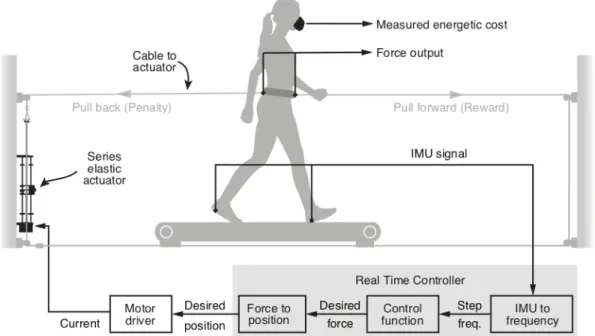
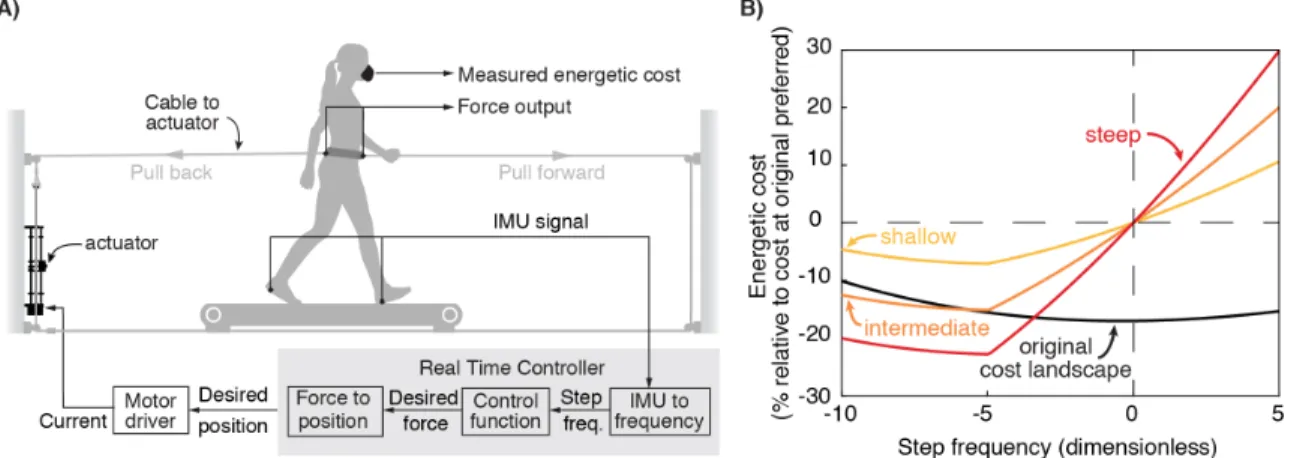
We designed a system to manipulate the energetic cost of human walking. We achieve this by applying controlled horizontal fore-aft forces to the user as a function of one or more measured gait parameters. In this paper, we use a single parameter, step frequency, for ease of comparison with prior work (75,96,103). For an individual walking at a constant speed, there is an energetic cost associated with each step frequency, with the minimal cost occurring at their preferred step frequency. We term this their originally preferred step frequency. Our system applies a backward or forward pulling force at each measured step frequency. Thus, the final energetic cost experienced by the user is the sum of the energetic cost associated with that step frequency and the energetic penalty (or reward) from the applied force. This new association between step frequency and energetic cost is the new cost landscape. In this manner, we can shift the energetic optimum higher or lower than the originally preferred step frequency. We then measure users’ preferred step frequency in the new cost landscape to determine their new preferred step frequency.
As a first test of our design, we simulated the system’s effect on a user’s energetic cost. We used literature data of the energetic cost associated with various walking step frequencies when no force is applied, where step frequency is measured as percent of the individual’s preferred step frequency (96). We also used literature data for the energetic cost of walking at the preferred step frequency while a range of forces are applied, where the forces are measured as percent body weight of the individual (103). We then combined these two data sets to obtain the energetic cost of walking at various step frequencies over a range of applied horizontal forces. Constraining the range of step frequencies to ±15% of preferred, and the range of horizontal forces to ±15% of body weight, we estimated that our system could vary a user’s energetic cost of walking from -45% to +230% relative to their original energetic minimum.
Based on these initial simulations, we built a mechatronic system to apply rapid, accurate, and precise forces as a function of the user’s measured step frequency (Figure 2.1). In this system, users walk on a single-belt treadmill (Trackmaster TMX425C, Full Vision Inc., Kansas, USA) while wearing a hip-belt (Osprey Isoform4 CM) that places them in a closed loop with the actuator. The hip-belt is tailored with extended belt loops in the front and back to which we attach long inextensible nylon cables. The long lengths (~409