University of Dayton
eCommons
Computer Science Faculty Publications Department of Computer Science
10-2018
ChAmElEoN: A Customizable Language for
Teaching Programming Languages
Saverio Perugini
University of Dayton, [email protected]
Jack L. Watkin
University of Dayton
Follow this and additional works at:https://ecommons.udayton.edu/cps_fac_pub
Part of theGraphics and Human Computer Interfaces Commons, and theOther Computer Sciences Commons
This Article is brought to you for free and open access by the Department of Computer Science at eCommons. It has been accepted for inclusion in Computer Science Faculty Publications by an authorized administrator of eCommons. For more information, please [email protected], [email protected].
eCommons Citation
Perugini, S. & Watkin, J.L. (2018). "ChAmElEoN: A Customizable Language for Teaching Programming Languages."Journal of Computing Sciences in Colleges,34(1), 44-51. USA: Consortium for Computing Sciences in Colleges. ACM Digital Library. (Available at https://dl.acm.org/citation.cfm?id=3280498.)
C A E E N: A CUSTOMIZABLE LANGUAGE FOR TEACHING PROGRAMMING LANGUAGES
Saverio Perugini and Jack L. Watkin Department of Computer Science
University of Dayton 300 College Park Dayton, Ohio 45469–2160 (937) 229–4079 [email protected] ABSTRACT
C A E E N is a programming language for teaching stu-dents the concepts and implementation of computer lan-guages. We describe its syntax and semantics, the educa-tional aspects involved in the implementation of a variety of interpreters for it, its malleability, and student feedback to inspire its use for teaching languages.
INTRODUCTION
The C A E E N programming language, inspired by [3], is a lan-guage for teaching students the concepts and implementation of computer languages. In particular, in the course of their study of programming languages, students have implemented a variety of an environment-passing interpreters for C A E E N, in the tradition of [3], initially in Racket (Scheme) and, more recently, in Python.
The scanner and parser for C A E E N were developed us-ing Python Lex-Yacc (PLY v3.9)—a scanner/parser generator for Python—and have been tested in Python 3.4.6. For the details of , see http://www.dabeaz.com/ply/. The front end of our C A E E N interpreter in Racket is built using —a scan-ner/parser generator for Scheme.
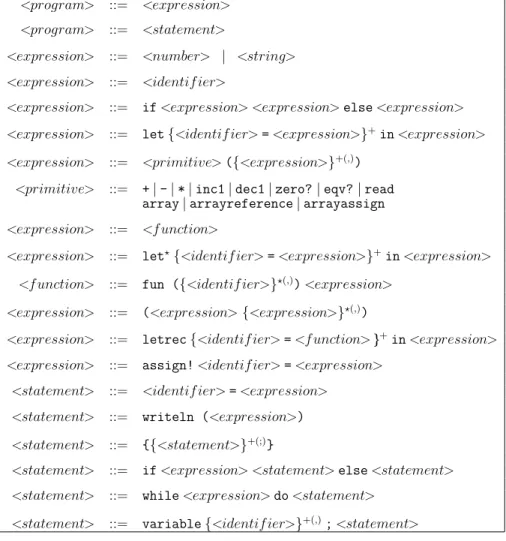
<program> ::= <expression> <program> ::= <statement>
<expression> ::= <number> | <string> <expression> ::= <identif ier>
<expression> ::= if<expression> <expression>else<expression> <expression> ::= let{<identif ier>=<expression>}+in<expression>
<expression> ::= <primitive>({<expression>}+(,))
<primitive> ::= +|-|*|inc1|dec1|zero?|eqv?|read
array|arrayreference|arrayassign <expression> ::= <f unction>
<expression> ::= let?{<identif ier>=<expression>}+in<expression>
<f unction> ::= fun ({<identif ier>}?(,))<expression>
<expression> ::= (<expression>{<expression>}?(,))
<expression> ::= letrec{<identif ier>=<f unction>}+in<expression>
<expression> ::= assign!<identif ier>=<expression> <statement> ::= <identif ier>=<expression>
<statement> ::= writeln (<expression>) <statement> ::= {{<statement>}+(;)}
<statement> ::= if<expression> <statement>else<statement> <statement> ::= while<expression>do<statement>
<statement> ::= variable{<identif ier>}+(,);<statement>
Figure 1: The grammar in for the C A E E N programming language.
The grammar in for C A E E N (v4) is given in Figure 1. C A E E N can be used as a functional, expression-oriented lan-guage [7] or as a statement-oriented lanlan-guage or both. To use it as an expression-oriented language, use the < program > ::= <expression>grammar rule; to use it as an imperative, statement-oriented language, use the<program>::=<statement>rule.
User-de ined functions are irst-class entities in C A E E N. This means that a function can be the return value of an expres-sion (i.e., an expressed value), bound to an identi ier and, thus, stored in the environment of the interpreter (i.e., a denoted value), and passed as an argument to a function. Notice from the rules in Figure 1, C A E E N supports side effect (through variable as-signment) and arrays. The primitivesarray,arrayreference, and arrayassigncreate an array, dereference an array, and update an array, respectively. While we have multiple versions of C A E E N, each supporting varying concepts, in version 4
Expressed Value = Integer∪String∪Closure
Denoted Value = Reference to an Expressed Value. Thus, akin to Java or Scheme, all denoted values are references, but are implicitly dereferenced.
LEARNING LANGUAGES THROUGH INTERPRETERS
There are multiple bene its from incrementally implementing lan-guage interpreters. First, students are confronted with one of the most fundamental truths of computing: “the interpreter for a com-puter language is just another program” [3]. Second, once a lan-guage interpreter is established as just another program, students realize quickly that implementing a new concept, construct, or fea-ture in a computer language amounts to little more than a few lines of code in the interpreter. Third, students learn the causal relation-ship between a language and its interpreter. In other words, they re-alize that an interpreter for a language explicitly de ines the
tics of the language it interprets. The consequences of this realiza-tion are compelling: students are mysti ied by the drastic changes they can affect in the semantics of implemented language by chang-ing only a few lines of code in the interpreter—sometimes as little as one line (e.g., using dynamic scoping rather than static scoping, or using lazy evaluation as opposed to eager evaluation).
Students start by implementing only primitive operations (see Figure 1; save for array manipulations). Then, students develop an evaluate-expression function which accepts an expression and an environment as arguments and evaluates the passed expression in the passed environment and returns the result. This function, which is at the heart of any interpreter, constitutes a large con-ditional structure based on the type of expression passed (e.g., a variable reference or function de inition). Then students add sup-port for conditional evaluation and local binding. Supsup-port for local binding requires a lookup environment which leads to the possibil-ity of testing a variety of representations for that environment, as long as it adheres to the well-de ined interface used by evaluate-expression. From there, students add support for non-recursive functions, which raises the issue of how to represent a function of which there are a host of options from which to choose. At this point, students can also explore implementing dynamic scop-ing as an alternative to the default static scopscop-ing. This amounts to little more than storing the calling environment, rather than the lexically enclosing environment, in the representation of the func-tion. Next, students implement recursive functions, which require a modi ied environment. At this point, students have implemented C A E E N v2—a purely functional language—and explored the use of multiple con iguration options for both aspects of the design of the interpreter as well as the semantics of implemented concepts (see Table 1).
Next, students start slowly to morph C A E E N, through its interpreter, into an imperative language by adding provision for side effect (e.g., through variable assignment). Variable assignment
Table 1: Con iguration options in C A E E N. Interpreter Design Options Language Semantic Options Type Representation Representation Scoping Environment Parameter Passing of Environment of Environment of Functions Method Binding Mechanism
Named Abstract Syntax Abstract Syntax Static Deep By-value
Nameless1 List of Vectors λ-expression Dynamic Shallow By-reference
λ-expression Ad-hoc By-value-result
By-name (lazy eval.) By-need (lazy eval.)
requires a modi ication to the representation of the environment. Now, the environment must store references to expressed values, rather than the expressed values themselves. This raises the issue of implicit versus explicit dereferencing, and naturally leads to ex-ploring a variety of parameter-passing mechanisms (e.g., pass-by-reference or pass-by-name/lazy evaluation). Finally, students close the loop on the imperative approach by eliminating the need to use recursion for repetition by instrumenting the language, through its interpreter, to be a statement-oriented, rather than expression-oriented, language. This involves adding support for statement blocks, while loops, and / operations.
The use of a scanner/parser generator facilitates this incre-mental development approach which leads to a malleable inter-preter/language. Adding a new feature typically involves adding a new grammar rule and/or primitive, adding a new ield to the abstract syntax representation of an expression, and adding a new case to theevaluate-expressionfunction. This is theme of [3].
Con iguring the Language
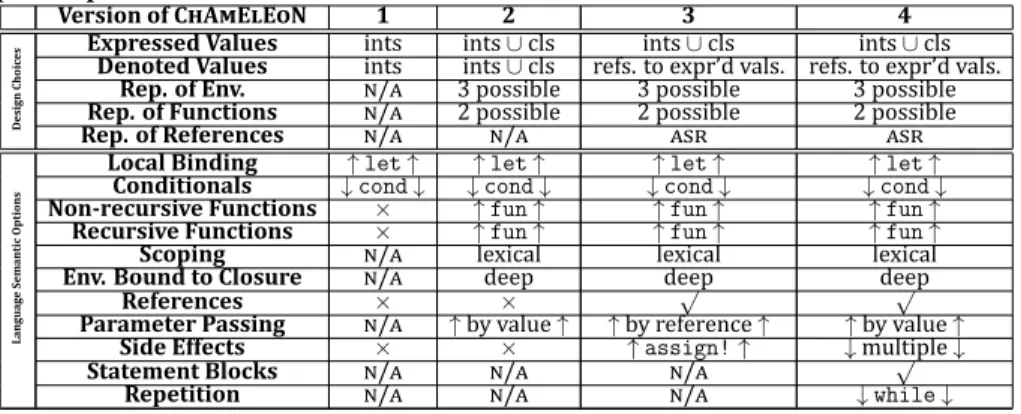
Table 1 enumerates the con iguration options available in C A E E N for aspects of the design of the interpreter (e.g., choice of representation of referencing environment), as well as for the semantics of implemented concepts (e.g., choice of parameter-passing mechanism). As we vary the latter, we get a different version of the language (see Table 2).
1Not all implementation options are available for use with the nameless
envi-ronment.
Table 2: Design choices and implemented concepts in progressive versions of C A E E N. The symbol↓ indicates that the concept is supported through its implementation in the de ining language. The symbol↑indicates that the concept is implemented from irst principles.
Design
Choic
es
Version of C A E E N 1 2 3 4
Expressed Values ints ints∪cls ints∪cls ints∪cls
Denoted Values ints ints∪cls refs. to expr’d vals. refs. to expr’d vals.
Rep. of Env. / 3 possible 3 possible 3 possible
Rep. of Functions / 2 possible 2 possible 2 possible
Rep. of References / /
Language
S
emantic
Options
Local Binding ↑let↑ ↑let↑ ↑let↑ ↑let↑
Conditionals ↓cond↓ ↓cond↓ ↓cond↓ ↓cond↓
Non-recursive Functions × ↑fun↑ ↑fun↑ ↑fun↑
Recursive Functions × ↑fun↑ ↑fun↑ ↑fun↑
Scoping / lexical lexical lexical
Env. Bound to Closure / deep deep deep
References × × √ √
Parameter Passing / ↑by value↑ ↑by reference↑ ↑by value↑
Side Effects × × ↑assign!↑ ↓multiple↓
Statement Blocks / / / √
Repetition / / / ↓while↓
Once students have some experience implementing language in-terpreters, they can begin to discern how to use the language itself to support features currently unsupported in the interpreter. For in-stance, prior to supporting recursive functions in C A E E N, stu-dents can simulate support for recursion by passing a function to itself:
ChAmElEoN> l e t
sum = fun (x) if zero? (x) 0 else +(x, (sum dec1(x) ) )
in
(sum 5)
Runtime Error: Line 2 : Unbound Identifier 'sum'
ChAmElEoN> l e t sum = fun (s, x) if zero? (x) 0 else +(x, (s s,dec1(x) ) ) in (sum sum, 5) 15
Example C A E E N Program: A Simple Stack Object
Through an extension of the prior idea, even though C A E E N does not have support for object-oriented programming, students can use C A E E N to build object-oriented abstractions. For instance, the following C A E E N program, simpli ied for pur-poses for exposition, simulates the implementation of a simple stack class with two constructors (new_stackandpush) and three observers/messages (emptystack?, top, pop). The output of this program is 3. The stack object is represented as a C A E E N clo-sure. l e t −−− constructor new_stack = fun ( ) fun(msg) if eqv? (msg, 1)
−1−−− error: cannot top an empty stack
else
if eqv? (msg, 2)
−2−−− error: cannot pop an empty stack
else
1−−−represents true: stack is empty
−−− constructor
push = fun (elem, stack)
fun (msg)
if eqv? (msg, 1 ) elem
else if eqv? (msg, 2 ) stack
else 0
−−− observers
emptystack? = fun (stack) (stack 0)
top = fun (stack) (stack 1)
pop = fun (stack) (stack 2)
in
l e t
simplestack = (new_stack)
in
(top (push 3 , (push 2 , (push 1 , simplestack) ) ) )
Other example programs, including an example more faithful to the tenants of object-orientation, especially encapsulation, are avail-able in our Git repositories (see Tavail-able 3). These programs demon-strate that we can create object-oriented abstractions from within the C A E E N language.
Table 3: Links to versions of C A E E N interpreters in Python and Racket.
Language BitBucket Link to Git Repository
Python https://bitbucket.org/chameleoninterpreter/chameleon-interpreter-in-python-release/src/master/ Racket https://bitbucket.org/chameleoninterpreter/chameleon-interpreter-in-racket-release/src/master/
STUDENT FEEDBACK
Students have found C A E E N interpreter-building helpful and fun, and to have educational merit.
Building the interpreter was helpful.
Implementing these concepts irst hand is what makes this class so worthwhile.
I really liked taking a look at the interpreter, which is at the heart of programming languages. In fact, the inter-preter is what de ines the programming language. I feel implementing concepts in a language is the best way to learn some of these tough concepts.
I would not ditch the interpreter, it is what ties many of the course themes together and it is where some of the more abstract concepts were concretely demonstrated. My favorite module was de initely module three where we got to see how an interpreter comes together.
CONCLUSION
The interpreter-based approach toward learning programming lan-guages is neither unique nor a panacea. Pedagogically, the in-terpreter and language survey approaches are essentially comple-ments of each other in advantages and disadvantages. For a discus-sion of the differences and trade-offs, we refer the reader to [4]. A myriad of other approaches for teaching programming languages
have been tried and tested [1, 2, 5, 6, 8]. What sets the interpreter-based approach in C A E E N apart from the others, and in par-ticular [3], is the use of Python—an approachable, practical, and widely-used programming language—as the implementation lan-guage. The use of C A E E N is integrated into a programming languages textbook—titledProgramming Languages: Concepts and Implementation—which is available free and by request on a trial basis for educators interested in adopting this approach. A sam-ple course outline of topics, including course notes, through the textbook is available online at http://academic.udayton.edu/ SaverioPerugini/pl. See Table 3 for links to our release versions of C A E E N interpreters in both Python and Racket.
ACKNOWLEDGMENTS
This material is based upon work supported by the National Sci-ence Foundation under Grant Numbers 1712406 and 1712404. Any opinions, indings, and conclusions or recommendations expressed in this material are those of the author(s) and do not necessarily re-lect the views of the National Science Foundation. We thank Nor-man Bashias in the Department of Computer Science at the Univer-sity of Dayton for providing comments on a draft of this paper.
REFERENCES
[1] Adams, E., Baldwin, D., Bishop, J., English, J., Lawhead, P., and Stevenson, D. Approaches to teaching the programming lan-guages course: A potpourri. InProceedings of the 11thAnnual SIGCSE Conference on Innovation and Technology in Computer Science Education, pages 299–300, New York, NY, 2006. ACM Press.
[2] Fossum, T. PLCC: A programming language compiler compiler. In Proceedings of the 45th ACM Technical Symposium on
puter Science Education (SIGCSE), pages 561–566, New York, NY, 2014. ACM Press.
[3] Friedman, D., Wand, M., and Haynes, C. Essentials of Program-ming Languages. MIT Press, Cambridge, MA, Second edition, 2001.
[4] Krishnamurthi, S. Teaching programming languages in a post-Linnaean age. ACM SIGPLAN Notices, 43(11):81–83, 2008. [5] Lee, K. A framework for teaching programming languages.
In Proceedings of the 46th ACM Technical Symposium on Com-puter Science Education (SIGCSE), pages 162–167, New York, NY, 2015. ACM Press.
[6] Pombrio, J., Krishnamurthi, S., and Fisler, K. Teaching program-ming languages by experimental and adversarial thinking. In Lerner, B., Bodík, R., and Krishnamurthi, S., editors, Proceed-ings of the 2ndSummit on Advances in Programming Languages (SNAPL), pages 13:1–13:9, 2017.
[7] Savage, N. Using functions for easier programming. Communi-cations of the ACM, 61(5):29–30, 2018.
[8] Sheldon, M. and Turbak, F. An aspect-oriented approach to the undergraduate programming language curriculum. ACM SIG-PLAN Notices, 43(11):124–129, 2008.