Exploiting Known Interference as Green Signal
Power for Downlink Beamforming Optimization
Christos Masouros
, Senior Member, IEEE
, and Gan Zheng
, Senior Member, IEEE
Abstract—We propose a data-aided transmit beamforming scheme for the multi-user multiple-input-single-output (MISO) downlink channel. While conventional beamforming schemes aim at the minimization of the transmit power subject to suppressing interference to guarantee quality of service (QoS) constraints, here we use the knowledge of both data and channel state infor-mation (CSI) at the transmitter to exploit, rather than suppress, constructive interference. More specifically, we design a new precoding scheme for the MISO downlink that minimizes the transmit power for generic phase shift keying (PSK) modulated signals. The proposed precoder reduces the transmit power com-pared to conventional schemes, by adapting the QoS constraints to accommodate constructive interference as a source of useful signal power. By exploiting the power of constructively interfering symbols, the proposed scheme achieves the required QoS at lower transmit power. We extend this concept to the signal to interference plus noise ratio (SINR) balancing problem, where higher SINR values compared to the conventional SINR balancing optimization are achieved for given transmit power budgets. In addition, we derive equivalent virtual multicast formulations for both optimizations, both of which provide insights of the optimal solution and facilitate the design of a more efficient solver. Finally, we propose a robust beamforming technique to deal with imper-fect CSI, that also reduces the transmit power over conventional techniques, while guaranteeing the required QoS. Our simulation and analysis show significant power savings for small scale MISO downlink channels with the proposed data-aided optimization compared to conventional beamforming optimization.
Index Terms—Constructive interference, convex optimization, downlink beamforming, power minimization, SINR balancing.
I. INTRODUCTION
T
HE power efficiency of wireless transmission links has recently attracted considerable research interest, in-line with the global initiative to reduce the emissions and operational expenses of communication systems. Accord-ingly, transmit beamforming schemes for power minimizationManuscript received May 30, 2014; revised September 19, 2014 and Feb-ruary 09, 2015; accepted April 18, 2015. Date of publication May 07, 2015; date of current version June 08, 2015. The associate editor coordinating the re-view of this manuscript and approving it for publication was Prof. Y. W. Peter Hong. This work was supported by the Royal Academy of Engineering, U.K. and the Engineering and Physical Sciences Research Council (EPSRC) project EP/M014150/1.
C. Masouros is with the Department of Electronic and Electrical Engi-neering—University College London, London WC1E 7JE, U.K. (e-mail: [email protected]).
G. Zheng is with the School of Computer Science and Electronic Engineering, University of Essex, Colchester, CO4 3SQ, U.K., and also with the Interdisci-plinary Centre for Security, Reliability and Trust (SnT), University of Luxem-bourg, Luxembourg (e-mail: [email protected]).
Color versions of one or more of the figures in this paper are available online at http://ieeexplore.ieee.org.
Digital Object Identifier 10.1109/TSP.2015.2430839
have become particularly relevant for the downlink channel. Capacity achieving non-linear dirty paper coding (DPC) techniques [1], [2] have been proposed for pre-subtracting interference prior to transmission. The DPC methods developed so far are in general complex as they require sophisticated sphere-search algorithms [3] to be employed at the transmitter and assume codewords with infinite length for the encoding of the data. Their suboptimal counterparts [4]–[6] offer a com-plexity reduction at a comparable performance. Still however, the associated complexity is prohibitive for their deployment in current communication standards. On the other hand, linear precoding schemes based on channel inversion [7]–[13] offer the least complexity, but their performance is far from achieving the optimum maximum likelihood bound for small scale MIMO systems, while the contrary has been shown for large scale MIMO [14]–[16]. Their non-linear adaptation, namely vector perturbation (VP) precoding [17]–[21] provides a performance improvement at the expense of an increased complexity since the search for the optimal perturbation vectors is an NP-hard problem, typically solved by complex sphere search algorithms at the transmitter.
More relevant to this work, optimization based techniques that directly minimize the transmit power subject to quality of service (QoS) constraints—most commonly to interfer-ence-plus-noise ratio (SINR)—have been studied for broadcast channels in [22], where convex optimization problems of such nature were proposed. Recent works have focused on the utility maximization in MIMO interfering broadcast channels [23], [24] and full duplex radio [25]. For the cases of channel state information (CSI) errors, robust versions of these optimizations have been studied in [26]–[35]. In [30], a robust max-min approach was developed for a single-user MIMO system based on convex optimization. Later in [36], the robust transmission schemes to maximize the compound capacity for single and multiuser rank-one Ricean MIMO channels were addressed, based on the uncertainty set in [31]. Robust beamforming for multiuser multiple-input single-output (MISO) downlink channels with individual QoS constraints under an imperfect channel covariance matrix was studied in [22], [32]. Recently in [33], the optimal power allocation over fixed beamforming vectors was obtained in the presence of errors in CSI matrices. Most recently, efficient numerical solutions to find conserva-tive robust beamforming for multiuser MISO systems with mean-square-error (MSE) and SINR constraints and different bounded CSI errors have been developed in [34], [35]. More-over, SINR balancing optimizations have been proposed in [37] where the minimum achievable SINR is maximized, subject to a total transmit power constraint.
This paper is based on the concept of interference exploita-tion, first introduced in [8], [9], [38], [39] where analytical in-terference classification criteria and low-complexity precoders based on channel inversion were derived. The analysis showed how the knowledge of both CSI and data at the base station can be used to predict and classify interference into constructive and destructive. The closed-form precoders in [8], [9] showed that by exploiting the constructive part of interference, higher receive SNRs can be provided without increasing the per user transmit power. However, when precoders are fully optimized, less is understood about the performance gain of the construc-tive interference approach over the conventional optimization, e.g., [22]. Recent work has explored the application of the con-cept of constructive interference [8], [9] in downlink beam-forming based on symbol level optimization [40], [41]. The work has focused on allowing constructive interference in the received symbols by means of perfect CSI at the transmitter and by constraining the resulting angle in the received PSK constel-lation to be strictly equal to the angle of the nominal constella-tion symbol. Accordingly, in this work we aim to improve such optimization-based precoders by exploiting constructive inter-ference as a source of signal power, and allowing for a more re-laxed optimization in received symbols. By doing so, we further reduce the transmit power required for guaranteeing the SNR constraints in the optimization, thus improving the power effi-ciency of transmission. We further derive CSI-robust precoders for interference exploitation, which have not been studied be-fore in the relevant literature. For clarity, we list the contribu-tions of this paper as follows:
1) We introduce a new linear precoder design for PSK that a) reduces the transmit power for given performance com-pared to existing precoders based on the proposed structive interference regions, and b) as opposed to con-ventional precoders, applies to scenarios with higher num-bers of users than transmit antennas,
2) We further adapt this concept to the SINR balancing problem, where higher SINR values compared to the conventional SINR balancing optimization are achieved for given transmit power budgets,
3) We re-cast the optimization problem as a virtual multicast optimization problem based on which we derive the struc-ture of the optimal solution and develop an efficient gra-dient projection algorithm to solve it,
4) We use the multicast formulation to derive a robust pre-coding scheme suitable for imperfect CSI with bounded CSI errors.
We note that, while the following analysis focuses on PSK mod-ulation, the above concept and relevant optimizations can be ex-tended to other modulation formats such as quadrature ampli-tude modulation (QAM) by adapting the decision thresholds of the constellation to accommodate for constructive interference [38]. It should be stressed however, that the proposed schemes are most useful in high interference scenarios where low order modulation such as BPSK and QPSK are used in the communi-cation standards to ensure reliability [42]. In addition, constant envelope modulation such as PSK has received particular in-terest recently with the emergence of large scale MIMO systems [43]. All the above motivate our focus on PSK constellations.
Finally, we note that, in line with the relevant literature we as-sume a time division duplex (TDD) transmission here, where the base station directly estimates the downlink channel using uplink pilot symbols and uplink-downlink channel reciprocity.
The rest of the paper is organized as follows. Section II in-troduces the system model considered in this paper and briefly describes the two conventional optimizations of interest:power minimizationandSINR balancing. In Section III the proposed beamforming optimization based on constructive interfer-ence is detailed for the case of power minimization, while its multicasting equivalent optimization is shown in Section IV. Section V presents the constructive interference optimization for the SINR balancing problem. The CSI robust versions of these optimizations are examined in Section VI for both power minimization and SINR balancing, for the case of bounded CSI errors. Finally numerical results are illustrated and discussed in Section VII and concluding remarks are given in Section VIII. In the following, we use the terms beamforming and precoding interchangeably, in-line with the most relevant literature.
II. SYSTEMMODEL ANDBEAMFORMINGOPTIMIZATION
Consider a –user Gaussian broadcast channel where an -antenna BS transmits signals to single-antenna users. Channel vector, precoding vector, received noise, data and SINR constraints for the –th user are denoted as , , , and respectively with denoting the constant am-plitude of the PSK modulated symbols and
where denotes the circularly symmetric complex Gaussian distribution with mean and variance . The re-ceived signal at user is
(1) The receive SINR at the -th receiver for this scenario is given as
(2) The transmit signal is
(3)
where any of the users’ symbols can be taken as reference. Without loss of generality, let us use as reference hereof. Accordingly, the instantaneous transmit power for a signal with envelope is defined as
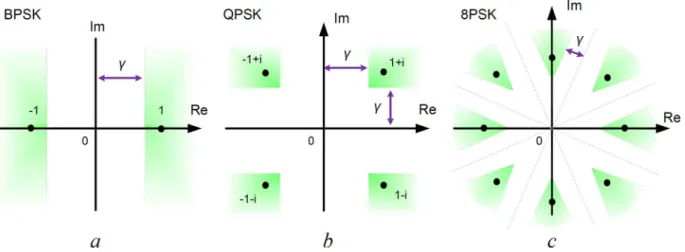
Fig. 1. Constructive interference in a) BPSK, b) QPSK and c) 8PSK.
A. Power Minimization
The conventional power minimization precoder, treating all interference as harmful, aims to minimize the average transmit power, subject to interference constraints as shown below [22]
(5) While optimal from a stochastic viewpoint, the above pre-coder ignores the fact that, instantaneously, interference can contribute constructively to the received signal power [9], and therefore from an instantaneous point of view we later show that it is suboptimal.
B. SINR Balancing
As regards the second optimization that is of interest in this work, SINR balancing maximizes the minimum achievable SINR subject to a transmit power budget, in the form
(6) where denotes the total transmit power budget. We note that the above optimization is non-convex and the solution involves more complex iterative solutions [37].
III. PROPOSEDOPTIMIZATIONBASED ONCONSTRUCTIVE
INTERFERENCE ANDPHASECONSTRAINTS
With the knowledge of the downlink channel and all user’s data readily available at the transmitter, and with the aim of exploiting the instantaneous interference, the interference for PSK modulation can be classified to constructive and destruc-tive based on known criteria [9], [38]. For clarity, these are sum-marized schematically in Fig. 1 for the basic PSK constellations. Here the scalar denotes the threshold distance to the decision
variables of the constellation, that relates to the SNR constraint, as detailed in the following. In brief, constructive interference is defined as the interference that moves the received symbols away from the decision thresholds of the constellation. This rep-resents the green areas in the constellations of Fig. 1 where these are taken with reference to a minimum distance from the deci-sion thresholds as per the SNR constraints. Note that these need not center on the nominal constellation points (the black dots in the figure) for generic SNR constraints. We refer the reader to [8], [9], [38] for further details on this topic.
As per the above classification and discussion, the optimiza-tions in (5), (6) can be modified to take the constructive in-terference into account in the power minimization. This can be done by imposing interference constraints, not in terms of suppressing the stochastic interference, but rather optimizing instantaneous interference to contribute to the received signal power, thus reducing the required transmit power accordingly. For the case when interference has been aligned by means of precoding vectors to overlap constructively with the signal of interest, all interference in (1) contributes constructively to the useful signal. Therefore all interference terms form compo-nents of the useful signal energy, which is given by the squared magnitude of the full sum in (1). Accordingly, it has been shown in [9] that the receive SNR is given as
(7) where all interference contributes in the useful received signal power. Accordingly, and based on the classification criteria de-tailed in [8] and Fig. 1 for -PSK based on constructive inter-ference, where the received interference is aligned to the sym-bols of interest, the problem can be reformulated as
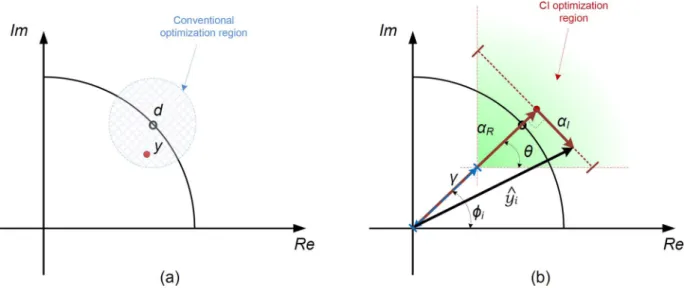
Fig. 2. Optimization regions for (a) conventional precoding and (b) precoding for interference exploitation and generic optimization constraints (QPSK example).
where , , and denote the real and imag-inary part, the sign and angle of respectively. Here the angle of interference is strictly constrained to equal the angle of the symbol of interest. The problem can be equivalently formulated as
(9) We note the use of the sum of phase shifted (by the phase of the symbol of interest ) interfering symbols plus the symbol of interest in the above expressions. This serves to isolate the received amplitude and phase shift in the symbol of interest due to interference. Here, the first constraint requires that the inter-ference perfectly aligns with the phase of the symbol of interest, to ensure that it overlaps constructively to the useful symbol [9], [38]. The second constraint requires that this constructive inter-ference is enough to satisfy the receive SNR threshold. Note that the above two conditions contain equations and inequali-ties, while there are real variables. Therefore, for the case
there are always sufficient degrees of freedom to satisfy these two sets of constraints, while our results in the following show that the proposed can be feasible with high probability even for cases with . Still, it can be seen that due to the strict angle constraint, the formulation (9) is more constrained than the constructive interference regions in Fig. 1 where the strict angle constraints do not exist. To obtain a more relaxed optimization for –PSK, let us observe the constellation ex-ample shown in the diagram of Fig. 2 for QPSK. Here, we have used the definitions and which are the real and imag-inary components of in the figure, the received symbol ignoring noise, phase shifted by the phase
of the desired symbol. We also define . By means of their definition, and essentially shift the observation of received symbol onto the axis from the origin of the constel-lation diagram to the constelconstel-lation symbol of interest. Clearly, provides a measure of the amplification of the received con-stellation point along the axis of the nominal concon-stellation point due to constructive interference and provides a measure of the angle shift from the original constellation point, i.e., the de-viation from the axis of the nominal constellation point with phase .
At this point, we should emphasize the key idea in the pro-posed optimization which is the central strength of the propro-posed scheme that relaxes the optimization and allows additional re-duction in the transmit power. In conventional optimizations, the signal power is optimized subject to SINR constraints. This is equivalent to constraining the interference each user experi-ences, so that the received symbol is within a certain distance from the nominal constellation symbol. From the view point of multiple users this essentially constrains the transmit vectors such that the received symbol is contained within a circle (or a hyper-sphere for multidimensional optimizations) around the nominal constellation point , so that the interference caused by the other symbols is limited. This is denoted by the dashed circle around the constellation point in Fig. 2(a). In contrast to this, here by use of the concept of constructive interference we allow a relaxation of and for all transmit symbols, under the condition that the interference caused is constructive, as se-cured by the constraints of the optimization. This gives rise to the constructive interference sector denoted by the green shaded sector in Fig. 2(b) [9], [38]. It can be seen that and are allowed to grow infinitely, as long as their ratio is such that the received symbol is contained within the constructive area of the constellation, i.e., the distances from the decision thresholds, as set by the SNR constraints , are not violated. It is clear that the region in Fig. 2(b) is only constrained along the vicinity of the decision thresholds, it therefore extends infinitely to the di-rections away from the decision thresholds and hence provides a more relaxed optimization with respect to the conventional re-gion of Fig. 2(a).
As regards the constructive area in the constellation, with re-spect to (9), it can be seen that the angle of interference need not strictly align with the angle of the useful signal, as long as it falls within the constructive area of the constellation. For a given modulation order the maximum angle shift in the con-structive interference area is given by . Accordingly, to relax the optimization, is allowed to be non-zero as long as the resulting symbol lies within the constructive area of the constellation. Using basic geometry and the constructive inter-ference regions derived for generic M-PSK in [13], we arrive at the optimization problem expressed as in (10), shown at the bottom of the page.
By noting that the last constraint actually incorporates the one for the real part of the received symbols, the optimization can be further reduced to the compact form of (11).
Clearly, the above optimization is equivalent to
(12) where for we have
(13) It can be seen that the above optimization in (11) is more relaxed than the zero-angle-shift optimization (8), which results in a smaller minimum in the transmit power. Moreover, it contains a number of inequalities which result in an increased feasibility region compared to the conventional optimization, as will be shown in the following. Problem (11) is a standard second-order cone program (SOCP), thus can be optimally solved using nu-merical software, such as Semudi. However, in the following
section, we derive a more computationally efficient algorithm to solve it. For the illustrative example of BPSK used in the fol-lowing results, the optimization can be modified to
(14) In (14) the constraint requires that the interference on each user’s symbol has the same sign as the symbol of interest (and is therefore constructive) and that this constructive interference has enough power to satisfy the SNR threshold. For the case of QPSK the same principle needs to be applied separately to the real and imaginary part of the received symbol (see Fig. 1(b)) and hence we have
(15)
IV. A VIRTUALMULTICASTFORMULATION AND ANEW
EFFICIENTALGORITHM A. A Virtual Multicast Formulation of (11)
The optimization in (11) can be re-cast as a virtual multicas-ting problem [44] according to the following theorem.
Theorem 1: The broadcast problem (11) with constructive interference is equivalent to the multicast problem below
(16)
(10)
where the modified channel is defined as . To be more specific, the optimal solutions to (11) and (16), and respectively, have the following relation
(17) (18)
Proof: First we re-write the constraint in (11) as (19) at the bottom of the page.
Observe that with (19), the composite precoding term in (11) can be treated as a single vector precoder, i.e., . Therefore the multicast reformulation (16) follows immediately.
Suppose the optimal solutions of user 1’s precoding vector in (11) is . Without loss of optimality, the other users’ pre-coding vectors can be simple rotated versions of , i.e.,
. As a special case, we have . This completes the proof.
Note that different from the classical multicast beamforming design, which is non-convex and difficult to solve [44], (16) is a convex problem with a quadratic objective function and linear constraints thus easily solvable. In a similar fashion, the problem (12) will have a similar multicast formulation.
Theorem 1 provides useful insight into the structure of the precoding vectors. It tells us that the original broadcast problem now becomes a multicast problem if interference is utilized con-structively. This is understandable because we take into account the correlation of the originally independent data streams, there-fore the transmission can be re-formulated as sending a common data stream to all users, and shaping the channel and the re-sulting signal overlap, so that the intended data is delivered to each receiver. More importantly, the multicast problem contains only a single vector and is therefore more easily solved than the original broadcast problem. The rest of this section is de-voted to deriving an efficient algorithm to solve (16).
B. Real Representation of the Problem
For convenience, we separate the real and imaginary parts of each complex notation as follows
(20)
where , , ,
, .
Further define real-valued vectors
(21)
It is easy to verify that , where . and denote all-zero matrix and identity matrix, respectively. With the new notations, we can express the real and imaginary parts in (17) as follows
(22) As a consequence, the constraint in (17) can be rewritten as
(23) Define , and we rewrite (16) as
(24) (25)
C. The Dual Problem
To further simplify the optimization let us formulate its dual problem. We let be the dual vector variables associated with the two sets of constraints in (24) and (25) respectively, and consider the Lagrangian of (24) as (26) at the bottom of the next page.
The dual objective is thus given by . Set-ting , we obtain the structure of the optimal below:
(27) It is not surprising to see that the optimal is the linear combination of the channel coefficients.
Substituting (27) into leads to
(28) Define and rearrange the terms, and we can obtain the following dual problem:
(29) where is an real matrix, and the
-th column of f and g are defined in (21) and after (23).
The problem (29) is a non-negative least-squares problem. It has wide applications but is known to be a challenging problem [46]. Without the non-negative constraint, its solution is given by
(30) Based on the above results, we have the following corollary to provide useful insight.
Corollary 1: If is a positive vector, the optimal solution to the original problem (11) with constructive interference is achieved when . The op-timal precoding solution can be obtained from (30) and (27). This is can be explained by the fact that is the dual variable and needs to satisfy the complementary slackness conditions in (24):
(31) (32) When , this implies that
(33) and it follows that or
.
D. A Gradient Projection Algorithm to Solve (29)
The general solution to (29) is difficult to derive. Here we propose a gradient projection algorithm to solve it. The gra-dient projection algorithm is the natural extension of the uncon-strained steepest descent algorithm to bound conuncon-strained prob-lems [45]. To this end, we first rewrite (29) as a standard convex problem:
(34) where . It is easy to verify that the gradient of is given by
(35)
Algorithm 1:Efficient Gradient Projection Algorithm to solve (34)
1:Input:
2:begin
3: Initialize arbitrarily . 4: In the -th iteration, update :
(36) where the step size can be chosen according to the Armijo rule or some other line search scheme. 5: Go back to line 4 until convergence. 6:end
7:Output: .
We then propose the following Algorithm 1 to solve (29). Once the optimal dual solution is found, the original precoding solution can be obtained from (27).
V. CONSTRUCTIVEINTERFERENCEOPTIMIZATION FOR
SINR BALANCING
The above concept of constructive interference can be applied to the SINR balancing problem of (6). The problem for the case of constructive interference can be reformulated as
(37)
which is not a convex problem because is concave. How-ever, this can be simply resolved by replacing it with a new vari-able, i.e., . Then we obtain an equivalent problem of (38) at the bottom of the page.
It can be seen that, as opposed to the conventional SINR bal-ancing problem (6), which is non-convex, the formulation in (38) is convex and can be solved by standard convex optimiza-tion techniques.
A. Multicast Formulation of (37)
In a similar fashion to the power minimization problem, the optimization in (37) can be re-cast as a multicasting problem according to the following theorem.
Theorem 2: Problem (38) is equivalent to the multicast problem below:
(39) where . To be more specific, if the optimal solutions to (37) and (16) are and , respectively, then they have the following relation:
(40) (41)
Proof: The proof follows the one for Theorem 1.
The above is a standard SOCP problem which can be effi-ciently solved using known approaches.
VI. ROBUST POWER MINIMIZATION WITH
BOUNDEDCSI ERRORS
A. Channel Error Model and Problem Formulation
In this section, we study the robust procoding design when the CSI is imperfectly known. We model user ’s actual channel as
(42)
where denotes the CSI estimates known to the BS, and represents the CSI uncertainty within the spherical set
We assume that the BS has no knowledge about except for its error bound thus we take a worst-case approach for the transmit precoding design to guarantee the resulting solution is robust to all possible channel uncertainties within . The spe-cific robust design problem is to minimize the overall transmit power for ensuring the users’ individual SINR constraints by optimizing the precoding vector , i.e.,
(43)
B. Conventional Robust Precoding
In the conventional multiuser MISO systems, the total transmit power is and robust design problem can be expressed as
(44)
The robust precoding design is characterized by the following theorem [35].
Theorem 3: The robust beamforming problem (44) can be relaxed to the following semi-definite programming (SDP) problem
(45) where
The problem (45) is convex and hence can be optimally solved. The resulting objective value of (45) provides a lower bound for the conventional power minimization.
Remark: When the SDP relaxation is tight, or (45) returns all rank-1 solution , then the optimal solution to solve (44) can be obtained by matrix decomposition such that
; otherwise, the required power in (44) is always higher than that in (45).
C. Robust Precoding Based on Constructive Interference
Based on the multicast formulation of the power minimiza-tion problem (16), the worst-case robust design for the case of constructive interference becomes
(46) The constraint in (46) is intractable due to the infinite number of error vectors. Below we show how to tackle it using convex optimization techniques. For ease of composition, we omit the user index.
First notice that robust constraint (46) can be guaranteed by the modified constraint below:
(47) We again separate the real and imaginary parts of each complex notation as follows
(48) Further define real-valued error vector and channel estima-tion vector
(49) Apparently . With the new notations, we can re-ex-press the real and imaginary parts in (47) as follows
(50) (51) As a consequence, (47) can be rewritten as
(52) The above constraint is equivalent to the following two con-straints:
(53)
(54)
whose robust formulations are given by
(55) (56) Finally we reach the following robust problem formulation
(57) Note that (57) is standard SOCP problem therefore can be effi-ciently solved. After we obtain the optimal , the robust solution can be determined using the relation in (21).
D. Robust SINR Balancing
For completeness, we also study the robust SINR balancing given total BS power constraint. Similar procedures can be taken as the above to derive it, therefore we give the problem formulation directly below
(58) The above is a typical SOCP problem that can be solved using standard approaches. Suppose the optimal is , then the maximum SINR value becomes .
VII. NUMERICALRESULTS
This section presents numerical results based on Monte Carlo simulations of the proposed optimization techniques, termed as CI in the following, and conventional precoding based on opti-mization for the frequency flat Rayleigh fading statistically un-correlated multiuser MISO channel for both cases of perfect and erroneous CSI. Systems with BPSK, QPSK and 8PSK modula-tion are considered while it is clear that the benefits of the pro-posed technique extend to higher order modulation. To focus on the proposed concept, we compare the proposed CI optimization solely to the conventional optimization of [22], [37], while it is clear the benefits of the proposed concept extend to modified optimization designs in the literature, by direct application of the constructive interference concept and the adaptation of the relevant QoS constraints. We use ‘ ’ to denote a mutiuser MISO system with transmit antennas and single-antenna terminals. Unless otherwise specified, QPSK is the default mod-ulation scheme.
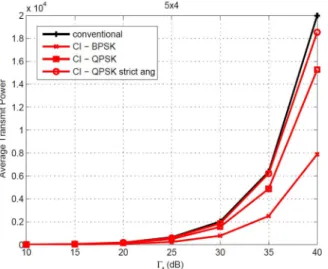
First, in Fig. 3 we compare the average transmit power with the conventional optimization and the proposed optimization problems (14) and (15) in the 5 4 scenario for BPSK and QPSK, respectively. Power savings of up to 50% can be seen. It can also be observed that the relaxed optimization (11) results in significant power gains compared to the strict angle constraints in (9). The same trend can be observed for the 4 4 systems
Fig. 3. Transmit power vs. for conventional and CI, , .
Fig. 4. Transmit power vs. for conventional and CI, , .
case of Fig. 4 where the conventional optimization results in a solution with increased transmit power, because less transmit antennas are available at the BS. The gains in this case are ampli-fied for the proposed relaxed optimization. The transmit power is also shown in Fig. 5 for the 3 4 scenario where the con-ventional precoder is inapplicable, as the optimization in (5) is infeasible for . Remarkably, the proposed optimization problem is feasible in the 92.6% of the cases. The relaxed na-ture of the problem indeed leads to larger feasibility regions. To illustrate the extended feasibility region for the proposed opti-mization problems, Fig. 6 shows the feasibility probability of a user system with respect to the number of transmit an-tennas. It can be seen that while the conventional optimization is only feasible for , the proposed can be feasible for lower values of .
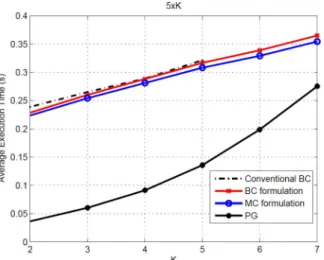
The complexity of the proposed power minimization problem is addressed in Fig. 7 for the system with . While ana-lytical complexity expressions are hard to derive for optimiza-tion-based precoding, here the complexity of the solvers with the broadcast (BC) formulation of (11), multicast (MC) for-mulation of (16) and gradient projection solver in Algorithm
Fig. 5. Transmit power vs. for conventional and CI, , .
Fig. 6. Feasibility probability vs. for conventional and CI, , .
1 is shown in terms of the average execution time of the op-timization algorithm, with increasing numbers of users. While the BC and MC show a similar computational complexity, the gradient projection solver in Algorithm 1 offers a significant reduction in the involved complexity down to less than 15%, which further motivates the multicast formulation of the opti-mization problem. Still, we note that the proposed optiopti-mization needs to be performed on a symbol-by-symbol basis. Accord-ingly, the proposed may involve excess complexity compared to conventional precoding optimization especially for slow fading scenarios, where the convectional channel-dependent precoding may not require the optimization to be performed frequently. Accordingly, for the slow fading scenario where the channel is constant over a transmission frame and for the example of an LTE frame with 14 symbol time slots, the proposed precoding with the gradient projection solver translates to a doubling of complexity per frame for the proposed scheme w.r.t. conventional precoding optimization. However, for the obtained transmit-power benefits as shown in our re-sults, the end complexity increase is definitely worthwhile the performance benefits offered. In fact, in terms of the ultimate
Fig. 7. Average execution time vs. for CI optimization with the BC formula-tion of (11), MC formulaformula-tion of (16) and gradient projecformula-tion solver in Algorithm 1, , QPSK.
Fig. 8. Achievable vs. Transmit power budget for conventional and CI,
, .
metric of power efficiency of the transmitter, we note that for an LTE base station the transmit power is measured in the order of around 20Watts, while the power consumption of the DSP processing is typically of the order of hundreds of milliWatts. Since with the proposed precoding our results show a halving of the transmit power at roughly double the DSP power, the gains in the power efficiency for the proposed scheme w.r.t. conven-tional precoding are therefore significant.
Figs. 8 and 9 compare the achievable SNR for the SINR bal-ancing problems (6) and (37). In Fig. 8 the achievable is shown for the 5 4 MISO where an SNR gain of about 2dB can be observed. The same trend is observed in Fig. 9 for the 5 4 MISO with an SNR gain of about 3dB. It is worth noting that for the case of constructive interference these SNR gains are due to the effect of constructive interference.
Finally Figs. 10 and 11 compare the performance of the pro-posed CSI-robust CI precoder with the conventional CSI-robust precoder of [35] for the 4 4 MISO. Fig. 10 shows the ob-tained transmit power with increasing CSI error bounds where it can be seen that for values in the region of the
Fig. 9. Achievable vs. Transmit power budget for conventional and CI,
, .
Fig. 10. Transmit power vs. error bound for conventional and CI, ,
, .
Fig. 11. Transmit power vs. SINR for conventional and CI, , , .
transmit power increases significantly. On the contrary, the pro-posed optimization shows a modest increase in transmit power
for high values of thanks to the relaxed optimization obtained by exploiting constructive interference. This is also shown in Fig. 11 where the average transmit power is shown with in-creasing SNR thresholds, for . Again the proposed shows a constant loss of less than 1dB compared to the perfect CSI case, while conventional precoding shows an increased sen-sitivity to the CSI errors.
VIII. CONCLUSION
A number of improved optimization-based precoding de-signs have been proposed for the multi-user MISO downlink channel. By taking advantage of the constructive interference, the proposed schemes deliver reduced transmit power for given QoS constraints, or equivalently increased minimum SNRs for a given transmit power budget. Both optimizations were adapted to virtual multicast formulations which were shown to be more efficiently solvable. The proposed concept was further extended to robust designs for imperfect CSI with bounded CSI errors. In all cases the proposed schemes provide superior performance over the conventional precoding schemes, which confirms the benefit of constructive interference when the precoders are fully optimized.
The concept of constructive interference opens up new op-portunities for future work in the optimization of precoding de-signs. Firstly, the extension to QAM constellation is non-trivial, and it needs a careful redesign of constructive interference sec-tors for determining the relevant optimization constraints. Sec-ondly, the robust design in Section VI takes a conservative ap-proach while the optimal robust precoder design is an impor-tant but challenging problem to be studied. Thirdly, as this work considers a single-cell system, and as multi-cell cooperation is made practical in systems such as cloud-RAN [47], it is worth investigating the potential of the proposed scheme in multi-cell environments. Another promising application scenario is multi-beam satellite systems where both CSI and data for different beams are available at the gateway station where forward link beamforming is designed [48].
REFERENCES
[1] M. Costa, “Writing on dirty paper,”IEEE Trans. Inf. Theory, vol. IT-29, pp. 439–441, May 1983.
[2] U. Erez, S. Shamai, and R. Zamir, “Capacity and lattice strategies for cancelling known interference,”IEEE Trans. Inf. Theory, vol. 51, no. 11, pp. 3820–3833, Nov. 2005.
[3] B. Hassibi and H. Vikalo, “On the expected complexity of integer least squares problems,” inProc. IEEE Int. Conf. Acoust., Speech, Signal Process, Orlando, FL, USA, May 2002, pp. 1497–1500.
[4] C. Windpassinger, R. Fischer, T. Vencel, and J. Huber, “Precoding in multiantenna and multiuser communications,”IEEE Trans. Wireless Commun., vol. 3, no. 4, pp. 1305–1316, Jul. 2004.
[5] C. Masouros, M. Sellathurai, and T. Rantarajah, “Interference opti-mization for transmit power reduction in Tomlinson-Harashima pre-coded MIMO downlinks,”IEEE Trans. Signal Process., vol. 60, no. 5, pp. 2470–2481, May 2012.
[6] A. Garcia and C. Masouros, “Power-efficient Tomlinson-Harashima precoding for the downlink of multi-user MISO systems,”IEEE Trans. Commun., vol. 62, no. 6, pp. 1884–1896, Jun. 2014.
[7] C. B. Peel, B. M. Hochwald, and A. L. Swindlehurst, “A vector-per-turbation technique for near-capacity multiantenna multiuser commu-nication—Part I: Channel inversion and regularization,”IEEE Trans. Commun., vol. 53, no. 1, pp. 195–202, Jan. 2005.
[8] C. Masouros and E. Alsusa, “Dynamic linear precoding for the ex-ploitation of known interference in MIMO broadcast systems,”IEEE Trans. Wireless Commun., vol. 8, no. 3, pp. 1396–1404, Mar. 2009. [9] C. Masouros, “Correlation rotation linear precoding for MIMO
broad-cast communications,”IEEE Trans. Signal Process., vol. 59, no. 1, pp. 252–262, Jan. 2011.
[10] C. Masouros and E. Alsusa, “Two-stage transmitter precoding based on data-driven code hopping and partial zero forcing beamforming for MC-DCMA communications,”IEEE Trans. Wireless Commun., vol. 8, no. 7, pp. 3634–3645, Jul. 2009.
[11] E. Alsusa and C. Masouros, “Adaptive code allocation for interference management on the downlink of DS-CDMA systems,”IEEE Trans. Wireless Commun., vol. 7, no. 7, pp. 2420–2424–, Jul. 2008. [12] Z. Ding and H. V. Poor, “A general framework of precoding design
for multiple two-way relaying communications,”IEEE Trans. Signal Process., vol. 61, no. 6, pp. 1531–1535, Mar. 2013.
[13] C. Masouros and E. Alsusa, “Soft linear precoding for the downlink of DS/CDMA communication systems,”IEEE Trans. Veh. Technol., vol. 59, no. 1, pp. 203–215, Jan. 2010.
[14] E. G. Larsson, F. Tufvesson, O. Edfors, and T. L. Marzetta, “Massive MIMO for next generation wireless systems,”IEEE Commun. Mag., vol. 52, no. 2, pp. 186–195, Feb. 2014.
[15] C. Masouros, M. Sellathurai, and T. Ratnarajah, “Large-scale MIMO transmitters in fixed physical spaces: The effect of transmit correla-tion and mutual coupling,”IEEE Trans. Commun., vol. 61, no. 7, pp. 2794–2804, Jul 2013.
[16] C. Masouros and M. Matthaiou, “Physically constrained massive MIMO: Hitting the wall of favorable propagation,”IEEE Commun. Lett., vol. 19, no. 5, pp. 771–774, May 2015.
[17] C. B. Peel, B. M. Hochwald, and A. L. Swindlehurst, “A vector-per-turbation technique for near-capacity multiantenna multiuser commu-nication—Part II: Perturbation,”IEEE Trans. Commun., vol. 53, no. 3, pp. 537–544, Mar. 2005.
[18] A. Li and C. Masouros, “A constellation scaling approach to vector perturbation for adaptive modulation in MU-MIMO,”IEEE Wireless Commun., 2015, to be published.
[19] C. Masouros, M. Sellathurai, and T. Ratnarajah, “Maximizing en-ergy-efficiency in the vector precoded MU-MISO downlink by selective perturbation,”IEEE Trans. Wireless Commun., vol. 13, no. 9, pp. 4974–4984, Sep. 2014.
[20] C. Masouros, M. Sellathurai, and T. Ratnarajah, “Vector perturbation based on symbol scaling for limited feedback MIMO downlinks,”
IEEE Trans. Signal Process., vol. 62, no. 3, pp. 562–571, Feb. 2014. [21] C. Masouros, M. Sellathurai, and T. Ratnarajah, “Computationally
effi-cient vector perturbation using thresholded optimization,”IEEE Trans. Commun., vol. 61, no. 5, pp. 1880–1890, May 2013.
[22] M. Bengtsson and B. Ottersten, “Optimal and suboptimal transmit beamforming,” inHandbook of Antennas in Wireless Commun, L. Godara, Ed. Boca Raton, FL, USA: CRC Press, 2001, ch. 18. [23] Q. Shi, M. Razaviyayn, Z. Q. Luo, and C. He, “An iteratively weighted
MMSE approach to distributed sum-utility maximization for a MIMO interfering broadcast channel,”IEEE Trans. Signal Process., vol. 59, no. 9, pp. 4331–4340, Sep. 2011.
[24] W. Yu, T. Kwon, and C. Shin, “Multicell coordination via joint sched-uling, beamforming, and power spectrum adaptation,”IEEE Trans. Wireless Commun., vol. 12, no. 7, pp. 1–14, Jul. 2013.
[25] D. Nguyen, L.-N. Tran, P. Pirinen, and M. Latva-aho, “Precoding for full duplex multiuser MIMO systems: Spectral and energy efficiency maximization,” IEEE Trans. Signal Process., vol. 61, no. 16, pp. 4038–4050, Aug. 2013.
[26] Y. Wu, S. Jin, X. Gao, M. R. McKay, and C. Xiao, “Transmit designs for the MIMO broadcast channel with statistical CSI,”IEEE Trans. Signal Process., vol. 62, no. 9, pp. 4451–4466, Sep. 2014.
[27] N. Vucic and H. Boche, “Robust QoS-constrained optimization of downlink multiuser MISO systems,” IEEE Trans. Signal Process., vol. 57, pp. 714–725, Feb. 2009.
[28] B. K. Chalise, S. Shahbazpanahi, A. Czylwik, and A. B. Gershman, “Robust downlink beamforming based on outage probability specifi-cations,”IEEE Trans. Wireless Commun., vol. 6, pp. 3498–3503, Oct. 2007.
[29] N. Vucic and H. Boche, “A tractable method for chance-constrained power control in downlink multiuser MISO systems with channel un-certainty,”Signal Process. Lett., vol. 16, pp. 346–349, May 2009. [30] A. Pascual-Iserte, D. P. Palomar, A. I. Perez-Neira, and M. A. Lagunas,
“A robust maximin approach for MIMO communications with partial channel state information based on convex optimization,”IEEE Trans. Signal Process., vol. 54, no. 1, pp. 346–360, Jan. 2006.
[31] J. Wolfowitz, Coding Theorems of Information Theory, 3rd ed. Berlin, Germany: Springer-Verlag, 1978.
[32] M. Biguesh, S. Shahbazpanahi, and A. B. Gershman, “Robust down-link power control in wireless cellular systems,”EURASIP J. Wireless Commun. Netw., vol. 2004, no. 2, pp. 261–272, Dec. 2004.
[33] M. Payar, A. Pascual, and M. Lagunas, “Robust power allocation de-signs for multiuser and multiantenna downlink communication systems through convex optimization,”IEEE J. Sel. Areas Commun., vol. 25, no. 7, pp. 1390–1401, Sep. 2007.
[34] N. Vucic and H. Boche, “Robust QoS-constrained optimization of downlink multiuser MISO systems,” IEEE Trans. Signal Process., vol. 57, no. 2, pp. 714–725, Feb. 2009.
[35] G. Zheng, K. K. Wong, and T. S. Ng, “Robust linear MIMO in the downlink: A worst-case optimization with ellipsoidal uncertainty re-gions,”EURASIP J. Adv. Signal Process., vol. 2008, 10.1155/2008/ 609028, Article ID 609028.
[36] A. Wiesel, Y. C. Eldar, and S. Shamai, “Optimization of the MIMO compound capacity,”IEEE Trans. Wireless Commun., vol. 6, no. 3, pp. 1094–1101, Mar. 2007.
[37] M. Schubert and H. Boche, “Solution of the multi-user downlink beam-forming problem with individual SINR constraints,”IEEE Trans. Veh. Technol., vol. 53, no. 1, pp. 18–28, Jan. 2004.
[38] C. Masouros, T. Ratnarajah, M. Sellathurai, C. Papadias, and A. Shukla, “Known interference in wireless communications: A limiting factor or a potential source of green signal power?,”IEEE Commun. Mag., vol. 51, no. 10, pp. 162–171, Oct. 2013.
[39] G. Zheng, I. Krikidis, C. Masouros, S. Timotheou, D. A. Toumpakaris, and Z. Ding, “Rethinking the role of interference in wireless networks,”
IEEE Commun. Mag., vol. 52, no. 11, pp. 152–158, Nov. 2014. [40] M. Alodeh, S. Chatzinotas, and B. Ottersten, “A multicast approach
for constructive interference precoding in MISO downlink channel,” inProc. ISIT, 2014.
[41] M. Alodeh, S. Chatzinotas, and B. Ottersten, “Constructive mul-tiuser interference in symbol level precoding for the MISO downlink channel,”IEEE Trans. Signal Process., vol. 63, no. 9, pp. 2239–2252, May 2015.
[42] Evolved Universal Terrestrial Radio Access (E-UTRA); Physical Channels and Modulation, 3GPP TS 36.211, V8.2.0 (2008-03), Release 8.
[43] F. Rusek, D. Persson, B. K. Lau, E. Larsson, T. Marzetta, O. Edfors, and F. Tufvesson, “Scaling up MIMO: Opportunities and challenges with very large arrays,”IEEE Signal Process. Mag., vol. 30, no. 1, pp. 40–60, Jan. 2013.
[44] N. D. Sidiropoulos, T. N. Davidson, and Z. Q. Luo, “Transmit beam-forming for physical-layer multicasting,”IEEE Trans. Signal Process., vol. 54, no. 6, pp. 2239–2251, Jun. 2006.
[45] C. T. Kelley, Iterative Methods for Optimization, Number 18 in Fron-tiers in Applied Mathematics. Philadelphia, PA, USA: SIAM, 1999.
[46] N. Meinshausen, “Sign-constrained least squares estimation for high-dimensional regression,”Electron. J. Statist., vol. 7, pp. 1607–1631, 2013.
[47] “C-RAN the road towards green RAN,” White Paper Version 2.5, China Mobile Res. Inst., 2011.
[48] G. Zheng, S. Chatzinotas, and B. Ottersten, “Generic optimization of linear precoding in multibeam satellite systems,”IEEE Trans. Wireless Commun., vol. 11, no. 6, pp. 2308–2320, Jun. 2012.
Christos Masouros(M’06–SM’14), is currently a Lecturer in the Department of Electrical & Elec-tronic Engineering, University College London. He received his Diploma in Electrical & Computer Engineering from the University of Patras, Greece, in 2004, M.Sc. by research and Ph.D. in Electrical & Electronic Engineering from the University of Manchester, U.K., in 2006 and 2009 respectively. He has previously held a Research Associate position in University of Manchester, UK and a Research Fellow position in Queen’s University Belfast, UK. He holds a Royal Academy of Engineering Research Fellowship 2011–2016 and is the principal investigator of the EPSRC project EP/M014150/1 on large scale antenna systems. His research interests lie in the field of wireless com-munications and signal processing with particular focus on Green Communica-tions, Large Scale Antenna Systems, Cognitive Radio, interference mitigation techniques for MIMO and multicarrier communications.
Gan Zheng(S’05–M’09–SM’12) is currently a Lec-turer in School of Computer Science and Electronic Engineering, University of Essex, U.K. He received the B.E. and the M.E. from Tianjin University, Tianjin, China, in 2002 and 2004, respectively, both in Electronic and Information Engineering, and the Ph.D. degree in Electrical and Electronic Engineering from The University of Hong Kong, Hong Kong, in 2008. Before he joined University of Essex, he worked as a Research Associate at University College London, U.K., and University of Luxembourg, Luxembourg. His research interests include cooperative communications, cognitive radio, physical-layer security, full-duplex radio and energy harvesting. He is the first recipient for the 2013 IEEE SIGNAL