REFERENCE SPECULATION-DRIVEN MEMORY MANAGEMENT
ADissertation by JINCHUNKIM
SubmittedtotheOfficeofGraduateandProfessionalStudiesof TexasA&MUniversity
inpartialfulfillmentoftherequirementsforthedegreeof
DOCTOROFPHILOSOPHY
Chair of Committee, Paul V. Gratz Committee Members, Daniel A. Jiménez
A. L. Narasimha Reddy Jean-Francois Chamberland Head of Department, Miroslav M. Begovic
May 2017
Major Subject: Computer Engineering
ABSTRACT
The “Memory Wall”, the vast gulf between processor execution speed and memory latency, has led to the development of large and deep cache hierarchies over the last twenty years. Although processor frequency is no-longer on the exponential growth curve, the drive towards ever greater main memory capacity and limited off-chip bandwidth have kept this gap from closing significantly. In addition, future memory technologies such as Non-Volatile Memory (NVM) devices do not help to decrease the latency of the first reference to a particular memory address. To reduce the increasing off-chip memory access latency, this dissertation presents three intelligent speculation mechanisms that can predict and manage future memory usage.
First, we propose a novel hardware data prefetcher called Signature Path Prefetcher (SPP), which offers effective solutions for major challenges in prefetcher design. SPP uses a compressed history-based scheme that accurately predicts a series of long complex address patterns. For example, to address a series of long complex memory references, SPP uses a compressed history signature that is able to learn and prefetch complex data access patterns. Moreover, unlike other history-based algorithms, which miss out on many prefetching opportunities when address patterns make a transition between physical pages, SPP tracks the stream of data accesses across physical page boundaries and continues prefetching as soon as they move to new pages. Finally, SPP uses the confidence it has in its predictions to adaptively throttle itself on a per-prefetch stream basis. In our analysis, we find that SPP outperforms the state-of-the-art hardware data prefetchers by 6.4% with higher prefetching accuracy and lower off-chip bandwidth usage.
Second, we develop a holistic on-chip cache management system that tightly inte-grates data prefetching and cache replacement algorithms into one unified solution. Also,
we eliminate the use of Program Counter (PC) in the cache replacement module by using a simple dead block prediction with global hysteresis. In addition to effectively predicting dead blocks in the Last-Level Cache (LLC) by observing program phase behaviors, the replacement component also gives feedback to the prefetching component to help decide on the optimal fill level for prefetches. Meanwhile, the prefetching component feeds con-fidence information about each individual prefetch to the LLC replacement component. A low confidence prefetch is less likely to interfere with the contents of the LLC, and as confidence in that prefetch increases, its position within the LLC replacement stack is so-lidified, and it eventually is brought into the L2 cache, close to where it will be used in the processor core.
Third, we observe that the host machine in virtualized system operates under different memory pressure regimes, as the memory demand from guest Virtual Machines (VMs) changes dynamically at runtime. Adapting to this runtime system state is critical to reduce the performance cost of VM memory management. We propose a novel dynamic memory management policy called Memory Pressure Aware (MPA) ballooning. MPA ballooning dynamically speculates and allocates memory resources to each VM based on the current memory pressure regime. Moreover, MPA ballooning proactively reacts and adapts to sudden changes in memory demand from guest VMs. MPA ballooning requires neither additional hardware support, nor incurs extra minor page faults in its memory pressure estimation.
DEDICATION
ACKNOWLEDGEMENTS
First of all, I deeply appreciate my advisor, Paul V. Gratz, for his endless advice, in-sight, and support. He guided me to approach a technical problem from various angles, encouraged me to voyage the unexplored research area, and gave me numerous oppor-tunities to work with greatest minds in both academia and industry. My research would not have been possible without his vision and professional experiences. I would also like to express my gratitude to my advisory committee members: Daniel A. Jiménez, A. L. Narasimha Reddy, and Jean-Francois Chamberland for their constructive feedback on my research, proposal, and this final dissertation.
I also thank to my colleagues at Computer Architecture, Memory Systems and In-terconnection Networks (CAMSIN) and Texas Architecture and Compiler Optimization (TACO) research groups. Luke McHale, Eric Garfinkle, Gino Chacon, and Elvira Teran, it was my great pleasure to work with you all. I hope you will all continue the tradition of Whisky Club without having any loss of productivity. Special thanks to Chris Wilkerson, Alaa Alameldeen, Zeshan Chishti, and Seth Pugsley at Intel Labs. The collaboration with Intel researchers allowed me to learn the practical perspective of microarchitecture design. Finally, I would like to thank my family who has mentally, spiritually, and financially supported me during my Ph.D. program. I am very fortunate to have this lovely family in my life.
CONTRIBUTORS AND FUNDING SOURCES
Contributors
This work was supported by a dissertation committee consisting of Professor Paul V. Gratz, Professor A. L. Narasimha Reddy, and Professor Jean-Francois Chamberland of the Department of Electrical and Computer Engineering and Professor Daniel A. Jiménez of the Department of Computer Science and Engineering.
Chapter II and III were collaborated with Elvira Teran of the Department of Computer Science and Engineering, and Chris Wilkerson, Seth Pugsley, and Zeshan Chishti of Intel Labs. Chapter IV was collaborated with Viacheslav Fedorov of NXP when he was a graduate student of the Department of Electrical and Computer Engineering.
All other work conducted for the dissertation was completed by the student indepen-dently.
Funding Sources
Graduate study was supported by the National Science Foundation (NSF) through grants CCF-1320074 and I/UCRC-1439722, and a generous support by Intel Corporation.
TABLE OF CONTENTS
Page
ABSTRACT . . . ii
DEDICATION . . . iv
ACKNOWLEDGEMENTS . . . v
CONTRIBUTORS AND FUNDING SOURCES . . . vi
TABLE OF CONTENTS . . . vii
LIST OF FIGURES . . . x
LIST OF TABLES . . . xiii
CHAPTERI INTRODUCTION . . . 1
I.1 Memory Wall . . . 1
I.1.1 Data Prefetching . . . 3
I.1.2 Cache Replacement Policy . . . 4
I.1.3 Memory Management in Virtualized System . . . 7
I.2 Dissertation Statement . . . 7
I.3 Dissertation Organization . . . 8
CHAPTERII
CONFIDENCE-BASED MEMORY ACCESS PREDICTION
. . 9II.1 Introduction . . . 9
II.2 Motivation and Prior Work . . . 11
II.2.1 Speculating complex memory access patterns . . . 11
II.2.2 Adapting Aggressiveness . . . 12
II.2.3 Prefetching and Page Boundaries . . . 13
II.2.4 Other Prior Prefetchers . . . 14
II.3 Design . . . 15
II.3.1 Design Overview . . . 15
II.3.2 Learning Memory Access Patterns . . . 18
II.3.3 Path Confidence-based Prefetching . . . 20
II.3.4 Page Boundary Learning . . . 22
II.4 Evaluation . . . 26
II.4.1 Methodology . . . 26
II.4.2 Single Core Performance . . . 27
II.4.2.1 Prefetching Coverage and Accuracy . . . 29
II.4.2.2 Average Lookahead Depth . . . 31
II.4.2.3 Contribution to Performance Improvement . . . 32
II.4.3 Multi-programmed Mix Performance . . . 33
II.4.4 Sensitivity Study . . . 35
II.5 Summary . . . 37
CHAPTERIII H
OLISTIC MULTI-LEVEL CACHE MANAGEMENT
. . . 38III.1 Introduction . . . 38
III.2 Motivation . . . 40
III.2.1 Why do we need a holistic cache management? . . . 40
III.2.2 Why is a PC-based policy insufficient? . . . 42
III.2.3 Impact of Compiler Optimizations . . . 43
III.2.4 The PC can be replaced . . . 44
III.3 Design . . . 48
III.3.1 KPC-P: Confidence-based Prefeching . . . 49
III.3.1.1 KPC-P Overview . . . 49
III.3.1.2 KPC-P Training . . . 50
III.3.1.3 KPC-P Prefetching . . . 51
III.3.2 KPC-R: Global Hysteresis Replacement . . . 53
III.3.2.1 KPC-R Overview . . . 53 III.3.2.2 KPC-R Training . . . 54 III.3.2.3 KPC-R Placement/Replacement . . . 56 III.4 Evaluation . . . 58 III.4.1 Methodology . . . 58 III.4.2 Performance . . . 59 III.4.3 Analysis . . . 62 III.5 Summary . . . 66
CHAPTERIV D
YNAMIC MEMORY REALLOCATION IN VIRTUALIZED
SYSTEM
. . . .
67IV.1 Introduction . . . 67
IV.2 Design Motivation . . . 71
IV.2.1 Adaptation to System Conditions . . . 71
IV.2.2 Slow Reclamation and Reallocation . . . 73
IV.2.3 Working Set Estimation Overhead . . . 75
IV.3 Design . . . 77
IV.3.3 Adaptive Hysteresis . . . 81
IV.3.4 Implementation . . . 82
IV.4 Evaluation . . . 83
IV.4.1 Methodology . . . 83
IV.4.2 Repeating Single Application . . . 85
IV.4.3 Multiple Applications in Random Order . . . 87
IV.4.4 Hypercall Overheads . . . 88
IV.5 Summary . . . 90
CHAPTERV CONCLUSION . . . 91
REFERENCES . . . 93
LIST OF FIGURES
FIGURE Page
I.1 Memory access latency in terms of 3.2GHz processor cycle . . . 1
I.2 Impact of prefetching depth on a simple PC-based delta prefetcher . . . . 4
I.3 Performance of SHiP [17] and EAF [18] under data prefetcher . . . 6
II.1 Complex memory access pattern. . . 11
II.2 A case of lookahead prefetching caused by an infinite loop in the prediction pattern table. . . 13
II.3 Overall SPP architecture . . . 17
II.4 SPP table update operations. . . 19
II.5 Path confidence-based lookahead prefetching. . . 20
II.6 Learning delta patterns across page boundaries. . . 23
II.7 Prefetching Filter. . . 25
II.8 Single-core IPC speedup. . . 28
II.9 Prefetching coverage and useless prefetches. . . 30
II.10 Raw prefetch request breakdown. Both VLDP and BOP generate signifi-cant numbers of useless prefetches. . . 31
II.11 Average Lookahead Depth . . . 32
II.12 Contribution of SPP components. Stacked graph represents accumulated speedup from each component . . . 33
II.13 Normalized speedup for mixes of 4 workloads. . . 34
II.14 Sensitivity study. . . 36
III.2 Loop unrolling example . . . 44
III.3 Global hysteresis quickly trains and adapts to program phases . . . 45
III.4 Dead block prediction accuracy for PC and global hysteresis . . . 46
III.5 Design overview of the KPC system . . . 48
III.6 Update the signature and delta pattern . . . 50
III.7 KPC-P training and prefetching . . . 51
III.8 KPC-R global hysteresis update mechanism . . . 54
III.9 KPC-R updates fill level threshold for KPC-P . . . 55
III.10 SinglecoreperformancecomparedtoDA-AMPM+LRU . . . 59
III.11 4-coremultiprogrammedworkloadsperformance . . . 60
III.12 Variouscombinationsofprefetchingandreplacementalgorithms . . . . 61
III.13 Prefetchingcoverage: DA-AMPMvs. KPC-P . . . 62
III.14 DynamicadaptationoffilllevelthrsholdTF . . . 63
IV.1 Performance degradation of ballooning with Tmem . . . 68
IV.2 False balloon target due to clean pages invipsfrom the PARSEC suite . . 72
IV.3 Slow response to memory allocation and deallocation . . . 74
IV.4 Adaptive memory cushion. . . 78
IV.5 Improved response time with trigger . . . 79
IV.6 Performance analysis on trigger threshold . . . 80
IV.7 Create memory pressure by restrictingM EMhost . . . 84
IV.8 Performance analysis in 20% pressure . . . 86
IV.9 Performance analysis in 40% pressure . . . 86
IV.10 Performanceanalysisin60%pressure . . . 86
LIST OF TABLES
TABLE Page
II.1 Simulator parameters. . . 27
II.2 SPP storage overhead. . . 35
III.1 KPC-R prediction table . . . 56
III.2 KPC storage overhead . . . 64
III.3 Storage overhead comparison . . . 65
IV.1 Design overhead of MP aware ballooning . . . 82
IV.2 Baseline configuration . . . 83
CHAPTER I INTRODUCTION
I.1 Memory Wall
In computer architecture, the memory hierarchy represents multiple levels of memory devices optimized for different speeds, capacities, and manufacturing costs. For example, on-chip caches are designed with expensive SRAM cells that provide fast response time while traditional off-chip main memory (DRAM) is optimized for higher capacity with lower implementation cost. With an advent of future memory technologies, such as Phase Change Memory (PCM) or flash-based NVMs, the discrepancy between memory devices becomes wider than ever. As a result, in modern memory system architecture, we can observe a huge range of differences in terms of response time, capacity, and bandwidth. Figure I.1 shows different memory technologies ordered in memory access latency. As illustrated in Figure I.1, a gigantic gap, also known as “Memory Wall” [1], exists between processor and main memory speed. Similarly, an access to the storage devices is signifi-cantly slower than the memory access. Although future NVM technologies can reduce the number of disk accesses by exploiting higher memory capacity, NVM is still far slower than DRAM and its limited bandwidth is also a major performance bottleneck.
Core L1 L2 Core L1 L2 LLC FutureNVMs Fast DRAM 100 101 102 103 104 105 106 107 Slow SSD HDD Memory Wall Storage Access
To mitigate the impact of slow memory accesses, major processor vendors have relied on a large multi-level cache hierarchy. With the end of Dennard scaling [2], however, growing cache size comes at an increasingly high cost in terms of power and energy con-sumption. As argued by Esmaeilzadeh et al. [3], energy consumption must be justified by increased performance to be practical as VLSI scaling continues; under this constraint the diminishing performance gains seen with increasing cache size become hard to justify relative to their energy cost.
To maximize a given cache capacity under the limited power budget, computer archi-tects have focused on intelligent memory management techniques. In particular, advanced data prefetching and cache replacement algorithms have been deeply studied in modern microprocessor design. Ideally, if a core processor can accurately predict the future mem-ory references, data blocks can be prefetched from off-chip memmem-ory ahead of its actual use or preserved for the next reference until the block does not exhibit any temporal locality in a given time period. In doing so, the overall system performance can be dramatically improved by serving most memory requests at the on-chip cache level without paying expensive main memory access latency. The important question is how to design an accu-rate and powerful speculation algorithm with minimal hardware complexity. An efficient memory management becomes more critical in large server clusters. For example, in vir-tualized environments, a guest machine does not know the available memory of the host system which prohibits efficient memory reallocation across multiple Virtual Machines (VMs). In this case, system architects need to adjust the total global memory pressure of system as well as local memory pressure in a guest machine. Since the communica-tion between guest and host machines requires expensive system calls, it is also crucial to minimize the software communication overhead.
In the following sections, we will introduce basic backgrounds of these memory man-agement techniques and states the contribution of this dissertation.
I.1.1 Data Prefetching
Prefetching is a well-studied technique which can provide an efficient means to im-prove the performance of modern microprocessors. The aim of prefetching is to proac-tively fetch useful cache blocks from further down in the memory hierarchy, ahead of their first demand reference. In essence, prefetching hardware speculates on the spatial and temporal locality of memory references, based on past program behavior. In some earlier proposed prefetching techniques, the prefetching opportunity is limited to waiting until a cache miss occurs, and then prefetching either a set of blocks sequentially following the current miss [4], a set of blocks following a stride pattern with respect to the current miss [5], or a set of blocks spatially around the miss [6, 7]. More recent prefetchers attempt to predict complex, irregular access patterns [8, 9, 10, 11, 12]. While these methods show significant benefit, because they are inherently reactive, the depth of their speculation is limited, which can lead to untimely prefetches.
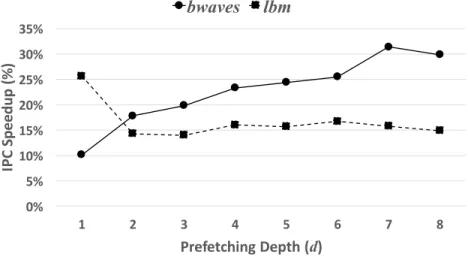
Increasing prefetch depth is one way to speculate deeper. For example, if a processor has a simple next-line prefetcher that prefetches a (+1) delta ahead of the current demand cache block, we can build a more aggressive nextdline prefetcher that prefetchesd∗(+1) deltas ahead of the current miss (e.g.,+11, +12, ..., +1d). To generalize, a stride prefetcher
whose delta distance (stride) is N and whose prefetching depth is d can be represented by (N1, N2, ...,Nd). Naively increasing the prefetching depth, however, does not always
improve overall system performance, because often the predicted reference stream and the actual reference stream will eventually diverge. Figure I.2 shows the effect of prefetching depth on two different SPEC CPU 2006 benchmarks using a simple Program Counter (PC) based delta prefetcher [13]. As the prefetching depth d grows, the PC delta prefetcher brings more cache blocks that are dN distance away from base address. In this figure,
0% 5% 10% 15% 20% 25% 30% 35% 1 2 3 4 5 6 7 8 IP C Sp ee du p (% ) Prefetching Depth (d)
bwaves
lbm
Figure I.2: Impact of prefetching depth on a simple PC-based delta prefetcher
is a predictable series of (+1) or (-1) deltas, up to seven steps ahead of the current demand access. After that point, the performance benefit drops as further speculative requests serve only to consume memory bandwidth, without contributing additional cache hits. On the other hand,lbmsuffers from performance degradation as the prefetching depth grows. Sincelbmhas a variety of memory access patterns [11], deeper prefetching with a simple delta predictor wastes bandwidth, and pollutes the cache. While deeper speculation is useful forbwaves,lbmshows the greatest benefit from a speculative depth of onlyd= 1. Thus, as Figure I.2 illustrates, achieving high performance across many workloads requires adapting speculation relative to its prefetching accuracy. The adaptive controll mechanism is one of main motivations for path confidence-based prefetching and more details will be discussed in the later section.
I.1.2 Cache Replacement Policy
The Last-Level Cache (LLC) is a large on-chip structure with significant power con-sumption. In many cases, however, most of the LLC blocks are replaced without any reuse
during their life time in the cache. Khan et al. [14] showed that, on average, 86% of cache blocks in a 2MB LLC is dead and do not exhibit further reuse behavior. To improve the efficiency of LLC, advanced replacement algorithms [14, 15, 16, 17, 18] have been inten-sively discussed over the last ten years and showed superior performance than traditional LRU-managed LLC.
Still, without coordination between cache management and speculation techniques at different levels in the cache hierarchy, schemes such as data prefetching and replace-ment often work at cross-purposes. Previous work suggests advanced prefetching algo-rithms [19, 6, 20, 10, 21, 22, 23, 24] to reduce the gap between processor speed and memory latency. Most data prefetchers are trained by private L1 or L2 cache accesses to make timely prefetches far ahead of demand requests. Often, however, the appro-priate placement within the shared LLC for these prefetched blocks is unclear. A so-phisticated cache replacement policy is the right tool to solve this problem. Previous work [15, 16, 25, 26, 14, 17, 18, 27] shows a substantial gain can be achieved by placing blocks predicted to be dead [26] at the vulnerable position in the LRU stack. However, with data prefetches, the incremental benefit of replacement policy often becomes marginal or sometimes even negative [28, 29, 30].
In particular, replacement policies which use the Program Counter (PC) of missing load to predict reuse [25, 26, 14, 17, 27] experience substantial interference from prefetched blocks, which by definition do not carry demand fetch load PC values. Figure I.3 com-pares the IPC speedup of a top performing, PC-based replacement policy (SHiP [17]), and a recently proposed non-PC-based replacement policy (EAF [18]) when a high per-formance data prefetcher, DA-AMPM [29] is being used. In this figure, the perper-formance is normalized to DA-AMPM with the baseline LRU replacement policy. Although SHiP typically shows better performance than EAF when running without prefetching, we see that here EAF outperforms SHiP across most applications. This is largely because PCs are
1.025 1.040 0.9 1.0 1.1 1.2 1.3 1.4 1.5 1.6
IPC Speedup over DA
-AMPM + LRU
DA-AMPM + SHIP DA-AMPM + EAF
Figure I.3: Performance of SHiP [17] and EAF [18] under data prefetcher
simply not available for prefetches, forcing SHiP to use a static prediction (always dead or always live) for prefetched blocks. On the other hand, EAF tracks the physical addresses of recently evicted blocks in a bloom filter to make a dead block prediction. When there is a cache miss and the missing block is found in the victim filter, that block is inserted with higher priority. The baseline assumption is that if a block with high reuse is prematurely evicted from the cache, it will be accessed soon after eviction [18]. Thus, EAF can make a per-block-based prediction for both demand and prefetch that yields higher performance than SHiP without relying on PCs.
To alleviate the harmful interference between prefetching and replacement policy, sev-eral works [28, 29, 30] propose to selectively prioritize the prefetch request over demand request or vice versa. While these approaches show some gains, there remains little inte-gration between the techniques, leaving critical program behavior information known by the prefetcher out of the replacement/placement decision, thus leaving performance on the table. In Chapter III, we will discuss how a holistic cache management can reduce the prefetching interference and improve the overall efficiency of multi-level caches.
I.1.3 Memory Management in Virtualized System
With the advent of Virtual Private Server (VPS) vendors, such as Amazon Elastic Compute Cloud (EC2) and Rackspace Cloud, cloud computing has become a large and growing component of the computing market. To provide adequate service for clients, vendors often utilize hardware virtualization due to its strong server consolidation and high scalability characteristics. In virtualized environments, a hypervisor or virtual ma-chine monitor (VMM) is responsible for managing virtualized hardware resources and the execution of guest virtual machines (VMs). The main memory size specified by each guest VM running on a given host, however, can quickly add up to impose a high cost in required host machine physical memory. Despite this high cost, VMs rarely fully uti-lize their entire virtuauti-lized main memory space, thus wasting this valuable resource. To deal with under-utilization of physical memory in virtualized environments, hypervisor memory-management techniques which enable physical memory overcommitment have been developed, however they often trade lower system memory requirement for a signif-icant performance cost, or do not effectively respond and adapt to dynamically changing memory pressure. The goal of Chapter IV is to reduce the performance overheads of hy-pervisor memory management techniques by proposing a Memory Pressure Aware (MPA) ballooning which dramatically improves responsiveness and adaptivity of virtualized sys-tem.
I.2 Dissertation Statement
In this dissertation, we introduce three reference-driven speculation mechanisms that can precisely predict the future memory usage. First, we propose a novel confidence-based data prefetcher. This prefetcher leverages confidence value to control the aggressiveness of data prefetching and extends its coverage by selecting a prefetching path with the highest confidence. Each prefetching path is represented by a series of signatures which is a
compressed form of past memory references. Second, we integrate both data prefetching and LLC replacement algorithms into one unified solution. Finally, we propose memory pressure aware ballooning that dynamically adapts to the global memory pressure state and reallocates memory resource in virtualized environments. Each prediction mechanism is designed to have minimal hardware or software complexity so that it can be easily implemented with the existing infrastructure.
I.3 Dissertation Organization
In the remaining chapters, each speculation mechanism is first introduced with the main research motivations and then followed by detailed implementation. Chapter II dis-cusses the path confidence-based data prefetcher. Chapter III extends the concept of path confidence and proposes a holistic multi-level cache management technique. Chapter IV introduces the global memory pressure of virtualized system and shows how the overall system memory can be efficiently managed across multiple virtual machines. Proposed designs are evaluated with a set of thorough experiments. In Chapter II and III, we use a microarchitectural simulator to demonstrate the performance impact of proposed tech-niques. In Chapter IV, we directly modify the Linux kernel and Xen Hypervisor [31] to measure the real time performance. Finally, Chapter V concludes this dissertation.
CHAPTER II
CONFIDENCE-BASED MEMORY ACCESS PREDICTION∗
This chapter presents a confidence-based prefetching mechanism that alleviates the impact of “Memory Wall”. We first introduce a background of data prefetching. Then, a detailed implementation is described in the design section. The evaluation section com-pares our confidence-based prefetcher with other state-of-the-art data prefetchers.
II.1 Introduction
To address both prefetching coverage and accuracy, prior work has adopted lookahead mechanisms [11, 21, 32]. These studies, however, suffer from high hardware complex-ity [21, 32], or do not implement adaptive throttling [11]. For example, B-Fetch [21] and Runahead [32] require either deep hooks into the core microarchitecture or a whole sec-ondary core to prefetch accurately, making them impractical to implement in the lower levels of the cache. Meanwhile, recent techniques, such as VLDP [11], showed that a lookahead path can be built by memory access pattern without relying on core pipeline in-formation. This algorithm, however, prefetches a static depth ahead of the demand fetch, without considering the prefetching confidence [11], either leading to missed opportunities when the accuracy is high or to inaccuracy in the face of divergent memory access patterns. Moreover, most hardware prefetchers work in the physical address space [6, 11, 12, 13], where the mapping between virtual and physical memory is not known. As a result, it is often difficult to predict patterns across 4KB physical page boundaries.
In this chapter, we propose a simple but powerful path confidence-based lookahead prefetcher, the Signature Path Prefetcher (SPP). The contributions of this work are:
∗Reprinted with permission from "Path Confidence based Lookahead Prefetching" by J. Kim, S. H.
Pugsley, P. V. Gratz, A. L. Narasimha Reddy, C. Wilkerson, and Z. Chishti 2016. Proceedings of the 2016 49th International Symposium on Microarchitecture, Copyright 2016 by IEEE
• We introduce a signature mechanism that stores memory access patterns in a com-pressed form and initiates the lookahead prefetching process. Up to four small deltas can be compressed in this 12-bit signature without aliasing. By correlating the sig-nature with future likely delta patterns, SPP learns both simple and complicated memory access patterns quickly and accurately. The signature can be also used to detect the locality between two physical pages, and continue the same prefetching pattern off the end of one physical page and onto the next.
• We develop a path confidence-based prefetch throttling mechanism. As lookahead prefetching goes deeper, a series of signatures builds a signature path. Each sig-nature path has a different confidence value based on its previous delta history, prefetching accuracy, and the depth of prefetching. The path confidence value is used to throttle prefetching depth dynamically in order to balance prefetch coverage with accuracy.
• Unlike prior lookahead based prefetchers [21, 32], SPP does not require deep hooks into the core microarchitecture and is purely based on the physical memory access stream.
We evaluate SPP with a combination of SPEC CPU 2006 and commercial workloads and find it achieves an average 27.2% performance improvement compared to a baseline without prefetching. Moreover, SPP outperforms recent, best of class, lookahead and non-lookahead prefetchers [10, 11, 12], including the winner of the most recent data prefetch-ing competition, by 6.4% on average. The remainprefetch-ing sections are organized as follows. Section II.2 discusses the motivation for path confidence based prefetching. Section IV.3 describes the detailed hardware implementation of SPP. A detailed performance evaluation is presented in Section III.4.
II.2 Motivation and Prior Work
In this section, we examine previously proposed prefetchers with an eye toward im-provement. In particular, we note that complex data access patterns are difficult to predict without the use of recursive lookahead mechanisms, while existing lookahead-based pre-fetchers do not consider path confidence, instead prefetching to an arbitrary degree. II.2.1 Speculating complex memory access patterns
An optimal prefetching algorithm should cover a wide range of memory access pat-terns. Simple stride prefetching techniques only detect sequences of addresses that differ by a constant value and fail to capture diverse delta patterns [33]. For example, Figure II.1 shows two examples of complex memory access patterns, taken from GemsFDTD and
mcf, which cannot be captured by a simple prefetcher. Though both show complicated patterns, GemsFDTD(Figure II.1a) has a repeating sequence of strides (+7, -6, +12, +6, -5, -6, -6), that should be predictable assuming the prefetcher can store a long delta his-tory. Concatenating such a long sequence in a simple pattern table, however, could result in huge storage overhead.
On the other hand, Figure II.1b shows thatmcf has a random (though biased) access pattern that is difficult to predict. In this particular case, it is better to use a simple next-line
7 -6 12 6 -5 -6 -6 1 -3 7 -6 12 6 -5 -6 -6 -12 -8 -4 0 4 8 12 De lta Pa tt er n Execution Time
(a)GemsFDTD: Complex but predictable pattern
-2-1 -10 1 13 1 11 1 -2 -1 -17 1 -2 27 1 11 1-31-2 -31 -2 13 1 -2 11 1 -7 1 -2 -1 -32 -24 -16 -8 0 8 16 24 32 De lta Pa tt er n Execution Time
(b)mcf: Complex and random patterns
prefetcher, because (+1) is the most commonly seen delta pattern. Offset based prefetchers such as the Best Offset prefetcher [12] and the Sandbox prefetcher [22] evaluate multiple offsets at run-time and issue prefetches with an offset that maximizes likelihood of use. These offset prefetchers do not, however, account for temporal ordering between delta patterns, and suffer from low accuracy on complex, yet predictable address patterns. In addition, if there are multiple offsets that are commonly observed during program execu-tion, offset prefetchers take longer to train or fail to select the optimal offset. Lookahead prefetchers [11, 21] efficiently encode the relationship between accesses to yield future predictions, enabling further speculative lookahead accesses.
II.2.2 Adapting Aggressiveness
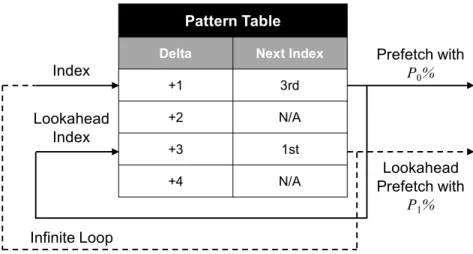
Lookahead prefetchers learn patterns by collecting histories of observed data access patterns, and correlating these with the next expected delta in the pattern. Figure II.2 shows an example lookahead prefetcher that recursively refers to a pattern table to generate future prefetches. In this example, the prefetcher indexes into the pattern table to find the next predicted delta for prefetching. Once this prefetch is issued, the prefetcher recursively uses that prediction to again index into the pattern table and generate further predictions. This recursion allows lookahead prefetchers [11, 21] to prefetch far ahead of the current program execution, and generate timely prefetches for as long as their predictions remain accurate.
In principle, the lookahead process can be repeated as long as the predicted pattern is found in the pattern table. As shown in Figure II.2, delta (+1) predicts the 3rd index (+3), and delta (+3) predicts the 1st index (+1), forming a loop. While the loop here may persist for many iterations, it is unlikely to persist forever, thus the true desired prefetching depth must be limited. To avoid over-prefetching, existing lookahead prefetchers [21, 11] glob-ally and staticglob-ally limit the depth to which lookahead is pursued ahead of the current
de-Pattern Table
Delta Next Index
+1 3rd
+2 N/A
+3 1st
+4 N/A
Index Prefetch with P0%
Infinite Loop Lookahead Prefetch with P1% Lookahead Index
Figure II.2: A case of lookahead prefetching caused by an infinite loop in the prediction pattern table.
mand access stream. Unfortunately, it is often the case that the ideal prefetch depth varies from application to application, as shown in Figure I.1, and even varies between prefetch streams within the same application. Thus a per-prefetch stream throttling mechanism is critical to adapt prefetch aggressiveness to the stream’s prediction confidence [20].
II.2.3 Prefetching and Page Boundaries
Virtual memory is a vital tool in the operation of modern computers, but it creates unique challenges when designing data prefetchers which work in the lower-levels of the cache. Two addresses which are contiguous in the virtual address space might be separated by great distances in the physical address space. By extension, patterns which are trivially easy to detect in the virtual address space might be nearly impossible to fully detect in the physical address space.
Prefetchers are often located alongside caches where they have no access to address translation hardware, and hence they do not have knowledge of the relationship between physical pages in the virtual address space. Thus, data access patterns which cross physical
page boundaries are difficult to exploit. Physical address prefetchers often try to learn intra-page or global patterns, applying these patterns to new pages that are encountered, or they discover simple patterns, like streams or strides, by considering each new page in a vacuum. This has the effect of either ignoring complex patterns altogether, as in the case of the Best Offset prefetcher [12], or requiring long, per-page, warmup times, as in Access Map Pattern Matching [10] and conventional stream prefetchers. All of these prefetchers must stop prefetching once a page boundary is reached, because it is impossible to know the physical mapping of the next page in the virtual address space. Although challenging to implement, an effective prefetcher should be able to seamlessly continue complex patterns detected in one page as they cross page boundaries, without having re-detect the pattern from scratch in the new page.
II.2.4 Other Prior Prefetchers
Somogyiet al. proposed Spatial Memory Streaming (SMS) [6] which leverages the correlation between memory request instruction addresses (PC) and access patterns spatial near the current memory request. This purely spatial pattern ignores the temporal ordering between future demand accesses. Later efforts extended this approach to detect the tempo-ral order between delta patterns [8, 9]. While these prefetchers achieve good performance, they require megabytes of hardware state storage, which is orders of magnitude more than the other prefetchers considered in this paper.
II.3 Design
To address the deficiencies outlined in Section II.2, we propose the Signature Path Prefetcher (SPP), a novel, low-overhead and accurate lookahead prefetcher.
II.3.1 Design Overview
SPP uses a speculative mechanism we refer to as “lookahead” to increases its prefetch-ing degree and improve timeliness. Once a delta prediction has been made by SPP, and a prefetch request has been issued, the accumulated history used to make the prediction(i.e.,
the signature) is speculatively extended to include the predicted delta, thereby generating a new lookahead signature (the mechanism is discussed in detail in Section II.3.2). This signature can then be used to make a new delta prediction, which leads to producing yet another signature. Thus, we use predicted deltas, with no confirmation of their accuracy, to recursively speculate down a “signature path.” These speculative signatures resem-ble techniques used in branch prediction to deeply speculate beyond unresolved branches. Relying on this mechanism, SPP can continue to speculate much further than the most recently confirmed delta. In fact, with this mechanism in place, the challenge shifts from generating new delta predictions to deciding when to stop.
From the discussion in Section II.2.2 of Figure II.2, we can conclude that lookahead prefetches will tend to be less accurate than initial prefetches. In general, as the number of speculative deltas increases, our confidence in the prefetch requests should decrease as the product of the confidence of each speculative prefetch along the path. To illustrate this, assume the probability of the first delta0 prediction being accurate is p0 and the
probability of the seconddelta1isp1. During speculative lookahead, the prefetch resulting
fromdelta1 has a probability of being accurate ofp0∗p1. This is because the path used
to select delta1 , contains delta0 which itself is only accurate with probability p0. In fact, the probability that the delta predicted at any lookahead depth of d will produce
a useful prefetch is a product of the probabilities of all prior speculative deltas (Q
p =
p0∗p1∗p2∗...∗pd). We label this path probabilityPdas the product of the probability of
all constituent deltas to depthd such thatPd = Q
p. Further, the probability of any path of depth d can be expressed as a function of the probability of the most recent delta and the probability of the previous path, as shown in Equation II.1:
Pd=pd·Pd−1 (II.1)
Pd can be compared against a given confidence threshold to adaptively determine when prefetching for this particular lookahead stream should be stopped. Further, this confi-dence,Pd, can also be used to determine which cache level to insert prefetched lines, with
more accurate/confident prefetches sent to a higher cache level and less accurate/confident prefetches sent to a lower cache level.
To gracefully handle the transition between physical pages, SPP shares learning across page boundaries. As discussed in Section II.2.3, SPP operates in the physical address space, without any access to address translation. Thus, the spatial relationships between physical pages are largely unknown and assumed to be random. Despite this, SPP lever-ages learning from one physical page to make timely predictions in other plever-ages. SPP does this in two ways, first, while delta history signatures are maintained on a per-physical page basis, as will be described in Section II.3.2, those signatures index into a global table for predicting deltas, which is shared by all pages. Second, as described in Section II.3.4, when the first demand access is made to a new physical page, the delta signature patterns from a previous physical page whose delta predictions crossed a page boundary can be inherited and used to bootstrap predictions in this new page. This gives SPP the advan-tage of not requiring long, per-page warmup periods to start prefetching complex patterns, which leads to higher prefetch coverage.
L1 Cache (32KB, LRU) L2 Cache (256KB, LRU) L3 Cache (2MB, LRU) Off-Chip DRAM Trained by L2 access Prefetch (Insert into L2 or LLC) Update filter SPP Module (5.37KB) Signature Table (ST) Pattern Table (PT) Global History Register
(GHR) Prefetch Filter (PF) Demand Prefetch Core Processor
Figure II.3: Overall SPP architecture
The high level design of the SPP engine is illustrated in Figure II.3. The SPP module consists of three main structures (Signature Table, Pattern Table, and Prefetch Filter) and a small Global History Register (GHR), which is used for cross-page boundary bootstrapped learning. SPP is trained by L2 cache accesses, and can fill prefetch requests into either the L2 or LLC (depending on the confidence of the predicted prefetch). The Signature Table (ST) tracks the 256 most recently used pages, and stores the history of previously seen delta access patterns in each page as a compressed 12-bit signature. The Pattern Table (PT) is indexed by the history signatures generated by the ST and stores predicted delta patterns. The PT also estimates the path confidence that a given delta pattern will yield a useful prefetch. If the delta generated by the PT is found to have sufficient confidence (above a configured threshold), then it is passed as a prefetch candidate to the Prefetch Filter (PF), which checks for redundant prefetches. If the predicted delta crosses a 4KB physical page boundary, SPP does not issue the prefetch but instead redirects the request to the GHR for page boundary learning. In the remainder of this section we describe each stage of the SPP in detail.
II.3.2 Learning Memory Access Patterns
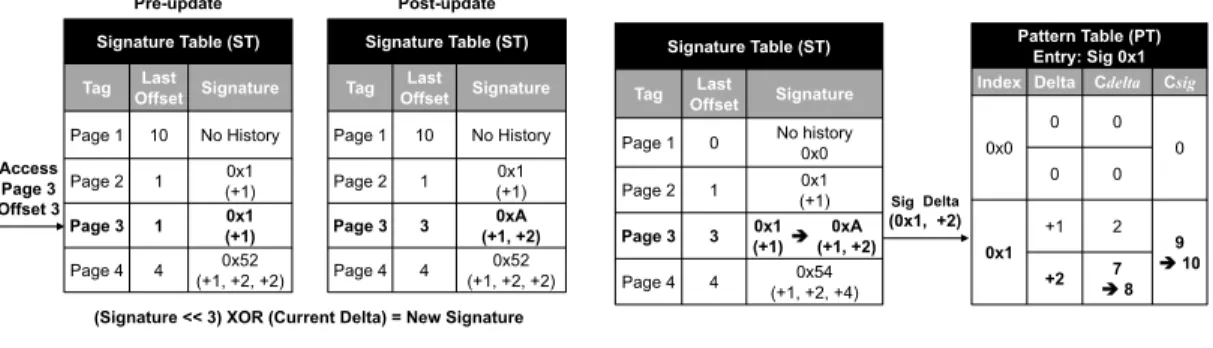
The ST, shown in Figure III.6, is designed to capture memory access patterns within 4KB physical pages, and to compress the previous deltas in that page into a 12-bit history signature. The ST tracks the 256 most recently accessed pages, and stores the last block accessed in each of those pages in order to calculate the delta signature of the current memory access, which is then used to access and update the PT. Whenever there is an L2 cache access, its physical address is passed to the ST to find a matching entry for the corresponding physical page. Figure III.6 shows an example of accessing the ST with a physical page number of 3 and block offset 3 from the beginning of the page. In this case, the ST finds a matching entry for this page and is able to read a stored signature 0x1. This signature is a compressed representation of a previous access pattern to that page, which was generated via a series of XORs and shifts as shown in Equation II.2. In this case, the signature 0x1 represents a single previous delta access to Page 3, which was (+1).
New Signature
=(Old Signature <<3-Bit) XOR (Delta) (II.2)
Since the ST stores the last block offset 1 accessed in Page 3, we know that the current delta in Page 3 is (3 - 1) = (+2). This delta is non-speculative, because it is based on a demand request to the L2. Therefore, we can infer that a given set of accesses (signature 0x1 in this instance) will lead to a delta of (+2). Figure II.4b shows how this correlation is used to update the delta pattern in the PT.
The probability of each delta occurring is approximated using a per-delta confidence valueCd, which is derived from counters stored in the PT. Since a matching delta (+2) that corresponds to 0x1 is found in the PT, the corresponding Cdeltacounter increases by one.
Signature Table (ST)
Tag OffsetLast Signature
Page 1 10 No History Page 2 1 0x1 (+1) Page 3 1 0x1 (+1) Page 4 4 (+1, +2, +2)0x52 Signature Table (ST)
Tag OffsetLast Signature
Page 1 10 No History Page 2 1 0x1 (+1) Page 3 3 (+1, +2)0xA Page 4 4 (+1, +2, +2)0x52 Access Page 3 Offset 3
(Signature << 3) XOR (Current Delta) = New Signature
Pre-update Post-update
(a) Update signature
Signature Table (ST) Tag OffsetLast Signature
Page 1 0 No history0x0 Page 2 1 (+1)0x1 Page 3 3 (+1)0x1 è(+1, +2)0xA Page 4 4 (+1, +2, +4)0x54 Pattern Table (PT) Entry: Sig 0x1 Index Delta Cdelta Csig
0x0 0 0 0 0 0 0x1 +1 2 9 è10 +2 è78 (0x1, +2) Sig Delta
(b) Update delta pattern
Figure II.4: SPP table update operations.
In order to estimate the prefetch accuracy probability for each delta, we also maintain an separate counter Csig, which tracks the total occurrences of the signature itself. If either
Cdelta orCsig saturates, all counters associated with that signature are right shifted by 1.
In doing so, SPP is able to continue updating its counters with the most recent information without ever completely losing all previously collected history. If the PT contains no matching delta, we simply replace the existing delta with the lowestCdeltavalue.
Unlike the ST, whose entries correspond to individual physical pages, each PT entry is shared globally by all pages. If Page A and Page B, for example, share the same access pattern, they will generate the same signature, which indexes to the same entry in the PT, and updates the same delta pattern in the PT. Sharing patterns between pages in the PT minimizes SPP training time as well as the number of entries needed to store predictions. Each entry in the PT can hold up to four different deltas so that multiple different deltas can be prefetched by a single signature. Each of the deltas in a PT entry can be prefetched if its corresponding probability (Cd =Cdelta/Csig) is above the given prefetching threshold
TP.
After updating the PT, the ST is also updated with a new signature based on the current delta (+2). Equation II.2 shows how the SPP generates a new history signature. The old
Pattern Table (PT) (𝑻𝑷= 0.25)
Index Delta Cdelta Csig
0xA +1 2 10 +2 8 0xB -1 2 5 +1 3 (0xA)Sig 𝑷𝒅= 𝜶 ⋅ 𝑷𝒅'𝟏⋅ 𝑪𝒅 𝑷𝟎= 𝑪𝒅𝒆𝒍𝒕𝒂 / 𝑪𝒔𝒊𝒈 𝑷𝟎= 𝟎.𝟖 𝑷𝟎≥ 𝑻𝑷 Prefetch (BaseCL+2) (0xA << 3) XOR (+2) = 0x52 Lookahead Signature
(a) Prefetch (Lookahead depthd=0)
Pattern Table (PT) (𝑻𝑷= 0.25)
Index Delta Cdelta Csig
0x52 +2 3 8 +3 5 0x53 -2 1 2 +2 1 (0x52)Sig (0x52 << 3) XOR (+3) = 0x293 Lookahead Signature 𝑷𝒅= 𝜶 ⋅ 𝑪𝒅⋅ 𝑷𝒅(𝟏 𝑷𝟏= 𝟎.𝟗 ⋅ (𝟓/𝟖) ⋅ 𝑷𝟎 𝑷𝟎= 𝟎.𝟒𝟓 𝑷𝟏≥ 𝑻𝑷 Prefetch (BaseCL+2 +3)
(b) Lookahead prefetch (Lookahead depthd=1)
Figure II.5: Path confidence-based lookahead prefetching.
signature 0x1 is left-shifted 3-bits and XORed with the current delta (+2). In this way, a 12-bit signature can represent the last four memory accesses in Page 3. Note that we refer to this signature as being “compressed” because deltas greater than 7 have the potential to overlap and cause aliasing with existing history. At this point, the new signature (0x1<<3) XOR (+2) = 0xA represents the current access pattern, (+1,+2), in Page 3. Assuming 4KB pages with 64B cache lines, all possible deltas fall in the range of (-63) to (+63). We use a 7-bit sign+magnitude representation for both positive and negative deltas. Thus, negative and positive deltas produce different signatures, pointing to different entries in the pattern table, and ultimately different prefetch targets.
II.3.3 Path Confidence-based Prefetching
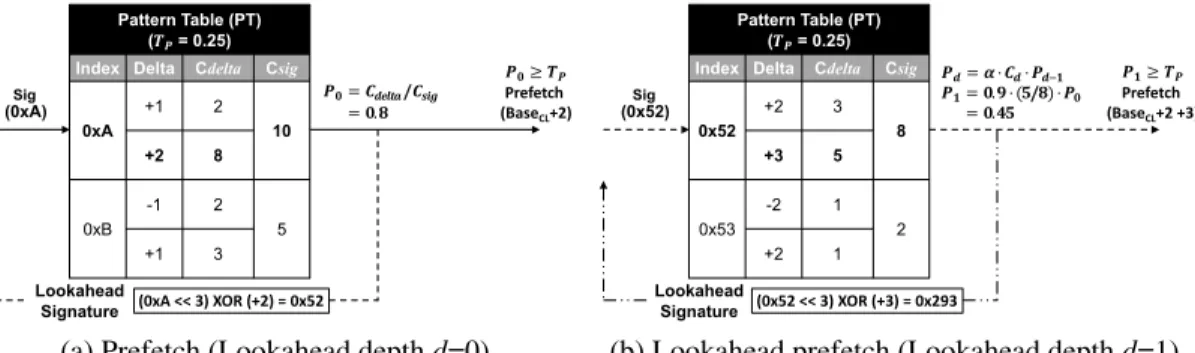
After updating the ST, as in Figure III.6, SPP accesses the PT so that it can predict the next delta following signature 0xA. As shown in Figure II.5a, the path confidencePd
is calculated for deltas associated with signature 0xA. The initial path confidence P0 is simply set by (Cdelta/ Csig) since there is no prior path confidence value. In this example,
(+2) delta has P0 = 0.8 which is greater than the prefetching thresholdTP. Therefore,
the PT adds the delta (+2) to the current cache line’s base address and issues a prefetch request.
In addition, the PT initiates the lookahead process by building a speculativelookahead
signature. As shown in Figure II.5a, the lookahead signature 0x52 is generated from 0xA
and the predicted delta (+2) using Equation II.2. While there could be multiple candidates for prefetching, SPP only generates a single lookahead signature, choosing the candidate with the highest confidence. The lookahead signature is used to index the PT again so that SPP can search for further prefetch and lookahead candidates down the signature path. If the lookahead signature 0x52 finds more prefetch candidates in the PT (Figure II.5b), the process will be repeated and prefetch requests will be issued. The lookahead mechanism is used recursively until the signature path confidencePdfalls below the prefetching
thresh-old TP. Note, a separate, greater confidence threshold Tf determines which level of the
cache a given prefetch will be fill into, either the L2 ifPdis greater thanTf or the LLC if Pdis less thanTf.
SPP also uses a global accuracy scaling factorαbased on the observed global prefetch-ing accuracy to further throttle down or increase the aggressiveness of the lookahead pro-cess. Thus, Equation II.1 is modified to includeαaccording to Equation II.3:
Pd =α·Cd·Pd−1 (α <1) (II.3)
If the prefetching accuracy is generally high across all prefetches,αwill decrease the path confidencePd very slowly, allowing deeper lookahead prefetching. On the other hand, if
global prefetching accuracy is low, α will quickly throttle down lookahead prefetching. The prefetching accuracy is tracked by the PF described in section II.3.5. The global α
and the local, per-deltaCdwork together to provide a throttling mechanism which globally
adapts to the general prefetching confidence of a given program phase, while simultane-ously favoring some signature paths over others based on their relative confidence.
calcula-tions in the context of floating point numbers. However, in a real implementation (and in our simulator), we use 7-bit fixed point numbers to represent path confidence val-ues between 0∼100, and perform multiplication and division on those fixed point num-bers. In addition, sinceCdelta andCsig are 4-bit saturating counters, we can use a simple
16x16=256 entry lookup table that stores all possible division results, which allows us to completely remove the expensive divider modules. Moreover, the extra computational latency can be hidden, because SPP can calculate the path confidence in the background while the L2 cache is waiting for the DRAM to service demand misses.
In addition to throttling whenPdfalls below the prefetch thresholdTp, SPP also stops
prefetching if there are not enough L2 read queue resources. Reserving L2 read queue entries is desirable because even accurate, useful prefetches can take resources away from even more performance-critical demand misses from the L1 cache. Therefore, SPP does not issue prefetches when the number of empty L2 read queue entry becomes less than the number of L1 MSHRs. To summarize, SPP stops prefetching if the prefetcher observes one of following conditions:
1. Low path confidencePd.
2. Too few L2 read queue resources.
II.3.4 Page Boundary Learning
One of the challenges for history-based prefetchers like SPP is the loss of history in-formation that occurs during transitions to new physical pages. Pages that are adjacent in the virtual address space may not be adjacent in the physical address space. As a result, patterns that are very easy to learn and follow in the virtual address space may be very hard to detect and predict when they are broken up by a physical page transition. Previously proposed history-based techniques [6, 11] address this by making predictions using the
63 62 61 60 59 58 +3 by 0x52 Pd= 0.45 Last Offset = 62 3 2 1 0
Global History Register (GHR)
Signature Pd OffsetLast Delta
0x52 0.45 62 +3
0x1CF 0.40 5 -17
Store Prefetch Request in GHR
Page A Boundary Page A +4 +3 -5
(a) GHR stores prefetch request that crosses physical page boundary
62 + 3 = 65 65 – 64 = Offset 1 Offset Match! (0x52 << 3) XOR (+3) = 0x293 3 2 1 0
Global History Register (GHR)
Signature Pd OffsetLast Delta 0x52 0.45 62 +3 0x1CF 0.40 5 -17
First Access to Page B Offset 1 (No Signature) èSearch GHR Prefetch with 0x293 1 2 3 Page B
(b) Immediately start prefetching for new page
Figure II.6: Learning delta patterns across page boundaries.
first offset in a page, or with very short delta histories. Although these predictions may increase coverage, they do so at the expense of accuracy because they are made with little or no information about what happened in the previously accessed page.
SPP addresses this problem with a novel mechanism that allows histories to be main-tained and tracked across physical page transitions. It does this by augmenting the per-page ST with a global history that is updated when the prefetcher makes a prediction off the end of a page, and is checked against when accessing new pages for the first time.
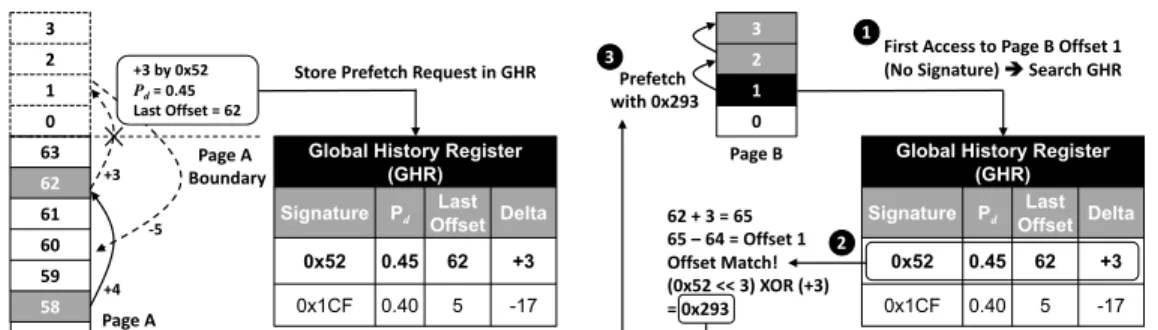
Figure II.6 shows how SPP connects a signature path across physical page boundaries without the need to relearn any delta history patterns, or do any other warmup in the new page. As shown in Figure II.6a, when there is a prefetch request that goes beyond the current Page A, a conventional streaming prefetcher must stop prefetching, because it is impossible for the prefetcher to predict the next physical page number. However, this boundary-crossing prediction can still be useful when the next page is accessed for the first time, and we find that the page offset of that first access matches the out-of-bounds offset previously predicted by SPP.
In order to track this behavior, the boundary crossing prediction is stored in a small 8-entry GHR. The GHR stores the current signature, path confidence, last offset, and delta
used for the out-of-page prefetch request, which is everything necessary to bootstrap SPP prefetching in a new page. If we access a new page that is not currently tracked (i.e.,a miss in the ST), SPP searches for a GHR entry whose last offset and delta match the current offset value in the new page. Figure II.6b shows that Page B is accessed with an initial offset of 1. SPP checks if any GHR entry’s last offset and delta value match the current offset of 1. In this case, the signature 0x52 has the last offset and delta whose sum (62 + 3 = 65) matches the offset of 1 in Page B, since there are only 64 64B blocks in 4KB physical page. We can now predict that Page B will produce a delta pattern that is a continuation of the signature 0x52.
Since the pattern predicted by signature 0x52 is now continuing in a new page, we need to connect the signature 0x52 with delta (+3) by generating a new signature. Using the same Equation II.2, we generate a new signature 0x293 for Page B that can begin prefetching immediately, without needing to learn any additional delta history. The new signature 0x293 is entered into the ST for future use by Page B. Thus, SPP does not suffer from long, per-page warmup periods, and it can prefetch complex patterns in new physical pages sooner, resulting in higher prefetch coverage. Unlike the Global History Buffer [34], which records all observed delta patterns, the GHR only stores delta patterns that cross page boundaries. Note that SPP does not stop looking even further ahead for more prefetch candidates after coming to the end of a page and updating the GHR. As shown in Figure II.6a, if the (+3) delta, which lands in Page B, is predicted to be followed by a (-5) delta, which comes back to Page A, then SPP can still exploit this behavior and prefetch an offset of 60 in Page A.
II.3.5 Prefetch Filter
The main objectives of the PF, shown in Figure II.7, are to decrease redundant prefetch requests, and to track prefetching accuracy. The PF is a direct-mapped filter that records
Prefetch Filter (PF) Tag Valid Useful
- 0 0
CLB 1 0
Prefetch Filter (PF) Tag Valid Useful
CLA 1 0 CLB 1 1 Prefetch CLA Pre-update Post-update Demand CLB
Figure II.7: Prefetching Filter.
prefetched cache lines. SPP always checks the PF first, before it issues prefetches. If the PF already contains a cache line, this means that line has already been prefetched, and SPP drops the redundant prefetch request. Entries in the filter get cleared by resetting aValid
bit when the corresponding cache line is evicted from the L2 cache.
Due to collisions, a filter entry may already be occupied by another prefetched cache line. In this case, SPP simply replaces the old cache line, stores the current prefetch request in the filter, and issues the current prefetch. Note that this simple replacement policy might erase cache lines from the filter before they get evicted from the L2 cache, which could lead to re-prefetching, but we find in practice that this happens very infrequently.
By adding aUseful bit to each filter entry, the PF can also approximate prefetching accuracy. SPP has two global counters, one which tracks the total number of prefetch requests (Ctotal), and the other which tracks the number of useful prefetches (Cusef ul).
The Ctotal counter increases whenever SPP issues a prefetch that is not dropped by the
filter. Useful prefetches are detected by actual L2 cache demand requests hitting in the PF, which increments the Cusef ul counter. To avoid increasing Cusef ul more than once
per useful prefetched line, we set a used bit in the PF entry which keeps it from being double counted. The global prefetching accuracy tracked by this filter is used for α in Equation II.3 to throttle the path confidence value.
II.4 Evaluation
In this section, we evaluate the SPP prefetch engine. We first present the evaluation methodology, followed by single core and multi-core performance. Finally, we present a sensitivity study of SPP’s design parameters.
II.4.1 Methodology
We evaluate SPP using the ChampSim simulator, which is an updated version of the simulation infrastructure used in the 2nd Data Prefetching Championship (DPC-2) [35]. We model 1-4 out-of-order cores, whose parameters can be found in Table II.1. ChampSim is a trace-based simulator, and we collect SimPoint [36] traces from 18 memory intensive SPEC CPU2006 [37] applications. We also collect single thread traces from 3 server workloads (Data Caching, Graph Analytics, SAT Solver) from CloudSuite [38]. Since our SimPoint methodology does not work with the server workloads, we instead collect the server workload traces after fast-forwarding at least 30B instructions to pass through the benchmark’s initialization phase. For performance evaluation, we warm up each core for 200M instructions and collect results over an additional 1B instructions.
Single core simulations use a single DRAM channel. In multi-core simulations, all cores share a single L3 cache and main memory system, with two DRAM channels. In-struction caching effects are not modeled in this simulation infrastructure. In ChampSim, all prefetching actions are initiated by an L2 access, but prefetches can be directed to fill in either the L2 or the L3 cache. Our simulation infrastructure uses a 4KB page size when mapping virtual to physical addresses. In ChampSim, virtual to physical page mappings are arbitrarily randomized. All of the prefetchers we evaluate in this work were designed to operate strictly in the physical address space with no knowledge of the relationship between physical and virtual address spaces.
algo-Core Parameters
1-4 Cores, 3.2 GHz 256 entry ROB, 4-wide
64 entry scheduler 64 entry load buffer
Private L1 Dcache 32KB, 8-way, 4 cycles
8 MSHRs, LRU
Private L2 Cache 256KB, 8-way, 8 cycles
16 MSHRs, LRU, Non-inclusive
Shared L3 (LLC) 2MB/core, 16-way, 12 cycles,
LRU, Non-inclusive Main Memory
1-2 64-bit channels 2 ranks/channel, 8 banks/rank
1600 MT/s
Table II.1: Simulator parameters.
rithms: the Variable Length Delta Prefetcher (VLDP) [11], the Best Offset Prefetcher (BOP) [12], and the DRAM-Aware Access Map Pattern Matching (DA-AMPM) [39] prefetcher†. We use the original code for each of these prefetchers submitted to DPC-2. In each case, their design parameters have been re-tuned to attain their highest performance in ChampSim running these traces. SPP does not use any feature of ChampSim that was not also available to the designers of the other evaluated prefetchers. SPP’s threshold con-figurations were empirically derived. The prefetching threshold TP = 0.25 and fill level
thresholdTF = 0.9 were found to provide good performance improvement and accuracy, and they are used throughout these results except where otherwise noted.
II.4.2 Single Core Performance
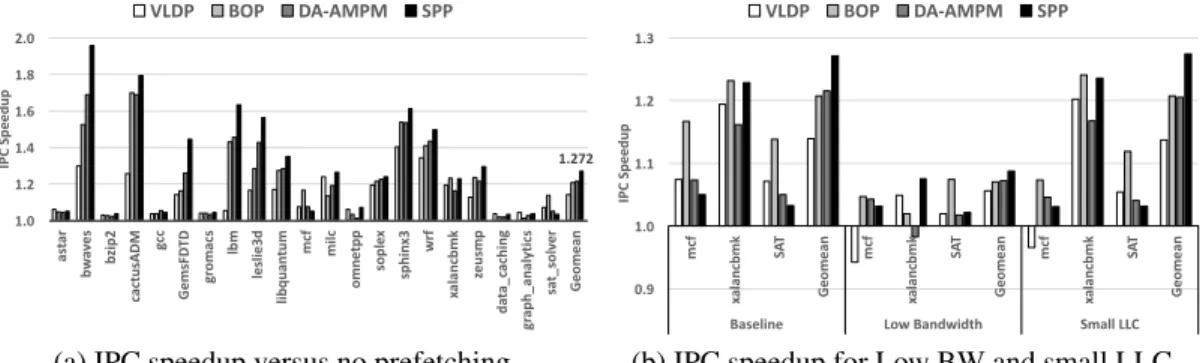
Figure II.8 shows the IPC speedup of all four evaluated prefetchers over a no-prefetching baseline. Overall,SPPoutperforms or matches all other prefetchers on nearly every bench-mark. On average, SPP achieves a 27.2% geometric mean speedup, which is 6.4% and 5.6% more than BOP and DA-AMPM respectively. Also, SPP outperforms VLDP (a recent lookahead prefetcher) by 13.2%. SPPshows particularly significant improvement
1.272 1.0 1.2 1.4 1.6 1.8 2.0 as tar bw av es bz ip 2 ca ct usAD M gcc G em sFD TD gr oma cs lbm le sl ie 3d libquan tum mcf milc om ne tpp so pl ex sp hi nx 3 wrf xa la nc bm k ze usm p da ta_c ac hing gr ap h_a na ly tics sa t_ so lv er Geo mea n IP C S pe ed up VLDP BOP DA-AMPM SPP
(a) IPC speedup versus no prefetching.
0.9 1.0 1.1 1.2 1.3 mcf xa la nc bm k SA T Geo mea n mcf xa la nc bm k SA T Geo mea n mcf xa la nc bm k SA T Geo mea n
Baseline Low Bandwidth Small LLC
IP C S pe ed up VLDP BOP DA-AMPM SPP
(b) IPC speedup for Low BW and small LLC.
Figure II.8: Single-core IPC speedup.
in benchmarks that have complex access patterns. For example, bothGemsFDTDandlbm
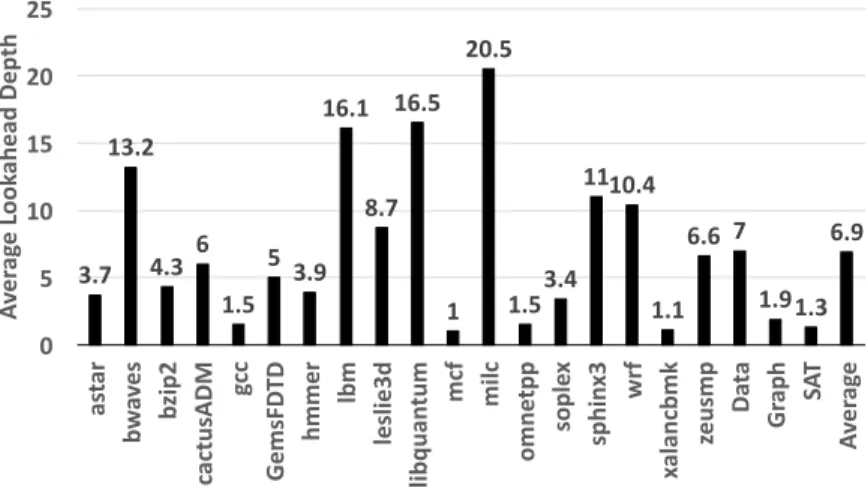
show substantial performance improvement with SPP. Further, SPP shows remarkable performance gains in bwaves, cactusADM, leslie3d,andlibquantum. These applications are highly predictable by SPP, and gain significantly from SPP’s ability to adaptively look ahead very deeply.
As Ferdmanet al.[38] noted in a prior study, data prefetching for large scale workloads is not as effective as prefetching for general purpose workloads. Performance with SPP only improves by 2∼4% for this class of benchmark. However,SPPandVLDPshow the best performance for Data Caching and Graph Analytics, because both prefetchers are able to capture the complex memory access patterns found in those workloads. BOPachieves a 13.8% performance gain in SAT solver by aggressively prefetching on every L2 cache access. The impact of aggressive prefetching by BOP will be discussed further in the next section. We also modeled and compared the performance of the SMS [6] prefetcher originally designed for server workloads, however, the overall performance of SMS on both SPEC and CloudSuite was less than that of DA-AMPM. To simplify the performance analysis, we only include the results from DA-AMPM.
constraints. The baseline configuration used for Figure II.8a has 12.8GB/s of DRAM bandwidth and 2MB LLC. The low bandwidth test is configured with only 3.2GB/s mem-ory bandwidth, and the small LLC configuration has only 512KB of last level cache. Along with a geomean across all benchmarks, Figure II.8b also shows performance for three benchmarks whereSPPhas lower performance than other prefetchers. As shown in Figure II.8b, due to aggressive prefetching, VLDPandBOP show similar or worse per-formance improvement for mcf and xalandbmk under the low bandwidth configuration. Meanwhile, BOPalways shows the best performance formcf andSAT solver regardless of resource constraints. We find that these benchmarks have random access patterns (i.e.,
pointer chasing) that cannot be easily captured in the physical address space. Therefore, offset-based prefetchers [12, 22] work better thanSPPfor these, because they are trained by individual offset occurrence frequency, and do not rely on longer delta patterns repeat-ing. However, the benefit of aggressive offset prefetching without pattern matching can be nullified by resource constraints when multiple workloads fight for limited shared LLC and DRAM bandwidth [40]. The performance degradation of BOP with mcf and SAT
solveris discussed in the multi-core analysis section.
II.4.2.1 Prefetching Coverage and Accuracy
The substantial performance benefit ofSPPversus the other prefetchers shown in Fig-ure II.8 is a direct result of SPP’sprefetching accuracy and coverage. Figure II.9 shows the prefetching coverage for each benchmark. In this figure, each prefetcher is indicated by its first letter (e.g., “V” forVLDP, “D” forDA-AMPM, etc.). Prefetching coverage is measured by the number of useful prefetches divided by the number of cache misses with-out prefetching. Because prefetching can be useful in different ways, we further break down the useful prefetches into four different categories. Usefulrepresents the portion of prefetched cache lines that are filled into the cache before their first demand access,
elimi--100% -80% -60% -40% -20% 0% 20% 40% 60% 80% 100% V B D S V B D S V B D S V B D S V B D S V B D S V B D S V B D S V B D S V B D S V B D S V B D S V B D S V B D S V B D S V B D S V B D S V B D S V B D S V B D S V B D S V B D S astar bwaves bzip2 cactusADM gcc GemsFDTD hmmer lbm leslie3dlibquantum mcf milc omnetpp soplex sphinx3 wrf xalancbmk zeusmp Data Graph SAT Average
Pr ef et ch C ov er ag e ( %)
Useless L2 Useful L2 Late LLC Useful LLC Late
Figure II.9: Prefetching coverage and useless prefetches.
nating all cache miss penalty. On the other hand,Laterepresents the portion of prefetched cache lines that were issued to DRAM but were not filled before their first demand ac-cess. Thus,Lateprefetches have the effect of accelerating the demand fetch compared to a regular cache miss. UsefulandLateare measured for both the L2 cache and the LLC. We also plot the fraction of useless prefetches on the bottom of the figure, showing the effect of over-aggressive, low-confidence prefetching. On average,BOPshows the high-est prefetching coverage, however, it also generates a large number of useless prefetches (mostly to the L2 cache), which consume additional DRAM bandwidth and energy. Al-hough SPP has slightly lower coverage compared to BOP, it has the largest number of L2 Usefulprefetches due to its highly accurate dynamic path confidence-based throttling.
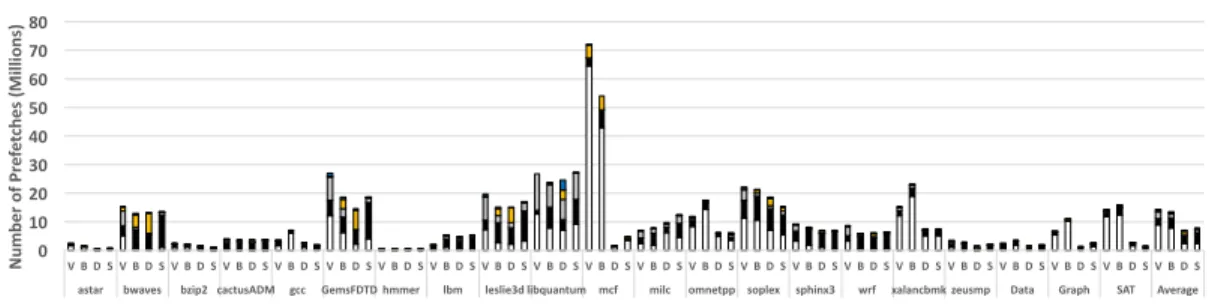
Because prefetching coverage alone does not show the aggressiveness of each prefetcher, we also plot the raw number of prefetch requests in Figure II.10. As discussed in Sec-tion II.4.2 and shown in Figure II.8a,BOPandVLDPoutperformSPPin three workloads
(mcf, xalancbmk andSAT solver) in a single-core environment. Figure II.10 shows that
for these workloads, BOP and VLDP generate a huge number of useless prefetches to achieve this performance advantage, aggressively consuming DRAM bandwidth and LLC capacity. In a single core environment, this over-prefetching does not negatively impact
![Figure I.3: Performance of SHiP [17] and EAF [18] under data prefetcher](https://thumb-us.123doks.com/thumbv2/123dok_us/10174285.2919726/19.918.226.730.148.408/figure-i-performance-ship-eaf-data-prefetcher.webp)