Lehigh University
Lehigh Preserve
Theses and Dissertations
2017
Cybersecurity of Demand Side Management in the
Smart Electricity Grid
Jiyun Yao
Lehigh University
Follow this and additional works at:
https://preserve.lehigh.edu/etd
Part of the
Electrical and Electronics Commons
This Dissertation is brought to you for free and open access by Lehigh Preserve. It has been accepted for inclusion in Theses and Dissertations by an authorized administrator of Lehigh Preserve. For more information, please [email protected].
Recommended Citation
Yao, Jiyun, "Cybersecurity of Demand Side Management in the Smart Electricity Grid" (2017).Theses and Dissertations. 2976.
CYBERSECURITY OF DEMAND SIDE MANAGEMENT IN THE
SMART ELECTRICITY GRID
Privacy Protection, Battery Capacity Sharing and Power Grid under Attack By
Jiyun Yao
A dissertation
Presented to the Graduate and Research Committee of Lehigh University
in Candidacy for the Degree of Doctor of Philosophy
in
Electrical Engineering
c
Copyright by Jiyun Yao, 2017.
Approved and recommended for acceptance as a dissertation in partial fulfillment of the requirements for the degree of Doctor of Philosophy.
Date
Dissertation Director
Accepted Date
Committee Members:
Prof. Parv Venkitasubramaniam (Committee Chair)
Prof. Shalinee Kishore
Prof. Rick S. Blum
Acknowledgements
First and foremost, I would like to thank my advisor Prof. Parv Venkitasubramaniam. He taught me the constant effort for striving for the perfection and the foremost requirement of discipline in research and in life.
I also thank Parv for teaching me courses, named: Information Theory, Fundamentals of Data Networks and Stochastic Control. I would like to emphasize here that these courses proved really helpful for me to understand the literature of stochastic optimization and game theory which turn out to be crucial in proving some optimality results in this work.
I also thank Parv to provide me financial help during my Ph.D. research, therefore, without any thought of financial trouble, I was able to conduct my thesis.
I would like to thank Professor Shalinee Kishore for teaching me course Advanced Topics in Smart Grid Communication, collaborating with me in the SEEDS project on DSM Misuse and for being in my thesis committee. I would like to emphasize here that the course Advanced Topics in Smart Grid Communication proved really helpful for me to understand the literature of Smart Grid which turn out to be crucial in the completion of this work.
I would like to thank Professor Rick S. Blum for teaching me the course Signal De-tection and Estimation, collaborating with me in the SEEDS project on DSM Misuse and for being a member of my thesis committee. I am really thankful for the Signal Detection and Estimation course to Prof. Blum and especially for some interesting discussion in this course.
I would like to thank Professor Lawrence V. Snyder for collaborating with me in the SEEDS project on DSM Misuse and for being a member in my thesis committee. I am really thankful for many insightful discussions and helpful suggestions.
I would like to thank my office mates, Abhishek Mishra, Omid Javidbakht, Ruochi Zhang, Parth Pradhan, Basel Alnajjab for discussions on various research topics and pre-senting interesting papers that motivated me to look further into that direction.
Wang with whom discussions on various topics leads to some very good and interesting contributions in my research.
Contents
Acknowledgements iv
List of Tables viii
List of Figures ix
Abstract 1
1 Introduction 3
1.1 Utility-Privacy Tradeoff of Energy Storage Management . . . 3
1.2 Privacy Aware Management of Distributed End-user Energy Storage Sharing 5 1.3 Quantitative Risk Assessment of Cyber Attack on DSM . . . 8
1.4 Outline of The Proposal . . . 11
2 Related Works 12 2.1 Utility-Privacy Tradeoff of Energy Storage Management . . . 12
2.2 Privacy Aware Management of Distributed End-user Energy Storage Sharing 13 2.3 Quantitative Risk Assessment of Cyber Attack on DSM . . . 13
3 Privacy Analysis of Battery Control Mechanisms in Demand Response 15 3.1 Model . . . 15
3.2 A ρ-POMDP Formulation . . . 19
3.2.1 Privacy as a Stepwise Additive Metric . . . 19
3.2.2 Dynamic Programming . . . 20
3.3 A Greedy Algorithm . . . 23
3.4 A “Revealing State” Approach . . . 24
3.4.1 Analysis of “Battery Centering” Strategy . . . 28
3.4.2 Upper Bound . . . 28
3.5 A Numerical Example . . . 29
4 Privacy Aware Management of Distributed End-user Energy Storage
Sharing 34
4.1 System Model and Stochastic Game Formulation . . . 35
4.1.1 Operational Model . . . 35
4.1.2 The Stochastic Game Model . . . 36
4.2 A Stochastic Signaling Game Formulation . . . 41
4.3 Complete Honest and Maximum Privacy Messaging . . . 43
4.3.1 A Lower Bound On The Weighted Cost Summation: Centralized Battery Management . . . 43
4.3.2 Privacy as a Stepwise Additive Metric . . . 48
4.3.3 A Completely Privacy Preserving Strategy: Message Blind Battery Management . . . 49
4.4 A Non-Stationary Equilibrium Of The Stochastic Game When Privacy Re-quirement Is Relaxed . . . 50
4.4.1 A Credit Based Battery Management Strategy . . . 50
4.4.2 A Special Case: i.i.d. Unforeseeable Demand . . . 54
4.5 Privacy Preserving Battery Management Strategy . . . 54
4.6 Simulation Results . . . 56
4.7 Summary . . . 58
5 Quantitative Risk Assessment of Cyber Attack on DSM 60 5.1 Preliminaries . . . 61
5.1.1 DSM System Model . . . 61
5.1.2 Cyber Attack Model . . . 63
5.2 A Discrete Time Linear System Formulation . . . 65
5.2.1 Electricity Price Impacted By Attack . . . 66
5.2.2 Power Line Load Impacted By Attack . . . 67
5.3 Optimal Direct Load Manipulation Strategy . . . 68
5.4 A Depth First Search Algorithm For Vulnerability Search . . . 71
5.5 Summary . . . 71
6 Conclusion and Future Works 73 6.1 Privacy Protection in DSM . . . 73
6.2 Energy Storage Sharing in DSM . . . 74
6.3 Risk Management and Prevention of DSM Cyber Attack . . . 74
References 76
Biography 81
List of Tables
List of Figures
3.1 A graphical representation of the model . . . 16
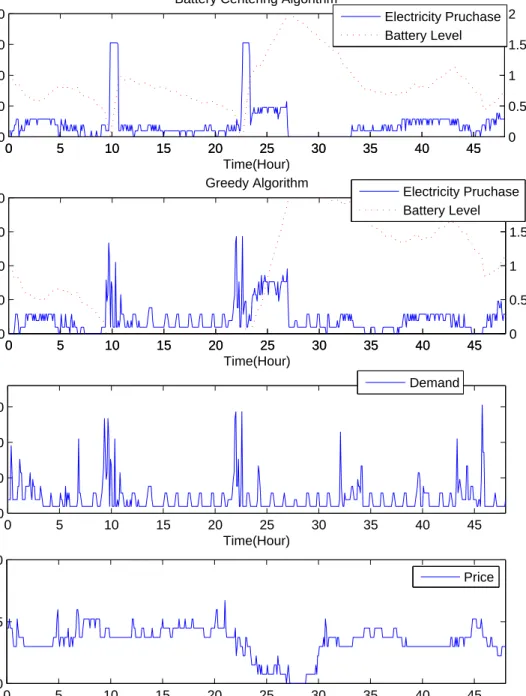
3.2 The system activity with an energy storage of 2 kWh . . . 31
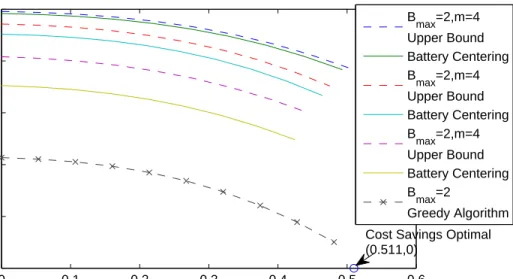
3.3 Privacy-cost savings for a real system . . . 32
3.4 Partial information protection - Cost savings for a real system . . . 33
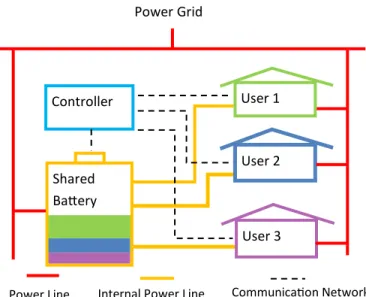
4.1 A battery sharing system with multiple users and the directional energy flow 36 4.2 The decision making process . . . 39
4.3 The optimal centralized battery management strategy structure . . . 45
4.4 Cost savings tradeoff between 2 users with a shared battery under the lim-iting average signaling game formulation . . . 57
4.5 The tradeoff between cost saving and privacy using privacy preserving strate-gies . . . 58
4.6 Convergence rate of RT(µ) under the limiting average signaling game for-mulation . . . 58
5.1 A typical radial residential distribution network . . . 63
Abstract
The presented research investigates two areas in security of Demand Side Management (DSM) systems in Smart Grid including privacy aware energy storage management and risk assessment of cyber attack on DSM communication infrastructure.
The first topic studies the privacy-cost saving tradeoff of an in-home energy storage sys-tem in demand response for an individual user. DSM syssys-tems in the electricity grid, which rely on two way communication between the consumers and utility, require the transmis-sion of instantaneous energy consumption to utilities. Perfect knowledge of a user’s power consumption profile by a utility is a violation of privacy and can be detrimental to the successful implementation of demand response systems. It has been shown that an in-home energy storage system (such as a battery/inverter) that provides a viable means to achieve the cost savings of instantaneous electricity pricing without inconvenience can also be used to hide a user’s power usage pattern. A fundamental tradeoff exists between the costs saved and the degree of privacy achievable, and in this work, the tradeoff achievable by a finite capacity battery assuming a zero tolerance for activity delay is studied using a Markov process model for user’s demands and instantaneous electricity prices. Due to high compu-tational complexity (continuous state-action space) of the stochastic control model, inner and upper bounds are presented on the optimal tradeoff. In particular, a class of battery charging policies based on minimizing “revealing states” is proposed to derive achievable privacy-cost savings tradeoffs. The performance of this algorithm is compared with inner bounds derived using a greedy heuristic and upper bounds derived using an information theoretic rate distortion approach. The framework proposed is shown to be applicable even when users only desire partial information protection such as presence/absence of activity or specific appliances they wish to hide.
The second topic studies the competitive energy storage sharing in demand response. Deregulated electricity markets with time varying electricity prices and opportunities for consumer cost mitigation makes energy storage such as a battery an attractive proposition. Sharing a large capacity battery across a group of homes in a community, can not only alleviate the economic deterrents but also exploit the fact that users’ activity patterns do not necessarily overlap. However, battery sharing induces competition for battery capacity between the users in general as they may want to maximize their own cost savings by occu-pying more battery capacity when the electricity price is low. Importantly, users might have privacy concerns when they communicate with the shared battery controller. The privacy
aware management of such a shared battery is the focus of this work. A game theoretical framework was proposed to capture the competitive behaviors of users sending messages through a communication network to an independent battery controller with an infinite horizon limiting average signaling game formulation. The privacy requirement serves as a constraint on messaging behaviors. The battery controller manages the charging and discharging based on the received, albeit incomplete, information transmission. With such a framework, we study the battery sharing when users are cooperative and completely pri-vate. When the privacy requirement is relaxed, the competitive behaviors of users sending messages to the battery controller is studied. A credit based battery management strategy is designed for the battery controller to ensure an equilibrium of the game and achieves the social optimality. However, the credit based battery management requires long time estab-lished observations and may also “coerce” users to share their energy demands accurately with the controller. We therefore, propose, a class of stationary suboptimal privacy preserv-ing battery management strategy in which the message set bepreserv-ing restricted to be completely private or partially private. In addition, we demonstrate that by changing the size of the message set, different pairs of preserved privacy and cost savings can be achieved. Through numerical simulations on real electricity pricing and usage data, we demonstrate the cost effectiveness of battery capacity sharing and the tradeoff between privacy preserving and cost mitigation using privacy preserving battery management strategy.
The third topic study the risk assessment of cyber attack on DSM system including economically motivated meter tampering and malicious cyber attack. Cyber-enabled De-mand Side Management (DSM) plays a crucial role in smart grid by providing automated decision-making capabilities that selectively schedule loads on these local grids to improve power balance and grid stability. Security and reliability of the cyber infrastructure that en-ables DSM is therefore critical to ensuring reliability and safety in energy delivery systems. The DSM communication are usually built on Advanced Metering Infrastructure (AMI). However, by virtue of topological weaknesses, it is vulnerable to cyber attacks that are un-detectable or stealthy. In this work, we investigate the topological vulnerabilities of DSM networks that could result in potential theft of electricity through hacked smart meters. In particular, a provably correct risk assessment protocol is proposed to identify completely the individual nodes in mesh network based AMIs that are potential targets of such eco-nomically motivated stealthy cyber attacks. The protocol proposed utilizes knowledge of the network topology and data obtained from existing system monitoring technologies. A case study is provided to demonstrate the protocol and its effectiveness. Another major challenge in DSM security is that the feedback mechanism in the load management may
aggravate the impact of cyber attack on the DSM system. We investigate the behavior of such feedback loop under the intentional cyber attack and evaluate its potential risk of overloading the power grid components. In particular, a tight upper bound is provided to characterize the potential risk when a fixed portion of the controllable loads are compro-mised.
1.
Introduction
Renewable energy share had increased to more than a quarter of global electricity pro-duction at the end of 2015 and this number has been rising every year [1]. Due to increased volatility of renewable energy and the emergence of flexible load scheduling through energy
management systems, grid operators have already begun to rely on demand side
man-agement (DSM) technology to match anticipated demand with the temporal generation profile [2].
1.1
Utility-Privacy Tradeoff of Energy Storage Management
Demand response, as is well known, requires two way communication between the consumer and the utility; the utility transmits instantaneous prices, and the consumer’s instantaneous (or granulated) consumption is transmitted back to the utility. The time varying prices provide incentive for the consumer to change his/her usage patterns providing operational benefit to the utility and cost benefit to the consumer. When this two way communication is perfect, in the absence of any consumer side action, or in other words, if the consumer’s consumption pattern does not adapt to the demand response mechanism, i) there is no cost-saving due to instantaneous prices ii) user’s privacy can be violated due to non-intrusive load monitoring by the utility [3,4]. The primary theme is to study a demand response scenario that aims to alleviate both these concerns, or in other words, save costs and maintain privacy.
Cost-savings alone can be accomplished by the consumer should he choose to alter his consumption pattern, for instance, by turning on appliances when prices are low and reduc-ing activities when prices are high. Such strategies save costs by reducreduc-ing user convenience (due to delay in activities) and do not alleviate the privacy issue.
An alternative mechanism to save costs without incurring much delay is the use of an in-home battery. Many recent studies [5–7] have investigated optimal charging and discharging
policies for batteries that balance cost savings with user convenience. In addition, practical experiments by ABB and GM in the United States [8] have demonstrated the viability and cost effectiveness for small scale storage to supply up to 3 hours of electricity usage for a group of 2-3 homes. An in-home battery can be charged when prices are low and be an alternative source of electricity when prices are high thus achieving cost-savings even under the assumption that “all demand is met immediately” either from the grid or from the battery. Most notably, in addition to providing cost-savings while guaranteeing convenience, the use of a battery can also provide privacy of actual demand– at any given time, the total consumption as measured by the utility would be an aggregate of the demand and the battery charge or discharge and without knowing exactly the amount of inflow or outflow
of electricity from the battery, there is uncertainty in therealdemand. From the consumer
perspective, there are two objectives, cost-savings and privacy protection, accomplished to varying degrees through the use of an in-home battery. These objectives are not necessarily aligned and the primary purpose is to investigate the tradeoff between these objectives such that users can tailor their battery charging/discharging mechanism to satisfy their desires for cost-savings and privacy.
In this work, we study the design of battery charging and discharging algorithms under practical limitations in response to time varying demand and prices assuming a zero tolerance for delay. For this purpose, we investigate a formal mathematical framework using Markov modeled systems and use Shannon’s equivocation [9] to characterize the uncertainty of the demand from the utility’s perspective.
The notion of privacy we consider isacausal in the sense that the eavesdropper/utility
can observe the entire time horizon of consumption data (the prices and fine grained electric-ity purchase data) to estimate the usage pattern in a household. Under this framework, we demonstrate that the optimal policy is in fact a solution to a Partially Observable Markov
Decision Process with non linear belief dependent rewards (ρ-POMDP). Due to the
continu-ous state-action space in this model, deriving optimal policies is computationally infeasible. We therefore propose a class of battery charging policies based on minimizing the frequency of ”revealing states” so as to obtain an achievable privacy-cost savings tradeoff for users. When the underlying model is limited to i.i.d. demand and price processes, we show that the parameters of this class can be optimized analytically. We compare the resulting per-formance with a greedy heuristic that aims to maximize instantaneous privacy and cost savings rewards, as well as with an upper bound on the privacy-cost savings tradeoff which we derive using classical information theoretic rate-distortion optimization. The closeness of the derived bounds, as shown in Section 3.5 based on real electricity usage and pricing
data, demonstrate the efficacy of the proposed class of algorithms. In some scenarios, a user may only be interested in hiding some basic information such as his presence/absence, or
a particular usage pattern; we extend our formulation to measure suchpartial information
leakage and analyze the protection our proposed policies can provide.
1.2
Privacy Aware Management of Distributed End-user
En-ergy Storage Sharing
Renewable energy share had increased to more than a quarter of global electricity pro-duction at the end of 2015 and this number has been rising every year [1]. The increased penetration of unpredictable renewable energy sources and the emergence of flexible load scheduling through energy management systems, have led grid operators to start relying on
demand response technology to match anticipated demand with the temporal generation profile [2]. A popular tool in demand response is time-varying prices, which induces con-sumers to modulate their electricity usage to facilitate better planning and maximize grid efficiency; for instance price variation can be used to shave off the peak power consumption and consequently reduce the need for inefficient peak power generators. The success of demand response relies on time varying prices providing the opportunity for consumers to save costs should they choose to alter their consumption pattern, for instance, by turn-ing on appliances when prices are low and reducturn-ing activities when prices are high. Such strategies save costs by reducing user convenience (due to delay in activities).
The time varying pricing also provides an opportunity for consumers to save cost
without sacrificing convenience through the use of an energy storage system such as a battery and inverter; consumers can charge the battery when prices are low and discharge the battery for activities when prices are high thus limiting the need to delay their activities while still saving costs. However, we notice that the installation of in-home energy storage does incur fixed purchase costs and recurring maintenance costs and could be expensive for an individual consumer [10]; sharing a large battery by a group of homes in a community or apartments in a building can eliminate the economic deterrents through cost-sharing. In addition, a large scale battery can also provide increased supply to users whose activity patterns do not overlap significantly– each user can share his unused battery capacity with other users or access other users’ unused capacity. Practical experiments by ABB and GM in the United States [8] have demonstrated the viability and cost effectiveness for small scale storage to supply up to 3 hours of electricity usage for a group of 2-3 homes. Such
shared storage is inherent to the vision of sustainable microgrids– groups of interconnected loads and distributed energy resources within clearly defined boundaries that act as a single controllable entity with respect to the grid.
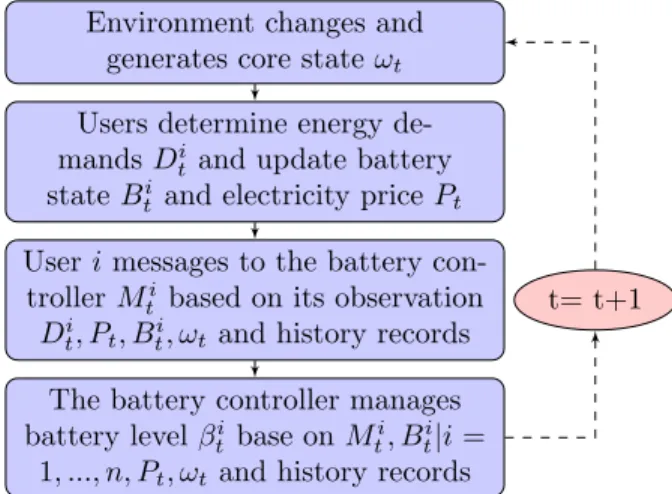
However, since the battery is shared among users instead of belonging to a single party, it should be managed by an independent controller on behalf of the commonwealth of all users. Meanwhile, a direct electricity consumption monitoring is not possible and the controller usually relies on a communication network to receive users’ reports on their status. Based on the received information, the battery controller decide how much electricity to be stored for each user. Two questions rise naturally in this scenario:
• Competition among users for the limited battery capacity. This is because more
capacity can leads additional cost savings. As as a result, users may not be honest about their real demands with the controller. A simple strategy would be exaggerating upcoming electricity demands when price is expected to increase.
• The privacy concerns for reporting accurate detailed energy consumption. As
demon-strated in [4], user’s in-home activities can be revealed using appliance signatures if detailed energy consumption is known by an adversary.
Therefore, it is essential to understand the competitive behaviors across users with privacy requirement when sharing the battery and be prepared for the possible uncertainty in users’ messaging over the communication network.
It is towards the privacy aware management of such a shared battery that this article provides theoretical contributions beside a more comprehensive and complete formulation of the battery sharing problem.
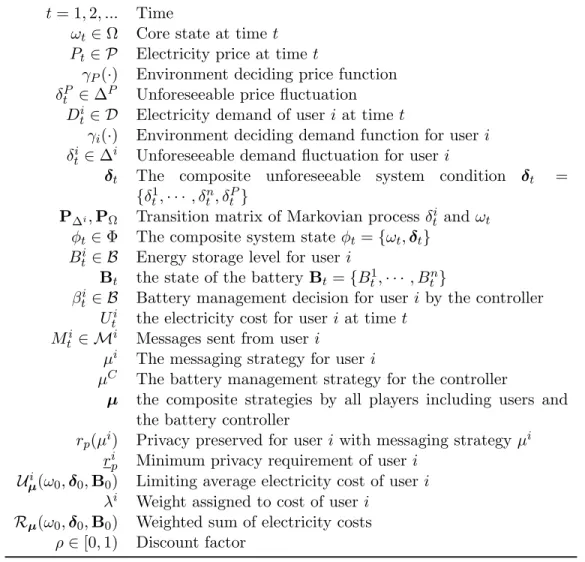
In particular, we propose a game theoretical framework to characterize the messaging behaviors of users with privacy requirements when they share a energy storage and aim to maximize their own cost reductions individually. The corresponding battery management strategies are studied, which are adaptive to time varying demands and prices assuming a zero tolerance for activity delay. With such a framework, we analyze the battery sharing when users are cooperative, privacy aware and completely private. When privacy is not a concern, we show that there always exists a non-stationary social optimal battery control policy – a credit based battery management scheme that ensures game theoretical equilib-rium among all players. With this strategy, no user can have any economic incentives by forfeiting electricity demand information to the battery controller. Meanwhile, the battery controller optimizes the social welfare for all users thanks to the complete and accurate information on the whole system.
In this battery sharing system, different users may have different priorities to the shared battery since the purchase and maintenance costs of the battery could be divided unequally across them. Consequently, there exists an achievable cost savings region in which each point corresponds to a simultaneously achievable set of cost-savings for the group of users. Depending on the users’ priority, the energy storage sharing system can operate at any point in the region. To characterize such cost savings region, the controller assigns different weights to the users and aims to optimize the social welfare which is a weighted objective.
We note that any shared resource management system requires certain operational policies or axioms that all users and the controller adhere to. However, the objective of every user is to minimize its own electricity cost by choosing an appropriate message to send. In order to capture the potential dishonest messaging behaviors, we do not specify the communication protocols that all users adhere to, but rather make them implicit through the definition of the battery controller and the users’ actions and objective. In contrast, based on battery status, electricity price, received messages and other public information including the environment condition, the battery controller decides the amount of electricity to be charged or discharged in battery for each user simultaneously. These quantities are chosen to optimize a weighted sum of the cost-savings across users. By sweeping across all possible weightings, we can characterize an achievable cost savings region.
There are two flavors to time varying pricing in demand response. Time-of-use pricing provides ’on-peak’ and ’off-peak’ price levels where the price level depends on the time of day and season of the year. These price schedules are determined in advance and don’t change frequently. Real-time pricing is more adaptive to market forces wherein the retail electricity price changes hourly or half-hourly and are based on instantaneous prices at the wholesale energy market. To encourage the efficient use of electricity, an increasing number of utilities start to use real time pricing in the retail market to coordinate the customers demand responses to the benefit of individual customers and the overall system. The focus of this work is on investigating the users’ competition over battery capacity, the battery control policies and achievable cost savings when certain privacy protection is required under real-time pricing. Mathematically, we formulate the problem as an infinite horizon limiting average stochastic signaling game with privacy constraints and multiple players in a scenario that “net-metering” – where users can sell stored electricity back to the grid for profit– is allowed. But our major results can also be generalized to the scenario where net-metering is not allowed as the they share similar principals.
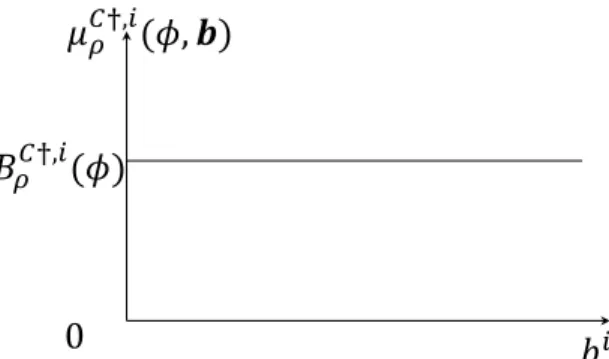
a non-stationary policy, the credit based battery management scheme, always optimizes a weighted sum of user costs – social optimal – and achieves a game theoretical equilib-rium. In this policy, users will provide detailed and honest demand information to the battery controller since one user’s access to the battery is strictly denied whenever he is found giving an “dishonest” message. Therefore, the battery management is simplified to a centralized control problem which was formulated as an infinite horizon limiting average Markov Decision process. Through the mathematical optimization, we will show that, the optimal centralized battery control yields a policy structure wherein the optimal action of the controller is always independent of current state of the battery, i.e., amounts of energy stored for each user in the battery. We then show that the dynamic policy optimization can be reduced to an integer linear programming solution with largely reduced complexity. However, the social-optimal battery management, the credit based battery manage-ment, require long time established observations and also “coerces” users to share their energy demands accurately with the controller which leads to privacy concerns. We there-fore propose a suboptimal privacy preserving battery management strategy in which the message set is restricted to be completely private or partially private. In the special case that the electricity price and users’ demands are independent conditioned on the core state, we demonstrate that the completely private battery management strategy relying on only public available information is optimal for the battery management. We also demonstrate the cost effectiveness of battery capacity sharing and the tradeoff between privacy preserv-ing and cost mitigation uspreserv-ing privacy preservpreserv-ing battery management strategy with real electricity usage and pricing data.
1.3
Quantitative Risk Assessment of Cyber Attack on DSM
Cyber-enabled DSM relies heavily on real-time, two-way communication capabilities between a central controller and various system elements, including flexible loads. Security and reliability of the cyber infrastructure that enables DSM is therefore critical to ensuring the reliability and safety in such systems.
In the electricity retail market with variable-electricity pricing, the real-time, two-way communication capabilities of Advanced Metering Infrastructures (AMI) enables a utility/load aggregator to collect fine grained usage from consumers and provide electricity pricing schedules to them. In addition, as an existing network infrastructure, it is also being considered as a preferred network access point for other DSM applications including direct load control and distributed energy resource management [11]. The critical role
placed on these embedded devices, AMIs, arises significant security concerns since they are physically attached to users’ properties and directly accessible by the users. Large-scale deployments of AMIs encourage the use of marginally cheaper hardware which results in limited computational resources to support advanced security functions such as intrusion monitoring. This also stymies the ability to produce sufficient randomness to create secure cryptographic keys [12]. We also note that the use of public-key-infrastructure (PKI) in AMI network is still rare which naturally raises the problem of key management and potential cyber attacks, such as man-in-the-middle data injection attack.
In Black Hat Europe 2014, researchers Javier Vazquez Vidal and Alberto Garcia Illera demonstrated how they were able to reverse engineer smart meters widely used in Spain, finding blatant vulnerabilities in the hardware [13]. While most smart meters currently installed in Spain used strong symmetric encryption standard AES-128, all AMI units shared the same encryption key which is stored in plain text in the flash memory. In other words, malicious party with access to one AMI device can launch a man-in-the-middle
attack and spoof all communication traffic from/to any other smart meters easily. At
the same time, the trend of open source tools makes access to AMI hacking tools and tutorials easier than ever. One example is the open source smart meter security test tool, Termineter, released by SecureState on Github [14] which allows users to interact with a
smart meter with one of its I\O interface. Though the intention of these tools is to enable
authorized users to test the security of AMI and to promote the awareness of AMI security, it nevertheless allows malicious parties from taking advantage of this tool.
Though there is no specific standard on AMI communication networks, mesh network structure has been widely adopted or proposed in industry [15,16]. A mesh network will use each node to relay data and will reconfigure itself if one path is broken. Though it is robust to node failures and easy to scale, the security level of a mesh network can suffer when the network is not well connected [17, 18]. The vulnerabilities of an AMI communication network can be exploited by disabling attacks on the underlying communication infrastruc-ture, insertion of false user requests, unauthorized alteration of DSM schedules and illegal market manipulation; all of which can impact system operations and result in both power shortage and economic losses. If one meter is hacked, not only can its own communication with the utility be altered, but all other communication transmitted through it may also be exposed to manipulation if man-in-the-middle attacks are launched [19].
While the majority of these vulnerabilities can be modelled using false data injection attacks, there are various strategies in system monitoring to detect and identify bad mea-surements, including nonrandom false data injection attacks [20]. However, it has been
demonstrated that undetectable attacks are still possible if attackers are aware of the sys-tem monitoring configuration [21]. We demonstrate that this weakness of traditional syssys-tem monitoring technology can be exploited for electricity theft through hacked smart meters in AMI relying on mesh networks to communicate between consumers and the utility.
To analyze the topological vulnerabilities of an AMI network against economically motivated stealthy cyber attack, traditional topology analysis or system monitoring tech-nology alone are not sufficient. In this work, a novel risk assessment protocol is proposed to analyze potential targets within existing AMI communication networks that are vulner-able to stealthy, uncoordinated, and economically-motivated cyber attacks. In doing so, we incorporate existing system monitoring technologies. While this protocol can help to assess the potential vulnerabilities of AMI communication network, it also assists to plan a more secure and robust communication network infrastructure. The AMI network designer can utilize the provided warnings and reduce the risk by placing additional AMI data collectors or system monitoring devices. In addition, the study of risk assessment is also a starting point of automated and optimal secure AMI network planning. Case study is provided to demonstrate the process of this method and its effectiveness.
After the quantitative evaluation of the economically motivated AMI hacking, we want to evaluate the potential risk of malicious cyber attacks on the DSM system.
The challenges of the DSM security lie in the feedback mechanism of the load manage-ment and the geographically distributed controllable loads and communication resources. Though each load contributes only a small amount of power and its compromising might not cause a noticeable impact on the energy delivery system, a carefully planned cyber attack can spread and impact a wide range of controllable loads. Meanwhile, the attacker can utilize the feedback mechanism of the load management to aggravate its impact and eventually cause overloads on certain critical devices or major power line and jeopardize the energy delivery system.
The key motivation is the fact that constructing an attack-proof DSM communication network is almost impossible and cost ineffective. For instance, the classic method to pre-vent the man-in-the-middle cyber attack is to treat the communication link as unreliable and to use the public key encryption to conduct key exchange when starting a new commu-nication session between any DSM device and the data collectors. However, key generation is difficult due to the limited randomness that can be produced from an embedded de-vice [12]. In addition, certificate management in PKI which is already an open problem is even harder to guarantee in this context [22]. Even if there is an currently unbreakable security mechanism, it can fail eventually due to the improved hardware and algorithm or
later discovered vulnerabilities. Consequently, the man-in-the-middle attack is very much a realistic possibility in this context. Therefore, we propose a framework to assess the potential risk when part of the distributed system is compromised and detect those vulner-abilities whose compromise can cause a severe impact on the power delivery system. The objective is to help the construction of a more robust and secure communication network for DSM from a topological perspective.
While this framework can help to assess the potential vulnerabilities of DSM commu-nication network, it also assists to plan a more secure and robust commucommu-nication network infrastructure. The communication network designer can utilize the provided warnings and reduce the risk by placing additional secure communication access points or encryption re-sources. In addition, the study of risk assessment is also a starting point of automated and optimal secure DSM communication network planning. From another angle, grid operator can also utilize this framework to “patch” those vulnerable link of the power grid bearing in mind that the communication network is not attack proof.
1.4
Outline of The Proposal
The proposal is organized as follows. Chapter 2 presents existing works relating to our research topics. Chapter 3 presents our work on privacy-cost savings tradeoff of an in-home energy storage for a single user in demand response. Next, in Chapter 4, our research regarding the end-user energy storage sharing is presented. Next, Chapter 5, presents our research on quantitative Impact of DSM cyber attack. Finally, we conclude our research and discuss promising future directions in Chapter 6.
2.
Related Works
2.1
Utility-Privacy Tradeoff of Energy Storage Management
Different approaches have been proposed to hide the information revealed through smart metering data. When using a trusted escrow service, encryption and data aggregation methods are studied in [23,24]. In the absence of trusted escrow, [25,26] propose “distorting” the data to prevent information retrieval by shifting loads or filtering energy usage data which is limited to the short time scale such as the exact time of switch action. A simple stochastic battery policy using a storage device at home to distort the instantaneous energy consumption while incurring zero delay is studied in [27]. But the fact that eavesdropper can use observations to estimate the past energy consumption is neglected. One recent approach to address the privacy preserving and cost saving tradeoff [28] defines privacy as the “flatness” of power consumption profile and proposes an online control algorithm. We note that “flatness” of a power profile is an indirect measure of privacy and their approach cannot prevent an eavesdropper from successfully inferring a user’s electricity profile when the battery control policy is available to the eavesdropper which is a key assumption in this chapter. Entropy as used in this chapter is a direct measure of an observer’s uncertainty, using which the primary purpose of this chapter is to characterize the tradeoff between privacy and cost savings. There is another recent work [29] presents the existence of tradeoff between privacy and energy efficiency through energy harvesting and storage wherein a numerical analysis on an i.i.d. binary model is presented.
2.2
Privacy Aware Management of Distributed End-user
En-ergy Storage Sharing
Different approaches have been proposed to provide cost savings through in-home energy storage. The optimal cost saving policies for a single user in-home storage system are studied in [5,6]. In [5], the authors model a system of an energy storage serving a single user with joint Markov price and demand processes and a continuous state space. They show that a threshold policy on the battery level is the optimal. In [6], the authors consider a more complex model of a user with non-controllable renewable energy, an energy selling back mechanism and a convenience utility.
The policies for energy storage sharing using a predetermined time-of-use pricing scheme are studied in [30, 31]. With a finite horizon formulation, an optimal centralized policy is proposed in [30]. In [31], a game theoretic approach is presented with a distributed algorithm to determine each user’s energy production and storage a day-ahead. However, counterparts of [30, 31] in real time pricing scheme are still lacking. As the electricity stor-age control is also stock manstor-agement, it is related to the newsvendor model problem with dynamic pricing [32]. But this model does not characterize the dynamics of multiple users sharing one energy storage.
In addition to cost savings, an in-home battery can also provide privacy protection of actual demand against smart metering’s detailed electricity usage monitoring. A simple stochastic battery policy using a storage device at home to distort the instantaneous energy consumption while incurring zero delay is studied in [27]. But the fact that eavesdropper can use observations to estimate the past energy consumption is neglected. There is another recent work [29] presents the existence of tradeoff between privacy and energy efficiency through energy harvesting and storage wherein a numerical analysis on an i.i.d. binary model is presented.
2.3
Quantitative Risk Assessment of Cyber Attack on DSM
In the context of AMI cyber security, the attacks studied in literature have focused on user privacy risks [33, 34]. In the broader context of demand side management, data injection attacks on a real-time electricity market was first presented in [35] and [36]. The authors in [35] presented the financial risks induced by the malicious attack and proposed a heuristic technique for finding a profitable attack. In [36], the authors introduced a
geometric framework based on which upper and lower bounds on the optimal data attack are obtained.
In [37], smart grid network topology attacks were first studied in which an adversary intercepts network and meter data to mislead the control center with incorrect topology information. The authors studied the condition for the existence of an undetectable attack for strong adversaries who can observe all meter and network data and for weak adversaries with only local information. They showed that with certain connectivity criteria satisfied, undetectable attacks do not exist.
While there are similarities between [37] and our work, there are major differences. [37] studied topology attacks in which the adversary is assumed to be destructive instead of selfish with the objective to mislead the control center with incorrect topology information. In addition, system monitoring constraints have not been considered in [37].
3.
Privacy Analysis of Battery Control Mechanisms
in Demand Response
DSM systems in the electricity grid, which rely on two way communication between the consumers and utility, require the transmission of instantaneous energy consumption to utilities. Perfect knowledge of a user’s power consumption profile by a utility is a violation of privacy and can be detrimental to the successful implementation of demand response sys-tems. It has been shown that an in-home energy storage system (such as a battery/inverter) that provides a viable means to achieve the cost savings of instantaneous electricity pricing without inconvenience can also be used to hide a user’s power usage pattern. A fundamen-tal tradeoff exists between the costs saved and the degree of privacy achievable, and in this work, the tradeoff achievable by a finite capacity battery assuming a zero tolerance for ac-tivity delay is studied using a Markov process model for user’s demands and instantaneous electricity prices. Due to high computational complexity (continuous state-action space) of the stochastic control model, inner and upper bounds are presented on the optimal tradeoff. In particular, a class of battery charging policies based on minimizing “revealing states” is proposed to derive achievable privacy-cost savings tradeoffs. The performance of this algo-rithm is compared with inner bounds derived using a greedy heuristic and upper bounds derived using an information theoretic rate distortion approach. The framework proposed is shown to be applicable even when users only desire partial information protection such as presence/absence of activity or specific appliances they wish to hide.
3.1
Model
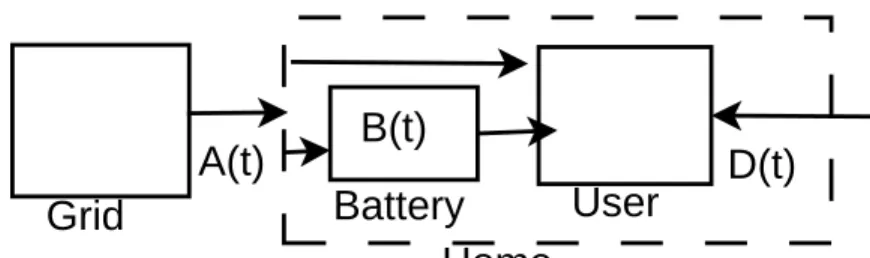
Consider a household consumer with stochastic energy requirements that can be sat-isfied by direct purchase from the grid or by discharging an in-home battery. A pictorial representation of the energy and information flow is shown in Fig. 3.1. Time and energy
Grid
A(t)
B(t)
D(t)
Battery
User
Home
Figure 3.1: A graphical representation of the model
levels are assumed to be discretized. Specifically, lett= 1,2,· · · denote the time slots over
an infinite horizon. Let {Dt ∈ D},{Pt ∈ P},{Bt ∈ B}denote the respective sequences of
random variables characterizing user’s demand, instantaneous price and battery evolution process with finite supports. The demand and price are modeled using two Markovian processes with initial state D1, P1 and transition probability pDi,j = Pr{Dt+1 = j|Dt = i},
pPi,j = Pr{Pt+1=j|Pt=i} respectively. The battery level is controlled by the given policy
as will be explained subsequently. The notation X1t =X1, ..., Xt.
Policy: Atdenotes the units of electricity purchased by the user from the grid at time
t. The choice of At at time t can be random. Privacy necessitates creating uncertainty
in instantaneous demands from the eavesdropper’s perspective, which can be increased by using probabilistic actions. Let Qt ={qt(d, b, a, p) = Pr{At =a|Dt =d, Bt = b, Pt =
p},∀b, d, p, a}, the probability distribution of purchasingAtunits of power givenDtunits of
demand and battery levelBt. Letµtdenote the function that maps all available knowledge
at timet to the probability distributionQt, and let µ=µ1, µ2,· · · define the policy of the
user in determining the level of energy to be purchased.
A simple policy to provide privacy protection is to charge the battery when it is empty and consume energy from the battery as long as it is not drained. This policy aggregates the electricity usage during a period into one short pulse and hides the electricity pattern during the discharging period. Although the intuitive policy provides some uncertainty (during the discharge), it is limited by its determinism and does not adapt to price changes.
From the user’s point of view, instantaneous demand, price and battery level are available at timetand consequently the user only has control on the probabilistic electricity
purchase action Qt at the specific state (b, d, p) ∈ B × D × P at time t. However, since
the utility is unaware of the demand at time t, an uncertainty exists from the perspective
of the utility over the present demand and battery level, and the privacy of the present demand will depend on the complete conditional distribution of action given demand and battery. Consequently, we pose the problem as one of optimizing the entire conditional
distribution {Pr{At|Bt=b, Dt=d, Pt=p}, p∈ P, d∈ D, b∈ B} as opposed to the point conditional distribution.
Battery evolution: For the remainder of this chapter, the battery efficiency is as-sumed to be perfect. Battery efficiency depends on the type of battery. We do note that the major type of commercial use battery, Li-ion battery has a charging and discharging efficiency close to 100% [38]. While this model does not completely capture the behavior of all types of batteries in all applications, it does capture the influence of a controllable stor-age to minimize information leakstor-age through in-out traffic analysis, which is our primary purpose.
We require that all demand must be met immediately from a combination of direct purchase and battery discharging (zero delay inconvenience). So the battery level evolves:
Bt=Bt−1+At−1−Dt−1 (3.1)
Utility/Eavesdropper: We assume that anybody interested in compromising a user’s
privacy can observeAt, the electricity purchased, and the energy pricePtat timet. The goal of an eavesdropper is to estimate the full history of demands using all observations. We also assume the eavesdropper has perfect information about the strategy used by the controller. Since the strategy is random, the realization of the randomness used by the controller is unavailable to the eavesdropper, and is an important factor in increasing privacy.
Privacy Measure: We quantify the privacy of user energy demand from an external
eavesdropper’s perspective using conditional entropy:
P(µ) = lim inf t→∞
H(D1t|At1, P1t)
t . (3.2)
The conditional entropy for a pair of random vectors ¯X,Y¯,
H( ¯X|Y¯) =−X
¯
x,y¯
Pr{X¯ = ¯x,Y¯ = ¯y}log Pr{X¯ = ¯x|Y¯ = ¯y}
is an accepted measure of privacy since it quantifies the uncertainty in ¯X from the
per-spective of an observer of ¯Y, and by virtue of Fano’s inequality [39], provides a good lower
bound to the observer’s probability of error in estimating ¯Xfrom ¯Y. Our entropic measure
of privacy is computed based on the complete posterior distribution across time generated by the policy given the set of observations. In other words the privacy defined as above
assumes that an eavesdropper can use all future observations to determine the demand at any time.
Expected Cost Savings: The instantaneous cost savings at timetisDtPt−AtPt− CB(Bt+1−Bt)+under the constraint ofBt∈ B, Dt∈ D, Pt∈ P, whereCB is the electricity storage cost which reflects the battery purchase cost towards every 1 kWh electricity stored. For mathematical convenience, we express the energy cost at each time slot as a function of the key variables:
u(Dt, Bt+1, At, Pt) = DtPt−AtPt−CB(At−Dt)+, Bt+1∈ B −∞, Bt+1∈ B/
We consider an infinite horizon average cost saving model in this chapter. Many of the reductions presented can be incorporated into finite horizon models as well. The average cost saving per time slot is given by:
U(µ) = lim inf t→∞
E(Ptu(Dt, Bt+1, At, Pt)) t
where the expectation is over the realization of the demands and prices, and the probabilistic strategy at each time slot.
Weighted Reward: In order to study the tradeoff between privacy and cost savings,
we define a weighted reward:
R(µ, λ) =λP(µ) + (1−λ)U(µ)
For desired weight λ∈[0,1], our objective is to find the optimal weighted reward:
J∗(λ) = sup µ
[λP(µ) + (1−λ)U(µ)]
and to design a policy that performs as close to the optimal tradeoff as possible. As long as the cost saving function is bounded, the solution to the weighted reward optimization is the same as the solution to privacy maximization with cost saving constraint (or cost
saving maximization with privacy constraint). Sweeping λ from 0 to 1, the tradeoff is
characterized. Users, depending on their preferences, can choose any operating point on the tradeoff curve.
3.2
A
ρ
-POMDP Formulation
The key to reducing the weighted optimization problem to the recursive Bellman
equa-tion form is in expressing the non-causal rewardas a sum of instantaneous rewards, one at
each time step. In particular, this requires the instantaneous reward to be causal. While the cost savings, by virtue of definition, is indeed a sum of costs earned at each step, the privacy as defined in the previous section is not directly so. In the subsequent analysis, we express the total privacy in terms of the sum of information leaked in every time step.
3.2.1 Privacy as a Stepwise Additive Metric
Using the chain rules of entropy and joint information [39], the privacy metric can be transformed:
H(Dn|An, Pn) =H(An|Dn, Pn) +H(Dn|Pn)−H(An|Pn) (3.3)
Since the demand is assumed independent of price (zero delay assumption), we can rewrite H(Dn|Pn) in (3.3) as: H(Dn|Pn) =H(Dn) = n X t=1 H(Dt|Dt−1) =nHD (3.4)
where HD is the entropy rate of the demand process. For any policyµ, the action at time
step tis only dependent on the past history up to timetand is necessarily independent of
the future demandsDnt+1 and pricesPtn+1. ThereforeH(An|Pn) can be expressed as:
H(An|Pn) = n X t=1 H(At|At−1, Pn) = n X t=1 H(At|At−1, Pt)
Similarly, H(An|Dn, Pn) can be upper bounded by:
H(An|Dn, Pn)≤ n X t=1 H(At|At−1, Dt, Bt, Pt) (3.5) Note thatBt= Pt−1 τ=1Aτ− Pt
τ=1Dτ+B1, and consequently entropyH(An|Dn, Pn) =
Pn
t=1H(At|At−1, Dt, Bt, Pt). Inequality (3.5) is due to the fact that conditioning reduces
conditioned onBt, Dt, Pt, At−1, then the upper bound in (3.5) is achieved. We can therefore restrict ourselves to such Markov policies. Within this reduced class of policies,
we combine (3.4) - (3.5) with (3.3) to get:
H(Dn|An, Pn) =
n
X
t=1
[HD+H(At|At−1, Pt, Dt, Bt)−H(At|At−1, Pt)] (3.6)
Consequently, the privacy metric can be expressed as
P(µ) = lim n→∞ 1 n n X t=1 E(rp(Dt, Bt, Pt, At)) where: rp(Dt, Bt, Pt, At) =HD+H(Dt, Bt|At, Pt)−H(Dt, Bt|At−1, Pt−1) (3.7) which is indeed a causal instantaneous reward.
3.2.2 Dynamic Programming
The causal instantaneous reward as expressed in (3.7) is dependent on conditional distributions with dimensions increasing across time (At−1, Pt−1), which can be captured
using a belief vector that measures the probability distribution of state variables given
all past history. Since the instantaneous rewards are causal, the belief at every step can be updated upon new actions and observations. We denote a prior distribution at the beginning of time step t,πptr(d, b) = Pr{Dt =d, Bt=b|At−1 =at−1, Pt−1 =pt−1}, and a posterior probability distribution upon observingAt, asπpto(d, b) = Pr{Dt=d, Bt=b|At= at, Pt = pt}. Accordingly, the entropy term H(Dt, Bt|At−1, Pt−1) is then the entropy of the prior distribution and
H(Dt, Bt|At, Pt)≤H(Dt, Bt|At, Pt, πptr) (3.8)
is the entropy of the posterior distribution. Note that, as before, the inequality in (3.8) can be achieved by making decisions solely based on present demand, battery, price sta-tus and the prior probability distribution πptr. Therefore, we restrained ourselves to such strategies, with which present demand, battery, price status are independent of past
eaves-dropper’s observation conditioned on the present observation At, Pt and knowledge of the
Given a policyµwith the constraint that decision making is only based onDt, Bt, Pt, πptr, we can rewrite the conditional probability distribution of the amount of energy purchase
Qt={qt(d, b, a) = Pr{At=a|Dt=d, Bt=b}, d∈ D, b∈ B, a∈ A}. The evolution of prior
and post probability distribution can then be described recursively:
πtpo|a(d, b) = π pr t (d, b)qt(d, b, a) P d,bπ pr t (d, b)qt(d, b, a) πpt+1r ( ¯d,¯b) =X d πtpo|a(d, b)pDd,d¯, whereb= ¯b−a+d (3.9) ¯
d,¯bis an arbitrary pair of demand and battery level at timet. Using the prior probability, we can also acquire the probability distribution of energy purchase At,γt(a), conditioned on the past energy purchase and price history:
γt(a) =P r{At=a|At−1, Pt}=X
d,b
πptr(d, b)qt(d, b, a)
The weighted reward at time slott can then be expressed as:
Rλ(πtpr, Qt) =λ[H(π po t ) +HD−H(π pr t )] + (1−λ) [π pr t (d, b)qt(d, b, a)u(d, b, a, Pt)]
Using the technique in [40] (Chapter 6), we can write the Bellman equation for sta-tionary strategies: J∗+ω(πpr) = sup Q {Rλ(πpr, Q) + X a γ(a)ω(πpo,aQ)} (3.10)
whereω(πpr) = limt→∞[Vt(πpr)−tJ∗], and:
Vt(πpr) t = supQ {Rλ(πpr,Q) + X a γt(a)[Vt−1(πtpo,a,Q)−Vt(πpr)] + Vt(πpr) t }
If a unique solution to (3.10) exists, then it would be the unique optimal strategy which is
stationary. Note that the stationary strategy in this problem is a mappingµ:D × P × B ×
P(D × B) 7→ P(A) where P(S) is the probability simplex over space S. Further, different from classic POMDP, the instantaneous reward here is non-linear and belief dependent due to the entropy function. In general, computing the optimal stationary strategy and finding the solution of the Bellman equation, if it exists, is computationally complex for
continuous state-action spaces. In subsequent sections, we therefore study specific policies to derive achievable inner bounds on the optimal tradeoff and use rate distortion theory to provide outer bounds on the optimal tradeoff. Prior to presenting the bounds, we propose
an extension of this framework to studypartial privacy in the application.
Privacy of Partial Information In some scenarios, a user may not be interested in
hiding the complete usage pattern in a home. Partial information such as “whether there is a high power device running” or “whether the house is occupied or empty” alone may be sufficient– privacy has always been a subjective idea. In the subsequent argument we show that the framework described thus far can be adapted to study the privacy of a deterministic function of demands as well.
Assuming the user’s requirement is not the protection of the exact demand processDn
but instead the protection of the sequence of functions φ(D1)...φ(Dt)..., where
φ:D →Ω
where Ω is the space of the partial information of D. Consider a simple example wherein
a user wishes to hide his presence or absence. The sequence of indicator functionsφ(Dt) =
1{Dt>0}would need to be protected. Similarly, for a given thresholdDth, a functionφ(Dt) =
1 if Dt> Dth and φ(Dt) = 0 if Dt≤Dth can be used to represent the timing sequence of
high power demands.
Using similar techniques as in (3.3)-(3.6), we get:
Pφ(µ) = 1 n n X t=1 [Hφ(Dt)+H(At|At−1, Pt, φt(D))−H(At|At−1, Pt)] (3.11)
where Hφ(Dt) is the entropy rate of φ(Dt) process. The average partial information privacy protection of a given policy in a finite time horizon can be numerically calculated by (3.11) while an upper bound can be provided using rate distortion optimization as will be discussed in Section 3.4.2.
Based on the described framework, our key objective is to provide computable solutions that are close to optimal for the general model with multiple levels of battery, price and demand that any practical system can be approximated by. In the subsequent discussion, we first study the greedy algorithm that optimizes the instantaneous tradeoff between privacy protection and cost savings at every step. We then propose a “Battery Centering” policy that aims to exploit the fact that minimum information is revealed when the purchase can
be made probabilistically independent of demand. Upper bounds on the optimal privacy-cost savings tradeoff are then derived using classical rate distortion theory.
3.3
A Greedy Algorithm
An intuitive sub optimal policy is to optimize the instantaneous reward. While the greedy algorithm is not guaranteed to converge, the average reward obtained computation-ally is expected to do so, and further the optimal policy is easy to calculate for each step
as a function of state and belief. The greedy optimal action distribution Q∗ for the greedy
policy is given by solving at each time step t:
Q∗ = arg sup Q
{λ[H(πpto) +HD −H(πptr)] + (1−λ) [π
pr
t (d, b)qt(d, b, a)u(d, b, a, Pt)]}
Due to the convexity of the instantaneous reward, the greedy algorithm can be implemented using iterative descent at every step to determine the optimal action and the belief in the subsequent state. It is also possible to extend the greedy algorithm to provide partial information protection. The instantaneous privacy reward in (3.11) can be bounded as:
rPφ(µ)≤Hφ(Dt)+H(At|π
pr,1
t , Pt, φt(D))−H(At|πtpr,2, Pt)
where πtpr,1= Pr{Dt, Bt|At−1, Pt−1, φt(D)}
πtpr,2= Pr{Dt, Bt|At−1, Pt−1}
as conditioning reduces entropy. The bound can be achieved by constraining At to be
independent of all past variables conditioned onBt, Dt, πtpr,1, πptr,2, Pt, φ(Dt). We therefore restrict ourselves to such policies. Therefore, the greedy optimal action distributionQ∗greedy for the partial information protection and cost savings is given by solving:
Q∗greedy =arg sup Q
{(1−λ) [πptr(d, b)qt(d, b, a)u(d, b, a, Pt)]
+λhH(At|πtpr,1, Pt, φt(D)) +HD−H(At|πtpr,2, Pt)
i
The greedy algorithm is a natural heuristic to avoid a global optimization over the whole time horizon. In order to design a better algorithm that can balance the current reward and future rewards, we propose a method that aims to create long term uncertainty in the demand process by decoupling the probabilistic actions from the recurring demand to the extent possible. Our numerical comparisons will demonstrate that the performance of this strategy is much closer to the maximum possible in comparison with the greedy algorithm.
3.4
A “Revealing State” Approach
In the entropy based stochastic control problem described in previous sections, the battery and demand process are estimated jointly using the electricity purchase along the complete time horizon. Note that if the battery level is at a medium level, the purchase
actionQtneed not be constrained by either battery or demand. This is a desirable situation
where the system state can be hidden, and a good policy would let this situation persist as long as possible. In contrast, if the battery reaches its maximum or minimum level, the
electricity purchase action Qt is severely constrained by the battery evolution (3.1) and
the resulting battery state estimation by the eavesdropper/utility will have high accuracy. Such a situation reveals the state of the system to the eavesdropper and is expectedly undesirable from a privacy perspective. This idea forms the motivation for the “battery centering” policy described heretofore.
In the battery centering strategy, we classify the system state into three stagesS(t)∈ {0,1,2}. Assuming that battery starts from a medium level b0 in stage 0, the electricity
purchase action is made according to a probability distribution (3.12) which is independent of battery level and demand until the battery reaches its maximum or minimum.
πaA(p) = Pr{at=a|Pt=p, p∈ P} (3.12)
The system transfers to stage 1 if the battery reaches maximum or to stage 2 if the battery reaches minimum. When the system is in stage 1 or 2, the electricity purchase is respectively large enough or small enough so that the battery level can traverse back to
the medium point b0 to go back to stage 0 again. We refer to the time duration between
the system entering and leaving a stage as the staying timeTstay(t) = max{t2−t1|S(k) =
S(t) if k, t∈[t1, t2)}.
Algorithm 1 “Battery Centering” Strategies
1: procedure Battery storage Bt maintaining
2: Initialization B0=b0
3: System state← Stage 0
4: while System state == Stage 0do
5: generateat according to distribution πaA(p)
6: if Bt+at−Dt∈ B then
7: purchaseAt←at
8: System state←Stage 0
9: else if Bt+at−Dt> Bmax then
10: purchaseAt←Bmax−Bt+Dt
11: System state←Stage 1
12: else
13: purchaseAt←Bmin−Bt+Dt
14: System state←Stage 2
15: while System state == Stage 1do
16: if Bt−Dt≥b0 then
17: purchaseAt←0
18: System state←Stage 1
19: else
20: purchaseAt←b0−Bt+Dt
21: System state←Stage 0
22: while System state == Stage 2do
23: if Bt+Dmax−Dt≤b0 then
24: purchaseAt←Dmax
25: System state←Stage 2
26: else
27: purchaseAt←b0−Bt+Dt
is independent of battery level Bt and demand Dt. For the Battery Centering policy, as long as the stage of the battery remains fixed, the system remains in a hiding state. A
revealing stateis defined to have occurred at time tifAtis deterministically related to Bt
and Dt. For the Battery Centering policy, the system reaches a revealing state only when
the stage of the battery changes. As an example, when the system moves from stage 0
to stage 1, At =Bmax−Bt+Dt is a deterministic function ofBt and Dt. The resulting
battery state is fully revealed and it is a revealing state. For the Battery Centering policy, the system remains in a hiding state until the battery stage changes at which point the system hits a revealing state for one time step before reverting back to a hiding state. Therefore, reducing the frequency of one will increase the frequency of the other. Our goal is to therefore optimize the parameters of the policy so that the frequency of occurrence of the revealing states is minimized. When the battery is in stage 1 or 2, this can be
accomplished by setting the purchase speed to 0 orDmax respectively.
Although the proposed algorithm can be used for any demand and price evolution model, the analytical optimization of the parameters of the algorithm is facilitated when the underlying model is i.i.d.. In the following, we assume i.i.d. underlying models and
present the mathematical background to maximize the staying time Tstay(t) of stage 0 in
the system for this class of policies.
Lemma 1. The battery level evolution in every stage of Algorithm 1 is equivalent to a
bounded random walk process:
Stage 0: Bt+1=B1+X10+...+Xt0, withPr(Xt0 =x) =
P
a,d,p|a−d=x[πaA(p)pDdpPp]
Stage 1: Bt+1=B1+X11+...+Xt1, withPr(Xt1 =x) =pD−x
Stage 2: Bt+1=B1+X12+...+Xt2, withPr(Xt2 =x) =pDDmax−x
Proof: This lemma follows if we treat the difference of battery level in every time slot as the random step. AsXti,i= 0,1,2 are i.i.d. in each stage and their sumsPt
τ=t0X
i τ+Bt0
are typical random walks.
Theorem 2. For battery centering strategies described in Algorithm 1, if Ea=P
a∈A,i∈P
aπaA(i)pPi =6 EDthen E|Bt−b0|=O(t). IfEa=ED thenE|Bt−b0|=O(
√
t).
Proof: Lemma 1 ensures that the movement of the states can be modeled as a random walk. According to the result in Chapter 2, [41], the distance between a random walk at time tand the original position at time 0 is O(t) if it is a biased walk or O(√t) if it is an unbiased walk. For a random walk with step Xt0 =at−Dt,E|Bt−b0|=O(t) ifEXt0 6= 0; E|Bt−b0|=O(
√
in stage 1 and 2 respectively in Algorithm 1, the expected staying time is fixed. Therefore, in order to reduce the frequency of “revealing” state, we design πAa(p) in such a way that Ea=ED.
In addition, as the equivalent random walk in stage 0 is unbiased, we want to maximize min{|Bmax−b0|,|Bmin−b0|} to increase the staying time in stage 0 which results in b0 =
1
2(Bmax+Bmin).
Theorem 3. For battery centering strategies described in Algorithm 1, the frequency of
revealing state increases with σa.
Proof: Following Lemma 1, the battery level process in stage 0 is equivalent to a
random walk process with step move Xt0 = at−Dt. Therefore, we have an estimation
of battery level at time t: Pr(Bt−b0 = k) ' {2πσX20 0
t}−0.5exp{− k2
2πσ2
X00t
} according to
Central Limit Theorem [41]. Noticing that at is independent ofDt, which leads to σ2X0
t = σat2 +σDt2 . With these argument, we can notice that the increase ofσawill lead the increase of Pr(Bt−b0 ≥Bmax−b0 orBt−b0 ≤Bmin−b0). Theorem 3 then follows.
The above theorem proves that reducing the variance of Xt0 will increase the time
spent at stage 0. Therefore, minimizing σX0
t =σat can minimize the frequency of system
traversing from one stage to another and consequently the frequency with which a system state is revealed to the eavesdropper. Such an approach would work very well if cost savings were not a consideration. In order to trade cost savings for privacy, the electricity purchase
needs to depend on the price, which would in turn increase σat. Optimizing the tradeoff
between privacy and cost savings is equivalent to optimizing the privacy protection with different minimum cost savings constraint. Using theorems 2 and 3, the optimization of privacy with cost savings constraint using the battery centering strategies can be solved by
linear programming (see (3.13)) to minimize σa given equality constraint Ea = ED and
inequality constraint Eap≤s, wheressweeps fromEDPmin toEDEP.
minimize X a∈A,i∈P (a−ED)2πaA(i)pPi (3.13) subject to X a∈A,i∈P aπaA(i)pPi =ED, X a∈A,i∈P apπaA(i)pPi ≤s
The proposed battery centering algorithm is an easily stated policy and can be im-plemented in practice by keeping track of the battery “stage” while the determination of
electricity purchaseAtis either generated according to a predetermined probability distri-bution or the result of a simple computation.
3.4.1 Analysis of “Battery Centering” Strategy
When implementing Algorithm 1 on a system with multiple albeit finite levels of battery
state, demand and price, πtpr follows a positive recurrent Markov Chain with countable
states. It is easily verified that revealing states are indeed positive recurrent states. Based on this fact, we can calculate the expected privacy and cost savings of strategy Algorithm 1 numerically. Under i.i.d. assumptions, we can also calculate the expected privacy and cost savings analytically for the battery centering strategy with given parameters using random walk theory as follows.
Step 1Calculate the expected step privacy of every stage. Denote the time between
two revealing state asηi. By the definition of expected step privacy in each stage, the law
of conditional entropy and the facts thatηi is totally dependent onDnand demand is i.i.d.. We have:
ErPi =HD −E
H(ηi)
Eηi
Step 2The expected privacy of the complete time horizon
ErP =HD−
2EH(η0) +EH(η1) +EH(η2) 2Eη0+
Eη1+Eη2
(3.14)
Equation (3.14) is due to the fact that random walk of stage 0 is unbiased and will end in stage 1 or 2 with equal likelihood while stage 1 and stage 2 will always end in stage 0.
Step 3The expected cost savings:
ErS =
2Eη0[P
p∈P,d∈DπP(p)πD(d)−Pp∈Pfa(p)pπP(p)] 2Eη0+
Eη1+Eη2
where ErS is the expected cost savings over the complete time horizon. It is known that
the accurate analysis of η for general step distribution is an open problem [41].
3.4.2 Upper Bound
In order to evaluate the closeness to optimality of the proposed battery centering strategies, we provide an upper bound by considering a weak eavesdropper who does not